
Chapter 06 Understanding Financial Markets and Institutions Answer
Key
Multiple Choice Questions
1.
Which of these provide a forum in which demanders of funds raise funds by issuing new
financial instruments, such as stocks and bonds?
2.
In the United States, which of these financial institutions arrange most primary market
transactions for businesses?
3.
Primary market financial instruments include stock issues from firms allowing their equity
shares to be publicly traded on stock market for the first time. We usually refer to these
first-time issues as which of the following?
4.
Once firms issue financial instruments in primary markets, these same stocks and bonds
are then traded in which of these?
5.
Which of these feature debt securities or instruments with maturities of one year or less?

6.
Which of the following is NOT a money market instrument?
7.
Which of these money market instruments are short-term funds transferred between
financial institutions, usually for no more than one day?
8.
Which of the following is NOT a capital market instrument?
9.
Which of these capital market instruments are long-term loans to individuals or
businesses to purchase homes, pieces of land, or other real property?
10.
Which of these markets trade currencies for immediate or for some future stated
delivery?
11.
Which of these formalizes an agreement between two parties to exchange a standard
quantity of an asset at a predetermined price on a specified date in the future?

12.
Which of these does NOT perform vital functions to securities markets of all sorts by
channeling funds from those with surplus funds to those with shortages of funds?
13.
Which of these refer to the ease with which an asset can be converted into cash?

14.
Which of the following is the risk that an asset’s sale price will be lower than its purchase
price?
15.
Which of these is the interest rate that is actually observed in financial markets?

16.
Which of these is the interest rate that would exist on a default-free security if no inflation
were expected?
17.
Which of the following is the risk that a security issuer will miss an interest or principal
payment or continue to miss such payments?
18.
Which of these is NOT a participant in the shadow banking system?
19.
How is the shadow banking system the same as the traditional banking system?
20.
Which of the following is the continual increase in the price level of a basket of goods and
services?
22.
Which of these is a comparison of market yields on securities, assuming all characteristics
except maturity are the same?
23.
According to this theory of term structure of interest rates, at any given point in time, the
yield curve reflects the market’s current expectations of future short-term rates.
24.
Which of the following theories argues that individual investors and financial institutions
have specific maturity preferences, and to encourage buyers to hold securities with
maturities other than their most preferred requires a higher interest rate?
25.
Which of these is the expected or “implied” rate on a short–term security that will originate
at some point in the future?

26.
Which of these is NOT a theory that explains the shape of the term structure of interest
rates?
27.
Interest rates A particular security’s default risk premium is 3 percent. For all securities,
the inflation risk premium is 2 percent and the real interest rate is 2.25 percent. The
security’s liquidity risk premium is 0.75 percent and maturity risk premium is 0.90 percent.
The security has no special covenants. What is the security’s equilibrium rate of return?

28.
Interest rates You are considering an investment in 30-year bonds issued by a
corporation. The bonds have no special covenants.
The Wall Street Journal
reports that
one-year T-bills are currently earning 3.50 percent. Your broker has determined the
following information about economic activity and the corporation bonds:
Real interest rate = 2.50 percent
Default risk premium = 1.75 percent
Liquidity risk premium = 0.70 percent
Maturity risk premium = 1.50 percent
What is the inflation premium? What is the fair interest rate on the corporation’s 30-year
bonds?

29.
Interest rates A corporation’s 10-year bonds have an equilibrium rate of return of 7
percent. For all securities, the inflation risk premium is 1.50 percent and the real interest
rate is 3.0 percent. The security’s liquidity risk premium is 0.15 percent and maturity risk
premium is 0.70 percent. The security has no special covenants. What is the bond’s
default risk premium?

30.
Interest rates A two-year Treasury security currently earns 5.25 percent. Over the next
two years, the real interest rate is expected to be 3.00 percent per year and the inflation
premium is expected to be 2.00 percent per year. What is the maturity risk premium on the
two-year Treasury security?

31.
Unbiased Expectations Theory Suppose that the current one-year rate (one-year spot
rate) and expected one-year T-bill rates over the following three years (i.e., years 2, 3, and
4, respectively) are as follows:
Using the unbiased expectations theory, what is the current (long-term) rate for four-year-
maturity Treasury securities?
32.
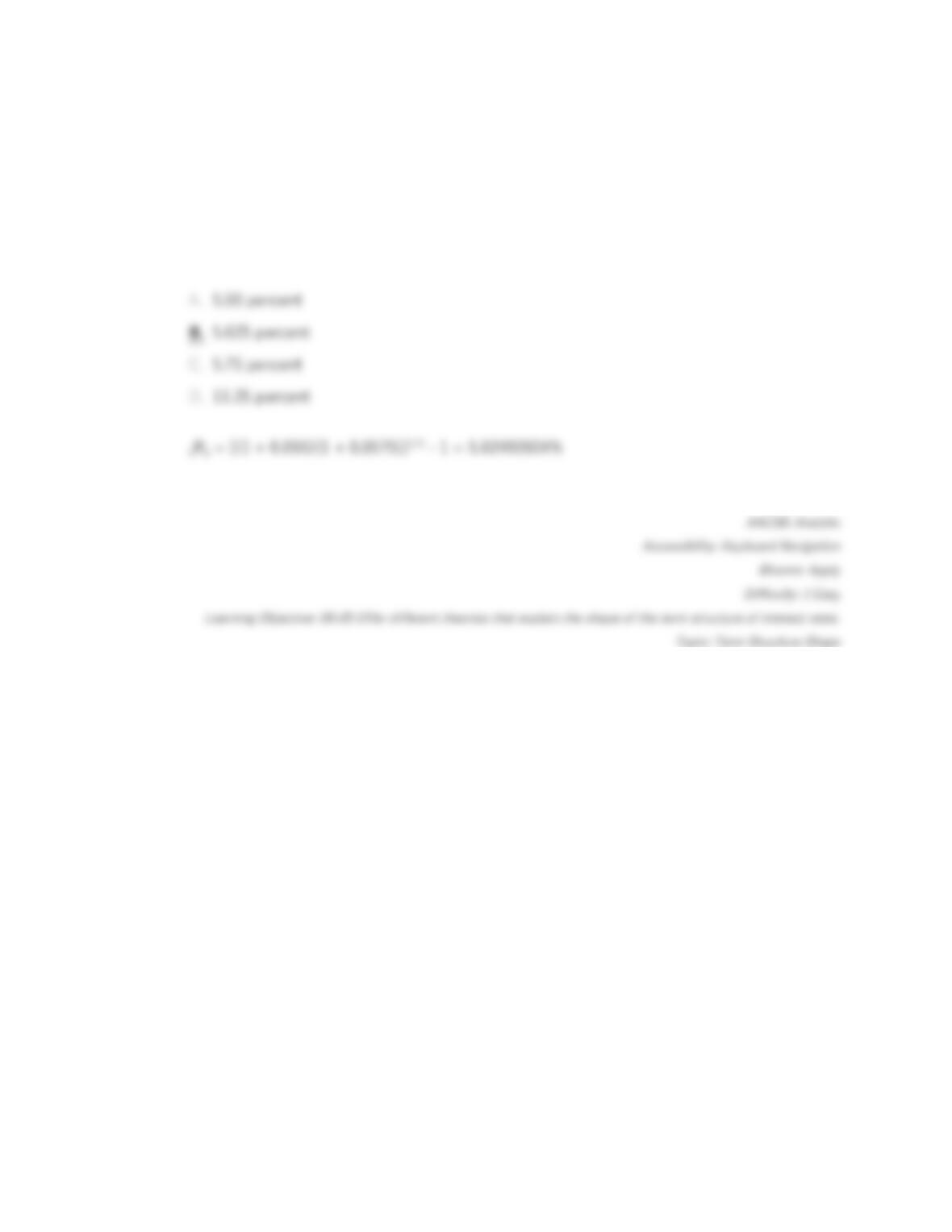
Unbiased Expectations Theory One-year Treasury bills currently earn 5.50 percent. You
expect that one year from now, one-year Treasury bill rates will increase to 5.75 percent. If
the unbiased expectations theory is correct, what should the current rate be on two-year
Treasury securities?

33.
Liquidity Premium Hypothesis One-year Treasury bills currently earn 5.50 percent. You
expect that one year from now, one-year Treasury bill rates will increase to 5.75 percent.
The liquidity premium on two-year securities is 0.075 percent. If the liquidity theory is
correct, what should the current rate be on two-year Treasury securities?