1
Test Items
Chapter 6: Understanding Students with Communication Disorders
Multiple Choice
1. Which of the following entails receiving, understanding, and expressing information,
feelings, and ideas?
A. Reading
B. Communication
C. Comprehension
D. Language
2. Which of the following is characterized by difficulty receiving or understanding information?
A. Speech disorder
B. Language disorder
C. Receptive language disorder
D. Expressive language disorder
3. A language variation used by a group of individuals that reflects regional, social, or
cultural/ethnic factors is:
A. Dialect
B. Ebonics
C. Accent
D. Difference
4. What percent of students aged 6–21 have speech/language disorders?
A. About 20%
B. Nearly 50%
C. Only 5%
D. Over 65%
5. The oral expression of language is:
A. Language
B. Speech
C. Phonology
D. Syntax
2
6. How many different sounds are produced in the English language?
A. 26
B. Over 100
C. 36
D. 45
7. Which of the following provides rules for putting together a series of words to form
sentences?
A. Language
B. Speech
C. Phonology
D. Syntax
8. How many morphemes does the word “bills” have?
A. 4
B. 3
C. 2
D. 1
9. Which dimensions of language determine the content and social use of language?
A. Semantics and pragmatics
B. Syntax and pragmatics
C. Semantics and phonology
D. Syntax and morphology
10. Which of the following refers to the meaning of what is expressed?
A. Semantics
B. Morphology
C. Phonology
D. Syntax
11. What is the overall organizer for language?
A. Semantics
B. Pragmatics
C. Syntax
D. Phonology
3
12. Which of the following emphasizes that communication skills are learned through social
interactions?
A. Inborn language acquisition device theory
B. Imitation and practice theory
C. Social interaction theory
D. Imitation and inborn acquisition theory
13. What part of the body is called the voice box?
A. Larynx
B. Pharynx
C. Vocal folds
D. Trachea
14. By what age have children learned to produce nearly all the consonants and vowels that make
up the words of their native language?
A. 2
B. 3
C. 5
D. 8
15. One of the most frequent communication disorders in preschool and school-age children is:
A. Apraxia of speech
B. Receptive language disorders
C. Expressive language disorders
D. Articulation disorders
16. Substitutions, omissions, and distortions are characteristics of:
A. Apraxia of speech
B. Articulation disorders
C. Receptive language disorders
D. Expressive language disorders
17. Which of the following is a motor speech disorder that affects the way in which a student
plans to produce speech?
A. Apraxia of speech
B. Voice disorders
C. Receptive language disorders
D. Expressive language disorders
4
18. Normal speech requires correct articulation, vocal quality, and:
A. Volume
B. Pitch
C. Fluency
D. Tempo
19. A language impairment that is not related to any physical or intellectual disability is a:
A. Speech impairment
B. Receptive language disorder
C. Specific language impairment
D. Expressive language impairment
20. A student who has difficulty distinguishing between the sound of the word “pen” and the
word “pin” has a:
A. Phonological disorder
B. Articulation disorder
C. Expressive language impairment
D. Receptive language disorder
21. Which of the following focuses on the use of social language—the communication between a
speaker and a listener within a shared social environment?
A. Phonology
B. Syntax
C. Semantics
D. Pragmatics
22. Each of the following may be related to the cause of a speech or language disorder EXCEPT:
A. Organic disorders
B. Inorganic disorders
C. Congenital disorders
D. Acquired disorders
23. When completing a fluency assessment, the speech-language pathologist measures each of
the following EXCEPT:
A. Amount of dysfluency
B. Age of onset of dysfluency
C. Type of dysfluency
D. Duration of dysfluency
5
24. A student who uses two languages equally well is considered to be:
A. Bilingual
B. Bidialectal
C. Multilingual
D. Multidialectal
25. Each is a method for implementing universal design for learning EXCEPT:
A. Vary the format for relaying information
B. Vary the ways in which students demonstrate their knowledge
C. Adjust the amount of time spent on units
D. Use facilitative language strategies
26. Which of the following is a primary component of most early education programs in which
others use strategies to promote speech and language development?
A. Community based instruction
B. Universal design for learning
C. System for augmenting language
D. Facilitative language strategies
27. When speech partners activate a student’s communication device in naturally occurring
communication interactions at home, school, and in the community and encourage the
student to use the device, they are using:
A. Community based instruction
B. Universal design for learning
C. System for augmenting language
D. Facilitative language strategies
28. Augmented input that focuses on communication boards or books is called:
A. Facilitative language strategies
B. Aided language stimulation
C. Total communication
D. Augmented communication
29. What percent of students with speech or language disorders spend 80-100% of their time in
general education settings?
A. Over 85%
B. Less than 25%
C. About 50%
D. Only 32%
6
30. Each of the following is an appropriate assessment accommodation for students with
language disorders EXCEPT:
A. Provide the students with additional time to take the test
B. Change multiple choice items to essay items
C. Provide visual supports
D. Allow the students to use a word processor
Praxis style questions
1. Shaneeka spends time alone during unstructured classroom activities and does not seek out or
join in peer interactions. You have demonstrated interactions for Shaneeka and discussed the
value of her contributions with her. How can you have Shaneeka’s peers help her with her
communication skills?
A. Have all students take turns talking with Shaneeka.
B. Provide a peer buddy who can model and encourage interactions with other children.
C. Have Shaneeka go to speech therapy with another student.
D. Assign Shaneeka specific questions to ask during group activities.
2. Tommy has difficulty with syntactically complete sentences when speaking or writing. He
avoids writing tasks and is sometimes teased about his speech. What can you do to help
Tommy with his syntax during classroom activities?
A. Provide visual and verbal models of complete sentences.
B. Make Tommy stop and think before he speaks or writes.
C. Tell the other students that Tommy has a problem and not to tease him.
D. Excuse Tommy from writing activities and limit speaking situations.
3. Second-grade teacher Mrs. Grimes teaches in a diverse classroom with students from various
cultures, socioeconomic levels, and linguistic levels. She is a keen observer of language in
her classroom. Which of the following students in Mrs. Grime’s classroom shows an
example of someone having difficulty with pragmatics?
A. Jose mispronounces his “s” so that it sounds like “th.”
B. Jill requests a crayon by saying, “Give it to me now!”
C. John says, “I know answer!”
D. Joan says “doggy” when she sees any animal with four legs.
7
Short Answer
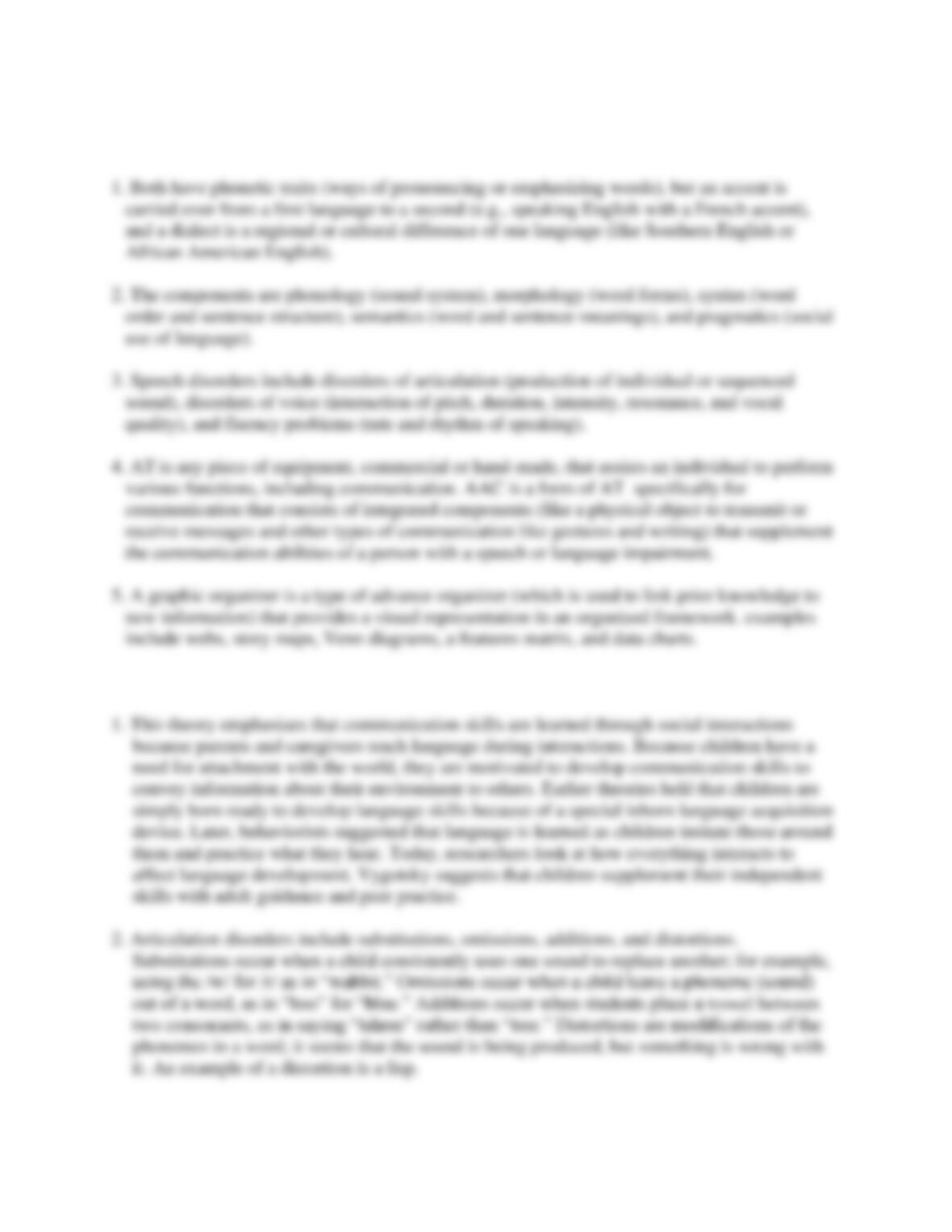
1. Compare and contrast accents and dialects.
2. List the five components of the English language system (with brief, parenthetical descriptions
of each).
3. List the three types of speech disorders (with brief, parenthetical descriptions of each).
4. How are assistive technology (AT) and augmentative and alternative communication (AAC)
systems related?
5. Define graphic organizers and give two examples.
Essay
1. Describe the social interaction theory and how it evolved.
2. Describe the four types of articulation disorders and give an example of each.
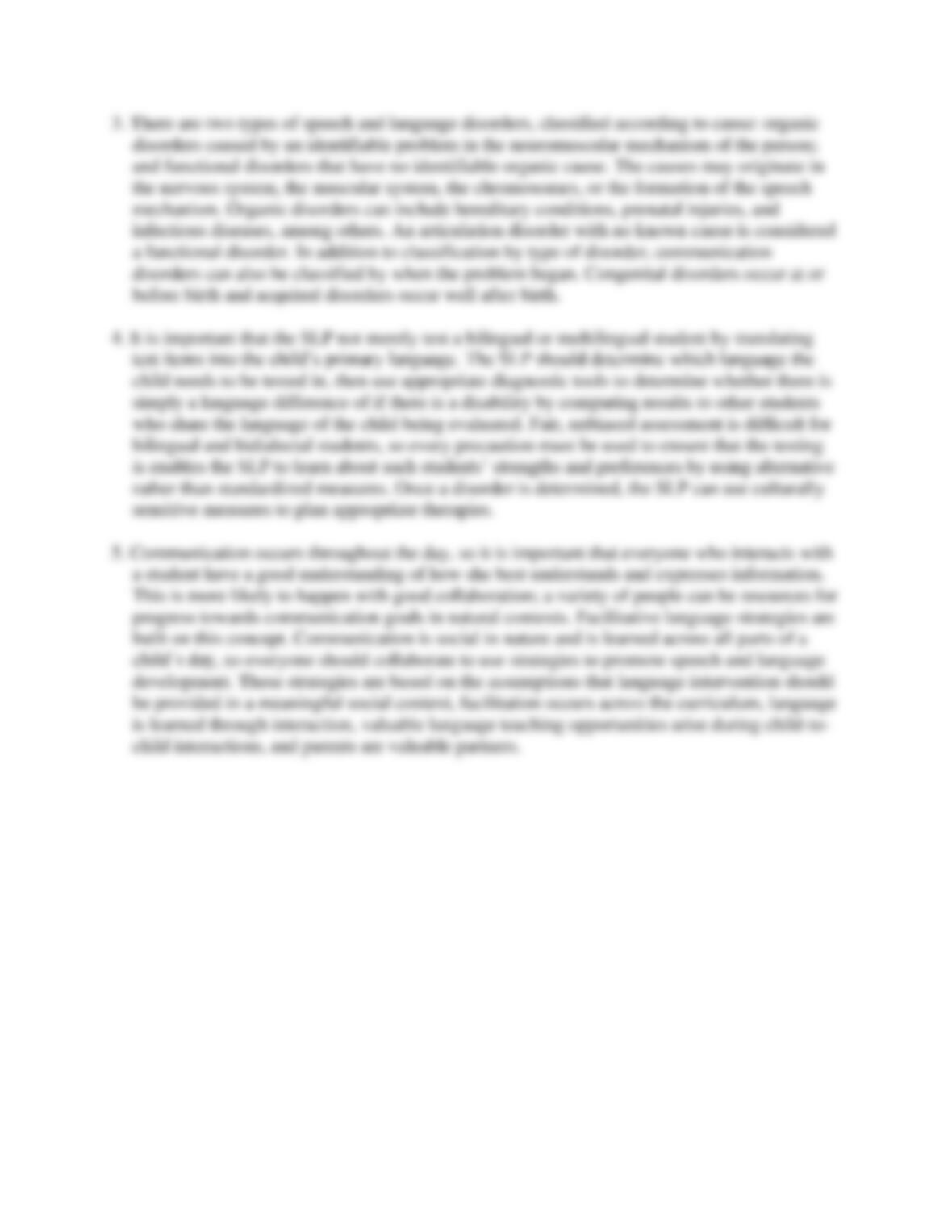
3. Summarize the causes of speech and language disorders.
4. How should a speech and language pathologist (SLP) assess bilingual or multilingual
students?
5. Discuss the importance of collaboration when providing services for students with
communication disorders in the context of facilitative language strategies.

8
Chapter 6
Multiple Choice
Praxis
9
Short Answer
Essay
10