
Test Bank—Chapter Six (Programming Languages)
Multiple Choice Questions
1. Which of the following is an example of a language that is based on the functional paradigm?
A. LISP B. PROLOG C. C D. C++
2. Which of the following is an example of a language that is based on the object-oriented paradigm?
A. LISP B. PROLOG C. C D. C++
3. Most machine languages are based on the
A. Imperative paradigm B. Declarative paradigm
C. Functional paradigm D. Object-oriented paradigm
4. Which of the following is not a type of statement found in a typical high-level imperative programming
language?
A. Imperative statement B. Exclamatory statement
C. Declarative statement D. Comment statement
5. Which of the following does not require a Boolean condition?
A. If- else statement B. While statement
C. Assignment statement D. For loop statement
6. Which of the following is not a control statement?
A. If- else statement B. While statement
C. Assignment statement D. For statement
7. Which of the following is not a loop?
A. If -else statement B. While statement
C. Repeat statement D. For statement
8. Which of the following is not a step in the process of translating a program?
A. Executing the program B. Parsing the program

C. Lexical analysis D. Code generation
9. Which of the following is not associated with object-oriented programming?
A. Inheritance B. Resolution C. Encapsulation D. Polymorphism
10. Which of the following is not associated with the concept of data type?
A. Coercion B. Boolean C. Operator precedence D. Strongly typed language
11. Positions within arrays are identified by means of numbers called
A. Indices B. Parameters C. Instance variables D. Constants
12. Which of the following is ignored by a compiler?
A. Control statements B. Declarations of constants
C. Function headers D. Comment statements
13. Which of the following is not a possible value of the expression 4 + 6 2 – 1
A. 4 B. 5 C. 6 D. 10
14. Which of the following is not a way of referring to a value in a program?
A. Variable B. Literal C. Constant D. Type
15. Which of the following is the scope of a variable?
A. The number of characters in the variable’s name
B. The portion of the program in which the variable can be accessed
C. The type associated with the variable
D. The structure associated with the variable
16. Which of the following is a means of nullifying conflicts among data types?
A. Inheritance B. Parsing C. Coercion D. Code optimization
17. Which of the following is not constructed by a typical compiler?
A. Source code B. Symbol table C. Parse tree D. Object program
18. Which of the following is a means of defining similar yet different classes in an object-oriented
program?
A. Inheritance B. Parsing C. Coercion D. Code optimization
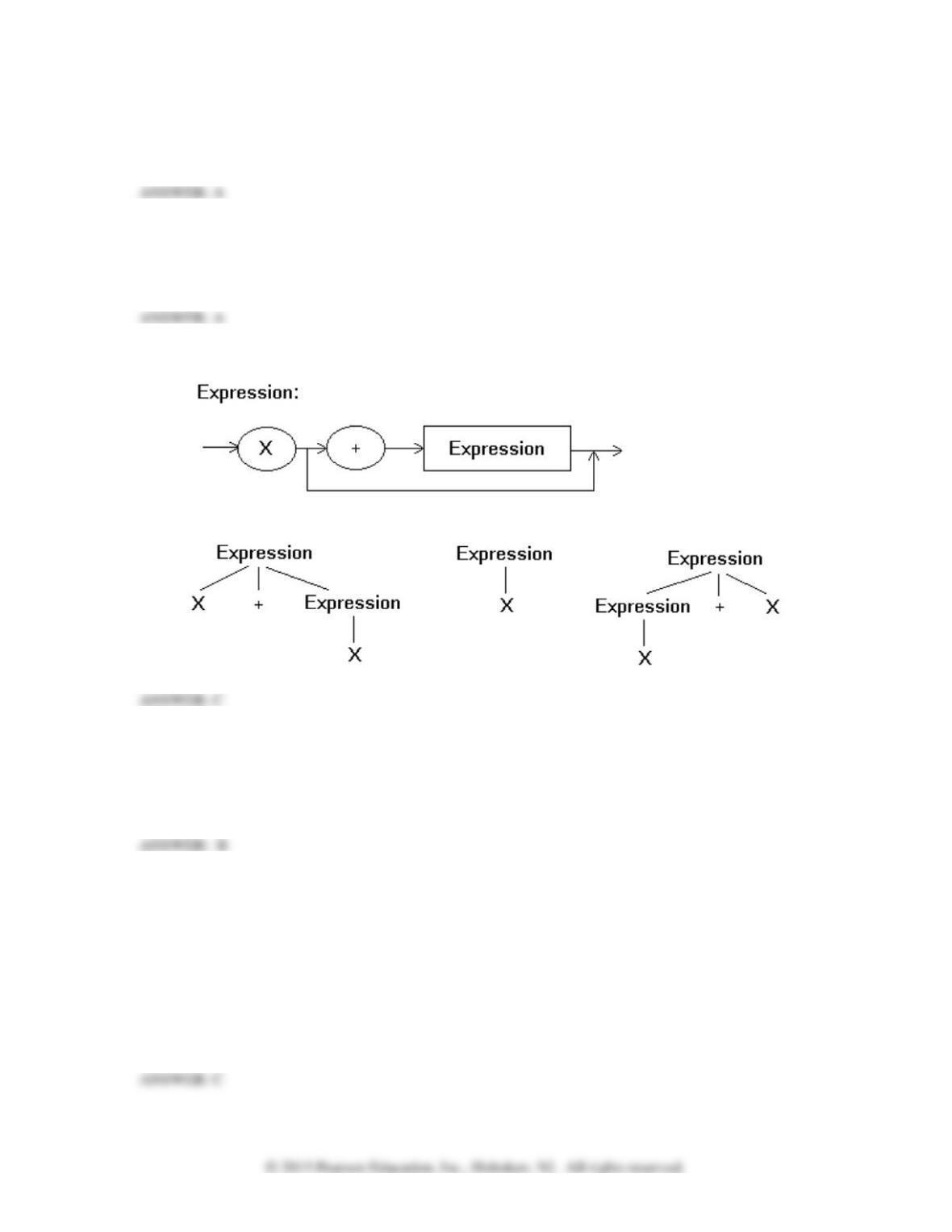
19. Which of the following is not a parse tree of an expression based on the following grammar?
A. B. C.
20. Which of the following statements is not a resolvent of the following clauses?
P OR Q OR R P OR T Q OR T R OR T
A. Q OR R OR T B. T OR P C. P OR R OR T D. Q OR T
21. Which of the following can Prolog conclude from the following program?
parent(jill, sue).
parent(jill, sally).
parent(john, sue).
parent(john, sally).
sibling(X, Y) :- parent(Z, X), parent(Z, Y).
A. parent(jill, john) B. sister(sue, sally)
C. sibling(sue, sally) D. sibling(jill, sue)

Fill-in-the-blank/Short-answer Questions
1. In contrast to _______________ languages such as English and Spanish, programming languages are
considered _______________ languages and are rigorously defined by their grammars.
2. List two disadvantages of both machine languages and assembly languages that are overcome by high–
level programming languages.
_____________________________________
_____________________________________
3. Indicate how each of the following types of programming languages is classified in terms of generation
(first generation, second generation, or third generation).
A. High-level languages _____________
B. Machine languages _____________
C. Assembly languages _____________
4. List four data types that occur as primitive types in many high-level programming languages.
____________________ ____________________
____________________ ____________________
5. What encoding system is commonly used to encode data of each of the following types?
A. Integer ___________________________
B. Real __________________________
C. Character ___________________________
6. A data structure in which all elements have the same type is called ___________________, whereas a
________________ may have elements of different types.

7. In programming languages that use + to mean concatenation of character strings, the expression
“2x” + “3x”
will produce what result?
________________
8. Rewrite the following instructions using a single if– else statement.
if (X == 5) goto 50
goto 60
50 print(Z)
goto 100
60 print(Y)
100 . . .
9. The following is a program segment and the definition of a function named sub.
.
.
X = 3; def sub(Y):
sub(X) Y = 5;
print(X);
.
.
A. What value will be printed by the program segment if parameters are passed by value?
____________
B. What value will be printed by the program segment if parameters are passed by reference?
____________
10. The following is a program segment and the definition of a function named sub.
. def sub():
X = 8 .
sub() X = 2
print(X) .
. .
A. What value will be printed by the program segment if X of function sub is a global variable?
____________

B. What value will be printed by the program segment if X of function sub is a local variable?
____________
11. To say that a grammar is ambiguous means that ___________________________________________
_____________________________________________________________________ .
12. List three items of information that would be contained in a typical parser’s symbol table.
________________________
________________________
________________________
13. Give three examples of key words that are often found in high-level imperative or object-oriented
languages.
___________________ _____________________ ______________________
14. In addition to the function’s name, what other information is contained in a typical function header?
____________________________________
15. In the context of the object-oriented paradigm, ____________ are templates from which
____________ are constructed. We say that the latter is an instance of the former.
16. In the context of the object-oriented paradigm, a __________________ is an imperative program unit
that describes how an object should react to a particular stimulus.
17. Based on the sketch of a class definition below, which methods can be invoked from outside an
instance of the class?
class Example
{public void method1( )
{ . . . }
private void method2( )
{ . . . }

public void method3( )
{…}
private void method4( )
{ . . .}
}
_________________________________________________________
18. What clause would produce the resolvent
P OR R OR S
when resolved with the clause
P OR Q
__________________
19. What general rule should be added to the Prolog program below so that Prolog can conclude that ice
cream is better than spinach?
better(icecream, peanutbutter).
better(peanutbutter, spinach).
___________________________________________________________
20. Based on the Prolog program below, what goal should be used to find the siblings of sue?
parent(jill, sue).
parent(jill, sally).
parent(john, sue).
parent(john, sally).
sibling(X, Y) :- parent(Z, X), parent(Z, Y).
_________________________________________
Vocabulary (Matching) Questions
The following is a list of terms from the chapter along with descriptive phrases that can be used to produce
questions (depending on the topics covered in your course) in which the students are ask to match phrases
and terms. An example would be a question of the form, “In the blank next to each phrase, write the term
from the following list that is best described by the phrase.”
Term Descriptive Phrase
assembly language A step up from machine language

programming paradigm A program development methodology
structured programming A methodology that applies well-designed control structures to
produce well-organized software
grammar The rules defining the syntax of a programming language
parse tree A “pictorial” representation of the grammatical structure of a string
compiler A program that translates other programs into machine language
interpreter A program that executes other programs written in a high-level
language without first translating them into machine language
high-level language A notational system for representing algorithms in human compatible
terms rather than in the details of machinery
semantics Meaning as opposed to appearance
syntax Appearance as opposed to meaning
operator precedence Dictates the order in which operations are performed
data structure A conceptual organization of information
parameter A means of passing information to a function
data type Encompasses both an encoding system and a collection of operations
syntax diagrams A way of representing a grammar
source program A program expressed in a high-level language
General Format Questions
1. What does it mean to say that a programming language is machine independent?
2. Explain the distinction between the imperative and declarative programming paradigms.
3. Explain why the generation approach to classifying programming languages fails to capture the full
scope of today’s languages.
4. Explain the distinction between translating a program (in a high-level language) and interpreting the
program.
5. Why is the straightforward “goto” statement no longer popular in high-level programming languages?
6. Explain the distinction between a formal parameter and an actual parameter.
7. Explain the distinction between global and local variables.
8. Explain the distinction between fruitful and void functions.
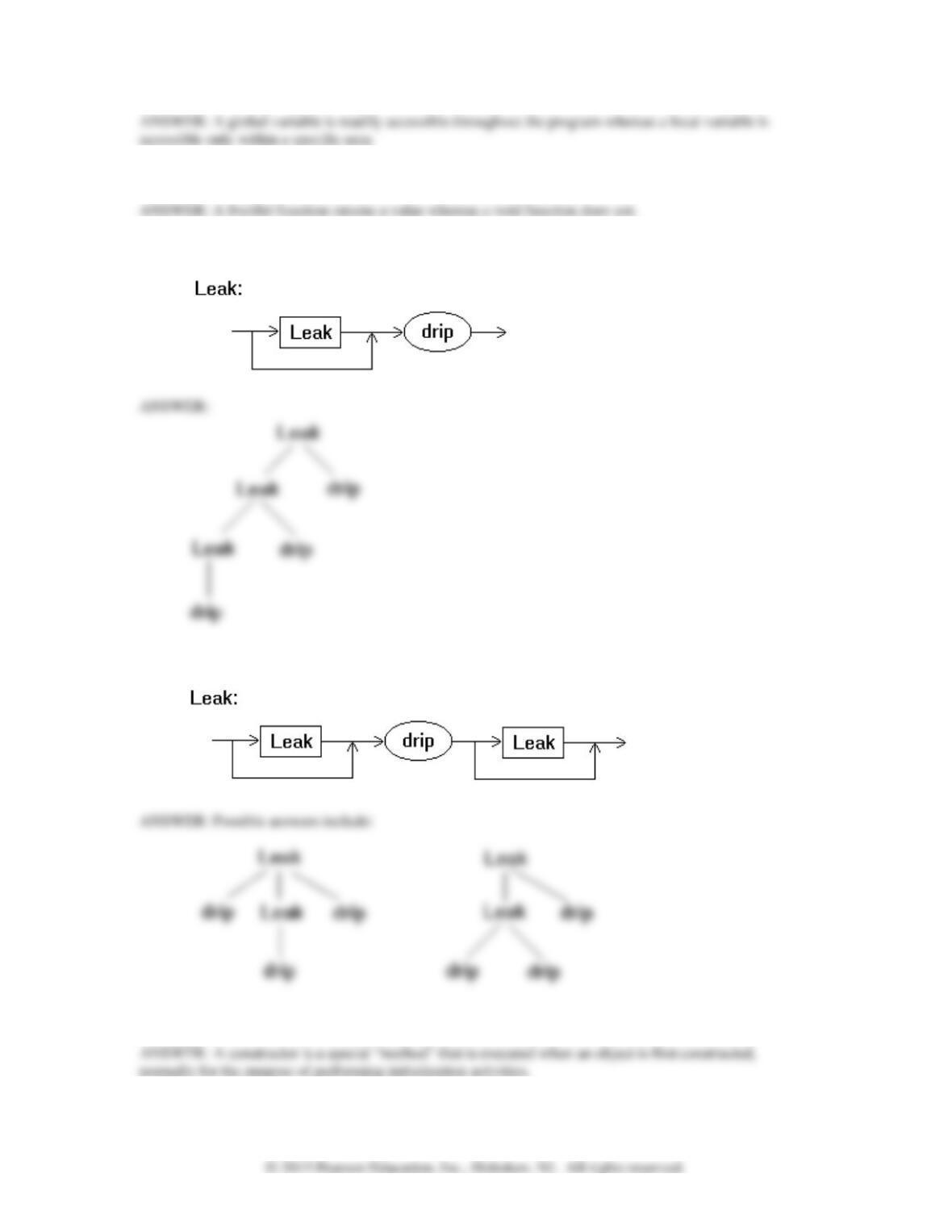
9. Based on the grammar below, draw a parse tree showing that the string “drip drip drip” is a Leak.
10. Show that the grammar below is ambiguous by drawing two distinct parse trees for the string “drip drip
drip.”
11. In the context of the object-oriented paradigm, what is a constructor?
12. Briefly describe the task of each of the following.

A. Lexical analyzer
B. Parser
C. Code Generator
13. Explain why key words in a programming language are often reserved words.