
CHAPTER 6
Planning for Integrating Assessment and Instruction
ITEMS
1. Researchers have demonstrated that most teachers know how to evaluate the quality of test items
without having to take special courses in assessment.
(a) True
(b) False
2. The depth of students’ learning depends both on how students are taught and on how they are
assessed.
(a) True
(b) False
3 Which of the following assessment formats is the LEAST relevant to summative evaluation of
students?
(a) Anecdotal records
(b) Multiple-choice tests
(c) Performance assessments
4. Conversations as an informal formative assessment technique will yield the best result(s) when the
questions require students to
(a) give rather long but correct answers.
(b) give short correct answers.
(c) express insights and understandings.
5. Which of the following will be the best technique for the summative assessment of students’
work?
(a) Comprehensive tests
(b) Short quizzes
(c) Homework
6. What is a growth and learning progress portfolio?
(a) A selection of only the student’s best works demonstrating achievement of the
learning objectives.
(b) A sample of a student’s work showing changes in achieving the learning objectives.
(c) A chart showing students’ growth and development over a period of time.
7. Which of the following is a major weakness of a growth and learning portfolio in formative
assessment?
(a) The results may be inconsistent from teacher to teacher.
(b) Requires a teacher to have a high level of knowledge to diagnose students’ problems.
(c) Covers broad segments of a student’s learning.
8. A standardized achievement test provides good diagnostic information to the teacher.
(a) True
(b) False
9. A weakness of typical teacher-made tests is that they tend to focus on assessing
(a) lower level thinking skills.
(b) applications of knowledge to real life situations.
(c) only verbal expression of knowledge.
10. In general, which of the following assessment alternatives would yield the most valid results for
purposes of formative assessment of students?
(a) Interviewing students individually
(b) Questioning students during instruction
(c) Best work portfolios.
11. Which of the following assessment alternatives yields results that have the lowest validity for
assigning summative grades to students?
(a) Teacher-made tests
(b) Best work portfolios
(c) Standardized tests
12. In general, combining the results from several assessments of a student yields scores of higher
validity than using the result of only one assessment.
(a) True
(b) False
13. In general, using the results of a single assessment for purposes of grading a student is less valid
than using multiple assessment results because any single assessment
(a) assesses on only one occasion.
(b) has a lower reliability than multiple assessment results.
(c) has a lower validity than multiple assessment results.
(d) All of the above
14. If you cannot state the action you will take by using the students’ assessment results, you are
creating a poor assessment plan.
(a) True
(b) False
15. The relevance of a learning unit assessment-planning chart is in its use in planning to
(a) assess students on learning objectives.
(b) teach students the learning objectives.
(c) Both a and b
(d) Neither a nor b
16. Which of the following is NOT part of a learning unit assessment plan?
(a) How teaching and assessment work hand in hand
(b) Exactly how a teacher plans to assess each learning objective
(c) How this unit’s assessment fits into the year’s overall assessment strategy
17. At the planning stage of instruction, the teacher should be most concerned with
(a) the mastery of the learning objectives by the students.
(b) the entry knowledge and skills of the students.
(c) the retention of essential content and skills.
18. When planning a semester’s instruction for a class, which of the following should be used?
(a) Standardized achievement test results
(b) Aptitude test results
(c) Student records
(d) All of the above
(e) Only (b) and (c)
19. In using casual conversations as a source of information for planning instruction and/or making a
decision about a student, your own idiosyncrasies are likely to
(a) enhance the validity of the result.
(b) reduce the validity of the result.
(c) ensure the reliability of the result.
20. One way to lower the reliability and validity of the results of questioning students during
instruction is to supplement the results with test results.
(a) True
(b) False
21. The table showing the weight of each assessment toward the official grade belongs in the
(a) marking period assessment plan
(b) unit assessment plan.
(c) both.
22. A unit’s preinstruction assessment should be a comprehensive pretest of the knowledge and skills
students are expected to have mastered by the end of instruction.
(a) True
(b) False
23. In order to ensure that students properly integrate their new learning into their existing knowledge
structures, it is necessary that you understand how students think about the subject before you
begin instruction.
(a) True
(b) False
24. Which of the following assessment formats would likely yield the most valid results for use in a
pre-instructional assessment procedure?
(a) Multiple-choice items
(b) Short answer items
(c) Essay items
25. The table of specifications is
(a) synonymous with a learning unit assessment planning chart.
(b) a two-way grid of content and thinking skill categories.
(c) a list of content areas to be covered in a test.
26. A table of specifications should include information on the weights to assign to different parts of
the assessment.
(a) True
(b) False
27. In the development of assessment blueprints, the number of learning objectives in each topical area
helps determine the weighting given to the particular area in the assessment.
(a) True
(b) False
28. In crafting a summative classroom assessment, it is appropriate to have the number of points for
each task be proportional to the amount of time you spent on teaching each topic.
(a) True
(b) False
29. When crafting a summative assessment instrument, a teacher has to ensure that the tasks
(a) reflect the learning objectives.
(b) provide a necessary surprise to keep students’ interest.
(c) are identical to the tasks practiced in the classroom.
(d) Both (a) and (c) must be ensured.

30. One sound reason for keeping the length of an assessment procedure short is that the reliability of
the students’ scores is increased.
(a) True
(b) False
31. Which of the following does NOT increase the student-centeredness of a classroom assessment?
(a) Sharing the test blueprint with the students.
(b) Allowing students input into the emphases or manner of assessment.
(c) Assessing students with tasks that are closely aligned with learning objectives.
(d) Using the blueprint as a guide for students to make practice tests.
32. What type of assessment is most useful for planning for differentiated instruction?
(a) Formative assessment
(b) Summative assessment
33. What is the major purpose for using Response to Intervention?
(a) To monitor the progress of all students so they can move at an individual pace through basic
instruction.
(b) To support teachers in their instruction of basic reading and mathematics skills.
(c) To support at-risk students so fewer special education placements are needed.
34. Which of the following measures is most likely to be used for RTI progress monitoring in an
elementary reading class?
(a) Reading proficiency level on the state reading test
(b) Number of words read correctly per minute
(c) Scores from a standardized diagnostic assessment of reading
Items 35 – 37 refer to the instructions that follow.
Read each of the numbered statements and decide which type of technology use it illustrates. Write
the letter of your choice of technology use on your answer sheet.
A — if the technology use illustrates supporting routine assessment tasks
B — if the technology use illustrates creating new learning networks
C — if the technology use illustrates developing collaborative technologies
35. A college professor posts a video on her online course, then has students submit a one-paragraph
response and take a quiz on the material, also on the online course site.
36. A high school uses scanning and scoring software to score final examinations and report the
results.
37. An elementary class is studying Mexico. Students in the class construct a blog with students in a
class in Mexico.
CHAPTER 6
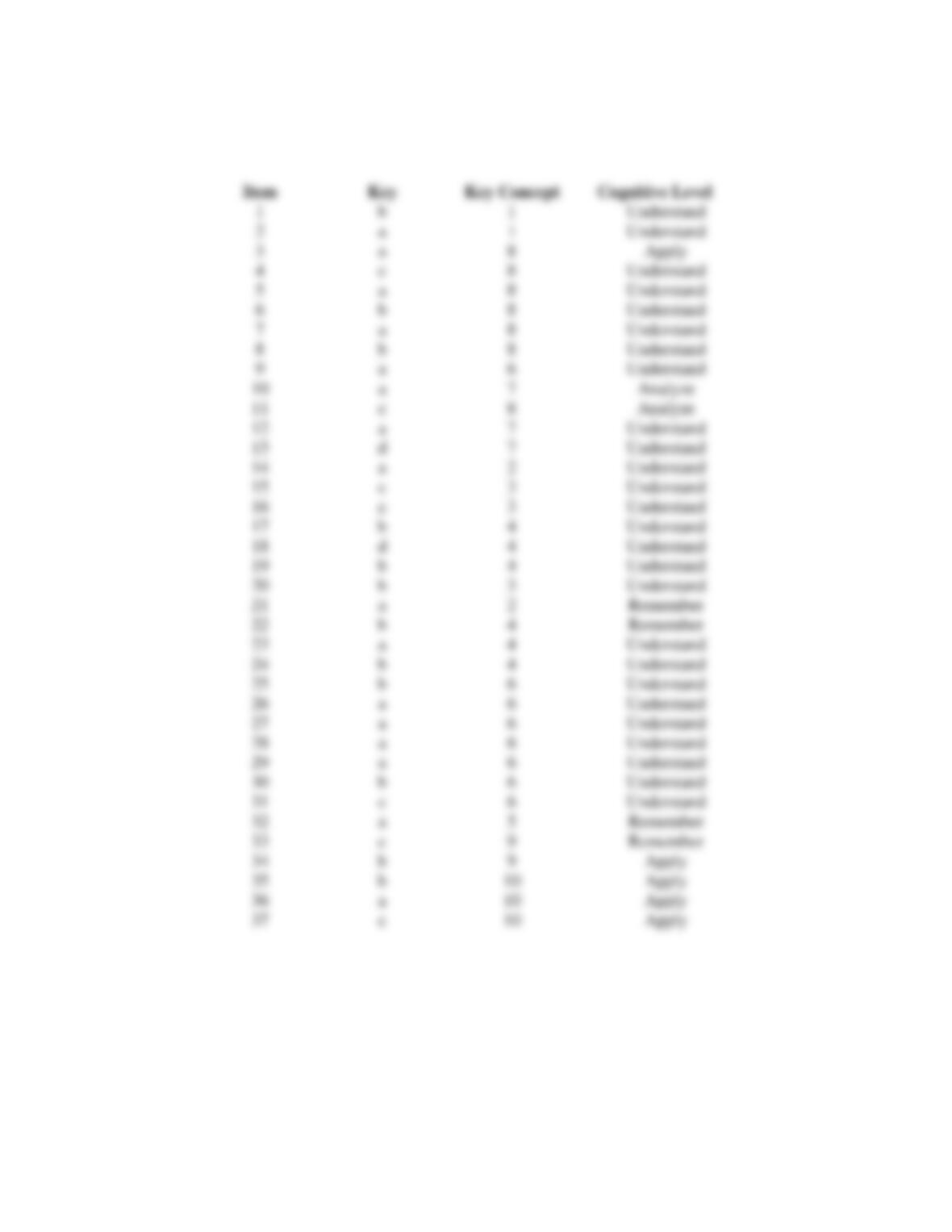
Answers and Classification of Items