Chapter 6
Chapter Focus
Student academic performance is best measured using the curriculum materials that the student
works with in the school setting on a day-today basis. Assessment that uses these materials and
that measures learning outcomes supported by these materials is called curriculum-based
assessment. This chapter introduces the various methods used in the classroom to assess student
performance. These methods, also generally known as informal methods of assessment, provide
valuable information to assist teachers and other IEP team members in planning instruction and
implementing effective interventions.
Check Your Understanding
Activity 6.1
1. A classroom teacher administers a quiz following the introduction of each new concept in
geometry.
2. The special education teacher requires her students to read oral passages twice a week to
determine their rate of fluency and accuracy of reading.
3. In science, the teacher administers a unit test and uses the score as part of the end-of-term
grade.
4. A third-grade language arts teacher uses curriculum-based measurement twice each week
to determine if students are correctly sequencing the letters in the spelling words.
5. Your assessment instructor administers a final exam to determine your mastery of
assessment skills.
6. In this text, the pre-test and Part I, II, III, and IV tests are examples.
Activity 6.2
1. A first-grade teacher asked each student to read three passages aloud. Matt’s scores were
10, 15, and 13.
What is Matt’s baseline score?
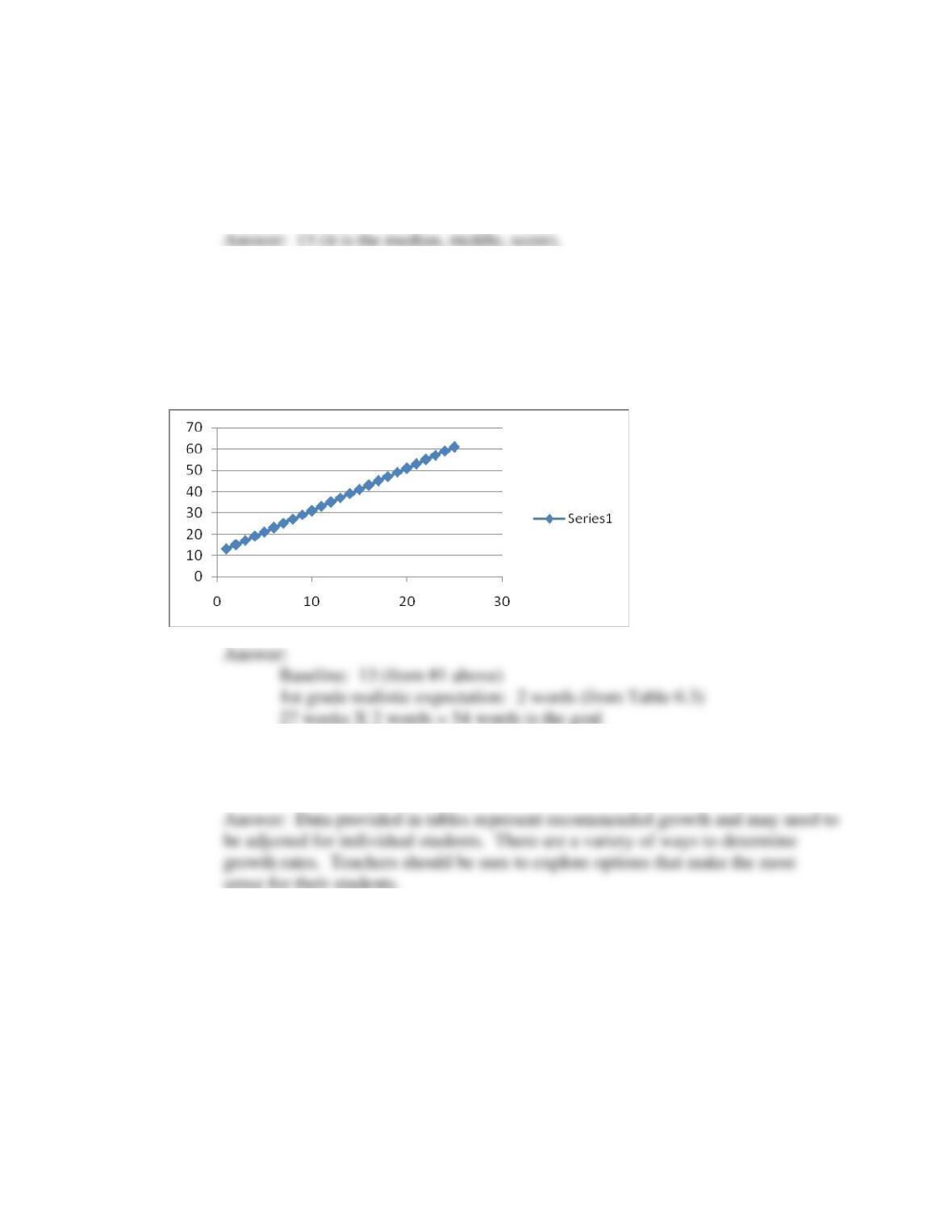
2. Following the determination of the baseline score, the aimline should be determined.
Refer to Table 6.3 in your text to determine the number of words a first-grade student is
expected to increase by each week. If there are 27 weeks remaining in the academic year,
what is the goal?
Aimline:
3. What should teachers remember when establishing goals in reading using expected
growth rates?
Activity 6.3
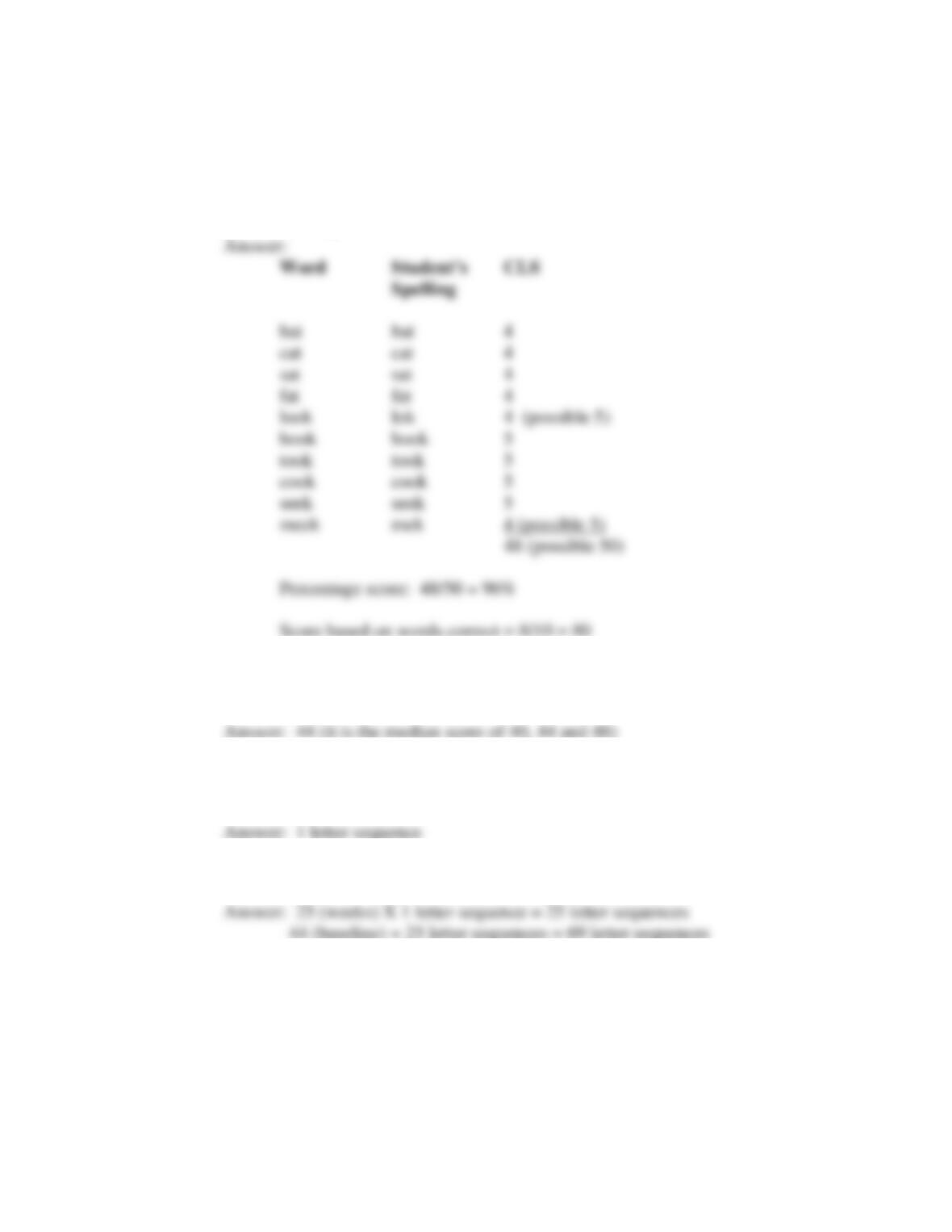
1. Look at the student’s spelling performance on the following CBM. Determine the correct
letter sequence score. If you convert this to the percentage of letter sequences correct,
what is the percent? What is the spelling score on the test based simply on the number of
words spelled correctly?
2. The other two scores obtained to determine the baseline were 40 and 44. What is the
baseline score?
3. Refer to Table 6.4 in your text. For a realistic growth rate, how many correct letter
sequences is the student expected to increase by each week in the second grade?
4. There are 25 weeks remaining in the school year. What is the goal for this student?
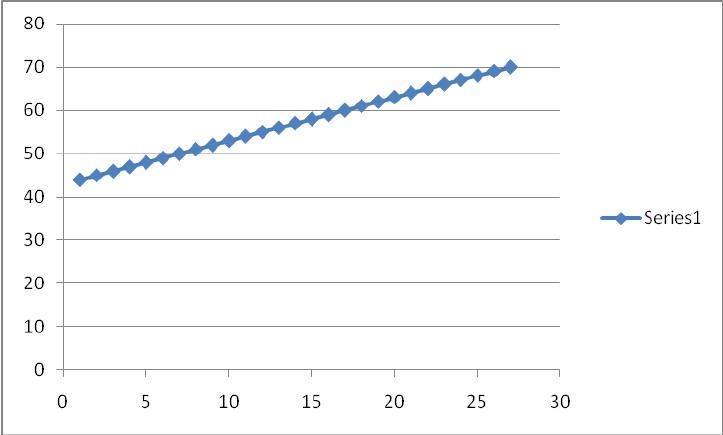
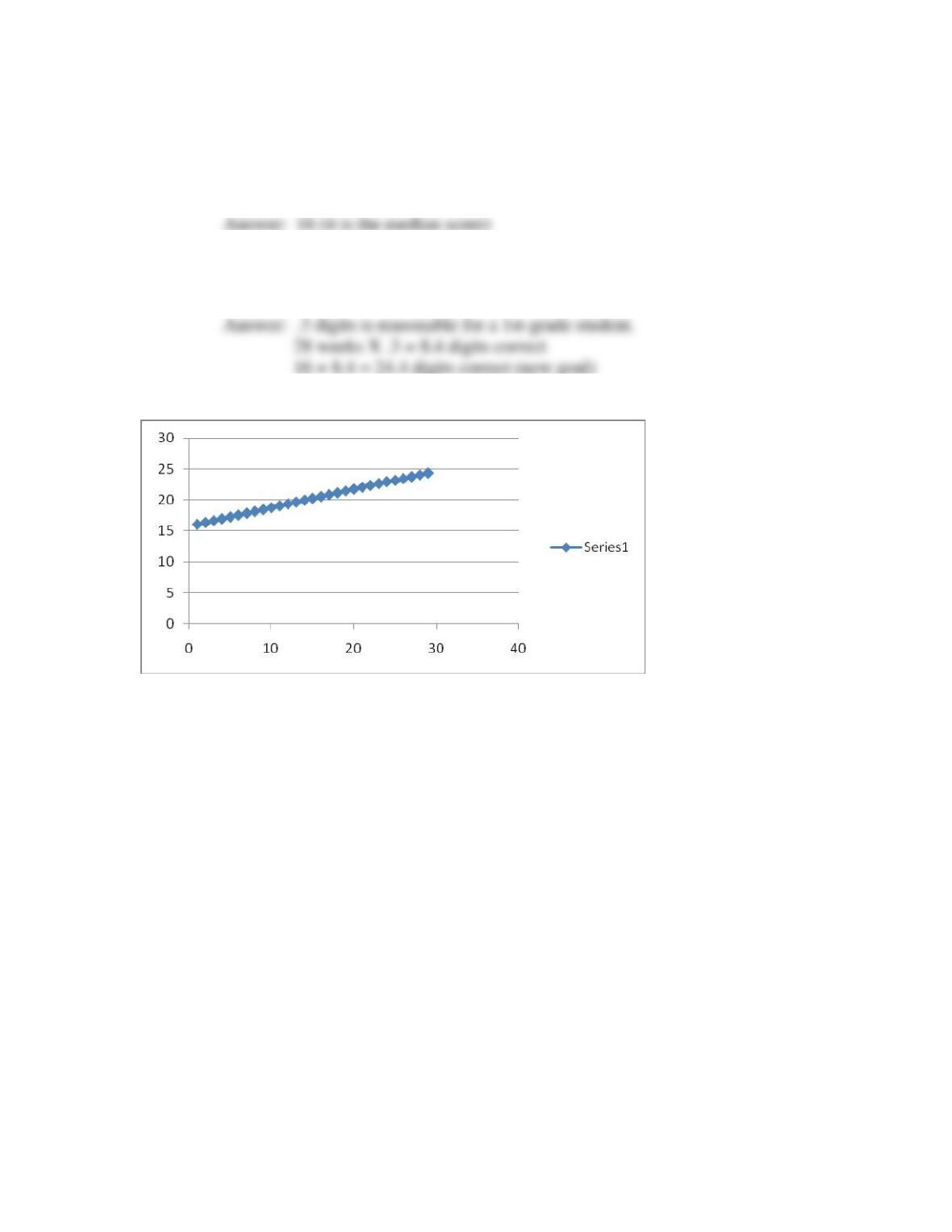
5. Construct the aimline.
Activity 6.4
1. A first-grade student was administered three math probes to determine her baseline score.
Her scores on the probes were 17, 14, and 16. What is the student’s baseline score?
2. Refer to Table 6.5 to determine the realistic expected growth rate for a first-grade student.
There are 28 weeks remaining in the academic year. Determine the goal for this student.
3. Construct the aimline.
Activity 6.5
1. What did students report about using CBMs in classroom instruction according to Fuchs,
Butterworth, and Fuchs?
2. One study reported the decrease in off-task behaviors when CBMs were employed. Why
would the use of CBMs impact students’ behavior?
3. One study by Marston, Mirkin, and Deno found that the use of CBMs was an effective
measure to be used in the special education eligibility process. Why?
4. What did Baker and Good find in their research using CBMs with bilingual students?
Activity 6.6
1. Look at the student responses on the following teacher-made criterion-referenced test.
Determine if the student met the criterion stated as the objective.
OBJECTIVE
John will correctly answer 9 out of 10 addition problems with sums of 10 or less.
5
3
8
9
4
6
7
2
4
1
+2
+2
+2
+1
+5
+2
+3
+4
+3
+6
7
5
10
10
8
4
10
6
7
7
2. Describe the types of errors John made.
Apply Your Knowledge
Using the suggested mastery level, instructional level, difficulty level, and failure level provided
in your text, where does this student fall in this particular skill according to this criterion–
referenced test?
Activity 6.7
1. Select one P1 skill and write a behaviorally stated objective that includes the criterion
acceptable for passing the objective.
2. Design a short criterion-referenced test to measure the first skill objective listed in the P1-
level.
Apply Your Knowledge
Write a behaviorally stated objective for students reading this chapter.
Activity 6.8
1. Examine the following task analysis. Identify smaller steps, or subskills, that you believe
need to be mastered as part of learning the more complex skill. Write the additional steps
in the spaces provided.
Skill: Adding numbers greater than 10
Adds numbers 0–10 with sums greater than 10.
Adds number facts 1–9 with sums greater than 10.
Adds number facts 1–9 with sums less than 10.
Adds number facts 1–8 with sums less than 10.
Identifies numbers 1–10.
Can count objects 1–10.
Additional subskills:
2. Write a task analysis for the following skill.
Skill: Recognizes initial consonant sounds and their association with the
consonant letters of the alphabet.
Necessary subskills:
Apply Your Knowledge
Develop a strategy for teaching one of the subskills you listed above.
Activity 6.9
Look carefully at the student’s responses in the following work sample from a language class.
Analyze the errors the student made. Write your analysis in the space provided.
Items missed—On a spelling test, the following words were missed by the student: break (spelled
brak), dream (spelled dreem), and waist (spelled wast).
1. What is the deficit skill?
2. What words might be included in a probe written by the teacher to address this deficit
skill?
Probe—Decoding words orally to teacher
Criterion—Decode 10/10 words for mastery; decode 9/10 words for instructional level; 8/10
words or fewer decoded indicates failure level
Apply Your Knowledge
Design a criterion-referenced probe for this skill and select the criterion necessary for mastery of
the skill.
Activity 6.10
1. Using material from the curriculum content in test items is called __.
2. Using informal assessment composed of actual class work curriculum materials is
called __.
3. A teacher who adds behavioral objectives following the analysis of test items on a
standardized norm-referenced test has adapted the instrument to reflect __ testing.
4. When a student has not mastered a specific skill, the teacher may wish to test the
student more thoroughly on the one skill with a self-developed __.
5. When a teacher assesses daily from curriculum content, the assessment is called __.
6. Breaking a complex task down into subskills, or substeps, is referred to as __.
7. Analyzing the types of errors made on a test or on student work samples is called __.
8. Teacher-made quizzes, curriculum-based assessment, criterion-referenced
assessment, class assignments, and tests are all types of __ assessment.
Apply Your Knowledge
Why might teachers prefer informal tests for measuring their students’ progress rather than
commercially published tests?
Answer: Informal tests are typically more aligned to the actual curriculum and
are more sensitive to small growth/progress than commercially published tests.
Activity 6.11
True and False Items
1. It is not true that curriculum-based assessment can be developed by the classroom
teacher.
2. Compared to norm-referenced assessment and other types of assessment used in general
and special education to assess the classroom performance of students, curriculum-based
assessment may be more sensitive to assessing the current classroom performance of
students.
Multiple Choice Items
1. In the assessment of students to determine the individual needs of learners, what types of
assessment may be used?
a. norm-referenced tests, curriculum-based assessment, teacher-made instruments
b. norm-referenced instruments, curriculum-based assessment, teacher-made tests,
classroom observations, probes
c. any of the above
d. only a and b
e. only a and d
f. none of the above
2. The results of assessment may assist the team in developing a(n)
a. goal
b. IEP
c. objectives
d. decision
Apply Your Knowledge
Use the information in Figure 6.9 to write matching test items for the terms
curriculum-based assessment, direct assessment, and teacher-made tests.
Activity 6.12
Use the following passage to design brief informal assessment instruments in the
spaces provided.
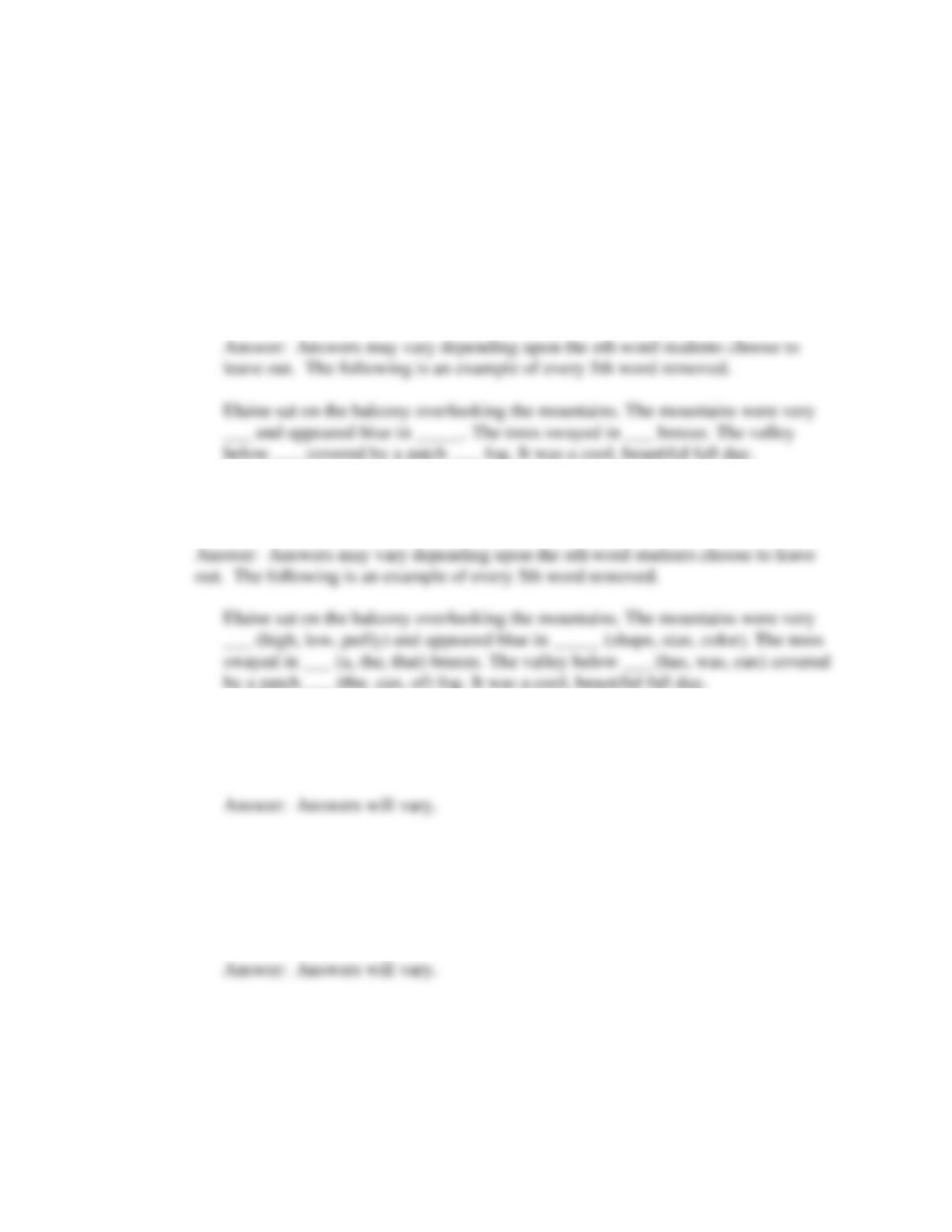
Elaine sat on the balcony overlooking the mountains. The mountains were very
high and appeared blue in color. The trees swayed in the breeze. The valley below
was covered by a patch of fog. It was a cool, beautiful fall day.
1. Construct an informal test using the cloze method. Remember to leave the first and last
sentences intact.
2. Construct an informal test using the maze method. Remember to provide three word
choices beneath each blank.
3. Select a sentence from the passage and construct an informal test using the sentence
verification method. Write three sentences, one of which has the same meaning as the
original sentence.
Apply Your Knowledge
Which of these informal reading comprehension assessment instruments was easiest
for you to write? Why?
Think Ahead Exercises
Part I
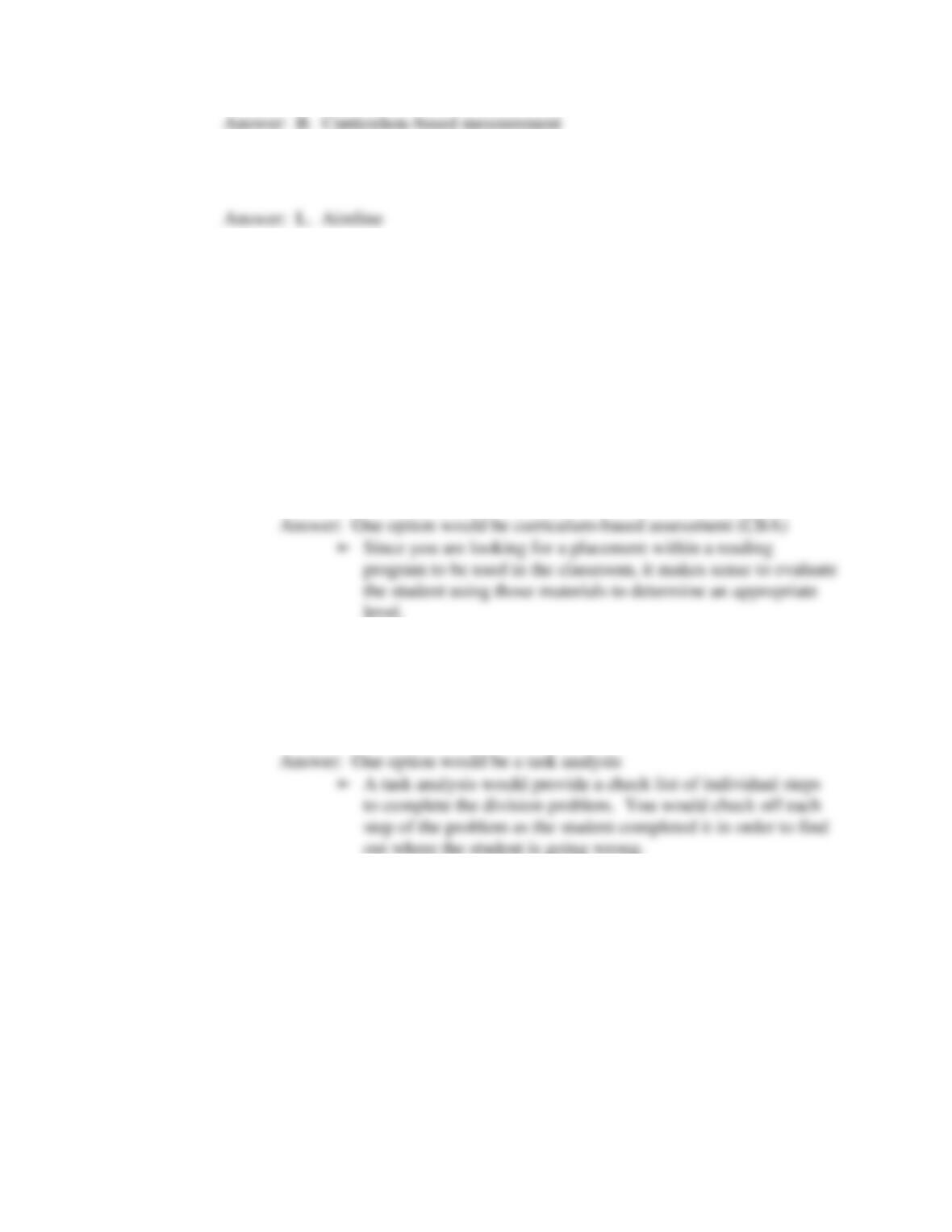
1. A teacher reviews the information provided in a student’s norm-referenced achievement
scores. She determines that the student has a weakness in the area of multiplication with
regrouping, but she is not certain exactly where the student is breaking down. In order to
determine this, the teacher decides to use ___.
2. A teacher who works with students with mild intellectual disabilities would like to assess
the students’ ability to return the correct amount of change when given a $10.00 bill to
pay for an item that costs $2.85. How might the teacher decide to assess this skill?
3. To determine the specific skills applied in completing double-digit addition problems, the
teacher can complete a(n) ___.
4. In a daily living skills class, a teacher can assess the student’s ability to make a complete
meal by using ___.
5. A teacher assesses students’ knowledge of the science unit by each student’s book report,
test grade, written classroom assignments, lab experiences, and journal. This group of
science products demonstrates one example of ___.
6. Error analysis, checklists, direct measurement, authentic assessment, portfolio
assessment, probes, and curriculum-based assessment are examples of ___.
7. A teacher sets a standard of reaching 90% mastery on the test assessing basic reading
decoding skills of second-grade-level words. This test is an example of ___.
8. Asking the parent of a child to complete a survey about the specific behaviors she
observes during homework time is an example of using ___ as part of assessment.
9. A teacher decides to evaluate the progress of her students following the conclusion of a
science unit. This type of assessment is known as ___.
10. By adding the number of correct letter sequences found in the baseline to the number of
weekly expected CLSs for the year, the teacher can plot the ___.
Part II
Answers may vary for each question. An example assessment and rationale are provided for
each item.
1. Standardized test results you received on a new student indicate that she is performing
two grade levels below expectancy. You want to determine which reading book to place
her in.
Method of assessment ___
Reason ___
2. A student who understands division problems when they are presented in class failed a
teacher-made test. You want to determine the reason for the failure.
Method of assessment ___
Reason ___
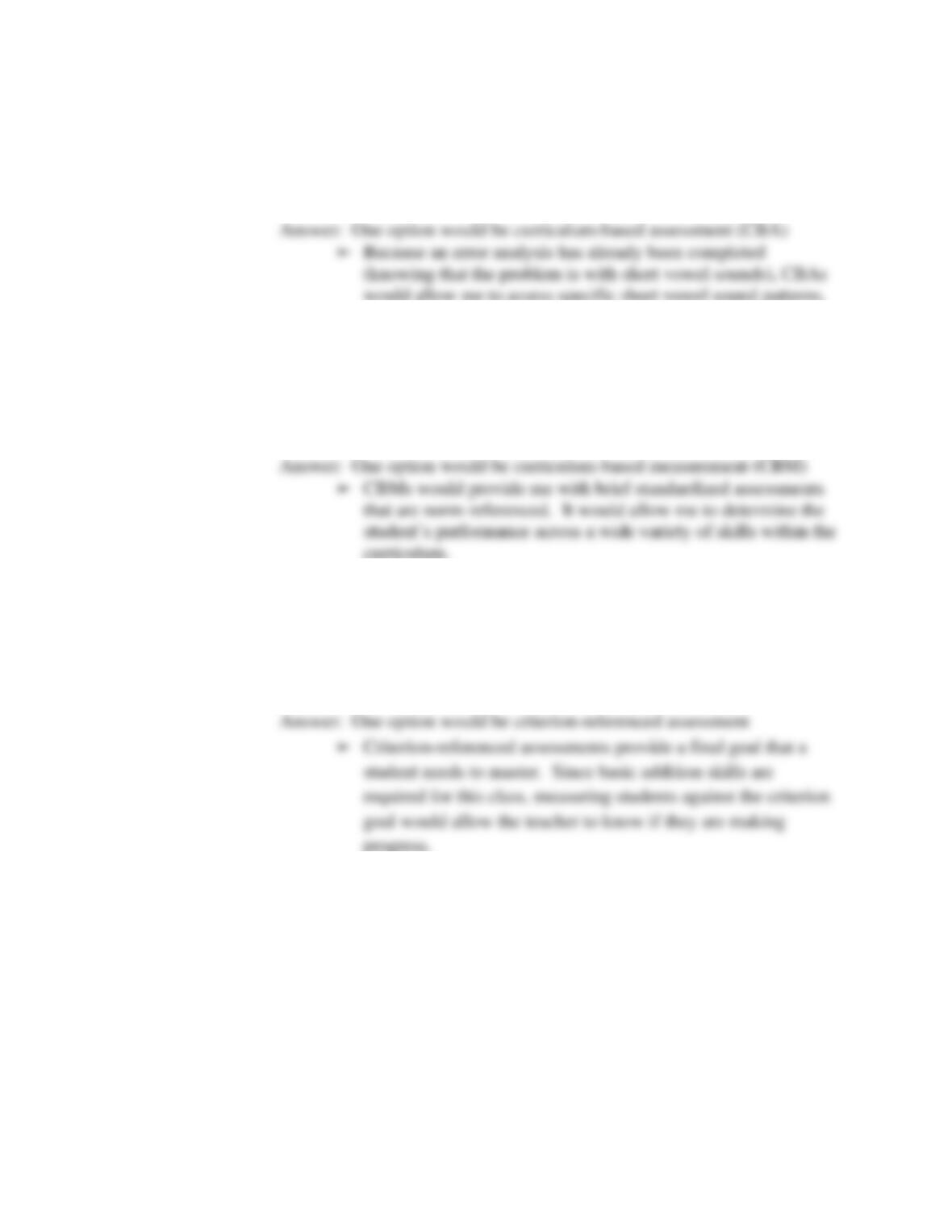
3. Following a screening test of fifth-grade level spelling, you determine that a student
performs inconsistently when spelling words with short vowel sounds.
Method of assessment ___
Reason ___
4. A student seems to be performing at a different level than indicated by norm referenced
math test data. You think you should meet with his parents and discuss his actual
progress in the classroom.
Method of assessment ___
Reason ___
5. You want to monitor the progress of students who are acquiring basic addition
computation skills to determine whether they are progressing toward end-of-the year
goals.
Method of assessment ___
Reason ___