Survey of Economics, 6e (O’Sullivan/Sheffrin/Perez)
Chapter 6 Perfect Competition
6.1 Preview of the Four Market Structures
1) What is the characteristic of a perfectly competitive firm that causes it to be a price taker?
A) many buyers and sellers
B) homogeneous product
C) free entry and exit
D) A and B are correct.
2) Which of the following is NOT a characteristic of a perfectly competitive market?
A) a large number of firms in a market
B) selling a standardized product
C) substantial barriers to entry
D) an individual firm having no control over price
3) Which of the following is NOT a characteristic of a perfectly competitive market?
A) a small number of firms in a market
B) selling a standardized product
C) no barriers to entry
D) an individual firm having no control over price
4) Which of the following is a characteristic of a perfectly competitive market?
A) a large number of firms in a market
B) selling a standardized product
C) no barriers to entry
D) all of the above
5) Consumers do not have a strong preference for the output of one seller over that of another in
a perfectly competitive market because
A) there a large number of firms in the market.
B) the firms sell a standardized product.
C) there are no barriers to entry.
D) an individual firm has control over price.
6) A perfectly competitive market
A) is dominated by one firm.
B) consists of at most five firms.
C) is made up of a large number of firms.
D) consists of only one firm.
7) Who are the price takers in a perfectly competitive market?
A) both the buyers and the sellers
B) the buyers
C) neither the buyers nor the sellers
D) the sellers
8) A price taker is a buyer or a seller who
A) takes the market price as given.
B) buys or sells only at a price where profits can be made.
C) accepts whatever price that the government legislates as the price of the good or service.
D) has the ability to influence the equilibrium price in the market.
9) A price maker is a buyer or a seller who
A) takes the market price as given.
B) buys or sells only at a price where profits can be made.
C) accepts whatever price that the government legislates as the price of the good or service.
D) has the ability to influence the equilibrium price in the market.
10) Firms in a perfectly competitive market
A) sell a differentiated product.
B) sell homogeneous products.
C) usually have large advertising budgets.
D) try to attract customers away from their competitors.
11) A market in which firms sell a homogeneous product and cannot influence market price is
most likely
A) a perfectly competitive market.
B) an oligopoly.
C) a monopolistically competitive market.
D) a monopoly market.
12) In a market for a homogeneous good, if sellers and buyers can enter or exit a market freely,
the market is most likely
A) an oligopoly.
B) a monopolistically competitive market.
C) a monopoly.
D) a perfectly competitive market.
13) Which of the following statements about a perfectly competitive market is INCORRECT?
A) There are many sellers, each supplying a small quantity.
B) There are many buyers, each purchasing a small quantity.
C) The market sell homogeneous products.
D) Buyers and sellers cannot enter exit the market freely.
14) Which of the following is the best example of a perfectly competitive firm?
A) DeBeers Diamond Company
B) your local cable TV company
C) Tino’s Italian Eatery, a local restaurant
D) Jones’s wheat farm in eastern Washington
15) A firm that can sell as much as it can produce at the market price is likely operating in
A) a perfectly competitive market.
B) a monopoly market.
C) a monopolistically competitive market.
D) an oligopoly market.
16) A perfectly competitive firm can
A) affect the market price for its good.
B) sell as much as it can produce at the market price.
C) prevent entry of other firms into their market.
D) collude with its competitors to set prices.
17) A market where individual firms cannot affect the market price of their good is most likely
A) a monopoly market.
B) an oligopoly market.
C) a monopolistically competitive market.
D) a perfectly competitive market.
18) How does the firm-specific demand curve in a perfectly competitive market compare to that
in a monopoly?
A) The firm-specific demand curve in a perfectly competitive market is horizontal. The demand
curve in a monopoly is downward sloping.
B) They are the same.
C) The firm-specific demand curve in a perfectly competitive market is horizontal. The demand
curve in a monopoly is upward sloping.
D) The firm-specific demand curve in a perfectly competitive market is vertical. The demand
curve in a monopoly is horizontal.
19) In which of the following market structures do you find many sellers?
A) monopoly
B) perfect competition
C) monopolistic competition
D) monopolistic competition and perfect competition
20) In which of the following market structures do you no barriers to entry?
A) monopoly
B) perfect competition
C) monopolistic competition
D) monopolistic competition and perfect competition
21) In which of the following market structures can you find differentiated products?
A) monopoly
B) perfect competition
C) oligopoly
D) monopolistic competition and oligopoly
22) If a firm is a price taker, the demand curve faced by the firm is
A) horizontal.
B) vertical.
C) downward sloping.
D) upward sloping.
23) If the demand curve faced by a firm is horizontal, then the firm is ________ and a ________.
A) perfectly competitive; price taker
B) perfectly competitive; price maker
C) a monopoly; price taker
D) monopoly; price maker
24) A perfectly competitive market is one where
A) each firm controls the price charged for its product by changing the quantity they produce.
B) each firm sells at the government mandated price.
C) each firm within the market must sell its good at the market price.
D) a firm can affect market price by increasing output.
25) Toby sells wheat in a perfectly competitive market. The demand curve for Toby’s wheat is
A) horizontal.
B) vertical.
C) downward sloping.
D) U-shaped.
Recall the Application about the wireless phone service provided by thousands of
entrepreneurial women in Pakistan to answer the following question(s).
26) Recall the Application. What makes the wireless telephone market in Pakistan perfectly
competitive?
A) There are many buyers and many sellers.
B) Any entrepreneur who invests $310 can enter the market.
C) Wireless phone calls are standardized product.
D) All of the above are correct.
27) Recall the Application. What makes the wireless telephone market in the United States NOT
perfectly competitive?
A) There are many buyers and many sellers in the United States.
B) It is very expensive to enter the market in the United States.
C) Wireless phone calls are standardized product.
D) All of the above are correct.
28) Recall the Application. Because the average earnings of the “wireless women” in Pakistan is
three times the average wage rate, then we would expect that in the long-run
A) more entrepreneurs would exit the market.
B) more entrepreneurs would enter the market.
C) the earnings of wireless women would increase.
D) the cost of making a wireless call in Pakistan would increase.
29) A perfectly competitive firm has no control over the price that it charges.
30) Oligopolies are characterized by many firms.
31) Monopolistically competitive industries are characterized by no barriers to entry.
32) Monopolies are characterized by a firm demand curve that is more elastic than the market
demand curve.
33) Perfect competition is characterized by many firms and no barriers to entry.
34) What are the characteristics of perfect competition?
35) What are the four types of market structure?
36) What are the characteristics of monopolies?
37) What are the characteristics of oligopoly?
38) What are the characteristics of monopolistic competition?
39) What are the similarities between perfect competition and monopolistic competition?
6.2 The Firm’s Short-Run Output Decision
1) Farmer Brown sells her wheat in a perfectly competitive market. Suppose the current market
price of wheat is $2.50 per bushel.
A) Farmer Brown can sell as much wheat as she likes at $2.50 per bushel.
B) Farmer Brown can charge any price for her wheat, but will maximize profit if she sells for
less than $2.50.
C) Farmer Brown should charge more than $2.50.
D) Farmer Brown can charge more than $2.50 and still sell some wheat.
2) Brodie sells fish in a perfectly competitive market. Suppose the current market price of fish is
$4.50 per pound.
A) Brodie can sell as many fish as he can catch at $4.50 per pound.
B) Brodie can charge any price he likes for his fish, but will maximize profit if he sells for less
than $4.50.
C) Brodie should charge more than $4.50.
D) Brodie can charge more than $4.50 and still sell some fish.
3) You sell your good in a perfectly competitive market where the market price is $7.00. When
you sell 100 units your total revenue is $700. When you sell 101 units
A) total revenue increases by less than $7.
B) total revenue increases by exactly $7.
C) total revenue increases by more than $7.
D) total revenue may increase or decrease.
4) You sell your good in a perfectly competitive market where the market price is $33.00. When
you sell 100 units your total revenue is $3,300. When you sell 101 units
A) total revenue increases by less than $33.
B) total revenue increases by exactly $33.
C) total revenue increases by more than $33.
D) total revenue may increase or decrease.
5) Marginal revenue is equal to price for a perfectly competitive firm because
A) total revenue increases by the price of the good when an additional unit is sold.
B) total revenue increases by less than the price of the good when an additional unit is sold.
C) firms need to lower price to increase the quantity sold.
D) firms can increase price and still increase the quantity sold.
6) If individual firms face a horizontal demand curve at a given market price,
A) price is equal to average total cost.
B) price is equal to marginal cost.
C) price is equal to marginal revenue.
D) price is equal to average variable cost.
7) For the perfectly competitive firm
A) price always equals average cost.
B) price always equals marginal cost.
C) price always equals marginal revenue.
D) price always equals average variable cost.
8) Marginal revenue is equal to
A) the change in total revenue from selling one more unit of a good.
B) the number of units sold times the price of the good.
C) the change in average revenue from selling one more unit of a good.
D) all of the above
9) If a firm can maximize its profit by producing the output where price is equal to its marginal
cost, the firm is operating in
A) a perfectly competitive market.
B) an oligopolistic market.
C) a monopolistic market.
D) a monopolistically competitive market.
10) If a firm suffers an economic loss, its
A) price is less than its marginal cost.
B) price is less than its marginal revenue.
C) price is less than its average total cost.
D) none of the above
11) Jerry’s Quarry sells building stone in a perfectly competitive market. At its current level of
building stone production, Jerry’s Quarry has marginal costs equal to $45, and AVC is rising. If
the market price of building stone is $50, Jerry’s Quarry should
A) decrease its level of building stone production.
B) continue producing its current level of production.
C) increase its production of building stone.
D) shut down and produce no building stone.
12) Kevin’s Golf-a-Rama sells golf balls in a perfectly competitive market. At its current level of
golf ball production, Kevin has marginal costs equal to $1, and AVC is rising. If the market price
of golf balls is $2, Kevin should
A) decrease the level of golf ball production.
B) continue producing the current level of production.
C) increase the production of golf balls.
D) shut down and produce no golf balls.
13) Kevin’s Golf-a-Rama sells golf balls in a perfectly competitive market. At its current level of
golf ball production, Kevin has marginal costs equal to $2. If the market price of golf balls is $1,
Kevin should
A) decrease the level of golf ball production.
B) continue producing the current level of production.
C) increase the production of golf balls.
D) raise the price of its golf balls.
14) Alex’s Furniture Mart produces and sells tables in a perfectly competitive market. When
Alex’s Furniture Mart produces and sells 250 tables, its marginal cost is equal to $200, and AVC
is rising. If the market price of tables is equal to $150, Alex’s Furniture Mart should
A) decrease its level of table production.
B) increase its level of table production.
C) continue producing 250 tables.
D) raise the price of its tables.
15) Compact discs are sold in a perfectly competitive market. The current market price of
compact discs is $15. If at the current level of production of compact discs you calculate that the
marginal cost to your company is also $15, and that AVC is rising, in the short run your company
should
A) produce more compact discs.
B) produce fewer compact discs.
C) continue producing the current level of compact discs.
D) raise the price of its compact discs.
16) If a firm in a perfectly competitive market is currently producing the output where price =
marginal cost = average total cost, the firm is
A) earning a positive economic profit.
B) earning a zero economic profit.
C) suffering an economic loss.
D) all of the above
17) If a firm in a perfectly competitive market is currently producing the output where price =
marginal cost > average total cost, the firm is
A) earning a positive profit.
B) earning a zero profit.
C) suffering an economic loss.
D) all of the above
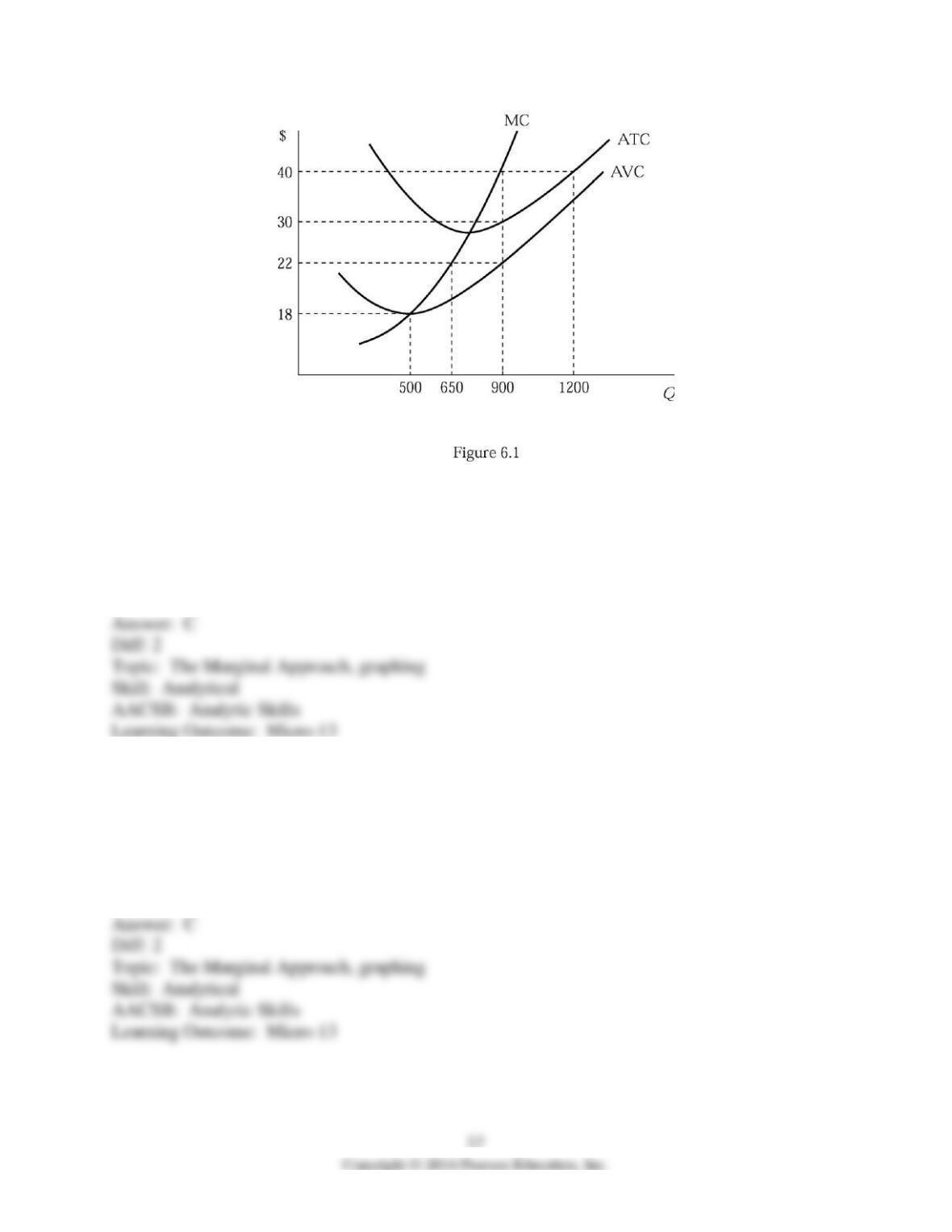
18) Figure 6.1 shows the cost structure of a firm in a perfectly competitive market. If the market
price is $40, the firm’s profit maximizing output level is
A) 500.
B) 650.
C) 900.
D) 1,200.
19) Figure 6.1 shows the cost structure of a firm in a perfectly competitive market. If the market
price is $40 and the firm is currently producing the profit maximizing output level, its total
variable cost is
A) $12,500.
B) $14,300.
C) $19,800.
D) $27,000.
20) Figure 6.1 shows the cost structure of a firm in a perfectly competitive market. If the market
price is $40 and the firm is currently producing the profit maximizing output level, its total fixed
cost is
A) $2,800.
B) $5,200.
C) $7,200.
D) $9,000.
21) Figure 6.1 shows the cost structure of a firm in a perfectly competitive market. If the market
price is $40 and the firm is currently producing the profit maximizing output level, the firm’s
profit is
A) $7,200.
B) $9,000.
C) $27,000.
D) $36,000.
22) Figure 6.1 shows the cost structure of a firm in a perfectly competitive market. If the firm’s
fixed cost increases by 3,000 due to a new government regulation,
A) the marginal cost curve shifts upward.
B) the average variable cost curve shifts upward.
C) the average total cost curve shifts upward.
D) none of the above
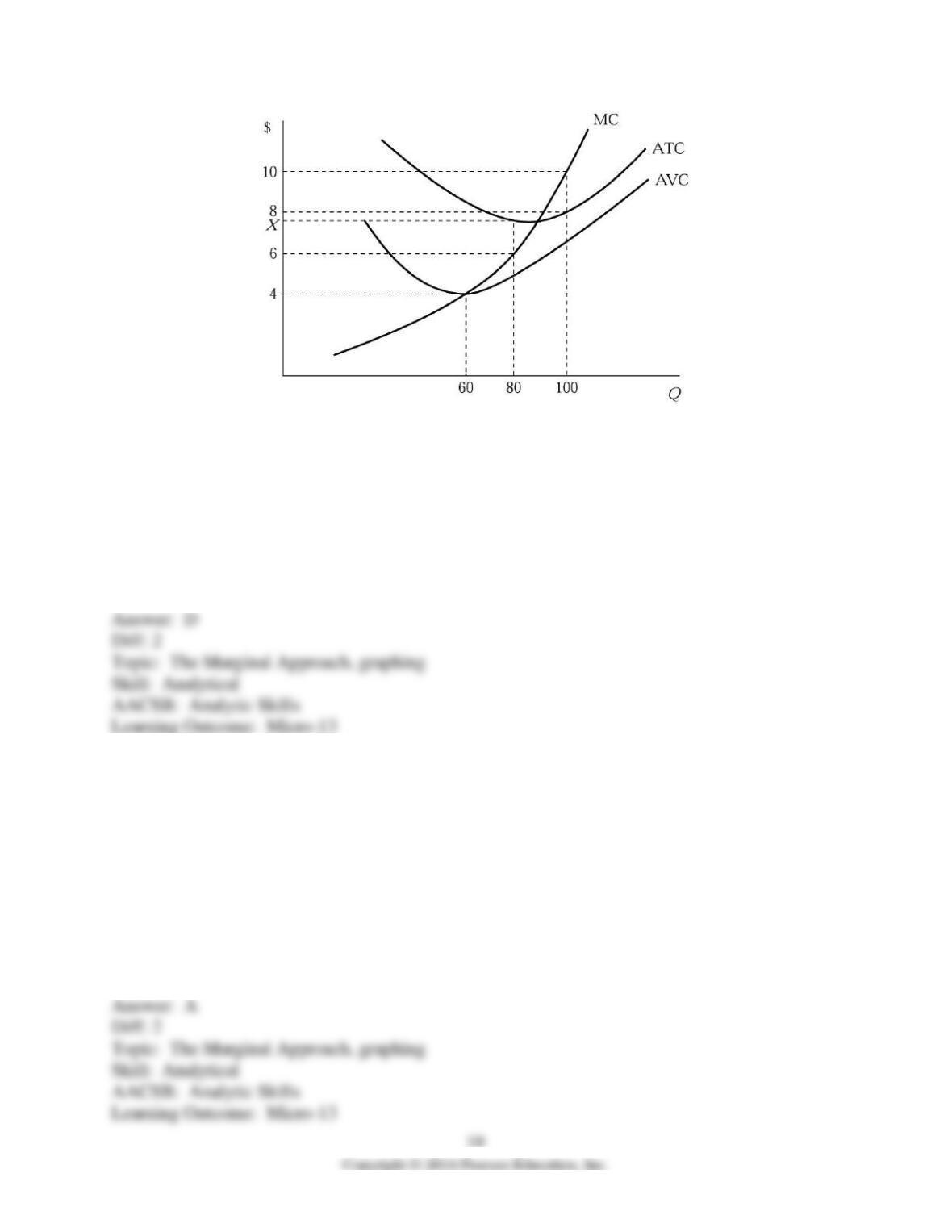
Figure 6.2
23) Figure 6.2 shows the cost structure of a firm in a perfectly competitive market. If the market
price is $10 and the firm chooses the profit maximizing output level, its profit is
A) $1,000.
B) $800.
C) $720.
D) $200.
24) Figure 6.2 shows the cost structure of a firm in a perfectly competitive market. Suppose the
current market price is $10 and the firm produces the profit maximizing output level. If the firm’s
total fixed cost increases due to a new government regulation, the short-run response of the firm
should be to
Note: since the question does not restrict the firm’s response to the short-run, we can’t rule out
that the rise in fixed cost will push the firm below the breakeven point and that the firm will exit
the industry in the long run, thus decreasing its current output level.
A) produce its current output level.
B) increase its current output level.
C) decrease its current output level.
D) There isn’t sufficient information.
25) Figure 6.2 shows the cost structure of a firm in a perfectly competitive market. Suppose that
market price falls to $6. If the firm produces at an output level that causes it to suffer an
economic loss of $120, its average total cost (X) is
A) $8.
B) $7.5.
C) $6.5.
D) $4.
26) Figure 6.2 shows the cost structure of a firm in a perfectly competitive market. Suppose the
current market price is $6 and the firm produces at a given output level. If the firm’s total fixed
cost increases due to a new government regulation, the short-run response of the firm should be
to
A) produce its current output level.
B) decrease its current output level.
C) increase its current output level.
D) There isn’t sufficient information.
27) If a profit-maximizing firm in a perfectly competitive market is currently producing the
output where (price – average variable cost) > average fixed cost, the firm is
A) making a positive economic profit.
B) making a zero economic profit.
C) suffering an economic loss.
D) none of the above