College Physics: A Strategic Approach, 3e (Knight)
Chapter 6 Gravity
6.1 Conceptual Questions
1) You are making a circular turn in your car on a horizontal road when you hit a big patch of
ice, causing the force of friction between the tires and the road to become zero. While the car is
on the ice, it
A) moves along a straight-line path away from the center of the circle.
B) moves along a straight-line path toward the center of the circle.
C) moves along a straight-line path in its original direction.
D) continues to follow a circular path, but with a radius larger than the original radius.
E) moves along a path that is neither straight nor circular.
2) When a car goes around a circular curve on a horizontal road at constant speed, what force
causes it to follow the circular path?
A) the normal force from the road
B) the friction force from the road
C) gravity
D) No force causes the car to do this because the car is traveling at constant speed and therefore
has no acceleration.
3) A car goes around a circular curve on a horizontal road at constant speed. What is the
direction of the friction force on the car due to the road?
A) tangent to the curve in the forward direction
B) tangent to the curve opposite to the direction of the car’s motion
C) perpendicular to the curve outward
D) perpendicular to the curve inward
E) There is no friction on the car because its speed is constant.
4) When an object moves in uniform circular motion, the direction of its acceleration is
A) in the same direction as its velocity vector.
B) in the opposite direction of its velocity vector.
C) is directed toward the center of its circular path.
D) is directed away from the center of its circular path.
E) depends on the speed of the object.
5) If you swing a bucket of water fast enough in a vertical circle, at the highest point the water
does not spill out. This happens because an outward force balances the pull of gravity on the
water.
A) True
B) False
6) When a car goes around a banked circular curve at the proper speed speed for the banking
angle, what force cause it to follow the circular path?
A) the normal force from the road
B) the friction force from the road
C) gravity
D) No force causes the car to do this because the car is traveling at constant speed and therefore
has no acceleration.
7) Two cars go around a banked curve at the proper speed for the banking angle. One car has
tires with excellent traction, while the other car has bald slippery tires. Which of these cars is
more likely to slide on the pavement as it goes around the curve?
A) the car with the new tires
B) the car with the bald tires
C) Neither car will slide.
D) It depends on if the pavement is wet or dry.
8) Two small balls, A and B, attract each other gravitationally with a force of magnitude F. If we
now double both masses and the separation of the balls, what will now be the magnitude of the
attractive force on each one?
A) 16F
B) 8F
C) 4F
D) F
E) F/4
9) Two small objects, with masses m and M, are originally a distance r apart, and the magnitude
of the gravitational force on each one is F. The masses are changed to 2m and 2M, and the
distance is changed to 4r. What is the magnitude of the new gravitational force?
A) F/16
B) F/4
C) 16F
D) 4F
E) F/2
10) Two small objects, with masses m and M, are originally a distance r apart, and the
gravitational force on each one has magnitude F. The second object has its mass changed to 2M,
and the distance is changed to r/4. What is the magnitude of the new gravitational force?
A) F/32
B) F/16
C) 16F
D) 32F
E) 2F
11) A spaceship is traveling to the Moon. At what point is it beyond the pull of Earth’s gravity?
A) when it gets above the atmosphere
B) when it is half-way there
C) when it is closer to the Moon than it is to Earth
D) It is never beyond the pull of Earth’s gravity.
12) If you stood on a planet having a mass four times that of Earth’s mass, and a radius two times
that of Earth’s radius, you would weigh
A) the same as you do on Earth.
B) two times more than you do on Earth.
C) two times less than you do on Earth.
D) four times more than you do on Earth.
13) An piece of space debris is released from rest at an altitude that is two earth radii from the
center of the earth. Compared to its weight on Earth, the weight of this debris is
A) zero.
B) the same as on the surface of the earth.
C) one-half of its weight on the surface of the earth.
D) one-third of its weight on the surface of the earth.
E) one-quarter of its weight on the surface of the earth.
14) A satellite encircles Mars at a distance above its surface equal to 3 times the radius of Mars.
If gm is the acceleration due to gravity at the surface of Mars, what is the acceleration due to
gravity at the location of the satellite?
A) gm/9
B) 0
C) gm
D) gm/3
E) gm/16
15) A hypothetical planet has a mass of one-half that of the earth and a radius of twice that of the
earth. What is the acceleration due to gravity on the planet in terms of g, the acceleration due to
gravity at the surface of the earth?
A) g
B) g/2
C) g/4
D) g/8
E) g/16
16) The acceleration due to gravity on Planet A is one-sixth what it is on Planet B, and the radius
of the Planet A is one-fourth that of Planet B. The mass of Planet A is what fraction of the mass
of Planet B?
A) 1/6
B) 1/16
C) 1/24
D) 1/96
E) 1/12
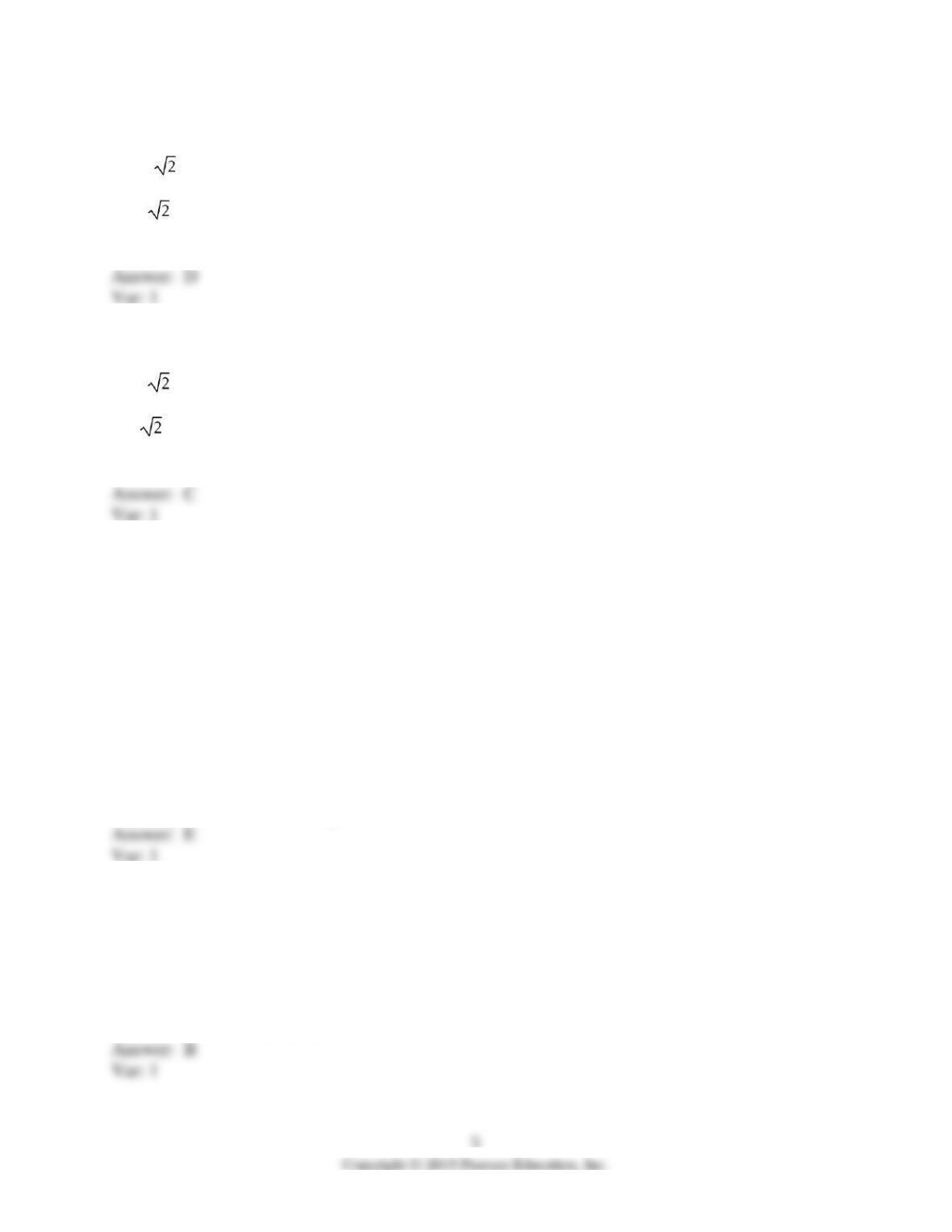
17) Two planets have the same surface gravity, but planet B has twice the radius of planet A. If
planet A has mass m, what is the mass of planet B?
A) m/
B) m
C) m
D) 4m
E) m/4
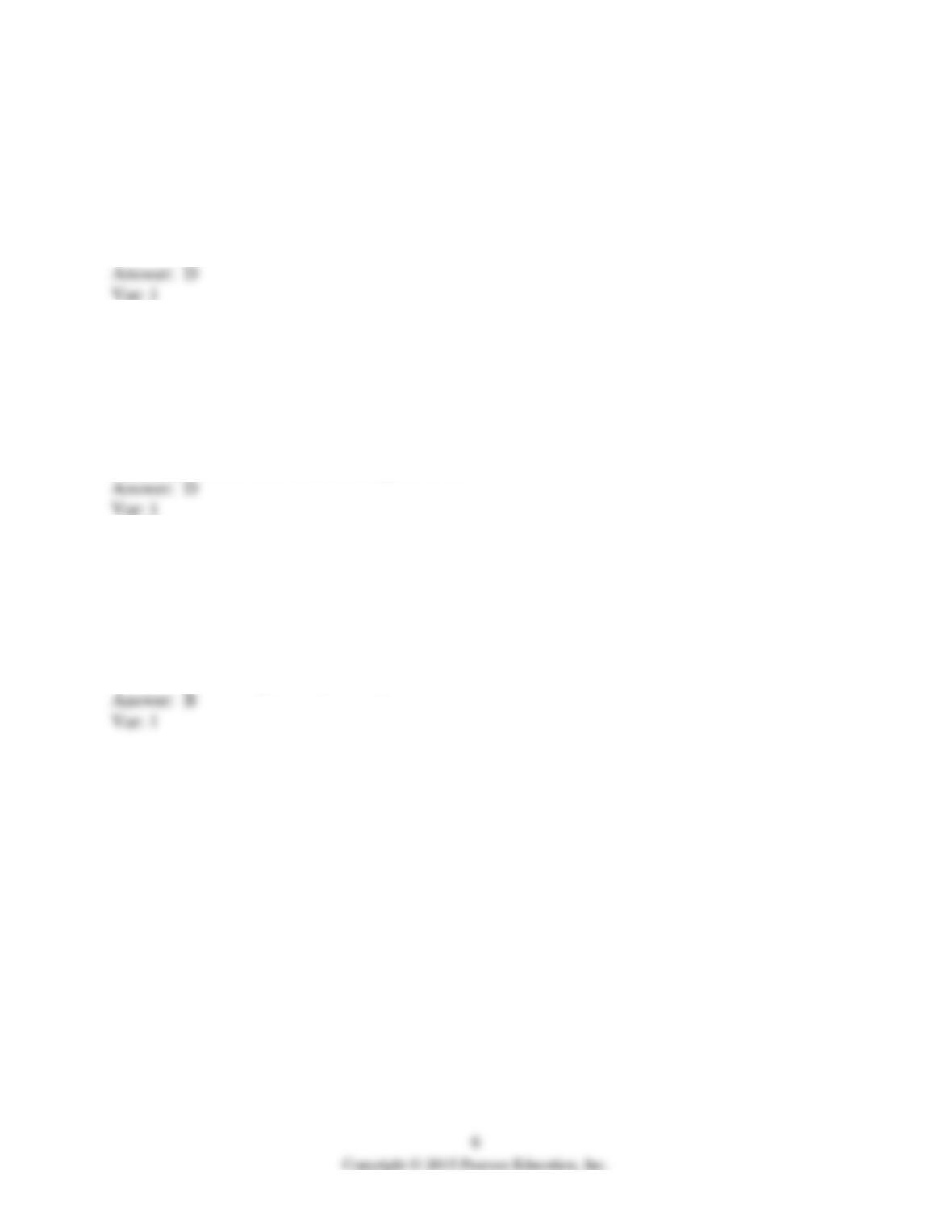
18) Two planets have the same surface gravity, but planet B has twice the mass of planet A. If
planet A has radius r, what is the radius of planet B?
A) r/
B) r
C) r
D) 4r
E) 2r
19) Planet A has twice the mass of Planet B. From this information, what can we conclude about
the acceleration due to gravity at the surface of Planet A compared to that at the surface of Planet
B?
A) The acceleration due to gravity on Planet A must be twice as great as the acceleration due to
gravity on Planet B.
B) The acceleration due to gravity on Planet A must be four times as great as the acceleration
due to gravity on Planet B.
C) The acceleration due to gravity on Planet A is the same as the acceleration due to gravity on
Planet B.
D) The acceleration due to gravity on Planet A is greater than the acceleration due to gravity on
Planet B, but we cannot say how much greater.
E) We cannot conclude anything about the acceleration due to gravity on Planet A without
knowing the radii of the two planets.
20) The reason an astronaut in an earth satellite feels weightless is that
A) the astronaut is beyond the range of the earth’s gravity.
B) the astronaut is falling.
C) the astronaut is at a point in space where the effects of the moon’s gravity and the earth’s
gravity cancel.
D) this is a psychological effect associated with rapid motion.
E) the astronaut’s acceleration is zero.
21) If Earth had twice its present mass but it orbited at the same distance from the sun as it does
now, its orbital period would be
A) 4 years.
B) 3 years.
C) 2 years.
D) 1 year.
E) 6 months.
22) Satellite A has twice the mass of satellite B, and moves at the same orbital distance from
Earth as satellite B. Compare the speeds of the two satellites.
A) The speed of B is twice the speed of A.
B) The speed of B is one-half the speed of A.
C) The speed of B is one-fourth the speed of A.
D) The speed of B is equal to the speed of A.
E) The speed of B is four times the speed of A.
23) Suppose our sun had 4 times its present mass but the earth orbited it at the same distance as it
presently does. What would be the length of the year on the earth under those conditions?
A) 1/4 as long as the present year
B) 1/2 as long as the present year
C) the same as the present year
D) twice as long as the present year
E) four times as long as the present year
6.2 Problems
1) A particularly scary roller coaster contains a loop-the-loop in which the car and rider are
completely upside down. If the radius of the loop is with what minimum speed must the
car traverse the loop so that the rider does not fall out while upside down at the top? Assume the
rider is not strapped to the car.
A) 11.4 m/s
B) 12.5 m/s
C) 10.1 m/s
D) 14.9 m/s
2) A 1000-kg car is moving at 30 m/s around a horizontal unbanked curve whose diameter is
0.20 km. What is the magnitude of the friction force required to keep the car from sliding?
A) 9000 N
B) 9800 N
C) 300 N
D) 900 N
E) 3000 N
3) The curved section of a horizontal highway is a circular unbanked arc of radius 740 m. If the
coefficient of static friction between this roadway and typical tires is 0.40, what would be the
maximum safe driving speed for this horizontal curved section of highway?
A) 54 m/s
B) 52 m/s
C) 50 m/s
D) 48 m/s
E) 46 m/s
4) A 250-kg motorcycle goes around an unbanked turn of radius 13.7 m at a steady 96.5 km/h.
What is the magnitude of the net force on the motorcycle?
A) 719 N
B) 2.95 × 10³ N
C) 1.31 × 10⁴ N
D) 4.31 × 10⁴ N
5) A 0.50-kg toy is attached to the end of a 1.0-m very light string. The toy is whirled in a
horizontal circular path on a frictionless tabletop. If the maximum tension that the string can
withstand without breaking is 350 N. What is the maximum speed the mass can have without
breaking the string?
A) 700 m/s
B) 26 m/s
C) 19 m/s
D) 13 m/s
6) A jet plane flying 600 m/s experiences an acceleration of 4.0 g when pulling out of a circular
dive. What is the radius of curvature of the circular part of the path in which the plane is flying?
A) 640 m
B) 1200 m
C) 7100 m
D) 9200 m
7) One way that future space stations may create artificial gravity is by rotating the station.
Consider a cylindrical space station 380 m in diameter that is rotating about its longitudinal axis.
Astronauts walk on the inside surface of the space station. How long will it take for each rotation
of the cylinder if it is to provide “normal” gravity for the astronauts?
A) 28 s
B) 39 s
C) 6.2 s
D) 4.4 s
8) A Ferris wheel has radius 5.0 m and makes one revolution every 8.0 s with uniform rotation.
A person who normally weighs 670 N is sitting on one of the benches attached at the rim of the
wheel. What is the apparent weight (the normal force exerted on her by the bench) of the person
as she passes through the highest point of her motion?
9) A 2.0-kg ball is moving with a constant speed of 5.0 m/s in a horizontal circle whose diameter
is 1.0 m. What is the magnitude of the net force on the ball?
A) 0 N
B) 20 N
C) 40 N
D) 50 N
E) 100 N
10) A 1000-kg car is slowly picking up speed as it goes around a horizontal unbanked curve
whose radius is 100 m. The coefficient of static friction between the tires and the road is 0.35. At
what speed will the car begin to skid sideways?
A) 9.3 m/s
B) 24 m/s
C) 34 m/s
D) 35 m/s
E) 19 m/s
11) A car moving at a steady 10 m/s on a level highway encounters a bump that has a circular
cross-section with a radius of 30 m. The car maintains its speed over the bump. What is the
normal force exerted by the seat of the car on a 60.0-kg passenger when the car is at the top of
the bump?
A) 200 N
B) 390 N
C) 790 N
D) 490 N
E) 590 N
12) A car moving at a steady 10 m/s on a level highway encounters a depression that has a
circular cross-section with a radius of 30 m. The car maintains its speed as it drives through the
depression. What is the normal force exerted by the seat of the car on a 60.0-kg passenger when
the car is at the bottom of the depression?
A) 200 N
B) 390 N
C) 790 N
D) 490 N
E) 590 N
13) Pulling out of a dive, the pilot of an airplane guides his plane into a vertical circle with a
radius of 600 m. At the bottom of the dive, the speed of the airplane is 150 m/s. What is the
apparent weight of the 70-kg pilot at that point?
A) 3300 N
B) 690 N
C) 2600 N
D) 490 N
E) 1400 N
14) Pulling out of a dive, the pilot of an airplane guides his plane into a vertical circle. At the
bottom of the dive, the speed of the airplane is 320 m/s. What is the smallest radius allowable for
the vertical circle if the pilot’s apparent weight is not to exceed 7.0 times his true weight?
A) 1700 m
B) 1500 m
C) 2200 m
D) 230 m
E) 42 m
15) In order to simulate weightlessness for astronauts in training, they are flown in a vertical
circle. If the passengers are to experience weightlessness, how fast should an airplane be moving
at the top of a vertical circle with a radius of 2.5 km?
A) 79 m/s
B) 310 m/s
C) 260 m/s
D) 160 m/s
E) 510 m/s
16) In a carnival ride, passengers stand with their backs against the wall of a cylinder. The
cylinder is set into rotation and the floor is lowered away from the passengers, but they remain
stuck against the wall of the cylinder. For a cylinder with a 2.0-m radius, what is the minimum
speed that the passengers can have so they do not fall if the coefficient of static friction between
the passengers and the wall is 0.25?
A) 8.9 m/s
B) 2.3 m/s
C) 3.0 m/s
D) 4.9 m/s
E) It depends on the mass of the passengers.
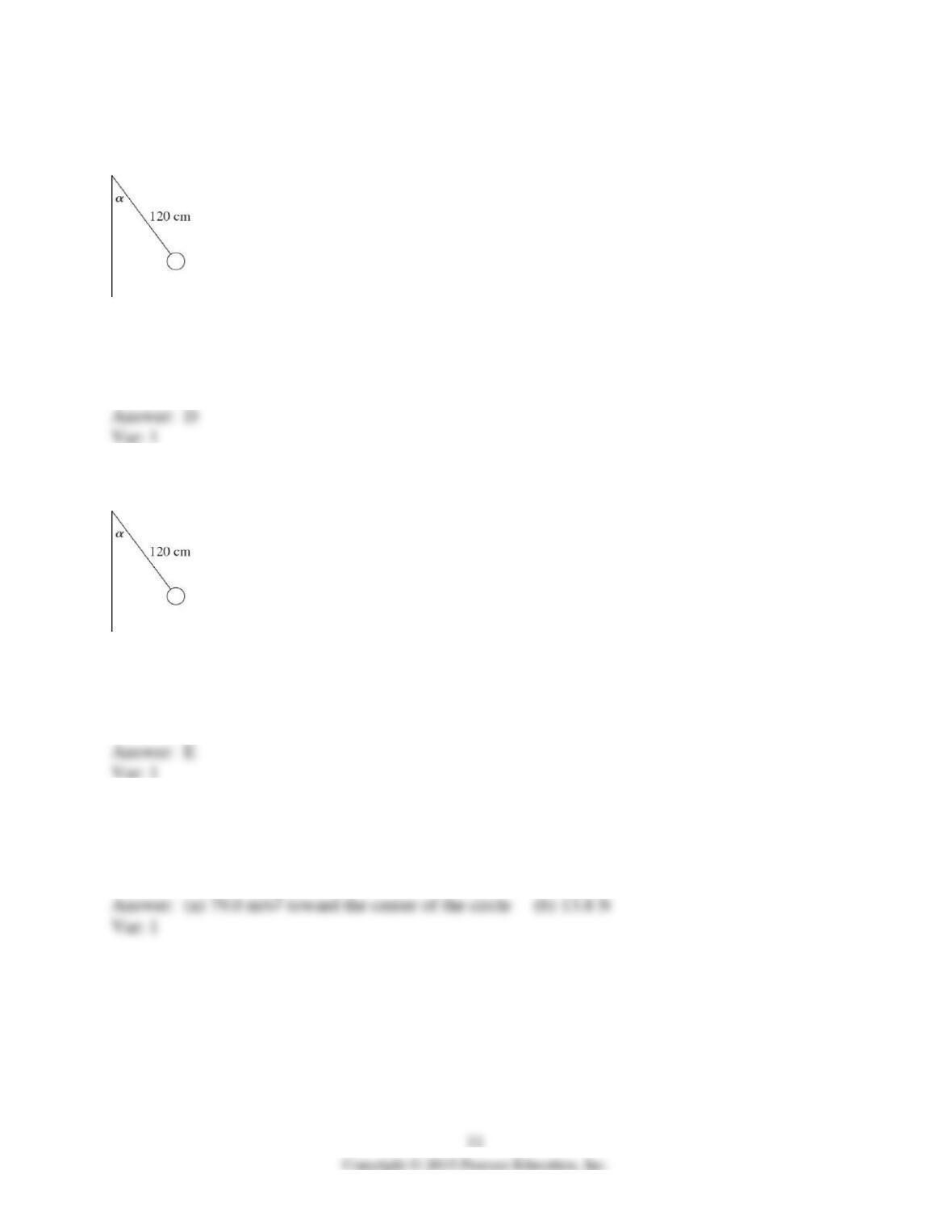
17) A 20-g bead is attached to a light 120-cm-long string as shown in the figure. This bead
moves in a horizontal circle with a constant speed of 1.5 m/s. What is the tension in the string if
the angle α is measured to be 25°?
A) 0.089 N
B) 0.041 N
C) 0.20 N
D) 0.22 N
E) 0.46 N
18) A 20-g bead is attached to a light 120 cm-long string as shown in the figure. If the angle α is
measured to be 18°, what is the speed of the mass?
A) 0.55 m/s
B) 2.0 m/s
C) 3.8 m/s
D) 1.3 m/s
E) 1.1 m/s
19) A small 175-g ball on the end of a light string is revolving uniformly on a frictionless surface
in a horizontal circle of diameter 1.0 m. The ball makes 2.0 revolutions every 1.0 s.
(a) What are the magnitude and direction of the acceleration of the ball?
(b) Find the tension in the string.
20) A car traveling at a steady 20 m/s rounds an 80-m radius horizontal unbanked curve with the
tires on the verge of slipping. What is the maximum speed with which this car can round a
second unbanked curve of radius 320 m if the coefficient of static friction between the car’s tires
and the road surface is the same in both cases?
A) 160 m/s
B) 80 m/s
C) 70 m/s
D) 40 m/s
E) 30 m/s
21) A future use of space stations may be to provide hospitals for severely burned persons. It is
very painful for a badly burned person on Earth to lie in bed. In a space station, the effect of
gravity can be reduced or even eliminated. How long should each rotation take for a doughnut-
shaped hospital of 200-m radius so that persons on the outer perimeter would experience 1/10 the
normal gravity of Earth?
A) 91 min
B) 8.7 min
C) 4.6 min
D) 1.5 min
E) 0.011 min
22) A 600-kg car is going around a banked curve with a radius of 110 m at a steady speed of 24.5
m/s. What is the appropriate banking angle so that the car stays on its path without the assistance
of friction?
A) 29.1°
B) 13.5°
C) 33.8°
D) 56.2°
E) 60.9°
23) The curved section of a speedway is a circular arc having a radius of 190 m. This curve is
properly banked for racecars moving at 34 m/s. At what angle with the horizontal is the curved
part of the speedway banked?
A) 32°
B) 34°
C) 30°
D) 28°
E) 26°
24) A curved portion of highway has a radius of curvature of 65 m. As a highway engineer, you
want to bank this curve at the proper angle for a steady speed of 22 m/s.
(a) What banking angle should you specify for this curve?
(b) At the proper banking angle, what normal force and what friction force does the highway
exert on a 750-kg car going around the curve at the proper speed?
25) Two horizontal curves on a bobsled run are banked at the same angle, but one has twice the
radius of the other. The safe speed (for which no friction is needed to stay on the run) for the
smaller radius curve is v. What is the safe speed on the larger-radius curve?
A) v /
B) 2v
C) v
D) v/2
26) What is the proper banking angle for an Olympic bobsled to negotiate a 100-m radius turn at
35 m/s without skidding?
A) 31°
B) 41°
C) 51°
D) 61°
27) A highway curve of radius 100 m, banked at an angle of 45°, may be negotiated without
friction at a speed of
A) 22 m/s.
B) 31 m/s.
C) 44 m/s.
D) 67 m/s.
28) A highway curve of radius 80 m is banked at 45°. Suppose that an ice storm hits, and the
curve is effectively frictionless. What is the speed with which to take the curve without tending
to slide either up or down the surface of the road?
A) 9.4 m/s
B) 28 m/s
C) 780 m/s
D) The curve cannot be taken safely at any speed.