6-1: Flexible Budgets
A chair manufacturer has established the following flexible budget for the month.
Units Produced and Sold
1,000 1,500 2,000
Sales $10,000 $15,000 $20,000
Variable Costs (5,000) (7,500) (10,000)
Fixed Costs (2,000) (2,000) (2,000)
Profit $ 3,000 $ 5,500 $ 8,000
Required:
a. What is the sales price per chair?
b. What is the expected profit if 1,600 chairs are made?
6-1: Solution to Flexible Budgets (10 minutes)
6-2: Different Types of Budgets
The Sticky Company makes a glue that is used to glue the layers of wood veneer together
to make plywood. The process for making the glue has been used for many years and the
customers are satisfied with the product. The Sticky Company has had very low turnover of
personnel and the president and the managers have all been with the company for many years.
Although the company appears very stable today, plywood prices are rising and the construction
industry is beginning to switch to a cheaper product called chipboard. Chipboard uses a different
glue than the glue made by the Sticky Company.
Given the present condition of Sticky Company, should the company use long-term
budgets, line-item budgets, budget lapsing, flexible budgets, or zero-based budgeting?
6-2: Solution to Different Types of Budgets (15 minutes)
6-3: Top-down versus Bottom-up Budgets
Describe (a) the benefits of top-down budgeting and (b) the benefits of bottom-up
budgeting.
6-3: Solution to Top-down versus Bottom-up Budgets (15 minutes)
6-4: The Effect of Budgets on Organization
Describe how budgets and budgeting systems help solve the organization problem. Give
examples.
6-4: Solution to The Effect of Budgets on Organization (20 minutes)
6-5: Appendix Estimating Production Costs
The Fancy Umbrella Company makes beach umbrellas. The production process requires
3 square meters of plastic sheeting and a metal pole. The plastic sheeting costs $0.50 per square
meter and each metal pole costs $1.00. At the beginning of the month, the company has 5,000
square feet of plastic and 1,000 poles in raw materials inventory. The preferred raw material
amount at the end of the month is 3,000 square feet of plastic sheeting and 600 poles. The company
has 300 finished umbrellas in inventory at the beginning of the month and plans to have 200
finished umbrellas at the end of the month. Sales in the coming month are expected to be 5,000
umbrellas.
Required:
a. How many umbrellas must the company produce to meet demand and have sufficient
ending inventory?
b. What is the cost of materials that must be purchased?
6-5: Appendix: Solution to Estimating Production Costs (15 minutes)
6-6: Appendix Pro-Forma Financial Statements
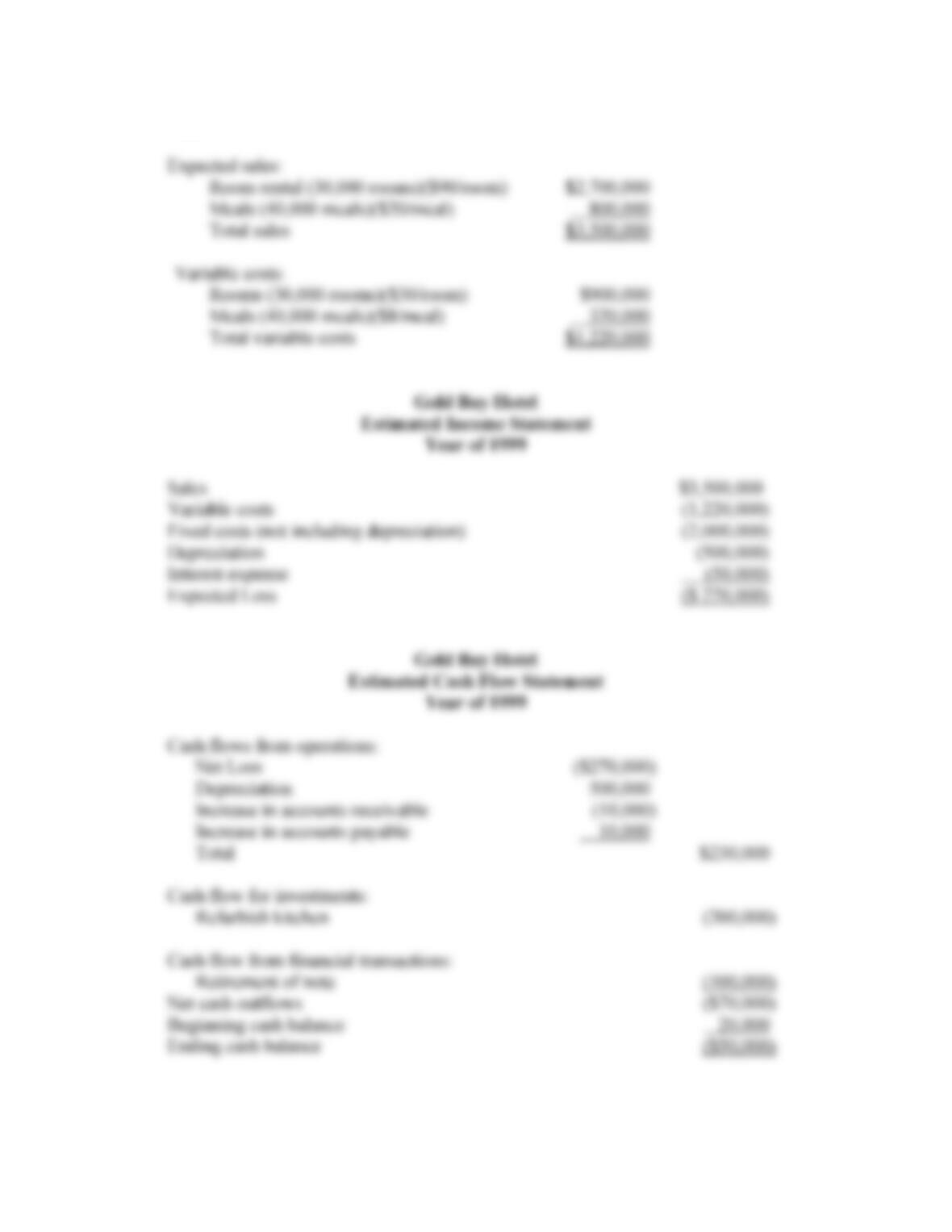
The Gold Bay Hotel is in the process of developing a master budget and pro-forma financial
statements for 1999. The beginning balance sheet for the fiscal year 1999 is estimated to be:
Gold Bay Hotel
Estimated Balance Sheet
1/1/99
Cash $ 20,000 Accounts Payable $ 20,000
Accounts Receivable 30,000 Notes Payable 500,000
Facilities 3,010,000 Capital Stock 100,000
Accumulated Dep. (1,100,000) Retained Earnings 1,340,000
Total Assets $1,960,000 Total Equities $1,960,000
During the year the hotel expects to rent 30,000 rooms. Rooms rent for an average of $90
per night. The hotel expects to sell 40,000 meals during the year at an average price of $20 per
meal. The variable cost per room rented is $30 and the variable cost per meal is $8. The fixed
costs not including depreciation is expected to be $2,000,000. Depreciation is expected to be
$500,000. The hotel also expects to refurbish the kitchen at a cost of $200,000, which is capitalized
(included in the facility account). Interest of the note payable is expected to be $50,000 and
$100,000 of the note payable will be retired during the year. The ending accounts receivable
amount is expected to be $40,000 and the ending accounts payable is expected to be $30,000.
Prepare pro-forma financial statements for the end of the year.
6-6: Appendix Solution to Pro Forma Financial Statements (25 minutes)
6-7: Appendix Budgeting Direct Materials
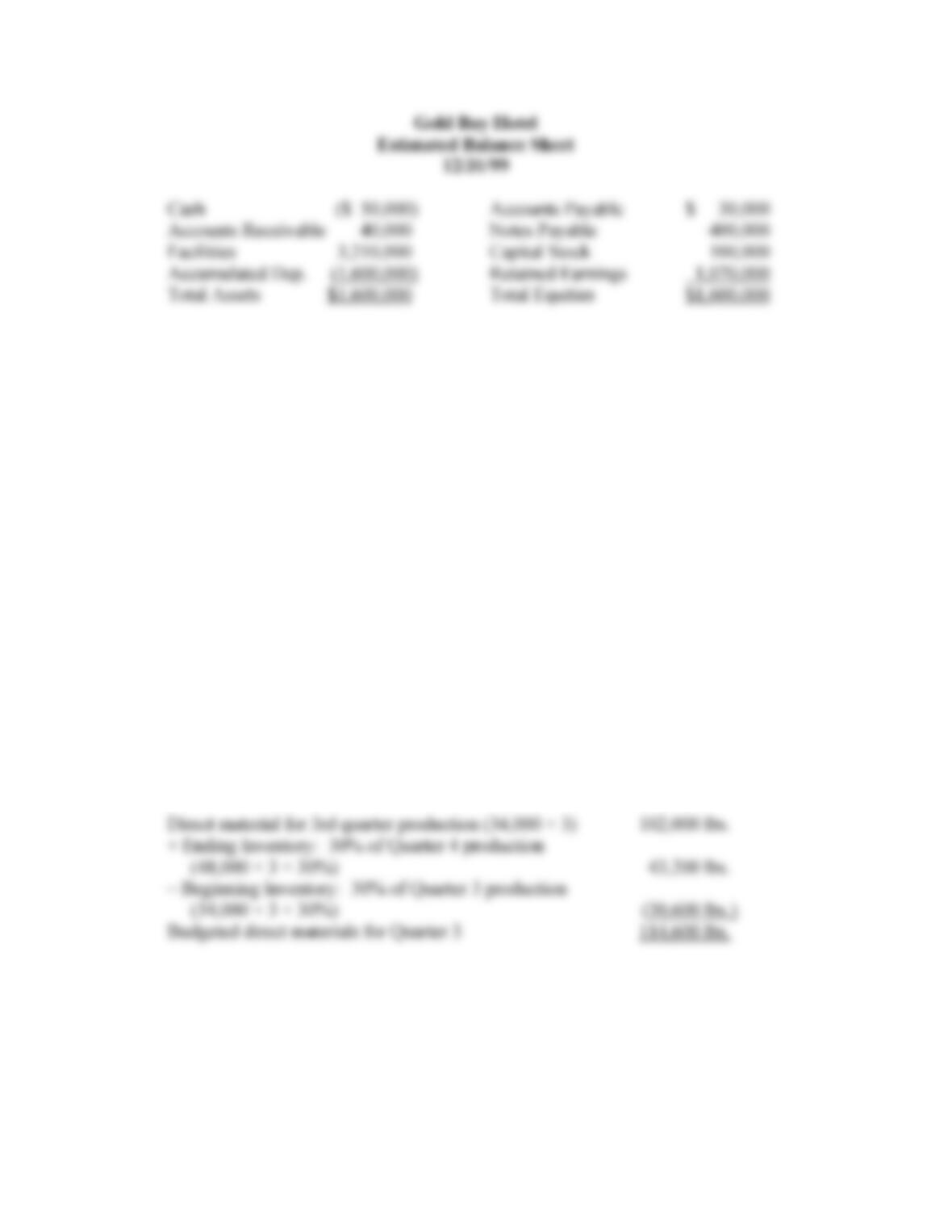
The Jung Corporation’s budget calls for the following production:
Quarter 1
45,000 units
Quarter 2
38,000 units
Quarter 3
34,000 units
Quarter 4
48,000 units
Each unit of production requires three pounds of direct material. The company’s policy is
to begin each quarter with an inventory of direct materials equal to 30 percent of that quarter’s
direct material requirements. Compute budgeted direct materials purchases for the third quarter.
Source: CMA adapted
6-7: Appendix: Solution to Budgeting Direct Materials (CMA adapted) (10 minutes)