Microeconomics, 4e (Hubbard/O’Brien)
Chapter 6 Elasticity: The Responsiveness of Demand and Supply
6.1 The Price Elasticity of Demand and Its Measurement
1) Price elasticity of demand measures
A) how responsive suppliers are to price changes.
B) how responsive sales are to changes in the price of a related good.
C) how responsive quantity demanded is to a change in price.
D) how responsive sales are to a change in buyers’ incomes.
2) Suppose the value of the price elasticity of demand is -3. What does this mean?
A) A 1 percent increase in the price of the good causes quantity demanded to increase by 3
percent.
B) A 1 percent increase in the price of the good causes quantity demanded to decrease by 3
percent.
C) A 3 percent increase in the price of the good causes quantity demanded to decrease by 1
percent.
D) A $1 increase in price causes quantity demanded to fall by 3 units.
3) If the percentage increase in price is 15 percent and the value of the price elasticity of demand
is -3, then quantity demanded
A) will increase by 45 percent.
B) will increase by 5 percent.
C) will decrease by 45 percent.
D) will decrease by 5 percent.
4) The price elasticity of demand for Stork ice cream is -4. Suppose you’re told that following a
price increase, quantity demanded fell by 10 percent. What was the percentage change in price
that brought about this change in quantity demanded?
A) 40 percent
B) 25 percent
C) 2.5 percent
D) 0.4 percent
5) If demand is inelastic, the absolute value of the price elasticity of demand is
A) one.
B) less than one.
C) greater than one.
D) greater than the absolute value of the slope of the demand curve.
6) A demand curve which is ________ represents perfectly inelastic demand, and a demand
curve which is ________ represents inelastic demand.
A) downward sloping; vertical
B) horizontal; downward sloping
C) vertical; downward sloping
D) upward sloping; horizontal
7) If demand is perfectly inelastic, the absolute value of the price elasticity of demand is
A) zero.
B) less than one.
C) more than one.
D) equal to the absolute value of the slope of the demand curve.
8) Jenna runs a small boutique in Capitola. She tells one of her suppliers that she is willing to pay
$6 for a pair of wool hand warmers and not a dime more. On the basis of this information, what
can you conclude about her price elasticity of demand for wool hand warmers?
A) It is elastic.
B) It is perfectly elastic.
C) It is perfectly inelastic.
D) The price elasticity coefficient is 0.
9) Seth is a competitive body builder. He says he has to have his 12-oz package of protein
powder to “feed his muscles” every day. On the basis of this information, what can you conclude
about his price elasticity of demand for protein powder?
A) It is elastic.
B) It is perfectly elastic.
C) It is perfectly inelastic.
D) The price elasticity coefficient is 0.
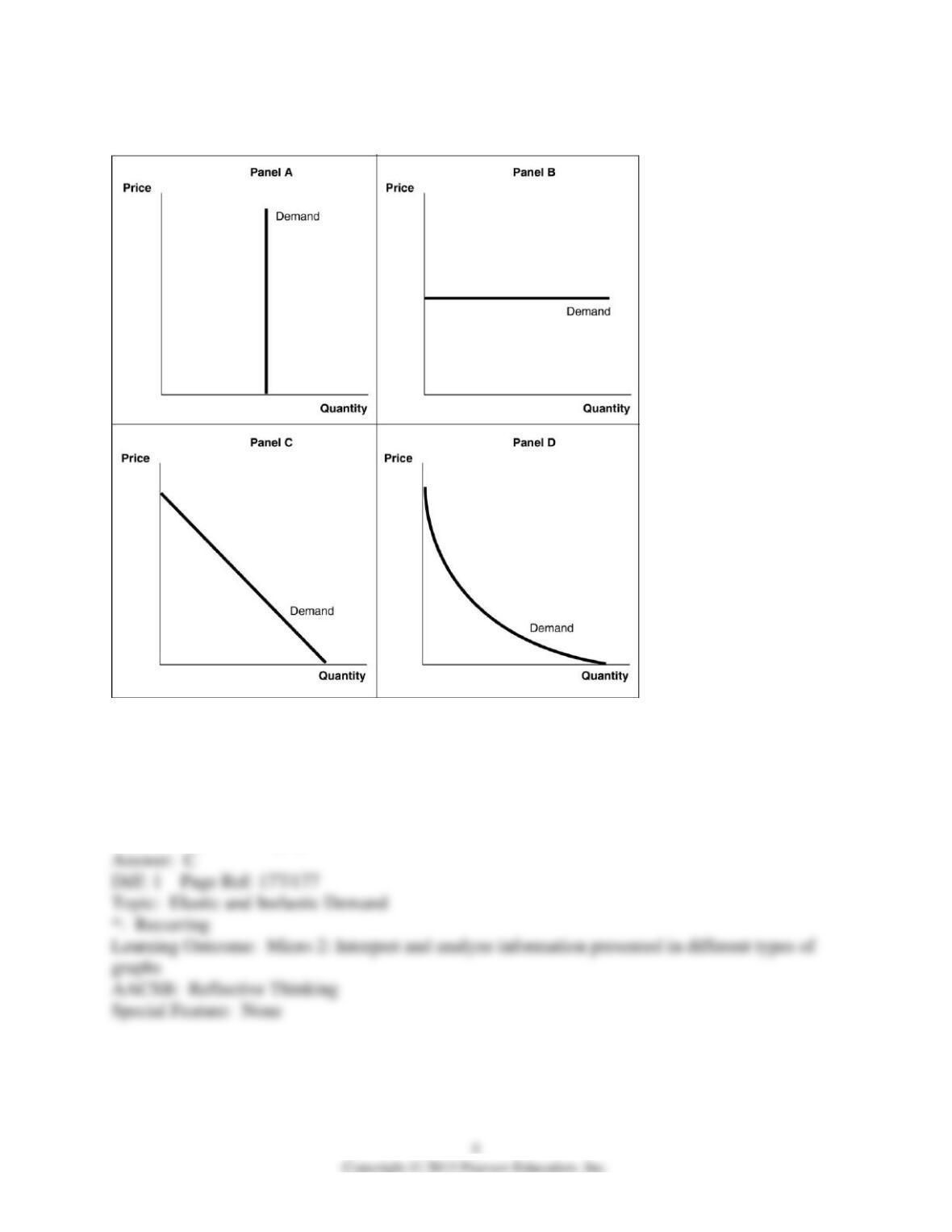
Figure 6-1
10) Refer to Figure 6-1. The demand curve on which elasticity changes at every point is given in
A) Panel A.
B) Panel B.
C) Panel C.
D) none of the above graphs.
11) Refer to Figure 6-1. A perfectly elastic demand curve is shown in
A) Panel A.
B) Panel B.
C) Panel C.
D) Panel D.
12) Refer to Figure 6-1. A perfectly inelastic demand curve is shown in
A) Panel A.
B) Panel B.
C) Panel C.
D) Panel D.
13) In May 2011, the average price of gasoline in the United States was $3.76 per gallon and
consumers bought 5 percent less gasoline than they had during May 2010, when the average
price was $2.79 per gallon. Based on these numbers, what was the price elasticity of demand for
gasoline from May 2010 to May 2011?
A) -0.33
B) -0.76
C) -2.96
D) -6.75
14) If 50 units are sold at a price of $20 and 80 units are sold at a price of $15, what is the
absolute value of the price elasticity of demand? Use the midpoint formula.
A) 0.17
B) 0.62
C) 1.62
D) 5
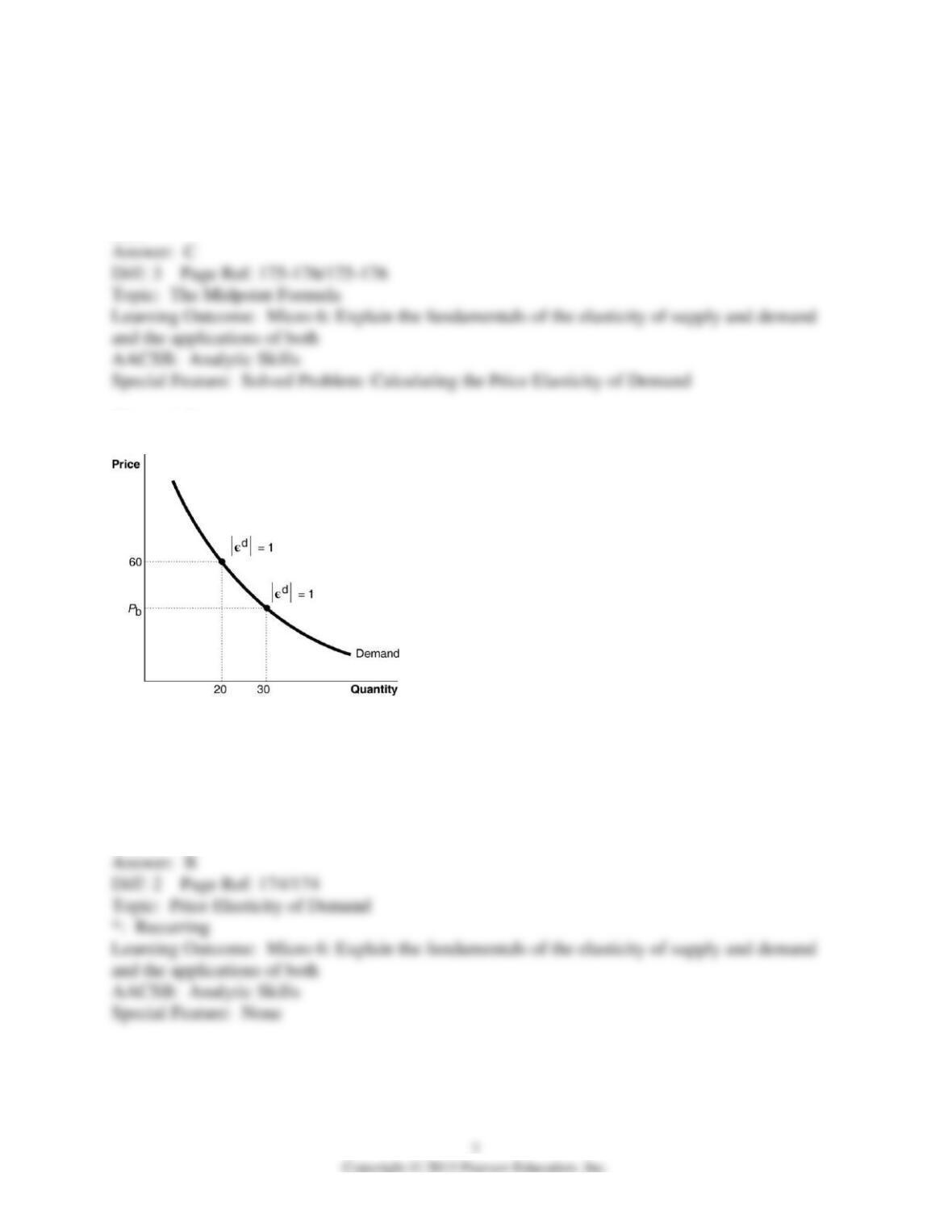
Figure 6-2
15) Refer to Figure 6-2. The absolute value of the price elasticity of demand at points a and b is
1. What is the value of Pb?
A) $50
B) $40
C) $30
D) $20
16) Suppose a hurricane decreased the supply of oranges so that the price of oranges rose from
$120 a ton to $180 a ton and quantity sold decreased from 800 tons to 240 tons. What is the
absolute value of the price elasticity of demand?
A) 0.11
B) 0.37
C) 2.69
D) 9.33
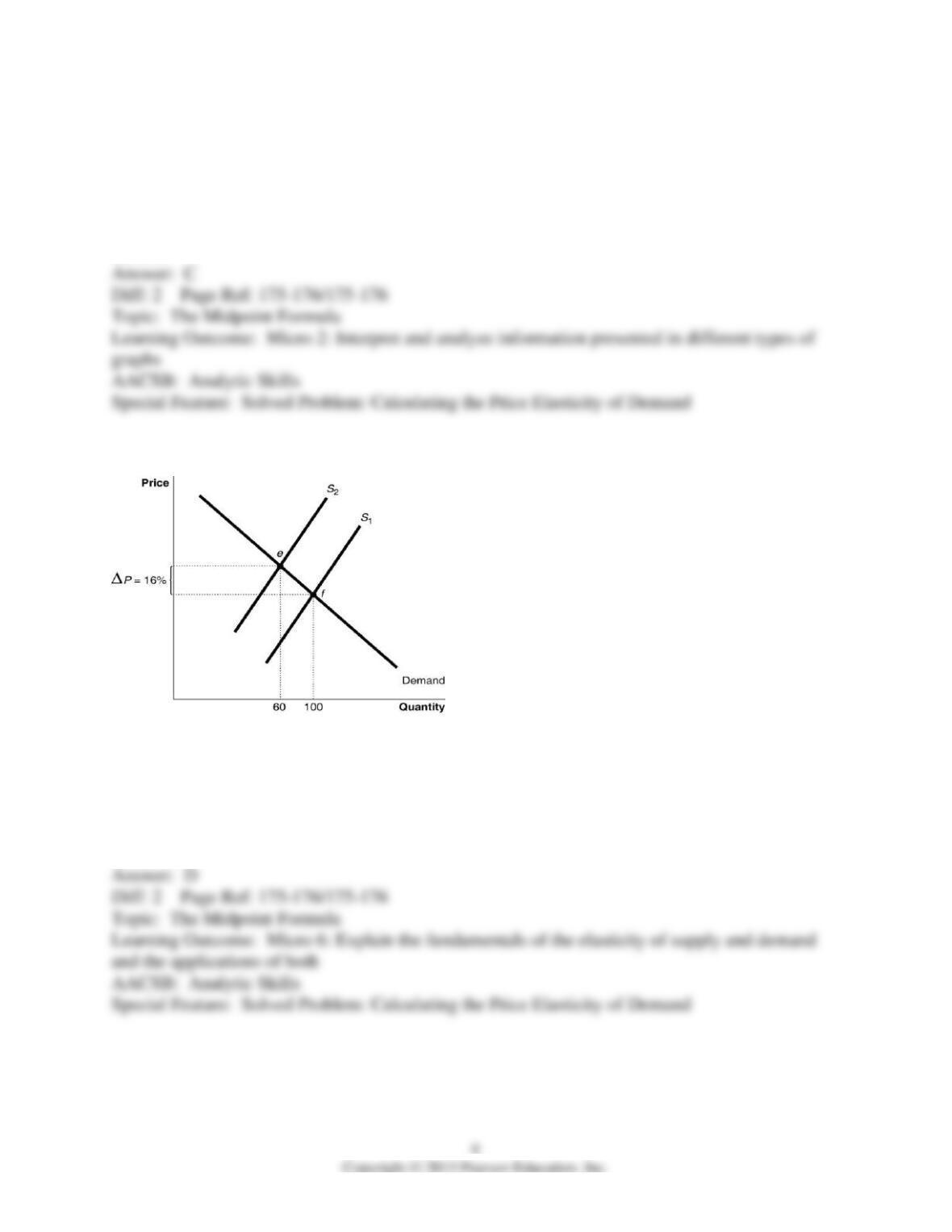
Figure 6-3
17) Refer to Figure 6-3. Using the midpoint formula, calculate the absolute value of the price
elasticity of demand between e and f.
A) 0.32
B) 0.4
C) 2.5
D) 3.125
18) Jaycee Jeans sold 40 pairs of jeans at a price of $40. When it lowered its price to $20, the
quantity sold increased to 60 pairs. Calculate the absolute value of the price elasticity of
demand. Use the midpoint formula.
A) 1.67
B) 1.0
C) 0.6
D) 0.53
19) Which of the following statements about price elasticity of demand is false?
A) The value of the price elasticity of demand is the reciprocal of the value of the demand
curve’s slope.
B) If quantity demanded changes by a larger percentage than the percentage change in price,
demand is elastic.
C) The value of the price elasticity of demand along a downward-sloping demand curve is
always negative.
D) A linear downward-sloping demand curve has a varying price elasticity coefficient.
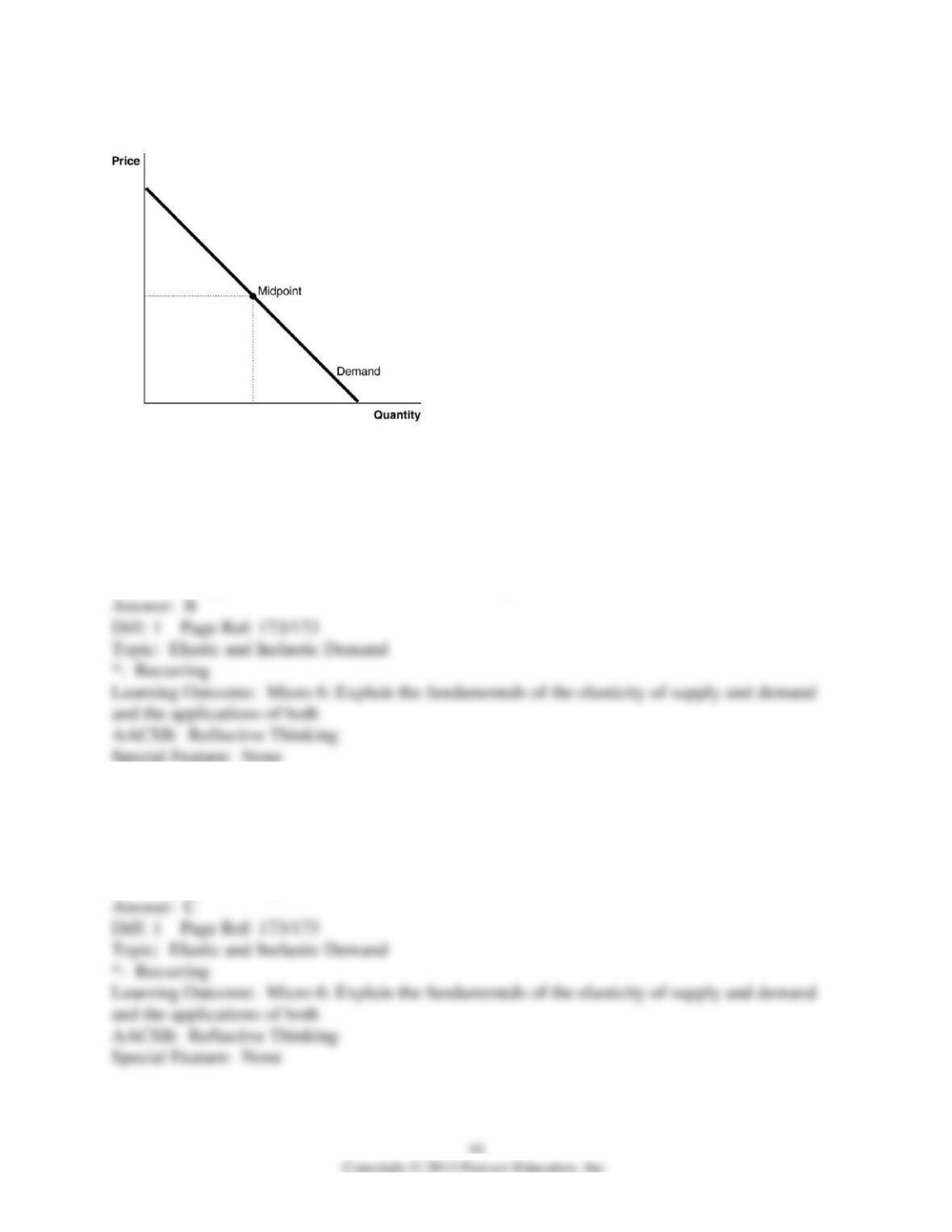
Figure 6-4
20) Refer to Figure 6-4. Which of the following statements is true about the price elasticity of
demand?
A) The elasticity coefficient is constant along the demand curve.
B) The elastic portion of a straight-line downward sloping demand curve corresponds to the
segment above the midpoint.
C) The inelastic portion of the demand curve corresponds to the segment above the midpoint.
D) At the midpoint of the demand curve, the elasticity coefficient is zero.
21) Refer to Figure 6-4. The inelastic segment of the demand curve
A) is coincident with the horizontal axis.
B) is coincident with the vertical axis.
C) lies below the midpoint of the curve.
D) lies above the midpoint of the curve.
22) Refer to Figure 6-4. At the midpoint of the demand curve, in absolute value,
A) the price elasticity coefficient is at a maximum.
B) the price elasticity coefficient is at a minimum.
C) the price elasticity coefficient is zero.
D) the price elasticity coefficient is one.
23) Which of the following statements is true about the price elasticity of demand along a
downward sloping linear demand curve?
A) It is inelastic at high prices and elastic at low prices.
B) It is unit-elastic throughout the demand curve.
C) It is elastic at high prices and inelastic at low prices.
D) It is perfectly elastic at very high prices and perfectly inelastic at very low prices.
24) If, for a given percentage increase in price, quantity demanded falls by a proportionately
smaller percentage, then demand is
A) unit-elastic.
B) perfectly elastic.
C) relatively inelastic.
D) relatively elastic.
25) If a 35 percent increase in price of golf balls led to an 42 percent decrease in quantity
demanded, then the demand for golf balls is
A) unit-elastic.
B) perfectly elastic.
C) relatively inelastic.
D) relatively elastic.
26) Facing stiff competition, Hendrix College, a small liberal arts institution in Conway, Ark.,
decided two years ago to bolster its academic offerings, promising students at least three hands–
on experiences outside the classroom, including research, internships and service projects.
Although it raised tuition and fees by 29 percent, enrollment in the freshman class rose by 37
percent.
Source: Jonathan D. Glater and Alan Finder, “In New Twist on Tuition Game, Popularity Rises
With the Price,” New York Times, December 12, 2006
Based on the information above, the demand for Hendrix College education is
A) unit-elastic.
B) perfectly elastic.
C) relatively inelastic.
D) More information is needed to answer the question.
27) If the demand for a life-saving drug was perfectly inelastic and the price doubled, the
quantity demanded would
A) also double.
B) decrease by 50%.
C) be cut in half.
D) remain constant.
28) At a price of $100, Beachside Canoe Rentals rented 11 canoes. When it increased its rental
price to $125, 9 canoes were rented. Calculate the absolute value of the price elasticity of
demand for canoe rentals, using the midpoint formula.
A) 2
B) 1.25
C) 0.9
D) 0.75
29) Consider the following types of demand curves:
a. a vertical demand curve
b. a horizontal demand curve
c. a linear downward-sloping demand curve
Which of the demand curves listed exhibits a price elasticity of demand coefficient that remains
constant along the demand curve?
A) a only
B) b only
C) a and b only
D) a, b, and c
30) If at a price of $24, Octavia sells 36 home-grown orchids and at $30 she sells 24 home-
grown orchids, the demand for her orchids is
A) elastic.
B) inelastic.
C) unit-elastic.
D) perfectly elastic.
31) If at a price of $50, Ghani sells 20 hand-made leather cell-phone covers but at a price of $60,
zero units are sold. Based on this information, the demand for his cell-phone covers is
A) elastic or perfectly inelastic
B) elastic or perfectly elastic.
C) unit-elastic.
D) perfectly inelastic.
32) At a price of $8 per dozen, Chuy sells 40 dozen homemade tamales per week. When he
raised her price to $12 per dozen, he still sold 40 dozen per week. Based on this information, the
demand for his tamales is
A) perfectly elastic.
B) inelastic.
C) perfectly inelastic.
D) unit-elastic.
33) For consumers who opt to pay a $10 monthly fee to have unlimited texting on their cell
phones, but choose not to pay a $5 monthly fee to have unlimited call minutes, the unlimited
texting option has a ________ than the unlimited minutes option.
A) higher price elasticity of demand
B) higher cross-price elasticity of demand
C) lower price elasticity of demand
D) lower cross-price elasticity of demand
34) The demand for gasoline is perfectly inelastic because most people need gasoline to drive
their cars.
35) If the demand for a product is elastic, the quantity demanded changes by a larger percentage
than the percentage change in price.
36) If, when price changes by 35 percent, the quantity demanded changes by 7 percent, then the
absolute value of the price elasticity of demand is 5.
37) Suppose at a price of $50, Yoshi’s Jazz Bar sells 20 tickets to its nightly jazz performance
and
at a price of $40, it sells 25 tickets. Based on this information, the demand for Yoshi’s jazz
performance is elastic.
38) What does price elasticity of demand measure? When is demand elastic? Inelastic? Unit
elastic?
39) When is demand perfectly elastic? When is demand perfectly inelastic? What are the values
of the price elasticity of demand when demand is perfectly elastic or perfectly inelastic? What do
perfectly elastic and perfectly inelastic demand curves look like?
40) Suppose the price of gasoline in July 2004 averaged $1.35 a gallon and 15 million gallons a
day were sold. In October 2004, the price averaged $2.15 a gallon and 14 million gallons were
sold. If the demand for gasoline did not shift between these two months, use the midpoint
formula to calculate the price elasticity of demand. Indicate whether demand was elastic or
inelastic.
6.2 The Determinants of the Price Elasticity of Demand
1) Which of the following products comes closest to having a perfectly inelastic demand?
A) gasoline
B) cholesterol medication in general
C) iPhones
D) bus rides
2) Which of the following statements about the price elasticity of demand is correct?
A) The elasticity of demand for a good in general is equal to the elasticity of demand for a
specific brand of the good.
B) The absolute value of the elasticity of demand ranges from zero to one.
C) Demand is more elastic in the long run than it is in the short run.
D) Demand is more elastic the smaller the percentage of the consumer’s budget the item takes up.
3) When there few close substitutes available for a good, demand tends to be
A) perfectly inelastic.
B) perfectly elastic.
C) relatively inelastic.
D) relatively elastic.
4) Jonah lives in a small town where there is only one Mexican restaurant. Which of the
following is likely to be true about the price elasticity of demand for meals at the Mexican
restaurant?
A) Demand is likely to be perfectly inelastic.
B) Demand is likely to be perfectly elastic.
C) Demand is likely to be relatively elastic.
D) Demand is likely to be relatively inelastic.
5) A demand curve that is horizontal indicates that the commodity
A) has few substitutes.
B) must be very cheap.
C) is a necessity.
D) has a large number of substitutes.
6) Which of the following goods would have the most inelastic demand?
A) ski vacations
B) bread
C) luxury cars
D) big screen TVs
7) The demand for all carbonated beverages is likely to be ________ the demand for Dr. Pepper.
A) more elastic than
B) perfectly elastic compared to
C) less elastic than
D) perfectly inelastic compared to
8) The demand for gasoline in the short run is
A) elastic because people can easily switch to public transportation.
B) perfectly inelastic because people have no choice but to buy gasoline.
C) unit-elastic because people tend to consume a stable amount of gasoline per period.
D) inelastic because there are no good substitutes for gasoline.