6-1
Chapter 06 Motivation Answer Key
True / False Questions
1.
Motivation determines what employees do at a given moment—the direction in which their
efforts are channeled.
2.
Motivation determines the direction, intensity, and outcome of effort.
6-2
3.
Motivation is not one thing but rather a set of distinct forces.
4.
Employees who are engaged completely invest their energies and themselves into the job.
5.
Expectancy represents the belief that low performance is the outcome of high efforts.
6-3
6.
The belief that a person has the capabilities needed to execute the behaviors required for
task success is known as self-actualization.
7.
Instrumentality represents the belief that stressful performance will result in positive
outcome(s).
6-4
8.
Valence can be positive, negative, or zero.
9.
Leticia has been assigned a task for which she knows that she does not have the
necessary skills or knowledge. However, she really wants the bonus she can earn by
completing the task. According to expectancy theory, Leticia will be highly motivated to
complete the task.
6-5
10.
Valence can be defined as cognitive groupings or clusters of outcomes that are viewed as
having critical psychological or physiological consequences.
11.
Hannah has been asked to give the opening speech at her global company’s annual sales
convention. She has successfully given speeches in the past, and her friends have all told
her she would be great at this. These have resulted in a high sense of self-efficacy, and
she accepts the assignment.
6-6
12.
Motivation that is controlled by some contingency that depends on task performance is
called intrinsic motivation.
13.
The attractiveness of many rewards varies across cultures.
14.
Research suggests that employees underestimate how powerful a motivator pay is to
them.
6-7
15.
Individuals who value money for the achievement, respect, and freedom it confers value
the rational meaning of money.
16.
Pay, bonuses, and promotions are some of the positive-valenced extrinsic outcomes
considered in studies of motivation.
6-8
17.
A difficult goal is one that stretches an employee to perform at his or her maximum level
while still staying within the boundaries of his or her ability.
18.
As goals move from moderate to difficult, the intensity and persistence of the effort
needed are minimized.
6-9
19.
In the absence of a goal, it is difficult to rely on trial and error to figure out how best to do
a task.
20.
When goal commitment is high, assigning specific and difficult goals will have significant
benefits for task performance.
6-10
21.
Task strategy reflects how complicated the information and actions involved in a task are,
as well as how much the task changes.
22.
Extrinsic theory acknowledges that motivation does not just depend on a person’s beliefs
and circumstances, but also on what happens to other people.
6-11
23.
When your ratio of outcomes to inputs is greater than your comparison other’s ratio, equity
distress is experienced, and the tension likely creates negative emotions such as anger or
envy.
24.
Equity theory argues that you compare your ratio of outcomes and inputs to the ratio of
some “comparison other.”
6-12
25.
In a situation you see as inequitable, cognitive distortion allows you to restore balance
mentally by altering your behavior in certain ways.
26.
Meaningfulness reflects energy rooted in the belief that work tasks contribute to some
larger purpose.
6-13
27.
Self-determination captures the value of a work goal or purpose, relative to a person’s own
ideals and passions.
28.
A sense of self-determination is a strong driver of extrinsic motivation.
29.
Competence brings with it a sense of pride and mastery that is itself intrinsically
motivating.
6-14
30.
Employees with high levels of competence can choose what tasks to work on, how to
structure those tasks, and how long to pursue those tasks.
31.
The motivating force with the strongest performance effect is the perception of equity.
6-15
32.
People who experience higher levels of equity tend to feel higher levels of affective
commitment and of normative commitment.
33.
Employees who feel a sense of equity on the job are more likely to engage in citizenship
behaviors, particularly when those behaviors aid the organization.
34.
Merit pay and profit sharing offer little in the way of difficult and specific goals.
6-16
35.
Merit pay represents the most common element of organizational compensation plans.
36.
A lump-sum bonus is a bonus received by members of a unit for meeting unit goals.
37.
Profit sharing tends to have a stronger motivational effect on employee effort than
individual incentives do.
6-17
Multiple Choice Questions
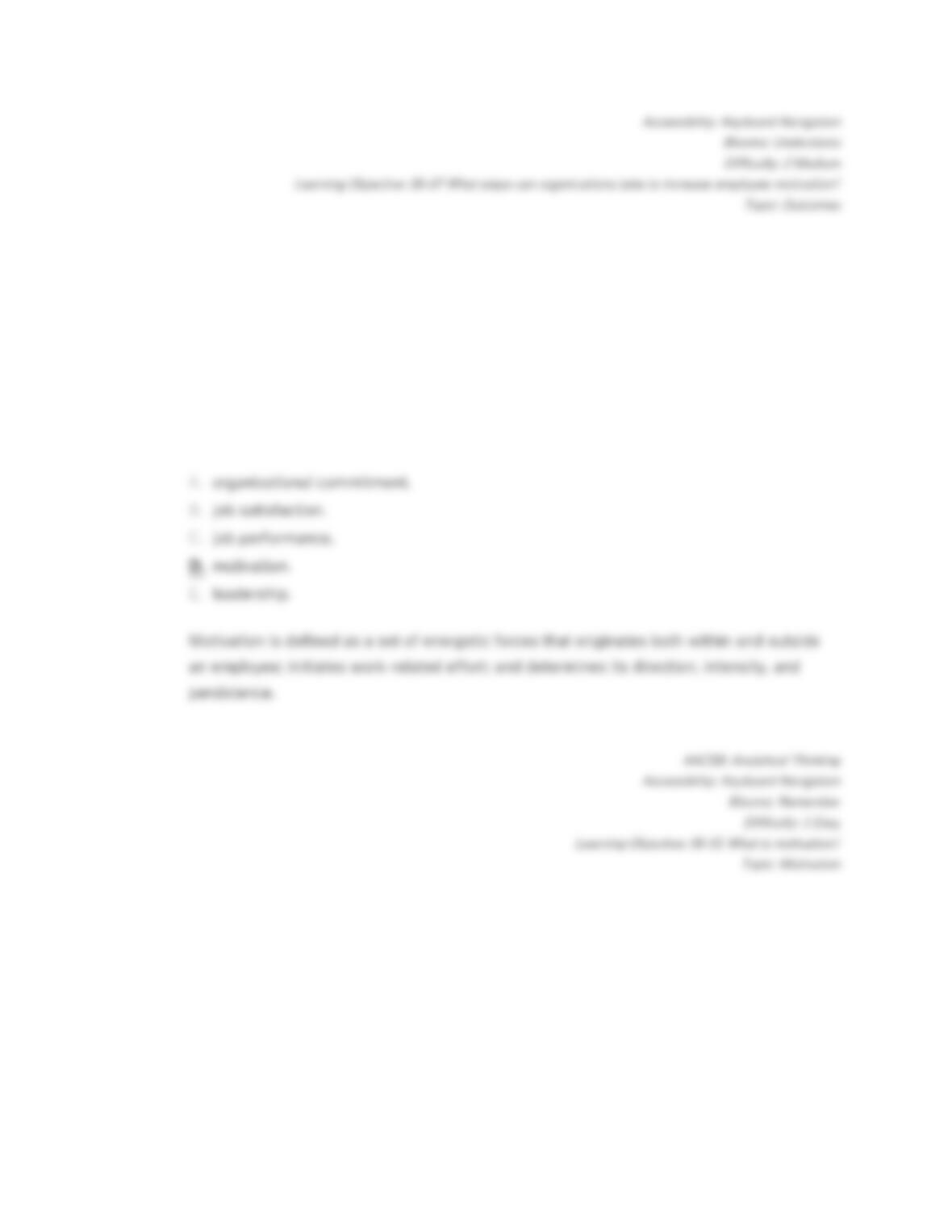
38.
The set of energetic forces that originates both within and outside an employee; initiates
work-related effort; and determines its direction, intensity, and persistence is known as:
6-18
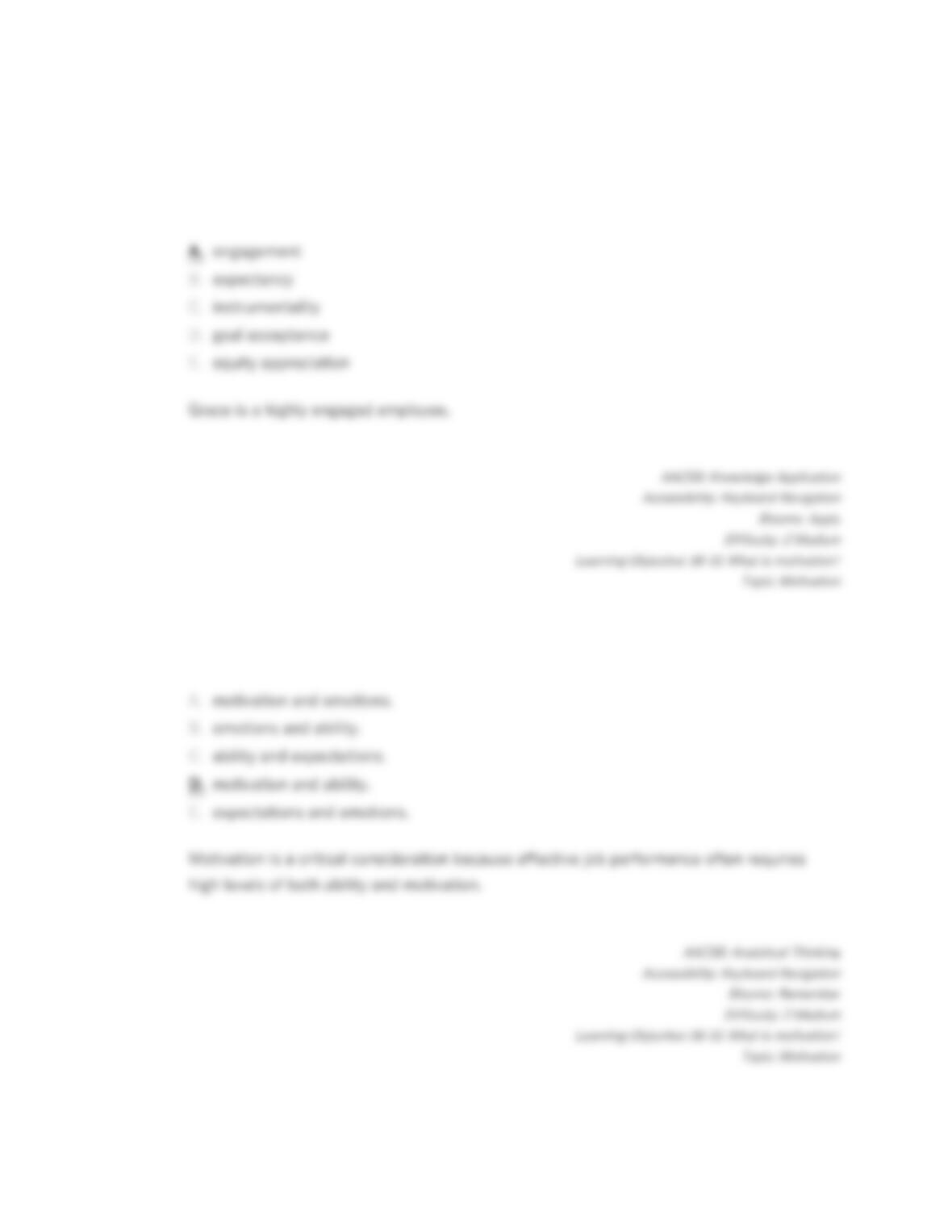
39.
Grace invests a great deal of energy in her job. She focuses closely, finds her tasks so
interesting that she loses track of time, and takes a lot of initiative. Grace demonstrates a
high level of ______.
40.
Effective job performance is most often a function of:
6-19
41.
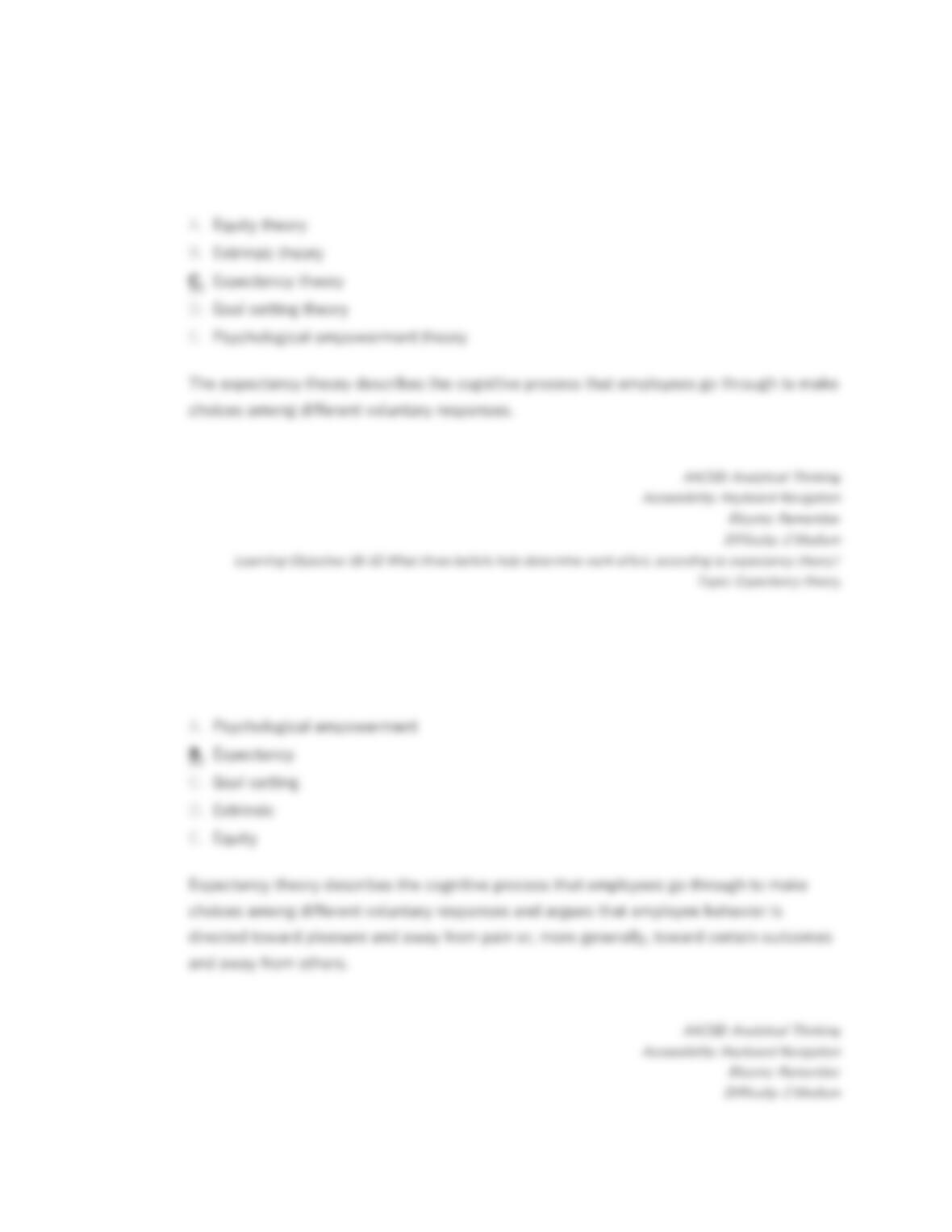
Which theory focuses most specifically on describing the cognitive process that employees
go through to make choices among different voluntary responses?
42.
_____ theory argues that employee behavior is directed toward pleasure and away from
pain or, more generally, toward certain outcomes and away from others.
6-20
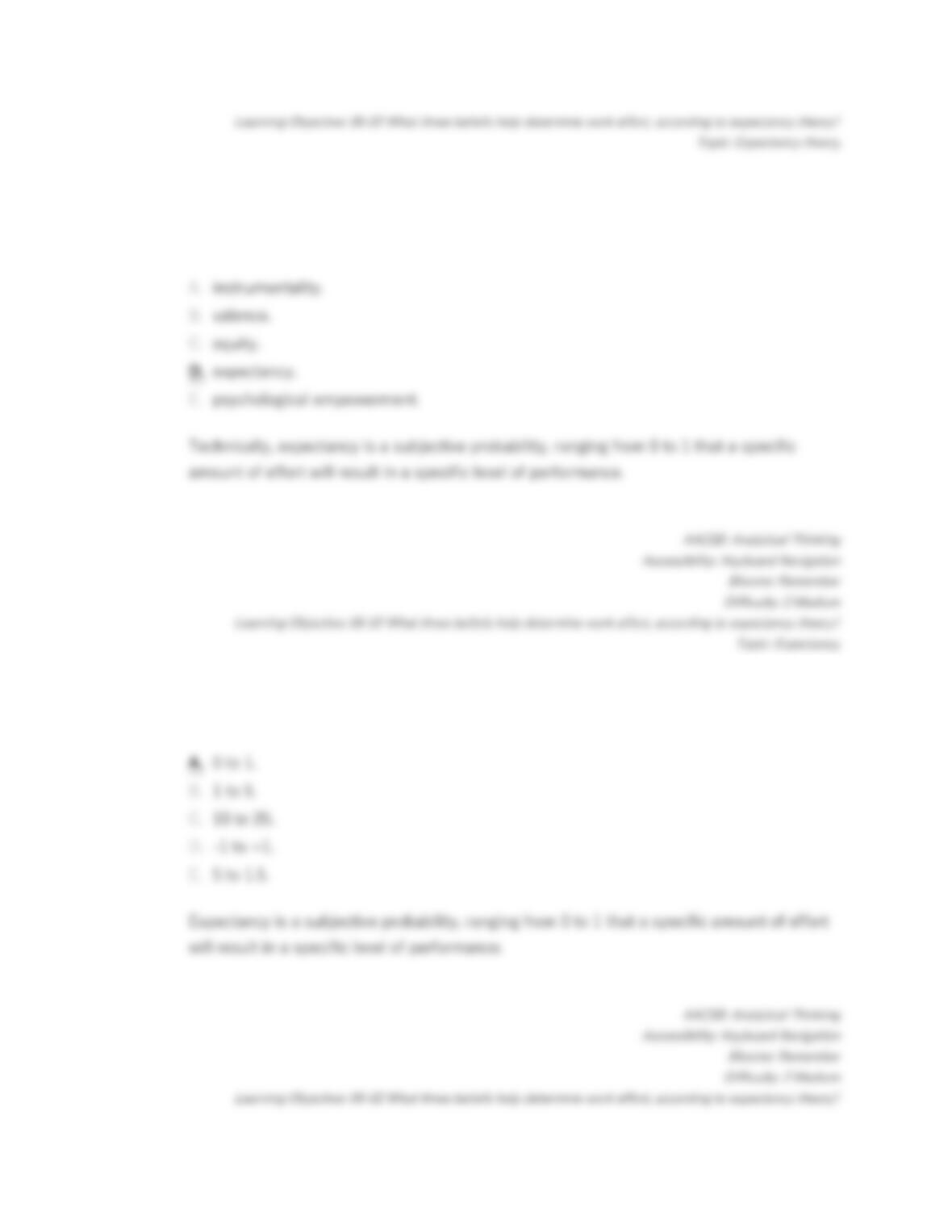
43.
The belief that exerting a high level of effort will result in the successful performance of
some task is known as:
44.
Expectancy is a subjective probability ranging from: