1
Chemistry, 6e (McMurry/Fay)
Chapter 6 Ionic Bonds and Some Main-Group Chemistry
6.1 Multiple-Choice Questions
1) Which contains ionic bonds?
A) CCl4
B) CaCl2
C) Cl2
D) HCl
2) Which contains covalent bonds?
A) NaH and HCl
B) only HCl
C) only NaCl
D) only NaH
3) Which contains both covalent bonds and ionic bonds?
A) HCl
B) NaCl
C) NH3
D) NH4Cl
4) What is the ground-state electron configuration of the ion Hg2+?
A) [Xe]4f145d10
B) [Xe]4f145d86s2
C) [Xe]4f145d106s2
D) [Xe]4f145d106s26p2
5) What is the ground-state electron configuration of the ion Cu2+?
A) [Ar] 3d9
B) [Ar] 4s1 3d8
C) [Ar] 4s2 3d7
D) [Ar] 4s2 3d10 4p1
6) How many electrons are in the outermost shell of the In3+ ion in its ground state?
A) 2
B) 3
C) 6
D) 18
7) Which of the following three sets consist of atoms or ions with the same electron configuration in the
ground state?
(I) O2-, Ne, and Mg2+
(II) Ni, Cu+, and Zn2+
(III) Hg, Tl+, and Pb2+
A) all three sets
B) all but (I)
C) all but (II)
D) only (I)
8) Which two ions have the same electron configuration in the ground state?
A) Rb+ and Cs+
B) Ba2+ and I–
C) Se2+ and I–
D) Fe2+ and Fe3+
9) What is the ground-state electron configuration of Se2-?
A) [Ar]3d104s24p2
B) [Ar]3d104s24p4
C) [Ar]3d124s24p4
D) [Ar]3d104s24p6
10) Which ion does not have a noble gas configuration in its ground state?
A) Sc3+
B) Al3+
C) Ga3+
D) As3-
11) Which ion has the same electron configuration as Kr?
A) Rb+
B) Br–
C) Se2–
D) All of these
12) Most of the compounds of the 2+ ions of the first row of the transition metals from Mn to Zn are
colored due to absorption of visible light promoting an electron from one 3d orbital to another. Which of
these ions should tend to form colorless compounds?
A) Mn2+
B) Co2+
C) Cu2+
D) Zn2+
13) Which ion has the smallest ionic radius?
A) Li+
B) Na+
C) K+
D) Rb+
14) Which ion has the smallest ionic radius?
A) F–
B) Cl–
C) Br–
D) I–
15) Indicate which is larger in each of the following two sets.
(I) Cr3+ or Cr (II) Se2- or Se
A) Cr3+ is larger than Cr and Se2- is larger than Se.
B) Cr3+ is larger than Cr and Se is larger than Se2-.
C) Cr is larger than Cr3+ and Se2- is larger than Se.
D) Cr is larger than Cr3+ and Se is larger than Se2-.
16) Arrange the ions N3-, O2-, Mg2+, Na+, and F– in order of increasing ionic radius, starting with the
smallest first.
A) Mg2+, Na+, F–, O2-, N3-
B) N3-, Mg2+, O2-, Na+, F–
C) N3-, O2-, Mg2+, F–, Na+
D) N3-, O2-, F–, Na+, Mg2+
17) Which of the following most likely represent the atomic radius of a Cr atom, the ionic radius of a
Cr2+ ion, and the ionic radius of a Cr3+ ion?
A) 128 pm for Cr, 167 pm for Cr2+, and 193 pm for Cr3+
B) 128 pm for Cr, 147 pm for Cr2+, and 193 pm for Cr3+
C) 128 pm for Cr, 109 pm for Cr2+, and 63 pm for Cr3+
D) 128 pm for Cr, 89 pm for Cr2+, and 63 pm for Cr3+
18) Consider Li+, F–, and O2-. Which ratio should be the largest?
A) (radius Li+)/(radius F–)
B) (radius Li+)/(radius O2-)
C) (radius F–)/(radius Li+)
D) (radius O2-)/(radius Li+)
19) Of the following, which element has the highest first ionization energy?
A) beryllium
B) boron
C) hydrogen
D) lithium
20) Of the following, which element has the highest first ionization energy?
A) aluminum
B) magnesium
C) silicon
D) sodium
21) Of the following, which element has the highest first ionization energy?
A) Al
B) Cl
C) Na
D) P
22) Of the following, which element has the highest first ionization energy?
A) Ca
B) K
C) Li
D) Mg
23) Of the following, which element has the highest first ionization energy?
A) Ca
B) Cl
C) Na
D) Se
24) Of the following, which element has the highest first ionization energy?
A) Cl
B) F
C) O
D) S
25) List the elements Na, Ca, Rb, Cl, He in order of decreasing first ionization energy.
A) He > Cl > Ca > Na > Rb
B) He > Na > Ca > Cl > Rb
C) He > Na > Cl > Ca > Rb
D) Rb > Ca > Cl > Na > He
26) List the elements Cs, Ca, Ne, Na, Ar in order of decreasing first ionization energy.
A) Ar > Ca > Cs > Na > Ne
B) Ne > Ar > Ca > Na > Cs
C) Ne > Ar > Na > Cs > Ca
D) Ne > Na > Cs > Ca > Ar
27) Which ionization process requires the most energy?
A) P(g) → P+(g) + e–
B) P+(g) → P2+(g) + e–
C) P2+(g) → P3+(g) + e–
D) P3+(g) → P4+(g) + e–
28) Which ionization process requires the most energy?
A) S(g) → S+(g) + e–
B) S+(g) → S2+(g) + e–
C) Cl(g) → Cl+(g) + e–
D) Cl+(g) → Cl2+(g) + e–
29) Which of the following species will have the highest ionization energy?
A) Na+
B) Ne
C) F–
D) O2-
30) Which of the following atoms with the specified electronic configurations would have the lowest
first ionization energy?
A) [He]2s22p3
B) [Ne]3s23p4
C) [Xe]6s1
D) [Xe]6s24f145d106p1
31) Which of the following represents the change in electronic configuration that is associated with the
first ionization energy of magnesium?
A) [Ne]3s13p1 → [Ne]3s1 + e–
B) [Ne]3s2 → [Ne]3s13p1
C) [Ne]3s2 → [Ne]3s1 + e–
D) [Ne]3s2 + e– → [Ne]3s23p1
32) Consider the following electron configurations for neutral atoms:
atom I = 1s22s22p63s2
atom II = 1s22s22p63s23p4
atom III = 1s22s22p63s23p6
Which atom would be expected to have the largest third ionization energy?
A) atom I
B) atom II
C) atom III
D) All of these atoms would be expected to have the same third ionization energy.
33) Which period 3 element has successive first through seventh ionization energies (kJ/mol) of
Ei1 = 578; Ei2 = 1,817; Ei3 = 2,745; Ei4 = 11,575; Ei5 = 14,830; Ei6 = 18,376; and Ei7 = 23,293?
A) Mg
B) Al
C) S
D) Cl
34) Which period 2 element has successive first through seventh ionization energies (kJ/mol) of
Ei1 = 1,402; Ei2 =2,856; Ei3 =4,578; Ei4 =7,475; Ei5 =9,445; Ei6 =53,267; and Ei7 = 64,360?
A) B
B) C
C) N
D) O
35) Which liberates the most energy?
A) Li(g) + e– → Li–(g)
B) Na(g) + e– → Na–(g)
C) K(g) + e– → K–(g)
D) Rb(g) + e– → Rb–(g)
36) Which liberates the most energy?
A) Br(g) + e⁻ → Br⁻(g)
B) Cl(g) + e⁻ → Cl⁻(g)
C) F(g) + e⁻ → F⁻(g)
D) I(g) → I⁻(g)
8
37) Which electron affinity process would liberate the most energy?
A) [He] 2s2 + e– → [He] 2s2 2p1
B) [He] 2s2 2p2 + e– → [He] 2s2 2p3
C) [He] 2s2 2p3 + e– → [He] 2s2 2p4
D) [He] 2s2 2p6 + e– → [He] 2s2 2p6 3s1
38) Which element has the most favorable (most negative) electron affinity?
A) B
B) C
C) Li
D) N
39) Which element has the most favorable (most negative) electron affinity?
A) Na
B) Mg
C) O
D) Ne
40) Which element has the least favorable (least negative) electron affinity?
A) B
B) C
C) N
D) O
41) Which of these elements has the most favorable (most negative) electron affinity?
A) Ca
B) N
C) Ne
D) S
42) What is the general trend in ionization energy and electron affinity values?
A) Both decrease as one traverses a period from left to right and both decrease as one descends a group.
B) Both decrease as one traverses a period from left to right and both increase as one descends a group.
C) Both increase as one traverses a period from left to right and both decrease as one descends a group.
D) Both increase as one traverses a period from left to right and both increase as one descends a group.
43) How many valence shell electrons does an atom of aluminum have?
9
A) 1
B) 2
C) 3
D) 13
44) An element that has the valence electron configuration 3s23p3 belongs to which period and group?
A) period 3; group 3A
B) period 3; group 5A
C) period 4; group 3A
D) period 4; group 5A
45) To reach a noble gas electron configuration how many electrons would sulfur have to adopt?
A) 1
B) 2
C) 6
D) 8
46) Which species does not have an octet of electrons for its outer core?
A) C4-
B) P3-
C) O2-
D) Mg+
47) An element M reacts with chlorine to form MCl2, with oxygen to form MO, and with nitrogen to
form M3N2. The most likely candidate for the element is
A) Li
B) Mg
C) Al
D) Si
48) How many electrons does magnesium lose and nitrogen need to form Mg3N2?
A) magnesium loses 2 and nitrogen gains 2
B) magnesium loses 2 and nitrogen gains 3
C) magnesium loses 3 and nitrogen gains 2
D) magnesium loses 3 and nitrogen gains 3
49) The octet rule is most likely to fail occasionally for which of the following elements?
10
A) C
B) N
C) Na
D) S
50) In the reaction of sodium metal with chlorine gas which of the following processes releases energy?
A) Cl2(g) → 2 Cl(g)
B) Cl(g) + e– → Cl–(g)
C) Na(s) → Na(g)
D) Na(g) → Na+(g) + e–
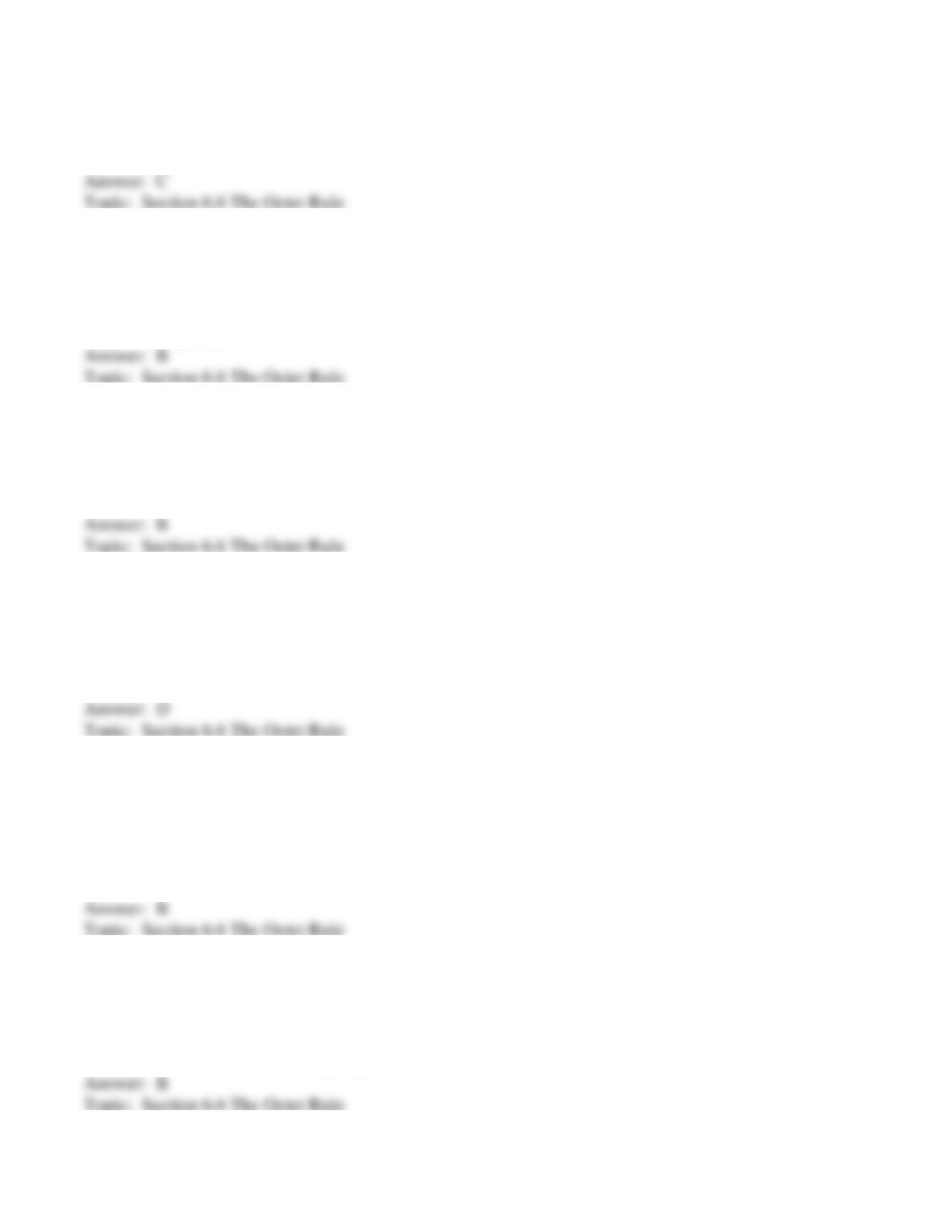
51) Calculate the energy change for the formation of LiCl(s) from its elements in their standard states
and the following tabulated information:
A) +1305.7 kJ/mol
B) +296.9 kJ/mol
C) -400.3 kJ/mol
D) -627.2 kJ/mol
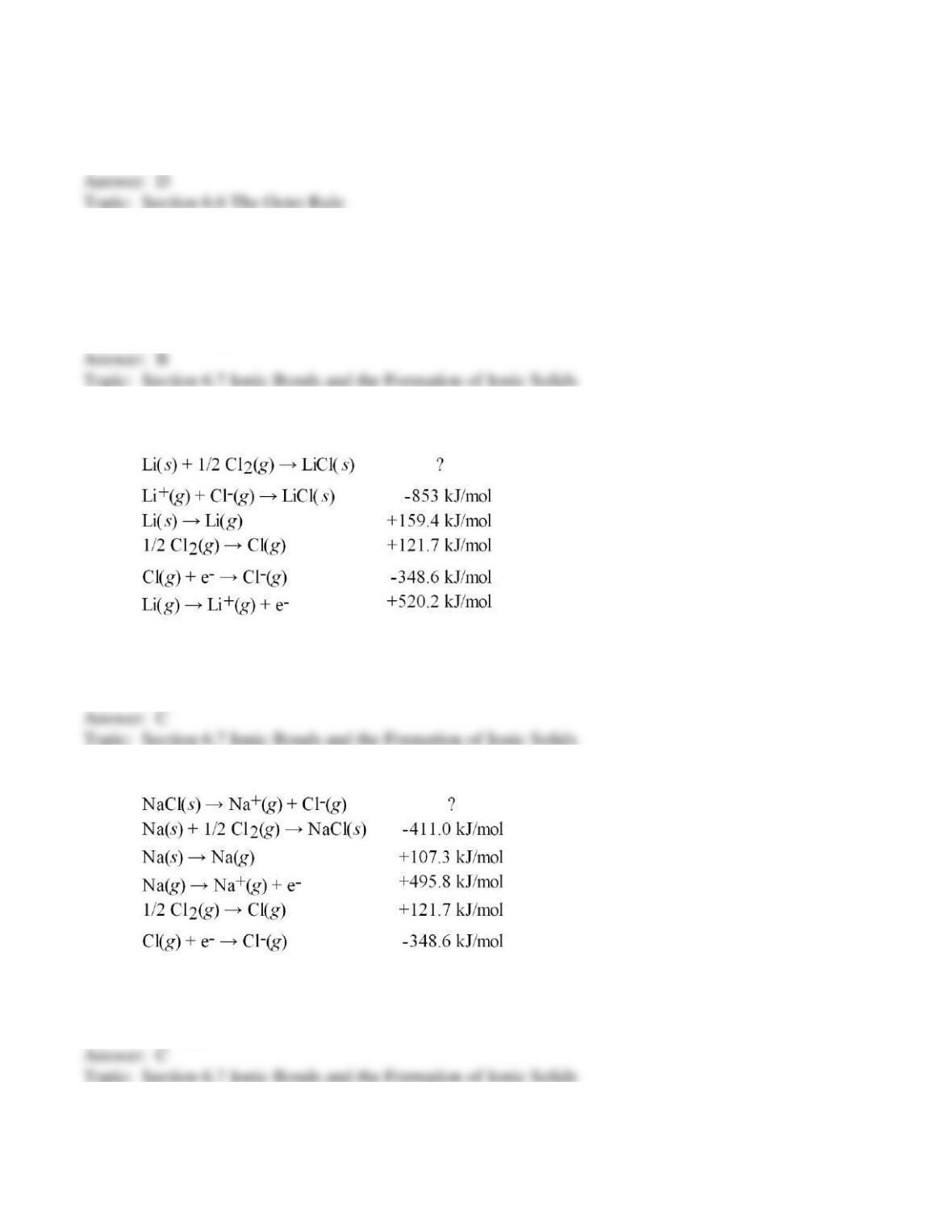
52) Calculate the lattice energy for NaCl(s) using a Born-Haber cycle and the following information:
A) +34.8 kJ/mol
B) +690.3 kJ/mol
C) +787.2 kJ/mol
D) +1512 kJ/mol
53) Calculate the lattice energy for MgCl2(s) using a Born-Haber cycle and the following information:
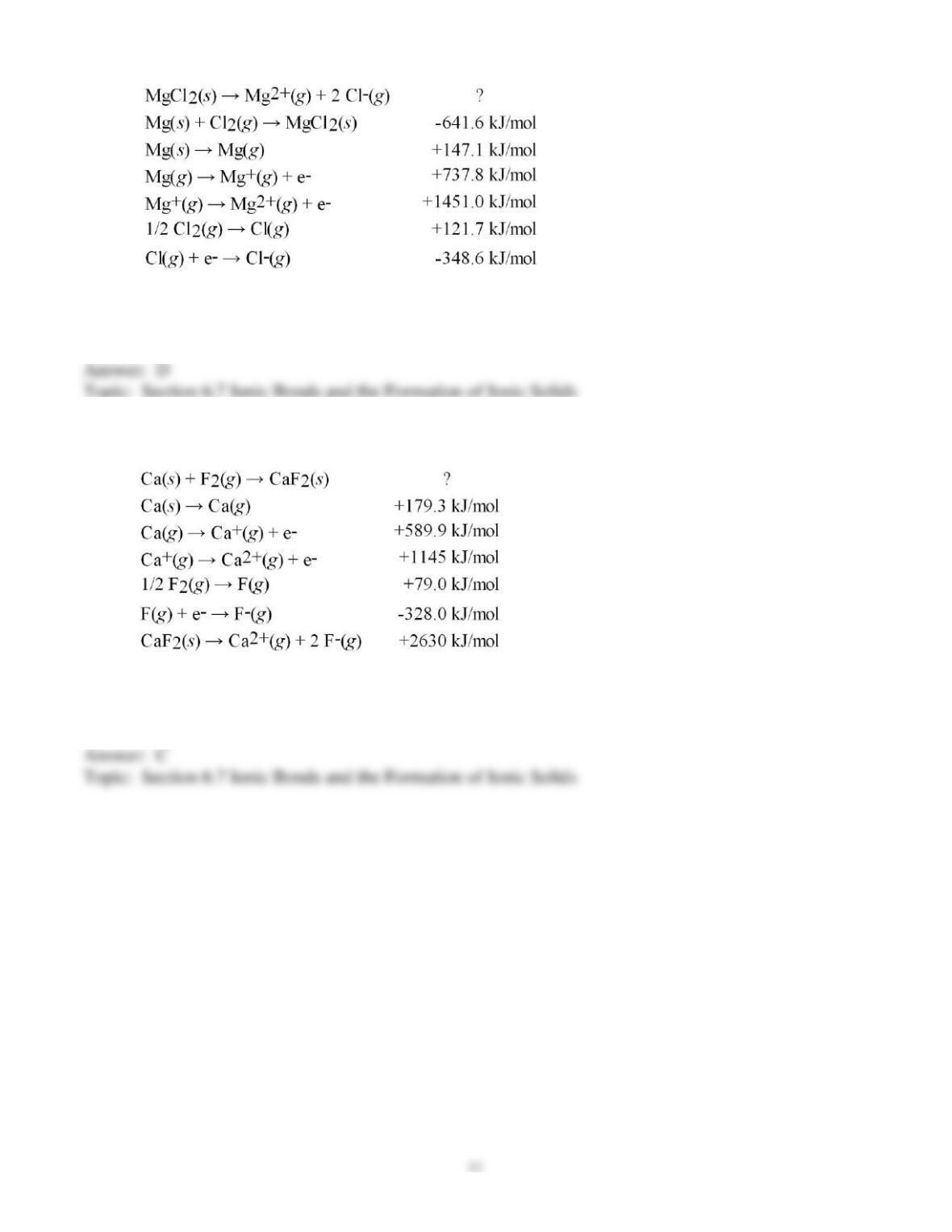
A) +641.6 kJ/mol
B) +1240.5 kJ/mol
C) +1882.1 kJ/mol
D) +2523.7 kJ/mol
54) Calculate the energy change for the formation of CaF2(s) from its elements in their standard states
and the following information:
A) +4046 kJ/mol
B) -965 kJ/mol
C) -1214 kJ/mol
D) -3286 kJ/mol
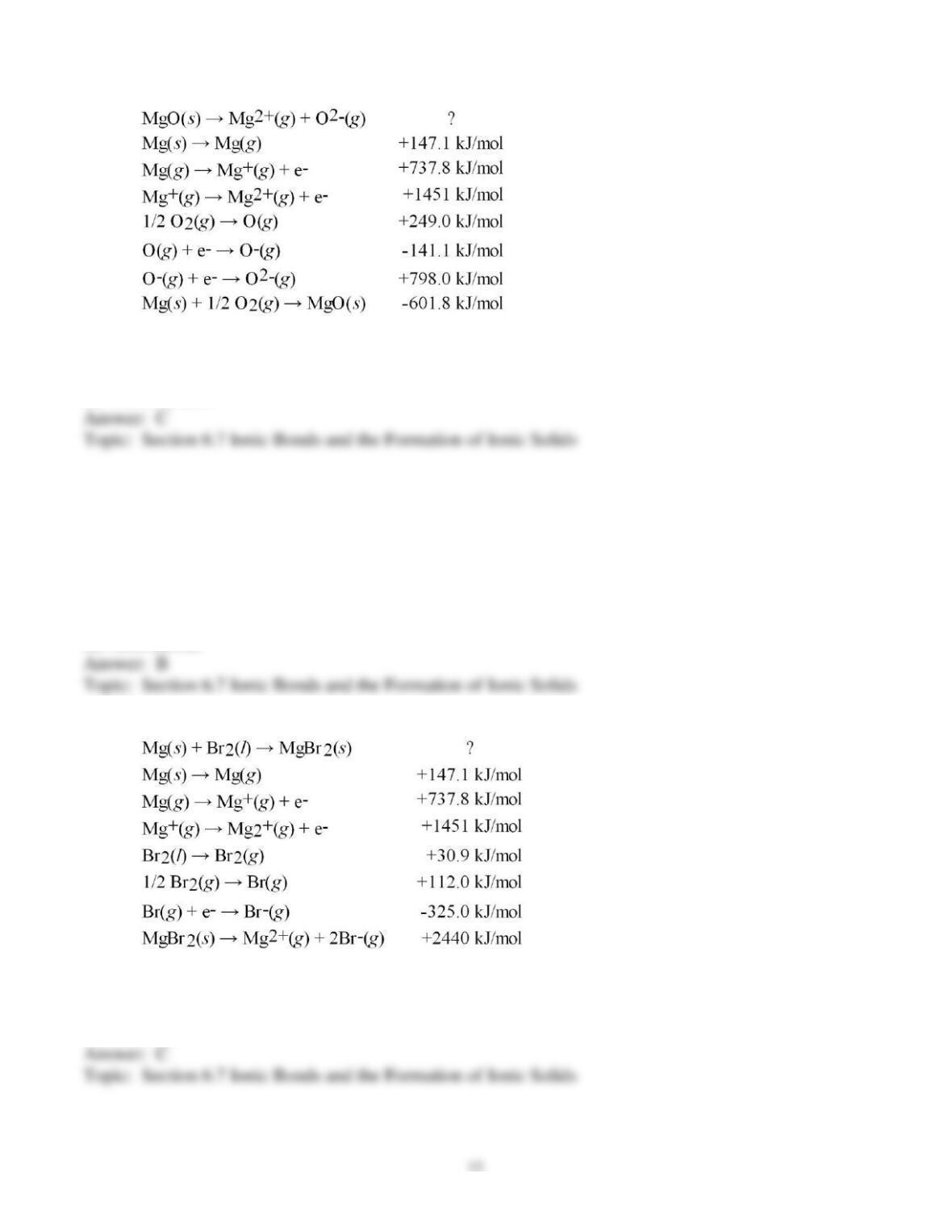
55) Calculate the lattice energy for MgO(s) using a Born-Haber cycle and the following information:
A) +1842 kJ/mol
B) +2444 kJ/mol
C) +3844 kJ/mol
D) +4108 kJ/mol
56) Calculate the energy change in kJ/mol for the reaction Li+(g) + F–(g) → Li(g) + F(g) using the
following information:
Li(g) → Li+(g) + e– +520 kJ/mol
F(g) + e– → F–(g) -328 kJ/mol
A) -848 kJ/mol
B) -192 kJ/mol
C) +192 kJ/mol
D) +848 kJ/mol
57) Calculate the energy change for the formation of MgBr2(s) from its elements in their standard states:
A) -150.8 kJ/mol
B) -286.0 kJ/mol
C) -499.2 kJ/mol
D) -5682 kJ/mol
13
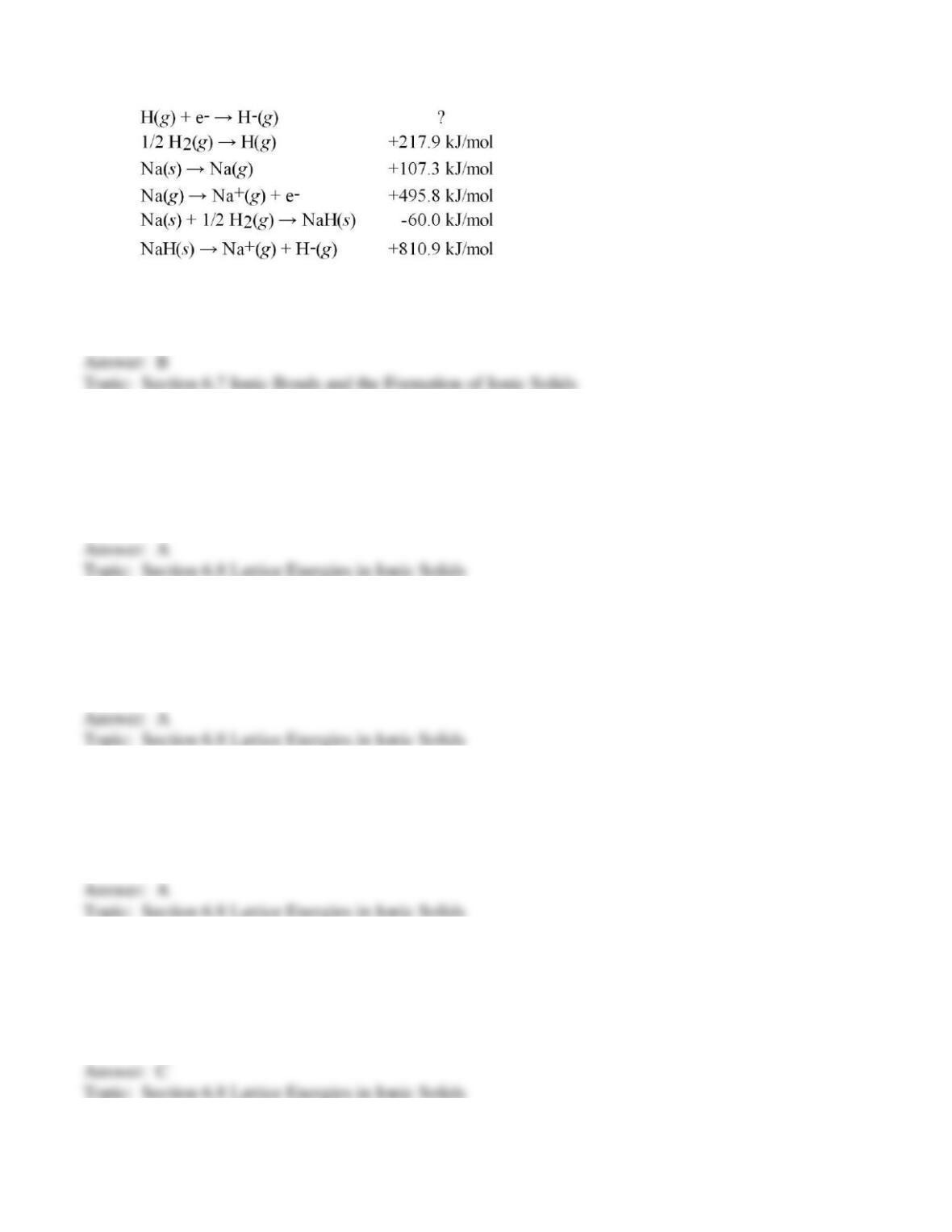
58) Calculate the electron affinity for the formation of the hydride ion from the following information:
A) -50.1 kJ/mol
B) -70.1 kJ/mol
C) -816 kJ/mol
D) -1632 kJ/mol
59) Which chemical process is associated with the lattice energy for sodium chloride?
A) NaCl(s) → Na+(g) + Cl–(g)
B) NaCl(g) → Na+(g) + Cl–(g)
C) Na(s) + 1/2 Cl2(g) → NaCl(s)
D) NaCl(s) + H2O(l) → Na+(aq) + Cl–(aq)
60) Which of the following ionic compounds would be expected to have the highest lattice energy?
A) NaF
B) NaCl
C) NaBr
D) NaI
61) Which of the following ionic compounds would be expected to have the highest lattice energy?
A) LiCl
B) NaCl
C) KCl
D) RbCl
62) Which ionic compound would be expected to have the highest lattice energy?
A) Na2O
B) MgO
C) Al2O3
D) CO2
63) Which ionic compound would be expected to have the highest lattice energy?
14
A) NaCl
B) MgO
C) AlF3
D) Al2O3
64) Which ionic compound would be expected to have the highest lattice energy?
A) Li2O
B) Na2O2
C) KO2
D) RbO2
65) Which alkali metal forms preferentially an oxide rather than a peroxide or superoxide?
A) Li
B) Na
C) K
D) Rb
66) Which alkali metal forms preferentially a peroxide and superoxide?
A) Li
B) Na
C) K
D) Mg
67) Which is not a chemical reaction of the alkali metal sodium?
A) 4 Na(s) + 2 O2(g) → 2 Na2O(s) + Na2O2(s)
B) 2 Na(s) + 2 NH3(l) → 2 NaNH2(sol) + H2(g)
C) 2 Na(s) + Cl2(g) → 2 NaCl(s)
D) 2 Na(s) + 2 H2O(l) → 2 NaOH(aq) + H2(g)
68) Which is not a chemical reaction of the alkali metal potassium?
A) K(s) + O2(g) → KO2(s)
B) 2 K(s) + 2 H2O(l) → 2 KOH(aq) + H2(g)
C) 2 K(s) + H2(g) → 2 KH(s)
D) 6 K(s) + N2(g) → 2 K3N(s)
69) Which alkali metal reacts with nitrogen to form a nitride?
15
A) Li
B) Na
C) K
D) All of these
70) The alkali metals Li and Na are commercially produced by
A) chemical reduction of their molten salts.
B) electrolysis of their molten salts.
C) thermal decomposition of their molten metal halides.
D) thermal decomposition of their molten metal oxides.
71) The alkali metals K, Rb, and Cs are commercially produced by
A) chemical reduction of their molten salts.
B) electrolysis of their molten salts.
C) thermal decomposition of their molten metal halides.
D) thermal decomposition of their molten metal oxides.
72) An incorrect statement about the alkaline earth metals is:
A) Melting points generally decrease as one descends the group.
B) Densities are less than those of the corresponding alkali elements of the same period.
C) Ionic radii of the M2+ ion increases as one descends the group.
D) The first ionization energy is less than that of the second ionization energy.
73) Which is not generally considered to be a chemical reaction of the alkaline earth metal calcium?
A) Ca(s) + Cl2(g) → CaCl2(s)
B) 2 Ca(s) + 2 H2O(l) → 2 Ca(OH)2(aq) + H2(g)
C) 6 Ca(s) + 2 N2(g) → 2 Ca3N2(s)
D) Ca(s) + O2(g) → CaO2(s)
74) Which is not generally considered to be a chemical reaction of the alkaline earth metal magnesium?
A) 2 Mg(g) + O2(g) → 2 MgO(s) at room temperature
B) 3 Mg(s) + N2(g) → Mg3N2(s) at elevated temperatures
C) Mg(s) + 2 H2O(l) → Mg(OH)2(s) + H2(g) at room temperature
D) Mg(s) + F2(g) → MgF2(s) at room temperature
75) Which alkaline earth metal reacts the most vigorously with water at room temperature?
16
A) Be
B) Ca
C) Ba
D) Sr
76) Group 2A metals tend to be somewhat less reactive than alkali metals, and the order of their
reactivity is
A) Ba > Sr > Ca > Mg > Be.
B) Be > Mg > Ca > Sr > Ba.
C) Ca > Mg > Be > Ba > Sr.
D) Sr > Ca > Mg > Be > Ba.
77) Calcium, strontium, and barium are all prepared commercially by the same method which is
A) electrolysis of the molten metal oxides.
B) electrolysis of the molten metal halides.
C) chemical reduction of the metal oxides with aluminium.
D) chemical reduction of the metal halides with oxygen.
78) Predict the product(s) when the reactants Be(s) + Br2(l) are mixed.
A) BeBr(s)
B) BeBr2(s)
C) Be2Br(s)
D) BeBr3(s)
79) Which of the following elements is a liquid at room temperature?
A) fluorine
B) chlorine
C) bromine
D) iodine
80) Which of the following elements is a solid at room temperature?
A) fluorine
B) chlorine
C) bromine
D) iodine
81) Which group of elements are found as diatomic molecules?
A) alkali metals
B) alkaline earth metals
C) halogens
D) noble gases
82) Both chlorine and bromine can be produced in the laboratory by reacting the halides with
manganese(IV) oxide. If the following equation is balanced in an acidic solution, then the MnO2 is
acting as a(n) ________ and the coefficient in front of H+ is ________.
____ MnO2(s) + ____ Cl–(aq) + ____ H+(aq) → ____ Mn2+(aq) + ____ Cl2(g) + ____ H2O(l)
A) oxidizing agent, 2
B) oxidizing agent, 3
C) oxidizing agent, 4
D) reducing agent, 3
83) Metals tend to react with the halogens to form metal halides. What is the reactivity order for the
halogens?
A) F2 > Cl2 > Br2 > I2
B) Cl2 > F2 > Br2 > I2
C) Br2 > I2 > Cl2 > F2
D) I2 > Br2 > Cl2 > F2
84) Which of the hydrogen halide acids is used to etch glass?
A) HF
B) HCl
C) HBr
D) HI
85) Which of the following reactions is inconsistent with the chemistry of the halogens?
A) H2(g) + Cl2(g) → 2 HCl(g)
B) Fe(s) + F2(g) → FeF2(s)
C) Br2(l) + 2 Cl–(aq) → 2 Br–(aq) + Cl2(g)
D) I2(s) + 3 Cl2(g) → 2 ICl3(s)
86) Interhalogen compounds can be produced by reacting two different halogens together. Which one of
the following compounds does not exist?
A) ClF
B) ClBr
C) ClBr3
D) IF3
87) Predict the product(s) of the reaction of Br2(aq) with I–(aq).
A) No reaction
B) IBr3–(aq)
C) BrO3–(aq) and I2(aq)
D) Br–(aq) and I2(aq)
88) Which of the following statements about helium is inconsistent with its chemistry?
A) A helium oxygen mixture is used as a deep-sea diving gas instead of compressed air.
B) In its liquid form it is used as a cryogenic coolant for superconductors.
C) It is one of the more reactive elements of its group.
D) Its melting point is -272.2°C and its boiling point is -268.9°C.
89) Which statement is inconsistent with the chemistry of the noble gases?
A) Both helium and radon are radioactive.
B) Helium and neon are both lighter than air.
C) Neon and argon are used in decorative or designer lights.
D) Xenon and krypton react with fluorine to form fluorides.