Exam
Name___________________________________
MULTIPLE CHOICE. Choose the one alternative that best completes the statement or answers the question.
1)
A 5 percent tax is going to be applied to a $100,000 tax base. What can be said about the revenue
collected assuming dynamic tax analysis?
1)
A)
The total revenue will be zero.
B)
The total revenue will be between $0 and $5,000.
C)
The total revenue will be $5,000.
D)
There is not enough information to determine what revenues will equal.
2)
Social Security contributions are
2)
A)
mandatory taxes partially paid out of workers’ wages and salaries.
B)
entirely paid by your employer.
C)
collected only from people earning more than $120,000 a year.
D)
a voluntary dollar amount that people contribute towards Social Security.
A
3)
A friend tells you he is studying the incidence of the corporate income tax. What is the subject of his
study?
3)
A)
how inflation affects the amount of tax revenue collected from firms
B)
how corporations can aid the government in collecting delinquent taxes
C)
how the burden of corporate taxation is distributed among stockholders, employees, and
consumers
D)
how frequently corporations should be taxed
C
B
4)
Suppose the income tax rate is 0 percent on the first $10,000; 10 percent on the next $20,000; 20
percent on the next $20,000; 30 percent on the next $20,000; and 40 percent on all income above
$70,000. Family A has income of $100,000 while Family B has income of $40,000. The marginal tax
rates faced by the two families are
4)
A)
30 percent on A and 20 percent on B.
B)
40 percent on A and 10 percent on B.
C)
30 percent on A and 30 percent on B.
D)
40 percent on A and 20 percent on B.
5)
When income is $15,000, the amount of income taxes owed is $2,000; when income increases to
$20,000, the amount owed increases to $3,000. The average income tax rate when a person earns
$15,000 is
5)
A)
15 percent.
B)
20 percent.
C)
13.3 percent.
D)
75 percent.
6)
The marginal tax rate is
6)
A)
the total taxes paid as a percentage of total income.
B)
the increase in taxes as a percentage of the increase in income.
C)
the sum of all individual tax rates.
D)
the average tax rate paid by both individuals and corporations.
7)
In order for the government to collect taxes, the government must first establish a(n)
7)
A)
justice system.
B)
philosophy of taxation.
C)
tax base.
D)
ad valorem taxation.
8)
The value of goods, services, incomes or wealth subject to taxation is
8)
A)
a unit tax.
B)
a sales tax.
C)
the tax base.
D)
the collected tax revenue.
9)
State sales taxes are operated as a system of
9)
A)
revenue minimizing taxation.
B)
unit taxation.
C)
income taxation.
D)
ad valorem taxation.
10)
For all employee earnings subject to Social Security taxes, what is the current Social Security tax
rate for employers?
10)
A)
4.2%
B)
0.8%
C)
2.9%
D)
6.2%
11)
The Social Security program is financed directly from
11)
A)
payroll taxes.
B)
voluntary contributions by the elderly.
C)
poll taxes.
D)
sales taxes on goods with inelastic demand.
12)
Reduction or elimination of dividend taxes is designed, in part, to
12)
A)
increase corporate tax levels.
B)
reduce inefficiencies in the production process.
C)
reduce the double taxation burden on individuals.
D)
make rich people richer.
13)
Governments have to rely on taxes for financing because
13)
A)
they cannot borrow unlimited amounts.
B)
gold prices have fallen steadily over the years.
C)
they are not allowed to sell bonds.
D)
they usually spend all of the gold reserves.
14)
A unit tax of $1 has been levied on a good. The equilibrium price of the good will most likely
14)
A)
increase by $1.
B)
decrease by $1.
C)
increase by an amount less than $1.
D)
remain unchanged.
15)
How does the imposition of an excise tax on a good affect its market equilibrium?
15)
A)
Equilibrium quantity decreases, and equilibrium price decreases.
B)
Equilibrium quantity increases, and equilibrium price decreases.
C)
Equilibrium quantity decreases, and equilibrium price increases.
D)
Equilibrium quantity increases, and equilibrium price increases
C
16)
In a proportional income tax system
16)
A)
marginal tax rates decline as the level of taxable income declines.
B)
marginal tax rates are the same regardless of the level of taxable income.
C)
everyone pays the same dollar amount in taxes.
D)
marginal tax rates increase as the level of taxable income increases.
B
17)
A typical capital gain is experienced by
17)
A)
all shareholders in the United States.
B)
only rich people.
C)
selling stock or a mutual fund.
D)
only investment bankers.
C
18)
The Social Security system was founded
18)
A)
during the last years of the nineteenth century, as people who had once depended on having
a family farm found themselves without a means of support.
B)
in response to concerns that arose during the high inflation of the 1970s.
C)
as the United States began to recover from the Great Depression.
D)
during the Civil War, to pay pensions for veterans.
C
C
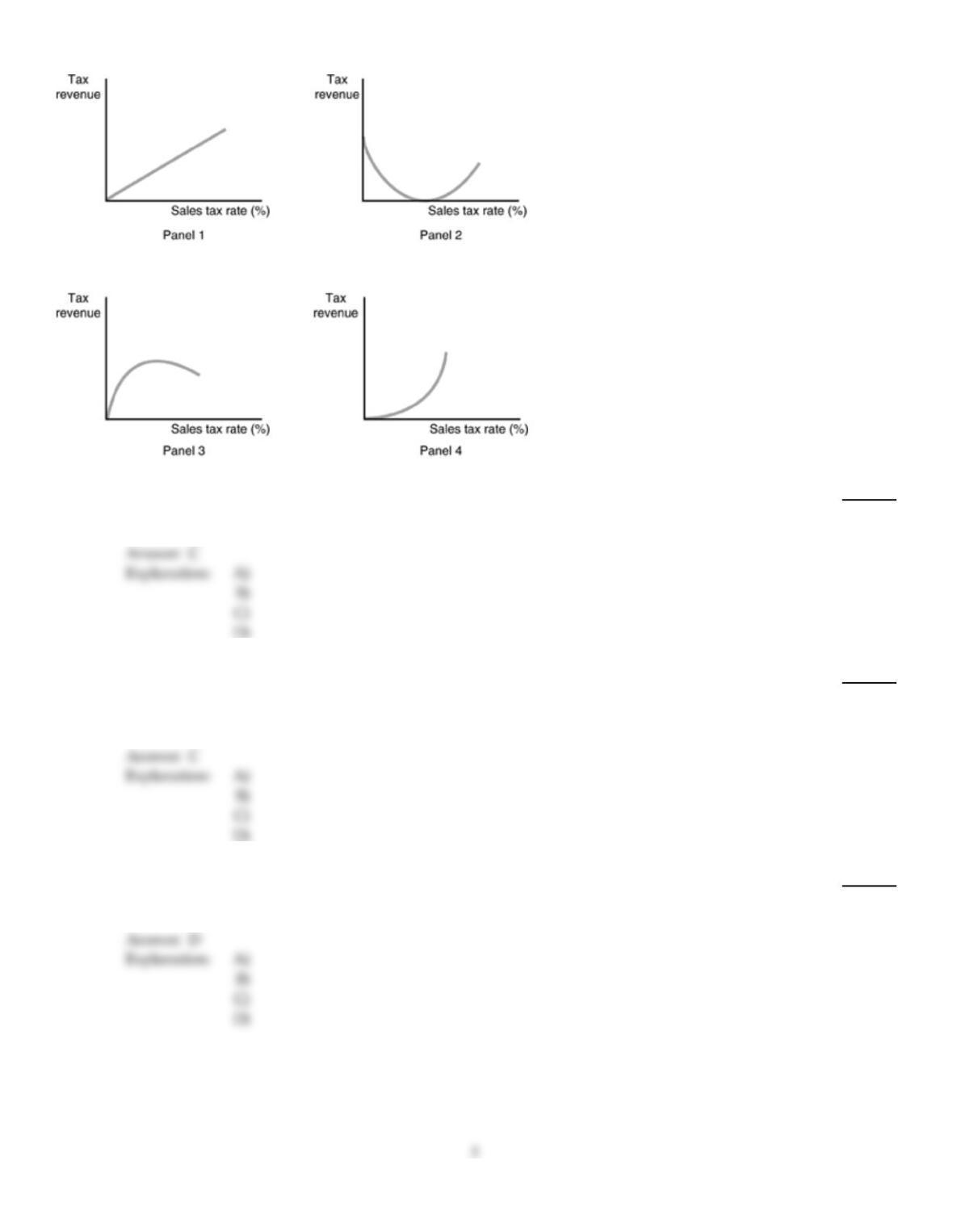
19)
Refer to the above figures. Which panel represents the expected relationship between tax revenue
and the sales tax rate if dynamic tax analysis is used?
19)
A)
Panel 1
B)
Panel 2
C)
Panel 3
D)
Panel 4
20)
A tax system in which the average and marginal tax rates are the same for every level of taxable
income and every change in income is an example of
20)
A)
progressive taxation.
B)
regressive taxation.
C)
proportional taxation.
D)
premium taxation.
21)
Social Security taxes are paid by
21)
A)
employers only.
B)
employees only.
C)
neither employers nor employees.
D)
both employers and employees.
22)
The earnings that a corporation saves for investment in other productive activities are
22)
A)
retained earnings.
B)
capital gains.
C)
transfers in kind.
D)
tax incidence.
23)
What happens when the government imposes a unit excise tax on a good?
23)
A)
That good’s supply curve shifts down by the amount of the tax.
B)
The newly taxed good’s supply curve shifts vertically upward by the amount of the per–unit
tax being levied.
C)
The amount of the tax is added to the current equilibrium price.
D)
The demand for the newly taxed good decreases.
B
24)
The marginal tax rate and the average tax rate are the same under a
24)
A)
progressive income tax system.
B)
proportional income tax system.
C)
regressive income tax system.
D)
none of the above.
B
25)
Using the fiscal year 2014 estimates, the largest component of federal revenue is the
25)
A)
individual income tax.
B)
excise tax.
C)
corporate income tax.
D)
social insurance and contributions.
A
A
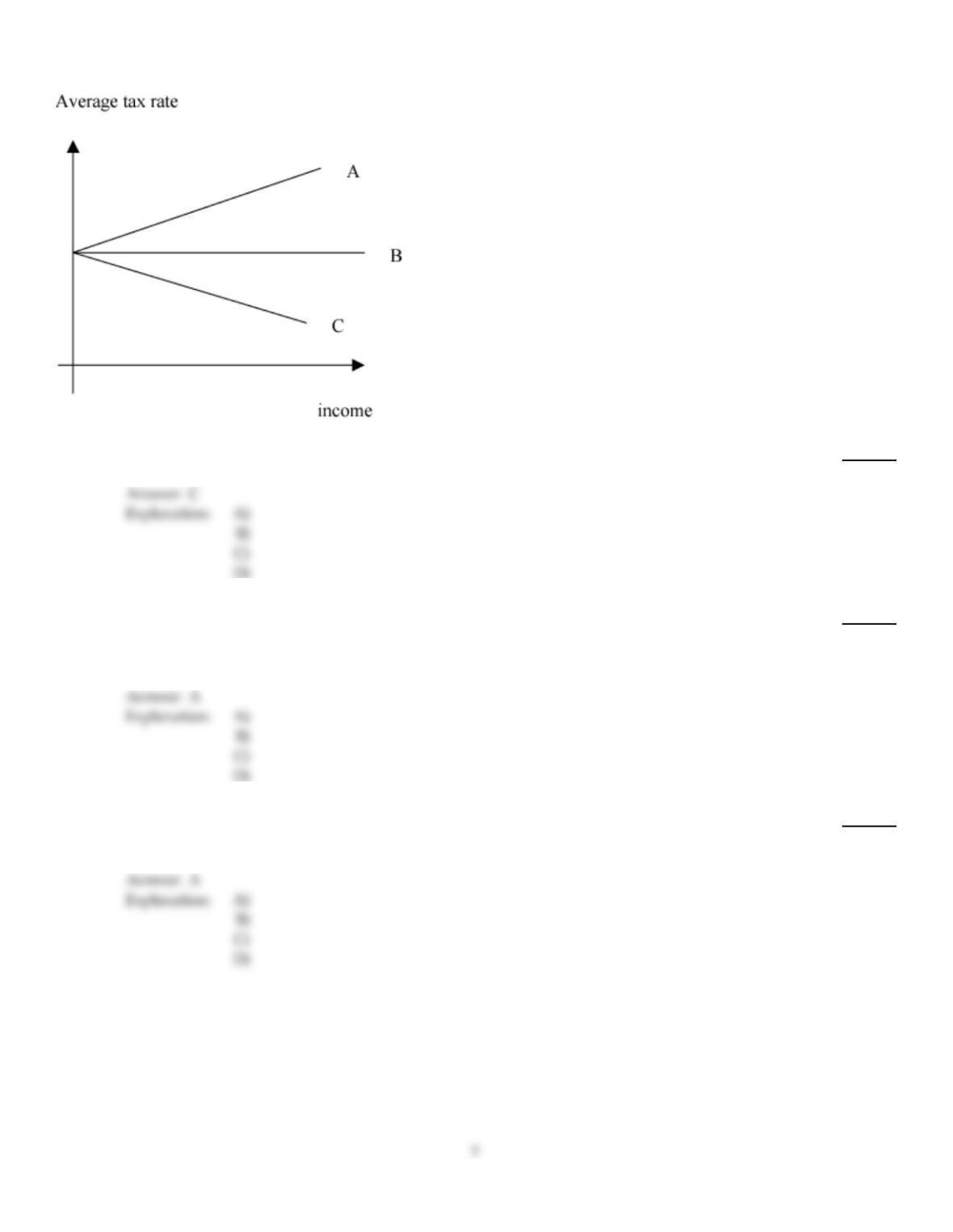
26)
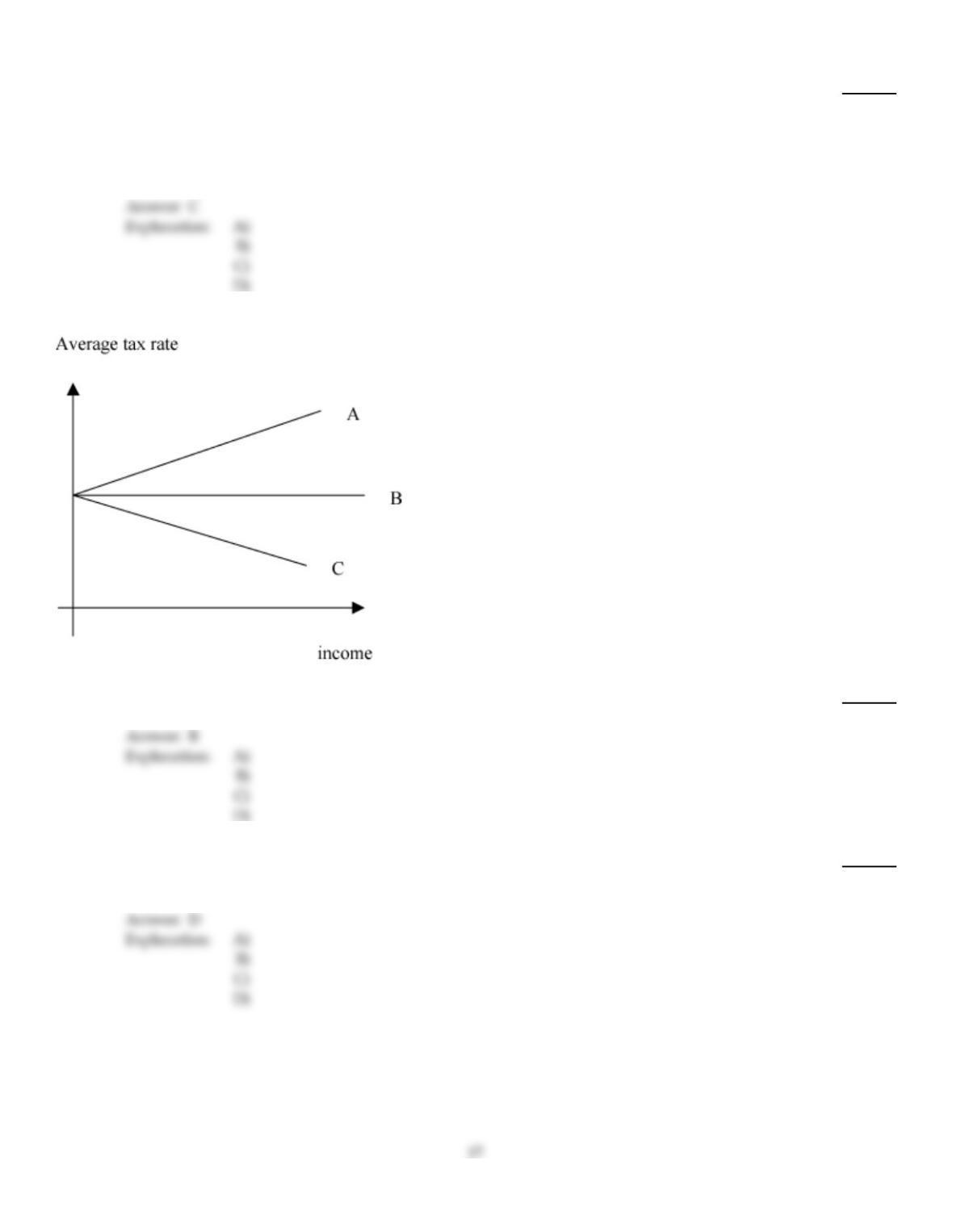
Using the above figure, which of the lines in the above diagram represents a regressive tax?
26)
A)
A
B)
B
C)
C
D)
none of them
27)
The sum of public spending on goods and services and transfer payments during a given period
cannot exceed tax revenues plus borrowed funds. This is the statement for
27)
A)
the government budget constraint.
B)
ad valorem taxation.
C)
a sales tax.
D)
an excise tax.
28)
For all employee earnings subject to Social Security taxes, what is the current Social Security tax
rate for employees?
28)
A)
6.2%
B)
4.2%
C)
0.8%
D)
2.9%
29)
Jamal earns $160,000 per year and Josephina earns $80,000 per year. They both pay the same price
to buy the identical automobile and each pays $1,600 in sales tax. In relation to their relative
incomes, this is an example of a
29)
A)
regressive tax.
B)
marginal tax.
C)
progressive tax.
D)
proportional tax.
30)
Dynamic tax analysis is based on the recognition that as tax rates are increased
30)
A)
tax revenue collections will change at the same rate as the tax rates.
B)
tax revenue collections will continually increase.
C)
tax revenue collections will eventually decline.
D)
tax revenue collections will increase at a faster rate than the tax rate change.
31)
Dynamic tax analysis assumes
31)
A)
changes in the tax rates have no effect on the tax base.
B)
changes in the tax rates will change the tax base.
C)
changes in the tax rates have no effect on tax revenue.
D)
all of the present tax rates will be in place for a minimum of twenty years.
32)
A local government currently has a tax base of $10 billion and a tax rate of 10 percent. If the tax rate
is increased to 12 percent, the tax base becomes $8.5 billion. If the goal is to maximize tax revenues
the tax rate should be
32)
A)
kept at 10 percent.
B)
abolished.
C)
raised above 12 percent.
D)
raised to 12 percent.
33)
The three possible sources of government funding include
33)
A)
foreign aid, revenues, and implicit fees.
B)
explicit fees, taxes, and borrowing.
C)
international income, personal income taxes, and export taxes.
D)
None of the above are correct.
34)
Suppose the capital gains tax is 28 percent and you purchased a house ten years ago for $80,000. If
you sold the house today you would get $140,000. Your tax liability would be
34)
A)
indeterminate without knowing the inflation rate.
B)
indeterminate without knowing the personal income tax rate.
C)
$16,800.
D)
$39,200.
35)
In what type of analysis will an increase in the tax rate always lead to an increase in tax revenues?
35)
A)
excise taxation
B)
static tax analysis
C)
dynamic tax analysis
D)
ad valorem taxation
36)
When a unit tax of $2 is levied on a product
36)
A)
both the consumer and producer pay $2 each.
B)
the consumer pays part of the $2 and the producer pays the rest.
C)
the entire $2 is paid by the producer.
D)
the entire $2 is paid by the consumer.
37)
Sales taxes are routinely collected by
37)
A)
the Internal Revenue Service.
B)
the merchants selling the good or services.
C)
the Department of Commerce.
D)
the Federal Trade Commission.
38)
The main source of government funding is
38)
A)
borrowing.
B)
transfer payments.
C)
user fees.
D)
taxes.
D
39)
An excise tax on gasoline causes
39)
A)
the market clearing price of gasoline to rise.
B)
supply of gasoline to shift to the left.
C)
a reduction in the quantity of gasoline demanded.
D)
All of the above are correct.
D
40)
How do taxation and user charges compare as government revenue sources?
40)
A)
Revenues from taxation are much greater than revenues from user charges.
B)
Each generates about the same amount of government revenue.
C)
User charges generate much more revenue than do taxes.
D)
We don’t know because the government does not publish revenue figures broken down.
A
41)
Over the long run, the fundamental funding sources for the government include
41)
A)
transfers between government agencies.
B)
borrowing.
C)
taxes.
D)
lending.
C
B
42)
When income is $15,000, the amount of income income taxes owed is $2,000; when income
increases to $20,000, the amount owed increases to $3,000. The marginal tax rate in this case is
42)
A)
13.3 percent.
B)
20 percent.
C)
15 percent.
D)
25 percent.
43)
Suppose that in the economy of Springfield, USA, Homer, who has an income of $50,000, pays
$10,000 in taxes. Edna, who has an income of $35,000, pays $9,000 in taxes. Based on this
information, we could say that Springfield’s tax system is
43)
A)
flat.
B)
proportional.
C)
progressive.
D)
regressive.
44)
The Social Security tax is considered to be a
44)
A)
progressive tax.
B)
proportional tax.
C)
marginal tax.
D)
regressive tax.
45)
Suppose the tax amount on the first $10,000 income is $0; $2000 on the next $20,000; $4000 on the
next $20,000; $6000 on the next $30,000; and 40 percent on any income over $80,000. Family A has
income of $30,000 and Family B has income of $80,000. What is the marginal and average tax rate
for each family?
45)
A)
Family A: marginal10 percent; average15 percent; Family B: marginal40 percent; average
20 percent.
B)
Family A: marginal10 percent; average6.7 percent; Family B: marginal30 percent;
average15 percent.
C)
Family A: marginal10 percent; average10 percent; Family B: marginal40 percent; average
40 percent.
D)
Family A: marginal10 percent; average20 percent; Family B: marginal30 percent; average
23 percent.
46)
When the profits of a corporation are taxed and the dividends paid to stockholders are also taxed
46)
A)
the government is engaging in capital gains taxation.
B)
the government is engaging in progressive taxation.
C)
the government is engaging in double taxation.
D)
the government is engaging in regressive taxation.
47)
The federal income tax code of the United States is
47)
A)
regressive.
B)
progressive.
C)
proportional.
D)
progressive for individuals but proportional for married couples.
B
48)
All of the following are possible funding sources for the government EXCEPT
48)
A)
user charges.
B)
taxes.
C)
borrowing.
D)
interest income collected from government bonds.
D
49)
Suppose the income tax rate schedule is 0 percent on the first $10,000; 10 percent on the next
$20,000; 20 percent on the next $20,000; 30 percent on the next $20,000; and 40 percent on any
income over $70,000. Family A earns $28,000 a year and Family B earns $65,000 a year. Both receive
a ten percent raise. What is the marginal tax rate of each and what is the extra tax paid by each after
the raise?
49)
A)
Family A: 10 percent marginal tax rate and $420 in extra taxes; Family B30 percent marginal
tax rate and $2275 in extra taxes.
B)
Family A: 20 percent marginal tax rate and $560 in extra taxes. Family B40 percent marginal
tax rate and $2600 in extra taxes.
C)
Family A: 20 percent marginal tax rate and $360 in extra taxes; Family B40 percent marginal
tax rate and $2100 in extra taxes.
D)
Family A: 10 percent marginal tax rate and $280 in extra taxes; Family B30 percent marginal
tax rate and $1950 in extra taxes.
C
C
50)
Which of the following is subject to double taxation?
50)
A)
Social Security income
B)
income earned by government employees
C)
income earned by people in the lowest tax bracket
D)
dividends and retained earnings
51)
Ad valorem taxation
51)
A)
is used to tax goods but not services.
B)
refers to the personal income tax.
C)
is a tax that is applied only to cigarettes and alcohol.
D)
is assessed by charging a tax rate as a fraction of the market price of a good.
D
52)
Should the government wish to lower the price of gasoline to the consumer, one approach might be
52)
A)
to raise the gasoline excise tax.
B)
to lower taxes on automobiles.
C)
to take action to shift the supply curve of gasoline to the left.
D)
to reduce the gasoline excise tax.
D
53)
If a new unit excise tax is levied on bottles of wine, the
53)
A)
demand for wine shifts to the left.
B)
supply of wine shifts to the right.
C)
supply of wine shifts to the left.
D)
demand for wine shifts to the right.
C
D
54)
Static tax analysis assumes
54)
A)
changes in the tax rates have no effect on tax revenue.
B)
all of the present tax rates will be in place for a minimum of twenty years.
C)
changes in the tax rates will change the tax base.
D)
changes in the tax rates have no effect on the tax base.
55)
The corporate income tax in the United States
55)
A)
excludes dividends paid out.
B)
does not apply to profits earned on exports.
C)
only taxes retained earnings.
D)
results in individuals’ being doubly taxed on corporate earnings.
D
56)
Suppose you are making $50,000 per year and paying $5,000 per year in income taxes. You get a
$10,000 per year raise and your income taxes are now $6,500 per year. Based on this information,
the income tax system is
56)
A)
bracketed.
B)
regressive.
C)
progressive.
D)
proportional.
C
57)
If you were to face a marginal tax rate of 15 percent, how much would your tax bill increase when
your income increased by $2,000?
57)
A)
$450
B)
$600
C)
$30
D)
$300
D
58)
How is the market for gasoline affected if the excise tax on gasoline is reduced?
58)
A)
The supply of gasoline decreases.
B)
The equilibrium quantity of gasoline decreases.
C)
The supply of gasoline increases.
D)
The equilibrium price of gasoline increases.
C
D
59)
Suppose you purchased 100 shares of stock in 2010 for $25 a share and you sell them today for $50
a share. If the capital gains tax is 28 percent, your tax liability is
59)
A)
$70.
B)
$700.
C)
$2500.
D)
indeterminate without knowing the inflation rate.
60)
If we wanted to analyze the effects of a $2 unit tax graphically, we would shift the
60)
A)
supply curve downward by $2.
B)
demand curve downward by $2.
C)
supply curve upward by $2.
D)
demand curve upward by $2.
61)
The marginal tax rate can be calculated by which of the following formulas?
61)
A)
total taxes due divided by total taxable income
B)
total taxable income divided by total taxes due
C)
the change in taxable income divided by the change in taxes due
D)
the change in taxes due divided by the change in taxable income
62)
Unit excise taxes imposed on gasoline, alcohol, and cigarettes are
62)
A)
largely paid by the producers because they want to maintain their level of sales.
B)
shared equally between the producer and the consumer.
C)
paid by the wholesalers of these products.
D)
largely paid by consumers because they are not very responsive to price changes.
63)
Ad valorem taxes
63)
A)
are assessed as a percentage of a good’s price.
B)
are applied only to imports.
C)
are based on income levels.
D)
are not used in the United States.
64)
A unit tax
64)
A)
is based on the value of the good being sold.
B)
does not influence equilibrium price and quantity.
C)
is the primary tax studied in dynamic tax analysis.
D)
is a constant tax assessed on each unit of a good sold.
65)
The tax base is
65)
A)
the value of all goods, services, incomes, or wealth subject to taxation.
B)
the maximum amount of tax revenue that government must collect each year.
C)
the sum of all incomes earned in the United States.
D)
the minimum amount of tax revenue that government must collect each year.
66)
Which of the following is an argument that the incidence of corporate taxation falls entirely on
consumers?
66)
A)
Most taxes on consumers are collected by corporations through sales taxes.
B)
Corporations pass their tax burdens on to consumers by charging higher prices equal to the
amount of the tax.
C)
Corporations always evade taxes so that consumers ultimately bear the tax burdens as
taxpayers.
D)
Corporations pass their tax burdens on to consumers because consumers ultimately work for
the corporations.
67)
A 5 percent tax is going to be applied to a $100,000 tax base. What can be said about the revenue
collected assuming static tax analysis?
67)
A)
The total revenue will be zero.
B)
The total revenue will be between $0 and $5,000.
C)
The total revenue will be $5,000.
D)
There is not enough information to determine what revenues will equal.
68)
Using the above figure, which of the lines in the above diagram represents a proportional tax?
68)
A)
A
B)
B
C)
C
D)
none of them
69)
Some economists argue that corporate income taxes are typically not paid by firms, but by
69)
A)
the board of directors of the firm.
B)
bond holders.
C)
the government.
D)
stockholders, employees, and consumers.
70)
The average tax rate can be calculated by which of the following formulas?
70)
A)
total taxes due divided by total taxable income
B)
total taxable income divided by total taxes due
C)
the change in taxes due divided by the change in taxable income
D)
the change in taxable income divided by the change in taxes due
71)
Of the following, which is the largest source of government funds in the long run?
71)
A)
user fees
B)
government transfers
C)
taxation
D)
government borrowing
Quantity Quantity Quantity Supplied
Price Demanded Supplied After Tax
$5 10 40 30
$4 15 35 25
$3 20 30 20
$2 25 25 15
$1 30 20 5
72)
Using the above table, a unit tax of $2 is imposed on the product. How much of the tax is paid by
the consumer?
72)
A)
$2
B)
$3
C)
$1
D)
unable to determine
73)
In a progressive tax system
73)
A)
the marginal tax rate increase as income increases but the average tax rate does not change as
income increases.
B)
the marginal tax rate and the average tax rate are the same for every income level and the
same as income increases.
C)
the marginal tax rate and the average tax rate decrease as income levels increase and the
marginal tax rate is less than the average tax rate.
D)
the marginal tax rate and the average tax rate increase as income levels increase and the
marginal tax rate exceeds the average tax rate.
74)
The fact that every dollar that the government spends or transfers must ultimately be provided by
the taxes and user charges it collects plus government borrowing is known as the
74)
A)
user charge constraint.
B)
government budget constraint.
C)
tax collection constraint
D)
government balance sheet constraint.
75)
If a unit excise tax is placed on a good for which the demand is very unresponsive to a price
change, then
75)
A)
the producers generally pay the majority of the tax.
B)
producers and consumers pay equal portions of the tax.
C)
the government generally pays the majority of the tax.
D)
the consumers generally pay the majority of the tax.
Quantity Quantity Quantity Supplied
Price Demanded Supplied After Tax
$5 10 40 30
$4 15 35 25
$3 20 30 20
$2 25 25 15
$1 30 20 5
76)
The demand and supply of a product is given in the above table. A unit tax of $2 is imposed on the
product. The equilibrium quantity for this product after the tax is imposed is equal to
76)
A)
15 units.
B)
20 units.
C)
30 units.
D)
25 units.
77)
Jamal earns $160,000 per year and Josephina earns $80,000 per year. If Jamal pays $16,000 in
income taxes and Josephina pays $5,000 in income taxes, the income tax system would be
77)
A)
regressive.
B)
proportional.
C)
marginal.
D)
progressive.
78)
What determines the proportion of a unit excise tax that will be passed on to consumers in the form
of higher prices?
78)
A)
the popularity of the tax
B)
the degree to which quantity demanded and supplied of the good respond to price changes
C)
the nature of the projects funded by the tax
D)
the number of additional taxes that consumers have to pay
79)
The average tax rate is defined as
79)
A)
change in taxes due/total taxable income.
B)
total tax due/total taxable income.
C)
total tax due/change in taxable income.
D)
change in taxes due/change in taxable income.