
ch6 Key
1. In most companies, all customers are equally profitable
2. The concept of activity–based costing is used to determine how serving particular customers causes activities
to be performed and costs to be incurred under customer profitability analysis.
3. Outsourcing is not useful in meeting customer needs because fixed costs remain constant.
4. Customer profitability analysis helps management see the overall financial picture for each customer and how
management can use this information to help establish a strategic plan for the coming periods.

5. Quantitative factors in customer profitability analysis include the status of being a supplier to a prestigious
company and the potential to meet new contacts.
6. When management is determining where to devote the company’s resources in serving customers, it needs to
remember that, typically, the lion’s share of profits comes from the majority of their customers.
7. The decision to keep certain customers holding on the phone may be the result of customer profitability
analysis.
8. It is generally best to tie employee incentives as closely as possible to organizational goals.

9. Typical measures of product delivery performance include the percentage of on-time deliveries, the
percentage of orders filled and the delivery cycle time.
10. Quality-related measures such as the number of customer complaints, the number of warranty claims, and
the number of product units returned, are important in assessing the company’s effectiveness in serving its
customers.
11. Customer-related costs include selling costs, marketing costs, ordering costs and distribution costs.
12. Generally, budget levels that seem to motivate best are moderately tight but are perceived by employees as
reasonable and attainable.

13. The allocation method used in determining customer profitability has no effect on customer profitability
analysis.
14. Customer profitability analysis is not useful in the service industry.
15. Return on Sales is operating income divided by total assets.
16. It is possible for a company to have profitable products and, at the same time, incur customer–related costs
that make certain customer relationships unprofitable.

17. When ABC analysis relies on a cost hierarchy of unit–level, batch-level, product-line level, and facility-level
costs, the cost management team is focusing on the customer–related costs.
18. In computing overall company profitability, the method of cost allocation to products is not important.
19. Customer profitability analysis is useful in identifying the effectiveness of a new raw material mix.
20. Many of a company’s costs are incurred before the actual production phase or committed early in a product‘s
life.

21. Unprofitable customers should be eliminated quickly by the company.
22. The idea that employees should be held accountable for what they control means that factors outside of their
control should be ignored in evaluating performance.
23. Distribution costs include the costs of packing, shipping, and delivering products or services to customers.
24. Common-size customer profitability statements show the dollar amount of operating income by customer
type.

25. All other things being equal, decreasing the annual rent on the customer service office will increase the
contribution margin.
26. Customer profitability analysis would be useful in determining the effectiveness of a new customer service
help line.
27. Increasing market share will always lead to increased profit.
28. A customer profile categorizes individual customers according to their major cost or revenue drivers.
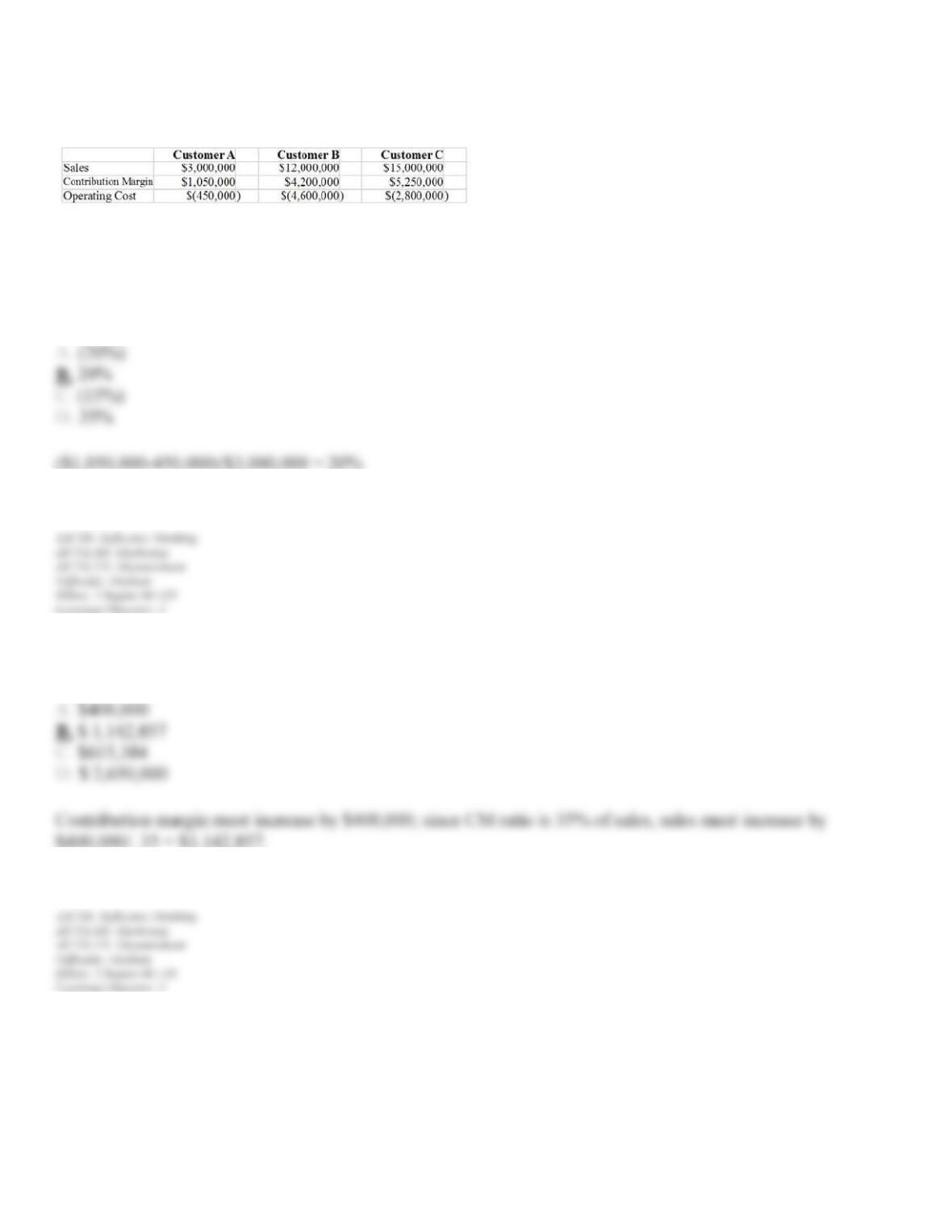
Use the following to answer questions 29-31:
Adelaide Proctoris computing return on sales for all of her customers. Her results indicate the following
Hilton – Chapter 06
29. Return on sales for Customer A is:
30. Assuming operating costs are fixed, in order to break even for Customer B, sales must increase by
approximately
31. All of the following would be reasons to keep Customer B except:
32. Which of the following factors can result in some customers being more profitable than others?
33. What issues come up in the task of assigning costs to customers?
34. ____is (are) determined by the company’s ability to maintain its share of the market and the overall demand
for the products of the industry
35. As part of customer profitability analysis, the relative use of certain activities by customers is compared to a
norm. When the comparison shows excessive use of an activity by a customer, which of the following questions
might be asked?
36. Which of the following is not a customer-related activity?
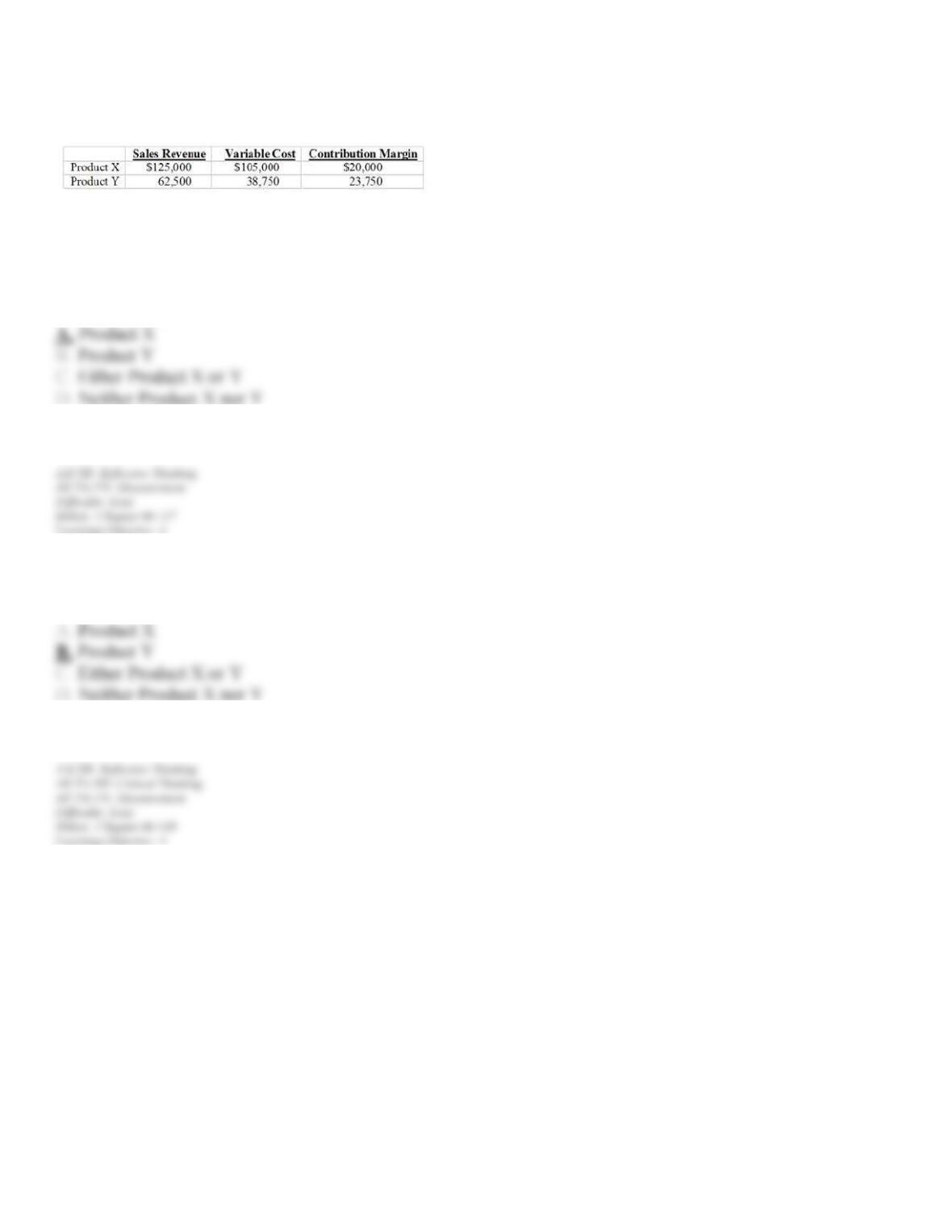
Use the following to answer questions 37-38:
The following information is available for last year:
Hilton – Chapter 06
37. If the salesperson’s commission is 3 percent of sales, which product would he prefer to sell?
38. If the salesperson’s commission is 10 percent of contribution margin, which product would he prefer to
sell?
39. Gerogetown Company desires a return on sales (ROS) of 20%. They must find an additional cost reduction
of $1,000,000from their current total costs of $9,000,000 assuming no changes in sales. Georgetown’s current
ROS is
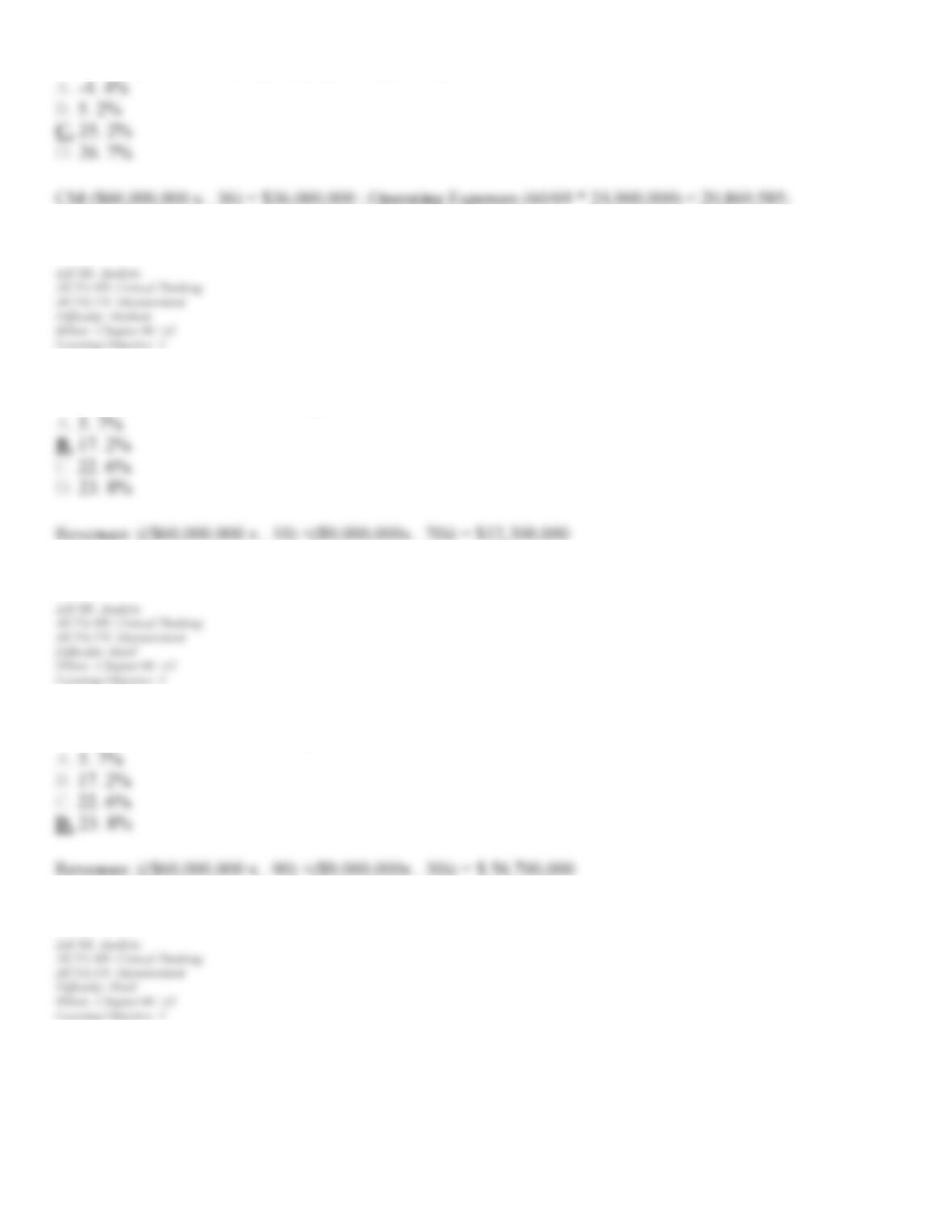
Use the following to answer questions 40-44:
Parkhurst Company manufactures and distributes two types of back braces, adult braces, and pediatric braces to
two types of customers, hospitals and physicians. Information on the customers and products is presented below.
(Assume operating costs are allocated based upon sales)
Hilton – Chapter 06
40. Current return on sales (rounded) for Pediatric Braces is:
41. Current return on sales (rounded) for Adult Braces is
42. Current return on sales for Hospital Customers is
43. Current return on sales for Physicians is
44. If Parkhurst Company desires a return on sales of 25%, costs must be reduced by:
Use the following to answer questions 45-46:
The Very Secret (VS) detective agency is investigating its computer research costs and hoping to trace those
costs to each of its three customer types, commercial clients, government clients and individual clients. Very
Secret uses in-house computer research and outsources other computer research. Very Secret bills its clients $70
per hours for each research hour regardless of type.
Hilton – Chapter 06
45. VS‘s total research costs (rounded) for Government Clients are
46. On Individual Clients, VS makes an average hourly profit (rounded) on research billed of
47. Easton Industries desires a return on sales of 20%. Their current sales revenue is $20,000,000 and their
current return on sales is 15%. Assuming sales remain the same, to achieve their desired target profit, they must
reduce their costs by
Use the following to answer questions 48-53:
Picture This (PT) manufactures two types of picture frames – large and small – that are sold to two types of
customers – gift shops and discount stores. Information on the customers and products is presented below.
(Assume operating costs are allocated based upon sales)
Hilton – Chapter 06