Chapter 6
The Current Asset Classification, Cash, and Accounts Receivable
MULTIPLE CHOICE QUESTIONS
1. Current assets are assets which
a. can be used immediately to retire liabilities.
b. are newly acquired.
c. have been converted into cash in the previous year.
d. are intended to be converted into cash within one year.
2. A company’s operating cycle may be described as
a. the period of time that is typically required for a company to convert cash into inventory and
inventory into cash.
b. the period of time from the beginning of operations until a company liquidates all of its assets.
c. always a one-year time period.
d. a cycle that is distinguished at the discretion of the Board of Directors on a daily basis.
3. Cash may consist of
a. coin and currency, loans to employees, and money orders.
b. petty cash, officer imprest accounts, and employee savings accounts.
c. money orders, postage stamps, and currency.
d. checking accounts, savings accounts, and bank drafts.
4. A compensating balance is
a. cash held by a foreign government.
b. a balance maintained by the company to pay the employees’ payroll.
c. a minimum cash balance that must be maintained on deposit.
d. items which are not cash, but equivalent to cash.
6-2 Test Bank – Chapter 6 – The Current Asset Classification, Cash, and Accounts Receivable
5. Which of the following are components of the quick ratio?
a. Cash and prepaid insurance
b. Cash and accounts receivable
c. Accounts receivable and inventory
d. All current assets except accounts receivable
6. Which of the following are components of the current ratio?
a. Accounts receivable and short term investments
b. Inventory, retained earnings, and accounts payable
c. Accounts payable, dividends, and cash
d. Short term investments, equipment, and land
7. Management will often choose accounting methods to
a. increase selling prices of a company’s products.
b. reduce repair costs on the company’s equipment.
c. manipulate net income from one period to the next to boost the company’s stock price.
d. increase working capital.
8. If a company with a current ratio of 2.0 pays $2,000 of its salaries payable, then its current ratio
will
a. change, but not enough information is provided to determine if it will increase or decrease.
b. decrease.
c. remain the same.
d. increase.
9. If a company with working capital of $210,000 pays $4,000 of bonds payable, then its working
capital will
a. increase.
b. decrease.
c. remain the same.
d. Not enough information to determine
Test Bank – Chapter 6 – The Current Asset Classification, Cash, and Accounts Receivable 6-3
10. The allowance for doubtful accounts is
a. an ‘other revenue’ account.
b. a contra accounts receivable account.
c. an ‘other expense’ account.
d. a contra expense.
11. The net realizable value of receivables is calculated as the face value of the receivables less
adjustments for
a. sales returns and sales discounts.
b. actual uncollected amounts adjusted for purchase discounts.
c. bad debts already written off.
d. sales returns, cash discounts, and estimated uncollectible accounts.
12. The face amount of accounts receivable for Rio Inc. is $20,000. It was estimated that 5% of the
accounts will not be collected, cash discounts of $500 will be exercised, and $200 of sales
returns will be experienced. The net realizable value of accounts receivable is
a. $19,500
b. $19,300
c. $20,000
d. $18,300
Solution: $20,000 – (5% X $20,000) – $500 – $200 = $18,300
13. Under the allowance method of accounting for bad debts, the recognition of bad debt expense
a. increases current assets and decreases net income.
b. decreases current assets and increases net income.
c. increases current assets and net income.
d. decreases current assets and net income.
14. Under the allowance method of accounting for bad debts, the write-off of an account receivable
determined to be uncollectible
a. decreases the current ratio.
b. increases the current ratio.
c. has no effect on the current ratio.
d. decreases working capital.
6-4 Test Bank – Chapter 6 – The Current Asset Classification, Cash, and Accounts Receivable
15. Delvin Co. uses the percentage of credit sales approach in estimating its bad debt expense. The
total estimate that is calculated by multiplying the percentage times the net sales revenue for the
period will be equal to
a. the debit balance required in the allowance for doubtful accounts after the recognition of bad
debt expense.
b. the credit balance required in the allowance for doubtful accounts after the recognition of bad
debt expense.
c. the difference between the beginning and the ending accounts receivable balance.
d. the amount of bad debt expense.
16. Maradonna Co. uses an aging schedule of accounts receivable in estimating its bad debt
expense. The total estimate, which appears on the aging schedule, will be equal to
a. the amount of bad debt expense on the company’s income statement.
b. the debit balance required in the allowance account prior to the recognition of bad debt
expense.
c. the increase in bad debt expense as a result of the estimate.
d. the credit balance required in the allowance account after the recognition of bad debt
expense.
17. On December 1, 2017, Smith Company delivered a shipment of goods to a Danish customer for
a price of 160,000 euros. If on that date 1.3 U.S. dollars could be exchanged for 1 euro. If Smith
closes its books on December 31 and 1 U.S. dollar is trading for 1 euro at that time, the adjusting
entry that Smith would record would include:
a. a credit to Exchange Rate Gain for $48,000.
b. a debit to Accounts Receivable for $20,800.
c. a debit to Exchange Rate Loss for $48,000.
d. a debit to Sales for $48,000.
Solution: ($160,000 X 1.3) – ($160,000 X 1) = $48,000
18. Under the allowance method of accounting for bad debts, the actual write-off of an account
receivable determined to be uncollectible
a. decreases current assets.
b. has no effect on current assets.
c. increases current assets.
d. occurs in the same accounting period as the sale.
Test Bank – Chapter 6 – The Current Asset Classification, Cash, and Accounts Receivable 6-5
19. Polo, Inc. uses the allowance method of accounting for bad debts. During July, Torey’s account
was written off as uncollectible. The write-off of Torey’s account
a. increases both the current and quick ratios.
b. decreases the current ratio and has no effect on the quick ratio.
c. has no effect on the current and quick ratios.
d. increases the current ratio and has no effect on the quick ratio.
20. Alma Company uses the allowance method of accounting for bad debts. Alma:
a. is violating the matching principle.
b. will record bad debt expense only when an account is determined to be uncollectible.
c. will not sell to customers on account anymore.
d. will report accounts receivable in the balance sheet at their net realizable value.
21. A company’s allowance for doubtful accounts is $4,000 and $3,000 on 1/1/18 and 1/1/17,
respectively. During 2017, bad debt expense was estimated to be 6% of net credit sales of
$100,000. During 2017, the amount of accounts written off as uncollectible amounts to
a. $6,000.
b. $7,000.
c. $5,000.
d. $4,000.
Solution: $3,000 + (6% X $100,000) – $4,000 = $5,000
22. The journal entry to record the recovery of a previously written-off $2,000 account receivable (for
customer Leno Company) under the allowance method would include:
a. a credit to Bad Debt Expense.
b. a credit to Cash.
c. a debit to Accounts Payable – Leno Company.
d. a credit to Allowance for Doubtful Accounts.
23. The allowance method of accounting for bad debts emphasizes the net realizable value of
accounts receivable on the balance sheet when
a. the direct write-off method is used.
b. the percentage of net credit sales approach is used to estimate uncollectibles.
c. the percentage of accounts receivable approach is used to estimate uncollectibles.
d. a company omits cash payments during the accounting period.
6-6 Test Bank – Chapter 6 – The Current Asset Classification, Cash, and Accounts Receivable
24. If a company’s collection period for accounts receivable is considered to be excessively long,
then
a. the company may want to invest excess cash from receivable collections in the stock market.
b. the company might examine its billing procedures in order to expedite collection from
customers.
c. customer returns should be disallowed in order to increase the collection of cash.
d. cash flows from operations will probably be more than sufficient.
25. During the year, Caltech Inc.’s accounts receivable turnover rate increased from 10 to 12 times.
The company makes credit sales only. The best explanation for the increase is that
a. the company’s credit department did a better follow up with customers whose account
balances became past due.
b. the company has recently dropped its credit check policy.
c. the company makes all customers pay cash instead of allowing purchases to be charged.
d. the company has more customers at the end of the year than it had at the beginning of the
year.
26. Summers, Inc. uses the allowance method to account for bad debts. The entry to record the
write-off of a customer’s account balance decreases
a. assets and owners’ equity.
b. assets and decreases liabilities.
c. owners’ equity and revenues.
d. the accounts receivable account.
27. If a company uses the allowance method to account for bad debts, the company’s owners’ equity
will decrease
a. at the end of the accounting period when an adjusting entry to estimate bad debts is
recorded.
b. on the date a customer’s account is determined to be uncollectible.
c. when the accounts receivable amount becomes past due.
d. on the date a customer’s account is written off.
28. Managers must understand how transactions affect working capital
a. because GAAP does not allow companies with weak working capital to obtain loans.
b. because lenders often use this to assess a company’s ability to meet current obligations.
c. so that management can avoid transactions that increase working capital.
d. in anticipation of meeting creditors guidelines before issuing new stock.
Test Bank – Chapter 6 – The Current Asset Classification, Cash, and Accounts Receivable 6-7
29. Which of the following would be separately reported as restricted cash in the balance sheet or
footnotes to the financial statement?
a. $8,000 in the savings account at First Bank
b. $200 in a petty cash drawer
c. $10,000 cash in an escrow account at Guarantee Bank
d. $4,000 in a checking account at Second Rate Bank
30. On March 1, 2017, Silver Corp. sold goods to a Chinese company for 10,000 Chinese yuan
(10,000 RMB) to be paid on April 1, 2017. The exchange rates on March 1 and April 1, 2017 are
US$8.0 = 1 RMB and US$8.5 = 1 RMB, respectively. What is Silver’s revenue in US dollars and
its 2017 exchange gain or loss?
a. Sales revenue = US $80,000; Exchange gain US $5,000
b. Sales revenue = US $85,000; Exchange loss US $5,000
c. Sales revenue = US $80,000; Exchange loss US $5,000
d. Sales revenue = US $85,000; Exchange gain US $5,000
Solution: Sales = 10,000 X 8.0 = $80,000; Gain = [10,000 X (8.5 – 8.0)] = $5,000
31. The current ratio fails to accurately reflect
a. the ability of a company to pay its current debts as they come due.
b. amounts that will come due within the next accounting period.
c. amounts due within the next operating cycle as of the end of the accounting period.
d. cash flows anticipated in future accounting periods.
32. Most companies
a. use working capital and current and quick ratios as low-cost surrogates for cash flow
measures.
b. place little importance on managing current assets.
c. have large amounts of current assets comprised of cash only.
d. are moving away from cash flow accounting.
6-8 Test Bank – Chapter 6 – The Current Asset Classification, Cash, and Accounts Receivable
33. The procedures designed to ensure that the cash account on the balance sheet reflects the
actual amount of cash in the company’s possession are referred to as
a. compensating balances.
b. record controls.
c. physical controls.
d. cash budgeting.
34. A company that maintains a cash balance of more than is necessary for its day-to-day needs
a. is likely to have cash flow problems.
b. is not using working capital to its ideal advantage.
c. is likely to have a very low solvency.
d. has a problem with physical controls.
35. Accounts used to cover day-to-day office expenses are referred to as
a. petty cash.
b. bad debts.
c. cash restrictions.
d. compensating balances.
36. An exchange rate
a. is the cash amount received from a customer who takes advantage of a cash discount.
b. is the value of one currency in terms of another currency.
c. seldom varies from one accounting period to the next.
d. is ignored by multinational companies.
37. Hedging is used to
a. reduce risks associated with holding receivables denominated in foreign currencies.
b. calculate the current ratio for multinational companies.
c. translate foreign currency into U.S. dollars.
d. ‘window dress’ uncollectible accounts.
Test Bank – Chapter 6 – The Current Asset Classification, Cash, and Accounts Receivable 6-9
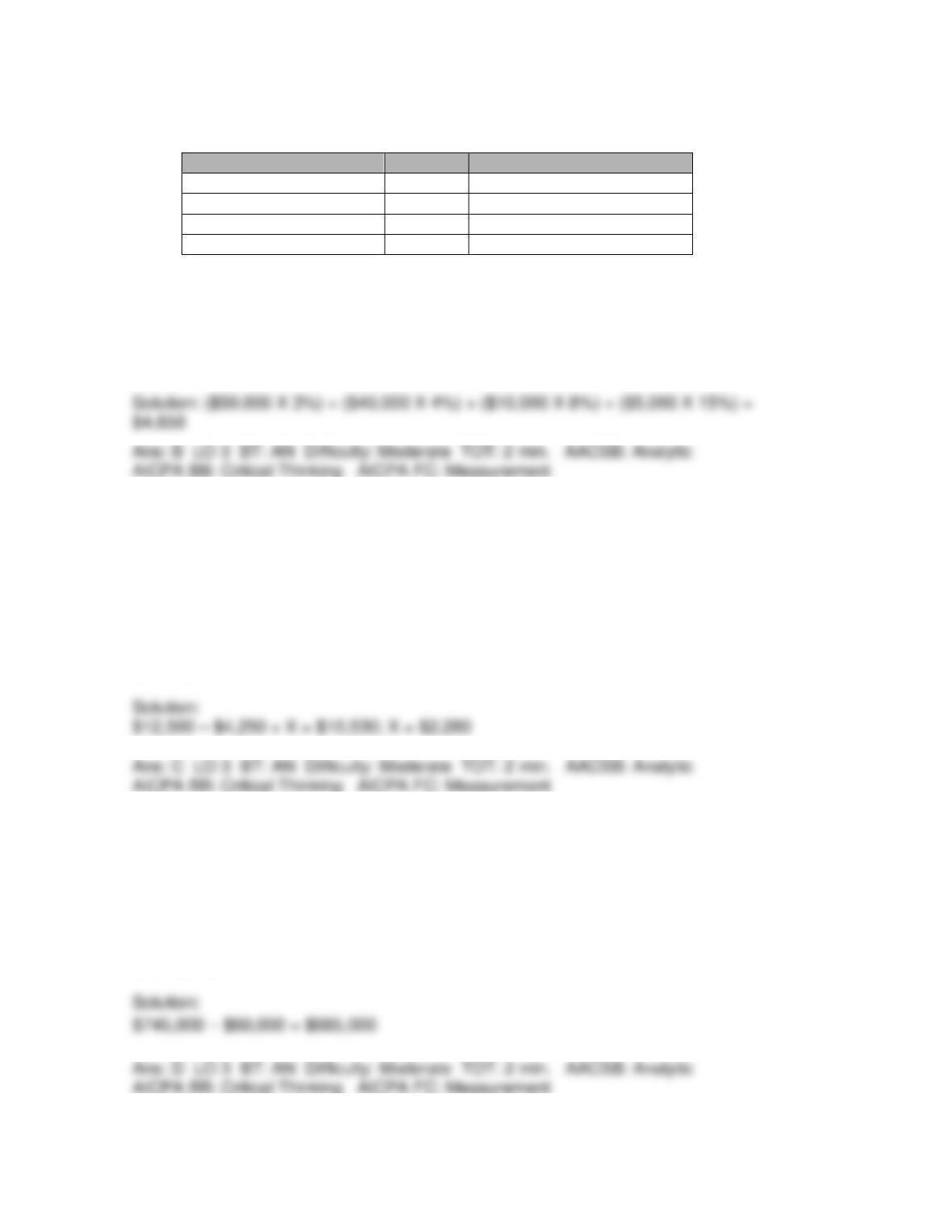
38. Tyson Corp. uses the aging method to estimate bad debts. The bookkeeper provided the
following schedule as of March 30th, 2017:
Account Age
Balance
Noncollection Probability
Current
$50,000
3%
1 — 30 days past due
40,000
4%
31 — 60 days past due
10,000
8%
Over 60 days past due
5,000
15%
What is the amount of receivables deemed uncollectible?
a. $1,650
b. $4,650
c. $3,400
d. $105,000
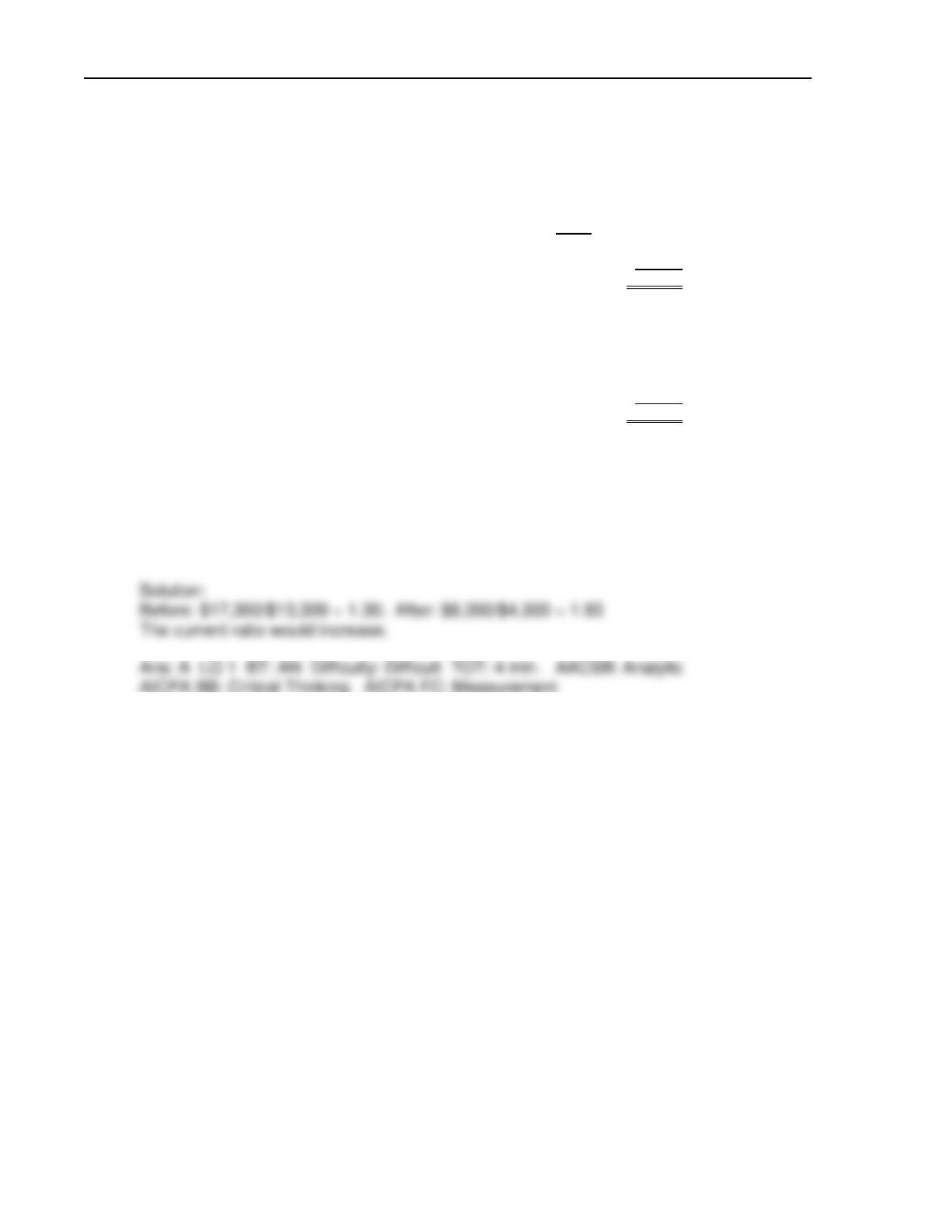
39. At the beginning of 2017, Cyrus Corp.’s allowance for doubtful accounts is $12,500.
During 2017, $4,250 was written off as uncollectible. At December 31, the company used an
aging schedule of accounts receivable and determined that $10,530 of the accounts receivable
would probably be uncollectible. What would be the bad debt expense that should be reported on
Cyrus’s 2017 income statement?
a. $5,720
b. $26,780
c. $2,280
d.$18,280
40. Before adjusting entries, Kilby Corp’s accounts receivable and allowance for doubtful accounts
are $745,000 and $7,000 (credit balance), respectively. Using an aging schedule of accounts
receivable, it is determined that $60,000 of the accounts receivable would probably be
uncollectible. Calculate the net realizable value of Truman’s receivables at year end.
a. $681,000
b. $695,000
c. $809,000
d. $685,000
6-10 Test Bank – Chapter 6 – The Current Asset Classification, Cash, and Accounts Receivable
41. The following information concerning the current assets and current liabilities of
Mason Company at December 31, 2017, is presented below.
Current Assets
Cash
$6,700
Accounts Receivable
$7,900
Less Allowance
(70)
7,830
Inventory
2,270
Prepaid expenses
500
Total
$17,300
Current Liabilities
Accounts payable
$9,000
Wages payable
500
Taxes payable
200
Rent payable
1,600
Notes payable
2,000
Total
$13,300
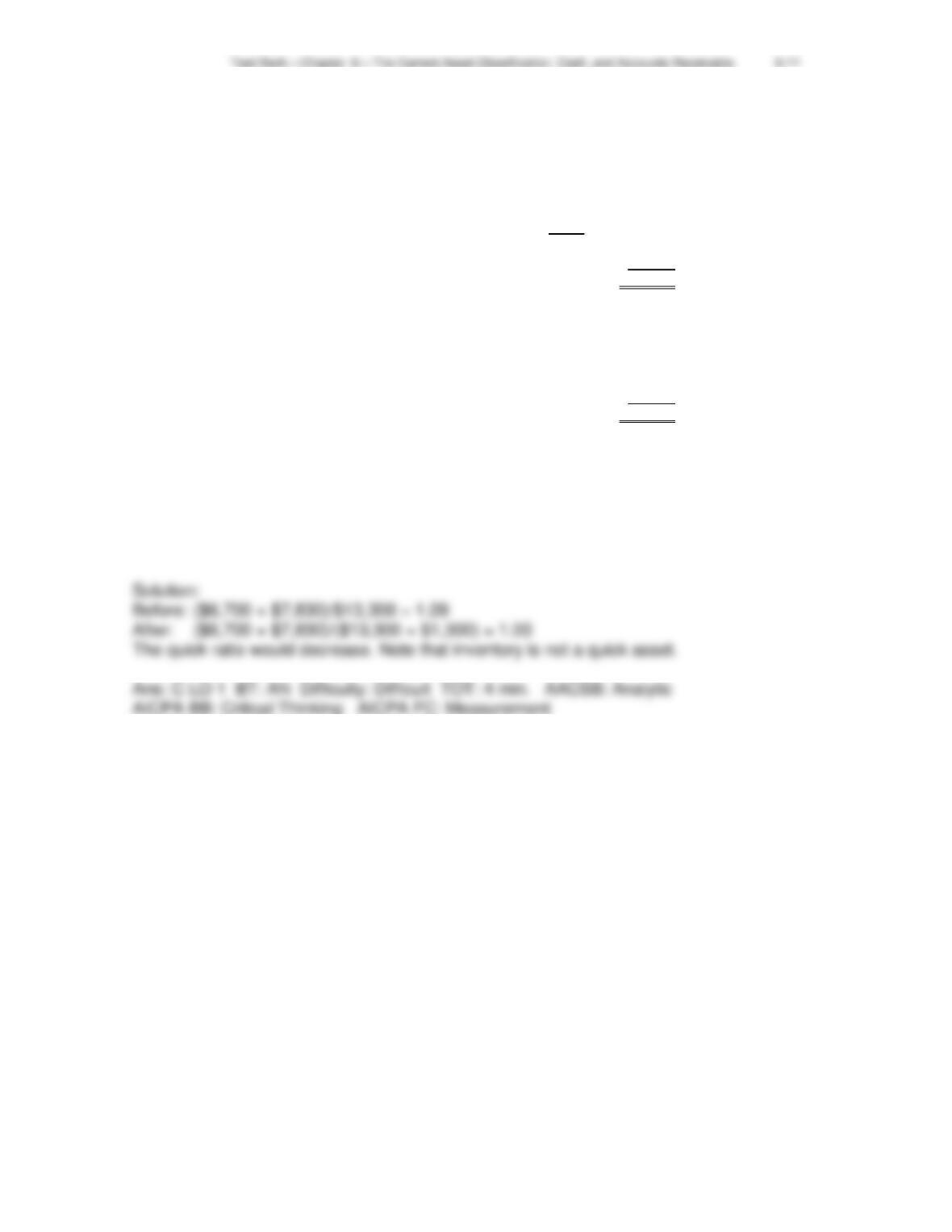
Based on this information, how would the current ratio be affected if Mason collects some
accounts receivable and then uses $9,000 cash to pay off the accounts payable?
a. The current ratio would increase from 1.30 to 1.93.
b. The current ratio would increase from 0.74 to 4.02.
c. The current ratio would decrease from 1.30 to 0.62.
d. The current ratio would increase from 1.09 to 1.61.
42. The following information concerning the current assets and current liabilities of
Mason Company at December 31, 2017, is presented below.
Current Assets
Cash
$6,700
Accounts Receivable
$7,900
Less Allowance
(70)
7,830
Inventory
2,270
Prepaid expenses
500
Total
$17,300
Current Liabilities
Accounts payable
$9,000
Wages payable
500
Taxes payable
200
Rent payable
1,600
Notes payable
2,000
Total
$13,300
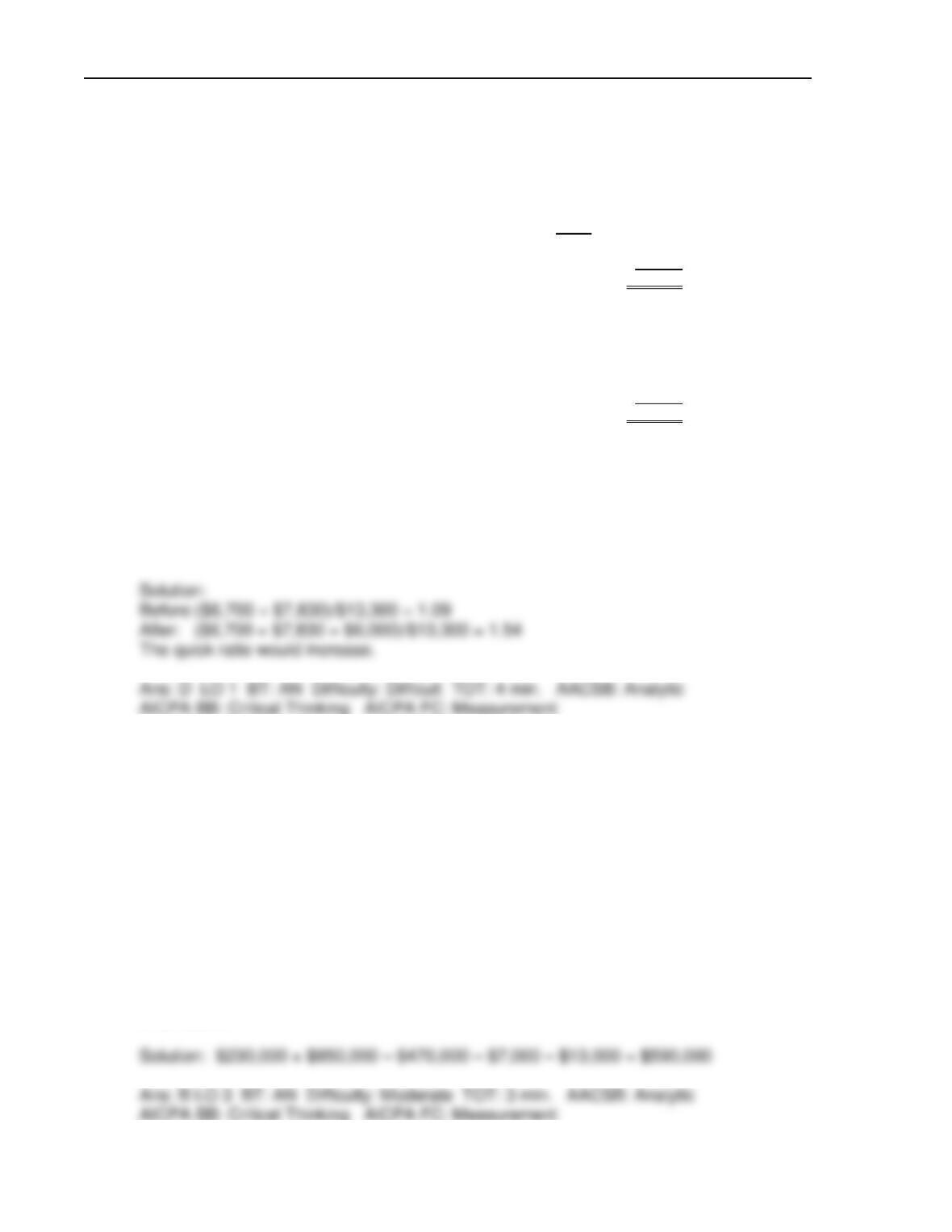
Based on this information, how would the quick ratio be affected if Mason purchased $1,300 of
inventory on account?
a. The quick ratio would decrease from 1.30 to 1.21.
b. The quick ratio would not change.
c. The quick ratio would decrease from 1.09 to 1.00.
d. The quick ratio would decrease from 1.09 to 1.21.
6-12 Test Bank – Chapter 6 – The Current Asset Classification, Cash, and Accounts Receivable
43. The following information concerning the current assets and current liabilities of
Mason Company at December 31, 2017, is presented below.
Current Assets
Cash
$6,700
Accounts Receivable
$7,900
Less Allowance
(70)
7,830
Inventory
2,270
Prepaid expenses
500
Total
$17,300
Current Liabilities
Accounts payable
$9,000
Wages payable
500
Taxes payable
200
Rent payable
1,600
Notes payable
2,000
Total
$13,300
Based on this information, what would the quick ratio be if Mason sold all of its inventory for
$6,000 cash?
a. The quick ratio would decrease from 1.09 to 0.19.
b. The quick ratio would decrease from 1.30 to 0.85.
c. The quick ratio would increase from 1.30 to 1.54.
d. The quick ratio would increase from 1.09 to 1.54.
44. Sanchez Inc. sells to customers only on credit. For the year ended December 31, 2017, the
following information is provided:
Sales revenue
$850,000
Accounts receivable, 1/01/17
230,000
Allowance for doubtful accounts, 12/31/17 (before adjustment for bad debts)
600
Collections during 2017
470,000
Accounts written off as uncollectible during 2017
13,000
Sales returns
7,000
What is the balance of the Accounts Receivable account at December 31, 2017?
a. $1,525,000
b. $590,000
c. $205,000
d. $135,000
Test Bank – Chapter 6 – The Current Asset Classification, Cash, and Accounts Receivable 6-13
45. Sanchez Inc. sells to customers only on credit. For the year ended December 31, 2017, the
following information is provided:
Sales revenue
$850,000
Accounts receivable, 1/01/17
230,000
Allowance for doubtful accounts, 12/31/17 (before adjustment for bad debts)
600
Collections during 2017
470,000
Accounts written off as uncollectible during 2017
13,000
Sales returns
7,000
If Sanchez estimates bad debts at 5% of net credit sales, how much is bad debt expense?
a. $34,000
b. $15,200
c. $23,400
d. $42,150
46. The balances of the allowance for doubtful accounts on the balance sheets dated December 31
of 2017 and 2016 were $2,000 and $7,000, respectively. During 2017, bad debt expense was
$12,000. What is the amount of accounts receivable that were written off as uncollectible during
2017?
a. $22,000
b. $8,000
c. $17,000
d. $2,000
6-14 Test Bank – Chapter 6 – The Current Asset Classification, Cash, and Accounts Receivable
47. The following information is provided for Atlanta, Inc..
Balance Sheet
2017
2016
Cash and cash equivalents
$89,000
$106,000
Accounts Receivables, less allowance for doubtful
accounts of $4,600 (2017) and $2,000 (2016)
198,000
154,000
How much is the balance in the Accounts Receivable account at December 31, 2017?
a. $193,600
b. $158,600
c. $202,600
d. $203,600
48. The following information is provided for Atlanta Inc.
Balance Sheet
2017
2016
Cash and cash equivalents
$89,000
$106,000
Accounts Receivables, less allowance for doubtful
accounts of $4,600 (2017) and $2,000 (2016)
198,000
154,000
What is the amount of the Net Realizable Value of the receivables at December 31, 2017?
a. $198,000
b. $154,000
c. $193,600
d. $190,400
Test Bank – Chapter 6 – The Current Asset Classification, Cash, and Accounts Receivable 6-15
49. The following information was taken from the unadjusted trial balance and aging schedule of
Diane Company on December 31, 2017. All sales are on account.
Accounts and related balances at December 31, 2017 before adjustment:
Debit
Credit
Accounts receivable
$46,000
Allowance for doubtful accounts
$ 680
Sales (all on account)
500,000
Sales returns
3,000
Aging Schedule of Accounts Receivable:
Age
Amount
% Uncollectible
0-30 days
$14,000
5%
30-60 days
20,000
8%
Over 60 days
12,000
12%
If Diane uses the aging schedule of accounts receivable to determine bad debts, what is the bad
debt expense for the year ending December 31, 2017?
a. $4,280
b. $3,600
c. $3,680
d. $3,060
6-16 Test Bank – Chapter 6 – The Current Asset Classification, Cash, and Accounts Receivable
50. The following information was taken from the unadjusted trial balance and aging schedule of
Diane Company on December 31, 2017. All sales are on account.
Accounts and related balances at December 31, 2017 before adjustment:
Debit
Credit
Accounts receivable
$46,000
Allowance for doubtful accounts
$ 680
Sales (all on account)
500,000
Sales returns
3,000
Aging Schedule of Accounts Receivable:
Age
Amount
% Uncollectible
0-30 days
$14,000
5%
30-60 days
20,000
8%
Over 60 days
12,000
12%
If Diane uses the aging schedule of accounts receivable to determine bad debts, what is the
Allowance for Doubtful Accounts balance at December 31, 2017?
a. $3,000
b. $4,280
c. $2,920
d. $3,740
51. The following information was taken from the unadjusted trial balance and aging schedule of
Diane Company on December 31, 2017. All sales are on account.
Accounts and related balances at December 31, 2017 before adjustment:
Debit
Credit
Accounts receivable
$46,000
Allowance for doubtful accounts
$ 680
Sales (all on account)
500,000
Sales returns
3,000
Aging Schedule of Accounts Receivable:
Age
Amount
% Uncollectible
0-30 days
$14,000
5%
30-60 days
20,000
8%
Over 60 days
12,000
12%
If Diane uses the aging schedule of accounts receivable to determine bad debts, what is the net
realizable value of accounts receivable on the 2017 financial statements?
a. $46,000
b. $42,260
c. $42,320
d. $30,400