12) What type of supply chains consider forward and reverse product flows over the entire life cycle?
A) two-pronged
B) life cycle
C) closed-loop
D) socially responsible
E) end-to-end
13) Suppose that a firm has made the following computations for its design for disassembly: processing
cost per unit = $12.00, disposal cost per unit = $6.00, resale revenue per unit = $20.00, and recycling
revenue per unit = $7.00. What is the revenue retrieval for this product?
A) $27.00
B) $8.00
C) $9.00
D) $1.00
E) $20.00
14) A firm is considering five different product designs. Data concerning the design for disassembly for
each of the designs are provided in the table below. Which design appears to be the best environmental
design based on revenue retrieval opportunity?
Product Design
Resale Revenue
per Unit
Recycling
Revenue per
Unit
Processing Cost
per Unit
Disposal Cost
per Unit
1
$30.00
$12.00
$15.00
$40.00
2
$10.00
$10.00
$3.00
$1.00
3
$5.00
$55.00
$48.00
$10.00
4
$4.00
$2.00
$1.00
$0.50
5
$42.00
$3.00
$8.00
$32.00
A) Design 1
B) Design 2
C) Design 3
D) Design 4
E) Design 5
15) Products are more “environmentally friendly” when they are made:
A) using cheaper materials.
B) using less energy.
C) according to OSHA standards.
D) where environmental regulations are lax.
E) more difficult to disassemble.
16) Analysis of environmental impacts of products from the design stage through end-of-life is known as
________.
17) The 3 Rs for sustainability are ________.
18) ________ materials translate into better fuel economy, fewer carbon emissions, and reduced operating
cost.
19) Boeing’s use of epoxy composites and titanium graphite laminate represent the environmentally
friendly concept of ________.
20) Opportunities to reduce environmental impact during production typically revolve around the three
themes of ________.
21) ________ supply chains consider forward and reverse product flows over the entire life cycle.
22) Why is product design the most critical phase in product life cycle assessment?
23) What is the formula for revenue retrieval of a product that has reached the end of its life?
24) Suppose that a firm has made the following computations for its design for disassembly: processing
cost per unit = $13.00, disposal cost per unit = $9.00, resale revenue per unit = $22.00, and recycling
revenue per unit = $8.00. What is the revenue retrieval for this product?
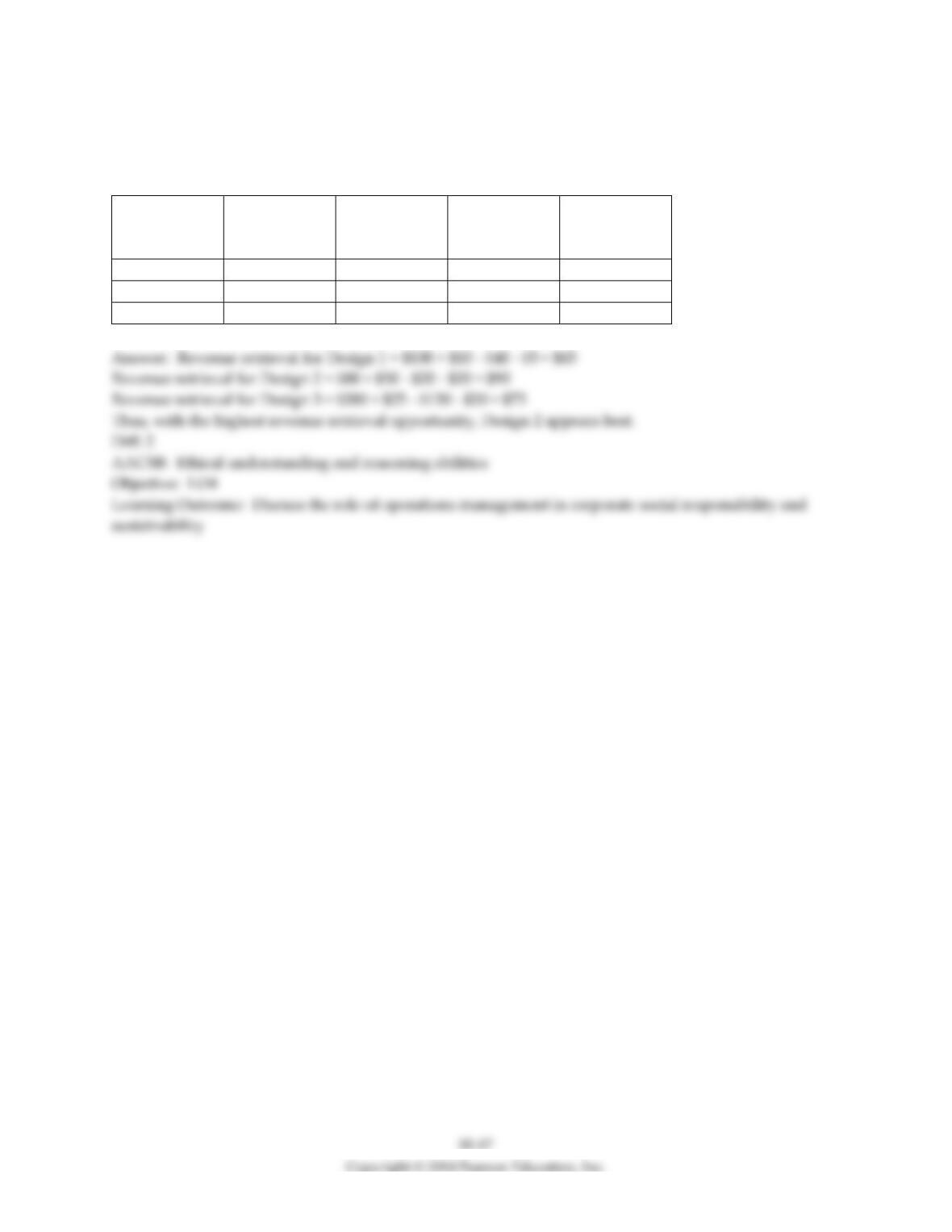
25) A firm is considering three different product designs. Data concerning the design for disassembly for
each of the designs are provided in the table below. Which design appears to be the best environmental
design based on revenue retrieval opportunity?
Product Design
Resale Revenue
per Unit
Recycling
Revenue per
Unit
Processing Cost
per Unit
Disposal Cost
per Unit
1
$100
$10
$40
$5
2
$80
$50
$20
$20
3
$200
$25
$130
$20
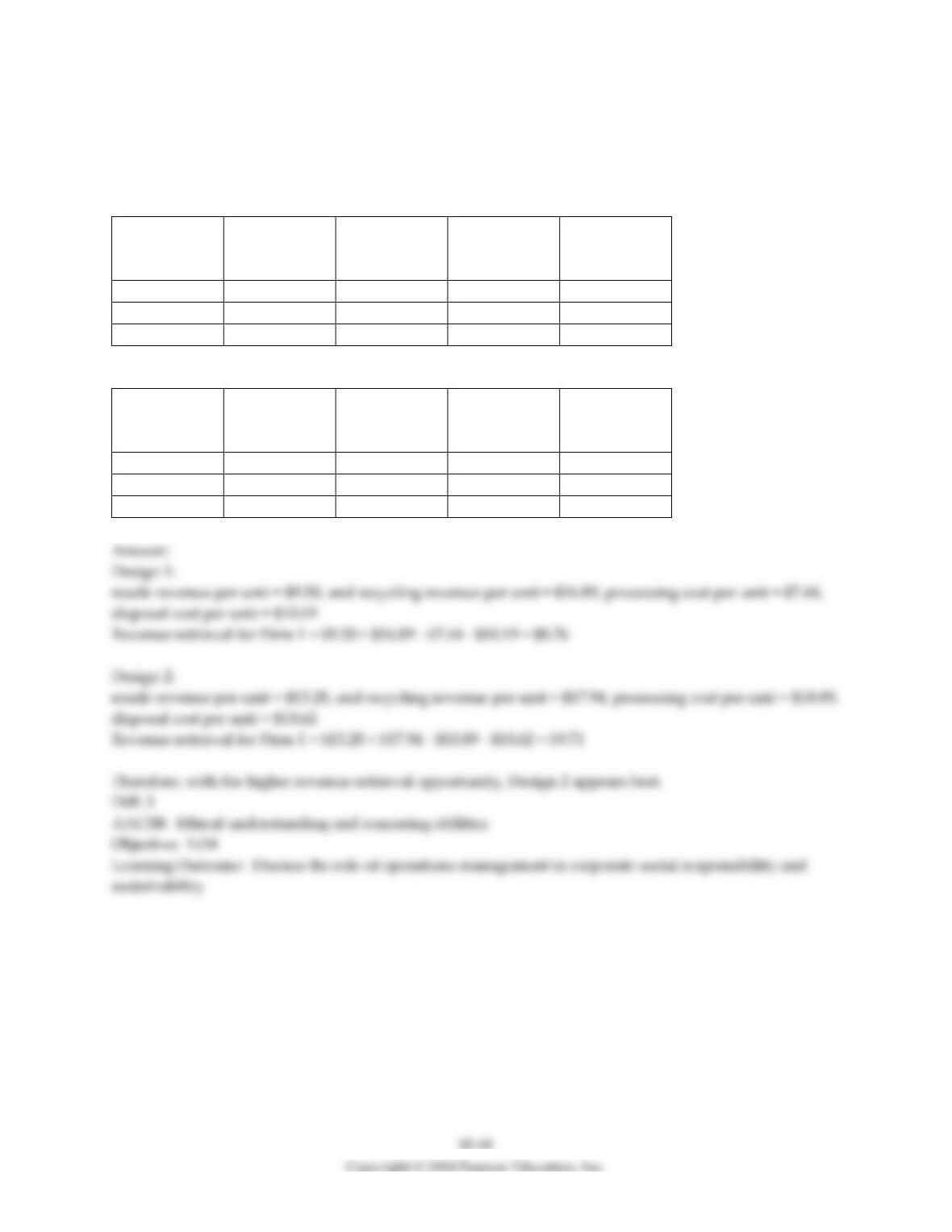
26) A firm is comparing two designs for a new product. Data concerning the design for disassembly for
both designs are provided in the tables below. Which design appears to be the best environmental design
based on revenue retrieval opportunity?
Design 1:
Component
Resale Revenue
per Unit
Recycling
Revenue per
Unit
Processing Cost
per Unit
Disposal Cost
per Unit
A
$5.60
$8.90
$3.50
$2.85
B
$2.56
$3.67
$3.25
$4.00
C
$1.34
$4.32
$0.69
$3.34
Design 2:
Component
Resale Revenue
per Unit
Recycling
Revenue per
Unit
Processing Cost
per Unit
Disposal Cost
per Unit
A
$4.76
$5.68
$6.00
$2.13
B
$3.21
$5.28
$2.42
$3.59
C
$5.31
$6.98
$2.47
$4.90
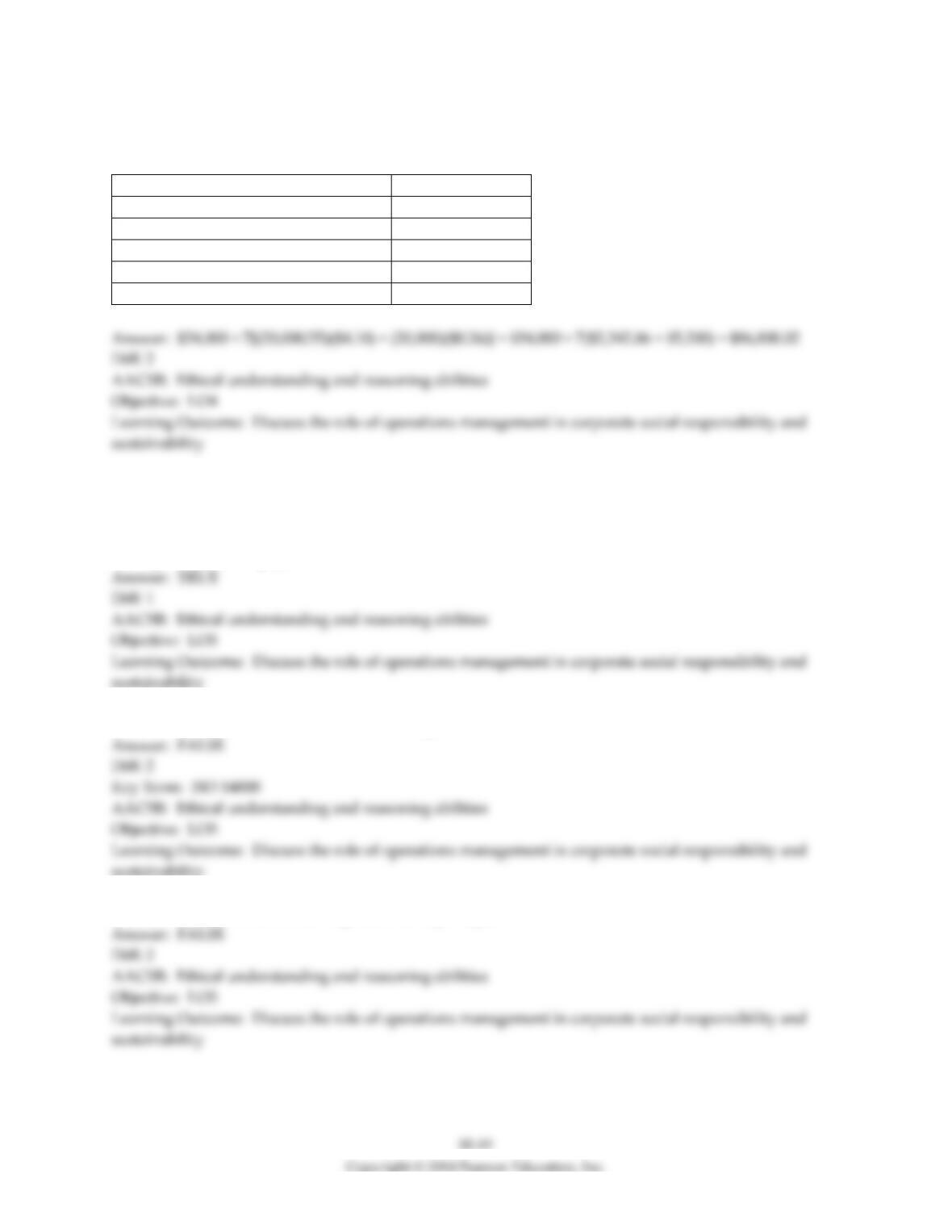
27) What is the total vehicle life cycle cost of a car that has the information provided in the following
table?
Vehicle Purchase Cost
$34,000
Vehicle Operating Cost per Mile
$0.26
Useful Life of Vehicle
7 years
Miles per Year
20,000
Miles per Gallon
35
Average Fuel Price per Gallon
$4.10
Section 4 Regulations and Industry Standards
1) Some governments are implementing laws that mandate the outright reduction of GHG emissions by
forcing companies to pay taxes based on the amount of GHG emissions that are emitted.
2) ISO 9000 is a series of environmental management standards that contain five core elements.
3) The UNFCCC works on the “cap-and-trade” principle.
4) Within environmental regulation, the “cap-and-trade” principle essentially allows companies to buy
and sell the right to pollute.
5) What does ISO stand for?
A) Industry Standards Organization
B) International Safety Organization
C) Industrial Safety Organization
D) International Standards for Oxygen
E) International Organization for Standardization
6) What does UNFCCC stand for?
A) United National Federation Council on Climate Change
B) UN Federation for Climate Change Cooperation
C) Uniform National Framework Climate Change Code
D) UN Framework Convention on Climate Change
E) UN Foundation for the Consequences of Climate Change
7) What percentage of the manufacturing process from Subaru’s Lafayette, Indiana, plant goes to the
landfill?
A) 0%
B) 2%
C) 5%
D) 12.5%
E) 15%
8) The European Union Emissions Trading System works on what principle?
A) Thatcher’s Theory of the Commons
B) pollute-and-pay
C) socialism
D) cap-and-trade
E) tax the richer companies more to pay for pollution control
9) What allows companies in Europe to buy and sell allowances for the right to pollute?
A) UNFCCC
B) ISO 9000
C) EUETS
D) ISO 14000
E) EPA
10) Within environmental regulation, the “cap-and-trade” principle produces a market that allows
companies to purchase and sell what?
A) hats that promote environmental awareness
B) shares of stock in renewable energy sources
C) emission allowances
D) space in landfills
E) carbon reduction sweepers
11) Which of the following is true about ISO 14000 certification?
A) It can reduce exposure to liability.
B) It deals with environmental management.
C) It offers a good systematic approach to pollution prevention.
D) One of its core elements is life cycle assessment.
E) All of the above are true.
12) Design for ________ encourages designers to create products that can be taken apart and whose
components can be recovered, minimizing impact on the environment.
13) The European Union Emissions Trading System works on the ________ principle.
14) A series of environmental management standards established by the International Organization for
Standardization is called ________ .
15) Identify two non-governmental organizations that provide guidance to businesses for reducing
environmental impacts from disposal of materials to reductions in greenhouse gas emissions.
16) Describe the European Union Emissions Trading System to combat climate change.
17) Identify the five core elements of ISO 14000.