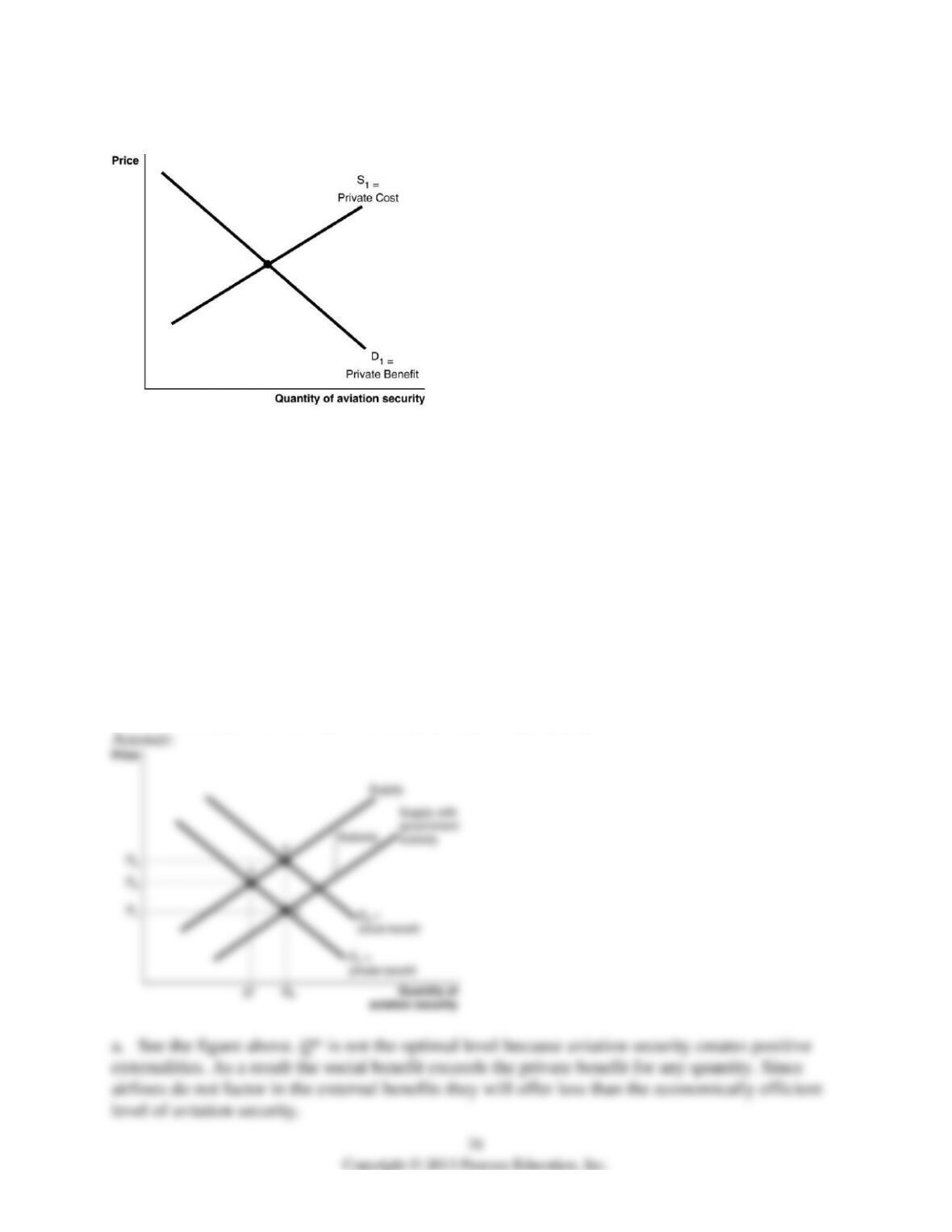
Figure 5-7
Figure 5-7 shows the market for aviation security. Aviation security generates a positive
externality because people who are not airline passengers benefit from aviation security.
23) Refer to Figure 5-7 to answer the following questions.
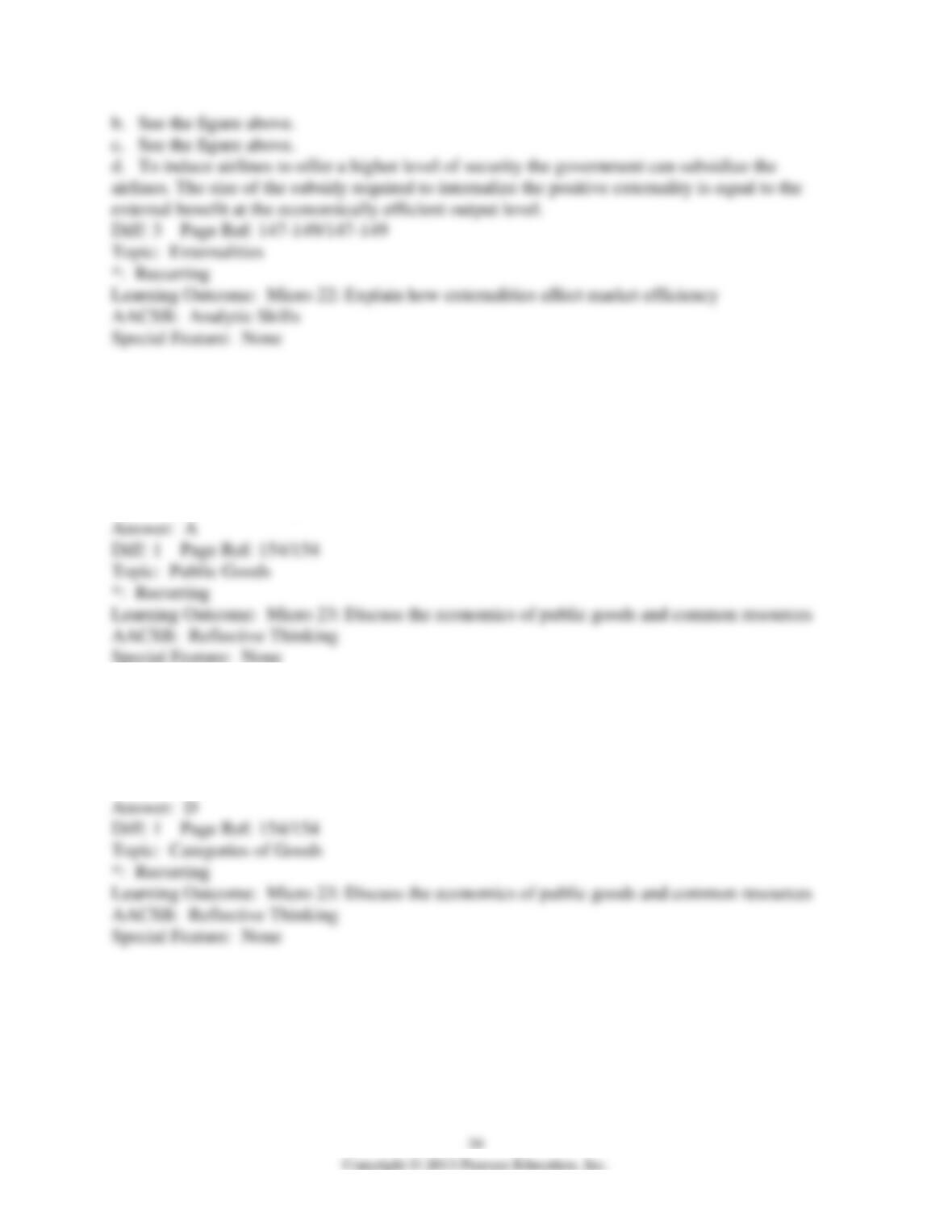
a. In the absence of any government intervention what is the equilibrium level of security that
airlines will supply? Denote this level, Q*. Briefly explain why this quantity is not the
economically efficient level of aviation security.
b. In the diagram, illustrate the presence of positive externalities in the aviation security market.
Label any new curve that you draw.
c. On your diagram identify the economically efficient level of aviation security. Denote this
level Qe.
d. Explain how a government subsidy for the airlines can bring about the economically efficient
aviation security level. Be sure to identify the size of the subsidy.
5.4 Four Categories of Goods
1) Public goods are distinguished by two primary characteristics. What are they?
A) nonrivalry and nonexcludability
B) government intervention and low prices
C) market failure and high prices
D) rivalry and exclusivity
2) Goods can be classified on the basis of whether their consumption is
A) internal and excludable.
B) rival and competitive.
C) includable and cooperative.
D) rival and excludable.
3) Classifying a good as excludable means
A) that someone can be barred from consuming the good based on race, creed or some other
irrelevant characteristic.
B) that anyone who does not pay for the good cannot consume it.
C) that consumption of the good causes no externalities.
D) that a producer with patent or copyright protection can exclude any other producer from
selling his product.
4) Classifying a good as rival means
A) that the good is produced in a competitive market.
B) that there is a shortage of the good.
C) that when one person consumes a unit of the good no one else can consume it.
D) anyone who does not pay for the good cannot consume it.
5) A private good is
A) a good that is rivalrous and nonexcludable.
B) a good that is nonrivalrous and nonexcludable.
C) a good that is rivalrous and excludable.
D) a good that is nonrivalrous and excludable.
6) A public good is
A) a good that is rivalrous and excludable.
B) good that is nonrivalrous and nonexcludable.
C) a good that is nonrivalrous and excludable.
D) a good that is rivalrous and nonexcludable.
7) Goods that are excludable but not rival are
A) public goods.
B) semi-private goods.
C) common resources.
D) quasi-public goods.
8) A good that is rival but not excludable is a
A) common resource.
B) public good.
C) quasi-public good.
D) quasi-private good.
9) All of the following are examples of public goods except
A) broadcast television with commercials.
B) clean water systems.
C) stock of knowledge in the public domain.
D) crime prevention.
10) Which of the following is an example of a nonexcludable product?
A) college education
B) a public library
C) public transportation
D) internet service for your home computer
11) The free rider problem refers to a situation in which
A) people consume a pure public good without payment, even though the good may not be
produced if no one chooses to pay.
B) the marginal cost of allowing additional consumers to consume a public good is zero.
C) high income individuals subsidize the production of goods, such as education, that make
society better off.
D) markets fail to allocate resources efficiently when benefits outweigh costs.
12) Which of the following best illustrates the free rider problem?
A) Since no one owns elephants and elephants are valued for their hide, meat and ivory,
elephants can be hunted to extinction.
B) For every purchase of a $30 fare card, you are entitled to five free bus rides.
C) If your neighbors professionally landscape their front yards, it is likely that the market value
of your property will increase.
D) All three homeowners in a quiet cul-de-sac have expressed the desirability of security lighting
in the common parking area. One of the homeowners installs the lighting and asks you to
contribute toward the cost. You choose not to contribute.
13) “Free riding” is a characteristic of which type of good?
A) a private good
B) a common resource
C) a public good
D) a good that is both rival and excludable
14) Parents who do not have their children immunized and attempt to benefit from other parents
who did have their own children immunized are exhibiting an economic behavior known as
A) excludability.
B) public rivalry.
C) free riding.
D) internalizing an external cost.
15) Which of the following describes the difference between the market demand curve for a
private good and the demand curve for a public good?
A) The market demand curve for a private good is derived by adding vertically the quantities that
consumers demand at each price. The demand curve for a public good is derived by adding
horizontally the quantities that consumers demand at each price.
B) The market demand curve for a private good is derived by adding horizontally the quantity of
the good demanded at each price by each consumer. The demand curve for a public good is
derived by adding up the price each consumer is willing to pay for each quantity of the good.
C) The market demand curve for a private good will always is downward sloping. The demand
curve for a public good will always is upward sloping.
D) The market demand curve is drawn holding everything other than the price of the good
constant; the demand curve for a public good is drawn by allowing all variables that affect
demand to change.
16) To derive a demand curve for a public good, we
A) add the price that each consumer is willing to pay for each quantity of the public good.
B) add the quantities that each consumer is willing to purchase at each price of the public good.
C) multiply the quantity demanded at each price by the number of the consumers.
D) multiply the price by the quantity for each consumer and add up across all consumers.
17) It is difficult for a private market to provide the economically efficient quantity of a public
good because
A) by law governments cannot use cost-benefit analysis to determine this quantity.
B) public goods produce positive and negative externalities.
C) individual preferences are not revealed in the market for the good.
D) it is too expensive to produce the necessary amount of the good.
18) The supply curve of a public goods shows
A) the total quantities that all producers are willing and able to supply at each price.
B) the maximum amount suppliers require to produce each quantity of the good.
C) the total cost of producing each unit of the good.
D) the marginal cost of producing each unit of the good.
19) The efficient output level of a public good occurs where the
A) greatest number of free riders occurs.
B) marginal cost of producing the last unit is equal to the marginal benefit realized by
consumers.
C) total cost of production is affordable.
D) marginal cost of production is at its lowest.
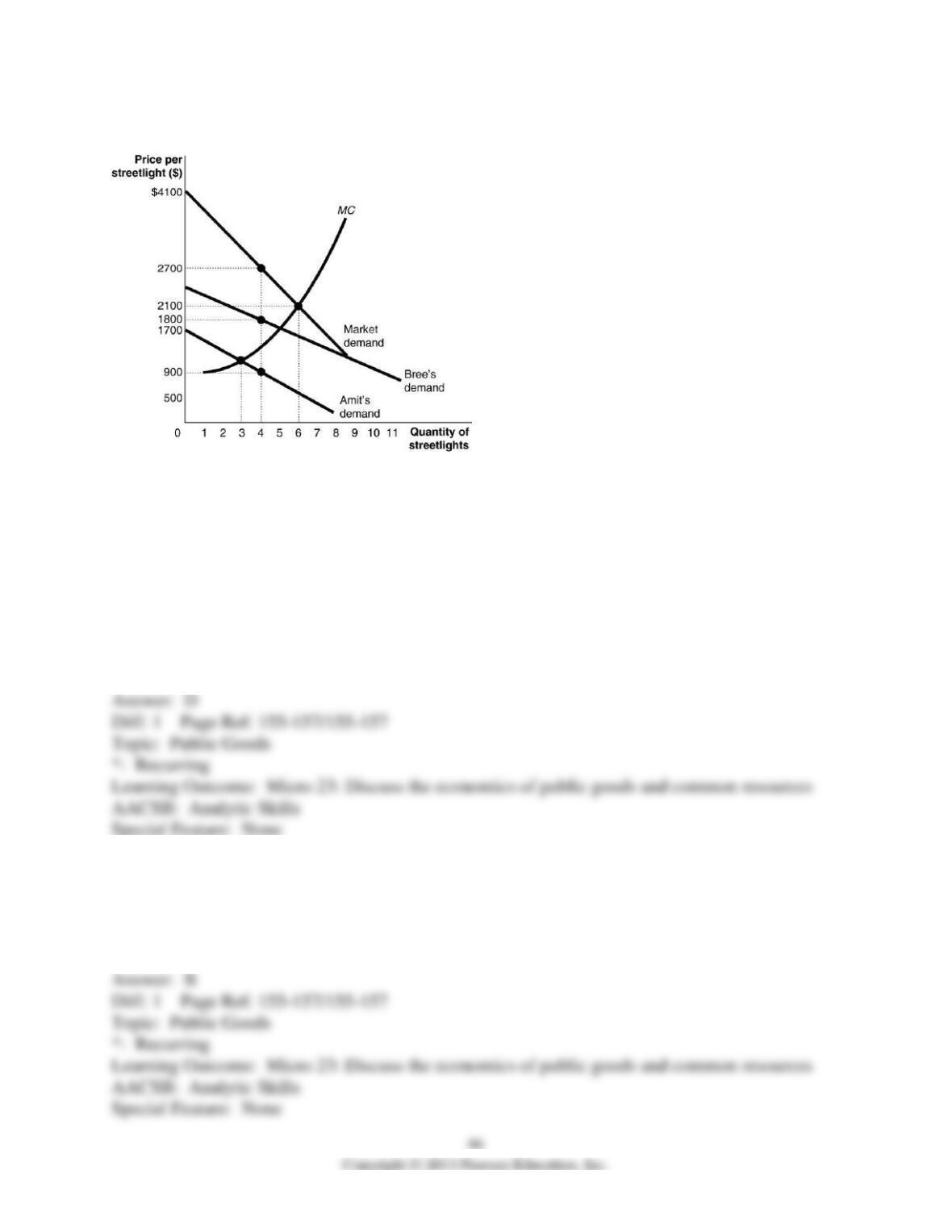
Figure 5-8
Amit and Bree are the only two homeowners on an isolated private road. Both agree that
installing street lights along the road would be beneficial and want to do so. Figure 5-8 shows
their willingness to pay for different quantities of street lights, the market demand for street
lights and the marginal cost of installing the street lights.
20) Refer to Figure 5-8. How much is Amit willing to pay to have 4 street lights installed?
A) $3,600
B) $2,700
C) $1,800
D) $900
21) Refer to Figure 5-8. How much is Bree willing to pay to have 4 street lights installed?
A) $1,500
B) $1,800
C) $2,700
D) $7,200
22) Refer to Figure 5-8. What is the optimal quantity of street lights to install?
A) 3
B) 4
C) 6
D) 9
23) Refer to Figure 5-8. Suppose Amit and Bree know each other’s preferences so that it is not
possible for one to deceive the other. Which of the following statements best describes the
circumstances under which the optimal quantity of street lights could be achieved?
A) The optimal quantity will be installed only if the two parties agree to pay according to their
willingness to pay as indicated by their respective demand curves.
B) Because there are only two consumers, it is likely that private bargaining will result in the
optimal quantity being installed.
C) The optimal quantity will be installed only if the two parties split the cost of installation
equally.
D) The optimal quantity will be installed only if Bree pays for the entire installation cost.
24) Which of the following is an example of a common resource?
A) elephants in the wild
B) lions in a zoo
C) a college education
D) public transportation
25) An important difference between the demand for a private good and the demand for a public
good is that
A) individuals reveal their preferences for a public good but they do not have to reveal their
preferences a private good.
B) the resources used to provide public goods are common resources or government owned; the
resources used to produce private goods are all privately owned.
C) individuals reveal their preferences for a private good but they do not have to reveal their
preferences for a public good.
D) the demand for a private good produces consumption externalities; the demand for a public
good produces production externalities.
26) In order to determine what quantity of a public good should be supplied governments
sometimes use
A) quantitative analysis.
B) economic forecasting.
C) econometrics.
D) cost-benefit analysis.
27) The “tragedy of the commons” is a term that refers to
A) tragic events such as forest fires and hurricanes that cause more damage than they should
because of the failure of government to develop a common approach to handling disasters.
B) the tendency for a common resource to be overused.
C) the failure of Britain’s House of Commons to respond quickly to tragedies such as the Great
Plague.
D) free riding that causes too little of a public good to be produced.
28) In England during the Middle Ages each village had an area of pasture on which any family
in the village was allowed to graze its cows and sheep without charge. Eventually, the grass in
the pasture would be depleted and no family’s cow or sheep would get enough to eat. The reason
the grass was depleted was
A) the area of pasture was nonexcludable and the consumption of the grass was rival.
B) self-interest motives led livestock owners to raise too many cows and sheep.
C) due to a policy of neglect on the part of the English government.
D) it did not get enough rainfall.
29) Haiti was once a heavily forested country. Today, 80 percent of Haiti’s forests have been cut
down, primarily to be burned to create charcoal. The reduction in the number of trees has lead to
devastating floods when it rains heavily. This is an example of
A) tragic externalities.
B) the Tragedy of the Commons.
C) human greed.
D) the consequences of not having a market economic system.
30) Negative externalities and the tragedy of the commons are problems that have a common
source. What is this common source?
A) self-interest motives of producers and consumers
B) a lack of concern for human rights
C) a lack of competition
D) a lack of clearly defined and enforced property rights
31) Which of the following is a possible solution when a scarce resource is subject to the tragedy
of the commons?
A) access to the commons can be restricted through community norms and laws
B) offer subsidies to consumers
C) force people to move away from the commons
D) persuade people to use less of the scarce resource through an advertising campaign
32) If the United States and other developed nations pay the cost of reducing public emissions,
developing nations such as China could benefit from the reduction while not contributing to it. In
this sense, one can think of reducing carbon emissions as being like a
A) public good.
B) private good.
C) quasi-private good.
D) quasi-public good.
33) In 2011, the Environmental Protection Agency proposed a plan to enact tougher limits on
smog-forming ozone. By implementing new pollution regulations, the government will cause the
polluters’
A) marginal private cost curve to shift up.
B) marginal private cost curve to shift down.
C) marginal social cost curve to shift up.
D) marginal social cost curve to shift down.
34) If the EPA does implement its plan to enact tougher limits on smog-forming ozone, the
quantity of product being produced by the polluting firms will ________ and the product price
will ________.
A) increase; increase
B) increase; decrease
C) decrease; increase
D) decrease; decrease
35) A public good that is a good that is both rival and excludable.
36) The social benefit of a given level of a public good is the vertical sum of all private benefits
for that level.
37) A modern example of the tragedy of the commons is the forests in many poor countries.
38) State whether each of the following goods and services is nonrival, nonexcludable or both:
a. A toll road
b. A public park
c. A lighthouse
d. An art museum
e. A radio broadcast of A Prairie Home Companion
39) How does a public good differ from a quasi-public good? In your answer give an example of
each type of good.
40) Explain how the decision by parents to not immunize their children, hoping that their
children will not get sick because other parents have had their children immunized, is an example
of free riding. How is this behavior dangerous to the public?
41) Define the tragedy of the commons. Give three examples of common resources. Briefly
explain why common property resources are subject to overuse.