9) Steven Cheung examined the relationship between beekeepers and apple growers. Cheung
noted that: “Pollination contracts usually include stipulations regarding the number and strength
of … [bee] colonies, the rental fee per hive, the time of delivery…the protection of bees from
pesticides, and the strategic placing of hives.” Cheung’s suggests that the relationship between
beekeepers and apple growers is an example of
A) the Coase Theorem.
B) how excessive legal costs can prevent economic efficiency from being achieved.
C) negative externalities.
D) government intervention improving economic efficiency.
10) Which of the following statements about the economically efficient level of air pollution is
correct?
A) The economically efficient level of pollution is zero.
B) The economically efficient level of pollution occurs where all social costs equal all social
benefits.
C) The economically efficient level of pollution occurs where the marginal cost of pollution
reduction equals the marginal social benefit of reduction.
D) The economically efficient level of pollution occurs where total benefits of pollution
reduction are maximized.
11) The costs in time and other resources that parties incur in the process of facilitating an
exchange of goods and services are called
A) enforcement costs.
B) implicit costs.
C) explicit costs.
D) transaction costs.
12) Private solutions to the problem of externalities are most likely when
A) government actively encourages these solutions.
B) transaction costs are low and the number of bargaining parties is small.
C) transaction costs are low and the number of bargaining parties is large.
D) transaction costs are low and the monetary damages to third parties is high.
13) Assume that air pollution from a copper smelter imposes external costs on people who live
near the smelter. If the victims of the pollution could not legally enforce the right of their
property not to be damaged, the amount of pollution reduction
A) would be significantly less than if the owners of the smelter were legally liable for damages.
B) would be less than the amount at which the marginal benefit of pollution reduction equaled
the marginal cost.
C) would be the same as if it would be if the owners of the smelter were legally liable.
D) would be too small; the government would have to intervene to bring about an efficient
outcome.
14) Compare two situations. (A) A firm is not legally responsible for damages that result from
air pollution caused by its production of steel. (B) A firm is legally responsible for damages that
result from its production of steel. Ronald Coase argued that
A) bargaining between the firm and the victims of the air pollution caused by the firm will result
in little reduction of pollution in either situation (A) or (B) because the firm has greater economic
and political power than the victims.
B) bargaining between the firm and the victims of the air pollution caused by the firm would lead
to a greater reduction in pollution in situation (A) than situation (B).
C) bargaining between the firm and the victims of the air pollution caused by the firm would lead
to a smaller reduction in pollution in situation (A) than situation (B).
D) bargaining between the firm and the victims of the air pollution caused by the firm would
lead to an equal reduction in pollution in situation (A) and situation (B).
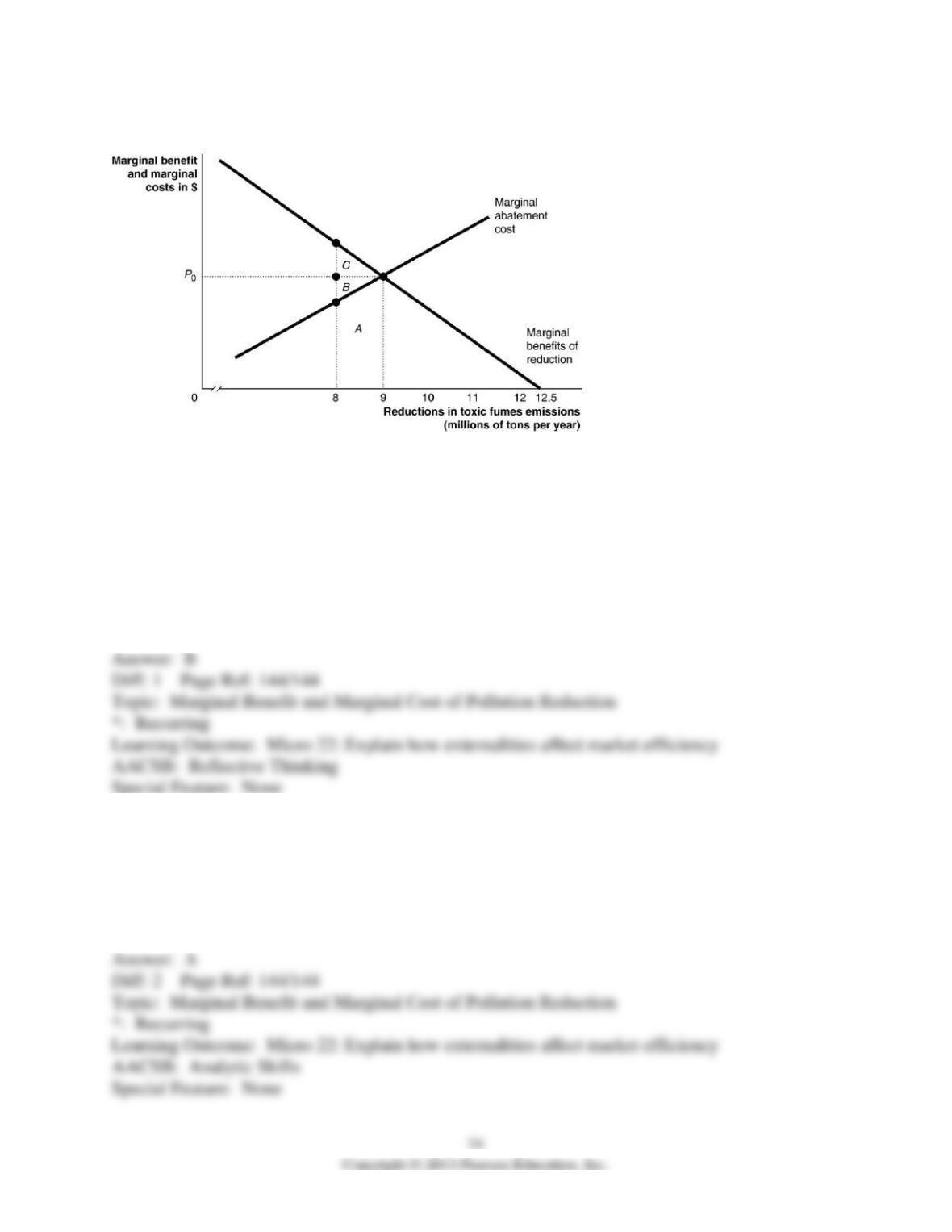
Figure 5-4
Consider a chemical plant that discharges toxic fumes over a nearby community. To reduce the
emissions of toxic fumes the firm can install pollution abatement devices. Figure 5-4 shows the
marginal benefit and the marginal cost from reducing the toxic fumes emissions.
15) Refer to Figure 5-4. What is the economically efficient level of pollution reduction?
A) 12.5 million tons
B) 9 million tons
C) 8 million tons
D) 0 tons
16) Refer to Figure 5-4. Suppose the emissions reduction target is currently established at 8
million tons. What is the area that represents the cost of eliminating an additional 1 million tons?
A) A
B) B + C
C) A + B
D) A + B + C
17) Refer to Figure 5-4. Suppose the emissions reduction target is currently established at 8
million tons. Should society undertake to reduce an additional 1 million tons so that the total
reduction is 9 million tons?
A) No, because there is a net cost represented by the area B + C.
B) Yes, because the marginal benefit exceeds the marginal costs.
C) Yes, because toxic fumes are dangerous and must be eliminated at any cost.
D) No, because the firms will pass the additional cost on to consumers.
18) Suppose a negative externality exists in a market. If transactions costs are low and parties are
willing to bargain then, according to the Coase theorem,
A) an efficient solution can be reached only if property rights are assigned to the victims of the
pollution.
B) an efficient solution can be reached only if property rights are assigned to the polluters.
C) an efficient solution can be reached regardless of the initial assignment of property rights.
D) government intervention is critical to reach an efficient solution.
19) Congressman Murphy made the following proposal: “We should establish policies that
completely eliminate air pollution. This is the only way to ensure that none of our citizens suffers
the negative effects of air pollution.” If Congressman Murphy’s proposal was adopted and all
forms of air pollution were eliminated, which of the following would be true?
A) The total cost of pollution reductions would equal the total benefit to society.
B) Economic efficiency would be maximized
C) The total benefit to society from reductions in air pollution would be maximized.
D) The marginal cost from pollution reductions would exceed the marginal benefit.
20) The Coase Theorem asserts that government intervention is a prerequisite for addressing
externality problems.
21) If transactions costs are low, private bargaining will always result in an efficient solution to
the problem of externalities.
22) What are transactions costs? Why do transactions costs create difficulties in finding a private
solution to the problem of pollution?
23) State the Coase theorem. What are some of the limitations of the Coase theorem in practice?
24) Ronald Coase is famous for the Coase Theorem, which is based on the premise that there is
an economically efficient level of pollution reduction. Many economists believe that the tradable
emissions allowance program that has been used to deal with the problem of acid rain has been
successful in reducing emissions of sulfur dioxide in an economically efficient manner. Why
isn’t this program an example of the Coase Theorem?
5.3 Government Policies to Deal with Externalities
1) The first economist to systematically analyze market failure was
A) Adam Smith.
B) Ronald Coase.
C) A. C. Pigou.
D) J. E. Meade.
2) Assume that production from an electric utility caused acid rain. If the government imposed a
tax on the utility equal to the cost of the acid rain, the government’s action would
A) externalize the externality.
B) result in a marginal social benefit greater than the marginal cost of the electricity.
C) be an example of supply side economic policy.
D) internalize the externality.
3) Assume that production from an electric utility caused acid rain and that the government
imposed a tax on the utility equal to the cost of the acid rain. This is an example of
A) a transaction cost.
B) a Pigovian tax.
C) a Pigovian subsidy.
D) the Coase Theorem.
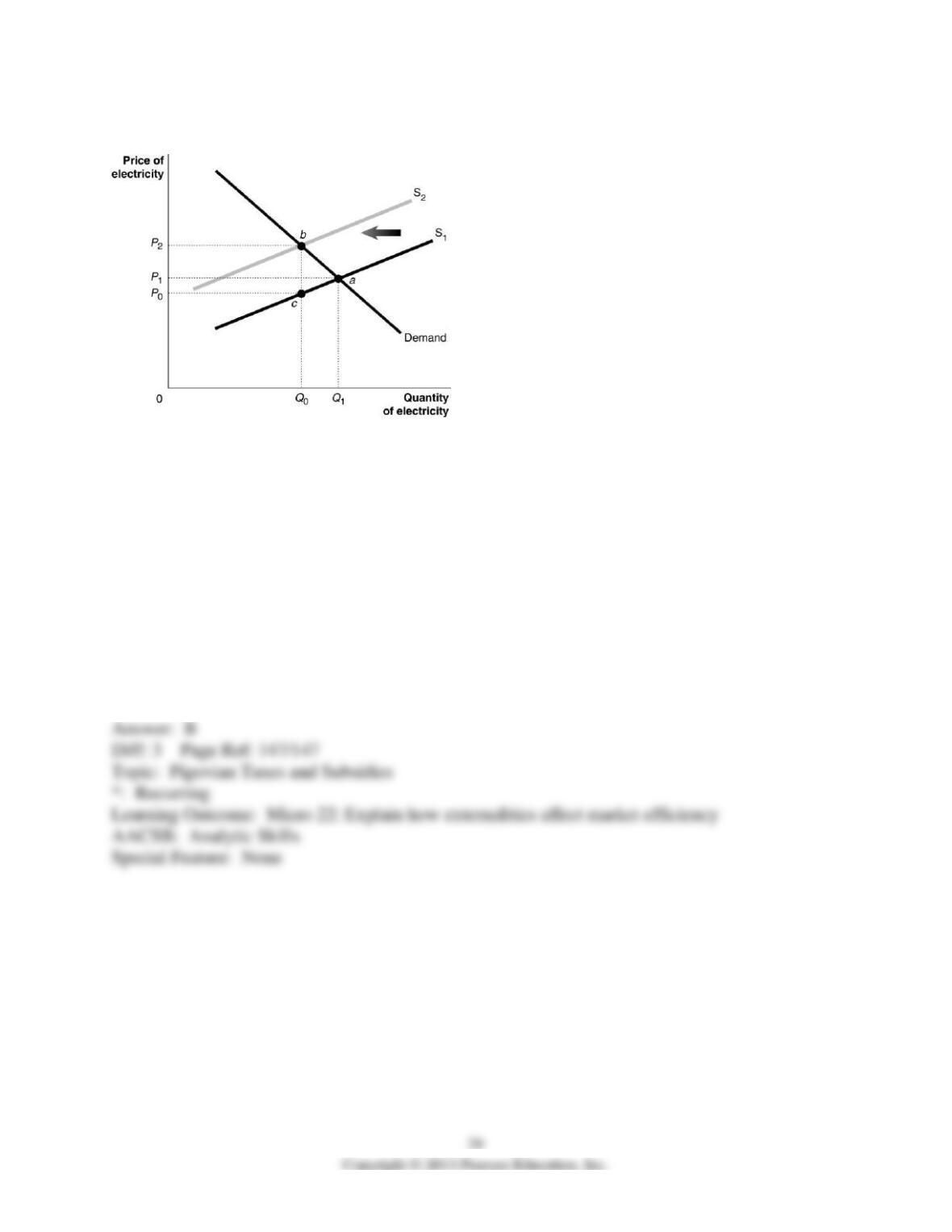
Figure 5-5
Coal burning utilities release sulfur dioxide and nitric acid which react with water to produce
acid rain. Acid rain damages trees and crops and kills fish. Because the utilities do not bear the
cost of the acid rain they overproduce the quantity of electricity. This is illustrated in Figure 5-5.
4) Refer to Figure 5-5. S1 represents the supply curve that reflects the private cost of production
and S2 represents the supply curve that reflects the social cost of production. One way to
internalize the external cost generated by utilities is to impose a Pigovian tax on the production
of electricity. What is the size of the Pigovian tax that will internalize the cost of the externality?
A) P0
B) P2–P0
C) P1–P0
D) P2–P1
5) Policies that mandate the installation of specific pollution control devices are called
A) command and control policies.
B) benefit policies.
C) welfare policies.
D) incentive policies.
6) Economic incentives are designed to make individual self-interest coincide with social
interest. According to economists, which of the following methods of pollution control best uses
economic incentives to reduce pollution?
A) Rewarding environmental groups for monitoring the activities of private firms that produce
products which generate pollution.
B) Imposing quantitative limits on the amount of pollution and imposing a penalty for non-
compliance with these limits.
C) Requiring the installation of specific pollution control devices.
D) Instituting a system of tradable emissions allowances.
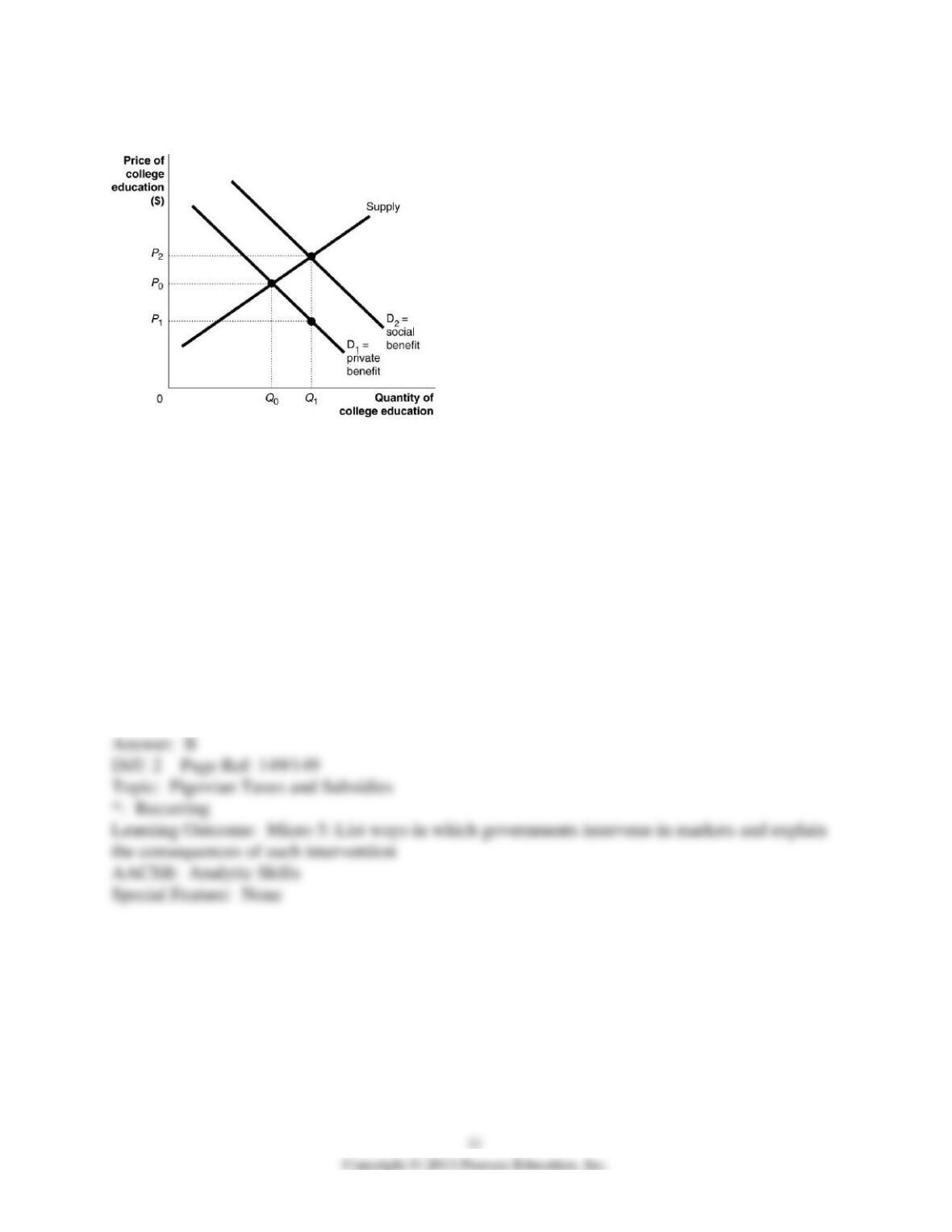
Figure 5-6
College education benefits society by producing a more employable workforce, reducing crime
and creating a better informed citizenry. Thus, the social benefits of college education exceed the
private benefits for any level of college education. This is illustrated in Figure 5-6.
7) Refer to Figure 5-6. One way to obtain the economically efficient amount of college
education is for governments to subsidize college education. What is the size of the per-student
Pigovian subsidy that the government must provide to internalize the external benefits? (Note
that the subsidy can be granted to the education institutions or to the students directly or
indirectly; for example, through low-interest student loans.)
A) P2–P0
B) P2–P1
C) P0–P1
D) P1
8) State and local governments subsidize college students with grants and low-interest loans. The
loans and subsidies are examples of
A) positive externalities.
B) Coase subsidies.
C) Pigovian subsidies.
D) emission allowances.
9) Which of the following is an example of a Pigovian tax?
A) payments by utilities to obtain tradable emissions allowances
B) a payroll tax
C) payments for licenses to pollute
D) a tax imposed on a utility that internalizes the cost of externalities caused by the utility
10) The efficient level of paper production will occur where the
A) marginal private benefit from consuming paper is equal to the marginal social cost of
production.
B) marginal social benefit from consuming paper is equal to the marginal social cost of
production.
C) the economically efficient level of the output of paper is equal to the economically efficient
level of inputs.
D) production of paper no longer produces negative externalities.
11) Which of the following describes a positive externality?
A) John Henry paints the outside of his house in order to increase its market value just before he
puts the house up for sale.
B) People who do not attend college still benefit from others who receive a college education.
C) The government imposes a tax on cigarettes in order to discourage smoking among teenagers.
D) Mary volunteers to drive her neighbor’s children to soccer practice.
12) The U.S. government has frequently used a “command and control” approach in dealing with
pollution. Which of the following describes this approach?
A) The government uses taxes in order to internalize the externalities caused by pollution.
B) The government uses subsidies to encourage firms to use new technology that reduces
pollution.
C) The government imposes quantitative limits on the amount of pollution firms are allowed to
generate.
D) The government distributes information to consumers and producers on how to reduce
pollution.
13) Which of the following is an example of the U.S. government’s use of a “command and
control” approach to reducing pollution?
A) In 1990 Congress approved measures designed to reduce sulfur dioxide emissions to 8.5
million tons annually by 2010.
B) The U.S. government imposed a tax on electric utilities to reduce damages from acid rain.
C) The government issued electric utilities tradable emissions allowances in other to reduce
emissions of nitrogen oxide.
D) In the 1980s the U.S. government required the installation of catalytic converters to reduce
emissions from all new automobiles.
14) Economists generally favor the use of tradable emissions allowances to reduce pollution.
However, the use of these allowances has been criticized by some environmentalists. Which of
the following describes this criticism?
A) Some environmentalists believe the allowances give firms a license to pollute.
B) Some environmentalists believe that the price of allowances is often too high for consumers
to afford.
C) Some environmentalists believe that Pigovian taxes are a more efficient way to reduce
pollution.
D) Some environmentalists oppose allowances on legal grounds; they believe the use of
allowances is unconstitutional.
15) If the government decides to impose a tax on potato chips, the government will cause
A) consumers to internalize the externality.
B) producers to internalize the externality.
C) the external cost to drinking soda to become a private cost paid by the government.
D) the external cost to drinking soda to become a private cost paid by producers.
16) All else equal, if the government decides to impose a tax on potato chips, the equilibrium
quantity of potato chips would ________ and the equilibrium price of potato chips would
________.
A) increase; increase
B) increase; decrease
C) decrease; increase
D) decrease; decrease
17) The 2005 European Union Emission Trading Scheme is an agreement among ________ to
reduce carbon dioxide emissions.
A) the European Union and the United States
B) 24 European Union nations
C) Western Europe and Africa
D) The European Union and the Asian nations of China, Japan, and South Korea
18) When the government imposes a tax equal to the external cost of producing a product that
causes pollution, the government is said to externalize the externality.
19) A.C. Pigou argued that the government can deal with a positive externality in consumption
by giving consumers a subsidy equal to the value of the externality.
20) Issuing marketable emission allowance permits to polluting firms will result in those firms
polluting more than is socially desirable.
21) What is meant by the term “internalizing an externality”? How does a Pigovian tax or
subsidy internalize an externality?
22) Some environmentalists have criticized tradable emissions allowances on the grounds that
they give permit holders a license to pollute. Furthermore, environmentalists argue that those
who sell their permits receive a monetary benefit from their contribution to polluting the
environment. Use economic reasoning to evaluate this criticism.