Microeconomics, 4e – Testbank 2 (Hubbard)
Chapter 5 Externalities, Environmental Policy, and Public Goods
5.1 Externalities and Economic Efficiency
1) An externality
A) is a benefit or cost that affects someone who is not directly involved in the production or
consumption of a good or service.
B) enhances market efficiency.
C) is a private cost or benefit that results from the production or consumption of a good or
service that is external to a market.
D) refers to production or consumption that occurs outdoors.
2) Pollution is an example of a
A) public good.
B) positive externality.
C) private cost.
D) negative externality
3) Which of the following would result in a positive externality?
A) A local government establishes a price ceiling on rental apartments.
B) An electric utility burns coal that causes acid rain.
C) Medical research results in a cure for malaria.
D) McDonald’s adds new fat-free items to its menu.
4) In the past the federal government often employed what is called a “command and control”
approach to the reduction of pollution emissions. Many economists are critical of this approach
because
A) it does not lead to significant reductions in pollution.
B) they believe a market-based approach will reduce emissions more efficiently.
C) the “command and control” approach is designed to help firms at the expense of consumers.
D) the “command and control” approach leads to negative externalities.
5) A positive externality results when
A) economists are sure that a good or service provides benefits to consumers.
B) someone pays for a good or service even though she is not directly affected by the production
or consumption of it.
C) when people who live in one country benefit from the production of a good or service that
occurs in another country.
D) people who are not directly involved in producing or paying for a good or service benefit
from it.
6) Which of the following describes how a negative externality affects a competitive market?
A) The externality causes a difference between the private cost of production and the social cost.
B) The externality causes a difference between the private cost of production and the private
benefit from consumption.
C) The externality causes consumer surplus to exceed producer surplus.
D) The externality causes a difference between the private cost of production and the equilibrium
price.
7) A free market fails when
A) there is government intervention.
B) there is an external effect in either production, consumption, or both.
C) firms that produce goods which create positive externalities go bankrupt.
D) firms that produce goods which create negative externalities earn high profits.
8) Which of the following could be evidence of a market failure?
A) Resources in an economy are not fully utilized.
B) The market price of a product is above the average cost of production.
C) There are only a handful of firms competing against each other in an industry.
D) Market prices do not reflect true production costs.
9) Alternative approaches for reducing carbon dioxide emissions are
A) carbon taxes and carbon scrubbing.
B) carbon trading and carbon subsidies.
C) carbon taxes and carbon trading.
D) burning low carbon coal and deforestation.
10) Which of the following describes how a positive externality affects a competitive market?
A) The externality causes a difference between the private benefit from consumption and the
social benefit.
B) The externality causes a difference between the private benefit from production and the social
cost of production.
C) The externality causes quantity demanded to exceed quantity supplied.
D) The externality causes a difference between the social cost of production and the social cost
of consumption.
11) “A competitive market achieves economic efficiency by maximizing the sum of consumer
surplus and producer surplus.” This statement
A) is true only if there are positive externalities in production in the market.
B) is true only if there are no negative externalities in the market.
C) is true only if there are no positive or negative externalities in the market.
D) is true in theory, but economic efficiency cannot be achieved in a real market.
12) If there are no externalities a competitive market achieves economic efficiency. If there is a
negative externality, economic efficiency will not be achieved because
A) too little of the good will be produced.
B) too much of the good will be produced.
C) a deadweight loss will occur that is equal to the area under the demand curve for the good.
D) economic surplus is maximized.
13) When there is a negative externality, the private cost of production ________ the social cost
of production.
A) is greater than
B) is equal to
C) eliminates
D) is less than
14) When there is a positive externality
A) the private benefit received by consumers is greater than the external benefit.
B) the social benefit received by consumers is greater than the private benefit.
C) the private benefit received by consumers is greater than the private cost.
D) the private benefit received by consumers is greater than the social benefit.
15) When production generates a negative externality, the true cost of production is the
A) private cost of production.
B) public cost of production.
C) social cost of production.
D) average cost of production.
16) If the social cost of producing a good or service exceeds the private cost,
A) a positive externality exists.
B) the sum of consumer surplus and producer surplus is maximized.
C) the market achieves economic efficiency.
D) a negative externality exists.
17) The cost borne by a producer in the production of a good or service is called
A) private cost.
B) public cost.
C) social cost.
D) internal cost.
18) If the social benefit of consuming a good or a service exceeds the private benefit
A) a negative externality exists.
B) the market achieves economic efficiency.
C) a positive externality exists.
D) the sum of consumer surplus and producer surplus is maximized.
19) An external cost is created when you
A) graduate from college.
B) buy flowers for your mother on Mother’s Day.
C) litter on the side of the road.
D) buy a sandwich for lunch.
20) When there is an externality in a market
A) the externality will move the market to an economically efficient equilibrium.
B) the externality will cause the market price to be less than or greater than the equilibrium price.
C) the government should use price controls to enable the market to reach equilibrium.
D) government intervention may increase economic efficiency.
21) The social cost of cutting trees for firewood in a government forest is
A) the increased likelihood of flooding as more trees are cut.
B) the increased likelihood of flooding as more trees are cut plus the private cost of cutting the
trees.
C) opportunity cost to the individual of cutting the wood.
D) the marginal costs of cutting the last tree.
22) Assume that emissions from electric utilities contribute to pollution in the form of acid rain.
Which of the following describes how this affects the market for electricity?
A) The equilibrium in the market is not efficient; the marginal benefit from electricity is greater
than the marginal social cost.
B) A deadweight loss occurs; at equilibrium the additional social cost of production is greater
than the additional benefit to consumers.
C) The equilibrium in the market is not efficient; because of the cost of the acid rain, economic
efficiency would be greater if more electricity were produced.
D) The equilibrium in the market is not efficient; consumer surplus is equal to producer surplus.
23) Medical research that ends in a cure for a serious disease produces positive externalities.
What is the impact of this positive externality on economic efficiency?
A) At equilibrium, less than the economically efficient quantity of medical research is produced.
B) A deadweight loss occurs because at equilibrium the marginal social cost of medical research
is greater than the marginal social benefit.
C) At equilibrium, more than the economically efficient quantity of medical research is
produced.
D) A deadweight loss occurs because at equilibrium the marginal social cost equals the marginal
social benefit.
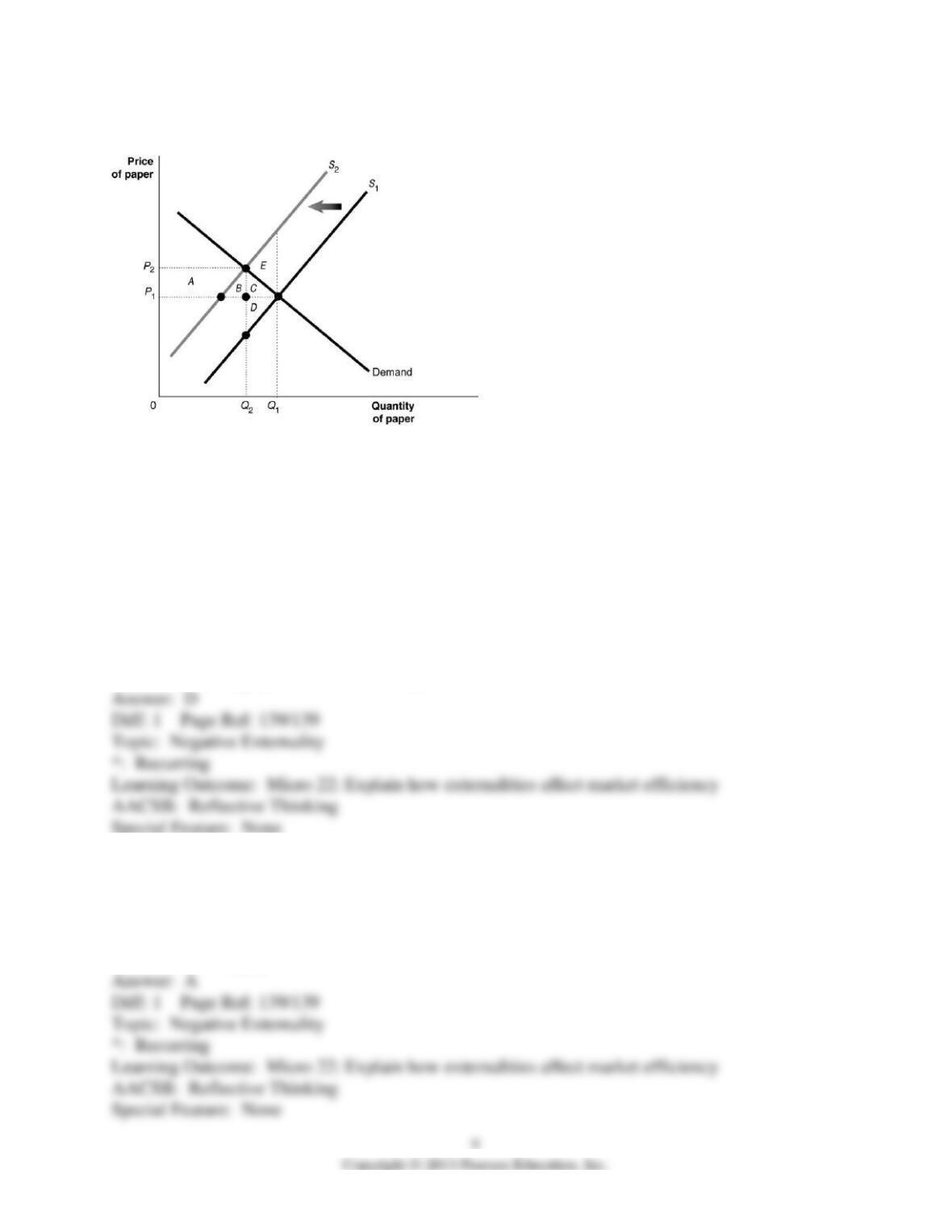
Figure 5-1
Suppose there are several paper mills producing paper for a market. These mills, located
upstream from a fishing village, discharge a large amount of wastewater into the river. The waste
material affects the number of fish in the river, and the use of the river for recreation and as a
public water supply source. Figure 5-1 shows the paper market. Use this Figure to answer the
following question(s).
24) Refer to Figure 5-1. What does S1 represent?
A) the market supply curve that reflects social cost
B) the market supply curve that reflects only external cost
C) the market supply curve that reflects only private benefit
D) the market supply curve that reflects private cost
25) Refer to Figure 5-1. What does S2 represent?
A) the market supply curve that reflects social cost
B) the market supply curve that reflect private cost
C) the market supply curve that reflects external cost
D) the market supply curve that reflects social benefit
26) Refer to Figure 5-1.What is the economically efficient output level?
A) Q1
B) Q2 minus Q1
C) Q2
D) Q1 plus Q2
27) Refer to Figure 5-1. What is the deadweight loss from producing at the market equilibrium?
A) area C
B) area E
C) area D
D) area F
28) Refer to Figure 5-1. Why is there a deadweight loss?
A) because the marginal social cost of producing each additional unit in excess of Q2 exceeds
the marginal benefit
B) because the marginal private cost of producing each additional unit in excess of Q2 exceeds
the marginal benefit
C) because the marginal social benefit of producing each additional unit in excess of Q2 exceeds
the private cost
D) because the marginal private benefit of producing each additional unit in excess of Q2
exceeds the social cost
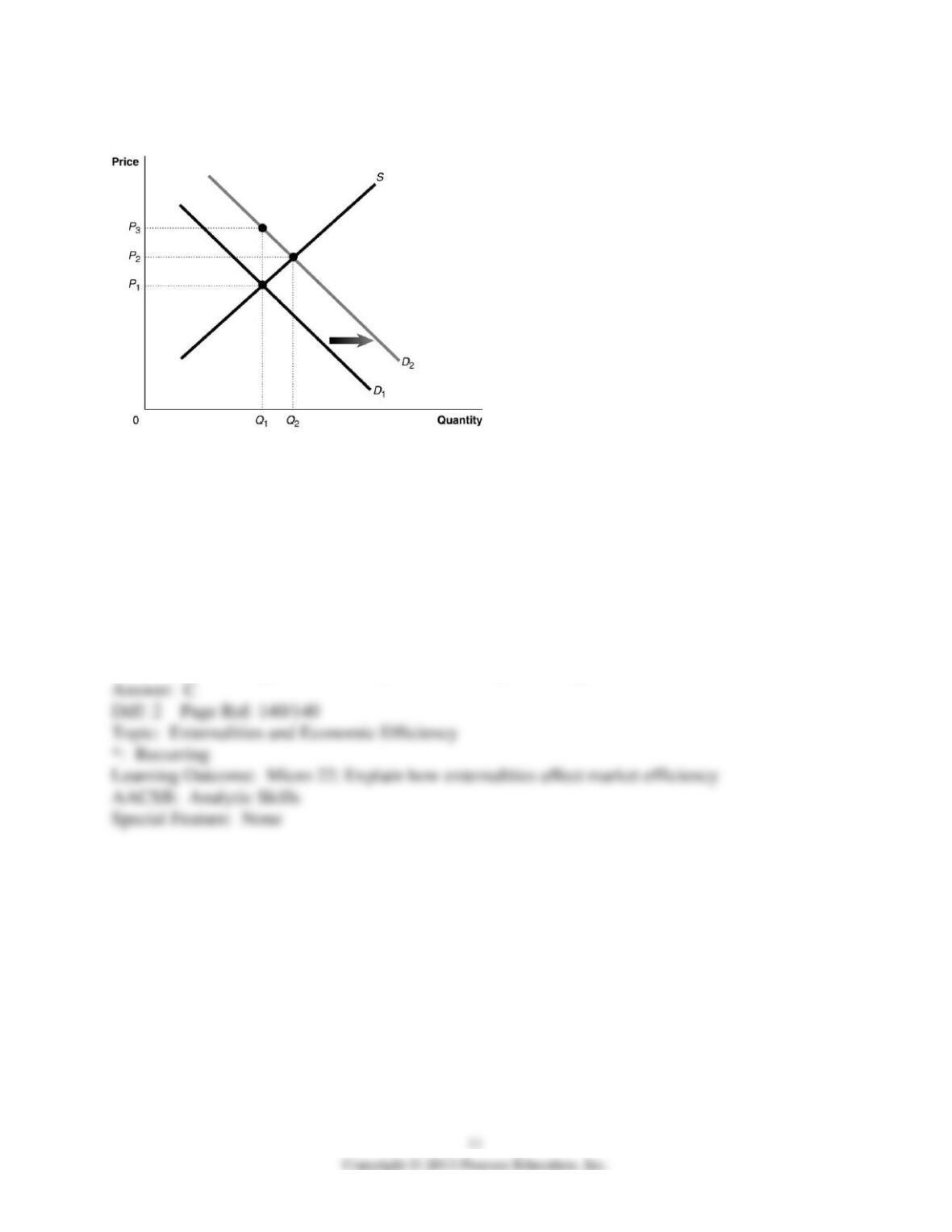
Figure 5-2
Figure 5-2 shows a market with an externality. The current market equilibrium output of Q1 is
not the economically efficient output. The economically efficient output is Q2.
29) Refer to Figure 5-2. Suppose the current market equilibrium output of Q1 is not the
economically efficient output because of an externality. The economically efficient output is Q2.
In that case, diagram shows
A) the effect of a subsidy granted to producers of a good.
B) the effect of an excess demand in a market.
C) the effect of a positive externality in the consumption of a good.
D) the effect of a negative externality in the consumption of a good.
30) Refer to Figure 5-2. If, because of an externality, the economically efficient output is Q2
and not the current equilibrium output of Q1, what does D1 represent?
A) the demand curve reflecting external benefits
B) the demand curve reflecting social benefits
C) the demand curve reflecting private benefits
D) the demand curve reflecting the sum of private and social benefits
31) Refer to Figure 5-2. If, because of an externality, the economically efficient output is Q2
and not the current equilibrium output of Q1, what does D2 represent?
A) the demand curve reflecting external benefits
B) the demand curve reflecting social benefits
C) the demand curve reflecting private benefits
D) the demand curve reflecting the sum of social and external benefits
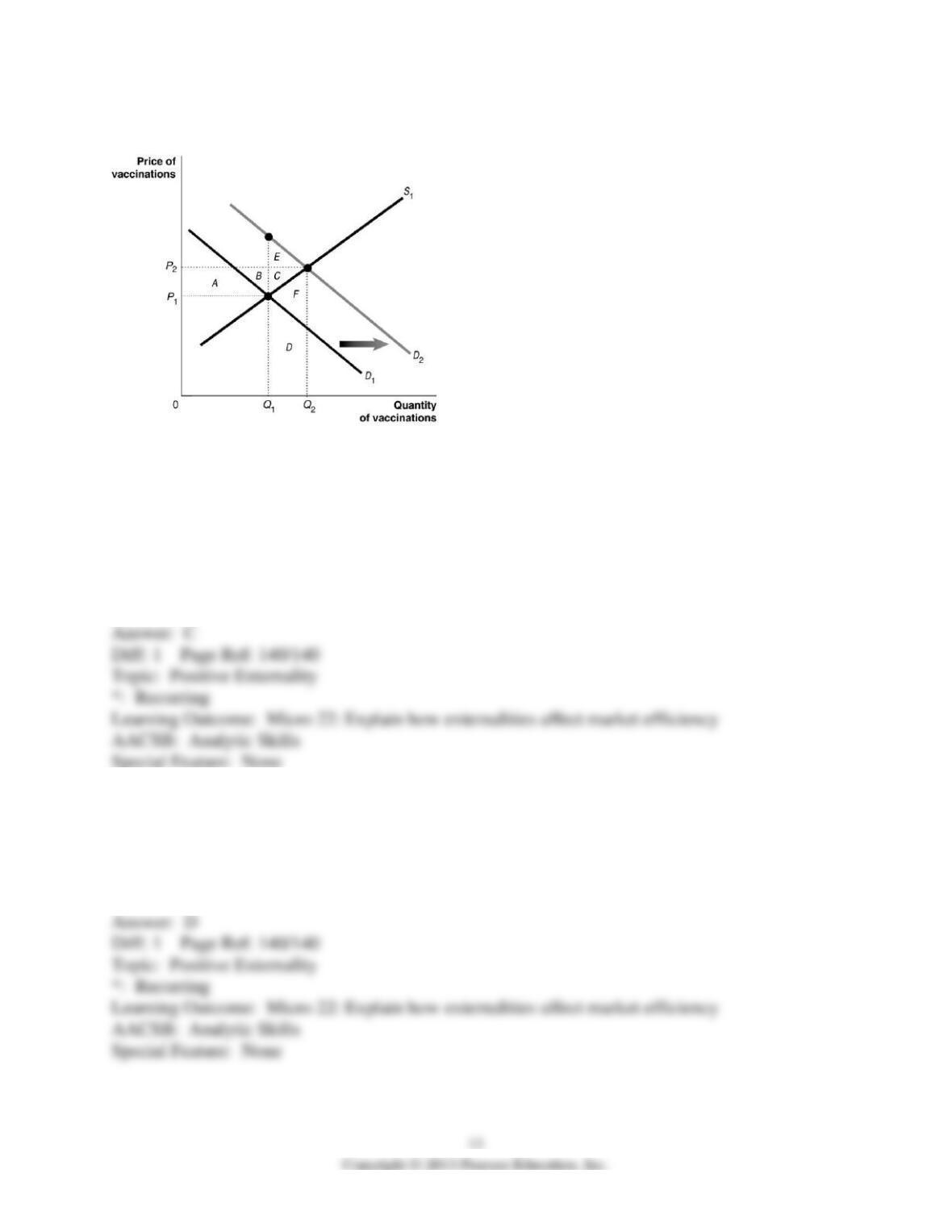
Figure 5-3
Figure 5-3 shows the market for measles vaccinations, a product whose use generates positive
externalities.
32) Refer to Figure 5-3. What does D1 represent?
A) the demand curve reflecting social benefit
B) the positive externalities curve
C) the demand curve reflecting private benefit
D) the social welfare curve
33) Refer to Figure 5-3. What is the economically efficient output level?
A) Q1
B) Q1 + Q2
C) Q2 – Q1
D) Q2
34) Refer to Figure 5-3. What does D2 represent?
A) the social welfare curve
B) the demand curve reflecting social benefit
C) the demand curve reflecting private benefit
D) the positive externalities curve
35) Refer to Figure 5-3. What is the market equilibrium output level?
A) Q1
B) Q2
C) Q1 + Q2
D) Q2 – Q1
36) Refer to Figure 5-3. What is the deadweight loss resulting from producing at the market
equilibrium?
A) B + C
B) E + C
C) F
D) C
37) Refer to Figure 5-3. Why is there a deadweight loss?
A) because the marginal private benefit for each additional unit between Q1 and Q2 exceeds the
marginal cost
B) because the marginal private cost for each additional unit between Q1 and Q2 exceeds the
marginal private benefit
C) because the marginal social cost for each additional unit between Q1 and Q2 exceeds the
marginal social benefit
D) because the marginal social benefit for each additional unit between Q1 and Q2 exceeds the
marginal cost
38) The social cost of a good or service is the cost borne by the producer.
39) An externality is an example of a market failure.
40) When products that create positive externalities are produced, at the market equilibrium
output, the social benefit generated by consuming the product exceeds the private benefit.
41) An external benefit is created when you pursue a college education.
42) When negative externalities exist, the competitive market supply curve does not include all
of the costs borne by members of society.
43) What is a private benefit from consumption? What is a social benefit from consumption?
When is the private benefit from consumption equal to the social benefit from consumption?
44) A negative externality is an example of market failure. The root of the problem lies in the
definition and enforcement of property rights. Explain.
45) How does a positive externality in consumption reduce economic efficiency?
5.2 Privates Solutions to Externalities: The Coase Theorem
1) Ronald Coase was awarded the 1991 Nobel Prize in Economics primarily for addressing
problems related to externalities. Which of the following describes Coase’s work?
A) Coase argued that government intervention is necessary to achieve economic efficiency in
markets that are affected by externalities.
B) Coase proved that economic efficiency cannot be achieved in a market that is affected by
positive or negative externalities.
C) Coase argued that under some circumstances private solutions to the problems of externalities
will occur.
D) Coase proved that a competitive market achieved a greater degree of economic efficiency
than a non-competitive market when externalities occur.
2) Which of the following statements describes the Coase Theorem?
A) It is not possible to completely eliminate an externality.
B) Under some circumstances private solutions to the problems that result from externalities can
be found.
C) Completely eliminating an externality is not economically efficient.
D) A negative externality occurs when the marginal social cost of production exceeds the social
benefit.
3) Congress passed the Clean Air Act in 1970. Since this act was passed, emissions of the six
main air pollutants
A) have fallen by more than one-half.
B) have increased significantly due to the growth of the U.S. economy.
C) cannot be measured since Congress failed to appropriate money to monitor the level of
emissions.
D) have remained essentially constant, even though significant economic growth has occurred in
the United States since 1970.
4) Kenneth Chay and Michael Greenstone examined the impact of reductions in air pollution
since the passage of the Clean Air Act of 1970. Which of the following statements summarizes
their findings?
A) The marginal benefit of reductions in air pollution was less than the marginal cost.
B) The marginal cost of reducing emissions of sulfur dioxide has increased over time as the
marginal benefit of the reductions has increased.
C) The benefits of reducing the six main air pollutants in the two years following the Act greatly
exceeded the costs.
D) In the two years following passage of the Act, fewer infants died than would have died if the
Act had not been passed.
5) If electric utilities continually reduce their emissions of sulfur dioxide,
A) the utilities will eventually be forced to go out of business.
B) the marginal benefit of additional emissions will rise.
C) the marginal cost of further emissions will rise.
D) the total benefit of sulfur dioxide emissions will fall.
6) If the marginal benefit of reducing emissions of some air pollutant is greater than the marginal
cost,
A) further reductions will make society better off.
B) the marginal benefit will rise and the marginal cost will fall as further reductions are made.
C) economic efficiency will be achieved when emissions are reduced to zero.
D) private businesses, rather the consumers, should be made to pay for the cost of further
reductions.
7) If the marginal benefit of reducing emissions of some air pollutant is less than the marginal
cost,
A) further reductions will make society better off.
B) further reduction will make society worse off.
C) pollution taxes should be imposed on producers to pay for further reductions.
D) economic efficiency will be increased if further reductions are made.
8) According to Steven Cheung: “Pollination contracts usually include stipulations regarding the
number and strength of …[bee] colonies, the rental fee per hive, the time of delivery…the
protection of bees from pesticides, and the strategic placing of hives.” Cheung cites this as
evidence that
A) the high costs of writing and enforcing complicated written agreements between owners of
beehives and apple orchards prevents economic efficiency from being achieved in these markets.
B) government intervention is not always necessary to bring about an economically efficient
number of apple trees and beehives.
C) government regulation of contracts between owners of beehives and apple orchards is
necessary to bring about an economically efficient number of apple trees and beehives.
D) the beekeeping and apple growing businesses have become more complicated and costly over
time due to the legal costs involved.