Chapter 58 – The Biosphere
58-1
Chapter 58
The Biosphere
Check All That Apply Questions
1. Which of the following are characteristics of biomes? Check all that apply.
Multiple Choice Questions
2. Researchers in Alaska were interested in increasing the sockeye salmon (Oncorhynchus
nerka) population in three coastal lakes. To accomplish this, the ponds were treated with
fertilizers. As a result, zooplankton biomass increased between 40% and 700% in the three
lakes. The substantial growth in zooplankton would suggest that prior to these experiments,
these lakes were __________________.
Chapter 58 – The Biosphere
58-2
Clarify Question
•
What is the key concept addressed by the question?
•
What type of thinking is required?
Gather Content
•
What do you already know about eutrophic vs. oligotrophic lakes?
Choose Answer
•
Given what you now know, what information and/or problem solving approach is most
likely to produce the correct answer?
Reflect on Process
•
Did your problem-solving process lead you to the correct answer? If not, where did the
process break down or lead you astray? How can you revise your approach to produce a
more desirable result?
Chapter 58 – The Biosphere
3. As the global concentration of carbon dioxide increases, there is great potential for direct
impact on the world’s
4. CO2 and other gases, which absorb the longer wavelengths of infrared light and radiated
heat from Earth, are responsible for causing the
5. If the energy of the sun no longer reached Earth, the primary productivity of which of the
following ecosystems would be least affected?
Chapter 58 – The Biosphere
58-4
6. While visiting the South Island of New Zealand, you notice that conditions vary sharply
across the island. The West Coast is very wet and receives between 600 and 1600 mm of
rainfall per year, while the East Coast only receives about 640 mm of rain per year and is very
dry. What best explains this regional difference in precipitation?
Chapter 58 – The Biosphere
58-5
Clarify Question
•
What is the key concept addressed by the question?
•
What type of thinking is required?
Gather Content
•
What do you already know about precipitation?
Choose Answer
•
Given what you now know, what information and/or problem solving approach is most
likely to produce the correct answer?
Reflect on Process
•
Did your problem-solving process lead you to the correct answer? If not, where did the
process break down or lead you astray? How can you revise your approach to produce a
more desirable result?
Chapter 58 – The Biosphere
58-6
7. The great deserts and associated arid areas of the world mostly lie along the western sides
of the continents at about
8. Drifting freely in the upper, well-illuminated waters of the ocean, a diverse biological
community exists, primarily consisting of microscopic organisms called
Check All That Apply Questions
Chapter 58 – The Biosphere
9. The distribution of biomes is dependent upon which of the following? Check all that apply.
Multiple Choice Questions
10. Most of the ultraviolet radiation reaching the upper atmosphere is absorbed by
Chapter 58 – The Biosphere
11. Periodic disturbances of the Pacific currents that cause global weather changes are given
the name
12. Photosynthetic organisms of the open oceans are confined to the upper
13. The relatively shallow part of the ocean extending from the low tide mark to the edge of
the continental shelf is called the
Chapter 58 – The Biosphere
58-9
14. During an ecology field trip to a lake, your professor asks you to take temperature
readings at various depths and record your data. At 5 meters, you note a temperature of 25C
and at 10 meters you record a temperature of 10C. Readings at 20 meters and below stay
fairly consistent around 8C. The temperature readings of 25C, 10C, and 8C represent
the:
Chapter 58 – The Biosphere
58–10
Clarify Question
•
What is the key concept addressed by the question?
•
What type of thinking is required?
Gather Content
•
What do you already know about thermal stratification?
Choose Answer
•
Given what you now know, what information and/or problem solving approach is most
likely to produce the correct answer?
Reflect on Process
•
Did your problem-solving process lead you to the correct answer? If not, where did the
process break down or lead you astray? How can you revise your approach to produce a
more desirable result?
Chapter 58 – The Biosphere
15. Destruction of which biome would result in the greatest loss of biodiversity?
16. Prairie is another name for a
17. Rhizosphaera needle cast is a fungal disease that affects spruce trees. Which of the
following biomes would be most severely affected by an outbreak of this disease?
Chapter 58 – The Biosphere
58–12
Clarify Question
•
What is the key concept addressed by the question?
o This question addresses biomes.
•
What type of thinking is required?
Gather Content
•
What do you already know about biomes?
Chapter 58 – The Biosphere
Choose Answer
•
Given what you now know, what information and/or problem solving approach is most
likely to produce the correct answer?
Reflect on Process
•
Did your problem-solving process lead you to the correct answer? If not, where did the
process break down or lead you astray? How can you revise your approach to produce a
more desirable result?
18. Tropical climates are warmer than temperate climates because
Chapter 58 – The Biosphere
19. Which of the following choices best describes the relationship that exists between
moisture and air temperature?
20. Which statement best describes the relationship between elevation and latitude?
Chapter 58 – The Biosphere
58–15
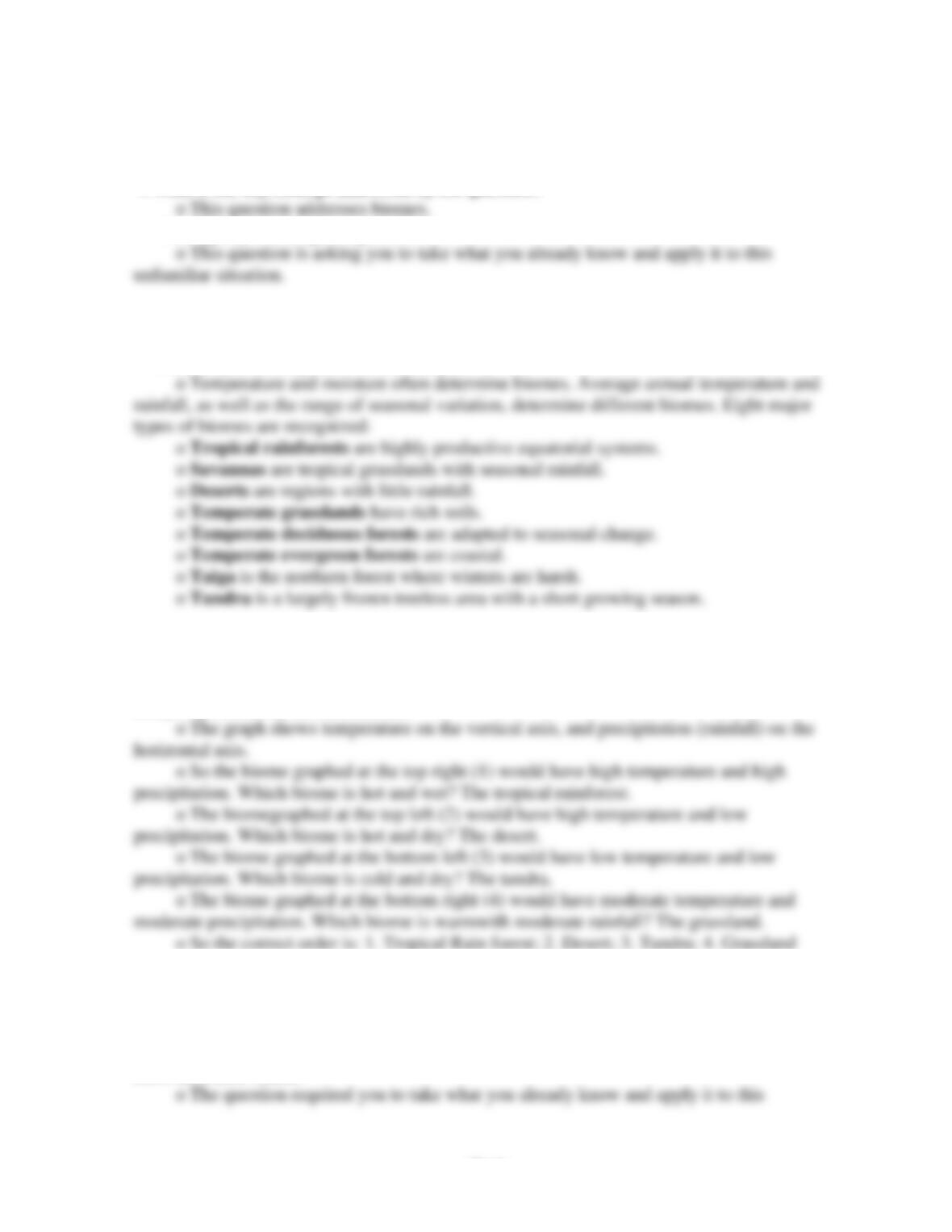
21. Biomes are broad regional areas with defined flora and fauna. Which one of the
following choices correctly identifies the biomes shown plotted in the graph of precipitation
versus temperature?
Chapter 58 – The Biosphere
58–16
Clarify Question
•
What is the key concept addressed by the question?
•
What type of thinking is required?
Gather Content
•
What do you already know about biomes?
Choose Answer
•
Given what you now know, what information and/or problem solving approach is most
likely to produce the correct answer?
o So the correct order is: 1. Tropical Rain forest; 2. Desert; 3. Tundra; 4. Grassland
Reflect on Process
•
Did your problem-solving process lead you to the correct answer? If not, where did the
process break down or lead you astray? How can you revise your approach to produce a
more desirable result?
Chapter 58 – The Biosphere
22. Biomagnification is a significant problem in aquatic communities. Levels of chemicals
magnify (increase or accumulate) at each new link in a food chain. Use the following
information to estimate the level of chemical X in a large-mouth bass. One alga can
accumulate 1 unit of chemical X. Eachcopepod eats 15 algae. A minnow consumes 10
copepods, each large-mouth bass consumes 20 minnows.
Chapter 58 – The Biosphere
58–18
Clarify Question
•
What is the key concept addressed by the question?
•
What type of thinking is required?
Gather Content
•
What do you already know about biomagnification?
Choose Answer
•
Given what you now know, what information and/or problem solving approach is most
likely to produce the correct answer?
Reflect on Process
•
Did your problem-solving process lead you to the correct answer? If not, where did the
process break down or lead you astray? How can you revise your approach to produce a
Chapter 58 – The Biosphere
more desirable result?
23. Temperate grasslands and temperate deciduous forests are two different biomes that are
located in the same latitudes. Which one of the following abiotic conditions is most likely to
account for the differences in their community composition?
24. If you plot mean annual precipitation against mean annual temperature and look at the
distribution of major biomes relative to these two variables, which biome would be in the
central region of the graph?