Hall: Guyton and Hall Textbook of Medical Physiology, 12th Edition
Chapter 57: Cerebral Cortex, Intellectual Functions of the Brain, Learning, and
Memory
Test Bank
1. An inability to properly vocalize words without a loss of understanding of the meaning of
the written word as well as the thought conveyed by the word might be associated with
damage to which brain structure?
A. The arcuate fasciculus
B. Wernicke’s area
C. The amygdale
D. The thalamus
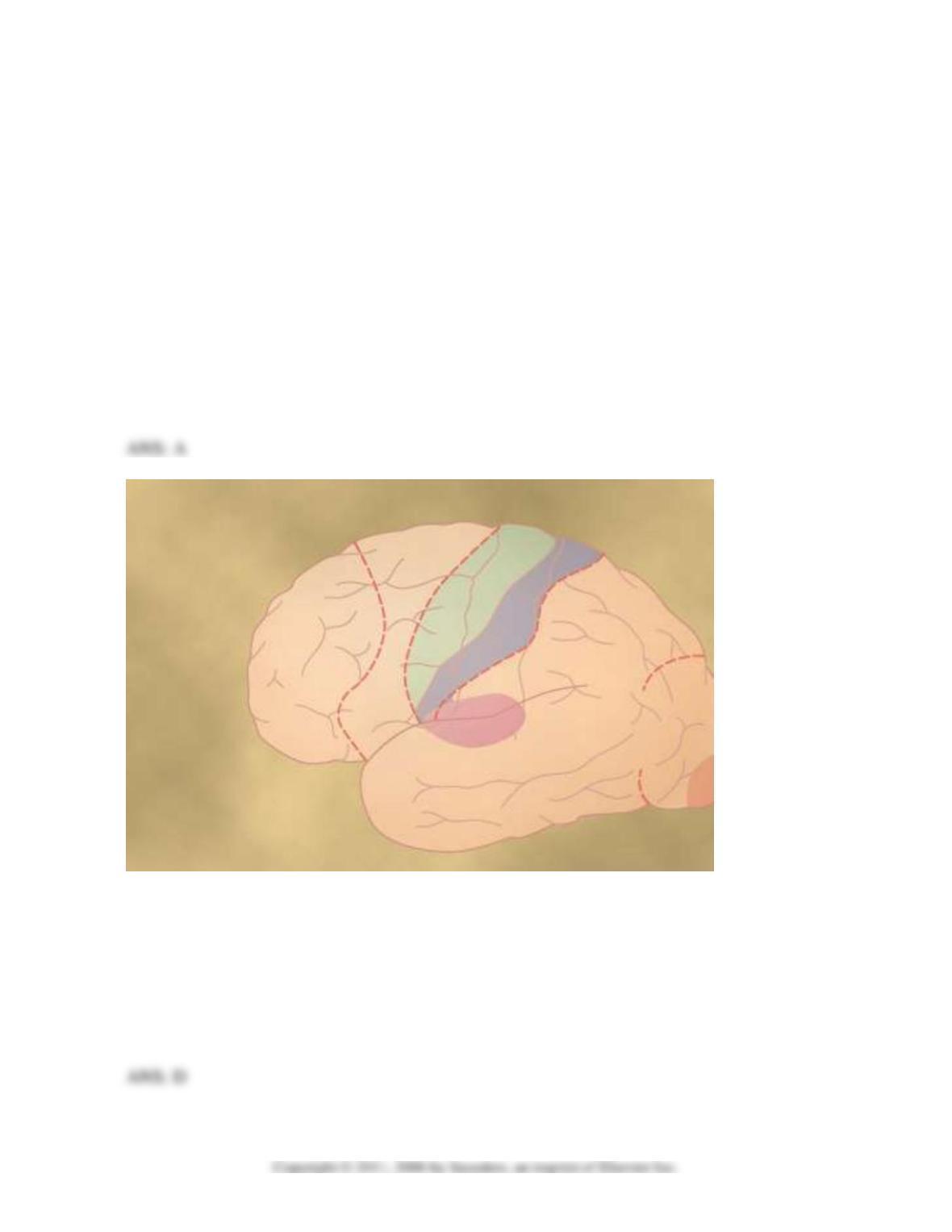
Questions 2-5: use the figure above to answer the questions.
2. Which structure connects brain areas D and B?
A. The medial forebrain bundle
B. The corpus callosum
C. The dorsal longitudinal fasciculus
D. The arcuate fasciculus
A
B
C
D
E

3. Which brain area is associated with verbal and symbolic intelligence?
A. A
B. B
C. D
D. E
4. Which brain area is associated with the elaboration of thought?
A. A
B. C
C. D
D. E
5. Which area of the brain contributes to our understanding of the spacial coordinates of the
body and its surroundings?
A. A
B. B
C. C
D. E
6. Which type of memory is thought to involve the potentiation of synaptic transmission
through the accumulation of calcium in the presynaptic membrane?
A. Immediate memory
B. Short-term memory
C. Lifelong memory
D. Long-term memory
7. The main function of Broca’s area of the cortex is:
A. To recognize a sound pattern as a word
B. To interpret the sound as a word and the underlying intellectual meaning that is
expressed by the word
C. To control the thinking mind
D. To activate and control the motor programs used in the vocalization of words
8. Retrograde amnesia is usually the result of damage to, or dysfunction of which of the
following structures?
A. The hippocampus

Test Bank
57-3
B. The subthalamus
C. The hypothalamus
D. The thalamus
9. The creation of memory can be interrupted by:
A. phosphorylation of a potassium channel to block it’s activity
B. activation of adenylate cyclase
C. an unnatural loss of consciousness
D. enhancing protein synthesis
10. Damage to Broca’s area on the dominant side of the brain results in which of the
following neurological symptoms?
A. Anterograde amnesia
B. Intension tremor
C. Ataxia
D. Aphasia
11. Which of the following structures provides the connection between Wernicke’s area and
Broca’s area in the cerebral cortex?
A. The medial lemniscus
B. The medial forebrain bundle
C. The corpus callosum
D. The arcuate fasciculus
12. Damage to the hippocamus may result in:
A. An inability to form new memories (i.e., anterograde amnesia)
B. A deficit in the sense of smell
C. An inability to recall past memories (i.e., retrograde amnesia)
D. Dysdiadochokinesia
13. Long-term memory differs from other types of memory in which of the following ways?
A. It is not destroyed by temporary cessation of consciousness
B. It can last for months or years
C. It requires a period of consolidation
D. All of the above

Test Bank
57-4
14. The two hemispheres of the brain are connected by which nerve fibers or pathways?
A. The lateral lemniscus
B. Corticofugal fibers
C. The corpus callosum
D. The arcuate fasciculus
15. How are thalamic structures involved in memory?
A. The thalamus is involved in the creation of memory
B. The thalamus provides the drive to consolidate memory
C. Thalamic structures are important for recalling memories
D. Thalamic structures are involved in determining which sensory experiences are
important and which ones are not