
Chapter 57 – Dynamics of Ecosystems
o Did you recognize that many factors can influence the productivity of an ecosystem?
30. In an ecosystem
31. During the 1960s, a group of scientists in the northeastern United States conducted an
experiment at Hubbard Brook, New Hampshire. A 38-acre watershed was completely
deforested and the runoff (water flow) monitored for several years. It was compared to an
adjacent watershed that was left untouched. The scientists collected data during those years
and found
32. In the food chain below, what does the blue jay represent?
crabgrass—cricket—garden spider—blue jay—red-tailed hawk

Chapter 57 – Dynamics of Ecosystems
Clarify Question
•
What is the key concept addressed by the question?
•
What type of thinking is required?
Gather Content
•
What do you already know about trophic levels?
Choose Answer
•
Given what you now know, what information and/or problem solving approach is most
likely to produce the correct answer?
Reflect on Process
•
Did your problem-solving process lead you to the correct answer? If not, where did the
process break down or lead you astray? How can you revise your approach to produce a
more desirable result?

Chapter 57 – Dynamics of Ecosystems
33. In the food chain below, what does the garden spider represent?
crabgrass—cricket—garden spider—blue jay—red-tailed hawk

Chapter 57 – Dynamics of Ecosystems
Clarify Question
•
What is the key concept addressed by the question?
•
What type of thinking is required?
Gather Content
•
What do you already know about trophic levels?
Choose Answer
•
Given what you now know, what information and/or problem solving approach is most
likely to produce the correct answer?
Reflect on Process
•
Did your problem-solving process lead you to the correct answer? If not, where did the
process break down or lead you astray? How can you revise your approach to produce a
more desirable result?

Chapter 57 – Dynamics of Ecosystems
57–25
34. A Viceroy caterpillar feeds on a leaf. One day’s feeding consumes 1000 calories worth of
leaves. 50% of the calories are lost in its feces and 33% of the calories are used in cellular
respiration.How many calories of the original intake are available to add to the caterpillar’s
biomass each day?

Chapter 57 – Dynamics of Ecosystems
Clarify Question
•
What is the key concept addressed by the question?
•
What type of thinking is required?
Gather Content
•
What do you already know about energy flow?
Choose Answer
•
Given what you now know, what information and/or problem solving approach is most
likely to produce the correct answer?
Reflect on Process
•
Did your problem-solving process lead you to the correct answer? If not, where did the
process break down or lead you astray? How can you revise your approach to produce a
more desirable result?
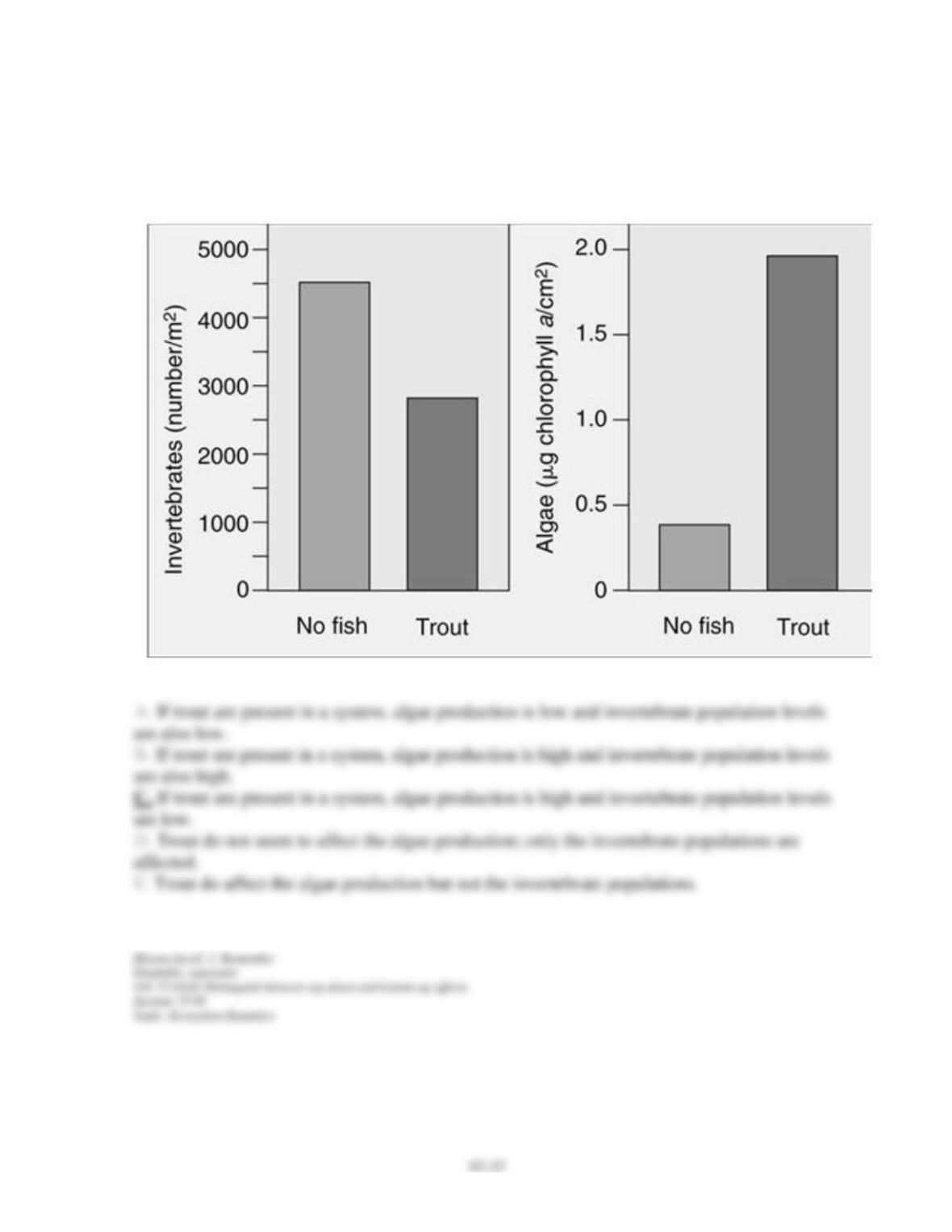
Chapter 57 – Dynamics of Ecosystems
35. The following figure shows studies in a stream where enclosures were set up either with
trout or with no trout. Which statement is a correct interpretation of the graph about trout,
invertebrates, and algae?

Chapter 57 – Dynamics of Ecosystems
36. Which one of the following ecosystems is most likely to show an inverted biomass
pyramid but a normal energy pyramid?
37. Which one of the following quantities best represents the respiratory heat lost by plants in
an ecosystem?
38. In a food chain with four trophic levels, what would be the energy in the top trophic level
if the energy contained in the primary producer level is 40,000 kcal/m2/yr? Assume a trophic
level transfer efficiency of 10%.

Chapter 57 – Dynamics of Ecosystems
Clarify Question
•
What is the key concept addressed by the question?
•
What type of thinking is required?
Gather Content
•
What do you already know about energy flow?
Choose Answer
•
Given what you now know, what information and/or problem solving approach is most
likely to produce the correct answer?
Reflect on Process
•
Did your problem-solving process lead you to the correct answer? If not, where did the
process break down or lead you astray? How can you revise your approach to produce a
more desirable result?

Chapter 57 – Dynamics of Ecosystems
57–30
39. In a food chain consisting of four trophic levels, if the energy present in the top level is
48 kcal/m2/yr, how much energy do you expect in herbivores? (Use an energy transfer rate of
10%.)

Chapter 57 – Dynamics of Ecosystems
Clarify Question
•
What is the key concept addressed by the question?
•
What type of thinking is required?
Gather Content
•
What do you already know about energy flow?
Choose Answer
•
Given what you now know, what information and/or problem solving approach is most
likely to produce the correct answer?
Reflect on Process
•
Did your problem-solving process lead you to the correct answer? If not, where did the
process break down or lead you astray? How can you revise your approach to produce a
more desirable result?

Chapter 57 – Dynamics of Ecosystems
57–32
40. In a marine ecosystem with an inverted biomass pyramid, which trophic level should have
the smallest number of organisms?
41. Addition of a primary carnivore to an ecosystem can sometimes influence the whole
ecosystem. This process is called
42. What feature do the carbon and nitrogen cycles have in common?
Check All That Apply Questions

Chapter 57 – Dynamics of Ecosystems
43. Which of the following are true statements about the carbon cycle? Check all that apply.
Multiple Choice Questions
44. According to MacArthur and Wilson’s island biogeography theory, which of the
following would be expected to have the smallest species richness?
45. The tropics are known to have greater species diversity than the temperate zones.Which
explanation for this phenomenon is the LEAST convincing?

Chapter 57 – Dynamics of Ecosystems
57–34
Clarify Question
•
What is the key concept addressed by the question?
Gather Content
•
What do you already know about species richness?
Choose Answer
•
Given what you now know, what information and/or problem solving approach is most
likely to produce the correct answer?

Chapter 57 – Dynamics of Ecosystems
Reflect on Process
•
Did your problem-solving process lead you to the correct answer? If not, where did the
process break down or lead you astray? How can you revise your approach to produce a
more desirable result?
Check All That Apply Questions
46. Which of the following observations were an outcome of studies by David Tilman and
coworkers at Cedar Creek, Minnesota on ecosystem stability? Check all that apply.

Chapter 57 – Dynamics of Ecosystems
47. Which one of the following statements about the trophic cascade in the sea otter and sea
urchin-kelp communities along the West Coast of North America are true? Check all that
apply.
Multiple Choice Questions
48. In an aquatic ecosystem, a secondary carnivore is temporarily excluded and then, after a
period of time, is returned. Which one of the following is NOT an expected top-down effect
after it is returned?

Chapter 57 – Dynamics of Ecosystems
57–37
Clarify Question
•
What is the key concept addressed by the question?
o This question addresses trophic cascades.
•
What type of thinking is required?
Gather Content
•
What do you already know about trophic cascades?
Choose Answer
•
Given what you now know, what information and/or problem solving approach is most
likely to produce the correct answer?
Reflect on Process
•
Did your problem-solving process lead you to the correct answer? If not, where did the
process break down or lead you astray? How can you revise your approach to produce a

Chapter 57 – Dynamics of Ecosystems
57–38
more desirable result?
Check All That Apply Questions

Chapter 57 – Dynamics of Ecosystems
49. Phosphorus deficiency often appears early in plant growth and results in stunting. Which
of the following are reasons why a deficiency in phosphorus would cause growth
abnormalities in plants? (Check all that apply.)
Clarify Question
•
What is the key concept addressed by the question?
•
What type of thinking is required?
Gather Content
•
What do you already know about the phosphorus cycle?
Choose Answer
•
Given what you now know, what information and/or problem solving approach is most
likely to produce the correct answer?
Reflect on Process
•
Did your problem-solving process lead you to the correct answer? If not, where did the
process break down or lead you astray? How can you revise your approach to produce a
more desirable result?

Chapter 57 – Dynamics of Ecosystems
50. Which of the following hypotheses support the basic principle of the species-area
relationship? Check all that apply.
Clarify Question
•
What is the key concept addressed by the question?
•
What type of thinking is required?
Gather Content
•
What do you already know about species richness?
Choose Answer
•
Given what you now know, what information and/or problem solving approach is most
likely to produce the correct answer?
Reflect on Process
•
Did your problem-solving process lead you to the correct answer? If not, where did the
process break down or lead you astray? How can you revise your approach to produce a
more desirable result?