
Chapter 56 – Community Ecology
36. You have been studying the relationship between jackals and tigers in India. Until
recently, the only relationship you have observed is that jackals will associate themselves with
a particular tiger and follow it at a safe distance in order to feed on the big cat’s kills.
However, recently you observed a jackal alerting a tiger to a kill with a loud cry. If you
continue to observe this alerting behavior, you might change the categorization of the
jackal/tiger relationship from ___________ to __________________.

Chapter 56 – Community Ecology
Clarify question:
What is the key concept addressed by the question?
What type of thinking is required?
Gather Content:
What do you already know about symbiotic relationships how the different behaviors of the
animals relate to each type of symbiosis? What other information is related to the
question?
Choose Answer:
Given what you now know, what information is most likely to produce the correct answer?
Reflection on Process:
Did your problem-solving process lead you to the correct answer? If not, where did the
process break down or lead you astray? How can you revise your approach to produce a
more desirable result?
Check All That Apply Questions
Chapter 56 – Community Ecology
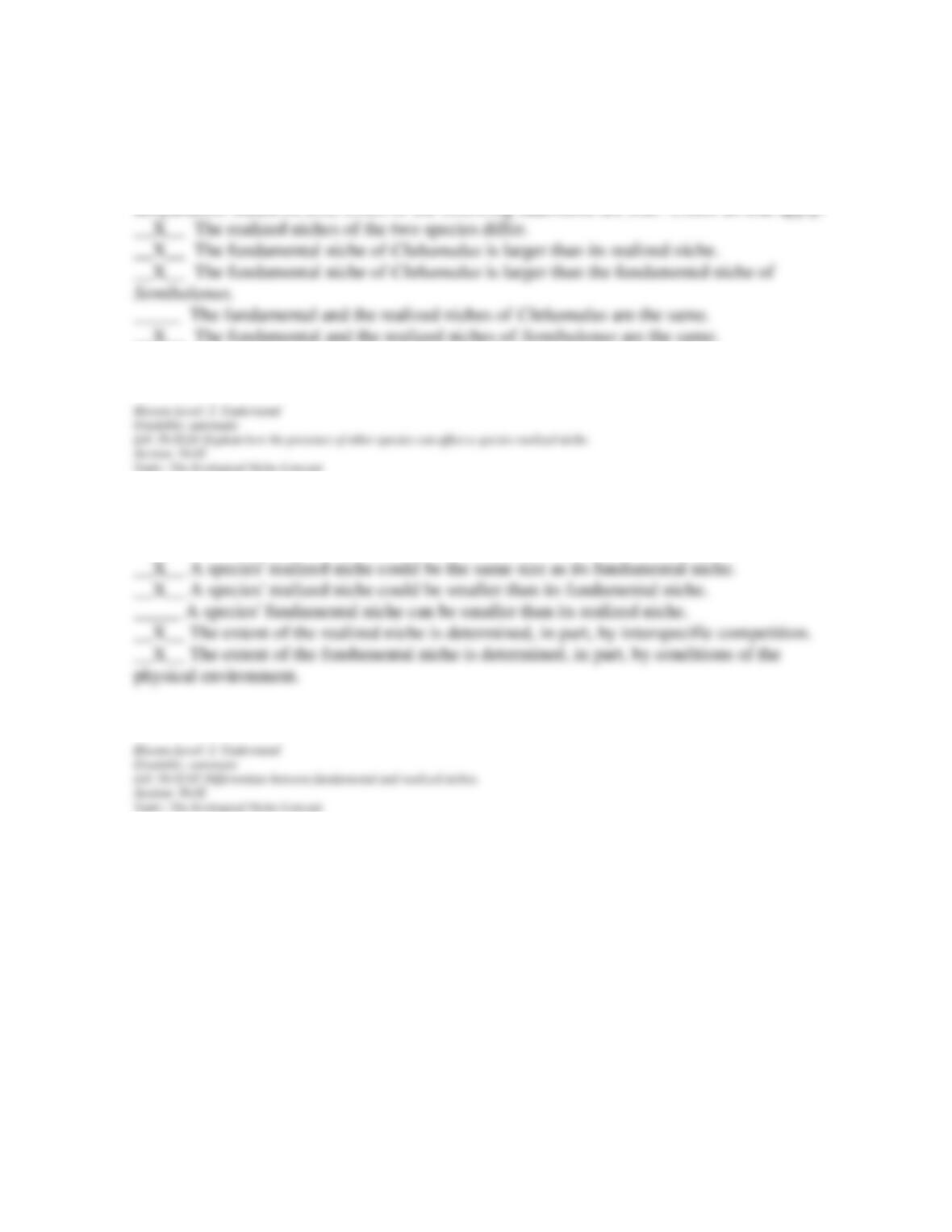
37. In studies of two species of barnacles in the marine intertidal zone it was observed that
Chthamalus can live in the upper intertidal zone and the lower intertidal zone if Semibalanus
is absent, and Semibalanus can only live in the lower zone because it is more subject to
dehydration. Based on this, which of the following statements are true? Check all that apply.
__X__ The fundamental and the realized niches of Semibalanus are the same.
38. Which of the following statements about the fundamental and realized niche are true?
Check all that apply.

Chapter 56 – Community Ecology
39. Which of the following factors could be important in determining a species’ fundamental
niche? Check all that apply.
Clarify question:
What is the key concept addressed by the question?
What type of thinking is required?
Gather Content:
What do you already know about fundamental niches and what factors influence the
niche? What other information is related to the question?
Choose Answer:
Given what you now know, what information is most likely to produce the correct answer?
Reflection on Process:
Did your problem-solving process lead you to the correct answer? If not, where did the
process break down or lead you astray? How can you revise your approach to produce a
more desirable result?
Multiple Choice Questions
40. Cattle egrets follow African ungulates such as African buffalo around and catch insects
that the buffalo flush out. Oxpeckers perch on the backs of buffalo and feed on ectoparasites

Chapter 56 – Community Ecology
that infest the buffalo. Which one of the following shows the ecological interaction that the
buffalo has with each bird?

Chapter 56 – Community Ecology
Clarify question:
What is the key concept addressed by the question?
What type of thinking is required?
Gather Content:
What do you already know about symbiotic relationships and the qualifications for each?
What other information is related to the question?
Choose Answer:
Given what you now know, what information is most likely to produce the correct answer?
Reflection on Process:
Did your problem-solving process lead you to the correct answer? If not, where did the
process break down or lead you astray? How can you revise your approach to produce a
more desirable result?
Check All That Apply Questions
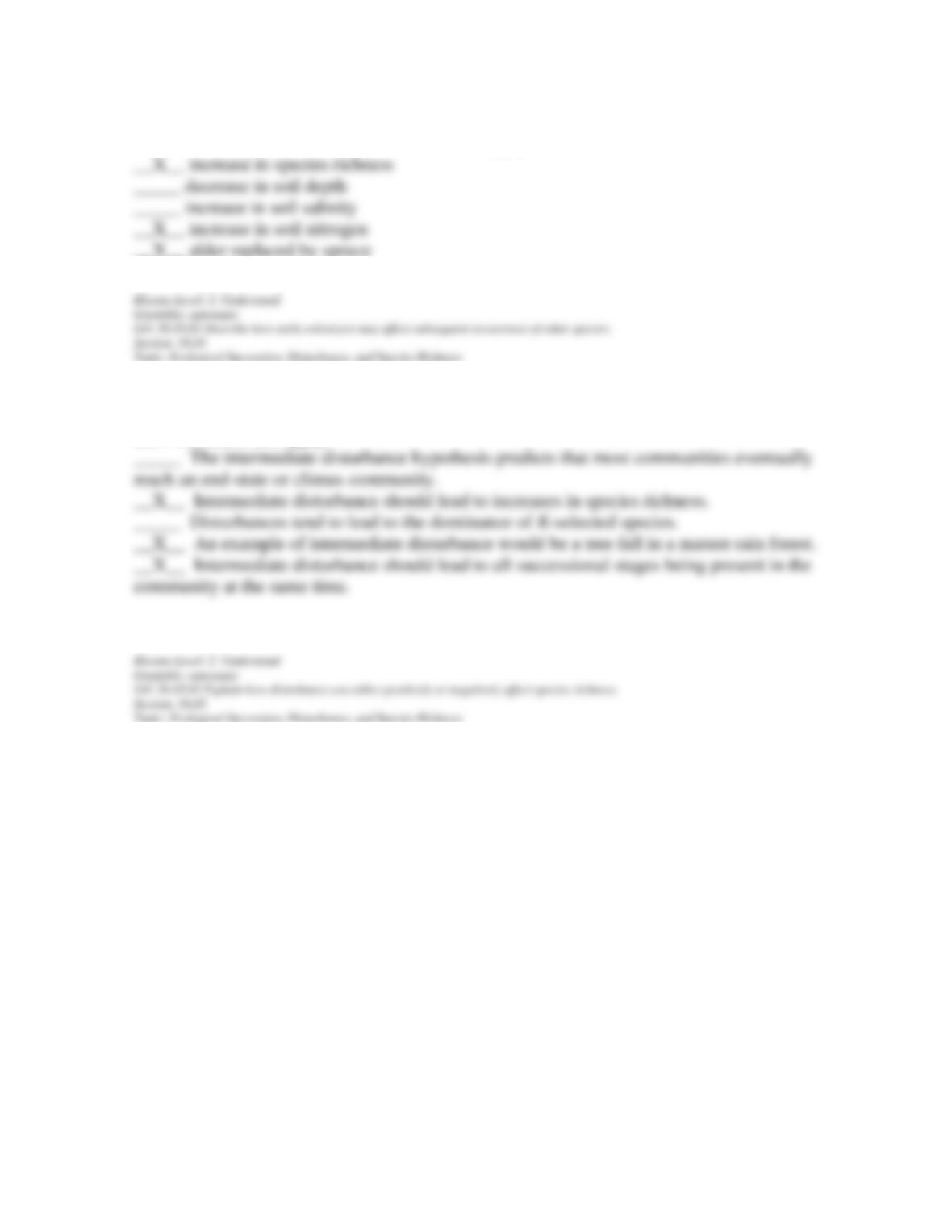
41. Which of the following would be an expected long-term change during primary
Chapter 56 – Community Ecology
succession on glacial moraines? Check all that apply.
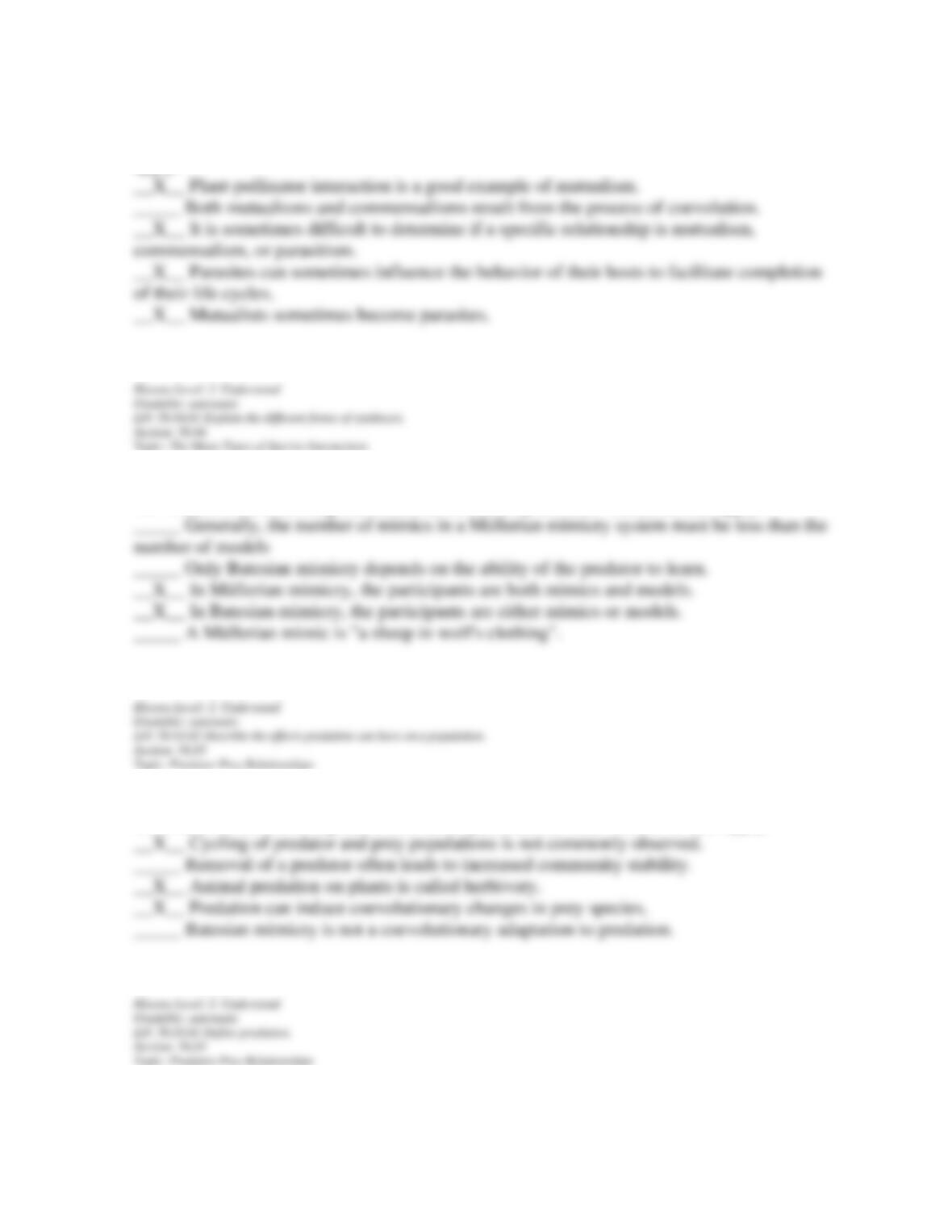
42. Which of the following statements about the intermediate disturbance hypothesis are
true? Check all that apply.
Chapter 56 – Community Ecology
43. Which of the following statements about symbiotic relationships are true? Check all that
apply.
44. Which of the following statements about mimicry are true? Check all that apply.
45. Which of the following statements about predation are true? Check all that apply.

Chapter 56 – Community Ecology
Fill in the Blank Questions
Place each of the following terms with the correct statement.
coevolution
defensive coloration
camouflage
secondary chemical compounds
Batesian mimicry
46. Organisms that possess this property are poisonous, sting, or are otherwise harmful;
commonly black, yellow, and red in color.
47. Is the process by which different kinds of organisms adjust to one another by genetic
change over long periods of time.
48. It is a situation in which a palatable organism resembles another kind of organism that is
distasteful or toxic.

Chapter 56 – Community Ecology
49. Adaptation that enables organisms to blend into their environment thereby avoiding
predation.
50. Chemical compounds produced by plants that are not components of major metabolic
pathways.
True / False Questions

Chapter 56 – Community Ecology
51. Interspecific competition can affect the phenotypic characteristics of organisms.
Clarify question:
What is the key concept addressed by the question?
What type of thinking is required?
Gather Content:
What do you already know about interspecific competition? What other information is
related to the question? Character displacement occurs when a species’ range overlaps with a
Choose Answer:
Given what you now know, what information is most likely to produce the correct answer?
Reflection on Process:
Did your problem-solving process lead you to the correct answer? If not, where did the
process break down or lead you astray? How can you revise your approach to produce a
more desirable result?

Chapter 56 – Community Ecology
52. Geographical allopatry between species is definitive evidence of interspecific
competition.
Clarify question:
What is the key concept addressed by the question?
What type of thinking is required?
Gather Content:
What do you already know about interspecific competition and the contribution that
geographic allopatry might have in establishing the competition? What other information is
related to the question?
Choose Answer
Given what you now know, what information is most likely to produce the correct answer?
Reflection on Process:
Did your problem-solving process lead you to the correct answer? If not, where did the
process break down or lead you astray? How can you revise your approach to produce a
more desirable result?