
Chapter 55 – Ecology of Individuals and Populations
55–21
37. What is the Allee effect?
38. What are population pyramids used to show?
Check All That Apply Questions
Chapter 55 – Ecology of Individuals and Populations
55–22
39. Which of the following apply to the demography of human populations today? (Check all
that apply.)
Multiple Choice Questions
40. What kind of population spacing would you expect for a species that is strongly
territorial?
Check All That Apply Questions
Chapter 55 – Ecology of Individuals and Populations
41. Which of the following are environmental factors that determine where an organism can
live? (Check all that apply.)
Multiple Choice Questions
42. You construct a life table for a plant species and find that in all cases about the same
proportion of the cohort survive to the beginning of the next time interval. What would you
call this?
Chapter 55 – Ecology of Individuals and Populations
55–24
43. Allen’s rule states that mammals from colder climates have shorter ears and appendages
than individuals of the same species from warmer areas. The related Bergman’s rule states that
mammal body size varies with latitude, with larger body size in populations located closer to
the poles and smaller body size in populations located closer to the equator. What can explain
both of these rules?
Check All That Apply Questions
44. Which of the following describe source-sink metapopulations?
__X__ Sink populations near source populations are less likely to go extinct.
Multiple Choice Questions
Chapter 55 – Ecology of Individuals and Populations
45. Parental care of the young is usually associated with species with a Type ___ survivorship
curve.
46. Which one of the following expressions from the logistic equation (dN/dt = rN ((K – N)/K)
represents the proportion of unused resources remaining for use by the population?
47. Under which condition will a population experience growth?
Chapter 55 – Ecology of Individuals and Populations
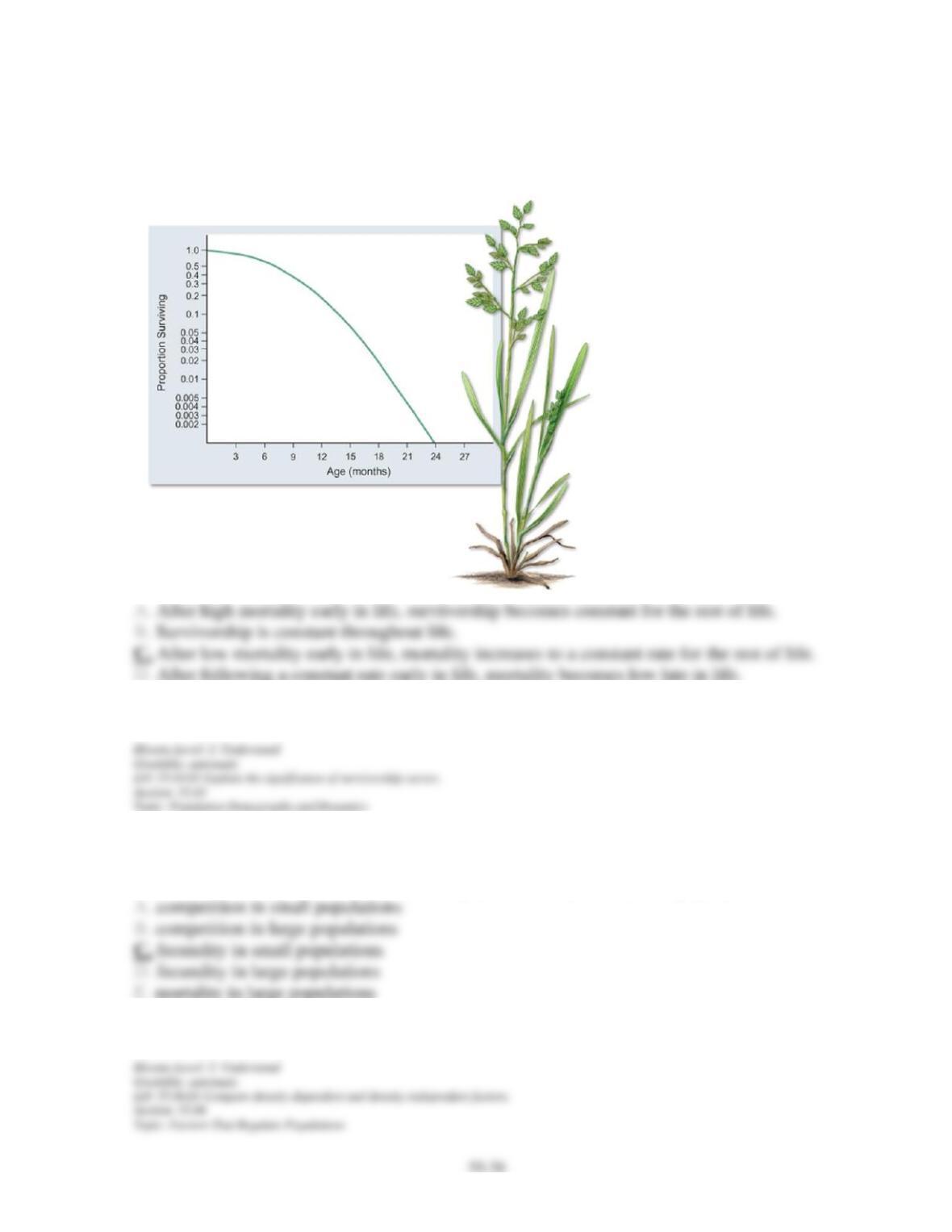
48. What is the most reasonable conclusion that can be made from data graphed in the figure?
49. Most density-dependent factors show negative feedback relative to population size. Which
one of the following is more likely to show positive feedback relative to population size?
Chapter 55 – Ecology of Individuals and Populations
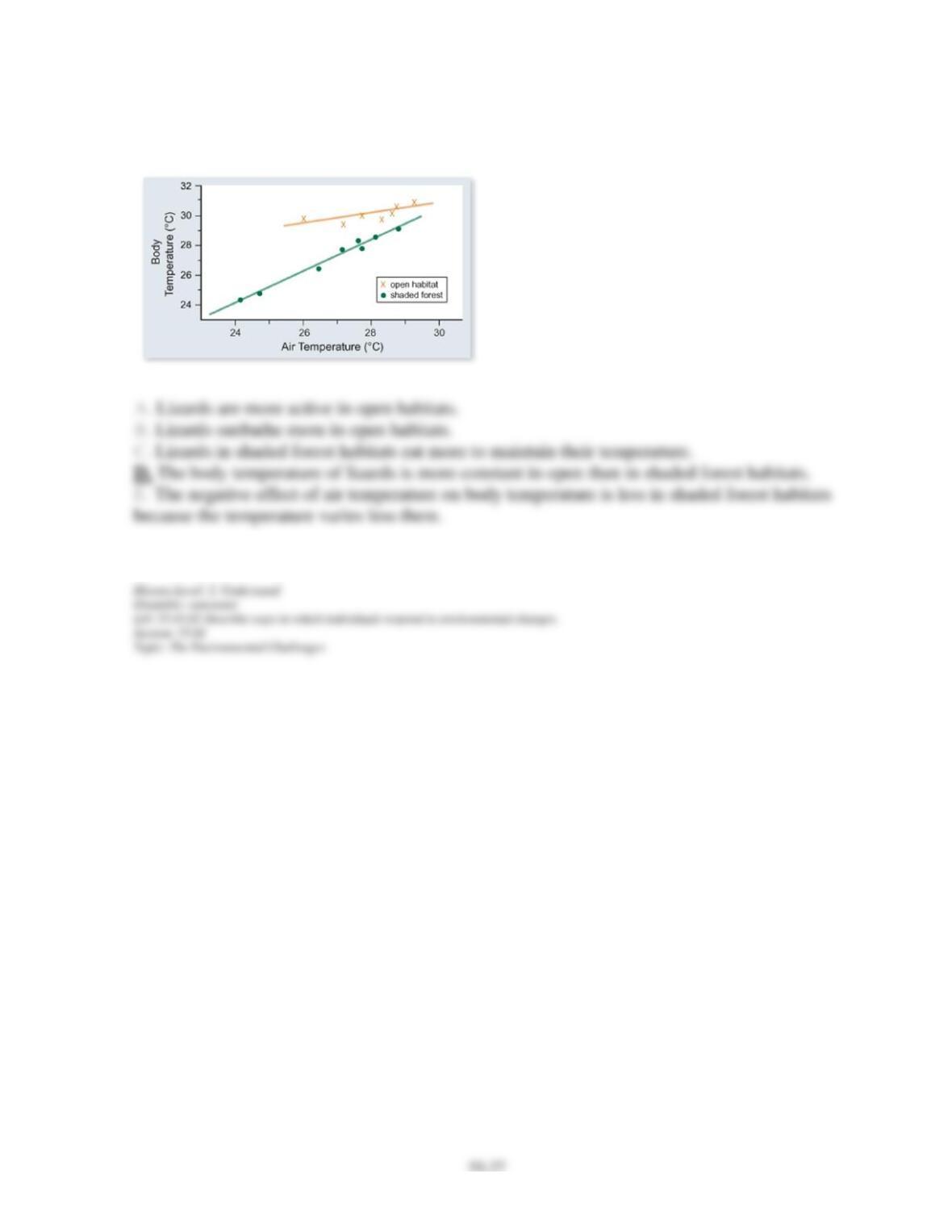
50. The figure included shows the body temperature of lizards versus air temperature in two
different habitats—open and shaded forest. Which one of the following conclusions is best
supported by these data.

Chapter 55 – Ecology of Individuals and Populations
51. Select the description of a population pyramid for a population that has the largest
potential for exponential growth.
52. What environmental challenge is posed to young plants by an old growth forest?
Chapter 55 – Ecology of Individuals and Populations
Clarify question:
What is the key concept addressed by the question?
What type of thinking is required?
Gather Content:
What do you already know about the conditions that exist in a mature forest environment?
What other information is related to the question?
Choose Answer:
Given what you now know, what information is most likely to produce the correct answer?
Reflection on Process:
Did your problem-solving process lead you to the correct answer? If not, where did the
process break down or lead you astray? How can you revise your approach to produce a
more desirable result? Were you able to make the correct choice? You needed to break down
Chapter 55 – Ecology of Individuals and Populations
55–30
53. You and your friends have just stepped off the plane in Cusco, Peru (11,200 ft). Your
friends are so eager to see Machu Picchu they want to start off hiking the Inca Trail right
away and not waste any time. How do you respond?
54. A zoo in Southern California has been successfully breeding arctic wolves and they want
to exchange some of their extra wolves for kangaroos from a zoo in southwestern Australia.
Since it is July, it is quite cold in the other zoo compared to Southern California. What
discussion might the zookeepers have about transferring the wolves?
Chapter 55 – Ecology of Individuals and Populations
Clarify question:
What is the key concept addressed by the question?
What type of thinking is required?
Gather Content:
What do you already know about the cold weather adaptations in wolves? What other
information is related to the question?
Choose Answer:
Given what you now know, what information is most likely to produce the correct answer?
Reflection on Process:
Did your problem-solving process lead you to the correct answer? If not, where did the
process break down or lead you astray? How can you revise your approach to produce a
more desirable result

Chapter 55 – Ecology of Individuals and Populations
55. There are not many species of fish living deep in the oceans, but the deep-sea fish
occasionally pulled up by fisherman have been bizarre creatures, such as the deep-sea
anglerfish with its giant fangs and bioluminescent lure. Why have these fascinating deep-sea
fish never been shown live on exhibit in an aquarium?
Chapter 55 – Ecology of Individuals and Populations
Clarify question:
What is the key concept addressed by the question?
What type of thinking is required?
Gather Content:
What do you already know about the deep sea environment? What other information is
related to the question? Deep sea environments are cold and dark. The darkness and cold
Choose Answer:
Given what you now know, what information is most likely to produce the correct answer?
Reflection on Process:
Did your problem-solving process lead you to the correct answer? If not, where did the
process break down or lead you astray? How can you revise your approach to produce a
more desirable result?
Chapter 55 – Ecology of Individuals and Populations
55–34
56. You and your friend are on vacation at Yellowstone Park. The plaque in front of a sulfur
hot spring reads: “This sulfur spring is 80C, has a pH of 2, and contains large amounts of
sulfur which is oxidized by Sulfolobus species of archaea.” Your friend is excited. “Boy, if
those microbes are that tough they should be easy to grow in the lab. I think I’ll work with
those for my summer project.” What do you think?
Chapter 55 – Ecology of Individuals and Populations
Clarify question:
What is the key concept addressed by the question?
What type of thinking is required?
Gather Content:
What do you already know about replicating the environmental conditions of hot springs
in the lab? What other information is related to the question?
Choose Answer:
Given what you now know, what information is most likely to produce the correct answer?
Reflection on Process:
Did your problem-solving process lead you to the correct answer? If not, where did the
process break down or lead you astray? How can you revise your approach to produce a
more desirable result?
Chapter 55 – Ecology of Individuals and Populations
55–36
57. You are earning your Ph.D. in marine biology, studying the microbial ocean community.
This year, you are shocked to discover that one of your study sites has become contaminated
due to an industrial waste water pipe. This dumping is drastically raising the temperature and
lowering the salinity of the water. What do you expect to find in your survey of the
ecosystem, and what might you find in a survey years from now?
Chapter 55 – Ecology of Individuals and Populations
Clarify question:
What is the key concept addressed by the question?
What type of thinking is required?
Gather Content:
What do you already know about how an ecosystem reacts to pollution? What other
information is related to the question?
Choose Answer:
Given what you now know, what information is most likely to produce the correct answer?
Reflection on Process:
Did your problem-solving process lead you to the correct answer? If not, where did the
process break down or lead you astray? How can you revise your approach to produce a
more desirable result?
Chapter 55 – Ecology of Individuals and Populations
55–38
58. Which factor allows bacteria species to adapt to environmental changes faster than fish?
Clarify question:
What is the key concept addressed by the question?
What type of thinking is required?
Gather Content:
What do you already know about the characteristics of bacteria that might allow them to
respond to changes in their environment? What other information is related to the
question?
Choose Answer:
Given what you now know, what information is most likely to produce the correct
answer?
Reflection on Process:
Did your problem-solving process lead you to the correct answer? If not, where did the
process break down or lead you astray? How can you revise your approach to produce a
more desirable result?

Chapter 55 – Ecology of Individuals and Populations
59. Kettle ponds derive from a hole left by a retreating glacier that is subsequently filled with
rainwater. A certain region has a series of disconnected kettle ponds, but occasionally heavy
rains flood them and create streams. Which type of animal is most likely to be present in this
area as a metapopulation?