Chapter 55 – Ecology of Individuals and Populations
Chapter 55
Ecology of Individuals and Populations
Multiple Choice Questions
1. Populations of endotherms that live in colder climates tend to have shorter ears and limbs
than populations of the same species in warm climates. This is called ____________ Rule.
2. The rate at which a population of a given species will increase when no limits are placed on
its rate of growth is called its
Chapter 55 – Ecology of Individuals and Populations
3. The size at which a population stabilizes in a particular place is defined as the __________
for that species.
4. Life history adaptations of ___________ populations are characterized by an early age of
first reproduction and short maturation time and life span.
5. Species that have a delayed reproductive stage, are competing for limited resources, and
have smaller numbers of slowly maturing large offspring show ________________
adaptations.
Chapter 55 – Ecology of Individuals and Populations
6. The statistical study of populations including sex ratio, age structure, and predicting
growth rates is called _________.
7. A group of population members all of the same age is called a ________.
8. Organisms such as lizards that need to maintain body temperature through external means
do so by
Chapter 55 – Ecology of Individuals and Populations
9. What is the life history adaptation called where organisms produce offspring several times
over many seasons?
10. Effects that are dependent on the size of the population and regulate the growth of
populations are called ___________ effects.
11. The trade-off between investments in current reproduction and in growth that promotes
future reproduction is referred to as the total cost of what?
Chapter 55 – Ecology of Individuals and Populations
12. A small group of mice are released on an island without mice but with abundant food for
mice and no predators. Initially, the growth of the mouse population will be limited mainly by
what?
13. A small group of mice were released on an island. The island previously had no mice on
it, but had abundant food and no predators. After several years of growth, the size of the new
island population stabilizes. However, at this point a hurricane drastically reduces the
population. How would you describe the situation?
Chapter 55 – Ecology of Individuals and Populations
Clarify question:
What is the key concept addressed by the question?
What type of thinking is required?
Gather Content:
What do you already know about natural event affecting a population? What other
Choose Answer:
Given what you now know, what information is most likely to produce the correct answer?
Reflection on Process:
Did your problem-solving process lead you to the correct answer? If not, where did the
process break down or lead you astray? How can you revise your approach to produce a
more desirable result?
Chapter 55 – Ecology of Individuals and Populations
14. Demographic studies include all of the following except what?
15. Clumped or patched populations that undergo local periodic extinction and recolonization
are called what?
Chapter 55 – Ecology of Individuals and Populations
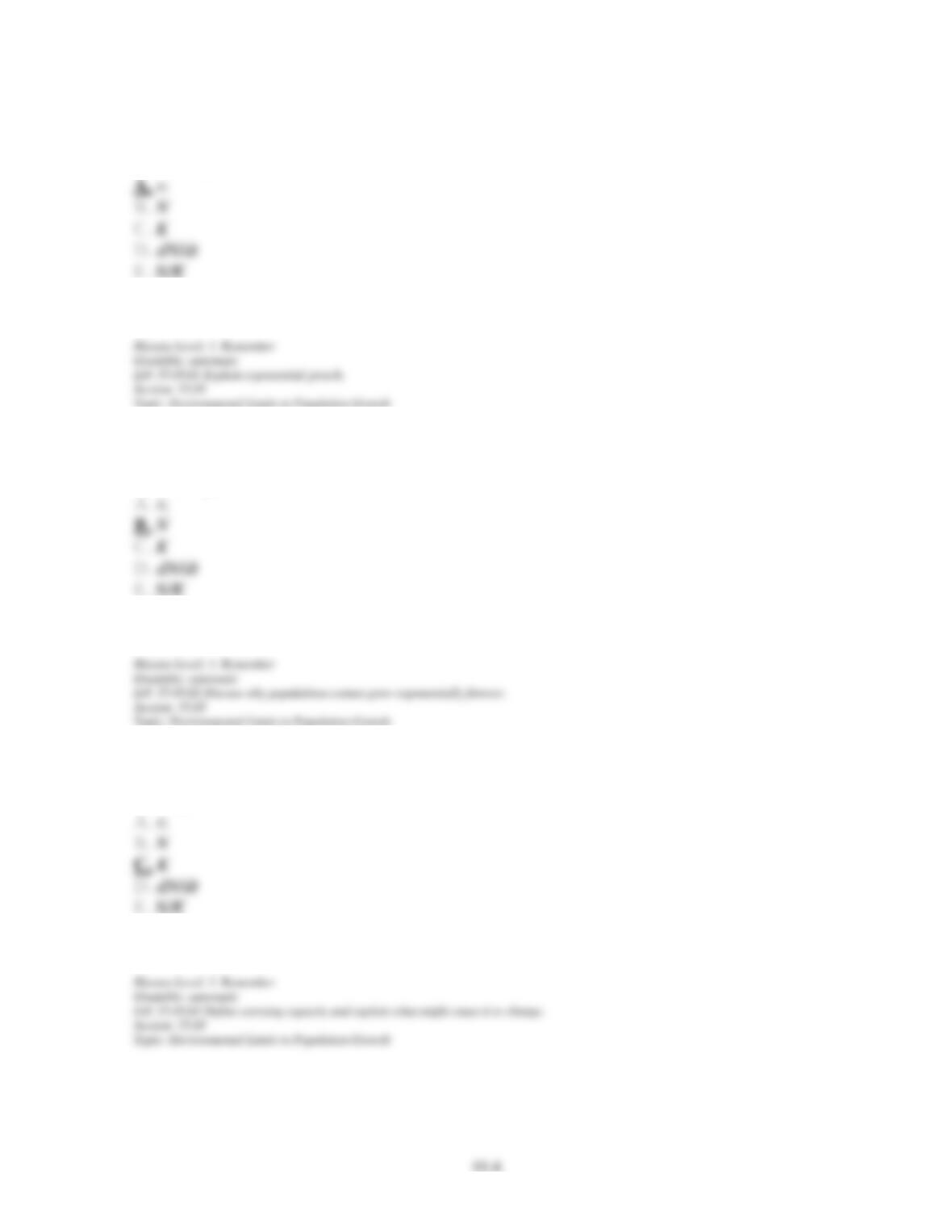
16. The biotic potential representing growth without limits at its maximal rate is indicated
by what symbol?
17. In the sigmoid growth curve, the number of individuals at any one time is indicated
by what symbol?
18. In the sigmoid growth curve, the carrying capacity of the environment is indicated by
what symbol?
Chapter 55 – Ecology of Individuals and Populations
55-9
19. The range of a population
Check All That Apply Questions
20. Which of the following describe density-dependent factors?
Multiple Choice Questions
Chapter 55 – Ecology of Individuals and Populations
55–10
21. Which is an example of a density-independent factor on a population?
22. What do we call populations of organisms that are usually near the carrying capacity?
Check All That Apply Questions
Chapter 55 – Ecology of Individuals and Populations
23. What are characteristics of r-selected populations? (Check all that apply.)
Multiple Choice Questions
24. Which of the following is an example of a species with r-selected adaptations?
Chapter 55 – Ecology of Individuals and Populations
25. Which is an example of a species with K-selected adaptations?
26. A species colonizes an island, goes through a phase of exponential growth, and reaches
the carrying capacity of the island. At what stage is the growth rate slowest?
27. In the logistic growth model, as the number of individuals in the population (N)
approaches the carrying capacity (K), what happens to the intrinsic rate of growth (ri)?
Chapter 55 – Ecology of Individuals and Populations
55–13
28. There are three aspects of entire populations that are important and often studied. Select
the best choice from the ones listed.
29. During the late 1800s, cattle egrets arrived in South America from Africa and began to
colonize. Their range has expanded dramatically over the years. Why were they able to do
this?
Chapter 55 – Ecology of Individuals and Populations
Clarify question:
What is the key concept addressed by the question?
What type of thinking is required?
Gather Content:
What do you already know about what impacts the colonization of a new habitat? What
other information is related to the question?
Choose Answer:
Given what you now know, what information is most likely to produce the correct answer?
Reflection on Process:
Did your problem-solving process lead you to the correct answer? If not, where did the
process break down or lead you astray? How can you revise your approach to produce a
more desirable result?
Chapter 55 – Ecology of Individuals and Populations
30. Populations have three basic types of dispersion patterns—clumped, random, and
uniform. What situation supports random distributions?
31. Which is an example of a clumped distribution of a population?
Chapter 55 – Ecology of Individuals and Populations
32. Many times species are composed of networks of distinct populations called
metapopulations. When do metapopulations occur?
33. Which factor increases the likelihood of population extinction?
Chapter 55 – Ecology of Individuals and Populations
55–17
Feedback:
Chapter 55 – Ecology of Individuals and Populations
55–18
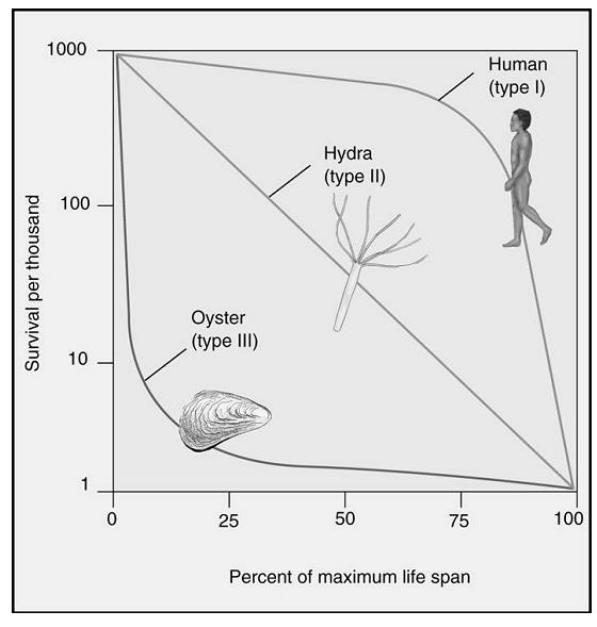
34. Which of the following statements about the graph is true?
Clarify question:
What type of thinking is required?
Gather Content:
What do you already know about the characteristics of the three survivorship curves?
What other information is related to the question?
Choose Answer:
Given what you now know, what information is most likely to produce the correct answer?
Reflection on Process:
Did your problem-solving process lead you to the correct answer? If not, where did the
process break down or lead you astray? How can you revise your approach to produce a
more desirable result? You needed to extract the information from the graph and decide
Chapter 55 – Ecology of Individuals and Populations
35. What often describes organisms with a Type III life history?
Chapter 55 – Ecology of Individuals and Populations
55–20
36. Which species would be most likely to have a Type III life history?
Clarify question:
What is the key concept addressed by the question?
Gather Content:
What do you already know about a type III survivorship curve? What other information is
related to the question?
Choose Answer:
Given what you now know, what information is most likely to produce the correct answer?
Reflection on Process:
Did your problem-solving process lead you to the correct answer? If not, where did the
process break down or lead you astray? How can you revise your approach to produce a
more desirable result?