Hall: Guyton and Hall Textbook of Medical Physiology, 12th Edition
Chapter 55: Cortical and Brain Stem Control of Motor Function
Test Bank
1. Fine motor movement of the index finger can be elicited by stimulation of which of the
following brain areas?
A. The primary motor cortex
B. The lateral cerebellar hemisphere
C. The premotor cortex
D. The supplemental motor area
2. Decerebrate rigidity caused by simultaneous contraction of both the agonist and
antagonist muscles in a limb can be alleviated by which of the following maneuvers?
A. Turning the head sharply toward the limb
B. Bending the head forward
C. Stimulating the pontine reticular formation by lightly stroking the palms of the hand
D. Cutting the dorsal roots associated with the affected limb
3. The stretch reflex is used clinically to:
A. Assess the integrity of the corticospinal tract
B. Assess the function of the vestibulo-occular reflex
C. Assess the level of activity of the gamma motor system
D. Assess the function of the vestibular system
4. In the right horizontal semicircular canal, rapid rotation of the head in the clockwise
direction will cause the endolymph to move in which relative direction?
A. In a clockwise direction
B. In a counterclockwise direction
C. In an upward direction
D. In a downward direction
5. Which of the following is paired correctly?
A. Gamma motor neuron – extrafusal muscle fiber
B. Alpha motor neuron – intrafusal muscle fiber
C. Betz cells – corticospinal tract
D. Utricle – angular acceleration detection
Test Bank
55-2
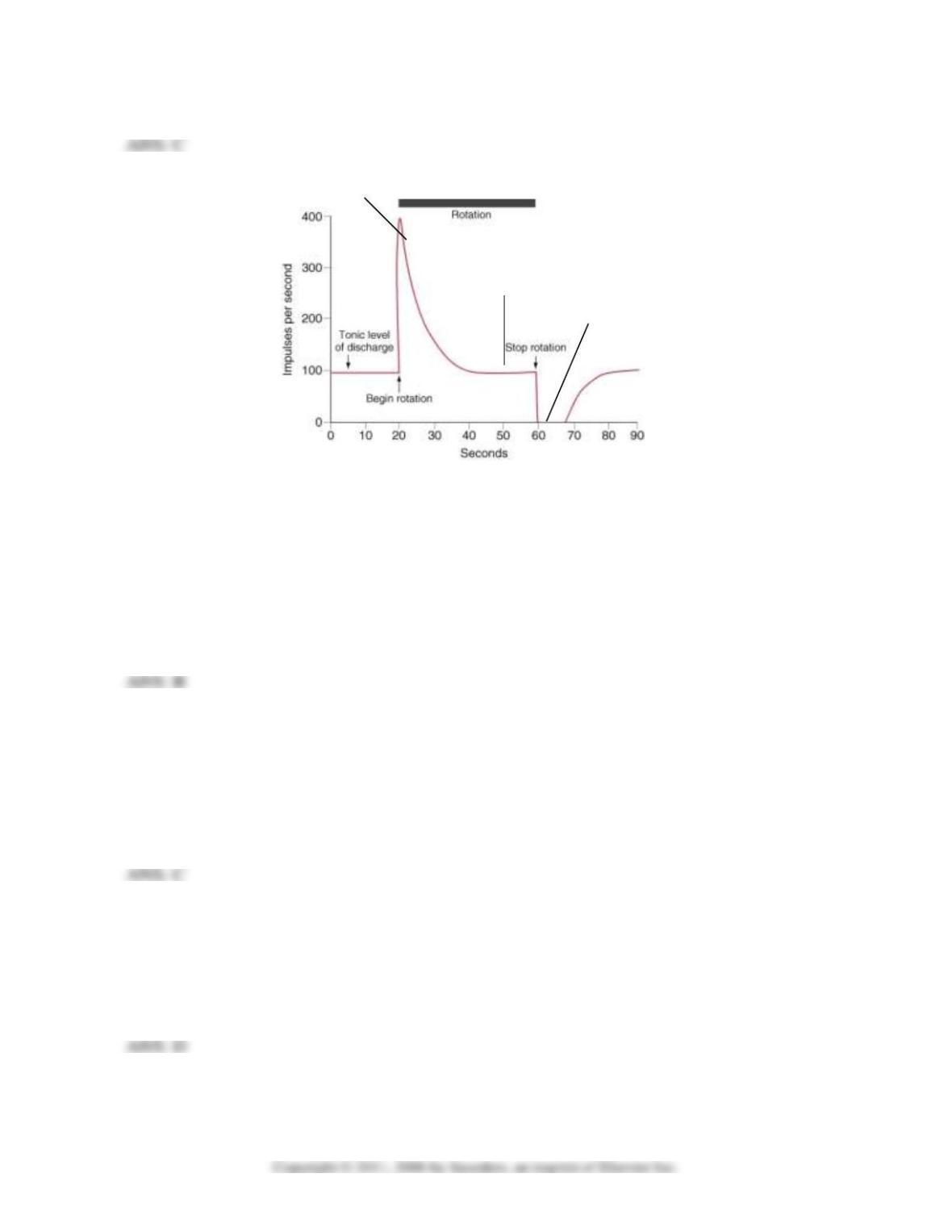
6. The figure above represents the response of a hair cell in the crista ampullaris of the
semicircular canal to stimulation by rotation in a human subject. With the subject’s eyes
closed, the subjective sensation of rotation will be ABSENT at which point/s indicated by
the letters A through C?
A. Point A
B. Point B
C. Point C
D. Points A and C
7. Which of the following structures in the vestibular apparatus is responsible for the
detection of angular acceleration?
A. The statoconia
B. The macula
C. The semicircular canals
D. The saccule
8. Which of the following brain regions contribute fibers to the corticospinal tract?
A. The somatic sensory cortex
B. The supplemental motor area
C. The primary motor cortex
D. All of the above
9. The rubrospinal tract originates from which area of the brain?
A
B
C
Test Bank
55-3
A. The magnocellular area of the red nucleus
B. The superior olivary nucleus
C. The pontine reticular formation
D. The nucleus raphe magnus
10. The phenomenon of decerebrate rigidity can be explained, at least in part, by which of
the following?
A. Stimulation of gamma motor neurons
B. Loss of cerebellar inputs to the red nucleus
C. Overactivity of the medullary reticular nuclei involved in motor control
D. All of the above can explain the phenomenon of decerebrate rigidity