
Chapter 54 – Behavioral Biology
54–61
Clarify question:
What is the key concept addressed by the question?
What type of thinking is required?
that occurs when a rat is placed in a Skinner box. In this question you must select all of the correct answers.
Gather Content:
What do you already know about what was studied with the Skinner box and what
behaviors are exhibited when playing video games? What other information is related to
the question?
Choose Answer:
Given what you now know, what information is most likely to produce the correct answer?
Reflection on Process:
Did your problem-solving process lead you to the correct answer? If not, where did the
process break down or lead you astray? How can you revise your approach to produce a
more desirable result?
Multiple Choice Questions
Chapter 54 – Behavioral Biology
81. You read about how learning preparedness influences the associations that an animal is
capable of learning. You want to explore the learning preparedness of hamsters. How might
you test the learning preparedness of this species?
Chapter 54 – Behavioral Biology
Clarify question:
What is the key concept addressed by the question?
What type of thinking is required?
Gather Content:
What do you already know about learning preparedness? What other information is
related to the question?
Choose Answer:
Given what you now know, what information is most likely to produce the correct answer?
Reflection on Process:
Did your problem-solving process lead you to the correct answer? If not, where did the
process break down or lead you astray? How can you revise your approach to produce a
more desirable result?
Chapter 54 – Behavioral Biology
82. You work in a lab that studies bird brains and behavior. You and your labmate have both
submitted brains to a colleague to be sectioned. Your species is a bird that is known for
storing large numbers of nuts each autumn in a variety of hidden locations. Your labmate’s
species is a raptor known for remarkable predatory behavior. What do you anticipate will be
different between the two brains?
Chapter 54 – Behavioral Biology
Clarify question:
What is the key concept addressed by the question?
What type of thinking is required?
Gather Content:
What do you already know about brain characteristics associated with different behaviors?
What other information is related to the question?
Choose Answer:
Given what you now know, what information is most likely to produce the correct answer?
Reflection on Process:
Did your problem-solving process lead you to the correct answer? If not, where did the
process break down or lead you astray? How can you revise your approach to produce a
more desirable result?
Chapter 54 – Behavioral Biology
83. In its youth, a pet parrot was owned by someone who kept the wings clipped and never
allowed it to fly. Later in life, the new owner let the feathers grow and let the parrot fly
around the house. But the parrot kept knocking over lamps and crashing into walls. “Wow,”
said the owner, “I guess parrots are just too clumsy to fly around a house without destroying
everything.” What is an alternative explanation?
Chapter 54 – Behavioral Biology
Clarify question:
What is the key concept addressed by the question?
What type of thinking is required?
Gather Content:
What do you already know about behaviors in an adult parrot based on how it was raised?
What other information is related to the question?
Choose Answer:
Given what you now know, what information is most likely to produce the correct answer?
Reflection on Process:
Did your problem-solving process lead you to the correct answer? If not, where did the
process break down or lead you astray? How can you revise your approach to produce a
more desirable result?

Chapter 54 – Behavioral Biology
84. A bird sanctuary sometimes takes over the care of eggs or chicks of an endangered duck
species if the parents are killed. They are sometimes able to use mothers of farm ducks to
cross-foster the chicks, but it doesn’t always work. Looking at the following data table, what
is the critical period for imprinting in this species? (Note: DAH stands for “days after
hatching”.)
Number of chicks
Age of chicks when
paired with foster
mother
Successful imprinting?
(assessed at 14 DAH)
13
eggs (0 DAH)
yes
7
1 DAH
yes
11
3 DAH
yes
5
8 DAH
no
9
11 DAH
no
Chapter 54 – Behavioral Biology
Clarify question:
What is the key concept addressed by the question?
What type of thinking is required?
Gather Content:
What do you already know about imprinting? What other information is related to the
question?
Choose Answer:
Given what you now know, what information is most likely to produce the correct answer?
Reflection on Process:
Did your problem-solving process lead you to the correct answer? If not, where did the
process break down or lead you astray? How can you revise your approach to produce a
more desirable result?
Chapter 54 – Behavioral Biology
54–70
85. You are on the committee to update the design of the hospital NICU (neonatal intensive
care unit), which currently has incubators for the babies but not much else. Based on what you
have learned about Harlow’s experiments with rhesus monkeys, what would you suggest
adding to the NICU to improve the babies’ health and well-being?
Clarify question:
What is the key concept addressed by the question?
What type of thinking is required?
Gather Content:
What do you already know about Harlow’s experimental results? What other information
is related to the question?
Choose Answer:
Given what you now know, what information is most likely to produce the correct answer?
Reflection on Process:
Did your problem-solving process lead you to the correct answer? If not, where did the
process break down or lead you astray? How can you revise your approach to produce a
more desirable result?
Chapter 54 – Behavioral Biology
86. A zoo is hand-rearing an endangered species of songbird. What is the best approach to
help prepare the males to attract mates?
Chapter 54 – Behavioral Biology
54–72
Clarify question:
What is the key concept addressed by the question?
Knowing what environment will be important for the males to learn mating behaviors.
What type of thinking is required?
Gather Content:
What do you already know about mating behaviors in male birds? What other information
is related to the question?
Choose Answer:
Given what you now know, what information is most likely to produce the correct answer?
Reflection on Process:
Did your problem-solving process lead you to the correct answer? If not, where did the
process break down or lead you astray? How can you revise your approach to produce a
more desirable result?
Check All That Apply Questions
Chapter 54 – Behavioral Biology
54–73
87. Based on the animal cognition experiments you have learned about, if you wanted to
design a test of animal cognition, what might you include in your experiment? (Check all that
apply)
_____ Count the number of individuals in a colony.
Chapter 54 – Behavioral Biology
Clarify question:
What is the key concept addressed by the question?
What type of thinking is required?
Gather Content:
What do you already know about animal cognition experiments? What other information
is related to the question?
Choose Answer:
Given what you now know, what information is most likely to produce the correct answer?
Reflection on Process:
Did your problem-solving process lead you to the correct answer? If not, where did the
process break down or lead you astray? How can you revise your approach to produce a
more desirable result?
Multiple Choice Questions
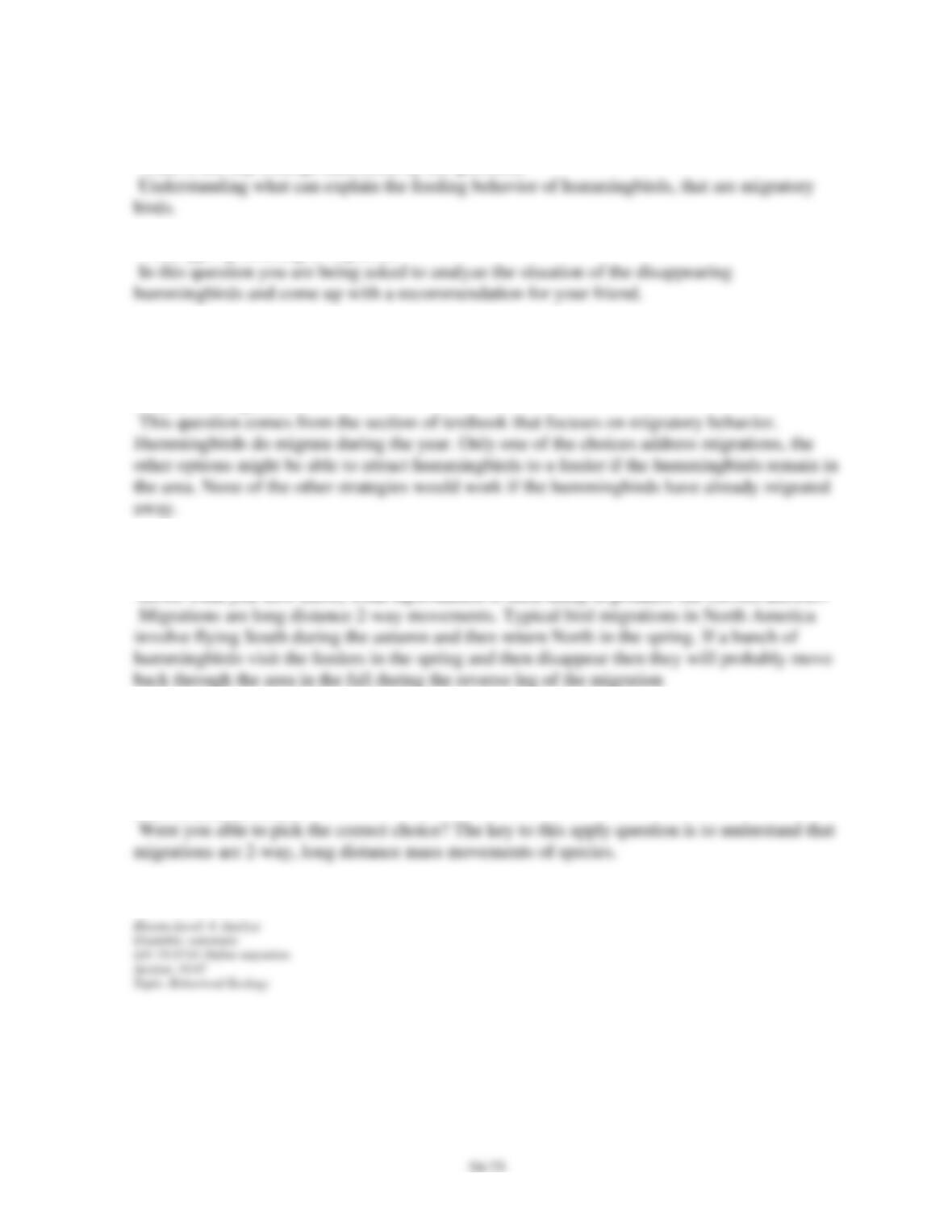
88. One spring, your friend living in Minnesota eagerly sets up her new hummingbird
feeders, and is thrilled to watch hummingbirds feeding on the nectar. However, she is
disappointed when after just a week or two the hummingbirds disappear. What advice would
you give her?
Chapter 54 – Behavioral Biology
Clarify question:
What is the key concept addressed by the question?
What type of thinking is required?
Gathering Content:
What do you already know about feeding behaviors in birds? What other information is
related to the question?
Choose Answer:
Given what you now know, what information is most likely to produce the correct answer?
Reflection on Process:
Did your problem-solving process lead you to the correct answer? If not, where did the
process break down or lead you astray? How can you revise your approach to produce a
more desirable result?
Chapter 54 – Behavioral Biology
54–76
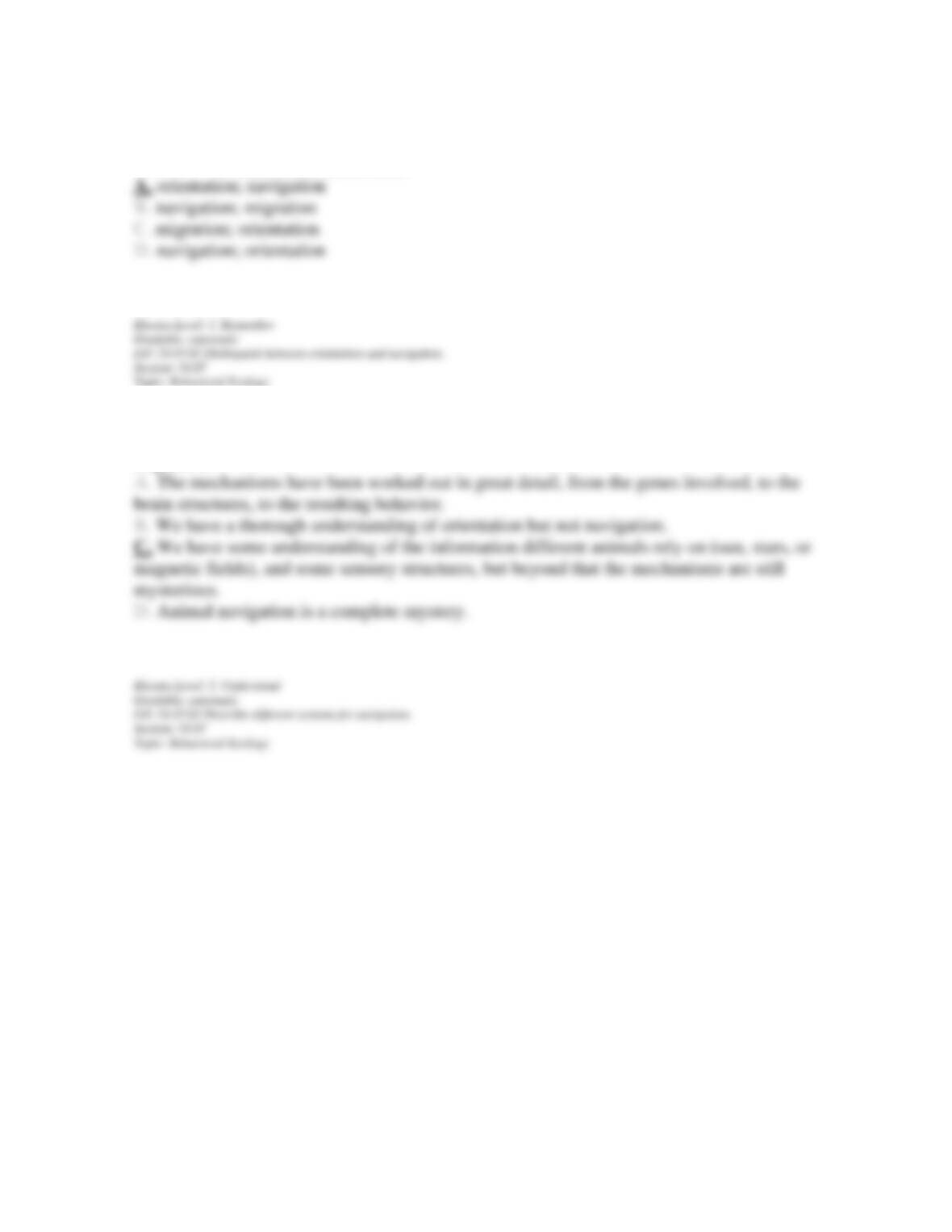
89. Research on starlings indicates that young birds migrate by _______________, but older
birds use true __________________.
90. Which statement best sums up our understanding of how animals navigate during
migration?
Check All That Apply Questions
Chapter 54 – Behavioral Biology
91. Swordtail fish are known for the long extensions on the males’ tails. What types of
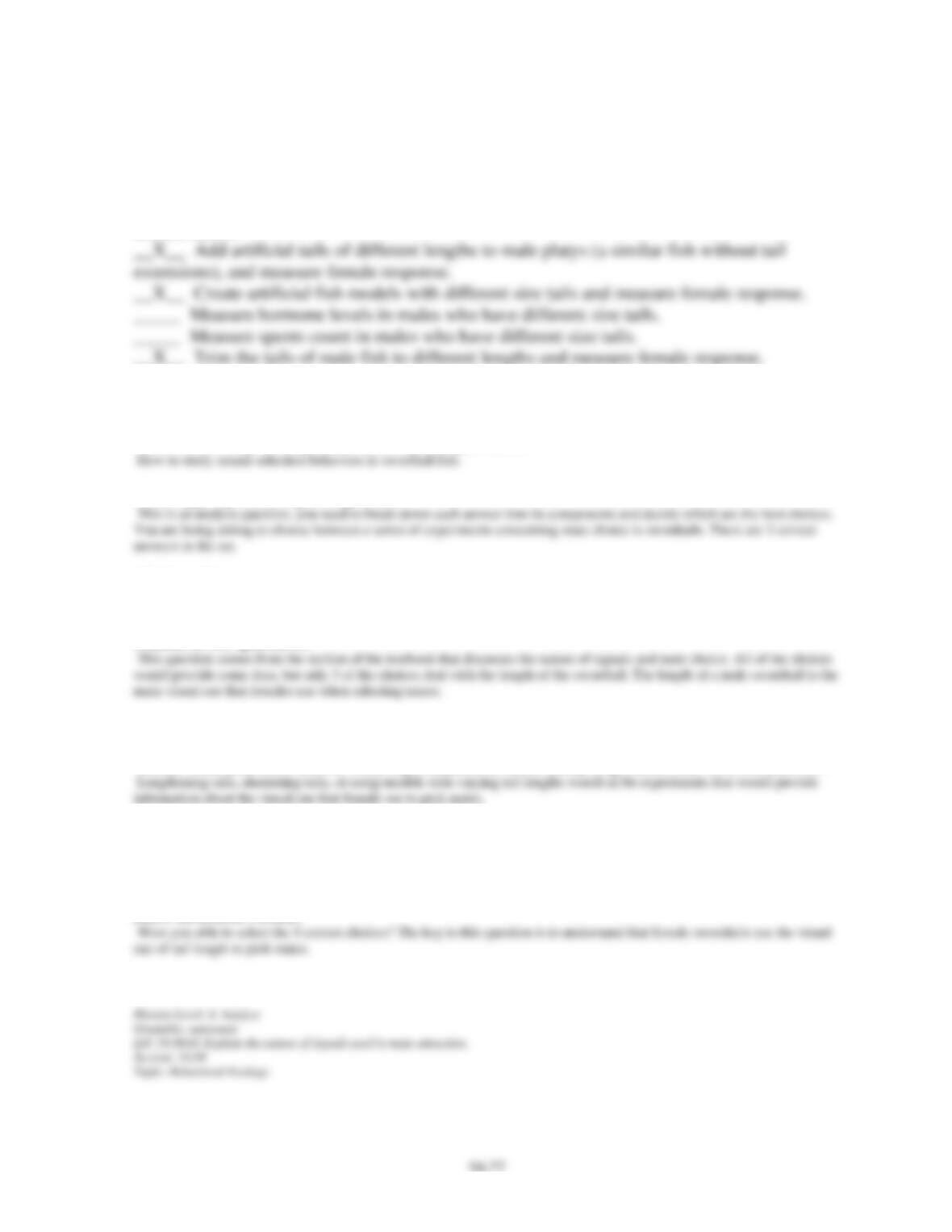
experiments might help you determine whether the females are using visual input about tail
length to choose between males? (Check the best three)
_____ Add artificial tails of different lengths to females and determine their response to
normal males.
Clarify question:
What is the key concept addressed by the question?
What type of thinking is required?
Gather Content:
What do you already know about sexual selection behaviors? What other information is
related to the question?
Choose Answer:
Given what you now know, what information is most likely to produce the correct answer?
Reflection on Process:
Did your problem-solving process lead you to the correct answer? If not, where did the
process break down or lead you astray? How can you revise your approach to produce a
more desirable result?
Chapter 54 – Behavioral Biology
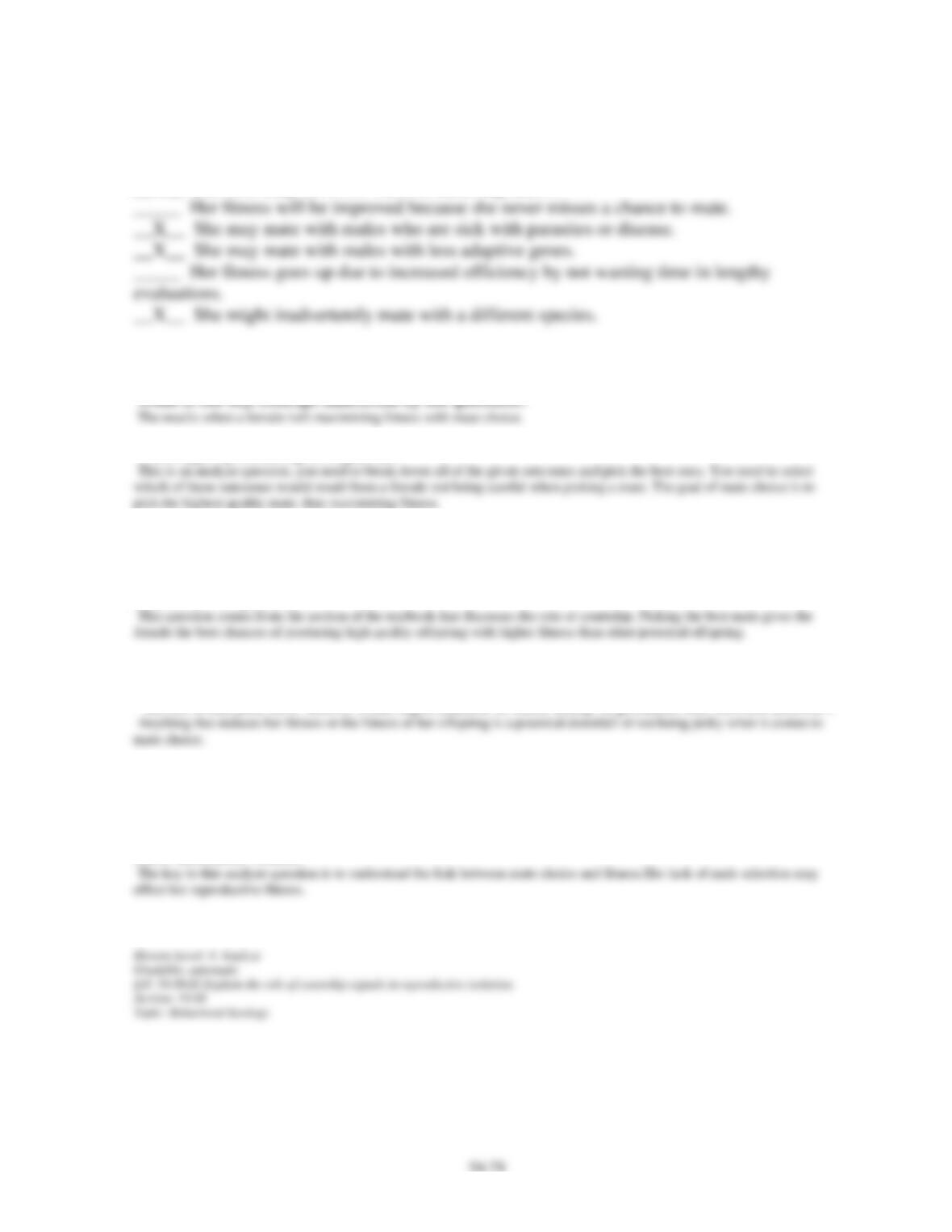
92. What are likely outcomes for a female who is not choosy enough, and has too broad of an
acceptance of reproductive signals? (Check all that apply.)
__X__ Her sons may have low success attracting mates.
Clarify question:
What type of thinking is required?
Gather Content:
What do you already know about mate choice and fitness? What other information is
related to the question?
Choose Answer:
Given what you now know, what information is most likely to produce the correct answer?
Reflection on Process:
Did your problem-solving process lead you to the correct answer? If not, where did the
process break down or lead you astray? How can you revise your approach to produce a
more desirable result?