Chapter 54 – Behavioral Biology
Chapter 54
Behavioral Biology
Multiple Choice Questions
1. Tinbergen is credited with founding the field of behavioral ______, the study of how
natural selection shapes behavior.
2. Animals tend to feed on prey that maximize their net energy intake. This is called the
__________ theory.
Chapter 54 – Behavioral Biology
3. Animals that acquire energy efficiently during foraging will increase their fitness by
having more energy available for _______________.
4. In many animals, ______ guides learning by determining what type of information can be
learned, meaning that what an animal can learn is often biologically influenced.
5. The degree of parental investment required often results in the non-random mating
behavior called __________.
Chapter 54 – Behavioral Biology
6. Alarm calling seems to be an example of _______, that is, it favors relatives.
7. Chemical signals that mediate interactions between two or more members of a given
species are called _______________.
8. Artificial selection and hybridization can demonstrate the __________ basis of behavior.
Chapter 54 – Behavioral Biology
9. A nonassociative learning called __________ can be defined as a decrease in response to a
repeated stimulus that has no positive or negative consequences.
10. As an animal matures, it forms attachments to other individuals and develops preferences.
This process is called
11. Current research in behavioral ecology focuses on the overall contribution that behavior
makes to an animal’s
Chapter 54 – Behavioral Biology
12. The processing of information and response in a manner that suggests thinking in the
animal is called
13. The signal from the environment that triggers a stereotyped behavior is a
14. By evaluating and selecting mates with superior qualities, an animal can increase its
Chapter 54 – Behavioral Biology
15. In birds, if the offspring require extensive care, usually involving both the male and
female, they are called
16. The modification of behavior as a result of experience is called
17. Habituation belongs to which of the following types of learning?
Chapter 54 – Behavioral Biology
18. If an unrelated stimulus, such as the ringing of a bell, was presented at the same time as
the meat powder, over repeated trials, a dog would salivate in response to the sound of the bell
alone. This kind of response is called
19. An animal learns to associate its behavioral response with a reward or punishment in
20. Who conducted the famous “imprinting” experiment on geese?
Chapter 54 – Behavioral Biology
21. Research has revealed that the development of psychological well-being and growth is
influenced by what?
22. A behavior that has evolved to aid relatives, although at personal risk, and thus increases
the chance of your genes being passed on to the next generation is known as
23. Which scientist described inclusive fitness as the effect an individual has on propagating
its alleles through its own reproduction and through kin selection?
Chapter 54 – Behavioral Biology
24. Social insect colonies are composed of highly specialized groups called what?
25. Insect workers propagate more of their own alleles by helping their mother reproduce
rather than by reproducing themselves; thus, they share a larger fraction of their ___________
with the next generation.
26. Courtship is often dependent on what?
Chapter 54 – Behavioral Biology
54–10
27. Foraging bees communicate with other bees in a waggle dance to give information about
the food. The important cue in the dance that conveys information about the required flight
direction to the food source relative to the hive-sun direction is the
Check All That Apply Questions
28. Which of the following are used by species for navigation? (Check all that apply.)
Multiple Choice Questions
Chapter 54 – Behavioral Biology
54–11
29. If a scientist is conducting a study of how an animal’s senses provide a physiological basis
for a particular behavior, what type of causation is she exploring?
30. If a scientist is conducting a study of how a male bird’s song and the female bird’s
response evolved, what type of causation is she exploring?
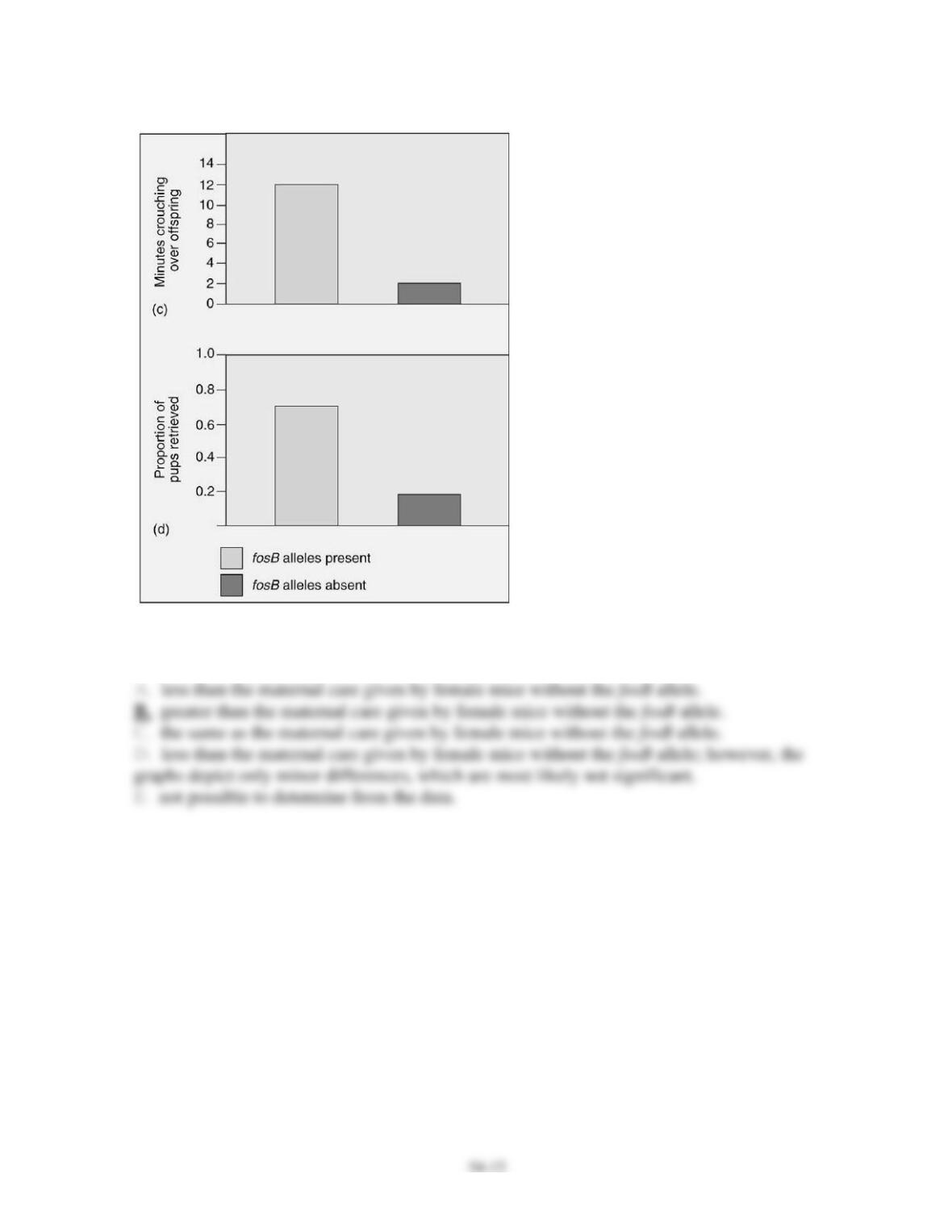
31. Which of the following is an appropriate interpretation for these graphs?
Chapter 54 – Behavioral Biology
Maternal care (as measured by minutes crouching over offspring and proportion of pups
retrieved) in female mice that have the fosB allele is
Chapter 54 – Behavioral Biology
54–13
Clarify question:
What is the key concept addressed by the question?
What type of thinking is required?
Gather Content:
What do you already know about the relationship between maternal behavior and a
particular allele? What other information is related to the question?
Choose Answer:
Given what you now know, what information is most likely to produce the correct answer?
Reflection on Process:
Did your problem-solving process lead you to the correct answer? If not, where did the
process break down or lead you astray? How can you revise your approach to produce a
more desirable result?
Chapter 54 – Behavioral Biology
32. Young birds see objects flying overhead and respond by crouching down into the nest and
remaining still. Over time some objects become familiar and the young birds do not crouch
down. What is this type of learning?
33. In an experiment studying predator and prey relationships, a scientist offers a naïve toad a
bumblebee as food. The bee stings the toad when the toad tries to catch and eat the bee.
Subsequent feeding trials with the toad reveal that the toad avoids feeding on bumblebees.
This is a demonstration of
Chapter 54 – Behavioral Biology
34. B. F. Skinner first introduced operant conditioning experiments. What happens in these
experiments?
35. Konrad Lorenz demonstrated that newly hatched birds would direct their social behavior
toward him if they saw him first after they hatched from their eggs. What is this called?
36. Recently the focus of research in behavioral ecology has been on the contribution by
behavior to an animal’s reproductive success. What is this called?
Chapter 54 – Behavioral Biology
54–16
37. A friend of yours is wondering about the differences between the words orientation and
navigation when these two terms are used in descriptions of bird migrations. Since you have
studied and know something about animal behavior, what do you tell your friend?
Check All That Apply Questions
38. Foraging behaviors are those having to do with which of the following? (Check all that
apply.)
Multiple Choice Questions
Chapter 54 – Behavioral Biology
39. The area over which an animal moves in the course of daily activity, but which it does not
necessarily defend against other animals, is called what?
40. In species where the young are precocial, meaning requiring little parental care, males
may be more likely to be what?
41. Living as a member of a group may have all of the following advantages except what?
Chapter 54 – Behavioral Biology
54–18
42. Haldane pointed out that if he received a certain allele, the chance that one of his brothers
would receive that allele would be
43. What is the term for selection that favors altruism toward relatives?
Check All That Apply Questions
Chapter 54 – Behavioral Biology
44. Which of the following are eusocial (true social) insects? (Check all that apply.)
Multiple Choice Questions
45. Hamilton explained the origin of altruism in selected insect societies with his kin selection
model of sex determination. Since males are haploid and females are diploid, the workers
share a very high proportion of alleles, theoretically as high as 75%. What is this called?
Chapter 54 – Behavioral Biology
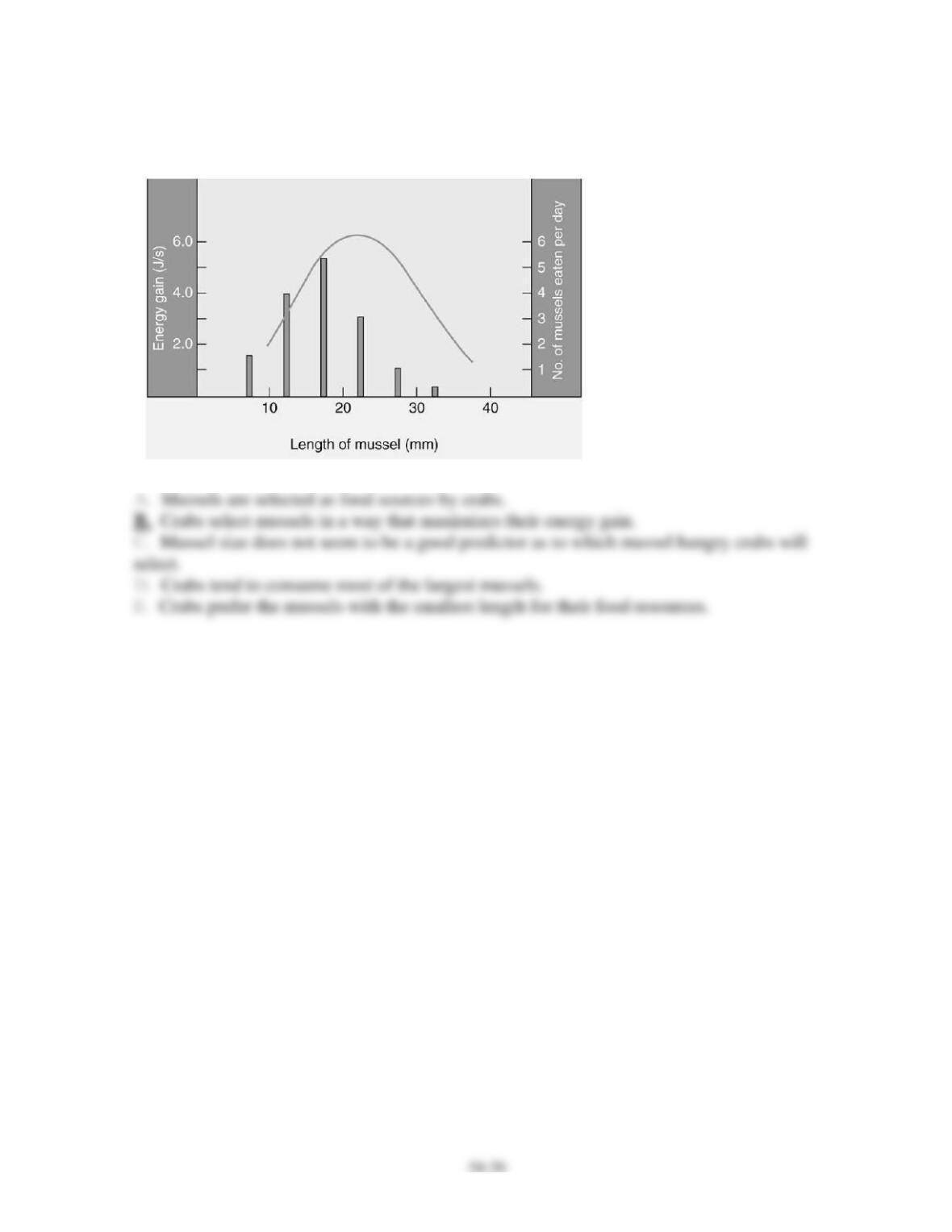
46. Which of the following is the best interpretation of the graph below of mussel size (x-
axis) versus energy gain (line graph, left y-axis), and number of mussels eaten per day
(histogram, right y-axis)?