
CHAPTER 54—ECOSYSTEMS
MULTIPLE CHOICE
1. Between the 1930s and the 1970s, the amount of all of the following except ____ increased in Lake
Erie.
a.
coliform bacteria
b.
phosphorus
c.
phytoplankton
d.
sewage
e.
fish population sizes
2. A nonnative species that was accidentally introduced into Lake Erie by attaching itself to boats is
a.
mayflies.
b.
oligochaete worms.
c.
phytoplankton.
d.
salmon.
e.
zebra mussels.
3. The Lake Erie ecosystem was affected by humans because human activities
a.
extracted resources without replacement.
b.
caused global warming.
c.
used the water without replacement.
d.
disrupted energy flow and the cycling of nutrients.
e.
extracted energy without replacement.
4. ____ make up the detrital food web.
a.
Carnivores and decomposers
b.
Decomposers and detritivores
c.
Decomposers and producers
d.
Herbivores and carnivores
e.
Producers and herbivores
5. Ecologists use compartment models to
a.
describe grazer food webs.
b.
describe detrital food webs.
c.
describe nutrient cycling
d.
describe species richness
e.
describe inputs of solar energy

6. One disadvantage of a simulation model of an ecosystem is that it
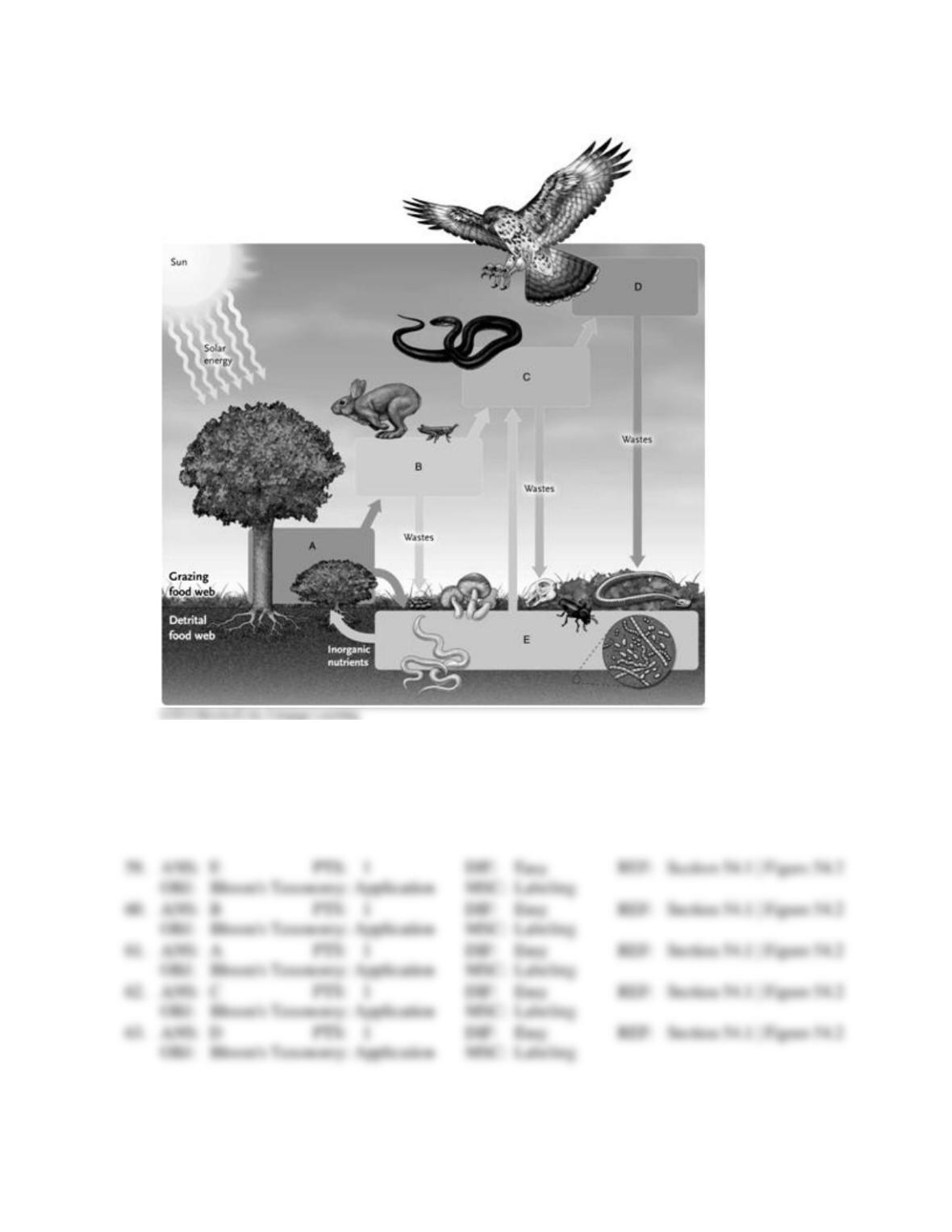
a.
does not take into effect interactions between organisms.
b.
does not take into effect nutrient availability.
c.
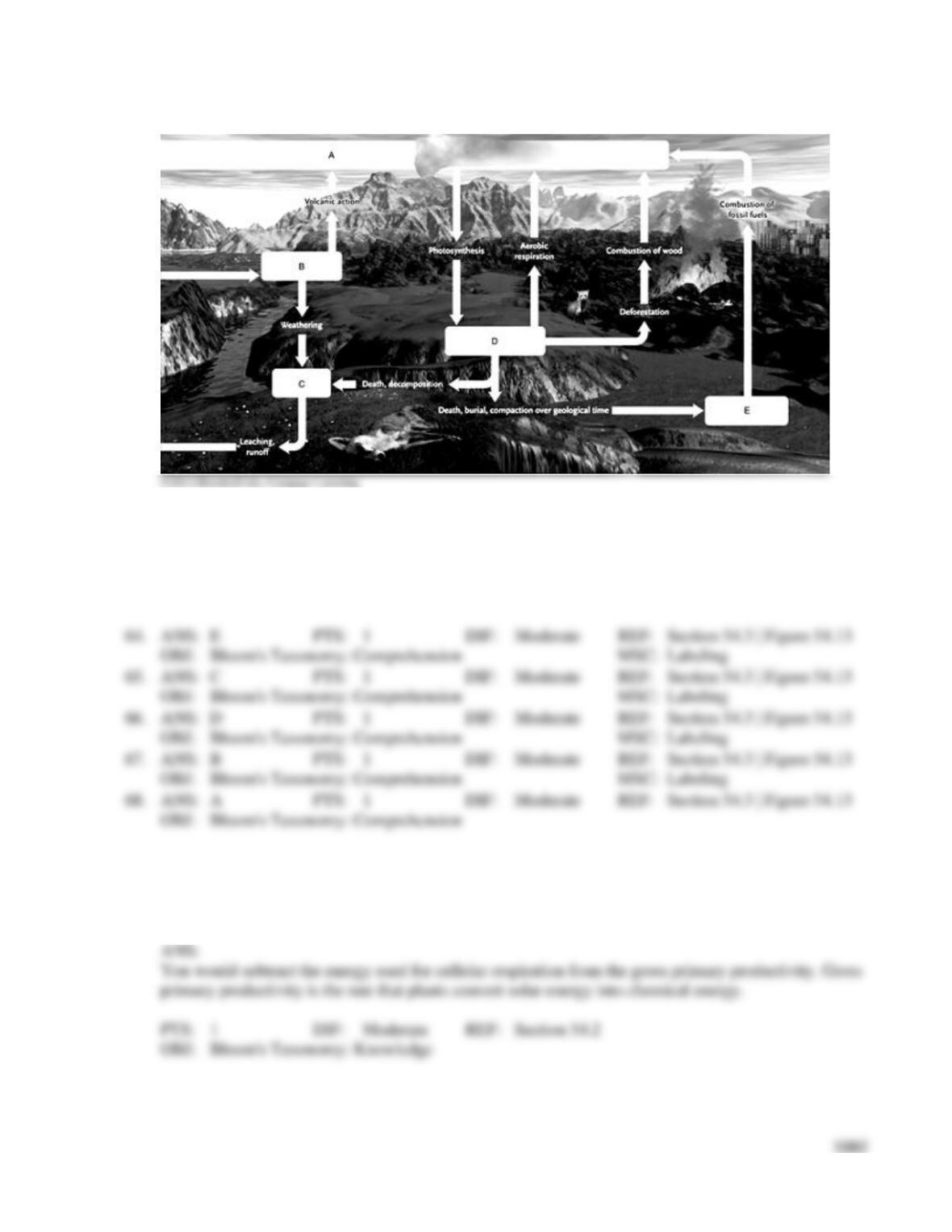
does not take into effect water availability.
d.
may not be accurate.
e.
may predict disastrous consequences.
7. Respiration would affect a compartment model by
a.
moving carbon, but not oxygen, from the available organic compartment to the available
inorganic component.
b.
moving oxygen, but not carbon, from the available organic compartment to the available
inorganic component.
c.
moving both carbon and oxygen from the available organic compartment to the available
inorganic component.
d.
moving both carbon and oxygen from the available inorganic compartment to the available
organic component.
e.
moving carbon, but not oxygen, from the available inorganic compartment to the available
organic component.
8. Herbivores are ____ energy transfer(s) away from the sun.
a.
one
b.
two
c.
three
d.
four
e.
five
9. The overall ecological efficiency of most organisms is between
a.
1 and 2 percent.
b.
2 and 5 percent.
c.
5 and 20 percent.
d.
10 and 50 percent.
e.
50 and 75 percent.

10. Nearly all ecosystems receive a constant input of energy from which outside source?
a.
bacteria
b.
biomass
c.
nutrients
d.
plants
e.
the sun
11. The length of day is ____ apt to change and the sunlight is ____ near the equator.
a.
less; strongest
b.
less; weakest
c.
more; strongest
d.
more; weakest
e.
equally; constant
12. Endothermic animals use the majority of their energy to
a.
digest.
b.
grow.
c.
move.
d.
reproduce.
e.
stay warm.
13. The conclusion from the energy flow study in Silver Springs was that
a.
energy flows are difficult to measure.
b.
most of the sun’s energy is harvested.
c.
only a little energy is transferred from one trophic level to the next.
d.
the energy flow in carnivores is equal to that of producers.
e.
trophic energy losses are not significant.
14. What three factors determine the ecological efficiencies of consumers?
a.
assimilation and harvesting efficiencies, and nutrient volume
b.
assimilation and harvesting efficiencies, and water volume
c.
production, harvesting, and assimilation efficiencies
d.
production and harvesting efficiencies, and amount of sunlight
e.
production and harvesting efficiencies, and percentage of decomposers

15. When comparing the pyramids of biomass between Silver Springs, Florida, and the English Channel,
a.
the pyramids for Silver Springs and the English Channel are both bottom heavy.
b.
the pyramids for Silver Springs and the English Channel are both top heavy.
c.
the pyramid for Silver Springs is bottom heavy and the English Channel pyramid is top
heavy.
d.
the pyramid for Silver Springs is top heavy and the English Channel pyramid is bottom
heavy.
e.
researchers are unable to create pyramids for Silver Springs and the English Channel.
16. What is the definition of the standing crop biomass?
a.
amount of sunlight absorbed by the plants
b.
assessing the health of the plants
c.
dry weight of the plants
d.
number of plant species present
e.
productivity of the plants
17. Trophic pyramids typically have a ____ base and a ____ top portion.
a.
narrow; narrow
b.
narrow; wide
c.
wide; narrow
d.
wide; wide
e.
flat; flat
18. Which of these following marine ecosystems has the highest mean net primary productivity?
a.
continental shelf
b.
estuaries
c.
kelp beds and reefs
d.
open ocean
e.
upwelling zones
19. Which of the following types of ecosystems would have the lowest percentage of total net primary
productivity?
a.
open ocean
b.
savanna
c.
swamp and march
d.
temperate deciduous forests
e.
tundra

20. Crabs and terrapins have a _____ impact on snail populations while snails have a _____ impact on
cordgrass populations and terrapins have a _____ impact on cordgrass populations.
a.
negative; negative; negative
b.
negative; negative; positive
c.
negative; positive; negative
d.
positive; negative; positive
e.
positive; positive; positive
21. Biological magnification is best defined as ____.
a.
the increase in toxicity of a chemical compound resulting from its metabolism by a living
organism
b.
the higher relative proportion of biomass among producers as compared to consumers in
an ecosystem
c.
the concentration of nondegradable poisons within organisms at higher trophic levels
d.
the concentration of degradable poisons within organisms at lower trophic levels
e.
the declining relative proportion of nondegradable poisons in organisms at higher trophic
levels as compared to those at lower trophic levels
22. Which of the following would most likely have the highest DDT concentration in tissue?
a.
zooplankton
b.
small herbivorous fish
c.
large predatory fish
d.
osprey
e.
large herbivorous fish
23. Which of the following symptoms would be characteristic of a child whose mother ate fish
contaminated by PCBs during her pregnancy?
a.
low birth weight and neonatal behavior problems
b.
low IQ and teen delinquency
c.
misshapen head and facial abnormalities
d.
spina bifida
e.
club foot

24. The largest reservoir of water is
a.
oceans.
b.
polar ice and glaciers.
c.
groundwater.
d.
lakes and rivers.
e.
atmosphere.
25. In the hydrologic cycle, water moves from the land to the air by ____ and returns to the land via ____.
a.
precipitation; evaporation and transpiration
b.
precipitation and evaporation; transpiration
c.
precipitation and transpiration; evaporation
d.
transpiration; precipitation and evaporation
e.
transpiration and evaporation; precipitation
26. The largest reservoir of carbon is
a.
consumers.
b.
nutrients in soil.
c.
producers.
d.
rock.
e.
water.
27. Which of the following carbon reservoirs contains the most carbon?
a.
atmosphere
b.
biomass on land
c.
lakes
d.
oceans
e.
soil
28. Nitrogen is made available to plants for their use by the process(es) of
a.
ammonification only.
b.
nitrification only.
c.
nitrogen fixation only.
d.
ammonification and nitrification only.
e.
ammonification, nitrification, and nitrogen fixation.

29. Name the process that takes place in nodules located on legumes.
a.
ammonification
b.
biological magnification
c.
denitrification
d.
nitrification
e.
nitrogen fixation
30. Which forms of nitrogen are readily usable by plants?
a.
NH4+ and NO3−
b.
NH4+ and NO2−
c.
N2 and NH3
d.
NH4 and NH3
e.
NO3− and NO4−
31. The main natural source of phosphorus is
a.
Earth’s crust.
b.
fertilizer.
c.
guano.
d.
legumes.
e.
water.
32. What was one of the primary results from the Hubbard Brook Watershed Project?
a.
Deforestation causes flooding.
b.
New plant species that absorb less water were discovered.
c.
Pollution is gravely affecting that water supply.
d.
Primary consumers are the most important part of that energy pyramid.
e.
Trees absorb too much water and are not useful in a watershed area.
33. The Hubbard Brook Watershed Project illustrated that
a.
deforestation can alleviate drought conditions.
b.
deforestation can result in polluted streams.
c.
deforestation results in calcium retention in soil.
d.
primary consumers are the most important part of that energy pyramid.
e.
trees absorb too much water and are not useful in a watershed area.

34. What is the main cause of carbon dioxide build up in the atmosphere?
a.
burning fossil fuels
b.
deforestation
c.
droughts
d.
flooding
e.
respiration due to overpopulation
35. Burning fossil fuels has clearly resulted in
a.
increases in atmospheric concentrations of carbon dioxide.
b.
increases in extinction rates.
c.
increases in concentrations of carbon dioxide in soils.
d.
increases of carbon retention in species.
e.
decreases in atmospheric concentrations of oxygen.
36. Humans have disrupted the nitrogen cycle primarily by
a.
irrigation.
b.
cutting down forests.
c.
using nitrogen-containing fertilizers.
d.
crop rotation.
e.
leaching.
37. Ocean acidification is being caused by
a.
global warming.
b.
nitrogen fertilizer runoff.
c.
phosphorous fertilizer runoff.
d.
transfer of carbon dioxide from atmosphere to ocean.
e.
transfer of carbon dioxide from ocean to atmosphere.
38. A small decrease in pH was shown to have a significant effect on
a.
climate change.
b.
the oceanic sink for carbon dioxide.
c.
genes involved in building mineralized skeletons in sea urchin larvae.
d.
genes involved in zooplankton reproduction.
e.
the ocean source for carbon dioxide.

39. Which factor would be least useful for making predictions regarding how urbanization and climate
change will affect the carbon cycle?
a.
the architecture of the canopy of trees overhead
b.
leaf positioning
c.
leaf losses
d.
timing of natural events
e.
extent of agricultural practices
Select the Exception
40. Which of the following is NOT part of the grazing food web?
a.
detritivores
b.
primary producers
c.
primary consumers
d.
secondary consumers
e.
tertiary consumers
41. To develop an effective simulation model for an ecosystem, a researcher must do all of the following
EXCEPT
a.
describe food webs.
b.
develop relevant equations.
c.
estimate productivity of all populations.
d.
identify major species.
e.
manipulate species richness.
42. In a marine environment, which of the following is NOT a limiting factor for primary productivity?
a.
depth of the water
b.
nutrients
c.
sunlight
d.
water
e.
nitrogen
43. The Hubbard Brook Watershed project measured all of the following EXCEPT
a.
amount of energy used by consumers.
b.
amount of nutrients washed away by streams.
c.
nutrient input.
d.
precipitation.
e.
uptake of nutrients by plants.

44. All of the following would help to reduce the amount of greenhouse gases in the atmosphere EXCEPT
a.
planting trees.
b.
reducing emissions from factories.
c.
reducing water usage.
d.
using solar heat in homes.
e.
walking to work.
45. Which of the following plants CANNOT participate in nitrogen fixation?
a.
beans
b.
clover
c.
peanuts
d.
alders
e.
wheat
46. An urban environment may impact all of the following changes to a forest EXCEPT
a.
amount of rainfall.
b.
rate of photosynthesis.
c.
rate of cellular respiration.
d.
seedling size.
e.
stomatal densities.
MATCHING
Match each description with the appropriate scientific term.
a.
Biogeochemical cycles
b.
Ecological efficiency
c.
Ecological pyramid
d.
Generalized compartment model
e.
Gross primary productivity
f.
Limiting factor
g.
Net primary productivity
h.
Pyramid of biomass
i.
Secondary productivity
j.
Simulation modeling
k.
Standing crop mass
l.
Trophic cascade
47. predicting what would happen if an ecosystem was changed
48. nutrients cycle between abiotic and living organisms
49. describing how nutrients accumulate in four compartments
50. rate at which a plant converts the sun’s energy into chemical energy
51. the element in short supply
52. the energy transfer from producers to consumers

1080
53. a diagram showing the inefficient transfer of energy from one trophic level to the next
54. the total dry weight of plants at a certain time
55. gross primary productivity minus the energy used for cellular respiration
56. the ratio of net productivity at one trophic level to the productivity at the trophic level below it
57. the reduction of productivity decreases at higher trophic levels
58. the relationship between a predator and prey that effects populations in two or more trophic levels
1081
Labeling
Fill in the blanks with the appropriate terms to correspond with the boxes in the following image.
59. detritivores and decomposers
60. primary consumers
61. primary producers
62. secondary consumers
63. tertiary consumers
Labeling
Fill in the blanks with the appropriate terms to correspond with the boxes in the following image.
64. coal, oil, peat
65. soil water
66. terrestrial food webs
67. terrestrial rocks
68. gaseous reservoir of carbon dioxide
SHORT ANSWER
69. How would you calculate the net primary productivity of an ecosystem?

70. Why is the productivity poor in the deeper parts of the ocean?
71. How would ecological efficiency change if all humans became vegetarians?
72. Where do terrestrial plants obtain the necessary carbon for photosynthesis?
73. Why is nitrogen necessary in the human body?
OTHER
74. Put the following stages of the phosphorus cycle in the proper order:
A.
Feces and urine are released from animals into soil.
B.
Phosphorus is plentiful in rocks and soil.
C.
Phosphorus goes from rivers into the ocean.
D.
Phosphorus goes from soil into rivers.
E.
Phosphorus goes to higher trophic levels.
F.
Following uplifting, plants take in phosphorus.
G.
Ocean floor experiences an uplifting and releases phosphorus.
1.
First stage
2.
Second stage
3.
Third stage
4.
Fourth stage
5.
Fifth stage
6.
Sixth stage
7.
Seventh stage
1.
B
2.
D
3.
C
4.
G
5.
F
6.
E
7.
A
ANS:
MODIFIED TRUE/FALSE
Questions
If the statement is true, write a “T” in the blank. If the statement is false, make it correct by changing
the underlined word(s) and writing the correct word(s) in the answer blank.
75. Oceans and the tropical rain forests contribute equally to global productivity.
76. Large zooplankton decrease the ecosystem’s main productivity when they are abundant.
77. Energy is conserved between each trophic level.
78. Water can be a limiting factor when measuring productivity.
79. Energy losses are multiplied in successive energy transfers in a food web.

80. Lake ecosystems have many trophic levels.
81. Most biomass in trees is found in leaves, which do undergo photosynthesis.
82. A large percentage of energy passes on from one trophic level to the next.
83. Fossil fuels are the result of buried organisms where low oxygen levels existed.
84. Scientists estimate that carbon dioxide in the atmosphere has increased by 35% in the last 150 years.
85. In the second half of the twentieth century, human activities have more than tripled the amount of
nitrogen released from land into the atmosphere or aquatic systems.
ESSAY
86. How do food webs relate to the idea of biological magnification of toxins?

87. What have you learned in the chapter about how humans can minimize their effects on food webs and
nutrient cycles?
88. How do agricultural practices affect the nitrogen cycle?