Chapter 53 – Animal Development
Chapter 53
Animal Development
Multiple Choice Questions
1. What event initiates development?
2. What factor has the strongest influence on the cleavage pattern of an embryo?
3. In mammals, embryonic cells form an inner cell mass that will become the body of the
embryo and a layer of surrounding cells that will become the chorionic membrane and
placenta. What are these surrounding cells called?
Chapter 53 – Animal Development
4. What structure is formed from both fetal and maternal tissue?
5. A couple conceives at the beginning of January. During which month will their child be
undergoing organogenesis?
Chapter 53 – Animal Development
53-3
Clarify Question
What is the key concept addressed by the question?
What type of thinking is required?
Gather Content
What do you already know about organogenesis? What other information is related to the
question?
Choose Answer
Given what you now know, what information is most likely to produce the correct answer?
Reflect on Process
Did your problem-solving process lead you to the correct answer? If not, where did the
process break down or lead you astray? How can you revise your approach to produce a
more desirable result?

Chapter 53 – Animal Development
53-4
6. A couple conceives a child on January 1st. Which day falls within the period of
somitogenesis?
Chapter 53 – Animal Development
53-5
Clarify Question
What is the key concept addressed by the question?
What type of thinking is required?
Gather Content
What do you already know about somitogenesis? What other information is related to the
question?
Choose Answer
Given what you now know, what information is most likely to produce the correct answer?
Reflect on Process
Did your problem-solving process lead you to the correct answer? If not, where did the
process break down or lead you astray? How can you revise your approach to produce a
more desirable result?
Chapter 53 – Animal Development
7. When the placenta is delivered, what event allows secretion of prolactin and milk
production?
8. New mothers may benefit from the aid of lactation consultants when learning to
breastfeed. These consultants give advice on technique, and help the mother to feel relaxed
and confident. What hormone is associated with calm, warm emotions and is also critical for
the milk let-down reflex?
9. What would be the result of a mutation that reduces the amount of acrosomal enzymes?
Chapter 53 – Animal Development
53-7
Clarify Question
What is the key concept addressed by the question?
What type of thinking is required?
Gather Content
What do you already know about the acrosomal region? What other information is related
to the question?
Choose Answer
Given what you now know, what information is most likely to produce the correct answer?
Reflect on Process
Did your problem-solving process lead you to the correct answer? If not, where did the
process break down or lead you astray? How can you revise your approach to produce a
more desirable result?
Chapter 53 – Animal Development
10. Certain groups of cells move inward from the surface of the blastula in a carefully
orchestrated migration called
11. The hollow crater formed during gastrulation is known as
Chapter 53 – Animal Development
12. What developmental event was key to the evolution of the chordates, by forming the
notochord and dorsal nerve cord?
13. What factors stimulate uterine contractions and birth?
14. What is the period of rapid cell division in which the embryo does not increase in overall
size?
Chapter 53 – Animal Development
53–10
15. What pattern of cleavage is characteristic of mammals?
16. What is the term for segmented blocks of tissue that form on either side of the notochord
and are added sequentially?
17. Which of the following leads to the occurrence of vertebrate sense organs?
Check All That Apply Questions
Chapter 53 – Animal Development
53–11
18. Which are structures formed from the neural crest? (Check all that apply.)
19. Which of the following are fetal membranes? (Check all that apply.)
Multiple Choice Questions
Chapter 53 – Animal Development
20. The developing embryo of reptiles, birds, and mammals is encased in the fluid-filled
________ membrane.
21. The human placenta is formed by the interaction of uterine tissue and what
extraembryonic tissue?
True / False Questions
22. The placenta protects the developing fetus from harmful substances like alcohol or
drugs.
Chapter 53 – Animal Development
53–13
Check All That Apply Questions
23. Which of the following describe the placenta? (Check all that apply.)
24. Which developmental events are accurately placed in the following timeline? (Check all
that apply.)
Multiple Choice Questions
Chapter 53 – Animal Development
25. What is the main role of human chorionic gonadotropin?
26. What stimulates milk production in mammary alveoli?
27. How is brain growth in humans different from other mammals?
Chapter 53 – Animal Development
53–15
28. The head of a sperm is capped with an organelle that contains glycoprotein-digesting
enzymes. What is this organelle called?
Check All That Apply Questions
29. Which tissues are correctly matched to their progenitor germ layer? (Check all that
apply.)
_____ ectoderm—lining of the digestive tract
Multiple Choice Questions
Chapter 53 – Animal Development
30. Select the correct sequence of vertebrate development beginning with fertilization.
31. In human females, what process causes milk production?
Chapter 53 – Animal Development
32. What is the first milk that is produced after birth called?
33. What are the two components of the human placenta?
34. Which of the following activates the egg?
Chapter 53 – Animal Development
53–18
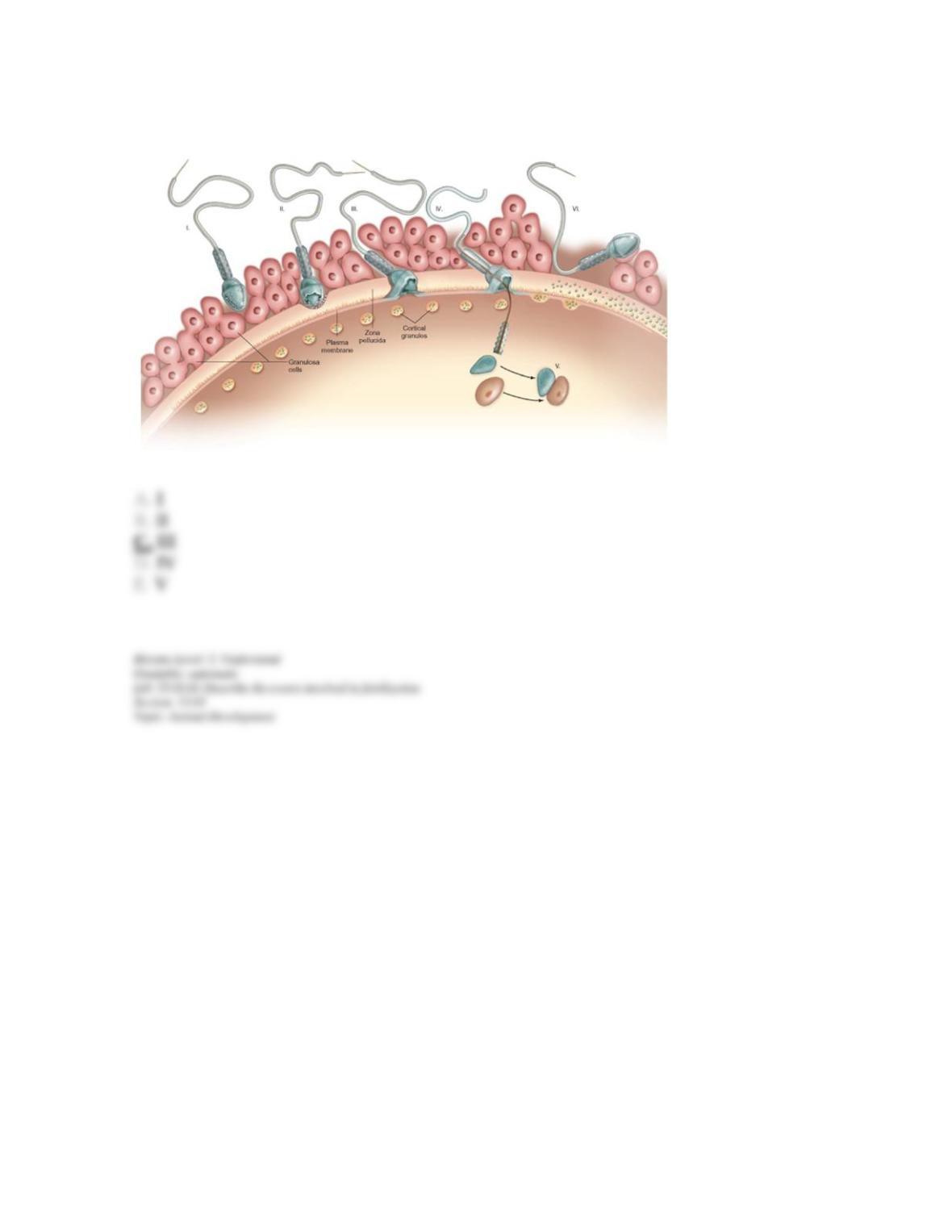
35. In this diagram, which of the following numbers represents the actual event of egg
activation?
Chapter 53 – Animal Development
53–19
Check All That Apply Questions
36. Which of the following are mechanisms to prevent polyspermy?
37. Which of the following result from sperm penetration? (Check all that apply.)
Multiple Choice Questions
Chapter 53 – Animal Development
38. Which of the following animals undergoes true holoblastic cleavage?
39. Which of the following animals undergoes rotational cleavage?
40. Working in an experimental fertility clinic, a researcher removes one cell from an 8-cell
stage chimpanzee embryo. What is the likely result?