Chapter 53 – Animal Development
53–21
Clarify Question
What is the key concept addressed by the question?
What type of thinking is required?
Gather Content
What do you already know about early development? What other information is related to
the question?
Choose Answer
Given what you now know, what information is most likely to produce the correct answer?
Reflect on Process
Did your problem-solving process lead you to the correct answer? If not, where did the
process break down or lead you astray? How can you revise your approach to produce a
more desirable result?

Chapter 53 – Animal Development
53–22
Check All That Apply Questions
41. Which of the following are derived from mesoderm?
Multiple Choice Questions
Chapter 53 – Animal Development
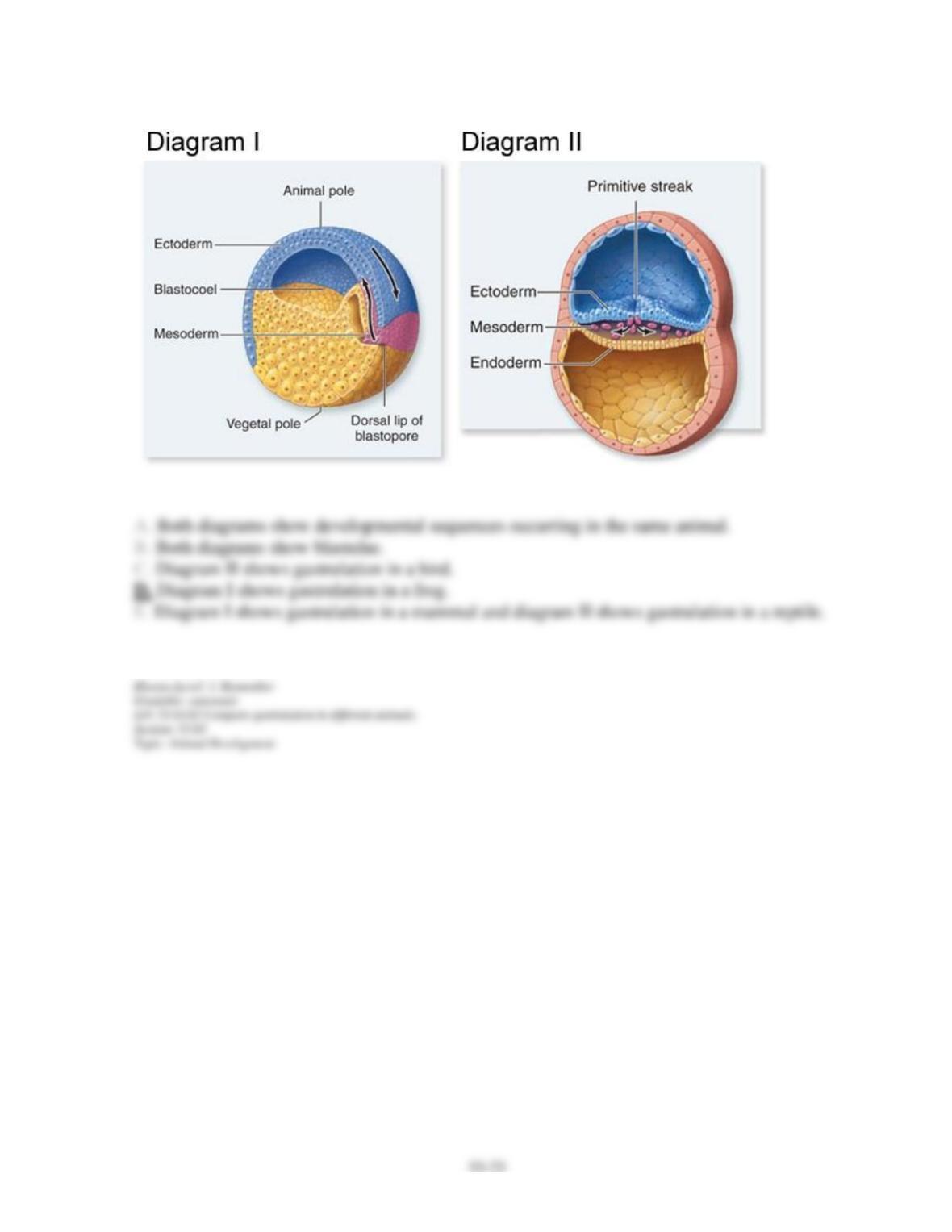
42. In the diagram, which of the following is true?
Chapter 53 – Animal Development
53–24
43. Removing some fluid from directly around a developing human fetus is performed by
inserting a long needle into the belly of the female patient. What extraembryonic membrane
will be punctured in this process?
Check All That Apply Questions
44. Which of the following regarding the Spemann organizer is true? (Check all that apply.)
Multiple Choice Questions
Chapter 53 – Animal Development
53–25
45. What actually begins the uterine contractions which leads to giving birth?
Fill in the Blank Questions
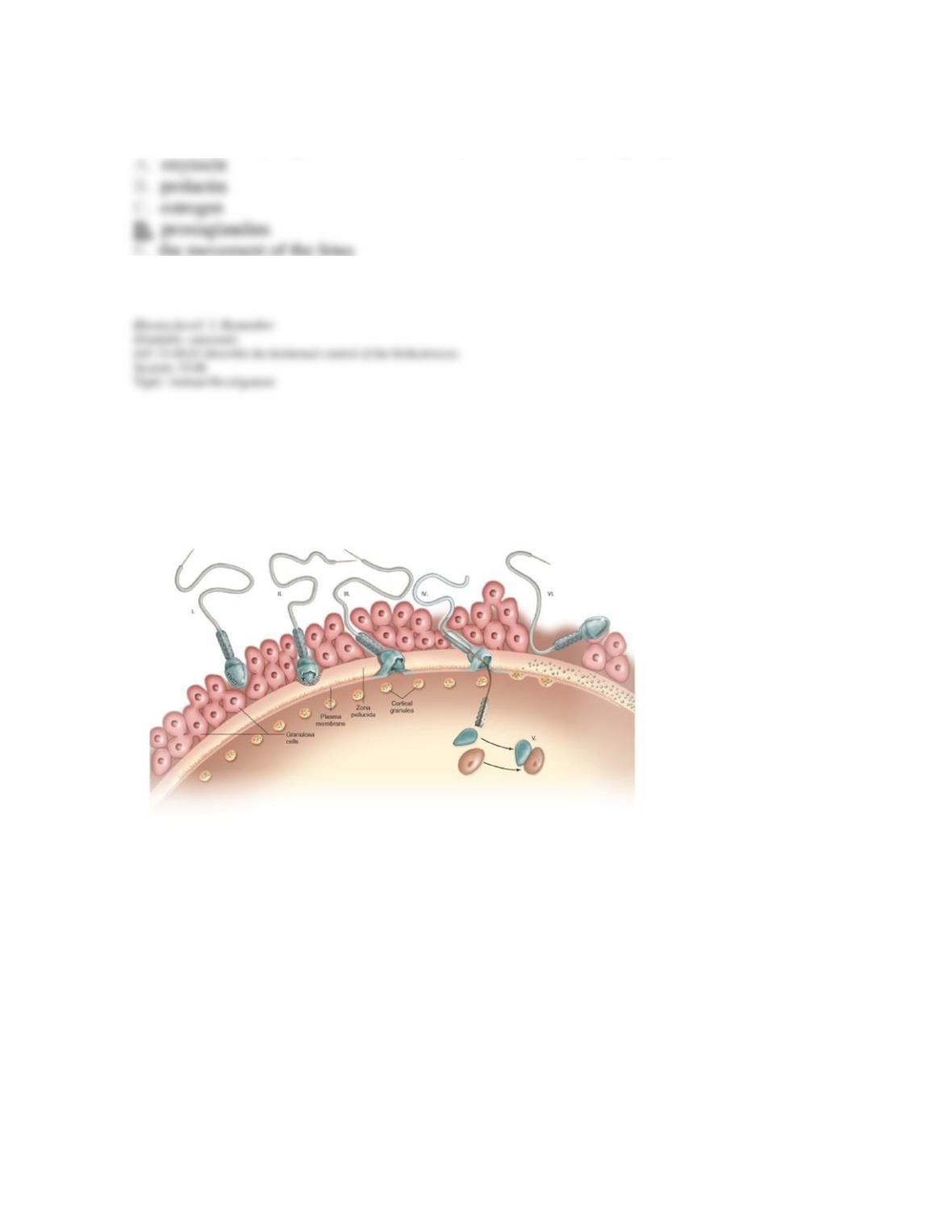
Referring to the figure of sperm penetration and fusion, match the lettered description with
the correct numbered step in the figure.
A. Some of the zona pellucida is degraded by acrosomal enzymes.
B. Enzymes are released by cortical granules that harden the zona pellucida.
C. Sperm and egg fuse at the plasma membrane.
Chapter 53 – Animal Development
D. Sperm penetrates the corona radiata.
E. The sperm nucleus dissociates and enters the cytoplasm.
F. Additional sperm can no longer penetrate.
Blooms Level: 1. Remember
LO: 53.01.01 Describe the events involved in fertilization
Section: 53.01
Topic: Animal Development
46. Step I
47. Step II
48. Step III

Chapter 53 – Animal Development
53–27
49. Step IV
50. Step V
51. Step VI
Choose the letter of the best match from the following:
A. third trimester of pregnancy
B. second month of pregnancy
C. first month of pregnancy
D. second trimester of pregnancy
E. third month of pregnancy
Chapter 53 – Animal Development
52. Neurulation occurs.
53. The embryo is now called the fetus.
54. The heart begins to beat.
55. The limbs, tail bud, and internal organs form.

Chapter 53 – Animal Development
53–29
56. Major nerve tracts are formed.
Multiple Choice Questions
57. In 1999, researchers found that they could create hybrid embryos between two species of
sea urchin that had been separated for 10 million years. By treating eggs to remove the jelly
coat, the sperm of the other species was able to fertilize. What step of the fertilization process
is normally blocked, preventing hybridization between these species?
Chapter 53 – Animal Development
53–30
Clarify Question
What is the key concept addressed by the question?
What type of thinking is required?
Gather Content
What do you already know about fertilization? What other information is related to the
question?
Choose Answer
Given what you now know, what information is most likely to produce the correct answer?
Reflect on Process
Did your problem-solving process lead you to the correct answer? If not, where did the
process break down or lead you astray? How can you revise your approach to produce a
more desirable result?
Chapter 53 – Animal Development
53–31
58. Egg activation by sperm entry is associated with a sudden increase in protein synthesis.
What must be true of these proteins?
59. Your research project involves sea cucumbers, a poorly-understood group of
echinoderms. You are trying to determine whether they block polyspermy by changing
membrane potential like sea urchins do. In the chart below, you have counted the number of
embryos that complete normal development after fertilization in either normal or low-sodium
artificial sea water (ASW), for each of three sets of experiments. Looking over your data,
what do you conclude?
cohort
ASW
low sodium ASW
(50mM Na)
A
25/25
2/24
B
22/23
1/22
C
24/26
1/27
Chapter 53 – Animal Development
53–32
Clarify Question
What is the key concept addressed by the question?
What type of thinking is required?
Gather Content
What do you already know about fertilization in sea urchins? What other information is
related to the question?
Choose Answer
Given what you now know, what information is most likely to produce the correct answer?
Reflect on Process
Did your problem-solving process lead you to the correct answer? If not, where did the
process break down or lead you astray? How can you revise your approach to produce a
more desirable result?
Chapter 53 – Animal Development
53–33
60. A research group claims that they have discovered microscopic fossilized embryos,
including some at the blastula stage, but other researchers are skeptical. Finally, one student
develops a technique for splitting the embryos in half to reveal the substructure. Cutting open
the first blastocyst embryo, the student is very excited. “It is a blastula!” she shouts,”Look,
you can see the ____________________ inside!”
Chapter 53 – Animal Development
53–34
Clarify Question
What is the key concept addressed by the question?
What type of thinking is required?
Gather Content
What do you already know about a blastula? What other information is related to the
question?
Choose Answer
Given what you now know, what information is most likely to produce the correct answer?
Reflect on Process
Did your problem-solving process lead you to the correct answer? If not, where did the
process break down or lead you astray? How can you revise your approach to produce a
more desirable result?
Chapter 53 – Animal Development
61. What is the role of cleavage in the early embryo?
62. What can you conclude about a species heavily reliant on diffusible morphogens in early
development?
Chapter 53 – Animal Development
53–36
Clarify Question
What is the key concept addressed by the question?
What type of thinking is required?
Gather Content
What do you already know about morphogens? What other information is related to the
question?
Choose Answer
Given what you now know, what information is most likely to produce the correct answer?
Reflect on Process
Did your problem-solving process lead you to the correct answer? If not, where did the
process break down or lead you astray? How can you revise your approach to produce a
more desirable result?
• Apply level:
Chapter 53 – Animal Development
63. You are studying the development of a poorly-understood species at the 8-cell stage. You
use a laser to zap away a certain one of the eight cells, and discover that part of the gut is
missing once the embryos finish development. Your colleague, who is working on a different
species, uses the laser to blast away one of the cells in her embryos, zapping each of the
possible cells in a set of eight experiments. However, when the embryos finish development,
every one is perfectly normal! What can you conclude about the two species?
Chapter 53 – Animal Development
53–38
Clarify Question
What is the key concept addressed by the question?
What type of thinking is required?
Gather Content
What do you already know about cleavage and developmental pathways? What other
information is related to the question?
Choose Answer
Chapter 53 – Animal Development
Given what you now know, what information is most likely to produce the correct answer?
Reflect on Process
Did your problem-solving process lead you to the correct answer? If not, where did the
process break down or lead you astray? How can you revise your approach to produce a
more desirable result?
64. What would result if an error inside gastrulation caused too few cells inside the
archenteron?
Chapter 53 – Animal Development
53–40
Clarify Question
What is the key concept addressed by the question?
What type of thinking is required?
Gather Content
What do you already know about the fate of the archenteron? What other information is
related to the question?
Choose Answer
Given what you now know, what information is most likely to produce the correct answer?
Reflect on Process
Did your problem-solving process lead you to the correct answer? If not, where did the
process break down or lead you astray? How can you revise your approach to produce a
more desirable result?