Chapter 51 – The Immune System
42. What do we call a lymphocyte that has never encountered an antigen?
43. Which of the following describes passive immunity?
Check All That Apply Questions
44. Which of the following are organs of the immune system? (Check all that apply.)
Chapter 51 – The Immune System
Multiple Choice Questions
45. Which of the following cells is matched to an incorrect function?
46. Which of the following is true regarding cytokines?
Check All That Apply Questions
Chapter 51 – The Immune System
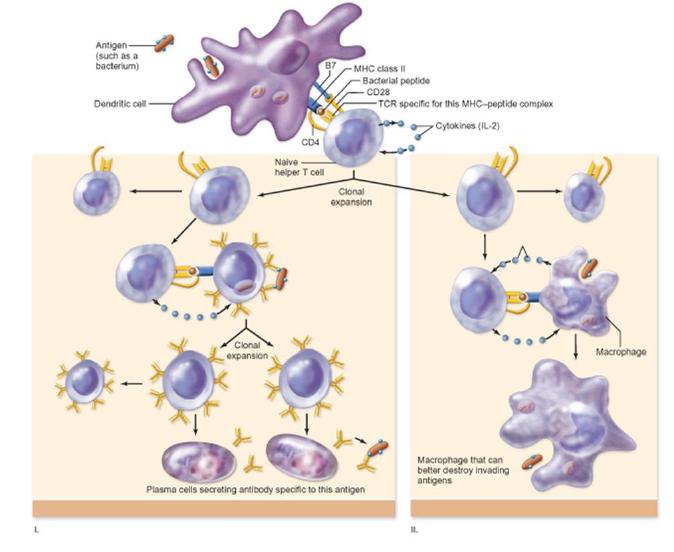
47. Referring to the figure showing helper T cell function, which statements are true? (Check
all that apply.)
Chapter 51 – The Immune System
48. Which of the following are a class of immunoglobin? (Check all that apply.)
49. Which of the following statements regarding hypersensitivity are true? (Check all that
apply.)

Chapter 51 – The Immune System
50. The hospital where you work is having an emergency blood shortage. Select the
following blood types that could safely be given to a young female with type AB Rh– blood.
Chapter 51 – The Immune System
Clarify Question
What is the key concept addressed by the question?
What type of thinking is required?
Gather Content
What do you already know about blood typing? What other information is related to the
question?
Choose Answer
Given what you now know, what information is most likely to produce the correct answer?
Reflect on Process
Did your problem-solving process lead you to the correct answer? If not, where did the
process break down or lead you astray? How can you revise your approach to produce a
more desirable result?
Chapter 51 – The Immune System
Multiple Choice Questions
51. What is the most fundamental difference between the innate immune system and acquired
immune system?
52. Imagine that a Toll-like receptor (TLR) gene has duplicated and mutated, creating a
leucine-rich region binding pocket that can now bind to the hemagglutinin protein in the
envelope of influenza virus. What do you predict will happen to this novel gene?
Chapter 51 – The Immune System
Clarify Question
What is the key concept addressed by the question?
Gather Content
What do you already know about TLRs? What other information is related to the question?
Choose Answer
Given what you now know, what information is most likely to produce the correct answer?
Reflect on Process
Did your problem-solving process lead you to the correct answer? If not, where did the
process break down or lead you astray? How can you revise your approach to produce a
more desirable result?

Chapter 51 – The Immune System
53. Until renamed by Paul Ehrlich in the 1890s, the heat-labile, nonspecific part of the
immune system that enhances inflammation was known as “alexin”. We now know that
various proteins of this system attract neutrophils to tissues, direct phagocytosis of targets by
neutrophils and macrophages, burst pathogens by insertion of the membrane attack complex
(MAC), stimulate histamine release, and increase capillary permeability. What did Ehrlich
rename this part of the immune system?
Check All That Apply Questions
Chapter 51 – The Immune System
54. While innate immunity is ancient and universal amongst animals, the adaptive immune
system is generally considered to be unique to the vertebrates. However, some researchers
have suggested, with much controversy, that invertebrates may have a form of adaptive
immunity as well. What sort of evidence would be required to fully demonstrate such a claim?
(Check all that apply.)
_____ B and T cells
Chapter 51 – The Immune System
Clarify Question
What is the key concept addressed by the question?
What type of thinking is required?
Gather Content
What do you already know about adaptive immunity? What other information is related to
the question?
Choose Answer
Given what you now know, what information is most likely to produce the correct answer?
Reflect on Process
Did your problem-solving process lead you to the correct answer? If not, where did the
process break down or lead you astray? How can you revise your approach to produce a
more desirable result?
Multiple Choice Questions
Chapter 51 – The Immune System
55. A patient has come to you for a second opinion. “I have these mysterious lumps in my
right armpit,” he says, “The other doctor says we may have to remove them. What do you
think?”
You notice red scratches on the patient’s right arm. “You must have a new kitten. Cat scratch
disease, from the bacterium Bartonella ,” you say, “And we certainly won’t remove those
lumps, they are really important! Those are your…”
Chapter 51 – The Immune System
Clarify Question
What is the key concept addressed by the question?
What type of thinking is required?
Gather Content
What do you already know about the composition of tissue in the region of the armpit?
What other information is related to the question?
Choose Answer
Given what you now know, what information is most likely to produce the correct answer?
Reflect on Process
Did your problem-solving process lead you to the correct answer? If not, where did the
process break down or lead you astray? How can you revise your approach to produce a
more desirable result?
Chapter 51 – The Immune System
56. T cells binding to MHC-peptide complexes are responsible for acceptance or rejection of
transplanted organs. To facilitate acceptance of the transplant, the ideal donor will have a
close genetic relationship with the recipient — even then, immune suppression drugs are often
necessary. In a strange variation of this phenomenon, the endangered Tasmanian devil of
Australia suffers from a devastating disease in which tumorous tissue is transmitted from
animal to animal. What is the likely explanation for the lack of rejection of this transmissible
tumor?
Chapter 51 – The Immune System
Clarify Question
What is the key concept addressed by the question?
What type of thinking is required?
Gather Content
What do you already know about tissue transplants? What other information is related to
the question?
Choose Answer
Given what you now know, what information is most likely to produce the correct answer?
Reflect on Process
Did your problem-solving process lead you to the correct answer? If not, where did the
process break down or lead you astray? How can you revise your approach to produce a
more desirable result?
Chapter 51 – The Immune System
57. You are studying a trafficking protein important for secretion in helper T cells. What is
the likely outcome of a defect in this protein?
58. What would happen to immunoglobulin genes if alternative mRNA splicing was
nonfunctional?
Chapter 51 – The Immune System
Clarify Question
What is the key concept addressed by the question?
What type of thinking is required?
Gather Content
What do you already know about mRNA splicing? What other information is related to the
question?
Choose Answer
Given what you now know, what information is most likely to produce the correct answer?
Reflect on Process
Did your problem-solving process lead you to the correct answer? If not, where did the
process break down or lead you astray? How can you revise your approach to produce a
more desirable result?
Chapter 51 – The Immune System
59. Two proteins, Rag-1 and Rag-2, catalyze VDJ recombination. What is the likely outcome
of a deletion of the Rag genes?
Chapter 51 – The Immune System
Clarify Question
What is the key concept addressed by the question?
What type of thinking is required?
Gather Content
What do you already know about the VDJ segments? What other information is related to
the question?
Choose Answer
Given what you now know, what information is most likely to produce the correct answer?
Reflect on Process
Did your problem-solving process lead you to the correct answer? If not, where did the
process break down or lead you astray? How can you revise your approach to produce a
more desirable result?
Chapter 51 – The Immune System
60. Two proteins, Rag-1 and Rag-2, catalyze VDJ recombination. Where would you expect
these proteins to be expressed?
Clarify Question
What is the key concept addressed by the question?
What type of thinking is required?
Gather Content
What do you already know about antibodies? What other information is related to the
question?
Choose Answer