Campbell’s Biology, 9e (Reece et al.)
Chapter 50 Sensory and Motor Mechanisms
Sensory transduction converts energy in an environmental stimulus into changes in neural activity,
leading to possible changes in behavior and physiology. In this chapter, an overview of sensory
transduction is followed by an exploration of the known details of mechanoreception, chemoreception,
and photoreception. The descriptions of gathering and processing environmental information via afferent
pathways then segues into a description of the means for acting on environmental information through
efferent motor pathways controlling muscle contraction. The sliding-filament mechanism of muscle
contraction, and its regulation and energy dynamics, is an entrée to subsequent chapters on behavior and
ecology.
Multiple-Choice Questions
1) The 11 pairs of appendages projecting from the rostral area of star-nosed moles are
A) chemosensory structures.
B) tactile structures.
C) olfactory structures.
D) highly sensitive photoreceptors.
E) gustatory structures.
2) The correct sequence of sensory processing is
A) sensory adaptation → stimulus reception → sensory transduction → sensory perception.
B) stimulus reception → sensory transduction → sensory perception → sensory adaptation.
C) sensory perception → stimulus reception → sensory transduction → sensory adaptation.
D) sensory perception → sensory transduction → stimulus reception → sensory adaptation.
E) stimulus reception → sensory perception → sensory adaptation → sensory transduction.
3) Sensory-transducing cells that fire both graded potentials and action potentials are found in
A) vision.
B) gustation.
C) olfaction.
D) audition.
4) Artificial electrical stimulation of a human’s capsaicin-sensitive neurons would likely produce the
sensation of
A) cold temperature.
B) hot temperature.
C) tactile stimulus.
D) odor of pepper.
E) deep pressure.
5) Artificial electrical stimulation of a human’s menthol-sensitive neurons would likely produce the
sensation of
A) cold temperature.
B) hot temperature.
C) tactile stimulus.
D) odor of pepper.
E) deep pressure.
6) Tastes and smells are distinct kinds of environmental information in that
A) neural projections from taste receptors reach different parts of the brain than the neural projections
from olfactory receptors.
B) the single area of the cerebral cortex that receives smell and taste signals can distinguish tastes and
smells by the pattern of action potentials received.
C) tastant molecules are airborne, whereas odorant molecules are dissolved in fluids.
D) distinguishing tastant molecules requires learning, whereas smell discrimination is an innate process.
E) odorants bind to receptor proteins, but none of the tastant stimuli bind to receptors.
7) Stimuli alter the activity of excitable sensory cells via
A) integration.
B) transmission.
C) transduction.
D) transcription.
E) amplification.
8) Choose the correct sequence of the following events leading to the sensory processing of a stimulus.
1. transmission
2. transduction
3. integration
4. amplification
A) 1 → 2 → 3 → 4
B) 1 → 4 → 2 → 3
C) 2 → 4 → 1 → 3
D) 3 → 1 → 2 → 4
E) 3 → 1 → 4 → 2
9) Immediately after putting on a shirt, your skin might feel itchy. However, this perception soon fades
due to
A) sensory adaptation.
B) accommodation.
C) the increase of transduction.
D) reduced motor unit recruitment.
E) reduced receptor amplification.
10) A given photon of light may trigger an action potential with thousands of times more energy because
the signal strength is magnified by
A) the receptor.
B) a G protein.
C) an enzyme-catalyzed reaction.
D) sensory adaptation.
E) triggering several receptors at once.
11) The muscle spindle is
A) an actin-myosin complex.
B) a troponin-tropomyosin complex.
C) axons wound around muscle fibers.
D) a group of dendrite-encircled muscle fibers.
E) a muscle cell that makes up a muscle group.
12) Statocysts contain cells that are
A) mechanoreceptors which function in orientation to gravity.
B) chemoreceptors used in selecting migration routes.
C) photoreceptors used in setting biological rhythms.
D) thermoreceptors used in prey detection.
E) chemoreceptors used in acid-base balance.
13) An earthworm without a statocyst would not be able to
A) move.
B) sense light.
C) hear.
D) orient with respect to gravity.
E) respond to touch.
14) The cellular membrane across which ion flow varies during auditory transduction is the
A) tectorial membrane.
B) tympanic membrane.
C) round-window membrane.
D) hair cell membrane.
E) basilar membrane.
15) Sound waves arriving at a listener first strike the
A) tectorial membrane.
B) tympanic membrane.
C) round-window membrane.
D) hair cell membrane.
E) basilar membrane.
16) The pathway leading to the perception of sound by mammals begins with the
A) hair cells of the organ of Corti, which rests on the basilar membrane, coming in contact with the
tectorial membrane.
B) hair cells of the organ of Corti, which rests on the tympanic membrane, coming in contact with the
tectorial membrane.
C) hair cells of the organ of Corti, which rests on the tectorial membrane, coming in contact with the
basilar membrane.
D) hair cells of the organ of Corti coming in contact with the tectorial membrane as a result of fluid
waves in the cochlea causing vibrations in the round window.
E) hair cells on the tympanic membrane that stimulate the tectorial membrane neurons, leading to the
auditory section of the brain.
17) The cochlea is an organ of auditory transduction that contains
A) fluid and cells that can undergo mechanosensory transduction.
B) air and cells that produce wax.
C) air and small bones that vibrate in response to sound waves.
D) fluid with stacks of chemosensory cells.
E) air and statocysts activated by movement.
18) Dizziness is a perceived sensation that can occur when
A) the hair cells in the cochlea move more than their normal limits.
B) moving fluid in the semicircular canals encounters a stationary cupula.
C) rods and cones provide information that does not correspond with information received by cochlear
hair cells.
D) the basilar membrane makes physical contact with the tectorial membrane.
E) the utricle is horizontal but the saccule is vertical.
19) The perceived pitch of a sound depends on
A) which part of the tympanic membrane is being vibrated by sound waves.
B) which part of the oval window produces waves in the cochlear fluid.
C) which region of the basilar membrane was set in motion.
D) whether or not the sound moves the incus, malleus, and stapes.
E) the listener having had training in music.
20) The sand grains or other dense materials resting on mechanoreceptors used by most invertebrates to
sense gravity are called
A) cochlea.
B) statoliths.
C) stapes.
D) pinnae.
E) antennae.
21) Mechanoreceptors that react to low frequency waves are part of the
A) human sense of taste.
B) pain receptors in birds.
C) human sense of smell.
D) lateral line systems in fish.
E) eyes in arthropods.
22) The lateral line system in fish transduces sensory information in a manner that, among these choices,
is most similar to
A) human vision.
B) human olfaction.
C) human gustation.
D) human vestibular sense.
E) human thermoreception.
23) The generation of action potentials in olfactory neurons initiated by odors drawn in the nasal cavity
is an example of
A) perception.
B) sensory transduction.
C) sensory adaptation.
D) habituation.
E) lateral inhibition.
24) Tastes and smells are similar in that
A) both types of stimuli are present in thousands of different chemicals.
B) both types of stimuli must be dissolved in a body fluid before they can be detected.
C) both types of stimuli are proteins (that is, molecules of very large size and high molecular weight).
D) both types of stimuli evoke action potentials in the cells to which they bind.
E) any given stimulus for one system evokes a response from the other system.
25) Sensillae are
A) smell receptors in animals with hydrostatic skeletons.
B) mechanoreceptors that help birds remain oriented during flight.
C) a specific type of hair cell in the human ear.
D) insect taste receptors found on feet and mouthparts.
E) olfactory hairs located on insect antennae.
26) Most of the chemosensory neurons arising in the nasal cavity have axonal projections that terminate
in the
A) gustatory complex.
B) anterior hypothalamus.
C) olfactory bulb.
D) occipital lobe.
E) posterior pituitary gland.
27) Umami perception follows the oral presence of
A) sugar water.
B) a rich chocolate flavor.
C) a savory and complex cheese.
D) acidic orange juice.
E) salt water.
28) The ratio of expressed receptor types to taste cells is
A) ~10:1
B) ~100:1
C) ~1,000:1
D) 1:1
E) 1:~100
29) Proteins coded by a very large family of related genes are active in the sensory transduction of
A) gustatory stimuli.
B) olfactory stimuli.
C) visual stimuli.
D) auditory stimuli.
E) stimuli related to the position of the head.
30) It can be very difficult to select an angle for sneaking up to a grasshopper to catch it because
grasshoppers have
A) excellent hearing for detecting predators.
B) compound eyes with multiple ommatidia.
C) eyes with multiple fovea.
D) a camera-like eye with multiple fovea.
E) binocular vision.
31) Compared to viewing a distant object, viewing an object held within 5 cm of the eye requires a lens
that
A) has been flattened, as a result of contraction of the ciliary muscles.
B) has been made more spherical, as a result of contraction of the ciliary muscles.
C) has been flattened, as a result of relaxation of the ciliary muscles.
D) has been made more spherical, as a result of relaxation of the ciliary muscles.
E) does not change its shape.
32) Sensory transduction of light/dark information in the vertebrate retina is accomplished by
A) ganglion cells.
B) amacrine cells.
C) bipolar cells.
D) horizontal cells.
E) rods and cones.
33) Rods exposed to light will
A) depolarize due to the opening of sodium channels.
B) hyperpolarize due to the closing of sodium channels.
C) depolarize due to the opening of potassium channels.
D) hyperpolarize due to the closing of potassium channels.
E) fire one action potential for each photon received.
34) A rod exposed to light will
A) fire action potentials that will increase its release of glutamate.
B) undergo a graded depolarization that will increase its release of glutamate.
C) undergo a graded hyperpolarization that will increase its release of glutamate.
D) undergo a graded depolarization that will decrease its release of glutamate.
E) undergo a graded hyperpolarization that will decrease its release of glutamate.
35) Lateral inhibition via amacrine cells in the mammalian retina
A) underlies habituation of vision.
B) enhances visual contrast.
C) prevents bleaching in bright light.
D) is required for color vision to occur.
E) recycles neurotransmitter molecules.
36) For the processing of visual information in the central nervous system of humans, the neuronal
projections of ganglion cells to the left and right lateral geniculate nuclei (LGN) are
A) all ipsilateral, meaning that left eye projections stay on the left side of the brain, and vice versa.
B) all contralateral, meaning that left eye projections project to the right side of the brain, and vice versa.
C) ipsilateral for the temporal side of each retina, and contralateral for the nasal side of each retina.
D) ipsilateral for the nasal side of each retina, and contralateral for the temporal side of each retina.
E) randomly crossed in terms of which side of the retina projects to either the left or right side of the
brain.
10
37) In the human retina
A) cone cells can detect color, but rod cells cannot.
B) cone cells are more sensitive than rod cells to light.
C) cone cells, but not rod cells, have a visual pigment.
D) rod cells are most highly concentrated in the center of the retina.
E) rod cells require higher illumination for stimulation than do cone cells.
38) Receptor proteins for the neurotransmitter molecules released by rods and cones are found on
A) ganglion cells.
B) horizontal cells.
C) amacrine cells.
D) bipolar cells.
E) lateral cells.
39) The blind spot in the human retina is the location that has the collected axons of
A) ganglion cells.
B) bipolar cells.
C) primary visual cortex.
D) optic chiasma.
E) lateral geniculate nuclei.
40) An injury to the occipital lobe will likely impair function of the
A) primary visual cortex.
B) thalamus.
C) optic chiasma.
D) sense of taste.
E) sense of touch.
41) A ligand for the umami receptor in the sense of taste is
A) glucose.
B) sodium ions.
C) potassium ions.
D) hydrogen ions.
E) monosodium glutamate.
42) The olfactory bulbs are located
11
A) in the nasal cavity.
B) in the anterior pituitary gland.
C) in the posterior pituitary gland.
D) in the brain.
E) in the brainstem.
43) The contraction of skeletal muscles is based on
A) actin filaments coiling up to become shorter.
B) myosin filaments coiling up to become shorter.
C) actin and myosin filaments both coiling up to become shorter.
D) actin cross-bridges binding to myosin and then flexing.
E) myosin cross-bridges binding to actin and then flexing.
44) Compared to oxidative skeletal muscle fibers, those classified as glycolytic typically have
A) a higher concentration of myoglobin.
B) a higher density of mitochondria.
C) a darker visual appearance.
D) a smaller diameter.
E) less resistance to fatigue.
45) Myasthenia gravis is a form of muscle paralysis in which
A) motor neurons lose their myelination and the ability to rapidly fire action potentials.
B) acetylcholine receptors are destroyed by an overactive immune system.
C) ATP production becomes uncoupled from mitochondrial electron transport.
D) the spinal cord is infected with a virus that attacks muscle stretch receptors.
E) troponin molecules become unable to bind calcium ions.
46) A skeletal muscle deprived of adequate ATP supplies will
A) immediately relax.
B) release all actin-myosin bonds.
C) enter a state where actin and myosin are unable to separate.
D) fire many more action potentials than usual and enter a state of “rigor.”
E) sequester all free calcium ions into the sarcoplasmic reticulum.
47) Most of the ATP supplies for a skeletal muscle undergoing 1 hour of sustained exercise come from
A) creatine phosphate.
12
B) glycolysis.
C) substrate phosphorylation.
D) oxidative phosphorylation.
E) de novo synthesis.
48) The calcium ions released into the cytosol during excitation of skeletal muscle bind to
A) troponin.
B) tropomyosin.
C) actin.
D) myosin.
E) transverse tubules.
49) The “motor unit” in vertebrate skeletal muscle refers to
A) one actin binding site and its myosin partner.
B) one sarcomere and all of its actin and myosin filaments.
C) one myofibril and all of its sarcomeres.
D) one motor neuron and all of the muscle fibers on which it has synapses.
E) an entire muscle.
50) The muscles of a recently deceased human can remain in a contracted state, termed rigor mortis, for
several hours, due to the lack of
A) phosphorylated myosin.
B) ATP needed to break actin-myosin bonds.
C) calcium ions needed to bind to troponin.
D) oxygen supplies needed for myoglobin.
E) sodium ions needed to fire action potentials.
51) Calcium ions initiate sliding of filaments in skeletal muscles by
A) breaking the actin-myosin cross-bridges.
B) binding to the troponin complex, which then relocates tropomyosin.
C) transmitting action potentials across the neuromuscular junction.
D) spreading action potentials through the T tubules.
E) reestablishing the resting membrane potential following an action potential.
52) Muscle cells are stimulated by neurotransmitters released from the synaptic terminals of
A) T tubules.
B) motor neuron axons.
C) sensory neuron axons.
D) motor neuron dendrites.
E) sensory neuron dendrites.
53) In a relaxed skeletal muscle, actin is not chemically bound to
A) myosin.
B) troponin.
C) tropomyosin.
D) Z lines
54) Skeletal muscle contraction begins when calcium ions bind to
A) energized cross-bridges.
B) myosin.
C) actin.
D) tropomyosin.
E) troponin.
55) A skeletal muscle with abnormally low levels of calcium ions would be impaired in
A) ATP hydrolysis.
B) the initiation of an action potential.
C) maintaining its resting membrane potential.
D) initiating contraction.
E) its ability to sustain glycolysis.
56) Which of the following is the correct sequence that describes the excitation and contraction of a
skeletal muscle fiber?
1. Tropomyosin shifts and unblocks the cross-bridge binding sites.
2. Calcium is released and binds to the troponin complex.
3. Transverse tubules depolarize the sarcoplasmic reticulum.
4. The thin filaments are ratcheted across the thick filaments by the heads of the myosin molecules using
energy from ATP.
5. An action potential in a motor neuron causes the axon to release acetylcholine, which depolarizes the
muscle cell membrane.
A) 1 → 2 → 3 → 4 → 5
B) 2 → 1 → 3 → 5 → 4
C) 2 → 3 → 4 → 1 → 5
D) 5 → 3 → 1 → 2 → 4
E) 5 → 3 → 2 → 1 → 4
57) The lumen of the transverse tubules of skeletal muscles contains
A) extracellular fluid.
B) cytosol.
C) actin.
D) myosin.
E) sarcomeres.
58) Sustained muscle contraction without relaxation between successive stimuli is called
A) tonus.
B) fused tetanus.
C) an all-or-none response.
D) fatigue.
E) a spasm.
59) Skeletal, cardiac, and smooth muscle all have
A) A bands and I bands.
B) transverse tubules.
C) gap junctions.
D) motor units.
E) thick and thin filaments.
15
60) Calcium ions regulate contraction of smooth muscle cells by binding to
A) troponin.
B) tropomyosin.
C) actin.
D) myosin.
E) calmodulin.
61) Action potentials in the heart move from one contractile cell to the next via
A) chemical synapses using acetylcholine.
B) chemical synapses using norepinephrine.
C) electrical synapses using gap junctions.
D) myelinated motor neurons.
E) non-myelinated motor neurons.
62) The hydrostatic skeleton of the earthworm allows it to move around in its environment by
A) walking on its limbs.
B) crawling with its feet.
C) swimming with its setae.
D) using peristaltic contractions of its circular and longitudinal muscles.
E) alternating contractions and relaxations of its flagellae.
63) Chitin is a major component of
A) the skeleton of mammals.
B) the hydrostatic skeletons of earthworms.
C) the exoskeleton of insects.
D) the body hairs of mammals.
E) the skeleton in birds.
64) An endoskeleton is the primary body support for the
A) annelids, including earthworms.
B) insects, including beetles.
C) cartilaginous fishes, including sharks.
D) bivalves, including clams.
E) crustaceans, including lobsters.
65) A ball-and-socket joint connects
A) the radius to the ulna.
B) the radius to the humerus.
C) the ulna to the humerus.
D) the humerus to the scapula.
E) the radius to the scapula.
66) Among these choices, the most energetically efficient locomotion per unit mass is likely
A) running by a 50-gram rodent.
B) running by a 40-kg ungulate.
C) flying by a 100-g bird.
D) swimming by a 10-g minnow (bony fish).
E) swimming by a 100-kg tuna (bony fish).
Art Questions
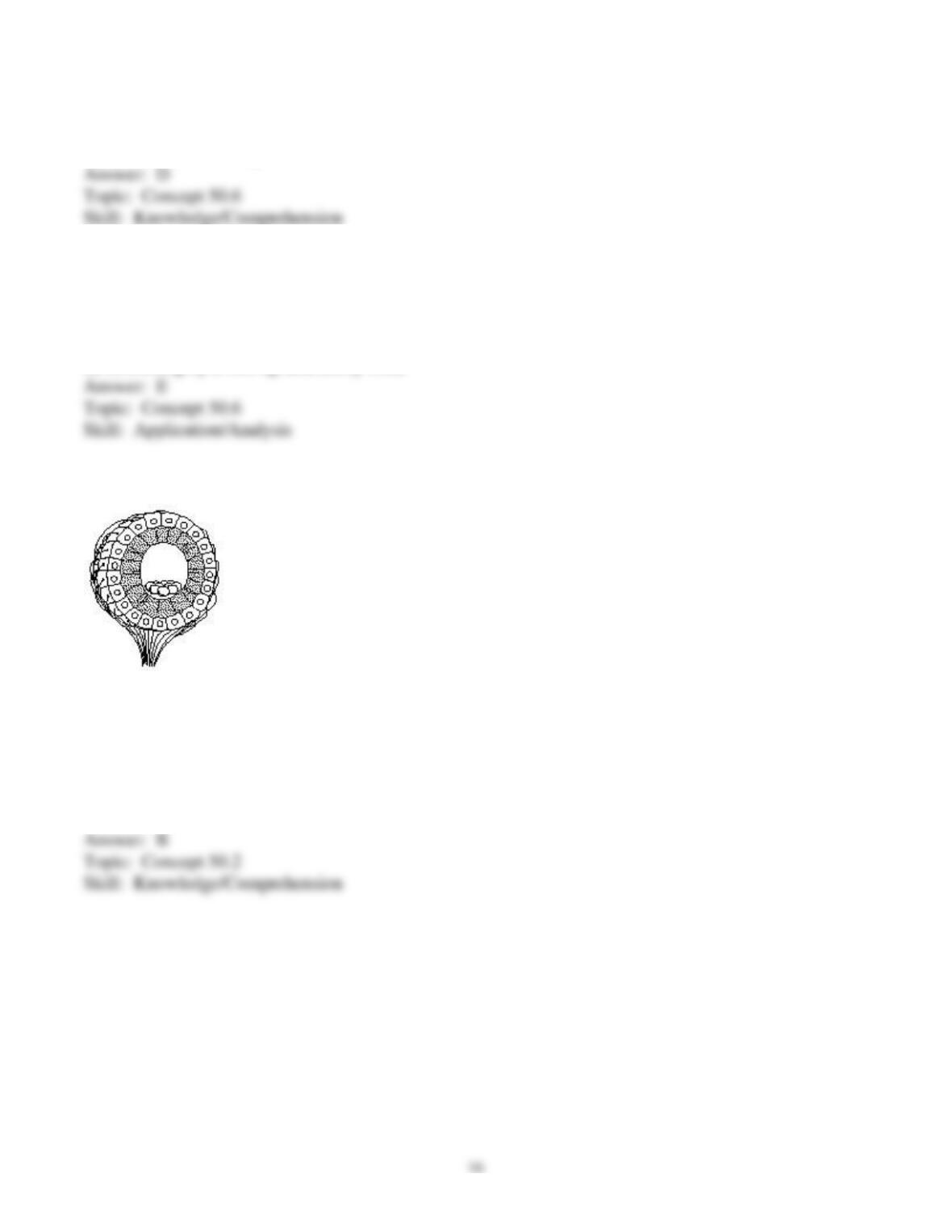
67) The structure diagrammed in the figure is the
A) neuromast.
B) statocyst.
C) taste bud.
D) ommatidium.
E) olfactory bulb.
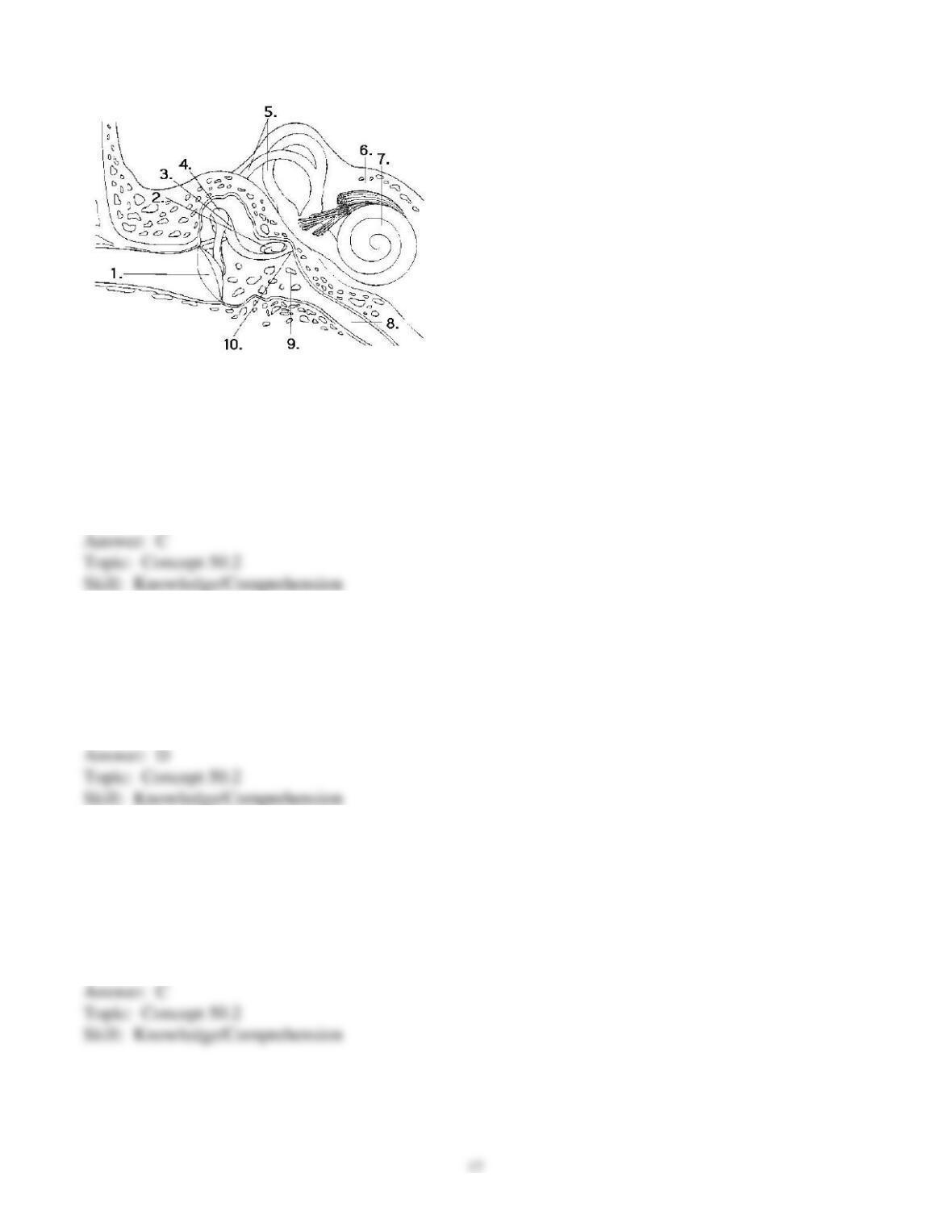
The following questions refer to this diagram of the ear.
68) The structure involved in equalizing the pressure between the ear and the atmosphere is represented
by number
A) 7.
B) 1.
C) 8.
D) 9.
E) 10.
69) The sense of head motion begins with sensory transduction by the structures at which numbers?
A) 2, 3, and 4.
B) 2, 5, and 7.
C) 4.
D) 5.
E) 7 and 8.
70) Vibrations of the tympanic membrane to the oval window are transmitted by the structures at which
numbers?
A) 1, 2, 3, and 4.
B) 2, 3, and 4.
C) 3 and 4.
D) 4.
E) 5.
71) The organ of Corti is represented by which number?
A) 3.
B) 4.
C) 5.
D) 6.
E) 7.
72) Hair cells are found in structures represented by numbers
A) 1 and 2.
B) 3 and 4.
C) 5 and 7.
D) 6 and 8.
E) 9 and 10.
73) The structure pictured in the figure is found in
A) skeletal muscles and smooth muscles.
B) cardiac muscles and skeletal muscles.
C) smooth muscles and cardiac muscles.
D) smooth muscles, skeletal muscles, and cardiac muscles.
E) smooth muscles.
74) Myosin filaments without actin overlap are in which section of the figure?
A) A
B) B
C) C
D) D
E) E
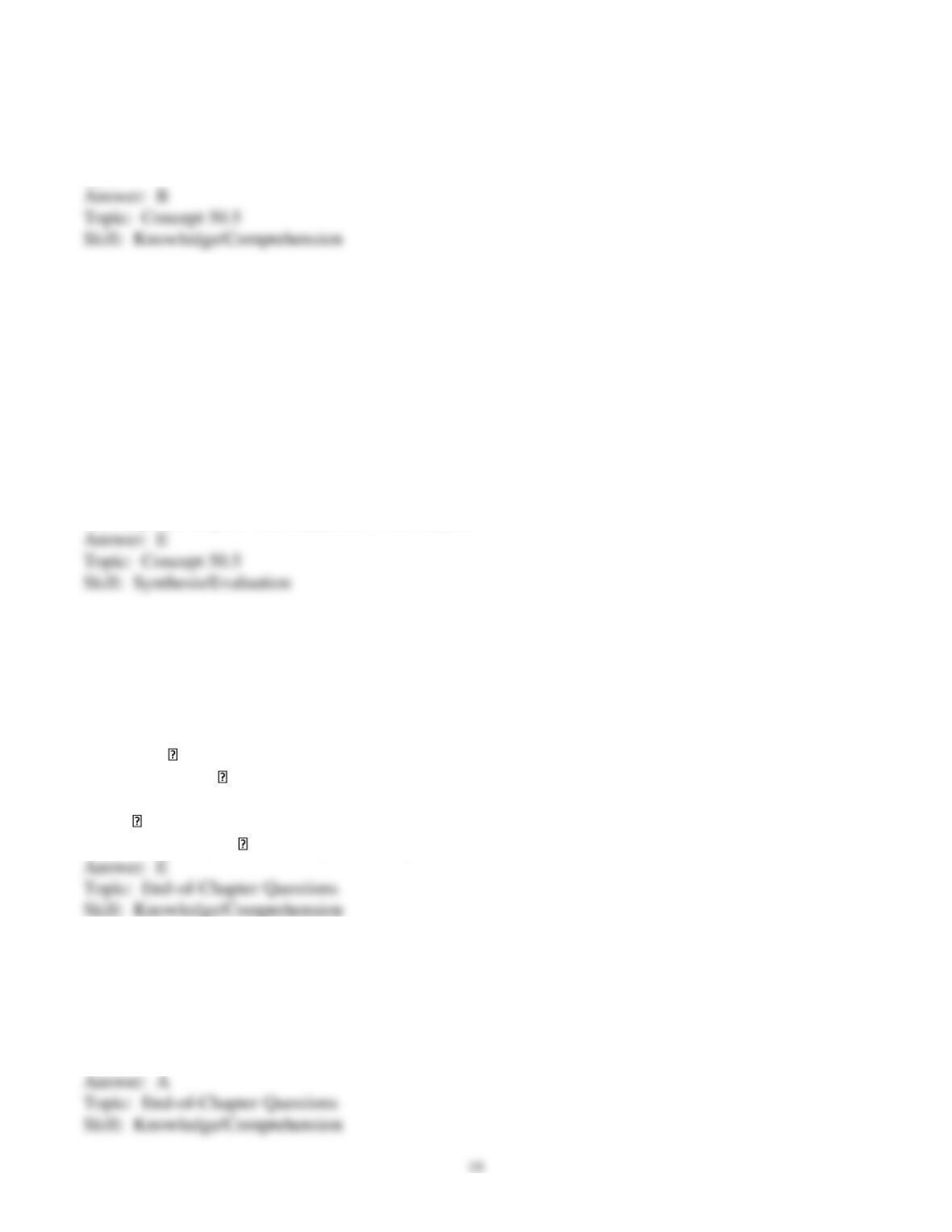
75) Overlapping actin and myosin filaments are found in which section of the figure?
A) A
B) B
C) C
D) D
E) E
Scenario Question
76) Experiments with genetically altered mice showed that the mice would consume abnormally high
amounts of bitter-tasting compounds in water after their
A) hormone receptors for digestive hormones were reduced or eliminated, showing that bitter tastes are
reinforced by digestive responses.
B) salt-taste cells were altered to express receptors for bitter tastants, suggesting that animals have
unregulated salt appetites.
C) visual sense was reduced or eliminated, suggesting that mice learn visual cues about bitter tastes.
D) olfactory sense was reduced or eliminated, suggesting that mice learn odor cues about bitter tastes.
E) sweet-taste cells were altered to express receptors for bitter tastants, suggesting that the sensation of
taste depends only on which taste cell is stimulated.
End-of-Chapter Questions
The following questions are from the end-of–chapter “Test Your Understanding” section in Chapter 50
of the textbook.
77) Which of the following sensory receptors is incorrectly paired with its category?
A) hair cell mechanoreceptor
B) muscle spindle mechanoreceptor
C) taste receptor–chemoreceptor
D) rod electromagnetic receptor
E) olfactory receptor electromagnetic receptor
78) The middle ear converts
A) air pressure waves to fluid pressure waves.
B) fluid pressure waves to air pressure waves.
C) air pressure waves to nerve impulses.
D) fluid pressure waves to nerve impulses.
E) pressure waves to hair cell movements.
79) During the contraction of a vertebrate skeletal muscle fiber, calcium ions
A) break cross-bridges by acting as a cofactor in the hydrolysis of ATP.
B) bind with troponin, changing its shape so that the myosin-binding sites on actin are exposed.
C) transmit action potentials from the motor neuron to the muscle fiber.
D) spread action potentials through the T tubules.
E) re-establish the polarization of the plasma membrane following an action potential.
80) Which sensory distinction is not encoded by a difference in neuron identity?
A) white and red
B) red and green
C) loud and faint
D) salty and sweet
E) spicy and cool
81) The transduction of sound waves into action potentials takes place
A) within the tectorial membrane as it is stimulated by the hair cells.
B) when hair cells are bent against the tectorial membrane, causing them to depolarize and release
neurotransmitter that stimulates sensory neurons.
C) as the basilar membrane becomes more permeable to sodium ions and depolarizes, initiating an
action potential in a sensory neuron.
D) as the basilar membrane vibrates at different frequencies in response to the varying volume of
sounds.
E) within the middle ear as the vibrations are amplified by the malleus, incus, and stapes.
82) Although some sharks close their eyes just before they bite, their bites are on target. Researchers
have noted that sharks often misdirect their bites at metal objects and that they can find batteries buried
under sand. This evidence suggests that sharks keep track of their prey during the split second before
they bite in the same way that
A) a rattlesnake finds a mouse in its burrow.
B) a male silkworm moth locates a mate.
C) a bat finds moths in the dark.
D) a platypus locates its prey in a muddy river.
E) a flatworm avoids light places.