Chapter 50 – Osmotic Regulation and the Urinary System
Chapter 50
Osmotic Regulation and the Urinary System
Multiple Choice Questions
1. Nearly two-thirds of every vertebrate’s body is composed of __________.
2. The regulatory systems of the animal body maintain a relatively stable internal condition
through a process called ____________________.
3. The organ that performs filtration of blood, reabsorption, and secretion in vertebrates is the
_______.
Chapter 50 – Osmotic Regulation and the Urinary System
50-2
4. About 180 liters of blood plasma is filtered into human nephrons per day and, of that
amount, about 2-3 liters leaves the body as urine. Therefore, the percentage of plasma filtrate
that leaves as urine each day is about _______.
Chapter 50 – Osmotic Regulation and the Urinary System
Clarify Question
What is the key concept addressed by the question?
What type of thinking is required?
Gather Content
What do you already know about filtrate? What other information is related to the
question?
Choose Answer
Given what you now know, what information is most likely to produce the correct answer?
Reflect on Process
Did your problem-solving process lead you to the correct answer? If not, where did the
process break down or lead you astray? How can you revise your approach to produce a
more desirable result?
Chapter 50 – Osmotic Regulation and the Urinary System
5. In vertebrates, most of the fluid that ultimately exits the body as urine first enters the
nephron tubules by the process of ____________.
6. This molecule or ion never uses active transport as its motive force for reabsorption into
blood capillaries in the kidney.
7. Kidneys are thought to have evolved first among the _____________.
Chapter 50 – Osmotic Regulation and the Urinary System
50-5
8. Marine reptiles eliminate excess NaCl by means of _____________ located near the nose
or the eye.
9. In mammalian kidneys, blood in the vasa recta and fluid in the loop of Henle flow in
opposite directions to create a ____________ multiplier system.
10. Mike has just returned home from college for the summer and notices that his 8-year old
Dalmation dog Patches is limping and has difficulty walking up and down stairs. When Mike
takes Patches to the vet, the vet recommends that Mike put him on a low-purine diet. This
dietary change will lessen the formation of painful precipitates of ___________ in Patches’
joints.
Chapter 50 – Osmotic Regulation and the Urinary System
50-6
Clarify Question
What is the key concept addressed by the question?
What type of thinking is required?
Gather Content
What do you already know about purine? What other information is related to the
question?
Choose Answer
Given what you now know, what information is most likely to produce the correct answer?
Reflect on Process
Did your problem-solving process lead you to the correct answer? If not, where did the
process break down or lead you astray? How can you revise your approach to produce a
more desirable result?
Chapter 50 – Osmotic Regulation and the Urinary System
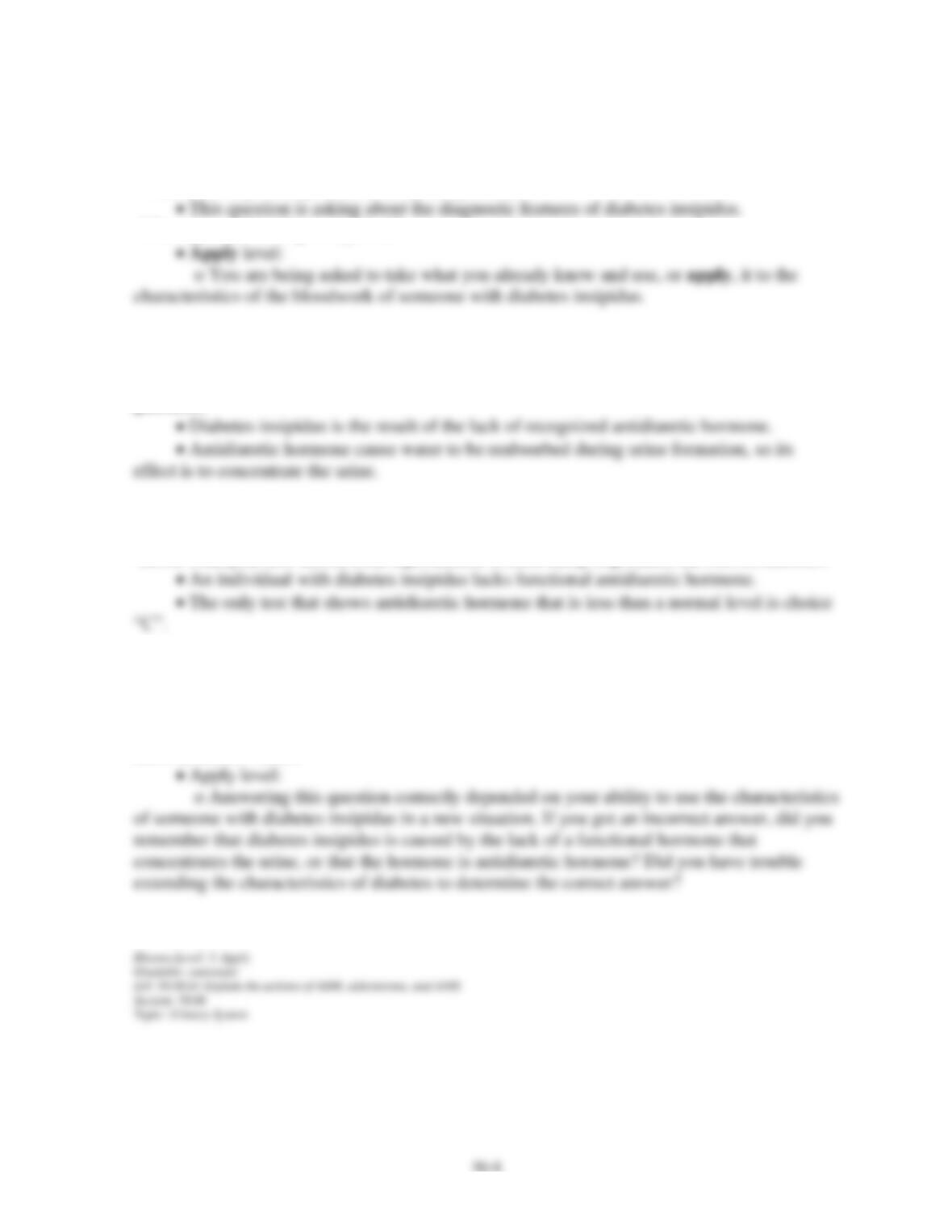
11. A doctor suspects his patient has diabetes insipidus. What is the most likely match to the
blood and urine profile of this patient?
Chapter 50 – Osmotic Regulation and the Urinary System
Clarify Question
What is the key concept addressed by the question?
What type of thinking is required?
Gather Content
What do you already know diabetes insipidus? What other information is related to the
question?
Choose Answer
Given what you now know, what information is most likely to produce the correct answer?
Reflect on Process
Did your problem-solving process lead you to the correct answer? If not, where did the
process break down or lead you astray? How can you revise your approach to produce a
more desirable result?
Chapter 50 – Osmotic Regulation and the Urinary System
12. Each human kidney contains about a million ______________, which are the tubular
functional units of the kidney.
13. Water and small solutes are filtered under pressure out of the blood plasma into nephrons
through the porous walls of _________, tufts of capillaries in the renal cortex.
14. The presence of a loop of Henle in nephrons is an evolutionary adaptation that enables
mammals and birds to reabsorb water efficiently and produce a ____________ urine.
Chapter 50 – Osmotic Regulation and the Urinary System
15. The diffusion of water across a plasma membrane is referred to as
16. Jill is lost in the desert and ran out of water six hours ago. What physiological effect or
response would most likely occur in this situation?
Chapter 50 – Osmotic Regulation and the Urinary System
50–11
Clarify Question
What is the key concept addressed by the question?
What type of thinking is required?
Gather Content
What do you already know about dehydration? What other information is related to the
question?
Choose Answer
Given what you now know, what information is most likely to produce the correct answer?
Reflect on Process
Did your problem-solving process lead you to the correct answer? If not, where did the
process break down or lead you astray? How can you revise your approach to produce a
more desirable result?
Chapter 50 – Osmotic Regulation and the Urinary System
17. Release of what protein is directly subject to negative feedback inhibition when blood
volume rises?
18. You wish to determine which organs function to remove waste products from the
hemolymph (blood) of an insect. You do so by injecting a suspension of particulate dye
particles into the abdominal cavity of an anesthetized cricket.Where will you find these dye
particles 45 minutes later, after you euthanize and dissect the cricket?
Chapter 50 – Osmotic Regulation and the Urinary System
50–13
Clarify Question
What is the key concept addressed by the question?
What type of thinking is required?
Gather Content
What do you already know about insect physiology? What other information is related to
the question?
Choose Answer
Given what you now know, what information is most likely to produce the correct answer?
Reflect on Process
Did your problem-solving process lead you to the correct answer? If not, where did the
process break down or lead you astray? How can you revise your approach to produce a
more desirable result?
Chapter 50 – Osmotic Regulation and the Urinary System
50–14
19. You put a solution of sucrose into a bag of dialysis tubing, which is permeable to water
but not to sucrose. You then put this bag into a beaker of water. An hour later, you observe
that the bag has swelled due to
Chapter 50 – Osmotic Regulation and the Urinary System
50–15
Clarify Question
What is the key concept addressed by the question?
What type of thinking is required?
Gather Content
What do you already know about the movement of water? What other information is
related to the question?
Choose Answer
Given what you now know, what information is most likely to produce the correct answer?
Reflect on Process
Did your problem-solving process lead you to the correct answer? If not, where did the
process break down or lead you astray? How can you revise your approach to produce a
more desirable result?
Chapter 50 – Osmotic Regulation and the Urinary System
20. All of the following are animal mechanisms to cope with the problem of water balance
EXCEPT
21. What is true of normal human urine production?
I-Blood pressure is used to push nitrogenous waste, water, and small molecules through a
filter, forming the filtrate, while cells and most proteins are retained in the blood.
II-Most water is reabsorbed as the filtrate is passing through a long tube.
III-Ammonia is produced as the metabolic breakdown is excreted.
Chapter 50 – Osmotic Regulation and the Urinary System
22. One of the key factors in vertebrate colonization of many diverse environments is
23. What is the route a red blood cell would take to circulate through a kidney, starting from
the aorta?
Chapter 50 – Osmotic Regulation and the Urinary System
24. Claire lost the ability to completely empty her bladder following a stroke, and a nurse
inserts a catheter into the open end of her urinary tract each day to remove the urine. Into what
structure does the nurse insert the catheter?
25. All of the following are reabsorbed by the nephron EXCEPT
Chapter 50 – Osmotic Regulation and the Urinary System
26. Which solute must be administered in high amounts because of its very efficient secretion
and removal by the kidney tubules?
27. Substances NOT usually found in normal human urine are
28. The presence of the loop of Henle allows which animals to reabsorb water and produce a
hypertonic urine?
Chapter 50 – Osmotic Regulation and the Urinary System
29. What animal has kidneys that are so efficient that it never has to drink water and can
obtain all of its water from its food?
30. Gary has a kidney stone lodged in his ureter. Where will the radiologist find the kidney stone on an x-ray?
31. How does the loop of Henle enable the mammalian kidney to produce hypertonic urine?
I-The ascending limb of the loop actively extrudes Na+.
II-The descending limb interacts with the ascending limb to raise the osmolarity of the
extracellular fluid in the renal medulla.
III-The concentration is further enhanced by the presence of urea, which draws water out of
the collecting ducts by osmosis.