Chapter 05 Fraud in Financial Statements and Auditor
Responsibilities Answer Key
Multiple Choice Questions
1.
Which of the following is NOT something external auditors are expected to do in looking
for fraud?
2.
If the financial statements are not materially misstated, the auditor should give a(an):
5-2
3.
An example of fraudulent financial statements is:
4.
Misstatements in the financial statements can result from:
5-3
5.
Misstatements in the financial statements are most likely to occur when there are:
6.
The auditor’s responsibility with regard to illegal acts is greatest when:
5-4
7.
The first step for an auditor who concludes an illegal act exists is to:
8.
An auditor concludes that a client has committed an illegal act that has not been properly
accounted for or disclosed. The auditor is most likely to withdraw from the engagement
when the:
5-5
9.
The Private Securities Litigation Reform Act imposes additional requirements on public
companies reporting to the SEC and their auditors when:
10.
Auditors are responsible to detect and correct errors when they are:
5-6
11.
Confidential client information can be disclosed outside the entity without violating the
AICPA Code of Professional Conduct in each of the following situations except when:
12.
The purpose of the fraud triangle is to identify:
5-7
13.
Which of the following is not part of the fraud triangle?
14.
The difference between errors in the financial statements as compared to fraud is:
5-8
15.
Which of the following is NOT a pressure that might lead to fraud?
16.
All of the following are in a position to commit fraud except:
5-9
17.
All of the following tend to be rationalizations for fraud except:
18.
The best explanation why the fraud at Tyco was not discovered and acted on is:
5-10
19.
Which of the following elements were NOT part of the fraud at Tyco?
20.
The Committee of Sponsoring Organizations of the Treadway Committee (COSO) analyzed
the financial reporting of public companies during the 1998-2007 periods when business
failures due to accounting fraud were high and found that:
5-11
21.
Which of the following is not one of the evaluations of the control environment of an
organization?
22.
What is enterprise risk management (ERM)?
5-12
23.
Which of the following is an element of ERM?
24.
The auditors’ responsibility to communicate findings with respect to fraud can best be
summarized as:
5-13
25.
Which of the following is NOT one of the communications that should be made by external
auditors to the audit committee?
26.
Section 302 of the Sarbanes-Oxley Act requires:
5-14
27.
The framework of COSO’s Enterprise Risk Management can best be characterized as:
28.
Which of the following is not an element of COSO Enterprise Risk Management?
5-15
29.
Which of the following is an element of the introductory paragraph of an auditor’s report
under AICPA standards?
30.
Which of the following is NOT an element of the auditor’s responsibility of the AICPA’s
auditor’s report?
5-16
31.
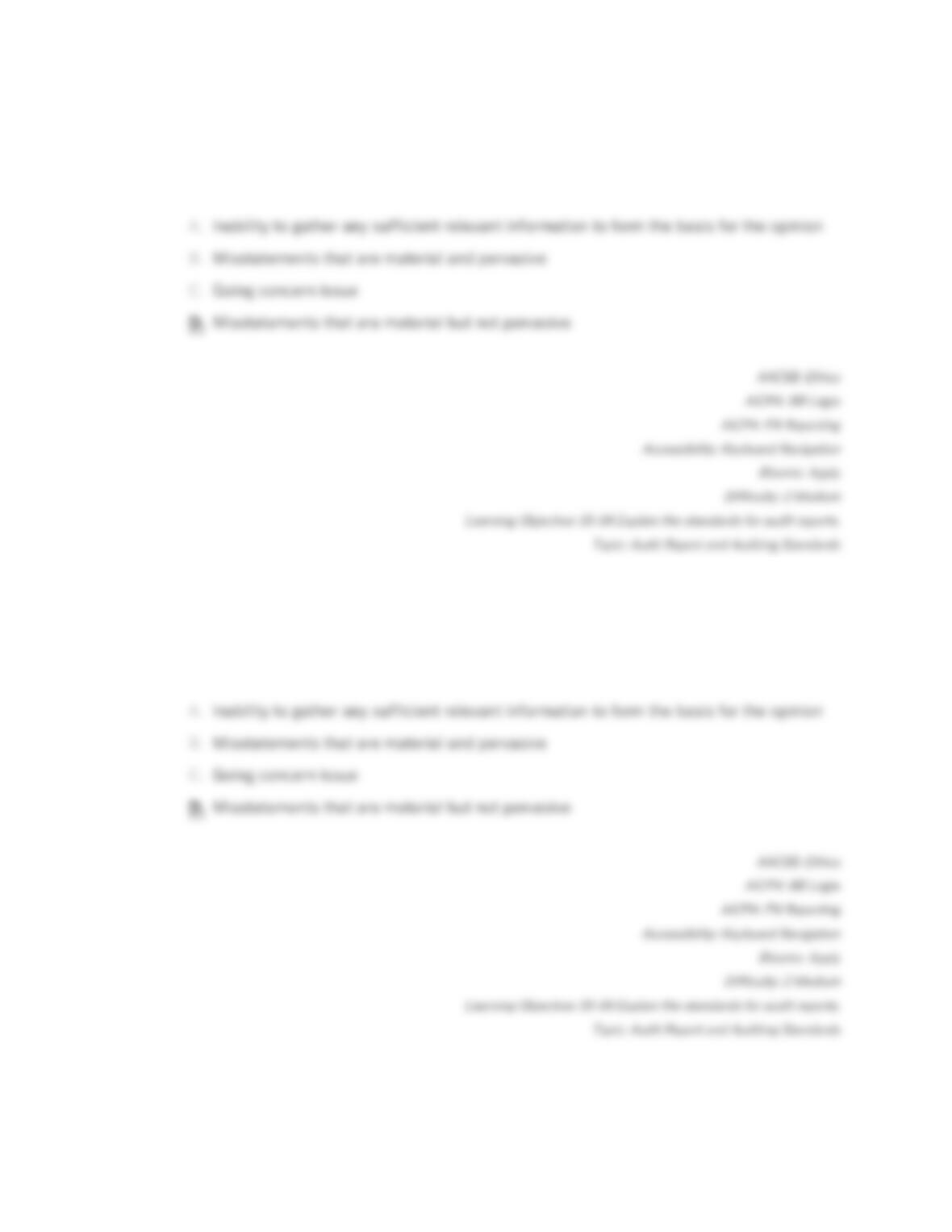
Typically, when a going concern issue exists the auditor should:
32.
In which of the following circumstances would a qualified opinion be appropriate?
5-17
33.
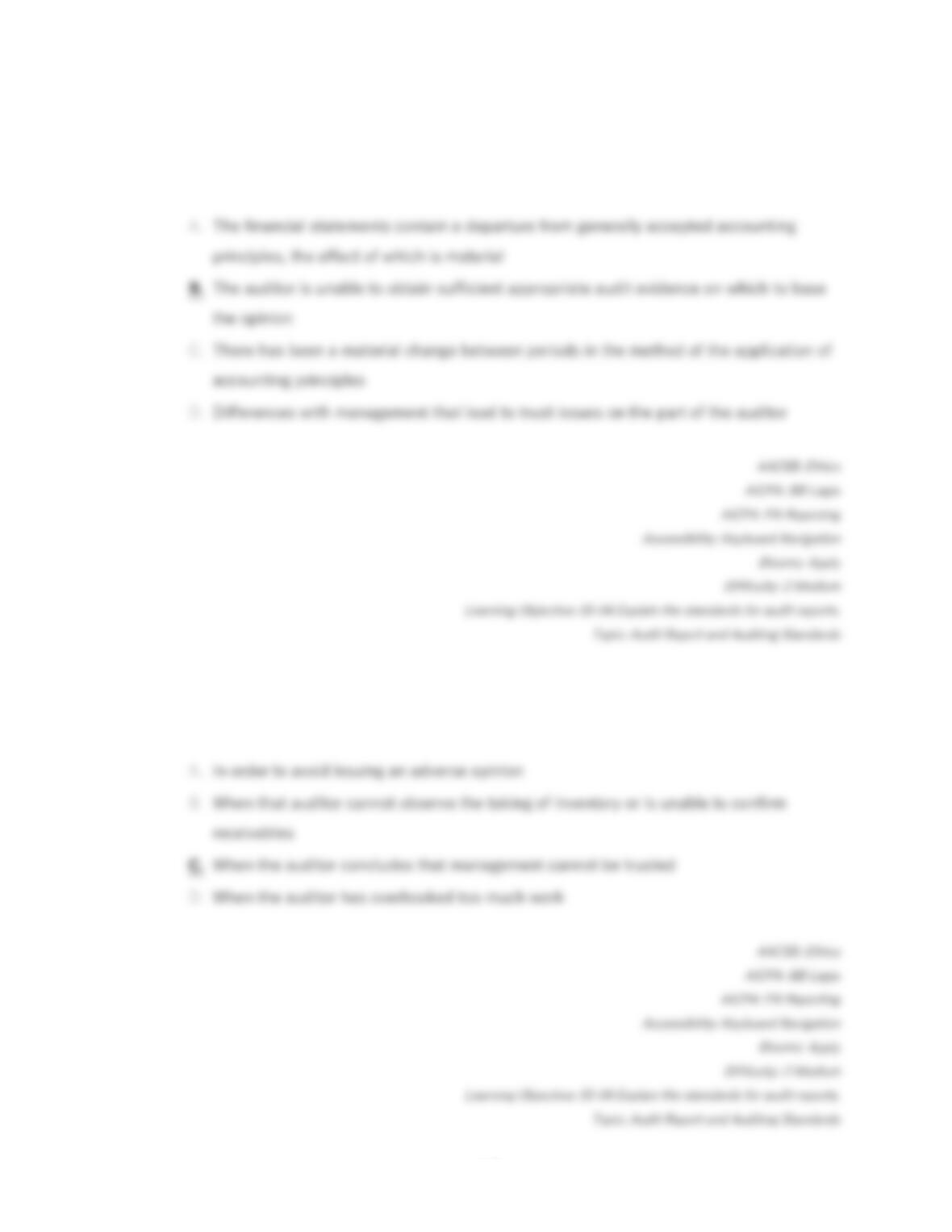
Which of the following is the most likely reason for an auditor to issue a modified opinion
with a qualification?
34.
Which of the following is the most likely reason for an auditor to issue an adverse
opinion?
5-18
35.
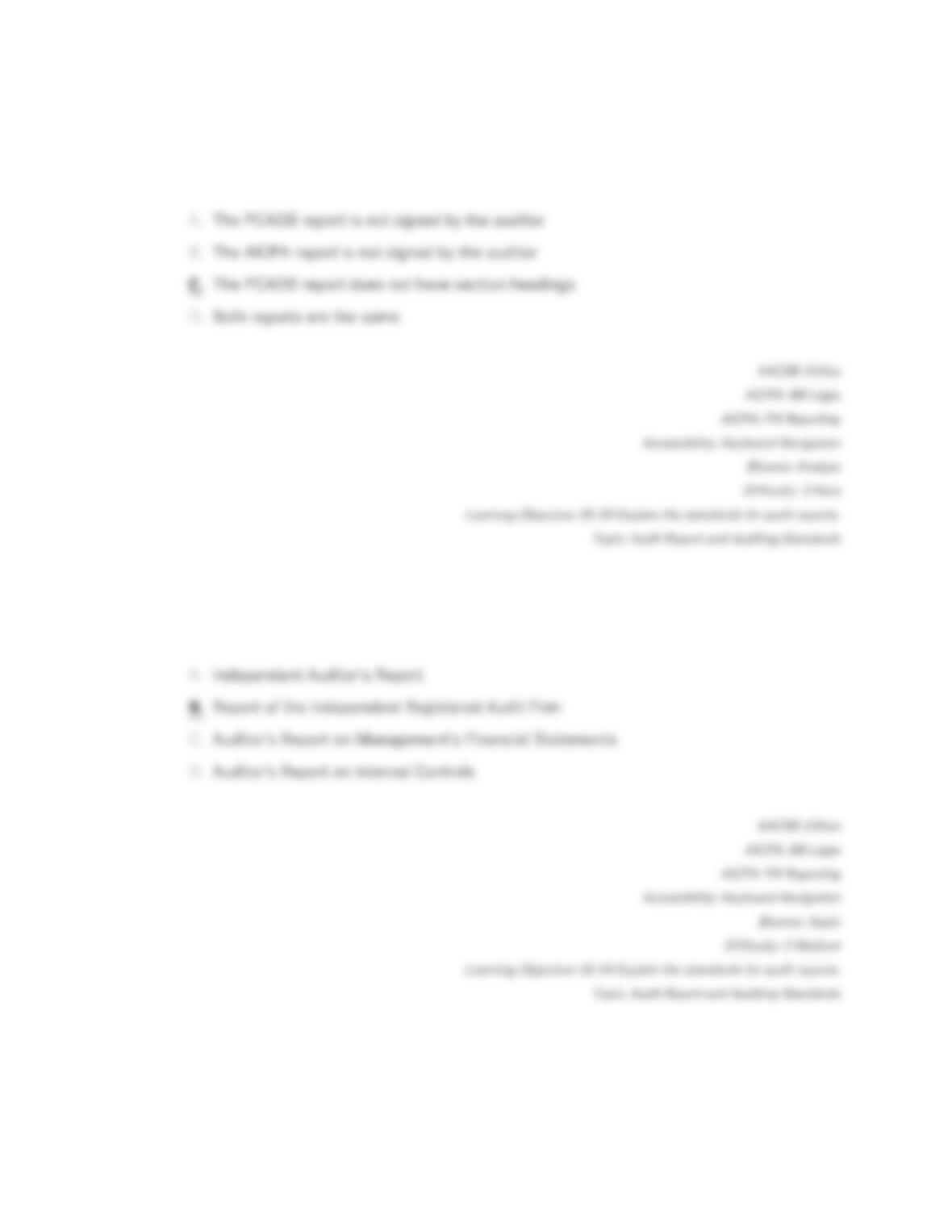
Under which of the following set of circumstances might the auditors disclaim an
opinion?
36.
When would it be appropriate for an auditor to withdraw from an engagement?
5-19
37.
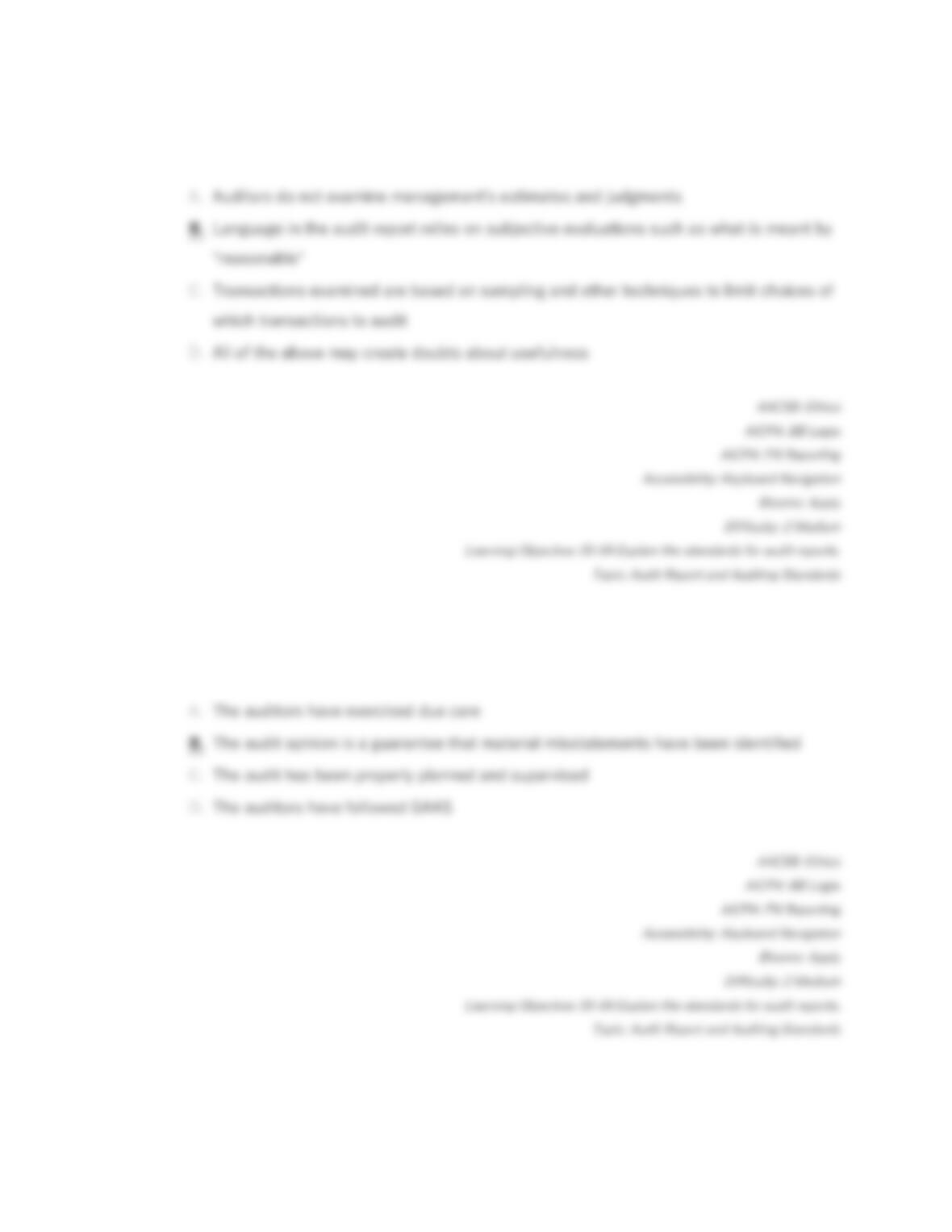
One difference between the AICPA auditor’s report and that of the PCAOB is:
38.
The title of the PCAOB auditor’s report is:
5-20
39.
Some critics claim the usefulness of the audit report is limited because:
40.
Which of the following is not true of “reasonable assurance”?