
Chapter 5: Inventories and Cost of Goods Sold
75. During a period of increasing cost prices, which inventory costing method will yield the lowest cost of goods sold?
a. Any method in which the company uses a periodic inventory system
b. FIFO
c. LIFO
d. Weighted Average Cost
76. Xu Corp. started business at the beginning of 2015. Xu selected the FIFO method for its inventory. In order to
maximize its profits for 2015 under this method, prices must be
a. Increasing
b. Decreasing
c. Stable
d. Fluctuating up and down at the same amount consistently over the year
77. Federal income tax rules allow businesses to use different inventory costing methods for tax reporting and
financial reporting with one exception. Which of the following situations is not allowed by federal income tax
rules?
Inventory Method Inventory Method
for Tax Reporting for Financial Reporting
a. LIFO LIFO
b. LIFO FIFO
c. Weighted Average FIFO
d. FIFO LIFO
78. Summer, Inc. has been in business for 20 years. During that time the company has consistently used the LIFO
inventory costing method. Because of inflation, prices for merchandise have increased consistently over the 20
years. The company has maintained the same inventory quantities over the 20-year period. Which one of the
following statements is true?
a. Summer, Inc.’s total net income for the past 20 years is greater than it would have reported using another
inventory method.
b. Summer, Inc. will have paid more income taxes over the past 20 years than it would have if it had used the
FIFO method.
c. Summer will have to continue using the LIFO method indefinitely because of generally accepted accounting
principles and federal income tax rules.
d. The ending inventory figure reported on the balance sheet may be significantly lower than its current value.

Chapter 5: Inventories and Cost of Goods Sold
79. Which one of the following statements regarding changing inventory methods is true?
a. A change in inventory methods can be justified if the change is made to better match profits with revenue.
b. Changing inventory methods affects consistency.
c. One place that the reader of an annual report would be able to identify that a company changed inventory
methods is the statement of stockholders’ equity.
d. Tax advantages are valid justification for changing inventory methods.
80. If cost of goods sold under FIFO was $8,000 and was $10,000 under LIFO, assuming a tax rate of 40%, how
much tax savings resulted from using LIFO?
a. There would be no tax savings.
b. $800
c. $1,200
d. $2,000
81. Which one of the following statements is false?
a. Differences in cash flows between LIFO and FIFO inventory methods are a direct result of the differences in
the purchases.
b. Differences in cash flows between LIFO and FIFO inventory methods are caused by differences in taxes.
c. The amount of cash to acquire inventory is the same for companies that use LIFO as for those companies that
use FIFO.
d. The primary determinant in selecting an inventory costing method should be the ability of the method to
accurately reflect the net income of the period.
82. When would LIFO liquidation occur?
a. As a result of selling more units than are purchased during the period.
b. As a result of selling less units than are purchased during the period.
c. As a result of selling the same number of units that are purchased during the period.
d. Not enough information.
83. Accountants should be aware that LIFO liquidations can potentially result in which of the following?
a. If older less costly layers are liquidated, a correspondingly lower cost of goods sold will result.
b. If older less costly layers are liquidated, a correspondingly higher gross profit will result.
c. If older less costly layers are liquidated, the company may be faced with higher taxes for those deferred in
previous periods.
d. All of these could result.

Chapter 5: Inventories and Cost of Goods Sold
84. Zebra Company overstated its December 31, 2014 inventory by $5,200. Which statement is true concerning
Zebra’s financial statement amounts for 2014?
a. Working capital is understated.
b. The current ratio is overstated.
c. Cost of goods sold is overstated.
d. Net income is understated.
85. If the amount assigned to ending inventory is incorrect,
a. The balance sheet is affected, but the income statement is not
b. The income statement is affected, but the balance sheet is not
c. The balance sheet is affected, but cost of goods sold is not
d. Both the balance sheet and the income statement are affected
86. A company fails to record one storeroom full of inventory in its year-end inventory records. As a result, this will
cause:
a. an overstatement of inventory on the year-end balance sheet.
b. an understatement of gross profit in the following year.
c. an overstatement of retained earnings at the end of the year.
d. an overstatement of cost of goods sold for the current year.
87. Hawk Store counted some of its inventory twice. As a result, its operating expenses will be
a. Correct only if Hawk Store calculates it cost of goods sold correctly
b. Correct since operating expenses are not affected by inventory costs
c. Overstated
d. Understated
88. If a company overstates its ending inventory for the current year, what are the effects on cost of goods sold and
net income for the current year?
Effect on Cost of Goods Sold Effect on Net Income
a. Understated Overstated
b. Overstated No effect
c. Understated Understated
d. Overstated Overstated

Chapter 5: Inventories and Cost of Goods Sold
89. If a company understates its ending inventory balance for 2015 by $15,500, what are the effects on its net income
for 2015 and 2014?
Effect on 2015 Net Income Effect on 2014 Net Income
a. Overstated by $15,500 Understated by $15,500
b. Understated by $15,500 Overstated by $15,500
c. Understated by $15,500 No effect
d. Overstated by $15,500 No effect
90. If a company overstates its ending inventory balance for 2015 by $10,000, and understates its ending inventory
balance for 2014 by $5,000 what are the effects on its net income for 2015 and 2014?
Effect on 2015 Net Income Effect on 2014 Net Income
a. Overstated by $15,000 Understated by $10,000
b. Understated by $5,000 Overstated by $10,000
c. Overstated by $15,000 Understated by $5,000
d. Overstated by $10,000 Understated by$5,000
91. If a company overstates its ending inventory balance for 2015 by $10,000, and overstates its ending inventory
balance for 2014 by $5,000 what are the effects on its net income for 2015 and 2014?
Effect on 2015 Net Income Effect on 2014 Net Income
a. Overstated by $15,000 Overstated by $10,000
b. Understated by $5,000 Overstated by $10,000
c. Overstated by $5,000 Overstated by $5,000
d. Overstated by $10,000 Overstated by $5,000
92. When the market value of inventory items has declined below its cost, which method would be the most
appropriate in complying with GAAP?
a. Gross Profit
b. LIFO
c. Lower of Cost or market
d. Retail

Chapter 5: Inventories and Cost of Goods Sold
93. When inventories are written down due to the application of the lower of cost or market (LCM) rule, the account
that is usually increased is
a. Cost of Goods Sold
b. Inventories
c. Loss on Decline in Inventory Value
d. Accumulated Depreciation – Inventory
94. Which one of the following statements regarding the application of the lower of cost or market method is true?
a. Generally, market value is greater than replacement cost.
b. When the lower of cost or market method is used, inventories are valued at selling price.
c. The lower of cost or market method is most commonly applied on a total inventory basis because it is a more
conservative approach.
d. The lower of cost or market method is an exception to the historical cost principle.
95. All of the following statements are true except:
a. Both U.S. GAAP and international financial reporting standards (IFRS) require the use of the lower-of-cost- or–
market rule to value inventories.
b. U.S. GAAP defines market value as replacement cost.
c. IFRS uses net realizable value with no upper or lower limits imposed.
d. Write-downs of inventory can be reversed in later periods under U.S. GAAP.
96. Which of these is not an acceptable inventory costing method under IFRS?
a. FIFO
b. LIFO
c. Specific Identification
d. Average cost

Chapter 5: Inventories and Cost of Goods Sold
97. Selected data for Sorenta, Inc. and New World Corp., two companies in the same industry, are presented below:
Sorenta, Inc.
New World Corp.
Sales
$50,000
$80,000
Cost of goods sold
30,000
50,000
Average inventory balance
5,000
5,000
Based on this data, which statement below is true?
a. Sorenta, Inc. has a lower gross profit ratio than New World Corp.
b. New World Corp has a higher net income than Sorenta, Inc.
c. New World Corp sells its inventory faster than Sorenta, Inc.
d. Sorenta, Inc. has lower storage costs and a lower investment in inventory than New World Corp.
98. Caruso, Inc. has an inventory turnover rate of 8 times. If its cost of goods sold is $150,000, then
a. The company will report sales of $1,200,000.
b. The gross margin will be $1,200,000.
c. The company’s average inventory is $18,750.
d. It sells its inventory 1,200 times per year.
99. A company began the year with $150,000 in inventory and ended the year with $170,000 in inventory. Cost of
goods sold for the year amounted to $960,000. Assuming 360 days in a year, how long, on average, does it take
the company to sell its inventory (to the nearest day)?
a. 6 days
b. 60 days
c. 120 days
d. 3 days

Chapter 5: Inventories and Cost of Goods Sold
100. The following information is reported in the operating activities section of Gateway’s statement of cash flows for
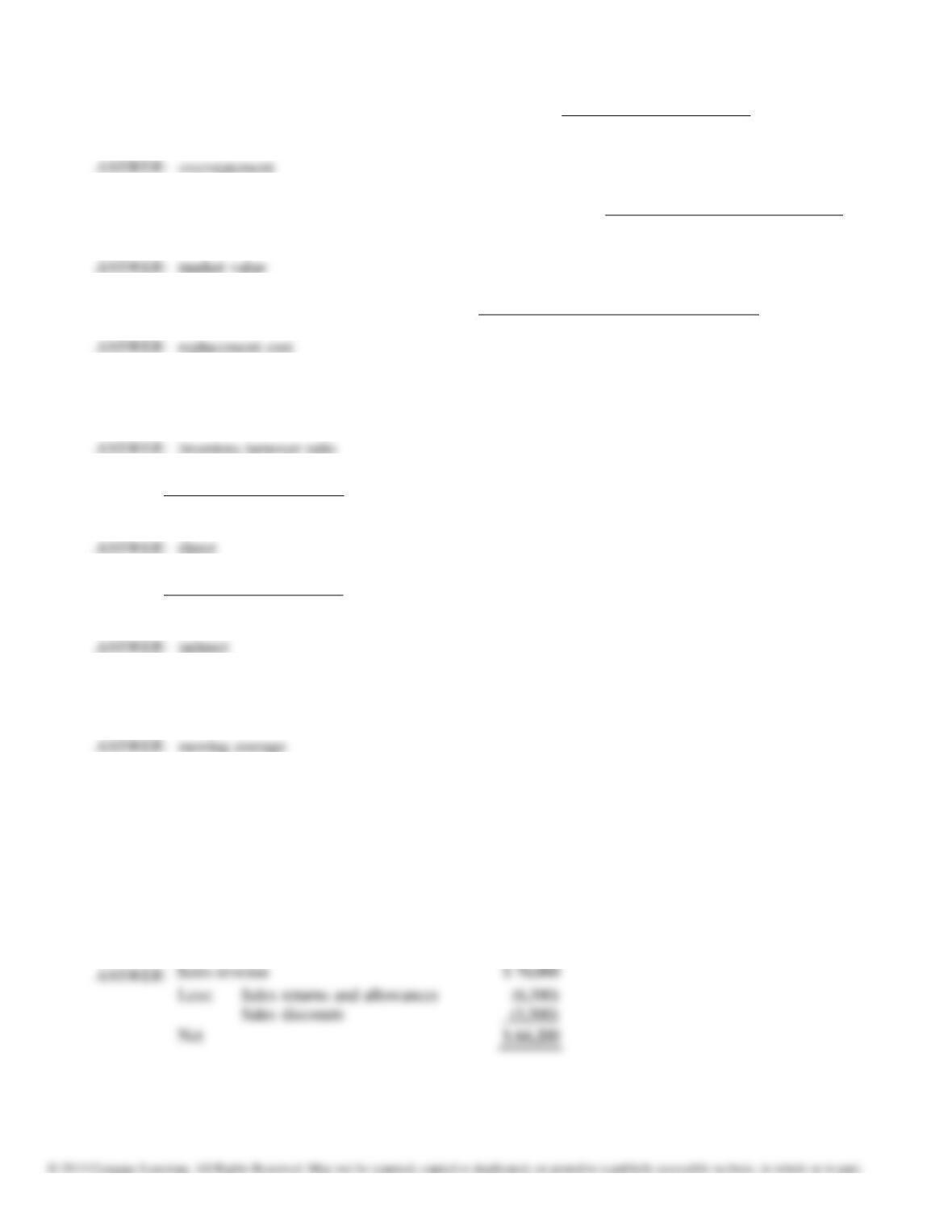
2014:
Net income
$1,200,000
Increase in inventories
600,000
Decrease in accounts payable
400,000
Which one of the following conclusions can be assumed from the information provided?
a. Gateway used the direct method to determine cash flows from operating activities.
b. Gateway purchased more merchandise than it sold in 2014.
c. Cash payments for merchandise purchases were less than the amount of merchandise purchased on credit
during 2014.
d. Cash payments for merchandise exceeded cost of goods sold by $200,000.
101. The following information was taken from the operating activity section of the 2014 statement of cash flows for
Limited Corp:
Additions to net income: Change in accounts payable $2,000
Deductions from net income: Change in inventories 8,000
Based on the information provided, which one of the following conclusions is correct?
a. Accounts payable decreased $2,000 in 2014.
b. Inventories increased $8,000 in 2014.
c. The direct method was used to prepare the operating section of the cash flow statement.
d. Cash payments of merchandise exceeded cost of goods sold by $2,000.
102. Payment for the acquisition of inventories is shown on the statement of cash flows as
a. An operating activity
b. An investing activity
c. A financing activity
d. Either an operating activity or a financing activity
103. Which of the following statements is true when using the indirect method of preparing the operating activities
section of the statement of cash flows?
a. Inventory decreases are subtracted from net income.
b. Inventory increases are subtracted from net income
c. Inventory increases are added to net income.
d. None of the above.
Chapter 5: Inventories and Cost of Goods Sold
104. Readers.com uses a perpetual inventory system.
Feb. 1
On hand, 30 units at $5.00 each
$150
8
Purchased 40 units at $5.35 each
214
15
Sold 50 units
22
Purchased 40 units at $5.20 each
208
28
On hand, 60 units
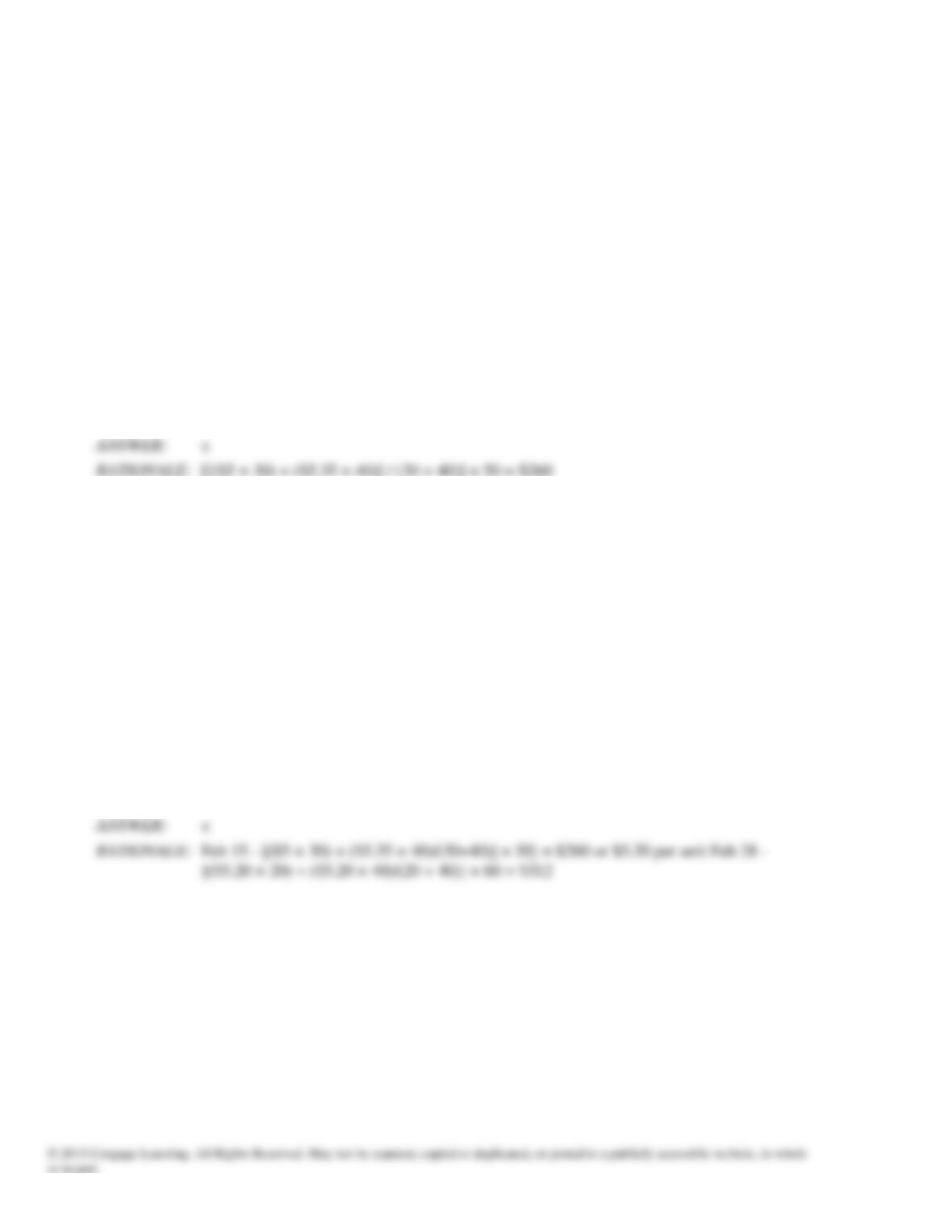
If Readers.com uses the moving average method, how much is cost of goods sold for the units sold on
February 15?
a. $245
b. $255
c. $260
d. $270
105. Readers.com uses a perpetual inventory system.
Feb. 1
On hand, 30 units at $5.00 each
$150
8
Purchased 40 units at $5.35 each
214
15
Sold 50 units
22
Purchased 40 units at $5.20 each
208
28
On hand, 60 units
If Readers.com uses the moving average method, how much is ending inventory on February 28?
a. $300
b. $306
c. $312
d. $318
Chapter 5: Inventories and Cost of Goods Sold
106. Adam Inc. uses a perpetual inventory system.
Jan. 1
On hand, 10 units at $2 each
$20
4
Sold 8 units for $10 each
80
22
Purchased 50 units at $4 each
200
26
Sold 48 units for $10 each
480
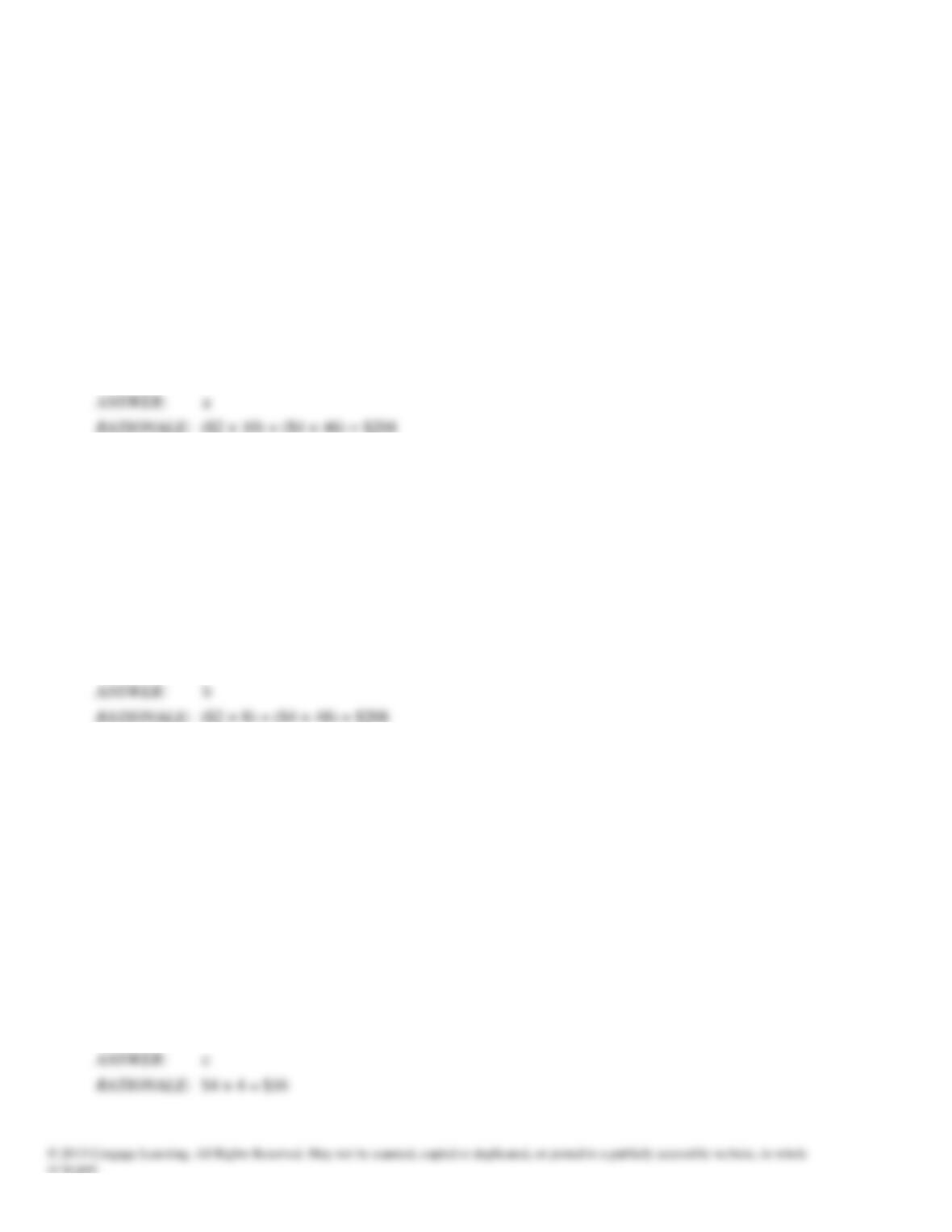
If Adam uses the FIFO method, how much is cost of goods sold for the month of January?
a. $204
b. $208
c. $212
d. $560
107. Adam Inc. uses a perpetual inventory system.
Jan. 1
On hand, 10 units at $2 each
$20
4
Sold 8 units for $10 each
80
22
Purchased 50 units at $4 each
200
26
Sold 48 units for $10 each
480
If Adam uses the LIFO method, how much is cost of goods sold for the month of January? a. $204
b. $208 c. $212 d. $560
108. Adam Inc. uses a perpetual inventory system.
Jan. 1
On hand, 10 units at $2 each
$20
4
Sold 8 units for $10 each
80
22
Purchased 50 units at $4 each
200
26
Sold 48 units for $10 each
480
If Adam uses the FIFO method, how much is ending inventory on January 31?
a. $8
b. $12
c. $16
d. $40

Chapter 5: Inventories and Cost of Goods Sold
109. The three forms or states in the development of inventory for a manufacturer are direct materials, direct labor,
and finished goods.
a. True
b. False
110. The three distinct types of cost to a manufacturer are direct materials, direct labor, and manufacturing overhead.
a. True
b. False
111. Gross margin as a percentage of sales is a common analytical tool for service companies.
a. True
b. False
112. Sales revenue is an inflow of assets.
a. True
b. False
113. If a customer returns merchandise which has already been paid for, the retailer may give either a cash refund or a
credit on account.
a. True
b. False
114. Sales Returns and Allowances is a contra-asset account.
a. True
b. False
115. The credit term of “n/30″ means that the net amount of the invoice, less any returns or allowances, is due within
30 days of the date of the invoice.
a. True
b. False

Chapter 5: Inventories and Cost of Goods Sold
116. On the income statement of a merchandising company, cost of goods is added to net sales to arrive at gross
margin or gross profit.
a. True
b. False
117. Like sales revenue, cost of goods sold represents an inflow of assets.
a. True
b. False
118. Cost of goods sold represents an outflow of an asset, inventory, from the sale of products.
a. True
b. False
119. If cost of goods sold does not equal the cost of merchandise purchased during the period, an adjustment must be
made to correct the error.
a. True
b. False
120. Cost of goods sold is equal to beginning inventory plus the net cost of purchases minus ending inventory.
a. True
b. False
121. Cost of goods sold is the difference between costs available for sale and beginning inventory.
a. True
b. False
122. With the periodic inventory system, the inventory account is updated after each sale or purchase.
a. True
b. False

Chapter 5: Inventories and Cost of Goods Sold
123. Under the periodic inventory system, a physical inventory must be taken at the end of the period to determine cost
of goods sold.
a. True
b. False
124. Under the perpetual inventory system, each time goods are purchased, the inventory account is transferred to
sales revenue.
a. True
b. False
125. A company using the periodic inventory system must total the selling prices of the units on hand at the end of the
period to value the ending inventory.
a. True
b. False
126. Purchase returns and allowances is subtracted from cost of goods sold to determine net purchases.
a. True
b. False
127. Purchase discounts decrease the total cost of merchandise acquired.
a. True
b. False
128. The buyer must include goods purchased FOB shipping point in its inventory account if the goods are still in
transit.
a. True
b. False
129. When merchandise is sold FOB shipping point, the buyer is responsible for the shipping costs.
a. True
b. False

Chapter 5: Inventories and Cost of Goods Sold
130. Cost of goods available for sale is equal to beginning inventory less cost of goods sold.
a. True
b. False
131. The gross profit ratio is computed by dividing net sales by gross profit.
a. True
b. False
132. The gross profit ratio is calculated as gross profit divided by net income.
a. True
b. False
133. It important that the proper amount be assigned to inventory because the amount assigned to inventory will affect
the amount eventually recorded as net sales.
a. True
b. False
134. The inventory method that assigns the most recent costs to ending inventory is LIFO.
a. True
b. False
135. The weighted average cost is calculated by adding up the units’ costs from each purchase and then dividing by the
number of purchases.
a. True
b. False
136. Under FIFO, the units in the ending inventory represent the oldest purchase(s).
a. True
b. False
137. Specific identification relies on matching unit costs with the actual units sold.
a. True
b. False

Chapter 5: Inventories and Cost of Goods Sold
138. Under LIFO, the units in the ending inventory represent the most recent purchase(s).
a. True
b. False
139. Changing inventory methods to take advantage of the tax breaks offered by LIFO is not a valid reason for a
change in methods.
a. True
b. False
140. A LIFO liquidation occurs when a company sells fewer units than it buys during the period.
a. True
b. False
141. According to the IRS‘s LIFO conformity rule, a company that chooses LIFO to report net income to its
shareholders may not use LIFO in preparing its income tax return.
a. True
b. False
142. A LIFO reserve represents the amount by which cost of goods sold on a FIFO basis exceeds the cost of goods
sold on a LIFO basis for the current year.
a. True
b. False
143. FIFO results in the least amount of income before taxes, assuming a period of rising prices.
a. True
b. False
144. The LIFO conformity rule requires that if a company uses LIFO in reporting income to stockholders, it also must
use LIFO on its tax return.
a. True
b. False

Chapter 5: Inventories and Cost of Goods Sold
145. Many countries prohibit the use of LIFO for tax or financial reporting purposes.
a. True
b. False
146. A counterbalancing inventory error is one where the error on the balance sheet is offset by the same amount of
error on the income statement.
a. True
b. False
147. If ending inventory is understated, then cost of goods sold is overstated.
a. True
b. False
148. If ending inventory is overstated, then net income is overstated as well.
a. True
b. False
149. The lower of cost or market (LCM) rule violates the historical cost principle.
a. True
b. False
150. The journal entry to write down inventory to its market value results in a loss on the income statement.
a. True
b. False
151. Both U.S. GAAP and international financial reporting standards (IFRS) require the use of the lower-of-cost–or–
market rule to value inventories.
a. True
b. False
152. The inventory turnover ratio is defined as cost of goods sold divided by average inventory.
a. True
b. False

Chapter 5: Inventories and Cost of Goods Sold
153. The inventory turnover ratio is a measure of how many times during a period a company sells off its inventory.
a. True
b. False
154. Under the indirect method, a decrease in inventory is added to net income to determine cash flow from operating
activities.
a. True
b. False
155. If a change in accounts payable was added back to net income on the statement of cash flows prepared using the
indirect method, then the amount owed to suppliers during the period had decreased.
a. True
b. False
156. Moving average is the name given to the use of an average cost method used with a periodic inventory system.
a. True
b. False
157. Whether LIFO costing is applied at the time each sale is made or only at the end of the period, both the periodic
and perpetual systems will yield the same ending inventory under LIFO.
a. True
b. False
158. Ending inventory valued under the FIFO method will be the same regardless of whether the periodic system or the
perpetual system is used.
a. True
b. False
159. The inventory of a(n) consists of three distinct types of costs: direct materials, direct
labor, and manufacturing overhead.
160. Sales returns and allowances is a contra account.

Chapter 5: Inventories and Cost of Goods Sold
161. For the buyer, a is an amount deducted by customers for payment within the
discount period.
162. Cost of goods sold is equal to beginning inventory plus the net cost of purchases minus
_________________________.
163. Under the inventory system, the inventory account is updated after each purchase or
sale.
164. The cost of goods purchased is equal to net purchases plus .
165. Shipping terms of mean that the buyer pays shipping costs.
166. The amount recognized on the Income Statement as the cost of inventory will be recognized as a(n)
_________________________.
167. When a company using LIFO experiences a partial or complete liquidation of its older, lower-priced inventory, its
gross margin will be (higher, lower, or unchanged) for the period.
168. The method most nearly approximates replacement cost of inventory on the balance
sheet.
169. The excess of the value of a company‘s inventory stated at FIFO over the value stated at LIFO is called a(n)
_________________________.
170. The method results in the best approximation of replacement cost of goods sold on the
income statement during periods of rising prices.
Chapter 5: Inventories and Cost of Goods Sold
171. The understatement of ending inventories in one period leads to a(n) of cost of goods
sold expense in the same period.
172. A departure from the cost basis of accounting may be necessary when the of
the inventory is less than its cost to the company.
173. Accountants define the market value of inventory as its .
174. The ratio of a company’s cost of goods sold to its average inventory is called its
________________________________________.
175. Under the method, the amount of cash paid to suppliers of inventory is shown as a
deduction in the operating activities category of the cash flow statement.
176. Under the method, an increase in inventory is shown as an adjustment to net income in
the operating activities category of the cash flow statement.
177. When a weighted average cost assumption is applied with a perpetual system, it is sometimes called a
__________________.
178. During the current period, Audix Corp. sold products to customers for a total of $76,000. Due to defective
products, customers were given $2,800 in refunds for products that were returned and another $3,500 in
reductions to their account balances. Discounts in the amount of $5,500 were given for early payment of account
balances.
REQUIRED:
Prepare the Net Sales section of Audix’s income statement.
Chapter 5: Inventories and Cost of Goods Sold
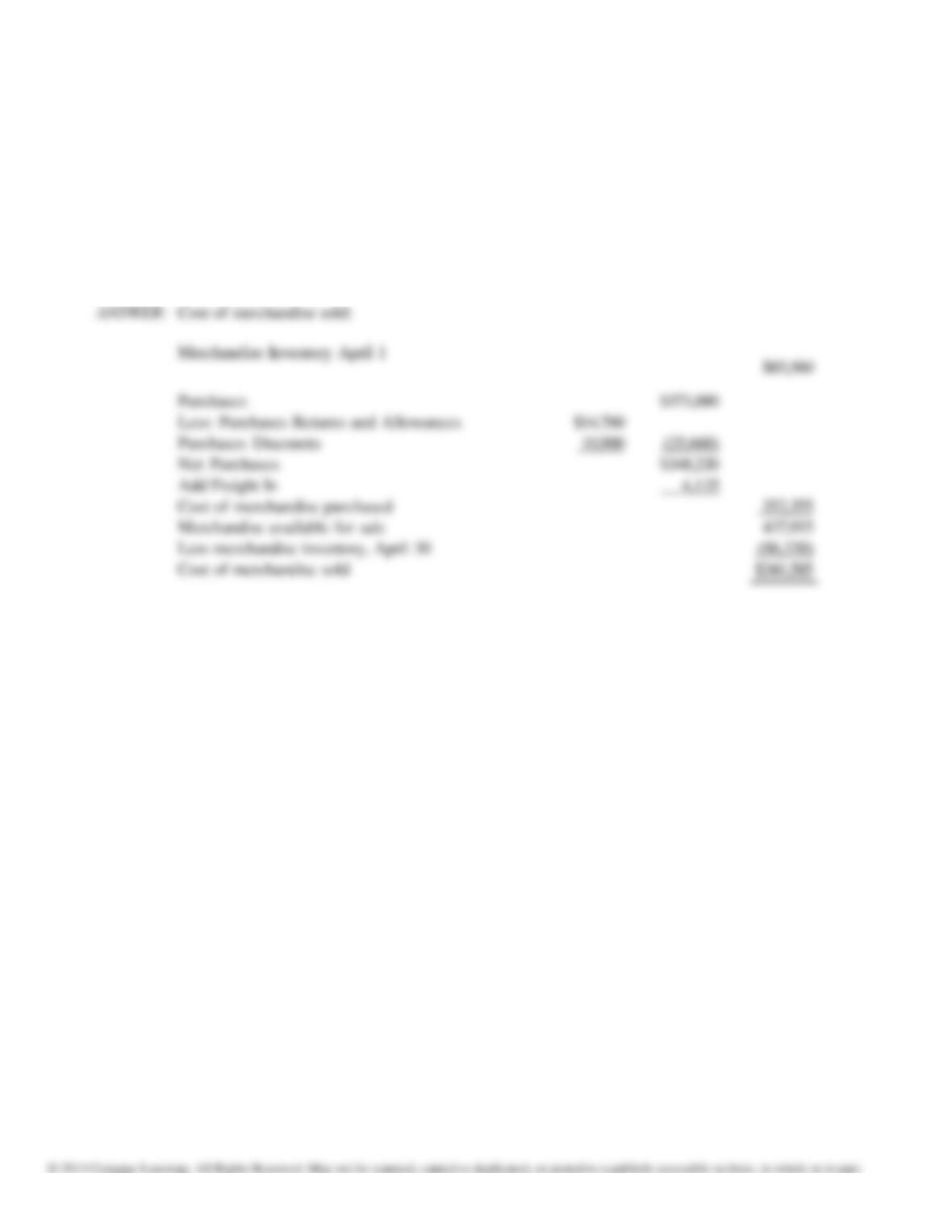
179. Based upon the following data, determine the cost of merchandise sold for April.
Merchandise Inventory April 1
$ 85,560
Merchandise Inventory April 30
96,330
Purchases
373,880
Purchases Returns & Allowances
14,760
Purchases Discounts
10,900
Freight In
4,135
(96,330)
Chapter 5: Inventories and Cost of Goods Sold
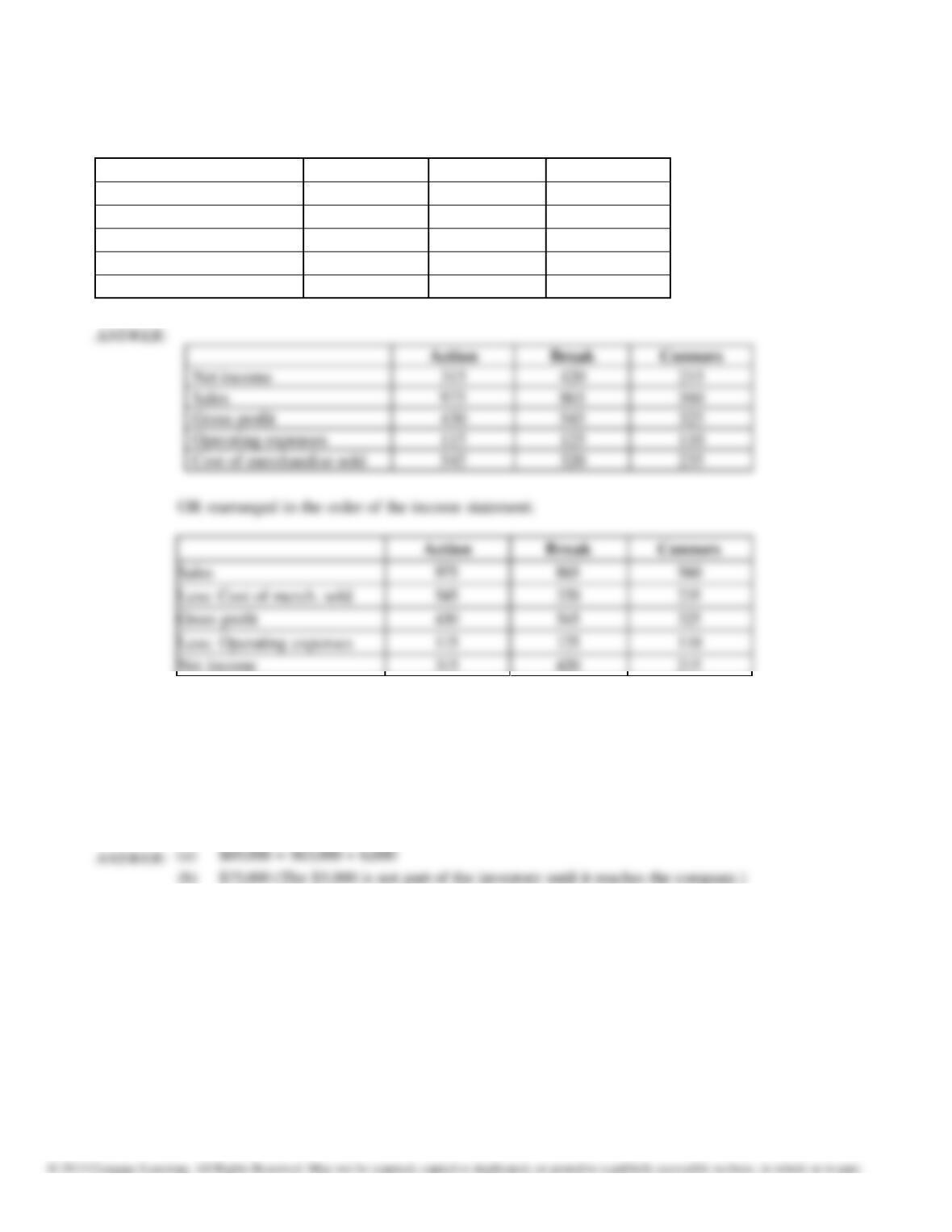
180. Complete the following data taken from the condensed income statements for merchandising companies: Action,
Break, & Connors.
Action
Break
Connors
Net income
315
?
215
Sales
?
865
560
Gross profit
430
?
325
Operating expenses
?
125
?
Cost of merchandise sold
545
320
?
Break
Connors
Sales
975
865
560
Less: Cost of merch. sold
545
320
235
Gross profit
430
545
325
315
420
215
181. For each of the following, calculate the cost of inventory reported on the balance sheet.
(a) The total merchandise inventory counted at the end of the year was $63,000. Purchases for
$6,000 are in transit under FOB shipping point terms.
(b) The total merchandise inventory counted at the end of the year was $75,000. Purchases for $5,000 are in
transit under FOB destination terms.