Exam
Name___________________________________
SHORT ANSWER. Write the word or phrase that best completes each statement or answers the question.
Provide an appropriate response.
1)
What is the degree of term 6c12?
1)
2)
Does scientific notation allow a negative number to be multiplied by a power of 10?
2)
3)
Explain how (–4x)5 and –4x5 are different.
3)
4)
Explain how (m – n)3 differs from m3– n3 by expanding (m – n)3.
4)
5)
What is the degree of term 20a15b18?
5)
6)
x and y are natural numbers such that x is less than y. What is the degree of the quotient
when a polynomial of degree y is divided by a polynomial of degree x?
6)
7)
In scientific notation, what is the largest integer which can be multiplied by a power of 10?
7)
8)
Is the product of a monomial and a binomial always a binomial? Why or why not?
8)
9)
Explain how (–3)6 and –36 are different.
9)
10)
The polynomial 17t9– 6t2– 6 is called a ? .
10)
11)
In multiplying two monomials, you use (but do not always show) the commutative and
associative properties. In each line below, name the property that has been used.
(8x3)·(4x5)= (8x3·4)x5_____________
= (8·4·x3)x5_____________
= (8·4)(x3·x5) _____________
=8·4·x8
11)
12)
12)
Explain how (p+ q)2 differs from p2+ q2 by expanding (p+ q)2.
13)
Explain why the difference of two polynomials in x, both of degree 6, can be of degree 5.
13)
14)
The polynomial 11m6+ 17m4 is called a ? .
14)
15)
What must be done to the dividend before beginning the “long division” process for
(9p2+ 5p4+ 3p3+ 4p+ 7) ÷ (8p + 6)?
15)
16)
Explain how (p– q)2 differs from p2– q2 by expanding (p– q)2.
16)
17)
Is (4x2y7)5 equivalent to 20x10y35?
17)
18)
Does the product rule apply to 118·54? Explain why or why not.
18)
19)
What is always the last step when dividing a polynomial by a polynomial?
19)
20)
Is it correct to simplify 43·34 as 1212?
20)
21)
For the exponential expression mn= 1, the variable m may equal ? .
21)
22)
Find and explain the mistake(s); then work the problem correctly.
(3x –7y)(3x –7y) =9x2+49y2
22)
23)
What must be done to the dividend before beginning the “long division” process for
(6y5+ 4y3+ 3y2+ 7y+ 5) ÷ (3y + 6)?
23)
24)
In scientific notation, what is the smallest positive integer which can be multiplied by a
power of 10?
24)
25)
The polynomial 17x5 is called a ? .
25)
26)
Give an example of a like term for –18c2d10.
26)
27)
Why is scientific notation used?
27)
28)
Explain how (x+ y)3 differs from x3+ y3 by expanding (x+ y)3.
28)
3
MULTIPLE CHOICE. Choose the one alternative that best completes the statement or answers the question.
Find the product.
29)
(x – 3)3
29)
A)
x3– 3x2+ 15x – 27
B)
x3– 9x2+ 27x – 27
C)
x3– 9x2+ 15x – 27
D)
x3– 9x2+ 9x – 27
30)
(–7)(–7)4(–7)(–7)(–7)2
30)
A)
(–7)6
B)
(–7)8
C)
–79
D)
(–7)9
31)
(3p2s4)2(s3)
31)
A)
9p4s9
B)
9p4s24
C)
3p4s11
D)
9p4s11
32)
12,000
32)
A)
1.2 × 10⁵
B)
1.2 × 10⁻⁴
C)
1.2 × 10⁻⁵
D)
1.2 × 10⁴
Solve the problem.
33)
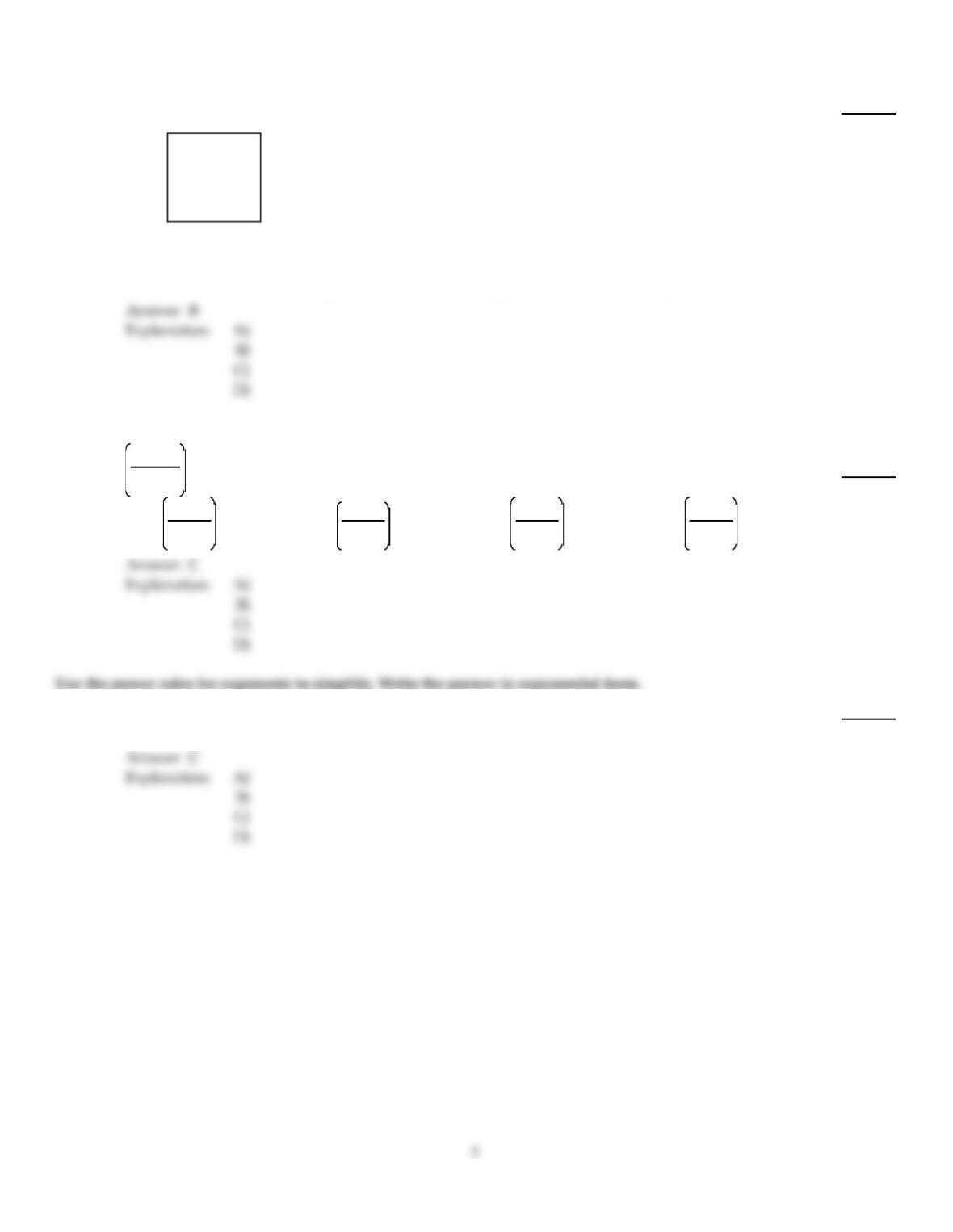
Determine a polynomial that represents the area of the figure.
3t +1
3t +1
33)
A)
9t2+1
B)
9t2+6t +1
C)
6t2+6t +2
D)
9t2+3t +1
Simplify by writing the expression with positive exponents. Assume that all variables represent nonzero real numbers.
34)
3p–3q
3–1m3
2
34)
A)
81q6q
m6
B)
9
p6m6
C)
81q2
p6m6
D)
9q2
p3m3
35)
(3t)7
35)
A)
21t7
B)
37t
C)
37t7
D)
3t7
Provide an appropriate response.
36)
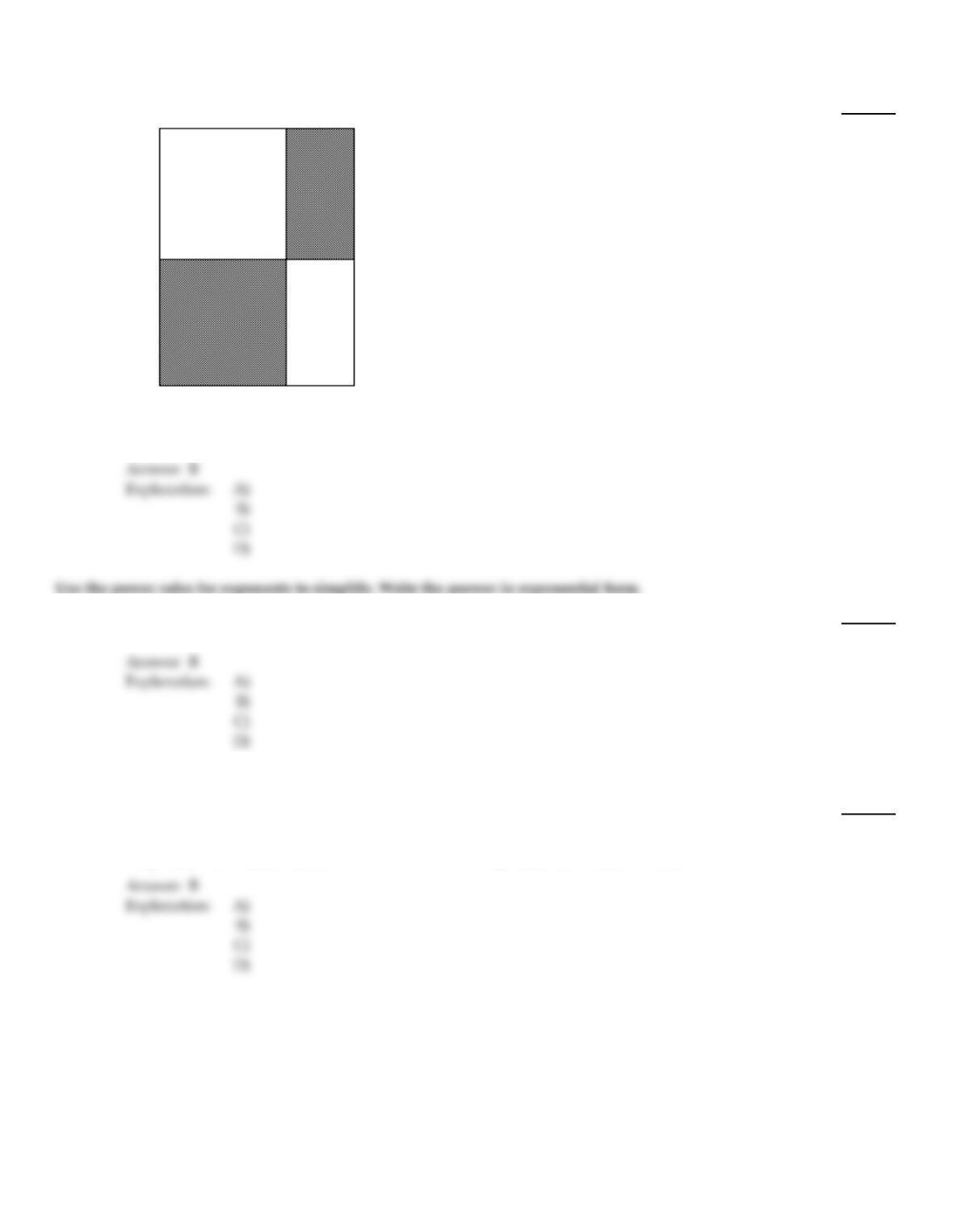
4
x
x 2
Find the total area.
36)
A)
x2+4x +8
B)
x2+6x +8
C)
x2+8
D)
x2+6
37)
4(rt)7
37)
A)
47r7t7
B)
4r7t7
C)
4rt7
D)
4r7t
Solve the problem.
38)
What polynomial, when divided by –11a3x8, yields 3a4x8+ 2x7+ 7a as a quotient?
38)
A)
–33a7x16 – 22a3x15 + 7a
B)
–33a7x16 – 22a3x15 – 77a4x8
C)
–33a7x16 + 2x7+ 7a
D)
–33a4x8– 22x7– 77a
6
Determine the number of terms and name the coefficients of the terms.
39)
x5
39)
A)
0
B)
1; 1
C)
1; 5
D)
1; 0
40)
3.938 × 10⁷
40)
A)
3,938,000
B)
275.66
C)
393,800,000
D)
39,380,000
41)
(x–1y9z)–4
(x–3y10z)–3
41)
A)
x5
y6
B)
1
x5y6z
C)
x–8
y–3
D)
1
x–11y4z
42)
(–5)–3
42)
A)
Negative
B)
Zero
C)
Positive
Perform the indicated operation.
43)
Subtract (20a4– 10a3) from (18a4+ 6a3).
43)
A)
–2a4+ 16a3
B)
–2a4– 4a3
C)
38a4– 4a3
D)
14a7
7
Find the product.
44)
(w – 12)2
44)
A)
144w2– 24w + 144
B)
w2+ 144
C)
w +144
D)
w2– 24w + 144
Write the number in scientific notation.
45)
748
45)
A)
7.48 × 10³
B)
7.48 × 10⁻²
C)
7.48 × 10²
D)
7.48 × 101
Solve the problem.
46)
The area of a rectangle is 9x3–9x2–27x +3. Find the width if the length is <a>.
46)
A)
3x3–3x2–27x + 1
B)
3x3–3x2–9x + 1
C)
9x2–9x –28
D)
3x3–3x2–9x
Add like terms, if possible, and write the result in descending powers of the variable.
47)
0.6y – 0.4y2
47)
A)
–0.4y2+ 0.6y
B)
0.6y2– 0.4y
C)
0.4y2– 0.6y
D)
0.2y3
Perform the division.
48)
( x2+ 7x – 18) ÷ ( x + 9)
48)
A)
x – 2
B)
x2– 2
C)
x + 2
D)
x2+ 8x – 9
8
Simplify the expression.
49)
3p2v3
s2
3 (s
0)
49)
A)
3p6v9
s5
B)
27p6v9
s6
C)
3p6v9
s6
D)
27p5v6
s5
50)
(2x4)(–9x3)(–2x2)
50)
A)
36x9
B)
–36x24
C)
–36x9
D)
36x24
51)
Find an expression that represents the volume of the figure.
4x2
4x2
4x2
51)
A)
96x4
B)
64x8
C)
12x2
D)
64x6
52)
(y +e)–5
(y +e)–6
52)
A)
1
(y +e)11
B)
(y +e)11
C)
y+e
D)
1
(y +e)
Find the product.
53)
(2k + 1)3
53)
A)
8k3+12k2+6k + 1
B)
8k3+24k2+6k + 1
C)
8k3+8k2+4k + 1
D)
8k3+ 1
54)
–8w + 5w2
54)
A)
2; 8 and 5
B)
2; 8
C)
2; –8 and 5
D)
2; –8
Perform the division.
55)
x4– 81
x2– 9
55)
A)
x2+ 3x + 3
B)
x2– 9x + 3
C)
x2– 9
D)
x2+ 9
56)
(2 ×10⁵)(9×10⁹)
56)
A)
1.8 ×10¹⁵
B)
1.8 ×10¹⁴
C)
18 ×1015
D)
18 ×1045
57)
(–36)3
57)
A)
– 39
B)
39
C)
318
D)
– 318

Simplify by writing the expression with positive exponents. Assume that all variables represent nonzero real numbers.
58)
t4
t7
58)
A)
1
t3
B)
t–7
C)
t3
D)
t4
t3
Add like terms, if possible, and write the result in descending powers of the variable.
59)
5y7+ 7y5– 2y2+ 5
59)
A)
15y14
B)
5y7+ 7y5– 2y2
C)
10y14 + 5
D)
Cannot be simplified
Identify the base and the exponent for the exponential expression.
60)
–(–5)7
60)
A)
Base: 7, exponent: 5
B)
Base: –5, exponent: 7
C)
Base: 7, exponent: –5
D)
Base: 5, exponent: 7
Find the value of the polynomial.
61)
5x + 8 when x =3
61)
A)
13
B)
7
C)
30
D)
23
Use the product rule, if possible, to simplify the expression. Write the answer in exponential form.
62)
22·27·23
62)
A)
812
B)
242
C)
212
D)
842
Evaluate the expression.
63)
2–1+ 6–1
63)
A)
3
2
B)
–1
4
C)
2
D)
2
3
Use scientific notation to calculate the answer to the problem. Write the answer in scientific notation.
64)
0.000027(150,000,000)
0.00009(0.0009)
64)
A)
5×10⁹
B)
0.5 ×10⁸
C)
5×10¹⁰
D)
4.5 ×10¹¹
Find the product.
65)
(x + 4y)3
65)
A)
3(x + 4y)
B)
x3+ 12x2y + 48xy2+ 64y3
C)
x3+ 4x2y + 8xy + 16xy2+ 32y2+ 64y3
D)
x3+ 64y3
66)
(–5x3)(–5x4)
66)
A)
–25x12
B)
–10x7
C)
–10x12
D)
25x7
67)
63·66
67)
A)
3618
B)
618
C)
69
D)
369
Find the product.
68)
(n + 11)2
68)
A)
n2+ 121
B)
n +121
C)
n2+ 22n + 121
D)
121n2+ 22n + 121
Perform the division.
69)
12x3+ 31x2+ 24x + 5
4x + 5
69)
A)
3x2+ 4x + 1
B)
x2+ 4x + 1
C)
x2– 4x – 1
D)
3x2+ 1
70)
What polynomial expression represents, in appropriate units, the perimeter of this square? The
area?
3t +1
3t +1
70)
A)
Perimeter: 12t + 1; Area: 6t2+6t +2
B)
Perimeter: 12t + 1; Area: 9t2+3t +1
C)
Perimeter: 12t + 4; Area: 9t2+6t +1
D)
Perimeter: 12t + 4; Area: 9t2+1
71)
–26
71)
A)
Base: 6, exponent: –2
B)
Base: –2, exponent: 6
C)
Base: 2, exponent: 6
D)
Base: 6, exponent: 2
Solve the problem. Express the answer in scientific notation to two decimals.
72)
If the speed of light is 3.00 × 10⁸ m/sec, how long does it take light to travel 2.29 × 10¹¹ m, the
distance from the sun to Mars?
72)
A)
76 sec
B)
7.6 × 10³ sec
C)
7.6 × 10² min
D)
7.6 × 10² sec
73)
(–2y)(–3y5)
73)
A)
–5y5
B)
–6y6
C)
2y – 3y5
D)
6y6
D
Find the product. Use the FOIL method.
74)
(2x – 11)(x + 2)
74)
A)
2x2– 22x – 7
B)
2x2– 7x – 22
C)
2x2– 9x – 22
D)
2x2– 7x – 7
B
Perform the division.
75)
z3– 125
z – 5
75)
A)
z2+ 10z + 25
B)
z2+ 5z + 25
C)
z2– 5z + 25
D)
z2+ 5z – 25
B
Add or subtract as indicated.
76)
(20s +17t) + (9t –14s)
76)
A)
6s +26t
B)
32st
C)
34s +26t
D)
29s +3
A
14
D
Simplify the expression.
77)
7
52·7
53
77)
A)
72
53
B)
75
55
C)
76
56
D)
75
5
If the number in the statement is written in scientific notation, write it without exponents. If it is written without
exponents, write it in scientific notation.
78)
The population of a small country is 6,552,000.
78)
A)
6.552 × 10⁴
B)
6.552 × 10⁵
C)
6.552 × 10⁶
D)
6.552 × 10⁻⁵
Find the product.
79)
(w – 3)2
79)
A)
w2+ 9
B)
w2– 6w + 9
C)
w +9
D)
9w2– 6w + 9
80)
Is it always true that a–b
c–d=cd
ab?
80)
A)
Yes
B)
No
Find the product.
81)
(9 m + 2)2
81)
A)
9m2+ 4
B)
81m2+ 4
C)
9m2+ 36m + 4
D)
81m2+ 36m + 4
15
Provide an appropriate response.
82)
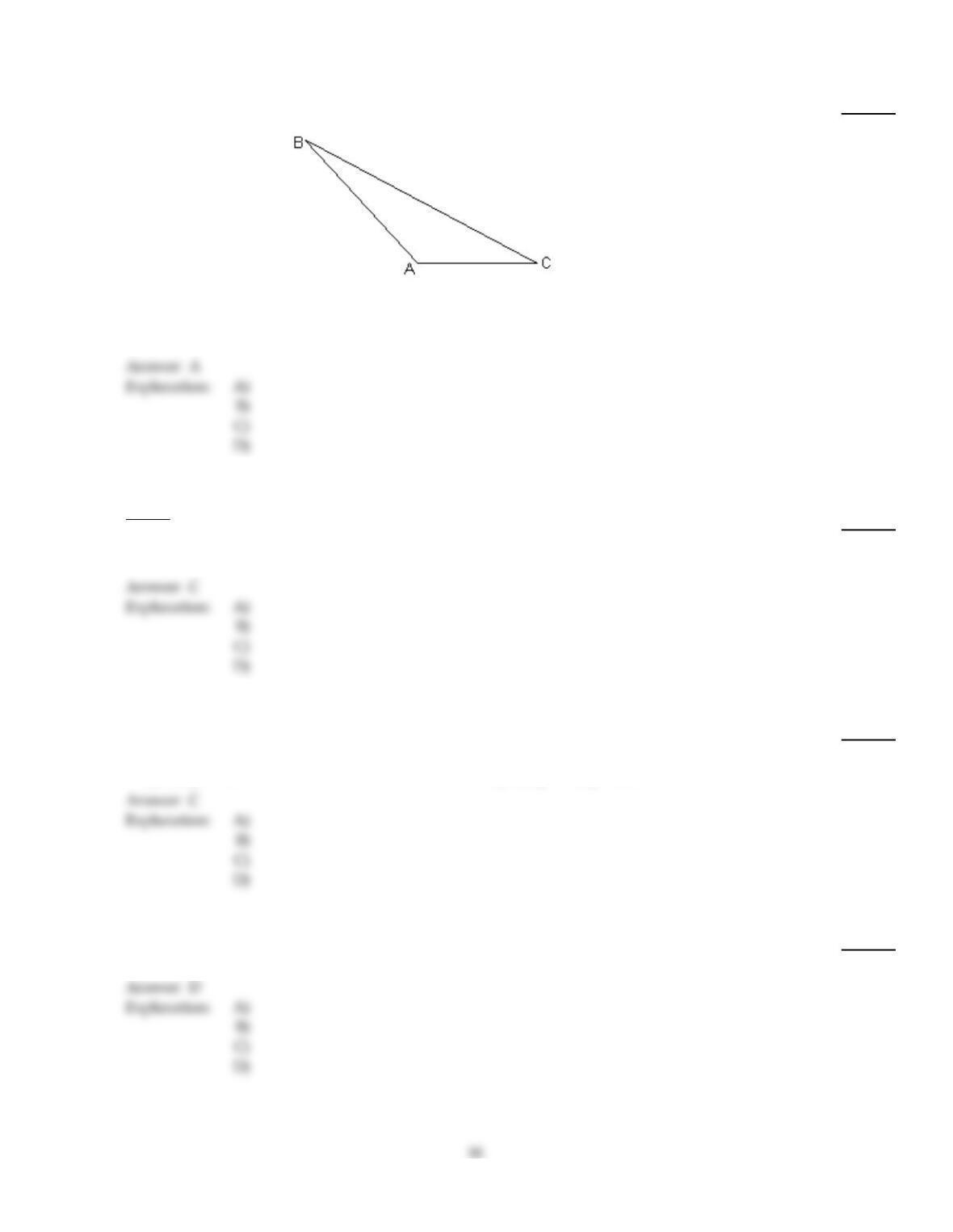
Find the measure of each angle.
A =(40x – 20)°
B =(19 – 2x)°
C =(25 + x)°
82)
A)
A =140°,
B =11°,
C =29°
B)
A =40°,
B =19°,
C =21°
C)
A =40°,
B =7°,
C =33°
D)
A =140°,
B =15°,
C =25°
Evaluate the expression.
83)
011
(–11)0
83)
A)
–1
B)
1
C)
0
D)
–11
Find the product.
84)
(10y2– 4)(10y2+ 4)
84)
A)
100y2+ 16
B)
10y2– 16
C)
100y4– 16
D)
100y4– 80y2+ 80
Write the number using scientific notation.
85)
The earth is approximately 92,900,000 miles from the sun.
85)
A)
9.29 × 10⁸
B)
9.29 × 10⁶
C)
9.29 × 10⁻⁷
D)
9.29 × 10⁷
Find the product.
86)
3t4(t + 4)(2t + 2)
86)
A)
6t6+ 24t5+ 24t4
B)
6t6+ 24t4
C)
6t6+ 30t5+ 24t4
D)
6t6+ 24t5+ 30t4
Determine whether or not the number is written in scientific notation.
87)
4.88 × 10⁶
87)
A)
in scientific notation
B)
not in scientific notation
88)
2.196× 10⁻⁵
88)
A)
0.0002196
B)
0.00002196
C)
0.000002196
D)
–219,600
89)
P =$300, r =0.01, n =2
89)
A)
$356.03
B)
$256.03
C)
$91,809.00
D)
$306.03
90)
(8.63 × 10⁴)(3.81 × 10⁻³)
90)
A)
3.3 × 10⁻¹²
B)
3.29 × 10²
C)
3.3 × 10²
D)
3.29 × 10⁻¹²
91)
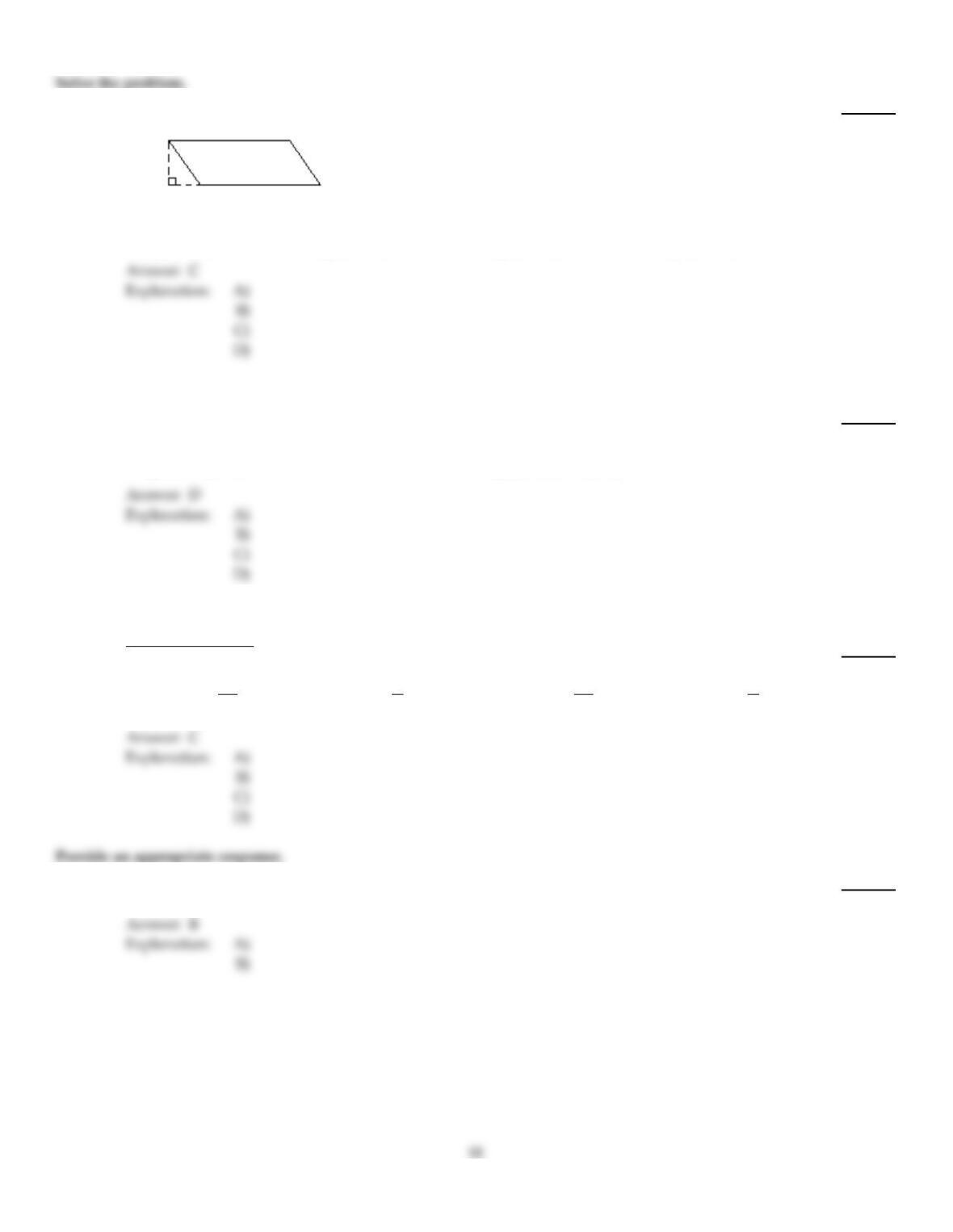
Determine a polynomial that represents the area of the figure.
2x –5
2x +5
91)
A)
4x2+25
B)
4x2+10
C)
4x2–25
D)
4x2–10
Perform the indicated operation.
92)
(–3+ x2+ 5x) + (–6x – 3 + x3) + (–3x + 1 + 2x3)
92)
A)
3x3+ x2– 4x – 2
B)
3x3– 5x2+ 2x – 5
C)
4x3– 4x – 5
D)
3x3+ x2– 4x – 5
Perform the division. Write the answer with positive exponents.
93)
21x6+ 28x4+ 28x2
7x4
93)
A)
3x + 4 +4
x2
B)
3x + 4 +4
x
C)
3x2+ 4 +4
x2
D)
3x2+ 4 +4
x
94)
Determine if the expression (–9 )–9 is positive or negative.
94)
A)
Positive
B)
Negative
Identify the base and the exponent for the exponential expression.
95)
–4x4
95)
A)
Base: 4x, exponent: 4
B)
Base: –4x, exponent: 4
C)
Base: 4, exponent: –4x
D)
Base: x, exponent: 4
96)
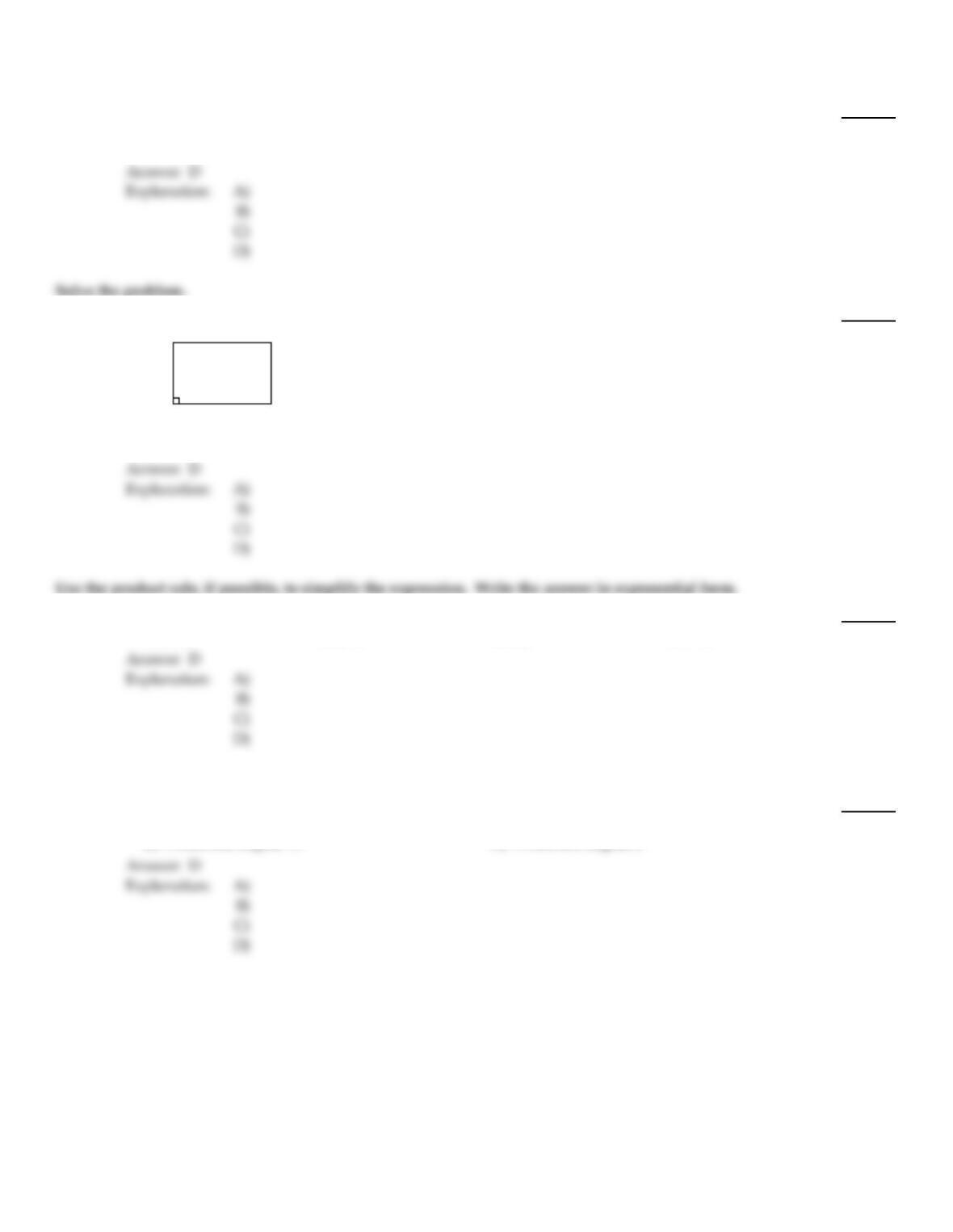
Determine a polynomial that represents the area of the figure.
2x –7
2x +7
96)
A)
4x2+28x –49
B)
4x2+49
C)
4x2–28x +49
D)
4x2–49
D
97)
(–9)5(–9)4
97)
A)
(81)20
B)
(81)9
C)
(9)9
D)
(–9)9
D
Identify the polynomial as a monomial, binomial, trinomial, or none of these. Give its degree.
98)
–5c6– 2c5+ 8c4
98)
A)
Binomial, degree 15
B)
Binomial, degree 5
C)
Trinomial, degree 15
D)
Trinomial, degree 6
D
19
D

Perform the division.
99)
9r3– 21r2– 14r – 12
r – 3
99)
A)
9r2+ 6r + 4
B)
9r2– 6r – 4
C)
r2 + 4r + 6
D)
9r2+ 6r +4
r – 3
Find the product.
100)
8(9x)
100)
A)
72x
B)
17x
C)
72
D)
17
A
101)
12x5(–12x5– 8x2– 8)
101)
A)
–144x10 – 8x2– 8
B)
–144x5– 96x2– 96
C)
–144x10 – 96x7– 96x5
D)
–144x10 – 96x7
C
102)
4x +3
5y2
102)
A)
16x2+9
25y2
B)
16x2+24
5xy +9
25y2
C)
16x2+12
5xy+9
25y2
D)
4x2+24
5xy +3
5y2
B
Determine whether or not the number is written in scientific notation.
103)
47,000
103)
A)
in scientific notation
B)
not in scientific notation
B
A
Find the product.
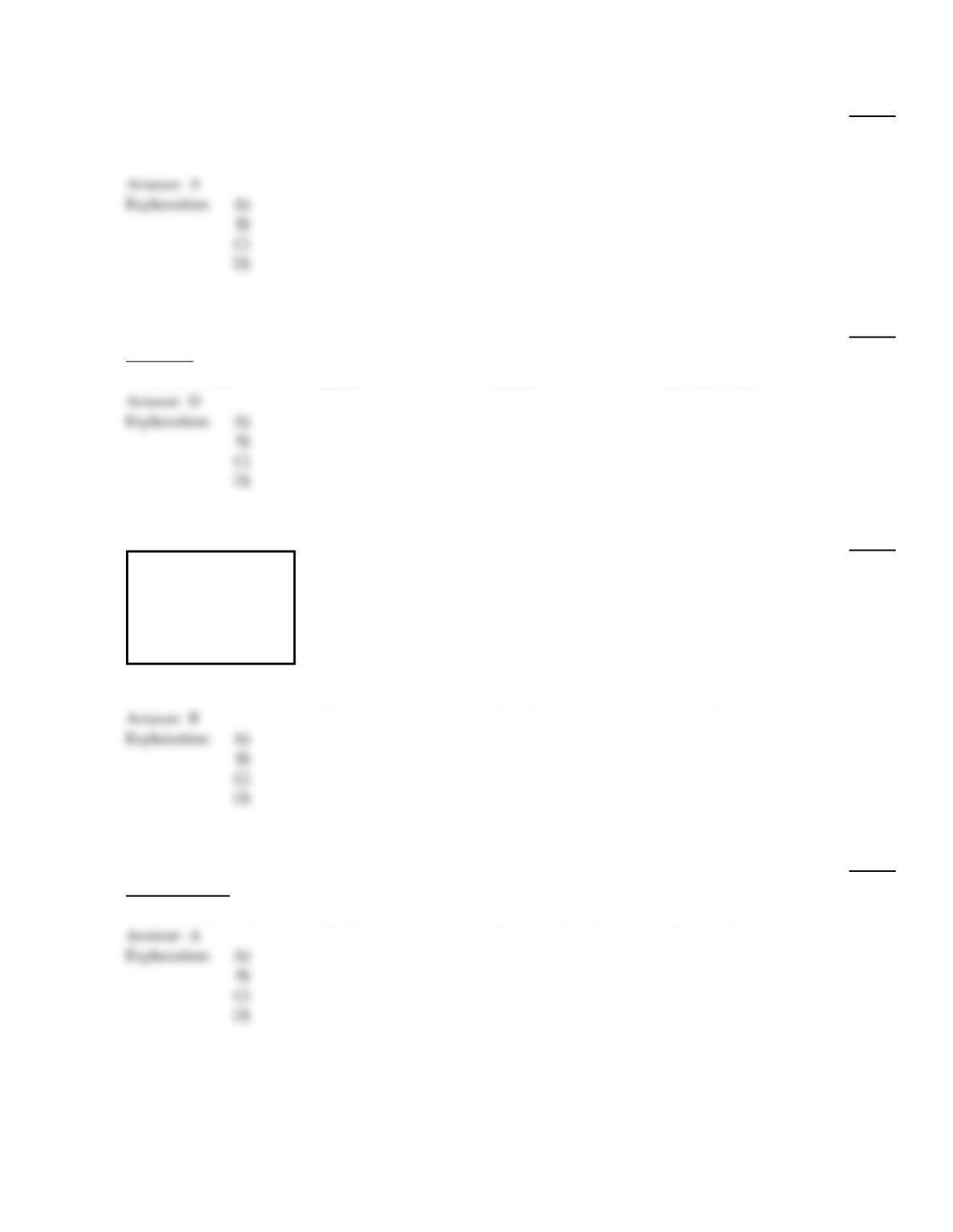
104)
(8p – 1)(64p2+ 8p + 1)
104)
A)
512p3– 1
B)
512p3+ 72p2– 1
C)
512p3+ 1
D)
64p3– 1
Add.
105)
8a4+ 8a3
3a4+ 7a3
105)
A)
11a8+ 15a6
B)
26a7
C)
26a14
D)
11a4+ 15a3
Predict the display a calculator would give for the expression shown in the screen.
106)
(4E9) * (4E9) / (4E5)
106)
A)
–1E23
B)
4E13
C)
4E23
D)
12E13
Subtract.
107)
9n7+ 4n6+ 5
2n7+ 2n6+ 16
107)
A)
7n7+ 2n6– 11
B)
–2n13
C)
7n7+ 6n6+ 21
D)
7n7+ 2n6+ 21
21
Find the product.
108)
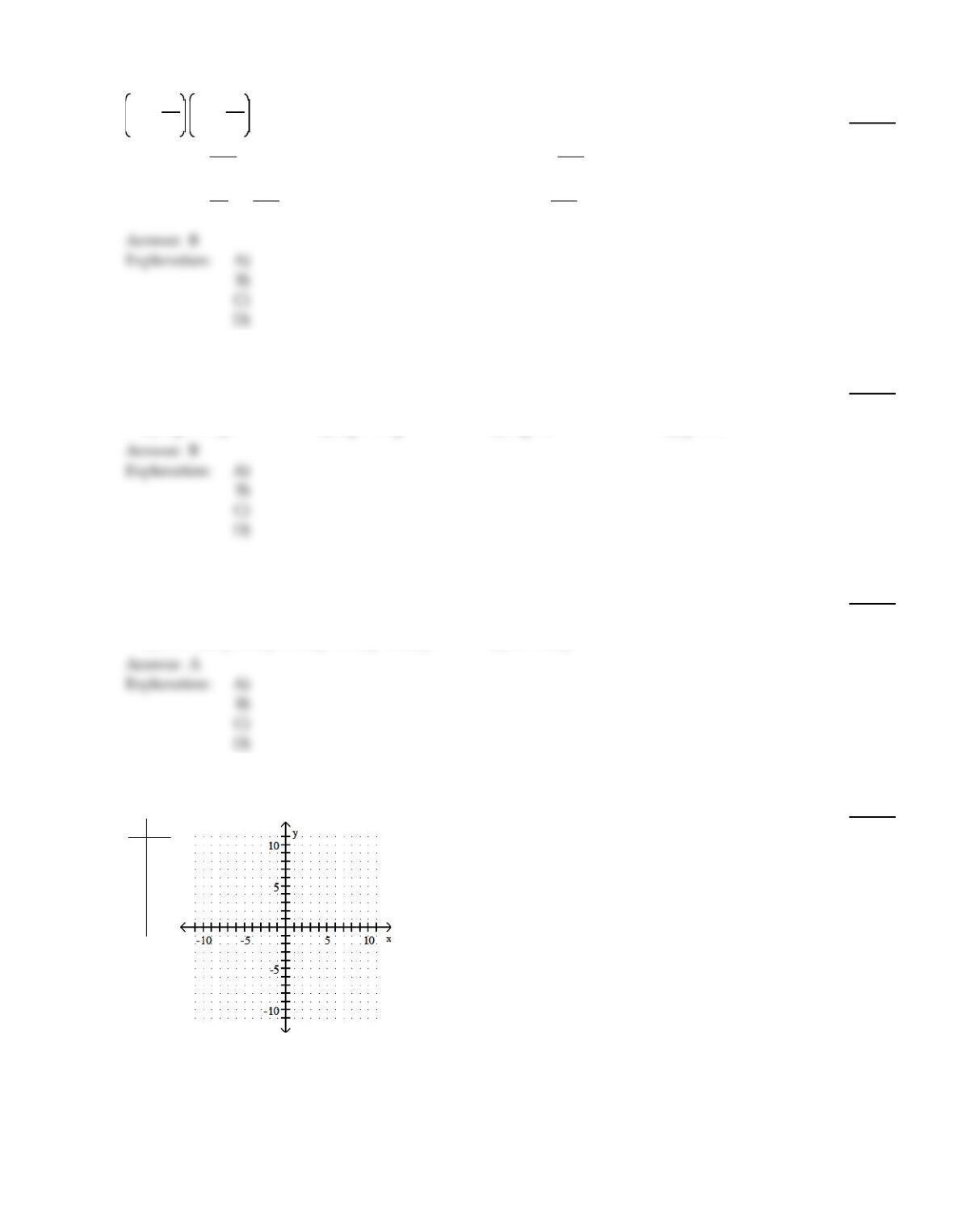
4x +3
11 4x –3
11
108)
A)
16x2+9
121
B)
16x2–9
121
C)
16x2–24
11x –9
121
D)
4x2–9
121
Solve the problem.
109)
The volume of a box is 5p4+ 27p3+ 28p2. The height is p and the width is p + 4. What is the
length?
109)
A)
5p3+ 7p2
B)
5p2+ 7p
C)
5p + 7
D)
p2+ 7
Find the product.
110)
(x + 4y)3
110)
A)
x3+ 12x2y + 48xy2+ 64y3
B)
3(x + 4y)
C)
x3+ 4x2y + 8xy + 16xy2+ 32y2+ 64y3
D)
x3+ 64y3
Graph the equation by completing the table of values.
111)
y = –x2– 5
x y
–2
–1
0
1
2
111)
22
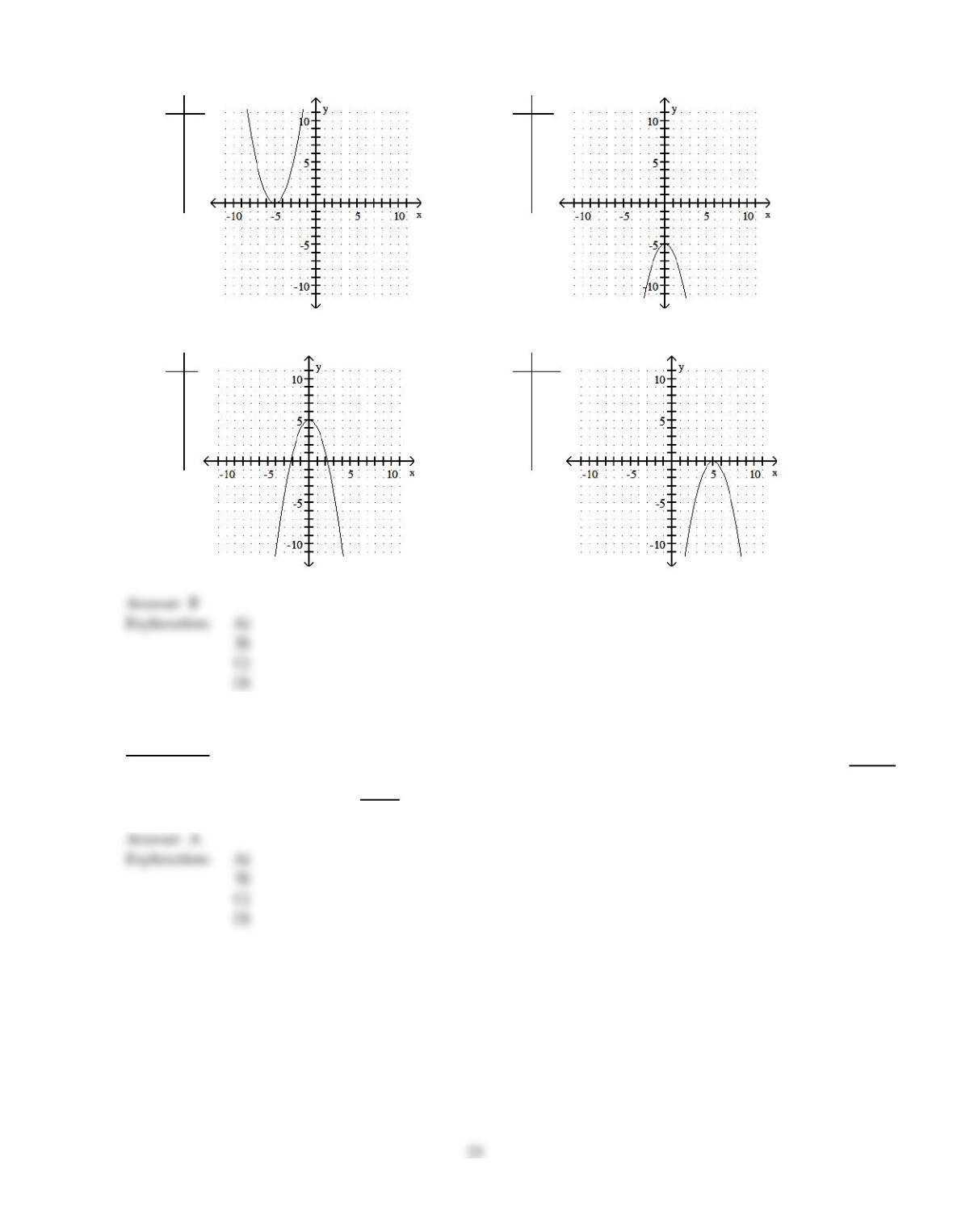
A)
x y
–2 9
–116
025
136
249
B)
x y
–2–9
–1–6
0–5
1–6
2–9
C)
x y
–2 1
–1 4
0 5
1 5
2 4
D)
x y
–2–49
–1–36
0–25
1–16
2–9
Perform the division.
112)
y2+ 4y + 4
y + 2
112)
A)
y + 2
B)
y +2
y + 2
C)
y – 2
D)
y2+ 2
Find the product.
113)
(–2x4y4)(–2x3y2)
113)
A)
4xy7
B)
4xy6
C)
4x7y6
D)
4x6y7
114)
(–2x)4
114)
A)
Base: 2x, exponent: 4
B)
Base: –2x, exponent: 4
C)
Base: x, exponent: 4
D)
Base: 4, exponent: –2x
Add.
115)
(4n6– 9n – 8n5) + (–2n5+ 6n6– 9n)
115)
A)
–3n6+ 2n5– 17n
B)
–18n12
C)
10n6– 10n5– 18n
D)
10n – 10n6– 18n5
Combine like terms when possible and write the polynomial in descending powers of the variable. Give the degree of
the simplified polynomial. Decide whether the simplified polynomial is a monomial, a trinomial, or none of these.
116)
2x5+ 8x2– 5x5
116)
A)
–3x5+ 8x2; 5; binomial
B)
Cannot be simplified
C)
5x12; 12; monomial
D)
5x2; 2; monomial
24
Simplify by writing the expression with positive exponents. Assume that all variables represent nonzero real numbers.
117)
36x9
39x4
117)
A)
x5
33
B)
3
x
C)
33
x5
D)
5
3
Find the value of the polynomial.
118)
5x5+ 3x4– 6x3–x2 when x = –2
118)
A)
–39
B)
–68
C)
–73
D)
–72
Solve the problem. Express the answer in scientific notation to two decimals.
119)
A light–year is the distance that light travels in one year. Find the number of miles in a light–year if
light travels 1.86 × 10⁵ miles/second.
119)
A)
6.0 × 10⁵ mi
B)
6.0 × 10⁷ mi
C)
6.0 × 10¹⁴ mi
D)
6.0 × 10¹² mi
Write the number in scientific notation.
120)
31.94
120)
A)
3.194 × 10⁻¹
B)
3.194 × 10²
C)
3.194 × 10⁻²
D)
3.194 × 101
Perform the indicated operation.
121)
[–(7n2– 6n– 3n3) – (3n2+ 10n– 7n3)] –n2
121)
A)
10n3– 11n2– 4n
B)
4n3+ 3n2– 16
C)
10n3– 9n2– 4
D)
–4n3– 5n2+ 16
25
122)
Add (9a5– 2a3) and (3a5– 3a3).
122)
A)
7a8
B)
12a5– 5a3
C)
7a16
D)
12a10 – 5a6
123)
11x2(6x6– 3x2)
123)
A)
66x8– 3x2
B)
66x8+ 33x4
C)
66x2– 33x
D)
66x8– 33x4
124)
(–4p9)(6p6)
124)
A)
24p54
B)
–24p15
C)
24p15
D)
–24p54
Graph the following by completing the table of values.
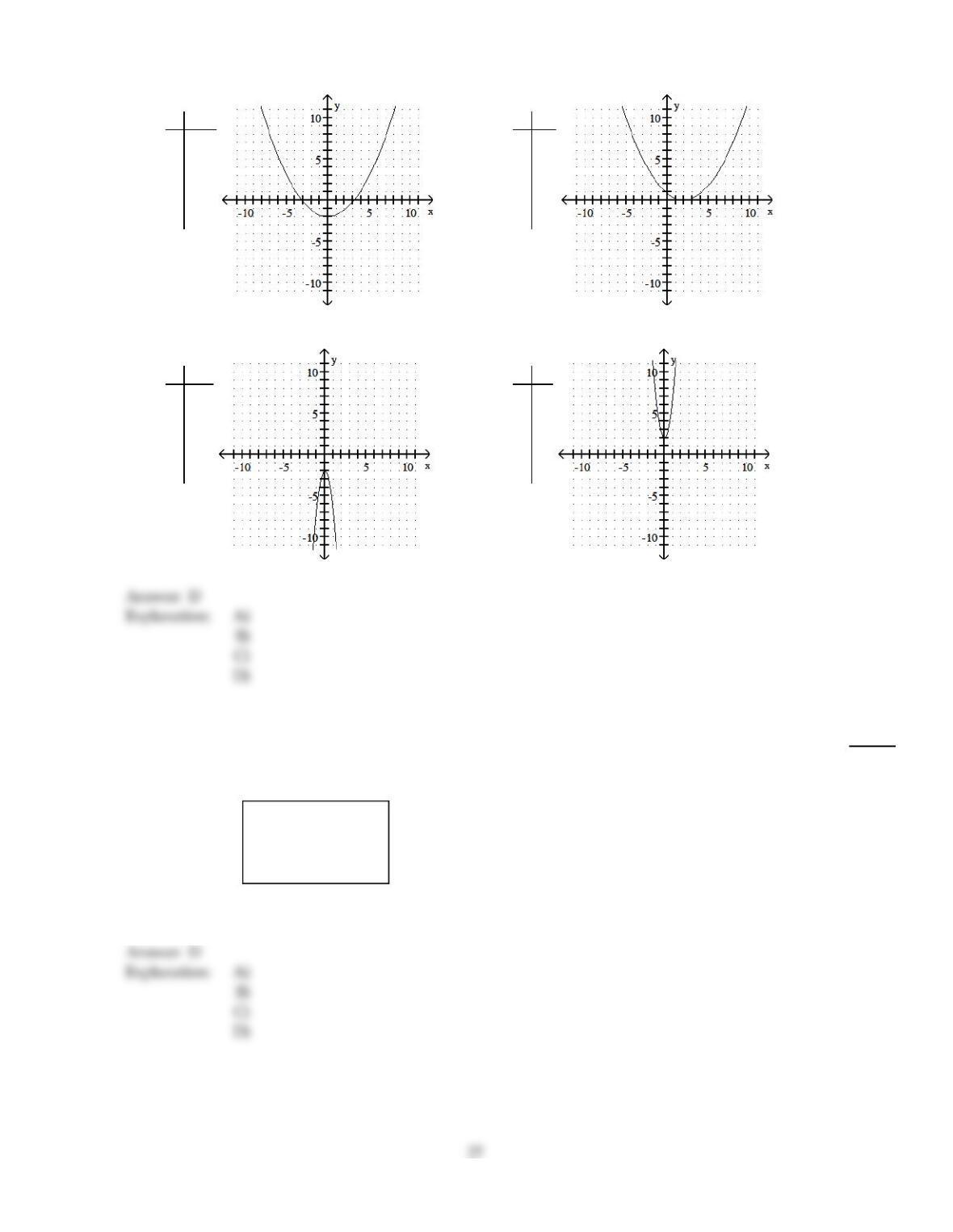
125)
y =5x2+ 2
x y
–2
–1
0
1
2
125)
26
A)
x y
–2–1.2
–1–1.8
0–2
1–1.8
2–1.2
B)
x y
–23.2
–11.8
00.8
10.2
2 0
C)
x y
–2–22
–1–7
0–2
1–7
2–22
D)
x y
–222
–1 7
0 2
1 7
222
Provide an appropriate response.
126)
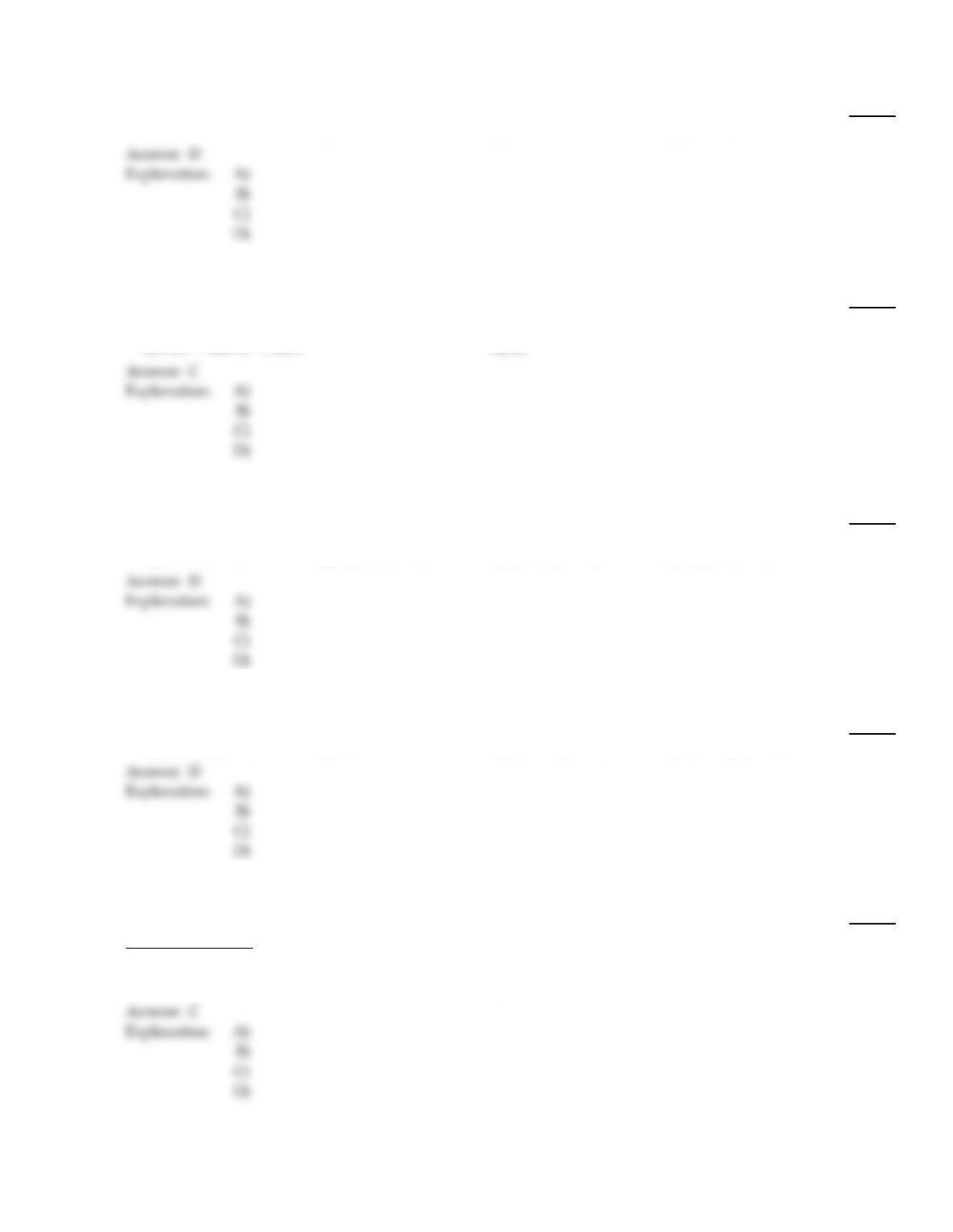
Find a polynomial that represents the perimeter.
4k2+ 6x
3k2+ 4
126)
A)
7k2+ 6x + 4
B)
14k2+ 20x
C)
7k2+ 10x
D)
14k2+ 12x + 8
Add like terms, if possible, and write the result in descending powers of the variable.
127)
6z8+ 5z9
127)
A)
11z8
B)
11z17
C)
11z5
D)
5z9+ 6z8
Perform the division.
128)
(42m6n –24m5n5+30m4n7) ÷ (6m3n)
128)
A)
7m3–24m5n5+30m4n7
B)
7m9–4m8n6+5m7n8
C)
7m3–4m2n4+5mn6
D)
32
Solve the problem. Express the answer in scientific notation to two decimals.
129)
The earth is approximately 92,900,000 miles from the sun. If 1 mile = 1.61 × 10³ m, what is the
distance to the sun in meters?
129)
A)
5.7 × 10¹⁰ m
B)
1.50 × 10¹⁰ m
C)
5.7 × 10⁻¹⁰ m
D)
1.50 × 10¹¹ m
Subtract.
130)
(8n7+ 9n5– 12) – (–17n5+ 5n7+ 13)
130)
A)
3n7+ 26n5+ 1
B)
4n12
C)
3n7+ 14n5+ 1
D)
3n7+ 26n5– 25
Add.
131)
3x8+ 2x7+ 9x6– 8
6x8+ 6x7+ 3x6+ 5
131)
A)
29x42 – 3
B)
9x16 + 8x14 + 12x12 – 3
C)
9x8+ 8x7+ 12x6– 3
D)
–2x8– 2x7+ 8x6+ 8
28

Find the product.
132)
(p + 8q)(p – 8q)
132)
A)
p2+ 16pq – 64q2
B)
p2– 16pq – 64q2
C)
p2– 16q2
D)
p2– 64q2
Determine whether the expression represents a number that is positive, negative, or zero.
133)
–22
133)
A)
Zero
B)
Positive
C)
Negative
Add.
134)
(7a4+ 6a3) + (8a4+ 6a3)
134)
A)
27a7
B)
27a14
C)
15a4+ 12a3
D)
15a8+ 12a6
135)
8n5+ 9n2– 8
6n5+ 9n2+ 4
135)
A)
14n5+ 18n2– 4
B)
14 + 18n5– 4n2
C)
–2n5+ 17n2+ 13
D)
28n7
Simplify by writing the expression with positive exponents. Assume that all variables represent nonzero real numbers.
136)
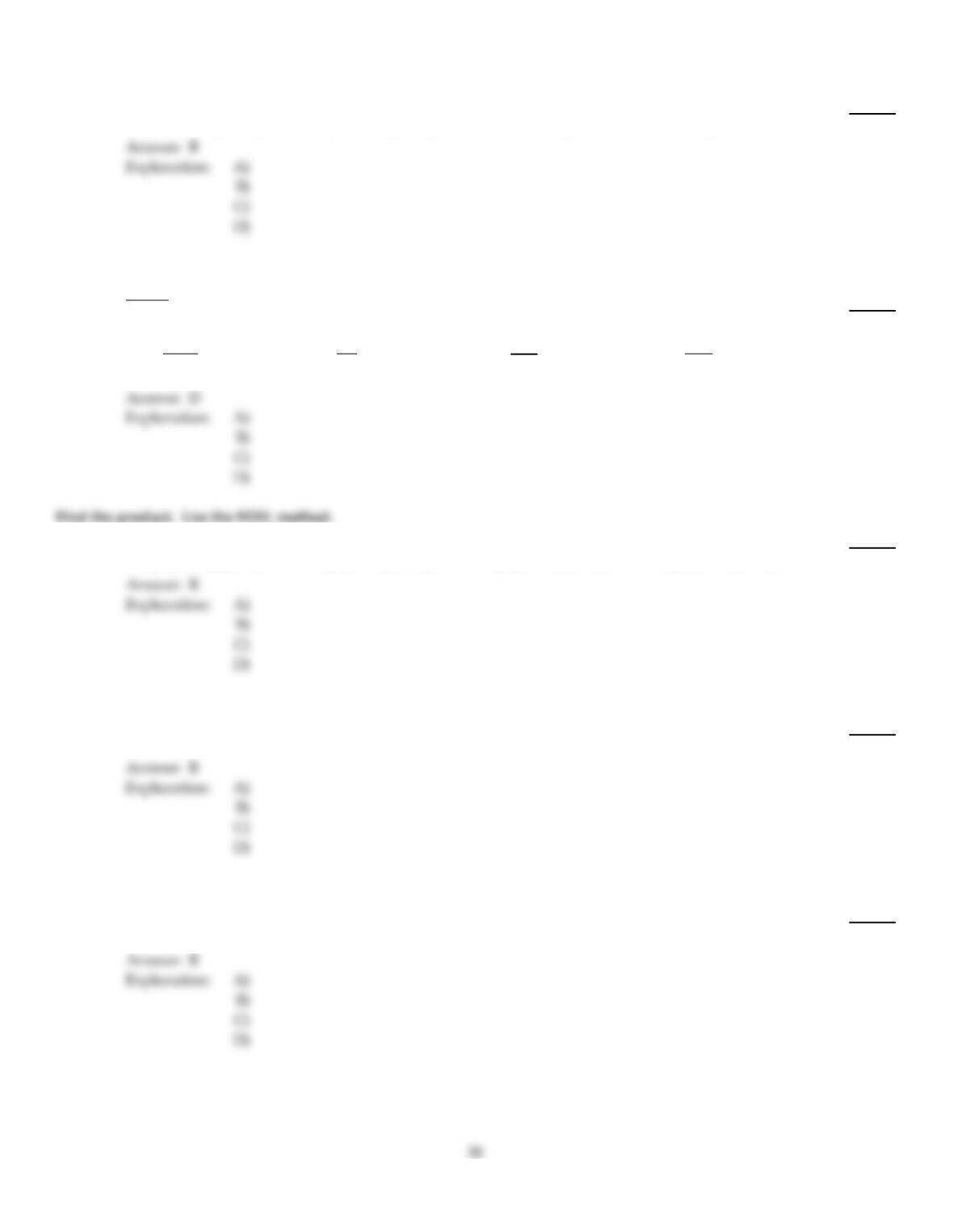
4
r–6
136)
A)
4r6
B)
r6
4
C)
4r–6
D)
4
Add or subtract as indicated.
137)
(26x +13xy –18y) – (19x –20xy –28y)
137)
A)
7x –33xy –46y
B)
7x +33xy + 10y
C)
13x – 7xy +46
D)
50xy
Simplify by writing the expression with positive exponents. Assume that all variables represent nonzero real numbers.
138)
14x–4
(2x)3
138)
A)
7
64x7
B)
7
x7
C)
7x7
4
D)
7
4x7
D
139)
(2x – 11)(2x – 11)
139)
A)
4x2+ 121x – 44
B)
4x2– 44x + 121
C)
2x2– 45x + 121
D)
2x2– 44x – 45
B
Add or subtract as indicated.
140)
(r + 3s + 4) + (3r + s) + (s + 2)
140)
A)
3r + 3s + 6
B)
4r + 5s + 6
C)
2r + 5s + 6
D)
4r + 4s + 6
B
Use the power rules for exponents to simplify. Write the answer in exponential form.
141)
(2rt)7
141)
A)
27rt7
B)
27r7t7
C)
2r7t7
D)
27r7t
B
B
Find the product. Use the FOIL method.
142)
(–9+ x)(3x + 7)
142)
A)
3x2– 21x – 63
B)
x2– 20x – 20
C)
3x2– 20x – 63
D)
3x2– 63x – 20
Find the product.
143)
(3 m + 5)2
143)
A)
3m2+ 30m + 25
B)
9m2+ 30m + 25
C)
3m2+ 25
D)
9m2+ 25
B
Solve the problem.
144)
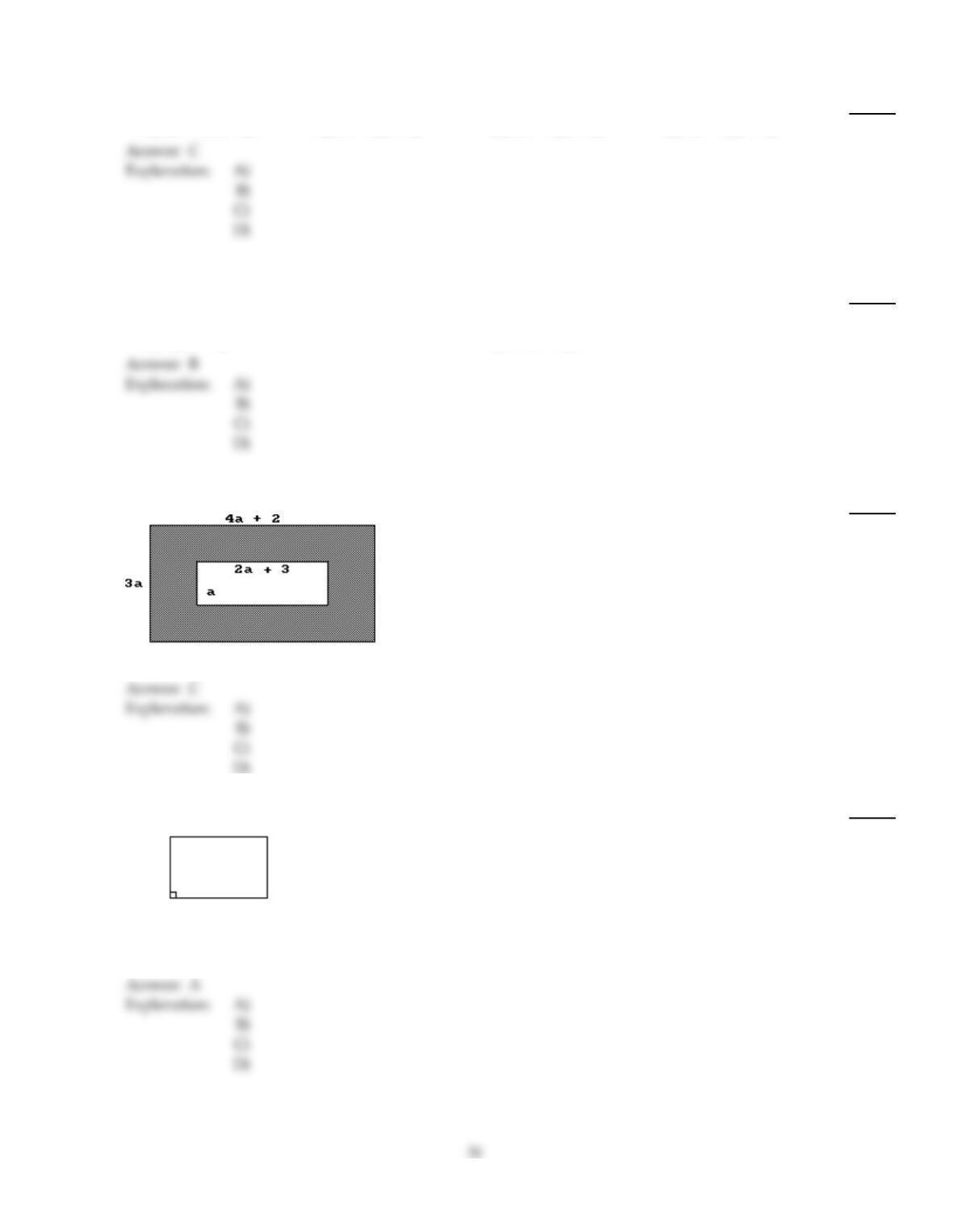
Find a polynomial that represents the area of the shaded region.
144)
A)
12a2+ 3a
B)
12a2+ 6a
C)
10a2+ 3a
D)
10a2– 1
C
145)
Find an expression that represents the area of the figure.
3x2
6x5
145)
A)
18x7
B)
9x10
C)
9x7
D)
18x10
A
C
Perform the division. Write the answer with positive exponents.
146)
20x7– 30x4
–5x7
146)
A)
–4+ 6x3
B)
–4+6
x3
C)
–4– 30x4
D)
20x7+6
x3
147)
(5r)7(5r)–6
147)
A)
25r13
B)
5r
C)
25r
D)
1
5r
B
148)
2y3– 4y2– y
148)
A)
3; 2, 4, 1
B)
3; 2, –4, –1
C)
3; 2, –4, 1
D)
2; 2, –4
B
Find the value of the polynomial.
149)
2x3+ 6x2+ 11 when x = –3
149)
A)
–1
B)
–61
C)
1
D)
11
D
Find the product. Use the FOIL method.
150)
(2x + 8)(2x – 8)
150)
A)
4x2+ 32x – 64
B)
2x2– 32x – 64
C)
4x2– 64
D)
4x2– 32x – 64
C
32
B

Perform the division. Write the answer with positive exponents.
151)
48x8+ 48x7+ 40x5+ 24x3
8x5
151)
A)
–6x3– 6x2– 5 –3
x2
B)
6x3+ 9x2+ 5
C)
6x3+ 6x2+ 5 +3
x2
D)
6x3+ 6x2+ 5
Find the product.
152)
2y3(4y +3)(y +4)
152)
A)
46y4+24y3
B)
8y5+24y3
C)
38y4+24y3
D)
8y5+38y4+24y3
If the number in the statement is written in scientific notation, write it without exponents. If it is written without
exponents, write it in scientific notation.
153)
The speed of light is 1.86 × 10⁵ miles per hour.
153)
A)
.0000186
B)
186,000
C)
1,860,000
D)
18,600,000
Perform the indicated operation.
154)
(4n6+ 4n3+ 5) – (15n3+ 2n6– 7) + (n7+ 10)
154)
A)
n7+ 2n6– 11n3+ 22
B)
n7+ 2n6+ 6n3+ 8
C)
13n9
D)
n7+ 2n6– 11n3+ 8
33
Find the product.
155)
(x + 4)3
155)
A)
x3+ 12x2+ 12x + 64
B)
x3+ 12x2+ 8x + 64
C)
x3+ 12x2+ 48x + 64
D)
x3+ 4x2+ 8x + 64
Perform the division.
156)
(6m2+ 8m – 8) ÷ ( m + 2)
156)
A)
6m – 4 +9
m – 4
B)
m – 4
C)
6m + 4
D)
6m – 4
Write the number in scientific notation.
157)
0.000000322015
157)
A)
3.22015 × 10⁶
B)
3.22015 × 10⁻⁶
C)
3.22015 × 10⁻⁷
D)
3.22015 × 10⁷
Find the product.
158)
x2(x – 2)3
158)
A)
x5– 2x4+ 8x3– 8x2
B)
x5– 6x4+ 8x3– 8x2
C)
x5– 6x4+ 6x3– 8x2
D)
x5– 6x4+ 12x3– 8x2
159)
If a polynomial in x of degree 6 is divided by a monomial in x of degree 2, what is the degree of
the quotient?
159)
A)
8
B)
Can’t tell
C)
2
D)
4
Determine the number of terms and name the coefficients of the terms.
160)
–6m + 4h
160)
A)
2; –6 and 4
B)
2; –6 and –4
C)
2; 6 and 4
D)
2; 6 and –4
161)
(–2)–4
161)
A)
–16
B)
1
16
C)
16
D)
–1
16
162)
11.84 × 10⁻²
3.2 × 10⁹
162)
A)
3.7 × 10⁻¹¹
B)
7.4 × 10⁷
C)
3.7 × 10⁷
D)
7.4 × 10⁻¹¹
163)
(z4)3
163)
A)
(z3)12
B)
z7
C)
z12
D)
4z3
164)
P =$150, r =0.10, n =6
164)
A)
$265.73
B)
$365.73
C)
$20,179,187,015,625.00
D)
$990.00
Add like terms, if possible, and write the result in descending powers of the variable.
165)
9m4+ 4m4
165)
A)
13m4
B)
52m
C)
13m8
D)
Cannot be simplified
166)
9m6– 9m6+ 7m6– 2m6
166)
A)
5m24
B)
30m
C)
5m6
D)
Cannot be simplified
167)
–6m8+ 2m7– 10m5+ 12m8– 13m7
167)
A)
27m20
B)
6m8– 11m7– 10m5
C)
540m
D)
Cannot be simplified
36
Solve the problem.
168)
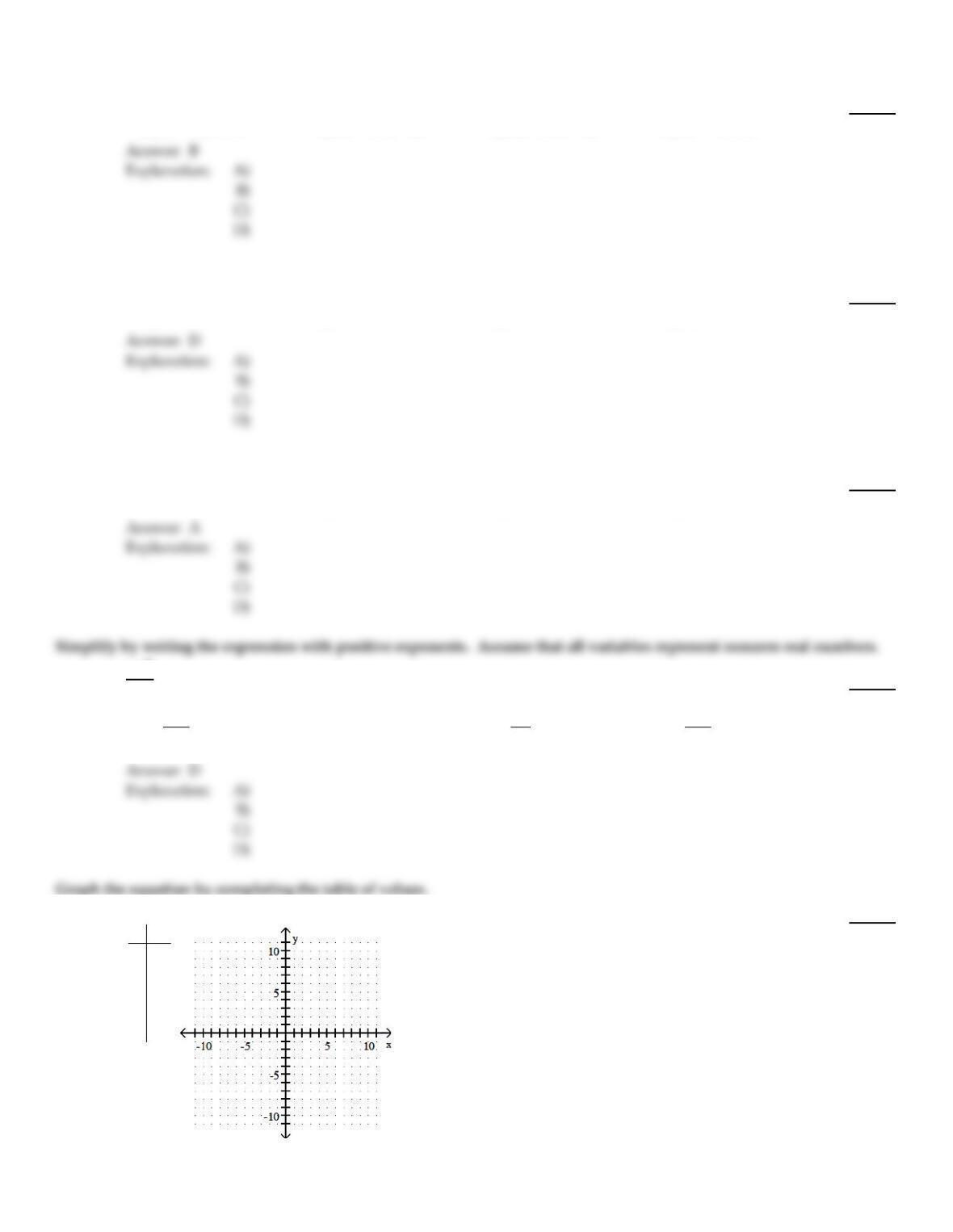
The area of a parallelogram is 15x3+49x2+45x +8. Find a polynomial that expresses the height if
the base is 5x +8.
168)
A)
3x2+10x + 1
B)
3x2+5x +8
C)
6x2+5x + 1
D)
3x2+5x + 1
Use the power rules for exponents to simplify. Write the answer in exponential form.
169)
2
38
169)
A)
58
B)
28
38
C)
16
24
D)
10
11
170)
(7.2 ×103) × (8.5 ×102)
170)
A)
61.2 ×10⁵
B)
61.2 ×10⁶
C)
6,120,000
D)
612,000
Solve the problem.
171)
The area of a triangle is 60x3–44x2–42x. Find a polynomial that expresses the length of the base
if the height is x.
171)
A)
120x3–88x2–84x
B)
60x2–44x –42
C)
120x2–88x –84
D)
30x3–22x2–21x
Find the product. Use the FOIL method.
172)
(2x – 6)(x + 5)
172)
A)
x2– 30x + 4
B)
2x2+ 4x – 30
C)
2x2+ 3x – 30
D)
x2+ 4x + 3
Perform the division.
173)
(5x2+ 9x – 2) ÷ (x + 2)
173)
A)
5x + 1
B)
x + 9
C)
5x2– 9
D)
5x – 1
D
Write the number using scientific notation.
174)
19,000,000
174)
A)
1.9 × 10⁷
B)
1.9 × 10⁶
C)
1.9 × 10⁻⁷
D)
1.9 × 10⁻⁶
A
175)
y–8
y3
175)
A)
1
y24
B)
y11
C)
1
y5
D)
1
y11
D
176)
y = –3x2
x y
–2
–1
0
1
2
176)
38
B
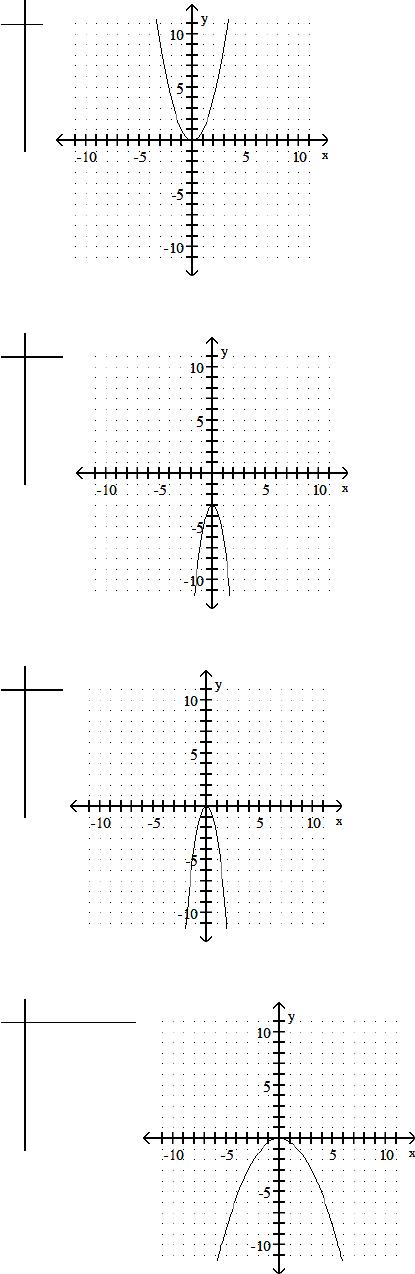
A)
x y
–2 4
–1 1
0 0
1 1
2 4
B)
x y
–2–15
–1–6
0 0
1–6
2–15
C)
x y
–2–12
–1–3
0 0
1–3
2–12
D)
x y
–2–1.3333333
–1–0.33333333
0 0
1–0.33333333
2–1.3333333
39

Perform the indicated operation.
177)
Find the sum of (8+ 9n5– 3n3) and (4n5+ 5n3+ 9).
177)
A)
13n5+ 2n3+ 17
B)
32n8
C)
12n5+ 14n3+ 6
D)
13 + 2n5+ 17n3
Find the product.
178)
(x – 5)4
178)
A)
x4– 20x3– 250x2– 500x + 625
B)
x4– 20x3+ 150x2+ 20x + 625
C)
x4– 5x3+ 150x2– 250 x + 625
D)
x4– 20x3+ 150x2– 500x + 625
179)
2x(2x +1)(3x –7)
179)
A)
2x(6x2– 11x –7)
B)
12x2– 22x –14
C)
12x3+ 22x2–14x
D)
12x3– 22x2–14x
Subtract.
180)
5x5+ 5x4– 8x3+ 3
7x5– 3x4– 4x3+ 4
180)
A)
–2x5+ 2x4– 12x3+ 7
B)
12x5+ 2x4– 12x3+ 7
C)
12x5+ 2x4– 12x3– 1
D)
–2x5+ 8x4– 4x3– 1
40
Solve the problem.
181)
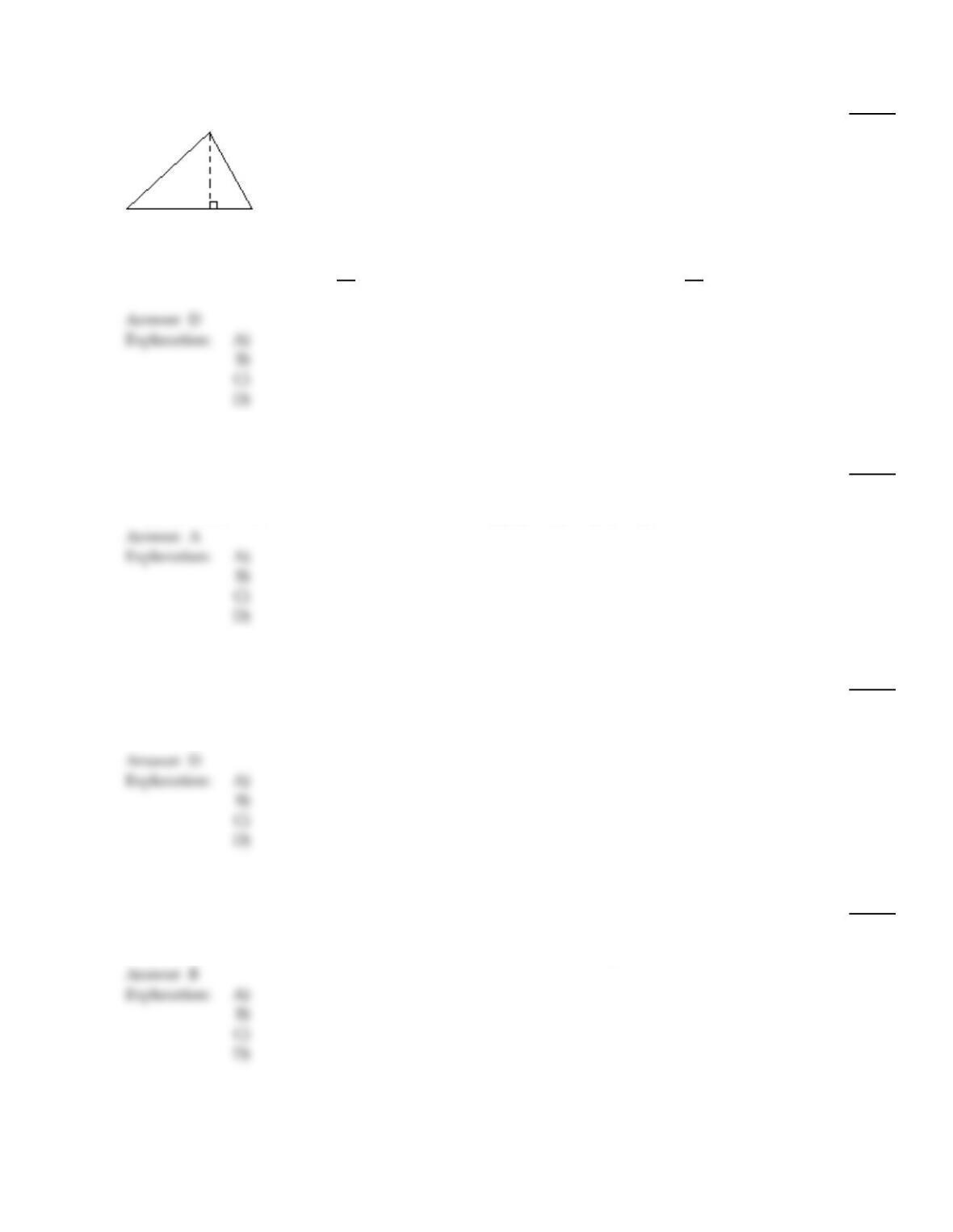
Find an expression that represents the area of the figure.
3s2
7s4
181)
A)
21s8
B)
21
2s8
C)
21s6
D)
21
2s6
Perform the indicated operation.
182)
(4x4–2x2+ x) – (9x3+8x2+4x) + (5x2– x)
182)
A)
4x4–9x3–5x2–4x
B)
4x4–9x3–3x2+4x
C)
–4x5+ 7x4–4x
D)
4x4+9x3–15x2–4x
Find the product.
183)
(6y – 5)(36y2+ 30y + 25)
183)
A)
36y3+ 125
B)
216y3+ 150y2– 125
C)
216y3+ 125
D)
216y3– 125
Add like terms, if possible, and write the result in descending powers of the variable.
184)
9x5+ 6x5– 5x5
184)
A)
–270x5
B)
10x5
C)
10x15
D)
Cannot be simplified
41
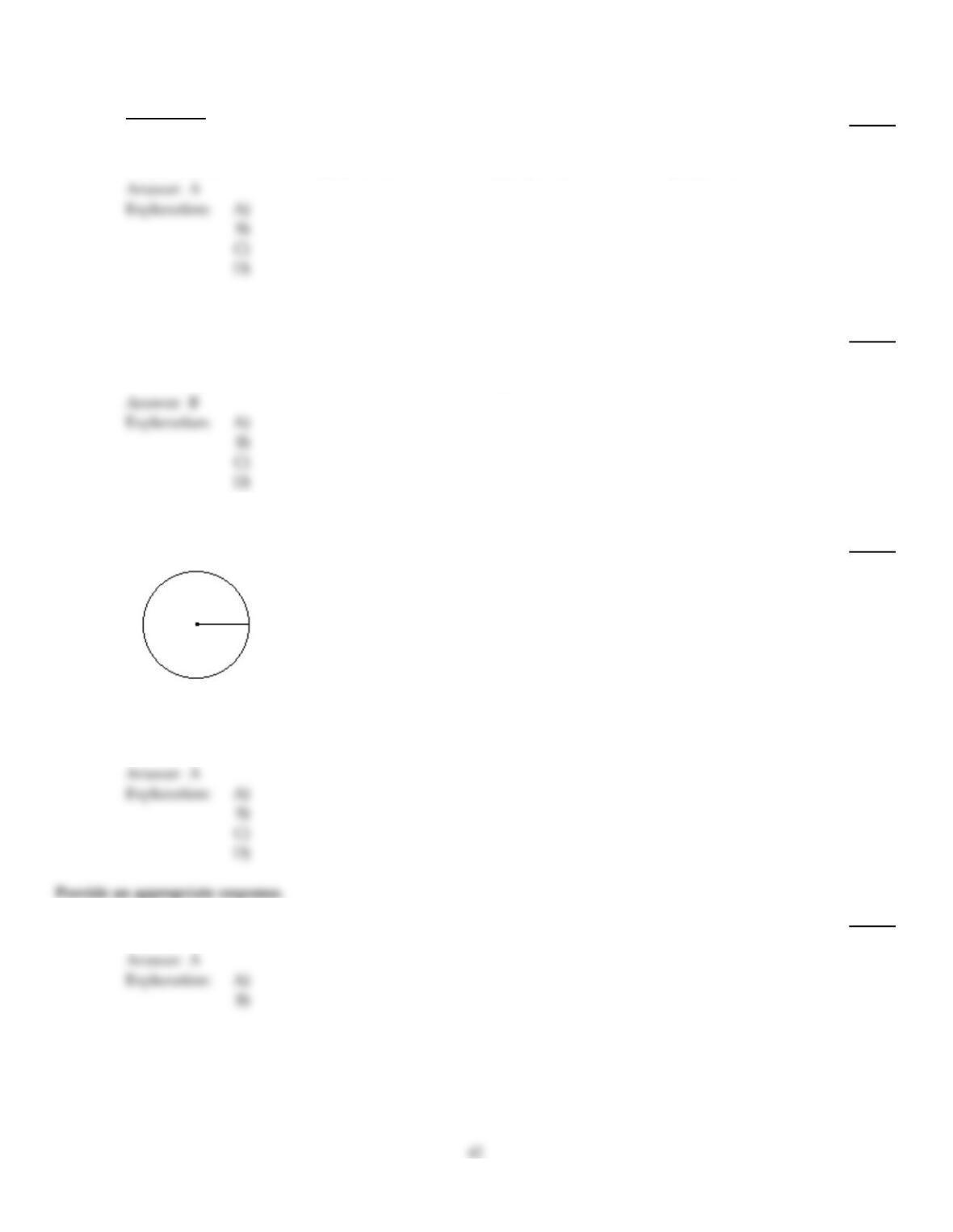
Perform the indicated operation. Write the answer in scientific notation.
185)
8.84 × 10⁻⁸
2× 10⁵
185)
A)
4.42 × 10⁻¹³
B)
8.84 × 10⁻³
C)
4.42 × 10⁻³
D)
8.84 × 10⁻¹³
Perform the division.
186)
(x4– 16) ÷ (x + 2)
186)
A)
x2+ 2x + 4
B)
x3– 2x2+ 4x – 8
C)
x3+ 2x2+ 4x + 8
D)
x3+ 2x2– 4x + 8
Solve the problem.
187)
Determine a polynomial that represents the area of the figure. Leave in the answer.
6x +5
187)
A)
36x2+60x +25
B)
36x2+60x +25
C)
36x2+25
D)
36x2+25
188)
Determine if the expression (–7 )–8 is positive or negative.
188)
A)
Positive
B)
Negative
189)
Determine if the expression 3–3 is positive or negative.
189)
A)
Positive
B)
Negative
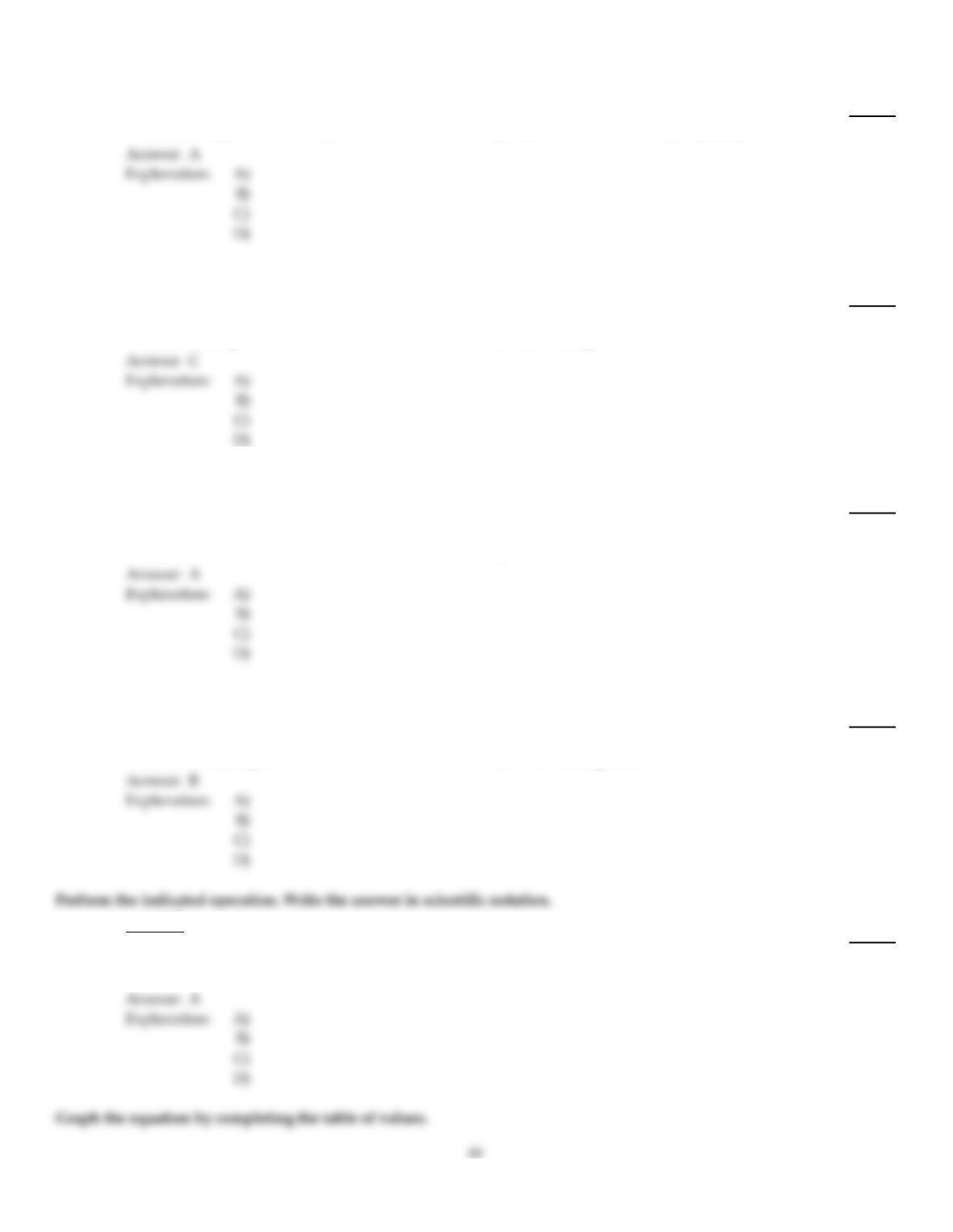
Graph the equation by completing the table of values.
190)
y = x2+ 4
x y
–2
–1
0
1
2
190)
A)
x y
–2 4
–1 9
016
125
236
B)
x y
–236
–125
016
1 9
2 4
C)
x y
–2 8
–1 5
0 4
1 5
2 8
D)
x y
–2 0
–1–3
0–4
1–3
2 0
43
Find the product.
191)
5x5(–7x + 6)
191)
A)
–35x6+ 30x5
B)
–5x5
C)
–35x6+ 6
D)
–35x + 30
Identify the base and the exponent for the exponential expression.
192)
9x10
192)
A)
Base: 10, exponent: x
B)
Base: 9x, exponent: 10
C)
Base: x, exponent: 10
D)
Base: 10, exponent: 9x
Find the product.
193)
(3 r – 2t)4
193)
A)
81r4– 216r3t + 216r2t2– 96rt3+ 16t4
B)
81r4+ 81r3t + 216 r2t2+ 216rt3+ 16t4
C)
81r4+ 3r3t – 216r2t2– 216rt3+ 16t4
D)
81r4– 216r3t + 216r2t2– 216rt3+ 16t4
Identify the polynomial as a monomial, binomial, trinomial, or none of these. Give its degree.
194)
15a6
194)
A)
Monomial, degree 15
B)
Monomial, degree 6
C)
Binomial, degree 6
D)
Binomial, degree 15
195)
6× 10⁻³
2× 10⁻⁷
195)
A)
3× 10⁴
B)
6× 10⁴
C)
3× 10⁻¹⁰
D)
6× 10⁻¹⁰
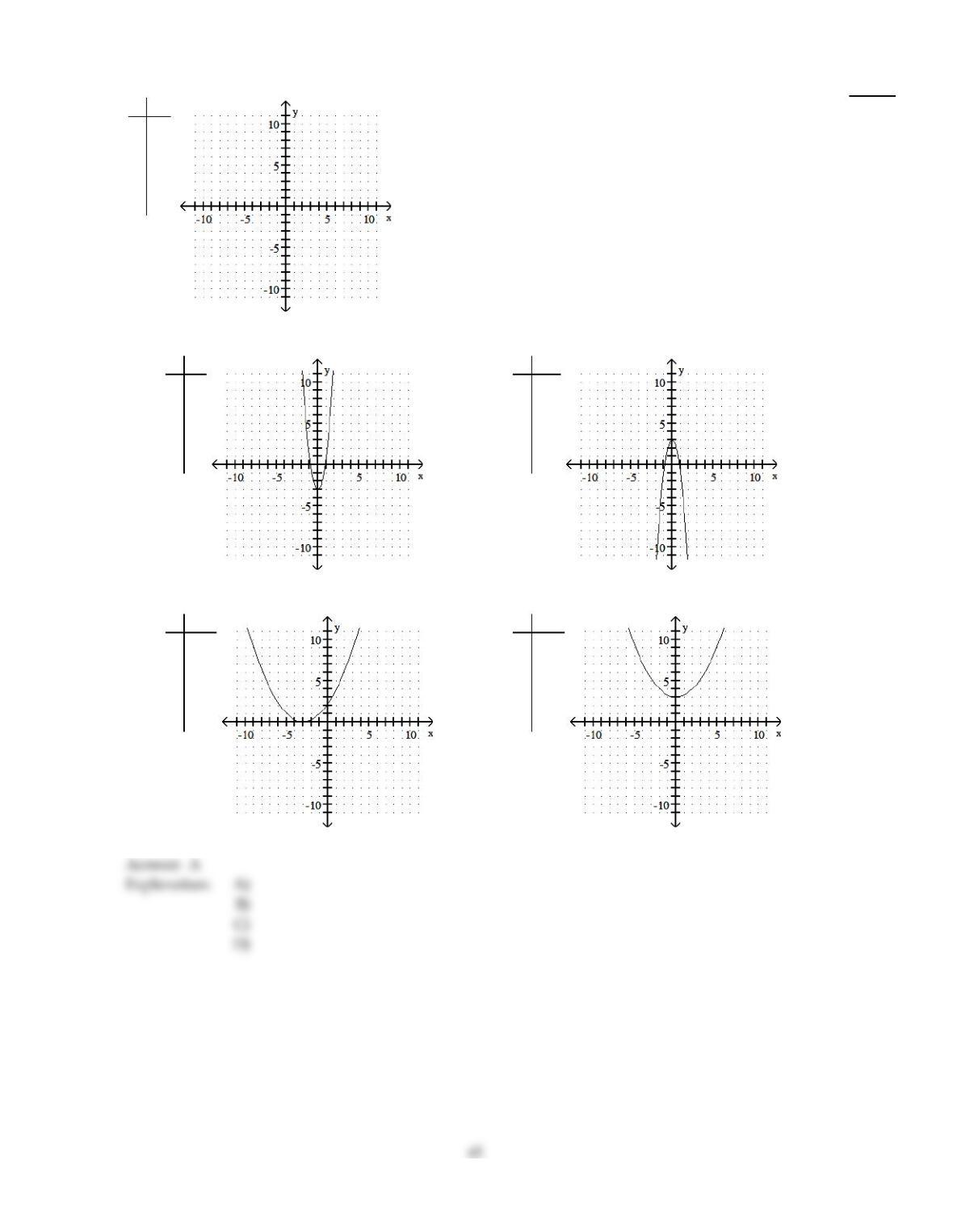
196)
y =4x2– 3
x y
–2
–1
0
1
2
196)
A)
x y
–213
–1 1
0–3
1 1
213
B)
x y
–2–13
–1–1
0 3
1–1
2–13
C)
x y
–20.25
–1 1
02.25
1 4
26.25
D)
x y
–2 4
–13.25
0 3
13.25
2 4
Find the value of the polynomial.
197)
–5x2+ 5x + 3 when x =2
197)
A)
–17
B)
3
C)
–11
D)
–7
198)
–6x +4 when x =2
198)
A)
–16
B)
–2
C)
–24
D)
–8
D
Write the number without exponents.
199)
8.686× 10⁻⁵
199)
A)
0.000008686
B)
0.0008686
C)
–868,600
D)
0.00008686
D
200)
–2x5(–7x6– 6x5)
200)
A)
26x5
B)
14x11 + 12x10
C)
14x11 – 6x5
D)
26x11 + 26x10
B
201)
7(–6x + 9)
201)
A)
–42x + 63
B)
–6x + 63
C)
21x
D)
–42x + 9
A
46
D
Determine the number of terms and name the coefficients of the terms.
202)
–4b
202)
A)
1; –4b
B)
2; 4b
C)
1; 4
D)
1; –4
Add.
203)
(–3+ 3x7+ 4x9– 4x8) + (7x8+ 9x7+ 9 + 7x9)
203)
A)
26x48 + 6
B)
4x9+ 4x8+ 13x7+ 3
C)
11x9+ 3x8+ 12x7+ 6
D)
11x18 + 3x16 + 12x14 + 6
Find the product.
204)
5x2(x2+ x –5)(x3–10)
204)
A)
5x7+5x6–25x5–50x4–50x3+250x2
B)
5x7+5x6+25x5–10x4–50x3+250x2
C)
5x6+5x5–25x4–50x3–50x2+250x
D)
5x7+5x6–25x5+50x4–25x3+50x2
Perform the indicated operation.
205)
(x –4)(x +8)
205)
A)
x2– 4x –4
B)
x2+ 4x –32
C)
x2–12x –32
D)
x2– 4x +32
47
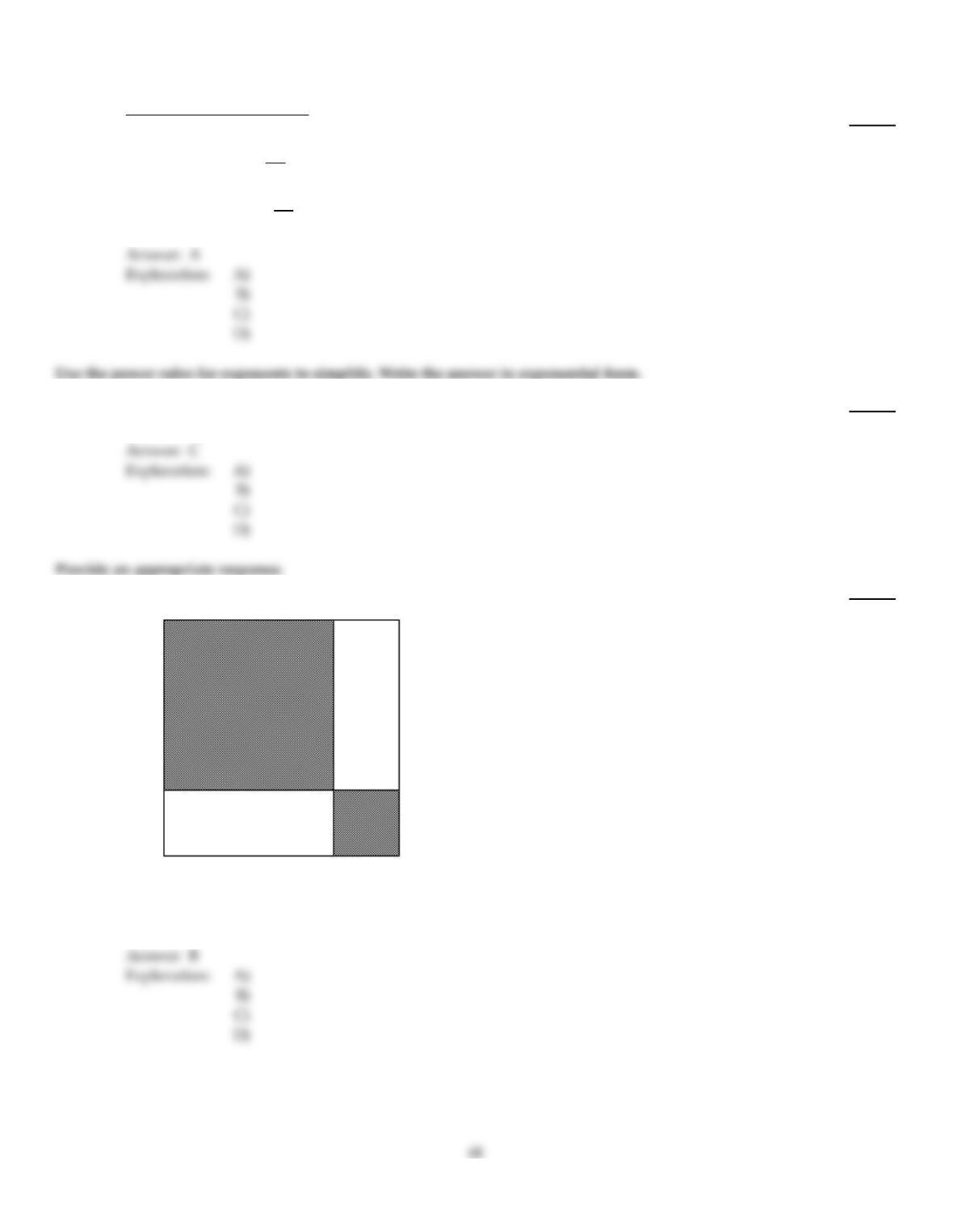
Perform the division.
206)
–40x7– 64x6– 40x4– 32x2
–8x4
206)
A)
5x3+ 8x2+ 5 +4
x2
B)
5x3+ 12x2+ 5
C)
–5x3– 8x2– 5 –4
x2
D)
5x3+ 8x2+ 5
207)
(–24)4
207)
A)
–216
B)
–28
C)
216
D)
28
208)
2x 3
2x
3
Find the total area.
208)
A)
4x2+6x +9
B)
4x2+12x +9
C)
2x2+6x +9
D)
2x2+12x +9
Perform the indicated operation.
209)
(3a3b5–6a4b2+9ab3–8ab + 14) – (10b5a3–a4b2+12ab3–4)
209)
A)
–7a3b5–5a4b2–3ab3–8ab +18
B)
–7a3b5–5a4b2+3ab3+8ab +16
C)
7a3b5–5a4b2–21ab3–7ab +10
D)
–4a3b5–8a4b2–21ab3–8ab +10
Evaluate the expression.
210)
3
4–4
210)
A)
–256
81
B)
81
256
C)
256
81
D)
–81
256
Simplify, and write the answer using only positive exponents. Assume all variables represent nonzero numbers.
211)
9–2·96
9–3
211)
A)
97
B)
7298
C)
817
D)
95
212)
(4 a – 3)2
212)
A)
4a2– 24a + 9
B)
16a2– 24a + 9
C)
16a2+ 9
D)
4a2+ 9
49
Perform the indicated operation.
213)
(9 x – 8y)2
213)
A)
9x2+ 64y2
B)
9x2– 144xy + 64y2
C)
81x2– 144xy + 64y2
D)
81x2+ 64y2
Simplify by writing the expression with positive exponents. Assume that all variables represent nonzero real numbers.
214)
(3x2y6)–3(9xy–1)2
(x6y)–5
214)
A)
y15
3x36
B)
3x36y16
C)
3x26
y15
D)
6x26
y15
Add like terms, if possible, and write the result in descending powers of the variable.
215)
12a9– 13a9+ 2a3+ 12a9– 10a3
215)
A)
3a9
B)
11a9– 8a3
C)
3a12
D)
Cannot be simplified
Perform the division.
216)
(x2+ 2x – 8) ÷ (x + 4)
216)
A)
x2– 2
B)
x2+ 2
C)
x + 2
D)
x – 2
50
Find the product.
217)
(n + 16)2
217)
A)
n2+ 256
B)
256n2+ 32n + 256
C)
n +256
D)
n2+ 32n + 256
Use scientific notation to calculate the answer to the problem. Write the answer in scientific notation.
218)
0.00000003(0.00019)
0.00000003
218)
A)
19 ×10–3
B)
1.9 ×10⁻⁵
C)
19 ×10–4
D)
1.9 ×10⁻⁴
219)
Decide whether the expression is positive, negative, or zero. 270–580
219)
A)
Positive
B)
Negative
C)
Zero
220)
7.96 × 10⁶
220)
A)
7,960,000
B)
79,600,000
C)
796,000
D)
477.6
221)
(6x4–3x2+ x) – (4x3+6x2+2x) + (3x2– x)
221)
A)
6x4–4x3–6x2–2x
B)
2x5+ 7x4–2x
C)
6x4+4x3–12x2–2x
D)
6x4–4x3–4x2+2x
51
Find the product.
222)
(2x2– 4x – 4)(x2– 5x + 3)
222)
A)
2x4– 10x3+ 26x2+ 8x – 12
B)
2x4– 14x3+ 22x2+ 8x – 12
C)
2x4– 14x3+ 26x2+ 8x – 12
D)
2x4– 10x3+ 22x2+ 8x – 12
223)
11x3(3x5– 12)
223)
A)
33x8– 132x3
B)
33x5– 132
C)
–99x3
D)
33x8– 12
224)
p2+ 4p – 26
p + 8
224)
A)
p + 4 +6
p + 8
B)
p – 4
C)
p – 6 +4
p + 8
D)
p – 4 +6
p + 8
225)
4x2(–7x3–3x2+2x –3)
225)
A)
–28x6–12x4+8x2–12x2
B)
–28x5–12x4+8x3–12x2
C)
–28x5–3x2+2x –3
D)
–44x2
52
Simplify the expression.
226)
1
x33 (x
0)
226)
A)
1
x6
B)
x9
C)
1
x9
D)
x6
227)
(–6)8
227)
A)
Base: 8, exponent: 6
B)
Base: 6, exponent: 8
C)
Base: 8, exponent: –6
D)
Base: –6, exponent: 8
Solve the problem.
228)
If a submarine goes 4 k3+ 25k2+ 4k – 72 miles in 4k + 9 hours, what is its rate of speed?
228)
A)
k2+ 17k – 8 miles/hr
B)
k2– 4k + 8 miles/hr
C)
k3+ 4k2– 8k miles/hr
D)
k2+ 4k – 8 miles/hr
Write the number without exponents.
229)
1.33 ×100
229)
A)
1.33
B)
13.3
C)
0
D)
0.133
230)
9.0716× 10⁻⁷
230)
A)
–907,710,000
B)
0.0000090716
C)
0.000000090716
D)
0.00000090716
If the number in the statement is written in scientific notation, write it without exponents. If it is written without
exponents, write it in scientific notation.
231)
It has been estimated that the average American watches 58,240 hours of television in a lifetime.
231)
A)
5.824 ×10³ hr
B)
58.24 ×10³ hr
C)
5.824 ×10⁴ hr
D)
5.824 ×10⁵ hr
Solve the problem.
232)
Find an expression that represents the area of the figure.(Leave in the answer.)
6t5
232)
A)
36t10
B)
36t25
C)
12t10
D)
36t5
233)
–11x9(2x9– 10x4– 2)
233)
A)
–22x18 – 10x4– 2
B)
–22x18 + 110x13 + 22x9
C)
–22x18 + 110x13 – 2
D)
–22x9+ 110x4+ 22
Subtract.
234)
(–7x5+ 4x7+ 8 + 6x6) – (–7– 2x6+ 7x7– 9x5)
234)
A)
–3x7+ 8x6+ 2x5+ 15
B)
11x7+ 4x6– 16x5+ 1
C)
–3x7+ 4x6– 16x5+ 1
D)
11x7+ 4x6– 16x5+ 15
54
235)
–30
235)
A)
1
B)
–1
C)
0
D)
–3
236)
8.288× 10⁻⁶
236)
A)
0.00008288
B)
–8,288,000
C)
0.000008288
D)
0.0000008288
237)
3x5– 6x4+ 2x3–x2 when x =2
237)
A)
8
B)
7
C)
12
D)
41
238)
–4x(11x + 4)
238)
A)
–44x2+ 4x
B)
11x2– 16x
C)
–60x2
D)
–44x2– 16x
239)
Is it true that –(–214)0= –1?
239)
A)
Yes
B)
No
If the number in the statement is written in scientific notation, write it without exponents. If it is written without
exponents, write it in scientific notation.
240)
The life span of the average male human being is approximately 37,843,200 minutes.
240)
A)
3.78432 ×10⁵ min
B)
3.78432 ×10⁷ min
C)
37.8432 ×10⁶ min
D)
3.78432 ×10⁶ min
241)
6.63 × 10⁻⁴
241)
A)
–663,000
B)
0.0000663
C)
0.00663
D)
0.000663
242)
Find an expression that represents the volume of the figure.
6xy
7x3y
3xy8
242)
A)
126x4y9
B)
21x5y10
C)
126x3y8
D)
126x5y10
243)
44
243)
A)
44
B)
256
C)
16
D)
3
244)
Is it true that in order to multiply a number by a positive power of ten, you must move the decimal
point to the left as many places as indicated by the exponent on the ten?
244)
A)
Yes
B)
No
245)
(4 r – 3t)4
245)
A)
256r4+ 4r3t – 768 r2t2– 768rt3+ 81t4
B)
256r4– 768r3t + 864r2t2– 768rt3+ 81t4
C)
256r4+ 256r3t + 864r2t2+ 864rt3+ 81t4
D)
256r4– 768r3t + 864r2t2– 432rt3+ 81t4
246)
(5z2+ 4z– 1)(z2+ 2z+ 1)
246)
A)
5z4+ 14z3+ 13z2+ 2z– 1
B)
5z4+ 10z3+ 13z2+ 2z– 1
C)
5z4+ 10z3+ 12z2+ 2z– 1
D)
5z4+ 14z3+ 12z2+ 2z– 1
Perform the division.
247)
x3+ 8
x + 2
247)
A)
x2– 2x – 4
B)
x2– 2x + 4
C)
x2– 4x + 4
D)
x2+ 2x + 4
Add or subtract as indicated.
248)
(4x2y + 5xy) – (6x2y – 4xy2) – (3xy + 2xy2)
248)
A)
–2x2y – 2xy2+ 8xy
B)
–2x2y + 2xy2+ 2xy
C)
–4x2y + 4xy2+ 2xy
D)
–2x2y – 2xy2+ 2xy
57
Perform the indicated operation.
249)
(–5x5+ 8x7– 2) + (9x6– 4) – (4x6+ 2x7+ 9x5)
249)
A)
10x7+ 13x6+ 4x5– 6
B)
6x7+ 13x6+ 4x5+ 2
C)
10x7+ 13x6+ 4x5+ 2
D)
6x7+ 5x6– 14x5– 6
Find the product.
250)
(2k – 3)(2k3– 2k2+ 2k– 4)
250)
A)
4k4– 10k3– 2k2– 14k+ 12
B)
4k4+ 2k3+ 10k2– 14k+ 12
C)
4k4– 10k3+ 10k2– 14k+ 12
D)
4k4– 10k3+ 10k2– 8k+ 12
251)
t(4t +6)(4t –6)
251)
A)
16t2–36
B)
16t3+36t
C)
16t3–36t
D)
16t4–36t2
Add or subtract as indicated.
252)
(x3y2+ 4x2y3+ 4xy – 4) + (x2y3– 8x3y2+ 5xy – 4)
252)
A)
–9x3y2+ 5x2y3+ 9xy – 8
B)
–7x3y2+ 5x2y3+ 4xy – 8
C)
–7x3y2+ 5x2y3+ 9xy – 8
D)
2x3y2– 4x2y3+ 9xy – 8
Solve the problem. Express the answer in scientific notation to two decimals.
253)
If the distance from the earth to the sun were 88,000,000 miles. How long would it take a rocket,
traveling at 3.8 × 10³ miles per hour, to reach the sun? (Round to three places)
253)
A)
2.316 hr
B)
2.316 × 10⁴ hr
C)
2.316 × 10² hr
D)
2.316 × 10³ hr
254)
Is it true that 5×10¹⁹ is written in scientific notation?
254)
A)
Yes
B)
No
A
255)
0.00003603
255)
A)
3.603× 10⁴
B)
3.603× 10⁻⁵
C)
3.603× 10⁻⁴
D)
3.603× 10⁵
B
256)
96
256)
A)
Base: 6, exponent: 9
B)
Base: 6, exponent: 54
C)
Base: 9, exponent: 6
D)
Base: 54, exponent: 6
C
257)
Add (n8– 12) to the difference between (3n7– 14n6– 20) and (19n6+ 8n7– 18).
257)
A)
n8– 5n7– 33n6– 50
B)
n8– 5n7– 33n6– 14
C)
n8– 5n7– 6n6– 50
D)
–52n13
B
Identify the polynomial as a monomial, binomial, trinomial, or none of these. Give its degree.
258)
13x4+ 3w3+ 5w – 4y5– 5
258)
A)
Trinomial, degree 13
B)
Trinomial, degree 5
C)
None, degree 5
D)
Binomial, degree 14
C
59

Simplify by writing the expression with positive exponents. Assume that all variables represent nonzero real numbers.
259)
(x4y–3)3
x–2y5
259)
A)
x12
y9
B)
x14
y14
C)
y14
x14
D)
y12
x9
260)
Add.
8n5+ 5n4+ 3
9n5– 2n4+ 3
260)
A)
17n5+ 3n4+ 6
B)
17 + 3n5+ 6n4
C)
26n9
D)
12n5+ 6n4+ 8
261)
The national debt of a small country is $6,270,000,000 and the population is 2,793,000. What is the
amount of debt per person?
261)
A)
$22.40
B)
$2.24 × 10³
C)
$2.24
D)
$2.24 × 10⁶
262)
1
3x2–1
8x +2
5
3
4x2–1
4x +1
10
262)
A)
–5
12x2+3
8x +1
2
B)
13
12x2+3
8x +1
2
C)
–5
12x2–3
8x +1
2
D)
13
12x2–3
8x +1
2
Solve the problem.
263)
The area of a rectangle is 12m2– 2m – 10 . Find the length if the width is 2m – 2.
263)
A)
12m + 5
B)
6m – 5
C)
6m + 5
D)
12m – 5
264)
(x – 3y)(3x – 11y)
264)
A)
x2– 20xy + 33y2
B)
x2– 20xy – 20y2
C)
3x2– 20xy + 33y2
D)
3x2– 20xy – 20y2
Subtract.
265)
(4x7+ 7x9+ 1 + 9x8) – (–4– 4x8+ 2x9+ 2x7)
265)
A)
5x9+ 5x8+ 6x7– 3
B)
9x9+ 5x8+ 6x7– 3
C)
9x9+ 5x8+ 6x7+ 5
D)
5x9+ 13x8+ 2x7+ 5
Identify the polynomial as a monomial, binomial, trinomial, or none of these. Give its degree.
266)
18x
266)
A)
Binomial, degree 0
B)
Monomial, degree 0
C)
Monomial, degree 18
D)
Monomial, degree 1
267)
(2m4z4)(2m4z2)
267)
A)
4mz8
B)
4m8z
C)
4mz6
D)
4m8z6
Perform the indicated operation. Write the answer without exponents.
268)
(3 ×105) × (6×102)
268)
A)
1,800,000,000
B)
180,000,000
C)
18,000,000
D)
18,000,000,000
269)
0.0002
269)
A)
in scientific notation
B)
not in scientific notation
270)
–8x8+ 16x6
–2x4
270)
A)
4x4– 8x2
B)
–4x10
C)
4x4+ 16x6
D)
–8x8– 8x2
271)
(x2– 81) ÷ (x – 9)
271)
A)
x + 81
B)
x + 9
C)
x – 81
D)
x2– 9
272)
(–3x6y)2
272)
A)
(–3)2x8y2
B)
–6x6y
C)
–6x6y2
D)
(–3)2x12y2
Write the quotient without using exponents.
273)
4× 101
2× 10⁻³
273)
A)
20,000
B)
0.04
C)
0.02
D)
40,000
274)
0.0000071715
274)
A)
7.1715 × 10⁻⁷
B)
7.1715 × 10⁻⁵
C)
7.1715 × 10⁶
D)
7.1715 × 10⁻⁶
275)
12x11 + 8x10 + 8x8+ 28x6+ 5x5
4x8
275)
A)
3x3+ 2x2+ 2 +7
x2+5
4x3
B)
3x3+ 8x10 + 8x8+ 28x6+ 5x5
C)
12x11 + 2x2+ 2 +7
x2+5
4x3
D)
3x3+ 2x2+ 2
276)
(–4x4)(3x2)
276)
A)
–12x6
B)
7x8
C)
7x6
D)
–12x8
Simplify by writing the expression with positive exponents. Assume that all variables represent nonzero real numbers.
277)
54
5–8
277)
A)
1
512
B)
5–8
C)
512
D)
5–4
278)
x
y5 (y
0)
278)
A)
x
y5
B)
x5
y5
C)
x5
y
D)
5x
5y
279)
Find a polynomial that represents the perimeter.
5x2+ 5x + 20
2x2– 3x + 18
279)
A)
12x2+ 7x + 38
B)
14x2+ 4x + 76
C)
7x2+ 2x + 38
D)
14x2+ 4x + 38
Perform the division.
280)
x4+ 4x2+ 5
x2+ 1
280)
A)
x2+ 3 +1
2
B)
x2+ 3
C)
x2+ 3 +2
x2+ 1
D)
x2+ 3x +1
281)
(5 x – 8y)2
281)
A)
5x2– 80xy + 64y2
B)
25x2+ 64y2
C)
5x2+ 64y2
D)
25x2– 80xy + 64y2
282)
(6E6)/(2E–2)
282)
A)
2E8
B)
2E 4
C)
3E4
D)
3E8
283)
A company produced 2,180,000 small appliances in one year and made a profit of $6,580,000. What
was the profit on each appliance?
283)
A)
$30.20
B)
$3.02 × 10⁶
C)
$3.02
D)
$3.02 × 10³
284)
0.000433
284)
A)
4.33 × 10⁻⁵
B)
4.33 × 10⁻³
C)
4.33 × 10⁻⁴
D)
4.33 × 10⁴
285)
(15x4–12x2+6x) 1
3x +2
285)
A)
5x5+30x4–4x3– 22x2+12x
B)
15x4–12x2+2x +2
C)
5x4+30x3–4x2+14x
D)
5x5–30x4+4x3+ 22x2–12x
286)
x6– 1
x3– 1
286)
A)
x3– 1
B)
x3+ 1
C)
x3
D)
x3+9x – 1
287)
(54x7– 54x5+ –81x2) ÷ (–9x2)
287)
A)
–6x5– 54x5– 81x2
B)
–6x5+ 6x3+ 9
C)
–6x7+ 6x5+ 9x2
D)
54x5– 54x3– 81
Use scientific notation to calculate the answer to the problem. Write the answer in scientific notation.
288)
380,000,000(0.000099)
0.00009
288)
A)
4.18 ×10⁸
B)
41.8 ×10⁸
C)
41.8 ×10⁷
D)
4.18 ×10⁶
Evaluate the expression.
289)
100+ (–4)0
289)
A)
2
B)
6
C)
1
D)
0
290)
(–2)3
290)
A)
–8
B)
–2
C)
8
D)
2
291)
Find the difference between (7n7+ 9n4+ 10) and (–10n4+ 4n7– 3).
291)
A)
3n7+ 19n4+ 7
B)
35n11
C)
3n7+ 19n4+ 13
D)
3n7+ 13n4+ 7
Evaluate the expression.
292)
–5–4
292)
A)
–1
625
B)
625
C)
–625
D)
1
20
293)
y2
293)
A)
Base: y, exponent: 2
B)
Base: 2y, exponent: 2
C)
Base: 2, exponent: 2y
D)
Base: 2, exponent: y
Solve the problem. Express the answer in scientific notation to two decimals.
294)
The earth is approximately 92,900,000 miles from the sun. If 1 mile = 1.61 × 10³ m, what is the
distance to the sun in meters?
294)
A)
5.7 × 10¹⁰ m
B)
1.50 × 10¹⁰ m
C)
5.7 × 10⁻¹⁰ m
D)
1.50 × 10¹¹ m
295)
A computer can do one calculation in 1.4 × 10⁻⁷ seconds.
295)
A)
0.00000014
B)
0.000000014
C)
14,000,000
D)
0.000014
Solve the problem. Express the answer in scientific notation to two decimals.
296)
The national debt of a country is $31,850,000,000 and the population is 4,550,000. What is the debt
per person? Write answer without exponents.
296)
A)
$70,000
B)
$700
C)
$144,917,500
D)
$7000
297)
28.32 × 10⁶
297)
A)
in scientific notation
B)
not in scientific notation
298)
30x8– 18x7– 24x6+ 18x4+ 7x2
6x6
298)
A)
5x2– 3x – 4 +3
x2+7
6x4
B)
5x3– 3x2– 4
C)
5x3– 18x7– 24x6+ 18x4+ 7x2
D)
30x8– 3x2– 4 +3
x2+7
6x3
Find the product.
299)
(3 a + 11c)(3a – 11c)
299)
A)
9a2+ 66ac – 121 c2
B)
3a2– 11c2
C)
9a2– 121c2
D)
9a2– 66ac – 121 c2
300)
(3x2)(2x4)
300)
A)
6x8
B)
5x8
C)
6x6
D)
5x6
C
301)
Evaluate the exponential expression –22p0, if p 0.
301)
A)
–22
B)
0
C)
–1
D)
–22p
A
302)
4–7
302)
A)
Negative
B)
Positive
C)
Zero
B
C
303)
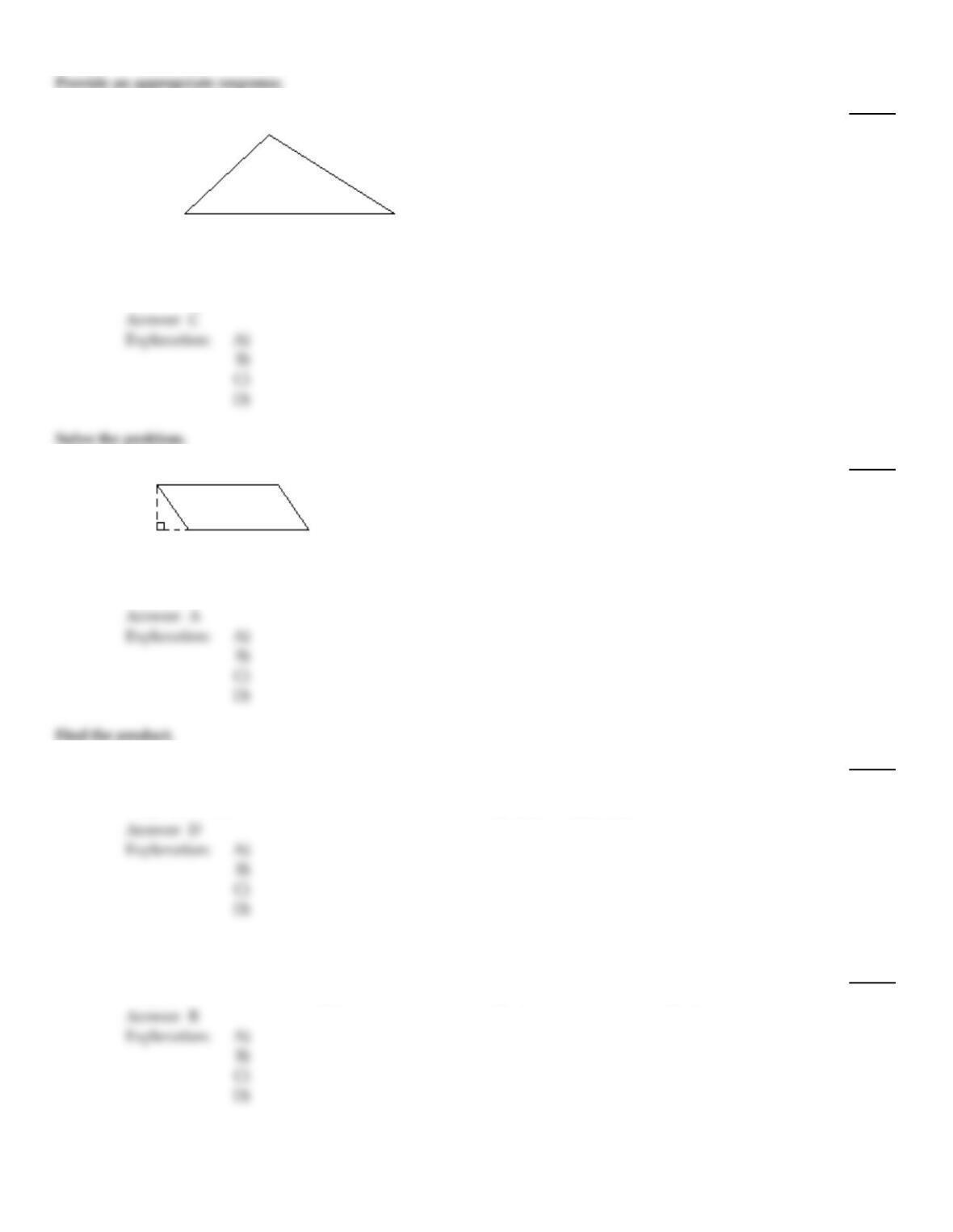
Find a polynomial that represents the perimeter.
2r2+ 3r r3+r2+ 2
8r + 8
303)
A)
3r3+ 12r + 10
B)
3r3+r2+ 11r + 10
C)
r3+ 3r2+ 11r + 10
D)
r3+ 2r2+ 12r + 10
304)
Find an expression that represents the area of the figure.
3s5
6s3
304)
A)
18s8
B)
9s8
C)
9s15
D)
18s15
305)
(7 a – 9)2
305)
A)
7a2+ 81
B)
7a2– 126a + 81
C)
49a2+ 81
D)
49a2– 126a + 81
Evaluate the expression.
306)
–(50) + (–8)0
306)
A)
1
B)
0
C)
–3
D)
–2
70
Determine the number of terms and name the coefficients of the terms.
307)
5m – 8b– c
307)
A)
3; 5, –8, 1
B)
3; 5, 8, –1
C)
3; 5, 8, 1
D)
3; 5, –8, –1
D)
Perform the division.
308)
(28x2+ 31x – 5) ÷ (7x – 1)
308)
A)
28x + 5
B)
x + 5
C)
5x + 1
D)
4x + 5
D
D)
Find the product.
309)
(9 x + 11y)2
309)
A)
9x2+ 121y2
B)
9x2+ 198xy + 121y2
C)
81x2+ 121y2
D)
81x2+ 198xy + 121y2
D
D)
310)
(8a)(7a2)
310)
A)
56a4
B)
8a + 7a2
C)
15a3
D)
56a3
D
D)
311)
–14x2
311)
A)
Binomial, degree –14
B)
Binomial, degree 0
C)
Monomial, degree –14
D)
Monomial, degree 2
D
D)
D

Perform the division.
312)
4x5– 4x4– 19x3+ 40x2– 6x – 15
2x2+ 3x – 5
312)
A)
2x3– 5x2+ 3x + 3
B)
2x3– 5x2– 3x + 3
C)
2x3+ 5x2+ 3x + 3
D)
2x3– 5x2+ 3x – 3
Evaluate the expression.
313)
(–10)0+ (–13)0
313)
A)
0
B)
–2
C)
2
D)
–23
Perform the indicated operation.
314)
–(2x3+ x –8) + (7x3+2x2) – (7x2–9x –1)
314)
A)
5x3+5x2+10x –9
B)
9x3–9x2+8x –9
C)
5x3–5x2+8x +9
D)
4x3–3x2–8x +9
315)
Subtract (6xy + 6xy2) from the difference between (6x2y + 3xy) and (3x2y + 5xy2).
315)
A)
3x2y – 11xy2– 3xy
B)
–3x2y – 5xy2– 3xy
C)
3x2y + 11xy2– 3xy
D)
3x2y + 11xy2+ 9xy
Perform the division.
316)
(p2+ 5p – 18) ÷ (p + 8)
316)
A)
p – 3 +6
p + 8
B)
p + 3 +6
p + 8
C)
p – 3
D)
p – 6 +3
p + 8
72
Use the product rule, if possible, to simplify the expression. Write the answer in exponential form.
317)
38·77
317)
A)
1015
B)
2156
C)
2115
D)
The product rule does not apply.
Evaluate the expression.
318)
130+ (–8)0
318)
A)
5
B)
0
C)
2
D)
1
C
Provide an appropriate response.
319)
Decide whether the expression is positive, negative, or zero. 1 –830
319)
A)
Positive
B)
Negative
C)
Zero
C
Simplify by writing the expression with positive exponents. Assume that all variables represent nonzero real numbers.
320)
t–4
t–7
320)
A)
t–3
B)
t11
C)
t–11
D)
t3
D
Write the expression using exponents.
321)
(–3x)(–3x)(–3x)(–3x)
321)
A)
–3x4
B)
–12x
C)
(–3x)4
D)
–(3x)4
C
D
Predict the display a calculator would give for the expression shown in the screen.
322)
1760000000000
322)
A)
1.76E–12
B)
17.6E13
C)
17.6E–13
D)
1.76E12
323)
(–r3s)2( –r4s4)5
323)
A)
r26s22
B)
–r–14s22
C)
–r26s22
D)
–r1033s1026
324)
pm5
q3
4 (q
0)
324)
A)
pm20
q12
B)
pm9
q7
C)
p4m9
q7
D)
p4m20
q12
Write the expression using exponents.
325)
1
2·2·2·2
325)
A)
1
2
B)
1
C)
1
24
D)
1
8
Perform the division. Write the answer with positive exponents.
326)
9x11 – 24x10 + 12x8+ 12x6+ 7x5
3x8
326)
A)
9x11 – 8x2+ 4 +4
x2+7
3x3
B)
3x3– 24x10 + 12x8+ 12x6+ 7x5
C)
3x3– 8x2+ 4 +4
x2+7
3x3
D)
3x3– 8x2+ 4
Use the product rule, if possible, to simplify the expression. Write the answer in exponential form.
327)
66+610
327)
A)
640
B)
1212
C)
614
D)
The product rule does not apply.
D
Determine the number of terms and name the coefficients of the terms.
328)
6c – 5w– n
328)
A)
3; 6, 5, 1
B)
2; 6 and –5
C)
3; 6, –5, 1
D)
3; 6, –5, –1
D
329)
The earth is approximately 92,900,000 miles from the sun.
329)
A)
9.29 × 10⁻⁷
B)
9.29 × 10⁸
C)
9.29 × 10⁷
D)
9.29 × 10⁶
C
330)
Is it true that in order to multiply a number by a negative power of ten, you must move the decimal
point to the left as many places as indicated by the absolute value of the exponent on the ten?
330)
A)
Yes
B)
No
A
C
Solve the problem.
331)
Determine a polynomial that represents the area of the figure.
6t +2
6t +2
331)
A)
36t2+24t +4
B)
12t2+24t +4
C)
36t2+12t +4
D)
36t2+4
332)
8·8·8·8·8·8
332)
A)
48
B)
68
C)
85
D)
86
333)
(–2m2z4)(5m3z2)
333)
A)
–10m6z5
B)
–10mz6
C)
–10mz5
D)
–10m5z6
334)
2–3
334)
A)
1
8
B)
–8
C)
8
D)
1
6
Perform the indicated operation.
335)
Subtract (3a5– 2a4) from the sum of (8a5+ 4a4) and (7a5– 8a4).
335)
A)
10a9
B)
12a10 – 2a8
C)
12a5– 2a4
D)
10a18
336)
x
x14
336)
A)
1
x14
B)
x14
C)
1
x13
D)
x13
337)
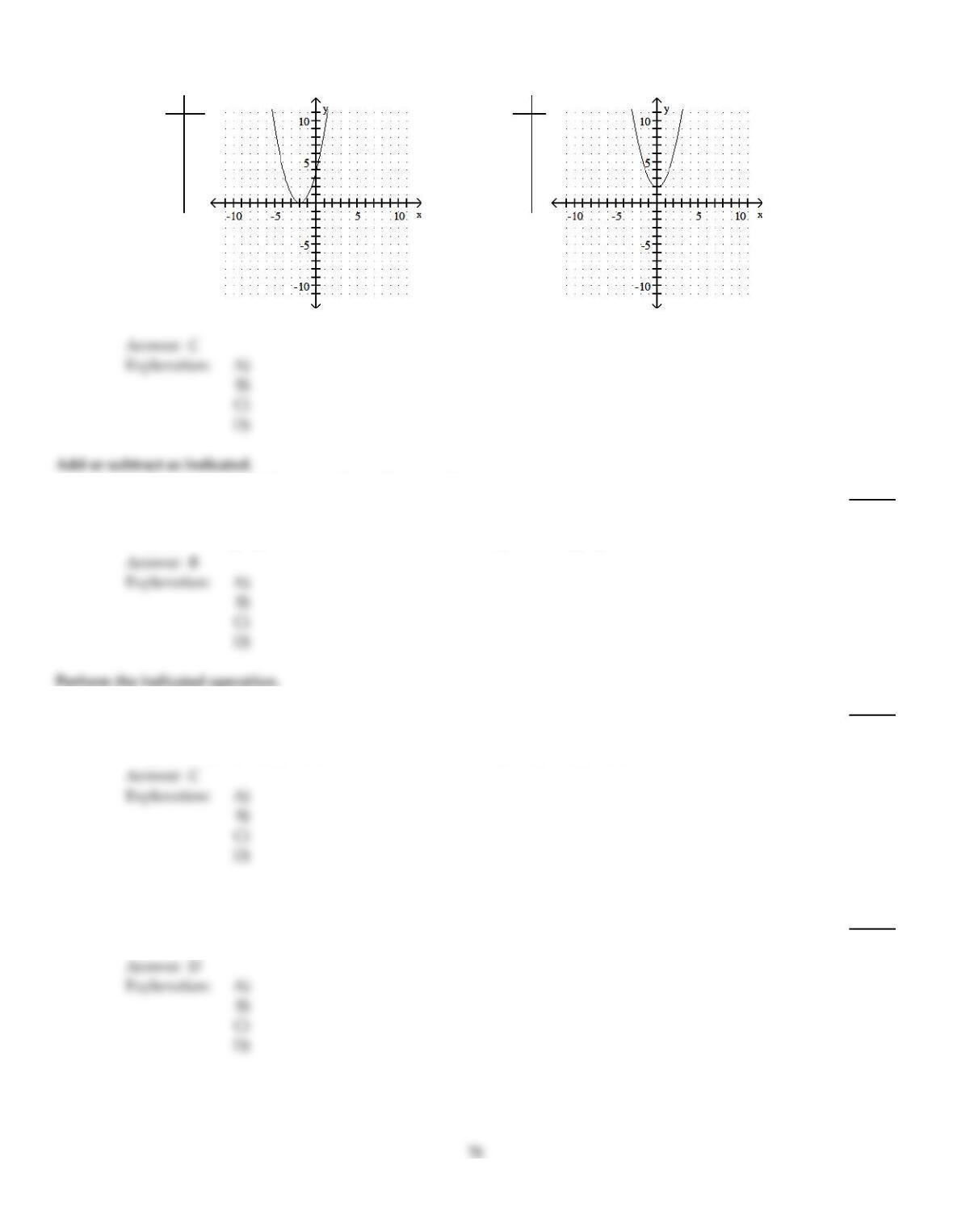
y = (x + 2)2
x y
–2
–1
0
1
2
337)
A)
x y
–2 2
–1–1
0–2
1–1
2 2
B)
x y
–216
–1 9
0 4
1 1
2 0
77
C)
x y
–2 0
–1 1
0 4
1 9
216
D)
x y
–2 6
–1 3
0 2
1 3
2 6
338)
(5x2+ 4xy +y2) + (5x2+ 8xy –y2) + (x2+ xy –y2)
338)
A)
11x2+ 13xy +y2
B)
11x2+ 13xy –y2
C)
10x2+ 12xy –y2
D)
9x2+ 11xy –y2
339)
(–7m – 8)(–8m2+ m – 2)
339)
A)
56m3+ 6m + 16
B)
56m3+ 71m2+ 6m + 16
C)
56m3+ 57m2+ 6m + 16
D)
–15m2+ 6m + 16
Subtract.
340)
(–7a5– 15a2) – (–20a5– 20a2)
340)
A)
18a7
B)
–27a5– 35a2
C)
13a5– 35a2
D)
13a5+ 5a2

Evaluate the expression.
341)
80+ 90
341)
A)
2
B)
17
C)
0
D)
1
Subtract.
342)
17a5+ 16a4
5a5+ 13a4
342)
A)
12a5+ 29a4
B)
22a5+ 29a4
C)
15a9
D)
12a5+ 3a4
Find the product.
343)
(5x –1)(4x5–2x3+5x2– x +1)
343)
A)
20x5–4x4–10x3+27x2+6x –1
B)
20x6–4x5–10x4+23x3–10x2+4x +1
C)
20x6–4x5–10x4+27x3–10x2+6x –1
D)
20x6–10x4+25x3–5x2+5x –1
Solve the problem. Express the answer in scientific notation to two decimals.
344)
Assume that the volume of the earth is 5 × 10¹⁴ cubic meters and the volume of a bacterium is
2.5 ×10⁻¹⁶ cubic meters. If the earth could be filled with bacteria, how many would it contain?
344)
A)
5.0 × 10⁻³¹ bacteria
B)
2.0 × 10⁻³⁰ bacteria
C)
2.0 × 1030 bacteria
D)
5.0 × 1031 bacteria
Identify the polynomial as a monomial, binomial, trinomial, or none of these. Give its degree.
345)
–7y5+ 1
345)
A)
Binomial, degree 6
B)
Binomial, degree 0
C)
Monomial, degree –7
D)
Binomial, degree 5
Find the product.
346)
–(4y –9)2
346)
A)
–16y2+72y +81
B)
–16y2+72y –81
C)
–16y2–81
D)
16y2–72y +81
347)
64x7– 24x6+ 24x5
8x6
347)
A)
8x – 3 +3
x
B)
8x – 24x6+3
x
C)
11x – 3
D)
8x – 3
Combine like terms when possible and write the polynomial in descending powers of the variable. Give the degree of
the simplified polynomial. Decide whether the simplified polynomial is a monomial, a trinomial, or none of these.
348)
10n5– 15n5+ 10n4+ 13n5– 2n4
348)
A)
Cannot be simplified
B)
16n9; 9; monomial
C)
16n5; 5; monomial
D)
8n5+ 8n4; 5; binomial
80
Identify the base and the exponent for the exponential expression.
349)
–y6
349)
A)
Base: 6, exponent: –y
B)
Base: –y, exponent: 6
C)
Base: 6, exponent: y
D)
Base: y, exponent: 6
350)
(5x2y)4(xy4)3
(xy)3
350)
A)
5x8y13
B)
625x8y13
C)
625x4y13
D)
5x11y16
B
351)
(6k + 1)3
351)
A)
216k3+216k2+18k + 1
B)
216k3+72k2+12k + 1
C)
216k3+108k2+18k + 1
D)
216k3+ 1
C
352)
(11y + x)(11y – x)
352)
A)
121y2+ 22xy – x2
B)
121y2– 22xy – x2
C)
121y2– x2
D)
22y2– x2
C
81
D
353)
Subtract.
6x9– 2x8+ 8x7+ 1
4x9+ 4x8+ 6x7– 3
353)
A)
10x9+ 2x8+ 14x7+ 4
B)
2x9+ 2x8+ 14x7– 2
C)
10x9+ 2x8+ 14x7– 2
D)
2x9– 6x8+ 2x7+ 4
354)
(–2)0
354)
A)
0
B)
–1
C)
1
D)
2
355)
What polynomial, when divided by –4ax3, yields –7ax7+ 3x2+ 7 as a quotient?
355)
A)
28ax7– 12x2– 28
B)
28a2x10 – 12ax5
C)
28a2x10 + 3x2+ 7
D)
28a2x10 – 12ax5– 28ax3
356)
(10a + 13c)(10a – 13c)
356)
A)
100a2– 169c2
B)
10a2– 13c2
C)
100a2+ 260ac – 169c2
D)
100a2– 260ac – 169c2
82
Determine whether the expression represents a number that is positive, negative, or zero.
357)
120
357)
A)
Negative
B)
Zero
C)
Positive
358)
(–5)2
358)
A)
–25
B)
–10
C)
10
D)
25
359)
(x + 1)(x – 1)
359)
A)
x2+ 2x – 1
B)
x2– 2x – 1
C)
x2– 1
D)
x2– 2
360)
(x–2)–7(x–1y)3
(xy–7)3
360)
A)
x42y–18
B)
x12y4
C)
x14y24
D)
x8y24
Solve the problem.
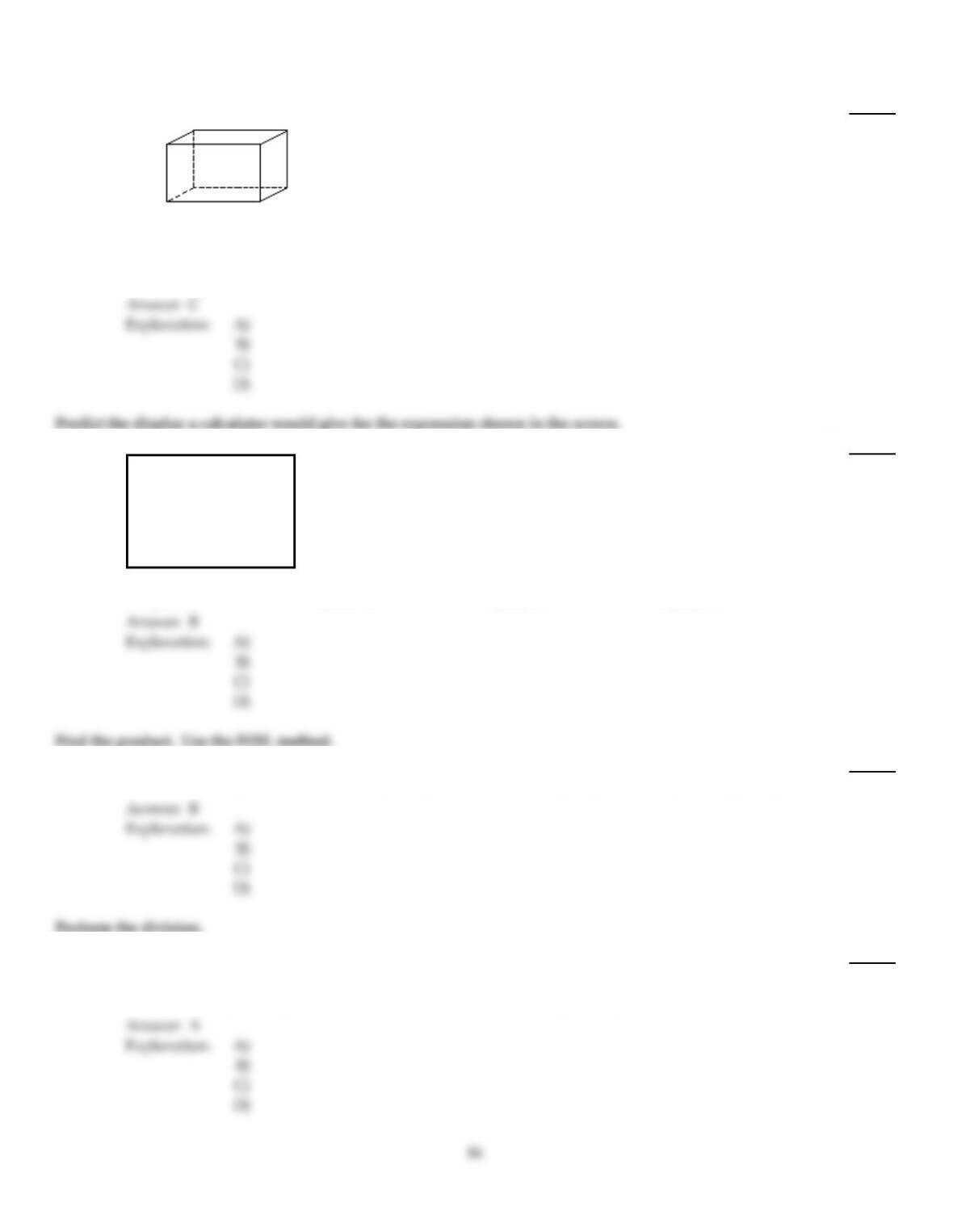
361)
Find an expression that represents the volume of the figure.
2xy4
2x9y
2x3y8
361)
A)
8x27y288
B)
8x39y39
C)
8x13y13
D)
24x12y9
362)
(2E8) * (1E–11)
362)
A)
2E19
B)
2E–3
C)
3E19
D)
3E–3
363)
(x + 4y)(x – 6y)
363)
A)
x – 2xy – 24y
B)
x2– 2xy – 24y2
C)
x2– 2xy – 2y2
D)
x2– 5xy – 24y2
Perform the division.
364)
(12x4y4+8x6y8–8x7y5) ÷ (4x4y4)
364)
A)
3+2x2y4–2x3y
B)
3+2xy4–2x2y
C)
3xy +2x2y4–2x3y
D)
3+2x2y3–2x3y2
Write the expression using exponents.
365)
5
75
75
75
75
75
7
365)
A)
6
5
7
B)
5
76
C)
65
7
D)
5
75
366)
(x – 4)(–4x – 5)
366)
A)
–4x2+ 11x + 20
B)
–4x2+ 9x + 20
C)
–4x2+ 11x + 11
D)
–4x2+ 20x + 11
367)
Decide whether the expression is positive, negative, or zero. 1
67 –86
367)
A)
Positive
B)
Negative
C)
Zero
Add.
368)
(–4+ 9n7– 9n4) + (9n7– 5n4– 6)
368)
A)
5n7+ 4n4– 15
B)
18 – 14n7– 10n4
C)
18n7– 14n4– 10
D)
–6n11
Determine whether the expression represents a number that is positive, negative, or zero.
369)
(–29)0–880
369)
A)
Zero
B)
Negative
C)
Positive
Identify the polynomial as a monomial, binomial, trinomial, or none of these. Give its degree.
370)
–8y5– 1y4+ 5
370)
A)
Trinomial, degree 5
B)
Trinomial, degree 9
C)
Trinomial, degree 10
D)
Binomial, degree 5
Find the product. Use the FOIL method.
371)
(x – 11y)(–4x – 11y)
371)
A)
x2+ 33xy + 33y2
B)
–4x2+ 33xy + 121y2
C)
–4x2+ 33xy + 33y2
D)
x2+ 33xy + 121y2
B
Explanation:
Find the product.
372)
(10x + 9y)2
372)
A)
10x2+ 81y2
B)
100x2+ 81y2
C)
100x2+ 180xy + 81y2
D)
10x2+ 180xy + 81y2
C
Explanation:
Identify the polynomial as a monomial, binomial, trinomial, or none of these. Give its degree.
373)
4
5r3+3
5r2
373)
A)
Binomial, degree 3
B)
Trinomial, degree 2
C)
Binomial, degree 5
D)
Binomial, degree 4
A
Explanation:
374)
8,100,000
374)
A)
8.1 × 10⁷
B)
8.1 × 10⁻⁶
C)
8.1 × 10⁻⁷
D)
8.1 × 10⁶
D
Explanation:
A
Explanation:
375)
(–10)0–100
375)
A)
10
B)
–1
C)
1
D)
0
Perform the division. Write the answer with positive exponents.
376)
–10x7+ 14x6– 14x5
–2x6
376)
A)
12x – 7
B)
5x + 14x6+7
x
C)
5x – 7
D)
5x – 7 +7
x
Perform the division.
377)
(x2– 9) ÷ (x + 3)
377)
A)
x2– 3
B)
x – 3
C)
x – 9
D)
x + 9
Simplify by writing the expression with positive exponents. Assume that all variables represent nonzero real numbers.
378)
p3
p–5
378)
A)
p8
B)
1
p8
C)
p–2
D)
p–8
Add like terms, if possible, and write the result in descending powers of the variable.
379)
–8y10 – 5y9
379)
A)
–13y9
B)
–13y19
C)
–13y10
D)
Cannot be simplified
Perform the division.
380)
(6m8n –4m7n4+12m6n6) ÷ (2m5n)
380)
A)
3m3–4m7n4+12m6n6
B)
3m13 –2m12n5+6m11n7
C)
3m3–2m2n3+6mn5
D)
21
Evaluate the expression.
381)
2–4
381)
A)
1
8
B)
–16
C)
1
16
D)
16
Find the product.
382)
4x4(3x7– 11x2+ 6)
382)
A)
12x11 – 44x6
B)
12x7– 44x2+ 24
C)
12x11 – 44x6+ 24x4
D)
12x11 – 11x2+ 6
88
Simplify by writing the expression with positive exponents. Assume that all variables represent nonzero real numbers.
383)
(73)5
76
383)
A)
714
B)
72
C)
721
D)
79
Find the product.
384)
(x – 5)4
384)
A)
x4– 20x3– 250x2– 500x + 625
B)
x4– 20x3+ 150x2+ 20x + 625
C)
x4– 5x3+ 150x2– 250 x + 625
D)
x4– 20x3+ 150x2– 500x + 625
385)
(w – t )2
385)
A)
w2–wt +t2
B)
w2– 2wt –t2
C)
w2– 2wt +t2
D)
w2+ 2wt +t2
386)
(52)4
386)
A)
58
B)
56
C)
256
D)
258
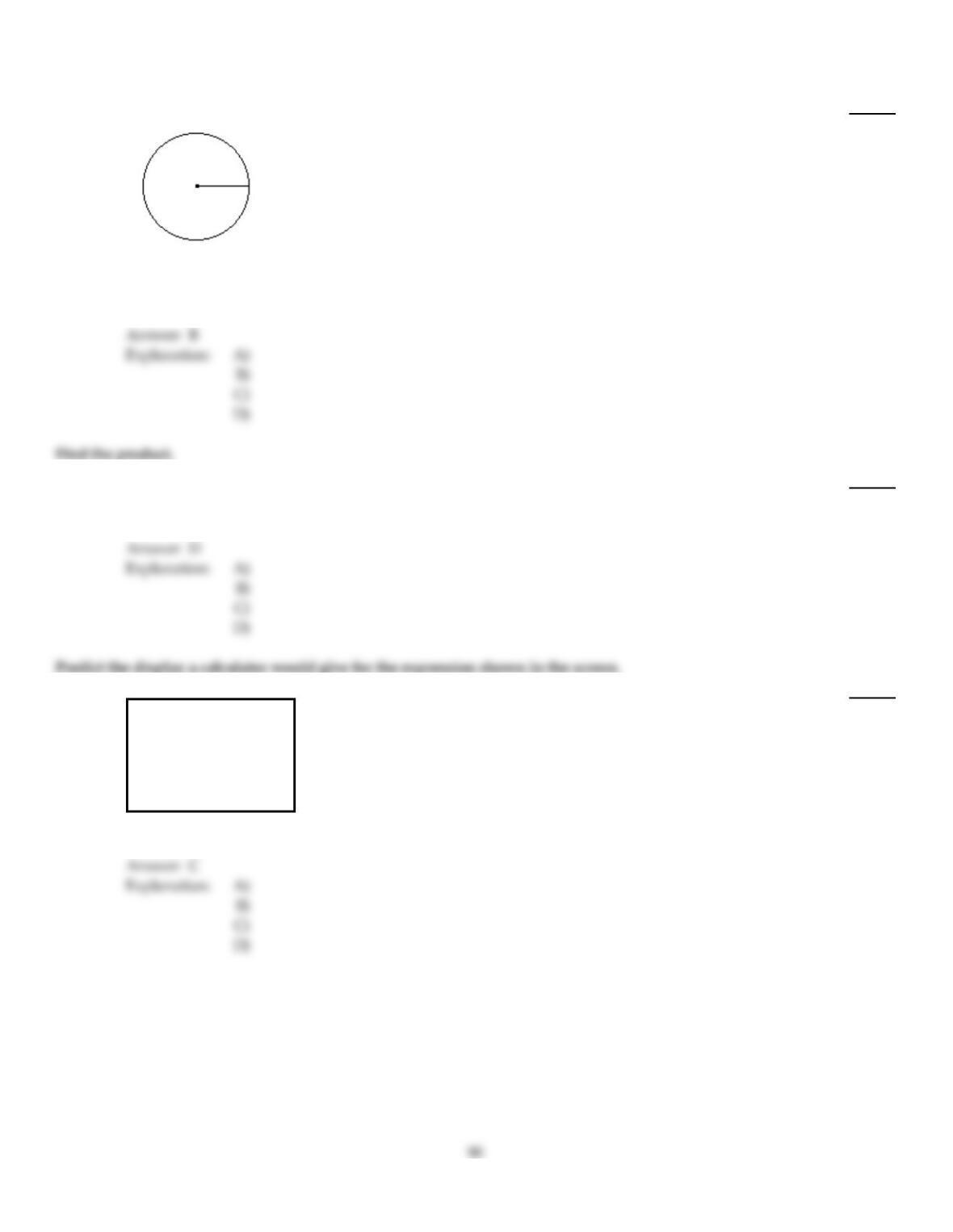
Solve the problem.
387)
Determine a polynomial that represents the area of the figure. Leave in the answer.
6x +3
387)
A)
36x2+36x +9
B)
36x2+36x +9
C)
36x2+9
D)
36x2+9
388)
3x5y(–9x4y – 4x3)
388)
A)
–27x9y2 – 12x8
B)
–27xy – 12x
C)
–27x9y2 – 4x3
D)
–27x9y2 – 12x8y
389)
.0000083
389)
A)
8.3E6
B)
83E6
C)
8.3 E–6
D)
83E–6
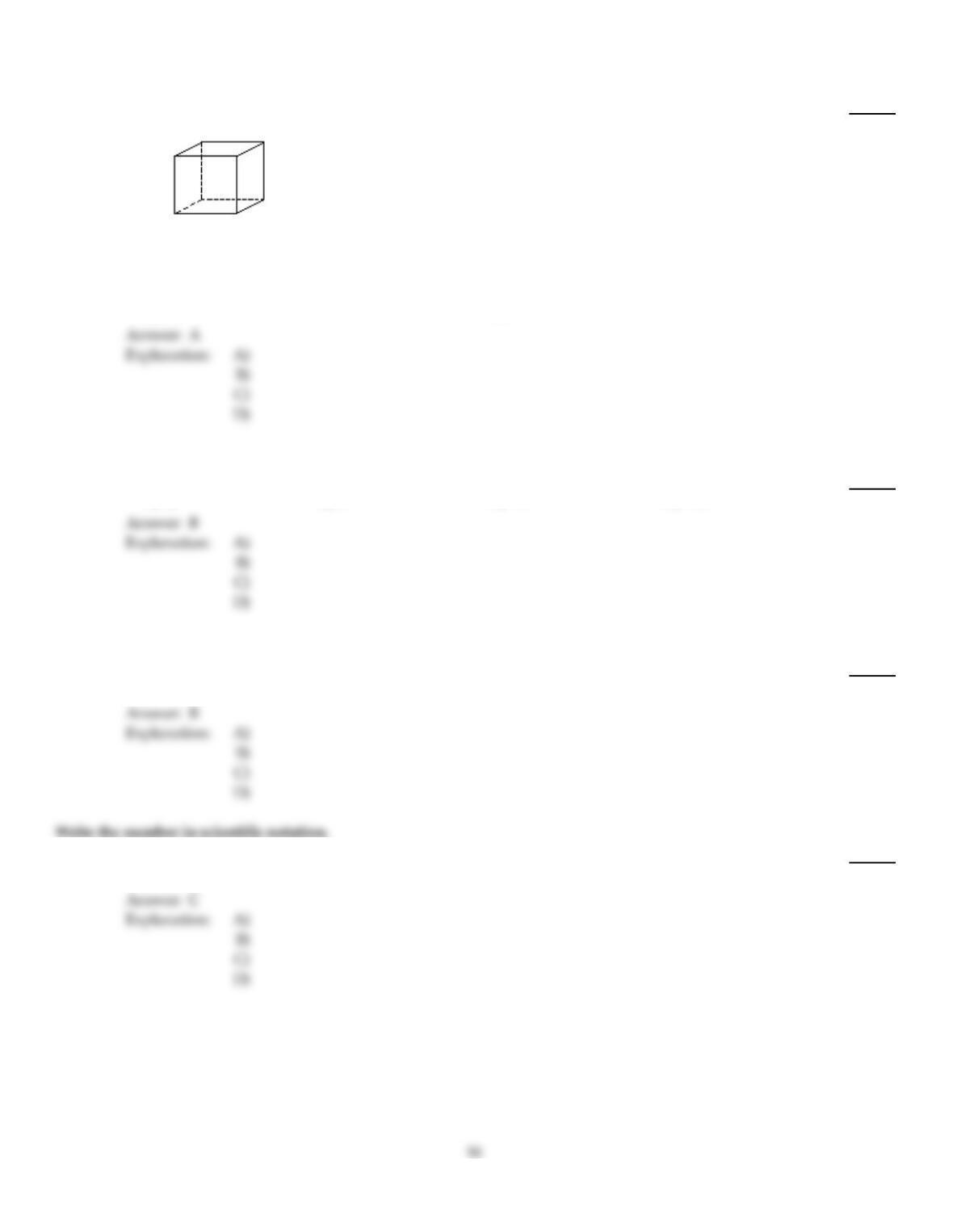
Solve the problem.
390)
Find a polynomial that represents the volume of the cube.
3x + 3
3x + 3
3x + 3
390)
A)
27x3+ 81x2+ 81x + 27
B)
54x2+ 108x + 54
C)
27x3+ 27
D)
27x3+ 243x + 27
Find the value of the polynomial.
391)
–5x2– 5x + 10 when x = –2
391)
A)
30
B)
0
C)
–4
D)
–10
Simplify the expression.
392)
(–5p)4 (–5p)6
392)
A)
25p10
B)
510p10
C)
510p
D)
–510p10
393)
0.0000000730011
393)
A)
7.30011 × 10⁸
B)
7.30011 × 10⁻⁷
C)
7.30011 × 10⁻⁸
D)
7.30011 × 10⁻⁹
394)
t–6·t4·t–8
394)
A)
1
t18
B)
1
t10
C)
t18
D)
t10
B
Find the product.
395)
(7 p + 10)(7p – 10)
395)
A)
49p2– 100
B)
p2– 100
C)
49p2+ 140p – 100
D)
49p2– 140p – 100
A
Solve the problem. Express the answer in scientific notation to two decimals.
396)
A computer can do one calculation in 1.4 × 10⁻⁷ seconds. How long would it take the computer to
do a trillion (1012) calculations?
396)
A)
1.4 × 10⁻⁷ sec
B)
1.4 × 10⁵ sec
C)
1.4 × 10¹² sec
D)
1.4 × 10⁶ sec
B
397)
150– 70
397)
A)
1
B)
0
C)
8
D)
2
B
398)
a9·a8·a3
398)
A)
a75
B)
a17
C)
a11
D)
a20
D
Find the value of the polynomial.
399)
3x3+ 2x2+ 9 when x =2
399)
A)
37
B)
41
C)
29
D)
31
Solve the problem.
400)
Find a polynomial that represents the area of the shaded region.
2x +7
12 x +1
x
400)
A)
2x2+ 7 –6x
B)
2x2+3x –7
C)
2x2+ 3x + 7
D)
2x2– 3x + 7
Find the value of the polynomial.
401)
2x3+ 4x2– x + 35 when x = –4
401)
A)
–35
B)
–105
C)
–25
D)
–37
Identify the base and the exponent for the exponential expression.
402)
(11x)14
402)
A)
Base: 14, exponent: x
B)
Base: x, exponent: 14
C)
Base: 14, exponent: 11x
D)
Base: 11x, exponent: 14
Simplify by writing the expression with positive exponents. Assume that all variables represent nonzero real numbers.
403)
t9
t
403)
A)
t
B)
t8
C)
1
t8
D)
t9
404)
(4m)–4
(7m)–5
404)
A)
44m
75
B)
74m
45
C)
45m
74
D)
75m
44
Perform the division.
405)
4z2–34z +42
4z –6
405)
A)
z –7
B)
z +7
C)
z +7–4
4z –6
D)
z –7+4
4z –6
Simplify by writing the expression with positive exponents. Assume that all variables represent nonzero real numbers.
406)
tz–4
t–3z
–2
406)
A)
t8
z6
B)
z8
t6
C)
t10
z8
D)
z10
t8
Determine the number of terms and name the coefficients of the terms.
407)
–8w + 4h
407)
A)
2; 8 and 4
B)
2; –8 and 4
C)
2; –8 and –4
D)
2; 8 and –4
D)
Perform the indicated operation.
408)
Add (5x + 10 + 6x3) to the sum of (–2+ x2+ 2x) and (3x + 8 + x3).
408)
A)
7x3+ x2+ 10x + 8
B)
8x3+ 10x + 16
C)
7x3+ x2+ 10x + 16
D)
7x3+ 4x2+ 7x + 16
C
D)
Simplify the expression.
409)
(–2p6q6r6)3
409)
A)
(–2)3p9q9r9
B)
–6p9q9r9
C)
(–2)18p18q18r18
D)
(–2)3p18q18r18
D
D)
410)
A company produces 918,000 small appliances in one year.
410)
A)
9.18 × 10⁵
B)
9.18 × 10⁻⁵
C)
9.18 × 10⁶
D)
91.8 × 10⁴
A
D)
Identify the polynomial as a monomial, binomial, trinomial, or none of these. Give its degree.
411)
–15z5+ 7z4+ 6z3+ 12
411)
A)
Binomial, degree 13
B)
Trinomial, degree 5
C)
Trinomial, degree 12
D)
None, degree 5
D
D)
95
B
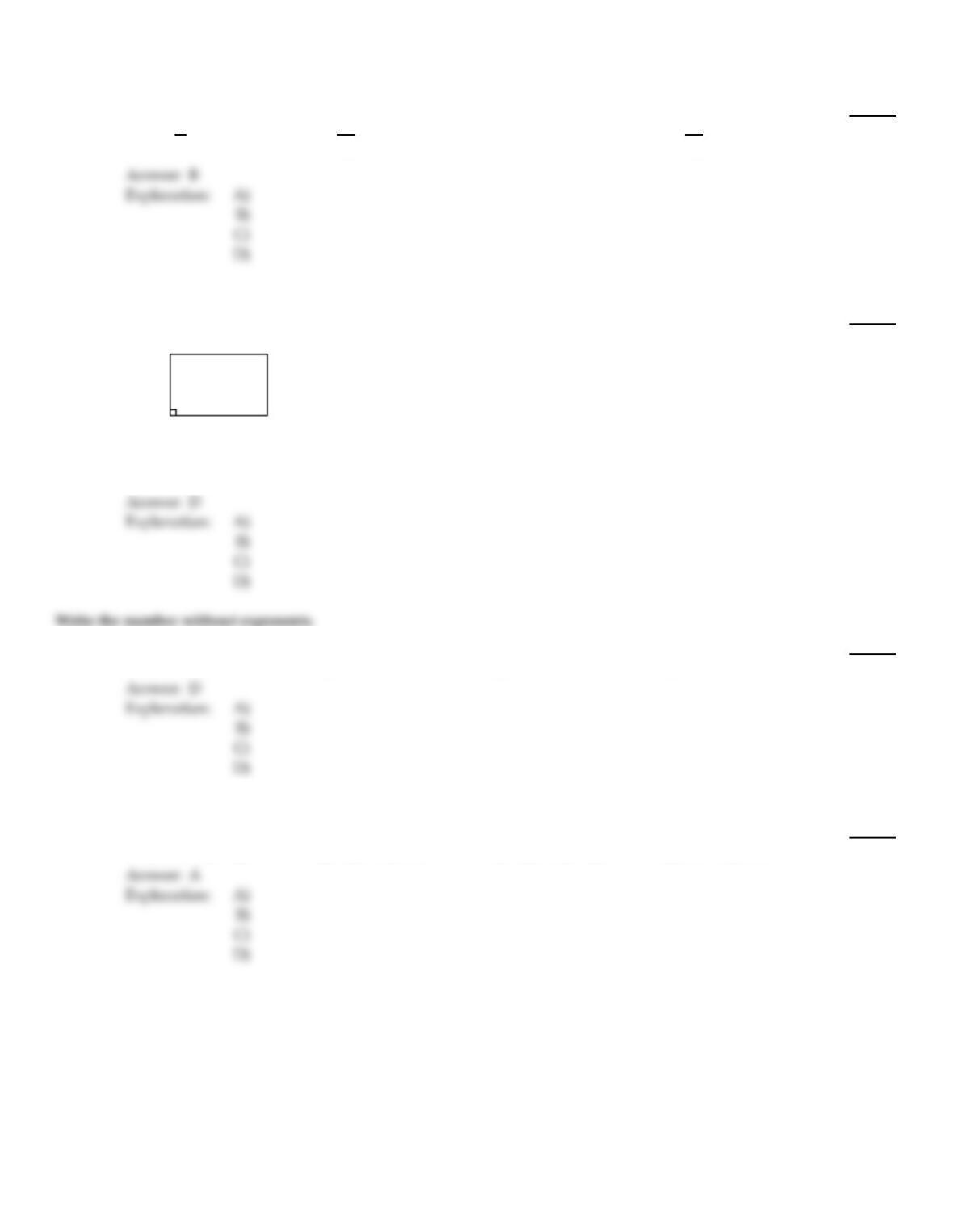
Evaluate the expression.
412)
4–1+ 9–1
412)
A)
–1
5
B)
13
36
C)
2
D)
36
13
Solve the problem.
413)
Determine a polynomial that represents the area of the figure.
4x +4
4x +3
413)
A)
12x2+28x +16
B)
12x2+16
C)
16x2+12
D)
16x2+28x +12
D
414)
5.5965 × 10⁷
414)
A)
559,650,000
B)
5,596,500
C)
391.755
D)
55,965,000
D
Find the product. Use the FOIL method.
415)
(–3x – 5)(–3x + 4)
415)
A)
9x2+ 3x – 20
B)
–6x2+ 3x + 3
C)
–6x2+ 3x – 20
D)
9x2+ 3x + 3
A
96
B
Write the number in scientific notation.
416)
446.833
416)
A)
4.46833 × 10²
B)
4.46833 × 10⁻³
C)
4.46833 × 10⁻²
D)
4.46833 × 10³
Evaluate the expression.
417)
60
417)
A)
1
B)
–1
C)
0
D)
6
A
418)
(–14)6
418)
A)
Negative
B)
Positive
C)
Zero
B
419)
0.58 × 10⁹
419)
A)
in scientific notation
B)
not in scientific notation
B
Find the product.
420)
(2 m – 3w)(2m + 3w)
420)
A)
4m2+ 12mw – 9w2
B)
2m2– 3w2
C)
4m2– 9w2
D)
4m2– 12mw – 9w2
C
97
A
Add like terms, if possible, and write the result in descending powers of the variable.
421)
6x8+ 6x2– 4x8
421)
A)
2x8+ 6x2
B)
8x18
C)
8x2
D)
Cannot be simplified
Solve the problem.
422)
A rectangular patio has an area of 3 m3+ 16m2+ 6m – 35. Find the length if the width is
3m + 7.
422)
A)
m2– 3m + 5
B)
m2+ 11.5m – 5
C)
m2+ 3m – 5
D)
m3+ 3m2– 5m
Perform the indicated operation.
423)
[ (5x2– 3x + 7) – (2x2– 2x – 3) ] – [ (5x2+4x – 6) + (–5x2– 2x – 10) ]
423)
A)
3x2– 7x +26
B)
–7x2– 7x +6
C)
7x2– 7x +20
D)
3x2– 3x +26
Write the expression using exponents.
424)
x · x · x · x · x
424)
A)
x5
B)
5x
C)
5(x)
D)
5

Evaluate the expression.
425)
1
3–2
425)
A)
1
6
B)
1
9
C)
–9
D)
9
Answer Key
Testname: C5
Answer Key
Testname: C5
Answer Key
Testname: C5
Answer Key
Testname: C5
Answer Key
Testname: C5
Answer Key
Testname: C5
Answer Key
Testname: C5
Answer Key
Testname: C5
Answer Key
Testname: C5