43) Calcium ions (Ca2+) are present in the endoplasmic reticulum at concentrations 1,000 times
higher than in the cytosol (the gel-like part of the cell outside organelles). One protein on the
endoplasmic reticulum membrane is devoted to allowing Ca2+ to move from the endoplasmic
reticulum to the cytosol, and another protein moves Ca2+ from the cytosol to the endoplasmic
reticulum. These processes are not trivial–Ca2+ released into the cytosol allows, for example, for
muscle contraction and communication between nerve cells. In this pair of Ca2+ transport
proteins, you would predict that the protein moving Ca2+ from the endoplasmic reticulum to the
cytosol ________, and the protein that moves Ca2+ from cytosol to the endoplasmic reticulum
________.
A) transports calcium slowly; transports calcium rapidly
B) works without ATP; requires ATP
C) requires ATP; works without ATP
D) is large; is small
E) is small; is large
44) Yeast cells take up glucose (a sugar) to use as their primary source of energy. Typically,
glucose concentrations outside yeast cells are far lower than glucose concentrations inside the
cells. Therefore, for yeast to take up glucose, the cells must use:
A) facilitated diffusion to move glucose down its concentration gradient.
B) active transport to move glucose up its concentration gradient.
C) facilitated diffusion to move glucose up its concentration gradient.
D) active transport to move glucose down its concentration gradient.
E) osmosis to directly absorb glucose.
45) All of the following processes bring materials into a cell except:
A) endocytosis.
B) receptor-mediated endocytosis.
C) exocytosis.
D) phagocytosis.
46) Phagocytosis is a type of ________ in which a cell engulfs another cell.
A) passive transport
B) active transport
C) facilitated diffusion
D) endocytosis
E) exocytosis
47) Insulin and many other hormones are protein molecules. Based on your knowledge of
transport processes, you can say that cells that secrete these types of hormones do so through:
A) facilitated diffusion.
B) pinocytosis.
C) passive diffusion.
D) receptor-mediated endocytosis.
E) exocytosis.
48) The 1985 Nobel Prize in Physiology or Medicine was awarded to Michael Brown and Joseph
Goldstein for their work on cholesterol metabolism. Brown and Goldstein investigated the cause
of remarkably high levels of circulating cholesterol found in certain families. Just as remarkable
was the high incidence of heart disease in these families. What Brown and Goldstein found was
not what might be expected–these individuals did not make too much cholesterol. Instead, most
of these people had defects in receptor-mediated endocytosis (RME). What could possibly link
high cholesterol levels in the blood and defective RME in these patients?
A) Cholesterol was being secreted from cells by RME at too high a rate and therefore
accumulated in the blood.
B) Cholesterol was not transported into cells by RME and therefore accumulated in the blood.
C) Cholesterol was being secreted by facilitated diffusion at too high a rate and therefore
accumulated in the blood.
D) Cholesterol was not transported into cells by active transport proteins and therefore
accumulated in the blood.
E) Cholesterol was not transported into cells by facilitated diffusion and therefore accumulated
in the blood.
49) The hydrophilic region of the phospholipid bilayer faces to the interior of the plasma
membrane.
50) In cystic fibrosis, cells cannot pump out enough chloride ions.
51) Having defective proteins in the cell membrane can cause disease.
52) The hydrophilic heads of phospholipids in the plasma membrane face a water-based
environment.
53) Cholesterol is a hormone receptor in the plasma membrane.
54) Integral proteins always extend completely through the plasma membrane.
55) The chief component of the plasma membrane is the phospholipid bilayer.
56) The glycocalyx is found just inside the plasma membrane of the cell.
57) Carbohydrate chains serve as the binding sites for many signaling molecules.
58) Hydrophobic molecules easily pass through the fatty-acid region of the plasma membrane.
59) Signals sent between cells reach a cell at receptor proteins.
60) Cholesterol helps to maintain the correct fluidity of the plasma membrane.
61) The phospholipid bilayer forms spontaneously in water.
62) The phospholipid bilayer forms because fatty-acid tails do not dissolve in water.
63) Transport proteins are integral plasma membrane proteins.
64) Some integral proteins can span the entire phospholipid bilayer.
65) The functioning of the immune system depends on recognition proteins.
66) The most up-to-date explanation of the structure of the plasma membrane is called the fluid-
mosaic model.
16
67) Water moves freely through a semipermeable membrane.
68) Osmosis is an example of passive transport.
69) Diffusion occurs because of random molecular movement.
70) A cell wall stops a plant cell from taking in so much water that it will burst.
71) A substance moving down the concentration gradient is an example of active transport.
72) Facilitated diffusion occurs through membrane-bound transport proteins.
73) Facilitated diffusion occurs down a concentration gradient.
74) Active transport moves a substance against the concentration gradient.
75) To move a molecule into a cell against the concentration gradient requires energy.
76) Exocytosis is an example of active transport of a substance into the cell.
77) Phagocytosis is an example of passive transport.
Match the following.
A) passive transport
B) facilitated diffusion
C) simple diffusion
D) exocytosis
E) active transport
F) endocytosis
78) The movement of molecules down their concentration gradient without the use of a transport
protein
Topic: Section 5.3
Skill: Knowledge/Comprehension
79) Uses transport proteins to assist the movement of materials down a concentration gradient
Topic: Section 5.3
Skill: Knowledge/Comprehension
80) Movement of materials across a cell membrane that does not require energy
Topic: Section 5.3
Skill: Knowledge/Comprehension
81) Requires the expenditure of energy to move molecules or ions across a cell membrane
Topic: Section 5.3
Skill: Knowledge/Comprehension
82) Uses a transport vesicle to bring large materials into the cell
Topic: Section 5.4
Skill: Knowledge/Comprehension
83) Uses a transport vesicle to release materials to the exterior of a cell
Topic: Section 5.4
Skill: Knowledge/Comprehension
84) The ________ functions in cell lubrication, adhesion, and signaling.
85) Osmosis refers to the diffusion of ________ across a membrane.
86) A ________ plasma membrane allows water but not solutes to pass through it.
87) ________ is the process that a cell can use to bring very large molecules into the cell.
88) The plasma membrane proteins of a cell can be linked to colored marker molecules. In an
experiment, you labeled the membrane proteins of one cell with a red marker and the membrane
proteins of a second cell with a blue marker. Using your understanding of the fluid-mosaic
model, what might you see happen if you connected the plasma membranes of the two cells so
that they form one continuous membrane?
89) A woman suffering from severe dehydration goes into the hospital. The doctor tells the
woman that her blood has far too much solute in it and not enough water. Explain how this
condition could affect the cells of her body and why.
90) An accident victim lost a lot of blood and was rushed to the emergency room. In the
emergency room, the first thing the doctors did was replace lost fluids by giving an IV of pure
water. But this caused the patient to die. Propose a reason why the patient died.
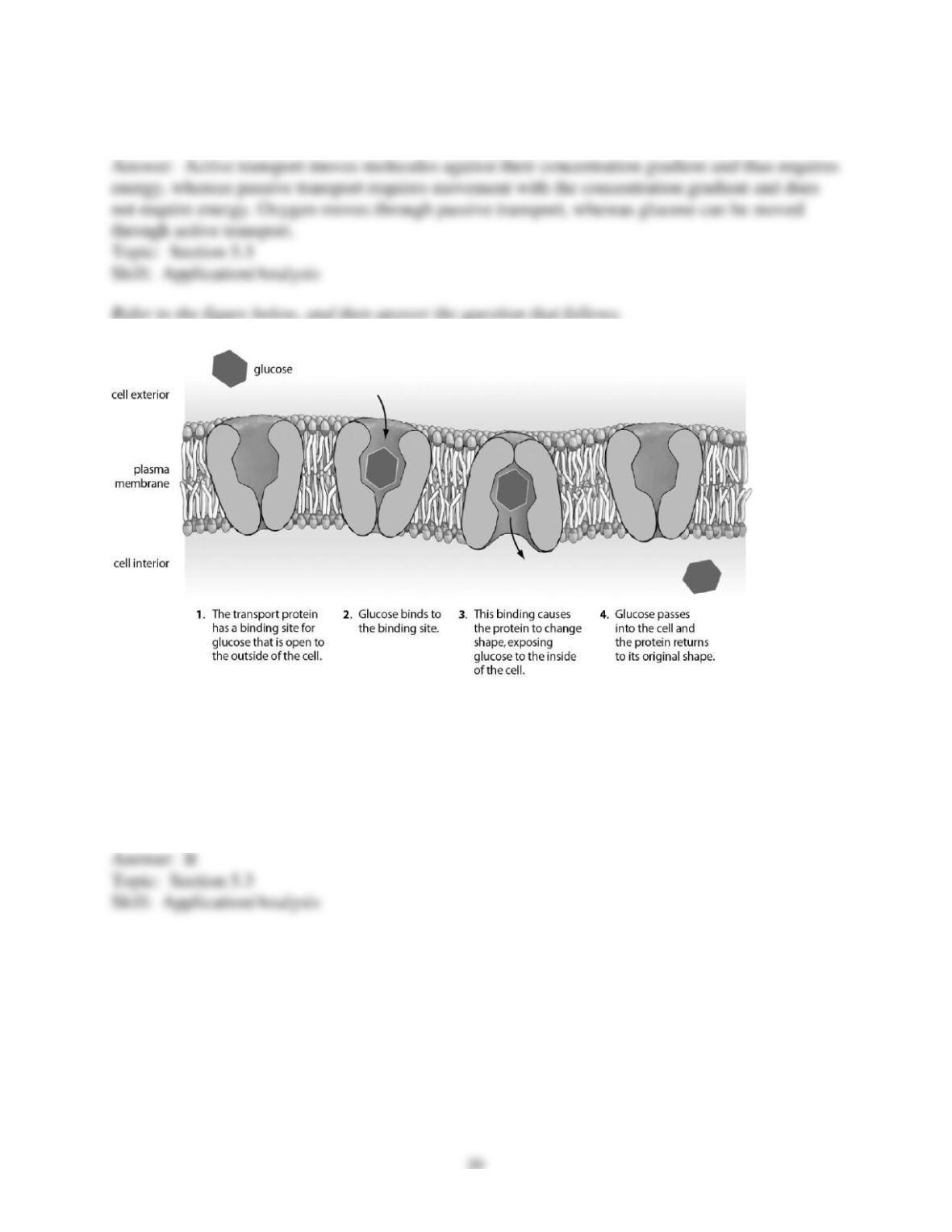
91) What are two major differences between active transport and passive transport? Please give a
specific example of each that occurs within a eukaryotic cell.
92) For this type of transport to take place, which of the following must be true about the interior
and exterior environments?
A) The amount of glucose outside the cell must be less than the interior concentration.
B) The glucose concentration must be higher outside the cell than inside the cell.
C) The glucose concentrations on both sides of the cell must be the same.
D) A transport protein is involved, so it doesn’t matter what the concentrations of glucose are on
either side of the membrane.
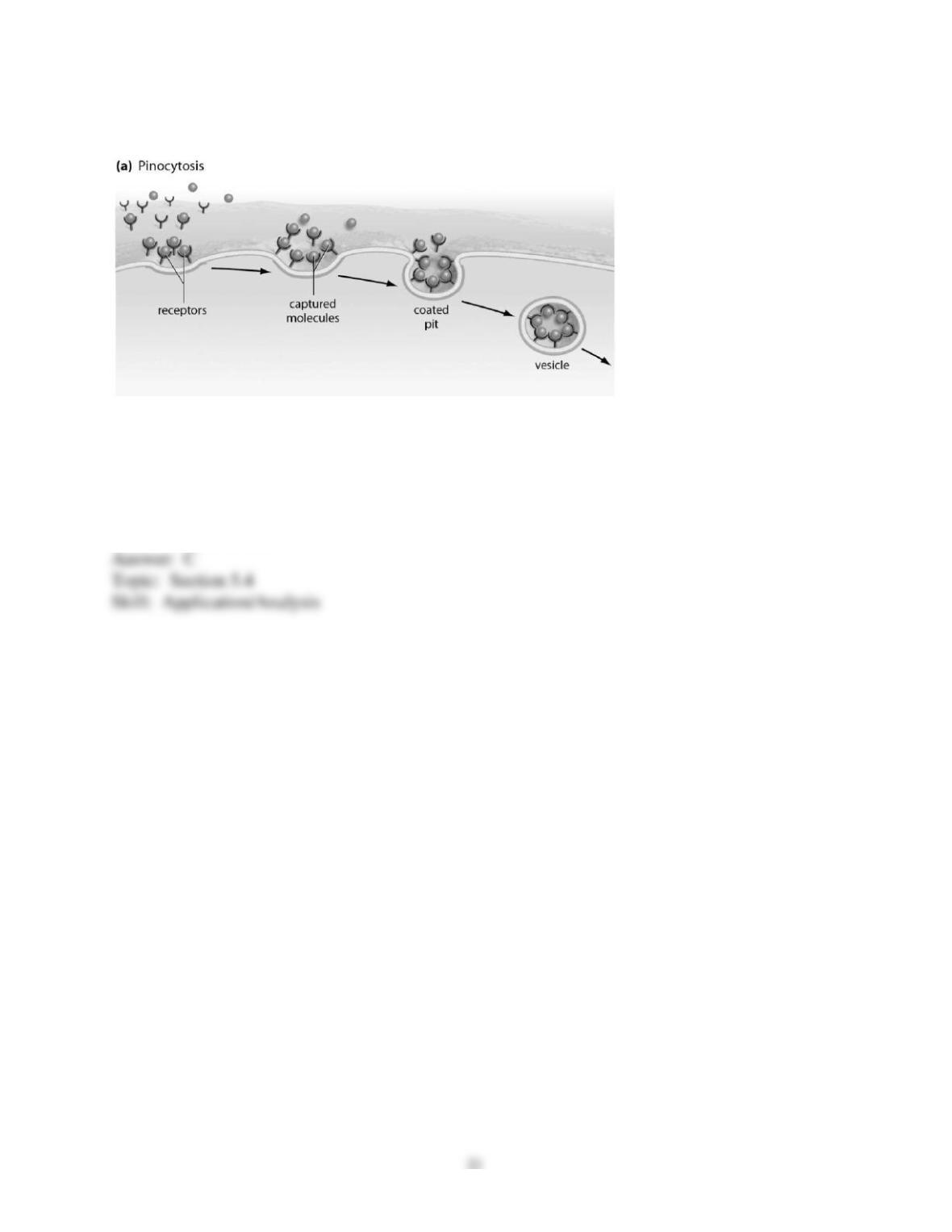
Refer to the figure below, and then answer the question that follows.
93) The type of transport shown is an example of:
A) simple diffusion.
B) active transport.
C) endocytosis.
D) exocytosis.
E) facilitated diffusion.