3) World Observatories: In order to carry out new observations, modern astronomy continually
produces new specialized telescopes and instruments, often incorporating revolutionary designs.
These include large collections of linked radio telescopes on Earth such as ALMA, enormous
radio dishes like China’s FAST, the exquisitely sensitive gravity wave detection system of LIGO,
or the soon-to-be-launched James Webb Space Telescope. These facilities often depend on
multinational funding, and in turn, serve the entire world. To maximize their usefulness, both
surveys and individual experiments are conducted. A survey typically looks over a search region
using deep and uniform sensitivity, so as to understand what is present and also to find new
things. In an experiment, an observer targets a limited number of known objects to refine details
of their composition, structure, and interactions, and perhaps tests a hypothesis regarding their
behavior. Can you suggest a new survey and a new experiment that would utilize a modern
observatory?
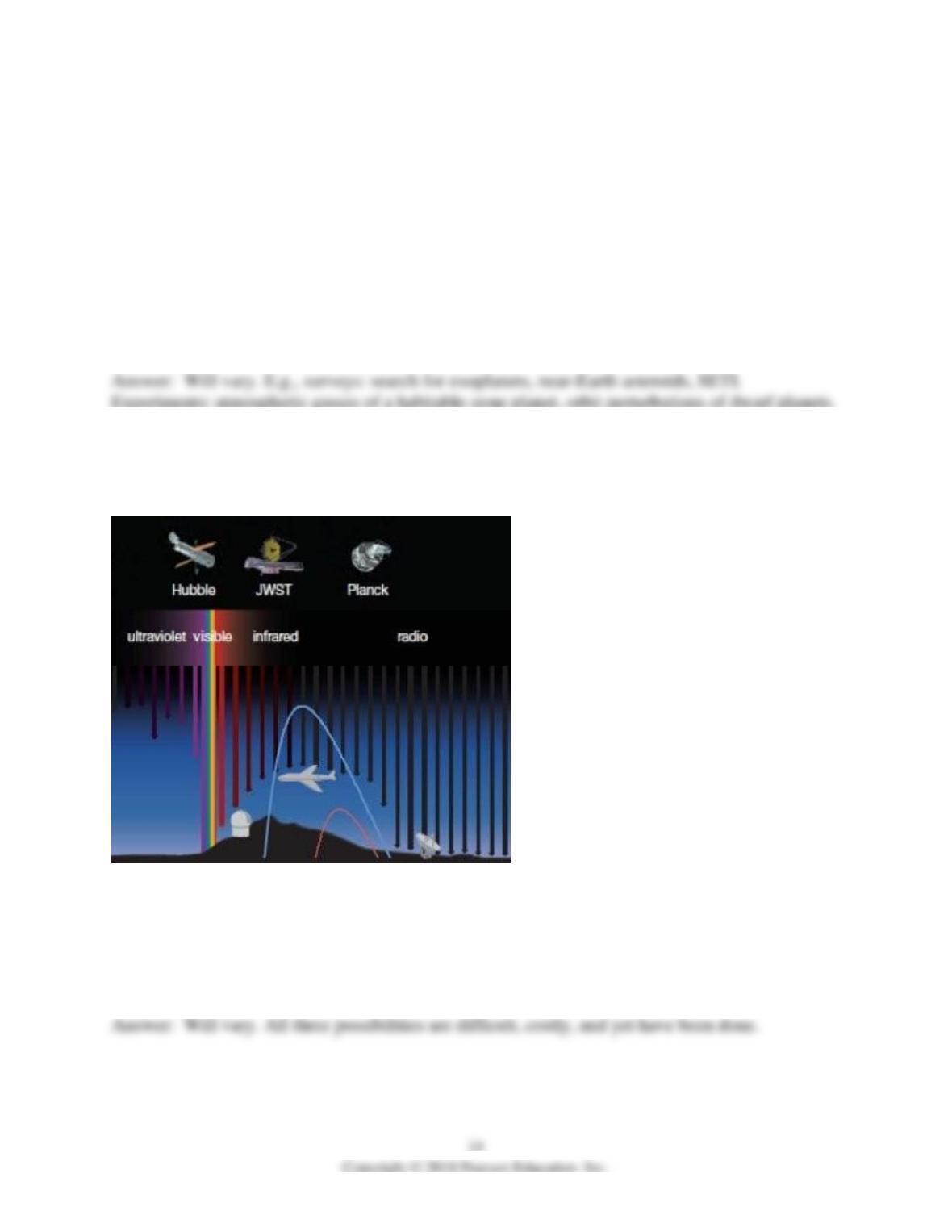
4) Observatory suitability: Consider the thermal spectra of two clouds of gas in space, as shown
in the figure below. The spectra are plotted as intensity vs. the x-axis wavelength scale of the
figure and each spectrum peaks at an infrared wavelength.
The blue spectrum shows a 50 K cloud peaking at 60 μm and the red spectrum shows a 10 K
cloud peaking at 300 μm. The image above shows that this radiation does not make it all the way
through the atmosphere to the Earth’s surface. To analyze the emission of such clouds one must
either observe the clouds from a satellite observatory or from an airplane observatory. Which
method do you think might be easier? Which might be less costly? Or, can you alternatively
imagine making an observatory that is carried aloft in a high altitude balloon?

5) Novel Observatories: Operating a large telescope from inside a jet airplane such as SOFIA
presents unique challenges. All airplanes shake (experience random accelerations) while flying,
due to variable air density, turbulence, and engine vibration. How do you think an airborne
telescope avoids the shaking with the aircraft to which it is attached? It still must be actively
steered to track the stars and galaxies as they move through the sky. (Hints: Does the telescope
need to be rigidly attached to the airplane? Is there a way a metal object can be made to move in
any direction without touching it?)
6) Imagine there is a far-advanced civilization on a planet going around a distant star. Imagine
this civilization had reached a technology state where they could teraform (reform) their entire
planet into a flat ring or sphere of Earth-like material that faced their star (as imagined in Niven’s
sci-fi novel “Ringworld”). Their Earth-like planetary surface would be enormously enlarged.
How would such a system look through our telescopes? (Assume our telescopes have insufficient
angular resolution to discern the ring.) What would the star and ring-planet’s combined spectrum
look like?
5.4 Short Answer Questions
1) Atomic number refers to ________.
2) Define atomic mass number.
3) An isotope of nitrogen has 7 protons and 7 neutrons. What are the atomic number and atomic
mass number of such an atom? If we added one neutron to this nucleus, and took away one
proton, would the result still be nitrogen? What if we simply added one neutron instead? Explain.

4) The common isotope of hydrogen has atomic number 1 and no neutrons. Hydrogen has two
isotopes named deuterium and tritium. (Deuterium and tritium, while having their own names are
still the forms of the element hydrogen.) Deuterium has one neutron, and tritium has two. What
are their atomic numbers and atomic mass numbers? Why is Deuterium combined with oxygen
to make D2O called heavy water?
5) Lithium, a white metal having a nucleus composed of 3 protons and typically 4 neutrons,
floats in water (and even in oil), and can be cut with a knife. Can you explain why?
6) The most common isotope of uranium is U-238, but the form used in nuclear bombs and
nuclear power plants is U-235. Given that uranium has atomic number 92, how many neutrons
are in each of these two isotopes?
7) Briefly explain why spectral lines are useful in determining the chemical composition of their
source.
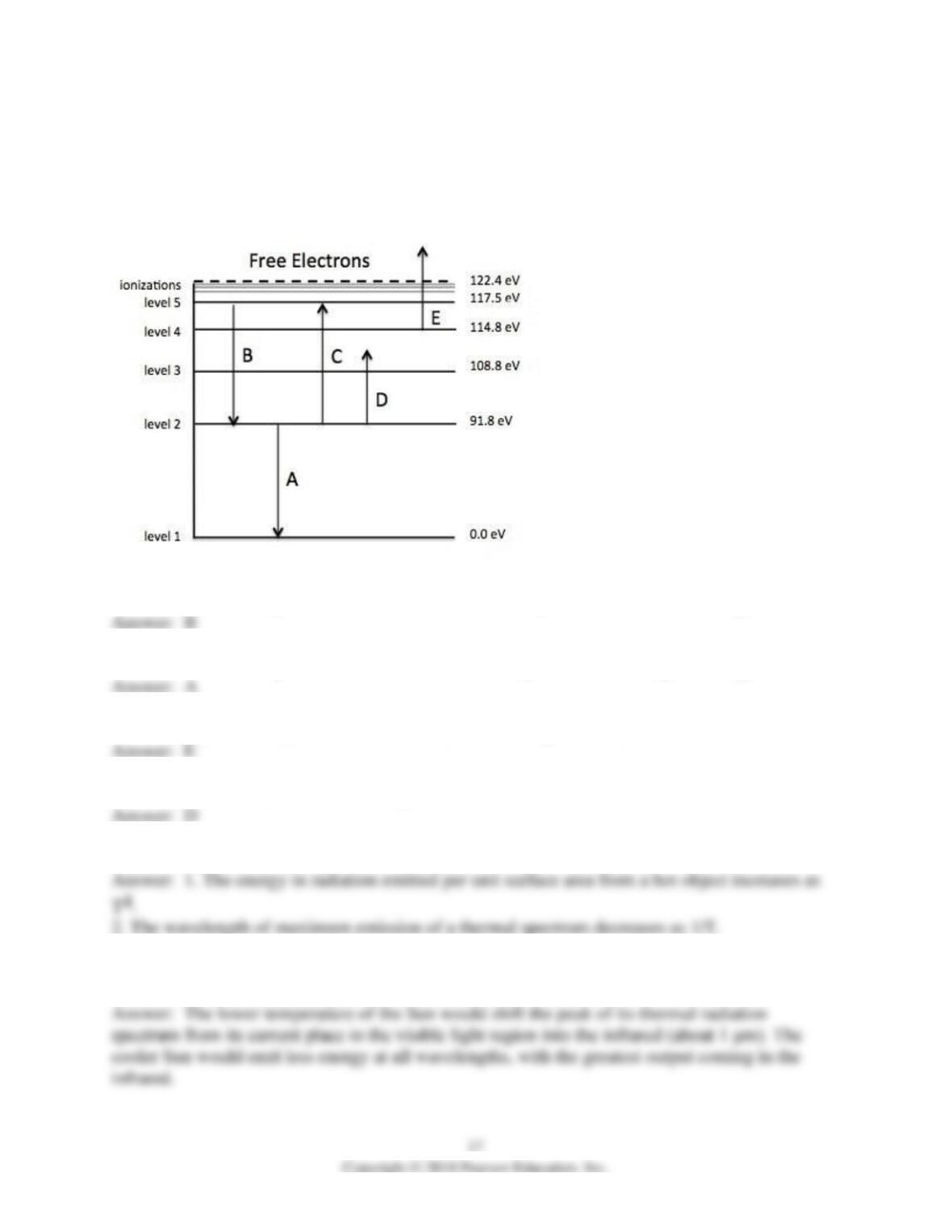
The following question(s) refer(s) to the diagram below. The levels represent energy levels in an
ionized lithium atom, Li++. Each level is labeled with its energy (above the ground state of
Level 1) in units of electron/volts (eV). The labeled transitions represent an electron moving
between energy levels.
8) Which transition represents an electron that absorbs a photon with 23 eV of energy?
9) Which transition represents the electron that emits a photon with the highest energy?
10) Which transition represents an electron that is breaking free of the atom?
11) Which transition, as shown, is not possible?
12) State the two laws of thermal radiation.
13) Suppose the surface temperature of the Sun were about 3,000 K, rather than 6,000 K. How
would the thermal radiation spectrum of the Sun be different?

14) Explain why an absorption line spectrum is not filled back in (to make the original
continuous spectrum) by the photons that are emitted as the excited electrons decay back down
to their original energy levels.
15) Briefly explain how we can use spectral lines to determine an object’s radial motion (toward
or away from us). Can we also learn the object’s tangential motion (across our line of sight) from
its spectral lines?
16) Both reflecting (mirrored) telescopes and refracting (lensed) telescopes invert the images
from the sky. Since our eyes act like refracting telescopes, why don’t we see the world upside-
down?
17) Suppose an astronomer proposed to build a major, world class observatory on your school
campus. Would it make a good observing site? Can you think of a type of observatory that would
lend itself to the local conditions? Or, are there any sites some distance from campus that would
be better?
18) The resolution of a 10-meter telescope is about 0.01 arcsecond for visible light. Would you
expect the actual angular resolution of a Keck 10-meter telescope in Hawaii to be better than,
equal to, or worse than 0.01 arcsecond? Explain.
19) Suppose two stars had the same size yet one was radiating far more UV radiation. What
could you conclude?
20) Explain how adaptive optics works.

21) Explain what an interferometer is and give an example.
22) While the Sun’s spectrum peaks at the color of green light, there is so much light coming
from adjacent colors (yellow and blue) that when our human eyes see the Sun from space (as the
astronauts do) we see it as white. On Earth’s surface, much of the blue sunlight is scattered by
molecules into the sky. How does this affect Sun’s apparent color?
23) Suppose two stars were the same temperature but one was putting out far more infrared
radiation. What would you conclude?
5.5 Mastering Astronomy Reading Quiz
1) From shortest to longest wavelength, which of the following correctly orders the different
categories of electromagnetic radiation?
A) gamma rays, X-rays, ultraviolet, visible light, infrared, radio
B) infrared, visible light, ultraviolet, X-rays, gamma rays, radio
C) radio, infrared, visible light, ultraviolet, X-rays, gamma rays
D) ultraviolet, X-rays, gamma rays, visible light, infrared, radio
2) Blue light hitting a red sweatshirt is an example of
A) transmission.
B) emission.
C) reflection or scattering.
D) absorption.
3) Cell phone signals passing through walls is an example of
A) transmission.
B) reflection or scattering.
C) absorption.
D) emission.

4) Suppose you watch a leaf bobbing up and down as ripples pass it by in a pond. You notice that
it does two full up and down bobs each second. Which statement is true of the ripples on the
pond?
A) They have a frequency of 2 hertz.
B) They have a frequency of 4 hertz.
C) We can calculate the wavelength of the ripples from their frequency.
D) They have a wavelength of two cycles per second.
5) Suppose you know the frequency of a photon and the speed of light. What else can you
determine about the photon?
A) its wavelength and energy
B) its temperature
C) its acceleration
D) the chemical composition of the object that emitted it
6) Which of the following best describes the fundamental difference between two different
elements (such as oxygen and carbon)?
A) They have different numbers of protons in their nuclei.
B) They have different mass numbers.
C) They have different numbers of electrons.
D) They have different names.
7) White light hitting white paper is an example of
A) reflection or scattering.
B) emission.
C) absorption.
D) transmission.
8) If we say that a material is opaque to ultraviolet light, we mean that it ________.
A) absorbs ultraviolet light
B) reflects ultraviolet light
C) transmits ultraviolet light
D) emits ultraviolet light
9) The energies of two photons you might detect emitted by hydrogen atoms are 10.2 and 2.1 eV.
Which photon has the longest wavelength?
A) They both have the same wavelength.
B) the 10 eV photon
C) the 2.1 eV photon

10) When observing visible light through a prism or diffraction grating, how can you tell if a line
spectrum is an emission spectrum or an absorption spectrum?
A) An absorption spectrum is mostly dark because an opaque object absorbs or reflects all light.
B) You must graph the intensity and analyze the graph.
C) An emission spectrum has bright lines on a dark background and an absorption spectrum has
dark lines on a rainbow background.
D) Emission lines are those where electrons are rising into a higher energy levels and absorption
are those where the electrons are dropping down to lower levels.
11) An atom that has fewer electrons than protons is called a(n) ________.
A) ion
B) molecule
C) attracter
D) isotope
12) Thermal radiation is defined as ________.
A) radiation with a spectrum whose shape depends only on the temperature of the emitting object
B) radiation produced by an extremely hot object
C) radiation that is felt as heat radiation in the form of emission lines from an object
13) Compare the energy and speed of infrared and visible light. Which of the following
statements is true?
A) Visible light has higher energy, but the same speed.
B) Infrared light has higher energy, but the same speed.
C) Infrared light has higher energy, and moves faster.
D) Visible light has higher energy, and moves faster.
14) Suppose you want to know the chemical composition of a distant star. Which piece of
information is most useful to you?
A) the wavelengths of spectral lines in the star’s spectrum
B) the peak energy of the star’s thermal radiation
C) the Doppler shift of the star’s spectrum
D) whether the star’s spectrum has more emission lines or more absorption lines
15) The spectra of most galaxies show redshifts. This means that their spectral lines ________.
A) have wavelengths that are longer than normal
B) are always in the red part of the visible spectrum
C) have wavelengths that are shorter than normal
D) have a higher intensity in the red part of the spectrum

16) What is the angular resolution of the human eye?
A) about 1 arcminute, or 1/60 of a degree
B) about 1 degree
C) about 1 arcsecond (1/3600 of a degree)
D) about 1 milliarcsecond
17) Which of the following observational techniques is appropriate for measuring Doppler
shifts?
A) imaging (taking a picture)
B) timing (measuring how the amount of light changes with time)
C) spectroscopy (taking a spectrum)
18) What do astronomers mean by light pollution?
A) Light pollution is light from human sources that makes it difficult to see the stars at night.
B) Light pollution is a type of air pollution created by lightweight gases such as hydrogen and
helium.
C) Light pollution means contamination of light caused by chemicals in the Earth’s atmosphere.
D) Light pollution is a term used to describe the appearance of the sky in regions that are
crowded with stars.
19) The stars in our sky twinkle in brightness and color because of ________.
A) turbulence in Earth’s atmosphere
B) rapid changes in the brightness and colors of stars caused by changes in their spectra
C) light pollution
D) the atmospheres of stars expand due to radiation pressure and then contract
20) What is the purpose of adaptive optics?
A) to reduce blurring caused by atmospheric turbulence for telescopes on the ground
B) to allow several small telescopes to work together like a single larger telescope
C) to increase the amount of light gathered by allowing the telescope’s computer to reconfigure
the pathways of observed light
D) to allow ground-based telescopes to observe ultraviolet light that normally does not penetrate
all the way to the ground
21) Which of the following telescopes is or will be best suited for studying the hottest
intergalactic gas (10 million K) in a cluster of galaxies?
A) The Chandra X-ray Telescope
B) The Atacama Large Telescope Array (ALMA, a radio interferometer)
C) The James Webb Space Telescope (JWST, visible and infrared light telescope)
D) SOFIA, the Stratospheric Observatory for Infrared Astronomy

5.6 Mastering Astronomy Concept Quiz
1) Which of the following best describes why we say that light is an electromagnetic wave?
A) The passage of a light wave can cause electrically charged particles to move up and down.
B) Light can be produced only by electric or magnetic appliances.
C) Light is produced only when massive fields of electric and magnetic energy collide with one
another.
D) The term electromagnetic wave arose for historical reasons, but we now know that light has
nothing to do with either electricity or magnetism.
2) Which of the following statements about X-rays and radio waves is not true?
A) X-rays travel through space faster than radio waves.
B) X-rays have shorter wavelengths than radio waves.
C) X-rays and radio waves are both forms of light, or electromagnetic radiation.
D) X-rays have higher frequency than radio waves.
3) Suppose you built a scale-model atom the size of Earth, how big would its nucleus be?
A) the size of a city
B) the size of a stadium
C) the size of a movie theater
D) the size of a person
4) Atom 1 has: 3 protons, 4 neutrons, and 2 electrons. Atom 2 has: an atomic weight of 6, 1
electron, and a charge of +2.
A) They are identical.
B) They are different elements of the same atomic mass.
C) They are each ions of different elements with different atomic masses.
D) They are each ions and isotopes of the same element.
5) Which of the following statements is true of green grass?
A) It absorbs red light and reflects green light.
B) It absorbs red light and emits green light.
C) It transmits all colors of light except green.
D) It means the lawn is healthy.
6) Suppose the angular separation of two stars is equal to the angular resolution of your eyes.
How will the stars appear to your eyes if you move them two times farther away from you?
A) The two stars will look like a single point of light.
B) You will not be able to see these two stars at all.
C) You will see only the larger of the two stars, not the smaller one.
D) You will see two distinct stars.
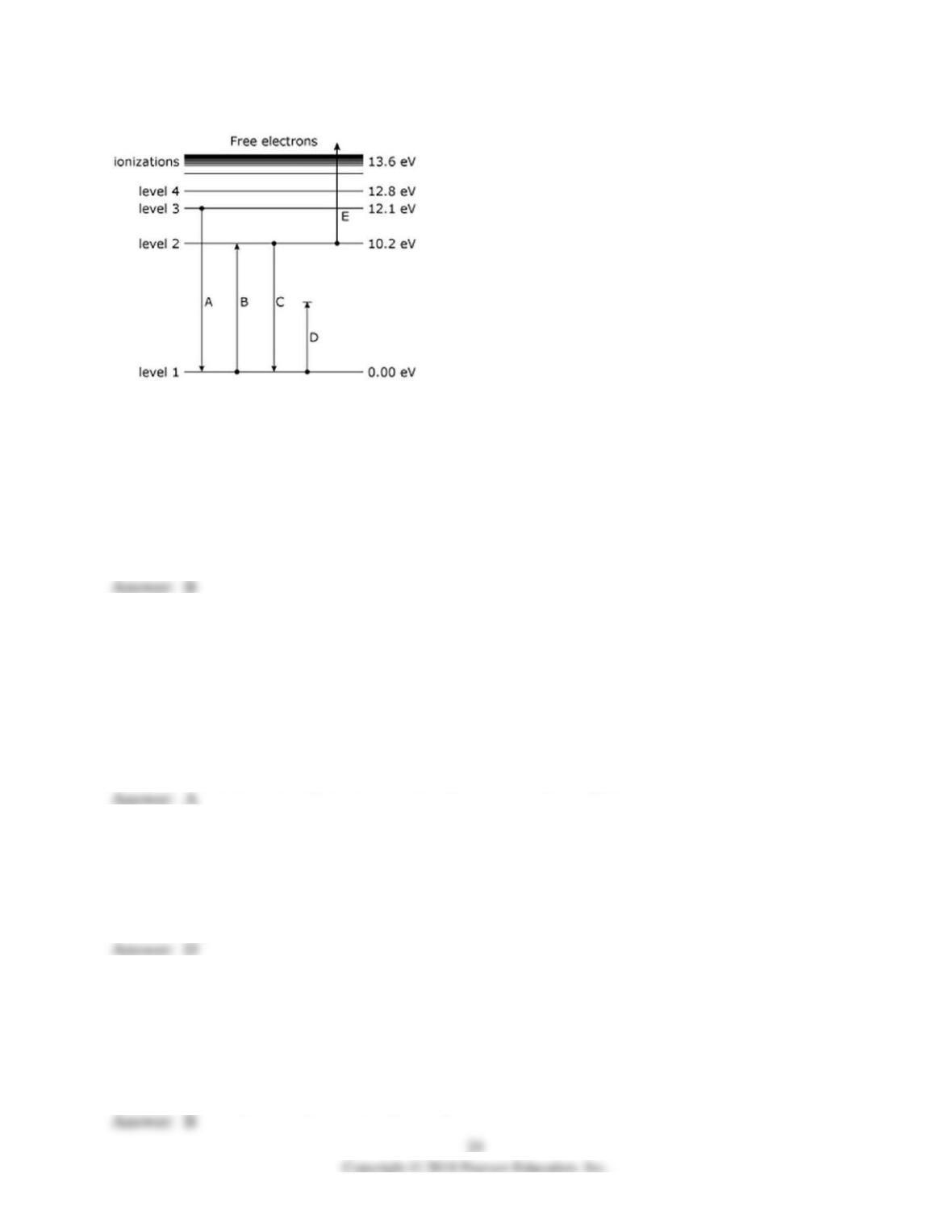
7) The diagram represents energy levels in a hydrogen atom. The labeled transitions (A through
E) represent an electron moving between energy levels. Which labeled transition represents an
electron that absorbs a photon with 10.2 eV of energy?
A) A
B) B
C) C
D) D
E) E
8) The diagram represents energy levels in a hydrogen atom. The labeled transitions (A through
E) represent an electron moving between energy levels. Suppose that an electron in a hydrogen
atom absorbs 10.2 eV of energy, so that it moves from level 1 to level 2. What typically happens
next?
A) The electron returns to level 1 by emitting an ultraviolet photon with 10.2 eV of energy.
B) The electron jumps to level 3 as soon as it absorbs any additional energy.
C) The electron remains in level 2 until it absorbs an additional 10.2 eV of energy.
D) A different electron drops into level 1, since it is now unoccupied.
9) Gamma-ray photons have a very small
A) energy.
B) mass.
C) frequency.
D) wavelength.
10) Suppose you are interested in studying X-ray emission from gas falling into black holes.
Which of these telescope technologies would be most suitable for your investigation?
A) a mountain-top telescope with an extremely largeprimary mirror
B) a telescope on a spacecraft in orbit around Earth
C) an array of linked telescopes spread out over a dry lakebed
D) a mountain-top telescope with adaptive optics

11) Suppose a star is moving toward us at a high velocity.
A) The wavelengths of its spectral lines would be shorter and their frequencies would be higher.
B) The wavelengths of its spectral lines would be shorter but their frequencies would be the
same.
C) The wavelength of its spectral lines would be shorter and their frequencies would be lower.
D) Its light would arrive to us at a higher velocity than if the star were stationary.
12) If a hydrogen emission line appears at 656.2 nm in the laboratory, what can we say about a
cloud of hydrogen gas with this same emission line at 680.2 nm?
A) It is receding away from us.
B) The location of the emission line has nothing to do with speed.
C) It is neither receding nor approaching us.
D) It is approaching us.
13) We are measuring the spectra of two hydrogen gas clouds. The laboratory frame wavelength
of one hydrogen line is 656.2 nm. Cloud A’s emission line wavelength is 660.1 nm and Cloud B’s
emission line wavelength is 670.1 nm. What can we conclude about these clouds?
A) They are both approaching us, and Cloud B is approaching faster than Cloud A.
B) They are both receding from us, and Cloud B is receding faster than Cloud A.
C) They are both approaching us, and Cloud A is approaching faster than Cloud B.
D) They are both receding from us, and Cloud A is receding faster than Cloud B.
14) The angular separation of two stars is 0.1 arcseconds and you photograph them with the
Discovery Channel Telescope using its 0.24 arc second resolution mode, what would you see?
A) The photo will seem to show only one star rather than two.
B) The two stars will appear to be touching, looking rather like a small dumbbell.
C) The stars will not show up at all in your photograph.
D) You will see two distinct stars in your photograph.
15) How does the light-collecting area of an 8-meter telescope compare to that of a 1-meter
telescope?
A) The 8-meter telescope has 64 times the light-collecting area of the 2-meter telescope.
B) The 8-meter telescope has 8 times the light-collecting area of the 2-meter telescope.
C) The 8-meter telescope has 4 times the light-collecting area of the 2-meter telescope.
D) The answer cannot be determined from the information given in the question.

16) One star is emitting primarily visible light and another star is emitting primarily infrared
light. Which star is hotter?
A) the star emitting infrared light
B) the star emitting visible light
C) Both stars are the same temperature.
D) The temperature also depends on the radius of the star, so one can’t decide based on the
information provided.
17) The Chandra X-ray Observatory must operate in space because
A) X-rays do not penetrate Earth’s atmosphere.
B) X-rays are too dangerous to be allowed on the ground.
C) X-ray telescopes require the use of grazing incidence mirrors.
D) it was built by NASA.
18) Which of the following is true about the images captured with X-ray telescopes?
A) They are shown with colors that are not the true colors of the objects that were photographed.
B) They are always made using adaptive optics.
C) They are the result of using highly curved mirrors.
D) They always have very high angular resolution.
E) The X-rays can be seen penetrating deeply into planetary surfaces.
19) You and I are emitting primarily
A) infrared radiation.
B) visual radiation.
C) radio radiation.
D) X-ray radiation.