Exam
Name___________________________________
MULTIPLE CHOICE. Choose the one alternative that best completes the statement or answers the question.
1)
What volcanic events formed Crater Lake, Oregon? When did they take place?
1)
A)
The crater of a large, extinct cinder cone filled with water; 5 million years ago.
B)
Landslides and volcanic mudflows dammed the Mazama River; 500 years ago.
C)
Caldera collapse followed major ash and pyroclastic–flow eruptions; 6000 years ago.
D)
A powerful explosion blew away the top of a stratovolcano; 10 million years ago.
2)
The Columbia Plateau in Washington and Oregon is ________.
2)
A)
a field of large stratovolcanoes
B)
a thick stack of welded–tuff layers
C)
a caldera filled with rhyolite lava flows
D)
a flood basalt plateau
D
3)
The average composition of rocks comprising a large composite cone or stratovolcano is similar to
a(n) ________ magma.
3)
A)
rhyolitic
B)
ultramafic
C)
andesitic
D)
basaltic
C
4)
Which of the following best describes Shiprock, a famous volcanic feature in New Mexico?
4)
A)
the eroded remains of a volcanic pipe and radiating dikes
B)
an extinct, massive, rhyolitic shield volcano
C)
a very recently active, basaltic cinder cone
D)
an extinct, highly symmetrical, composite volcanic cone
A
C
5)
Which kind of eruptive activity is most likely to be highly explosive?
5)
A)
lava flows from a large cinder cone complex
B)
fissure eruptions feeding lava to flood basalt accumulations
C)
eruptions of big, continental margin, composite cones or stratovolcanoes
D)
lava flows from a large shield volcano on an oceanic island
6)
Which of the following is associated with deep mantle hot spots?
6)
A)
Mount St. Helens and other volcanoes of the Cascade Mountains
B)
the very young cinder cones scattered across the southwestern United States
C)
the volcanoes of Hawaii and Quaternary activity in Yellowstone National Park
D)
Vesuvius and the other volcanoes of Italy
7)
Which one of the following statements is NOT true?
7)
A)
Melting temperatures of silicate rocks are lowered by small amounts of water.
B)
Basalt magmas in general have higher temperatures than rhyolite magmas.
C)
Melting temperatures of silicate rocks increase with increased pressure.
D)
When magma reaches the surface, its dissolved gas content increases.
8)
Pockets of magmas can be formed by the melting of deep continental crust heated by the intrusion
of other magmas. Which of the following correctly describes this process?
8)
A)
Intrusion of diorite magma causes basalt magma to melt from peridotite.
B)
Intruded rhyolite magma causes basalt magma to form by melting of granite.
C)
Intrusion of basaltic magma causes deep crustal rocks to melt, producing andesitic or rhyolitic
magmas.
D)
All of the above correctly describe the process.
9)
________ are usually the most abundant gases emitted during basaltic volcanism.
9)
A)
Neon and ammonia
B)
Oxygen and nitrogen
C)
Water and carbon dioxide
D)
Chlorine and sodium
10)
Which statement about the May, 1980, eruption of Mount St. Helens is FALSE?
10)
A)
The most powerful explosive event was preceded by a massive landslide.
B)
Plumes of ash rose high into the atmosphere during the major eruptive events.
C)
During the eruptive period, the mountain peak was substantially built up by new lava flows
and pyroclastic debris.
D)
Mudflows accompanied the major eruptive events.
11)
Which one of the following statements concerning volcanic blocks and bombs is TRUE?
11)
A)
Blocks are broken fragments of solid rocks; bombs have smaller sizes than lapilli.
B)
Bombs and blocks are both smaller than lapilli and cinders.
C)
Bombs are guided to Earth by laser beams; blocks fall anywhere.
D)
Bombs are ejected as magma lumps; blocks are ejected as solid fragments.
12)
Which kind of volcanism is typical of mid–oceanic ridge systems?
12)
A)
explosive; composite cones
B)
submarine; basaltic lava flows
C)
explosive; rhyolitic, pyroclastic flows
D)
fissure eruptions; flood basalts fields
13)
Which of the following best describes seamounts and islands of the deep ocean basins?
13)
A)
piles of basaltic lava flows built up from the ocean floor by multiple, summit and flank
eruptions
B)
huge granite batholiths intruded beneath the ocean floor
C)
andesitic pyroclastic rocks submerged when the mountains sank below sea level
D)
domed gabbro intrusions and massive, submarine, rhyolitic, pyroclastic cones
14)
________ tend to increase the explosive potential of a magma body beneath a volcano.
14)
A)
Low silica content and low viscosity
B)
Low viscosity and low dissolved gas content
C)
High viscosity and low dissolved gas content
D)
High viscosity and dissolved gas
15)
Volcanic bombs originate ________.
15)
A)
as blocks of volcanic rock ejected from an erupting volcanic crater
B)
as laser–guided, granite blocks launched from a supersonic jet
C)
as erupted magma blobs that partly congeal before falling to the ground
D)
as ash particles that join together in the eruptive plume and fall as cobble–sized objects
16)
________ only emit gas.
16)
A)
Crater
B)
Parasitic cones
C)
Calderas
D)
Fumaroles
17)
________ magma is the most abundant type of erupted at oceanic spreading centers.
17)
A)
Pegmatitic
B)
Basaltic
C)
Granitic
D)
Andesitic
18)
A ________ volcano is a very large, gently sloping mound composed mainly of basaltic lava flows.
18)
A)
shield
B)
stratospheric
C)
composite
D)
cinder cone
19)
Which was the most powerful, explosive volcanic eruption of historic time?
19)
A)
Nevado del Ruiz, Colombia, 1985
B)
Mt. Pele, Martinique, 1902
C)
Tambora, Indonesia, 1815
D)
Vesuvius, Italy, 79 A. D.
20)
Which region has the greatest concentration of currently active volcanoes?
20)
A)
the circum–Pacific area
B)
European Russia and Siberia
C)
the coastal plain of western Africa
D)
the area surrounding the Red Sea
21)
Which type of basaltic lava flow has its surface covered with sharp–edged, angular blocks and
rubble?
21)
A)
scoria
B)
pillow lava
C)
pahoehoe
D)
aa
22)
________ destroyed the city of St. Pierre, Martinique in 1902.
22)
A)
A nueé ardente
B)
Mudflows
C)
Basaltic lava flows
D)
Heavy ashfall
23)
Which type of basaltic lava flow has a fairly smooth, unfragmented, ropy surface?
23)
A)
pahoehoe
B)
aa
C)
scoria
D)
pegmatitic
24)
The 1991 Pinatubo eruption in the Philippines caused brilliantly colored sunrises and sunsets to be
seen for the next few years. What caused this phenomenon?
24)
A)
Sulfur dioxide and other erupted gases formed aerosols in the stratosphere.
B)
The eruption added large amounts of carbon dioxide to the atmosphere.
C)
The eruptive cloud destroyed parts of the Earth’s protective ozone layer.
D)
Radioactive atoms blown into the atmosphere glowed red as they decayed.
25)
The (geologically) recent volcanic activity in Yellowstone National Park is ________.
25)
A)
related to intraplate, hot spot volcanism
B)
related to a divergent plate boundary
C)
related to a transform plate boundary
D)
related to plate subduction
26)
Kilauea and Mauna Loa are ________.
26)
A)
small, basaltic cinder cones
B)
basaltic shield volcanoes
C)
explosive, rhyolitic volcanoes
D)
andesitic stratovolcanoes
27)
The ________ ocean basin is rimmed by the most subduction zones.
27)
A)
Indian
B)
Arctic
C)
Atlantic
D)
Pacific
28)
Mount St. Helens is ________.
28)
A)
a basaltic shield volcano
B)
a small, welded tuff cone
C)
an explosive stratovolcano
D)
a basaltic cinder cone
29)
In 1980, ________ was the first Cascade Range volcano to erupt since Mt. Lassen, California, in
1915–16.
29)
A)
Kilauea
B)
Mt. Rainier
C)
Mt. St. Helens
D)
Mt. Shasta
30)
The 1943 eruption of Paricutin in Mexico was characterized by ________.
30)
A)
mudflows and explosive ash eruptions
B)
pyroclastic eruptions and nueé ardente flows
C)
cinder cone building and basaltic lava
D)
welded–tuff deposition and caldera formation
31)
Which one of the following best describes volcanism in the Cascade Range, northwestern United
States?
31)
A)
related to plate subduction
B)
related to deep, transform faults
C)
related to a mantle hot spot
D)
related to a mid–oceanic ridge system
32)
Which one of the following statements concerning cinder cones is FALSE?
32)
A)
The cinders most commonly are basaltic.
B)
The cinders and other pyroclastic particles are consolidated into welded tuff.
C)
They are built mostly or entirely during one eruptive cycle.
D)
They are small volcanoes with fairly steep sides.
33)
Why would a plume of solid silicate rock rising slowly from deep in the mantle begin melting as it
neared the base of the lithosphere?
33)
A)
Temperatures remain high because of the geothermal gradient.
B)
The rock heats up and expands at lower pressures, causing it to liquefy.
C)
The lowered pressures cause rapid heat loss accompanied by melting.
D)
none of the above
34)
Which one of the following shows the correct order (left to right) of decreasing magma viscosity?
34)
A)
basalt, rhyolite, andesite
B)
basalt, andesite, rhyolite
C)
andesite, rhyolite, basalt
D)
rhyolite, andesite, basalt
35)
Which of the following statements best describes the big Hawaiian volcanoes?
35)
A)
They lie directly above an active subduction zone where the Pacific plate is sinking into the
mantle.
B)
They are situated in the interior of a large, Pacific plate above a hot spot deep in the mantle.
C)
They lie along the crest of the East Pacific Rise, a mid–ocean ridge or spreading center.
D)
They lie directly above a transform plate boundary that cuts deeply into the mantle.
36)
________ is a major dissolved volatile constituent in both magmas and volcanic gases.
36)
A)
Water
B)
Carbon monoxide
C)
Methane
D)
Hydrogen chloride
37)
The Icelandic volcanoes are related to plate tectonics because ________.
37)
A)
they lie on a subduction zone where two plates are converging
B)
they lie on a spreading center where two plates are converging
C)
they lie along a subduction zone where two plates are diverging
D)
they lie on a spreading center where two plates are moving apart
38)
Why do magmas rise toward Earth’s surface?
38)
A)
Magmas are mainly liquid and contain dissolved fluids such as water; most are less dense
than the adjacent solid rock.
B)
Most magmas are richer in silica than most crustal and upper mantle rocks.
C)
Magmas are more viscous than solid rocks in the crust and upper mantle.
D)
all of the above
SHORT ANSWER. Write the word or phrase that best completes each statement or answers the question.
Word Analysis. Examine the words and/or phrases for each question below and determine the relationship among the
majority of words/phrases. Choose the option that does not fit the pattern.
39)
a. caldera b. pipe c. crater d. fumarole
39)
40)
Vents that emit only hot gases and vapors are called ________.
40)
41)
What kind of volcanoes are Kilauea and the other big Hawaiian volcanoes?
41)
Word Analysis. Examine the words and/or phrases for each question below and determine the relationship among the
majority of words/phrases. Choose the option that does not fit the pattern.
42)
a. pahoehoe b. aa c. volcanic bomb d. pillow lava
42)
43)
Large, volcanic depressions formed by subsidence and collapse are known as ________.
43)
44)
Pyroclastic fragments intermediate in size between ash and bombs are known as ________.
44)
45)
A relatively small, summit depression on a volcano, marking a former eruptive vent, is
a(n) ________.
45)
46)
________ is the most abundant gaseous component dissolved in most magmas.
46)
Word Analysis. Examine the words and/or phrases for each question below and determine the relationship among the
majority of words/phrases. Choose the option that does not fit the pattern.
47)
a. ash b. crystals c. lapilli d. blocks
47)
48)
Composite volcanic cones are also known as ________.
48)
49)
Which kind of volcano is closely associated with convergent plate boundaries and
subduction zones?
49)
Word Analysis. Examine the words and/or phrases for each question below and determine the relationship among the
majority of words/phrases. Choose the option that does not fit the pattern.
50)
a. Mt. Vesuvius b. Mt. Mazama c. Mount Pelée d. Kilauea
50)
51)
________ denotes a basaltic lava flow covered with angular, congealed lava rubble.
51)
52)
Which basaltic lava flow has a relatively smooth surface?
52)
Word Analysis. Examine the words and/or phrases for each question below and determine the relationship among the
majority of words/phrases. Choose the option that does not fit the pattern.
53)
a. silica content b. temperature c. dissolved gases d. pressure
53)
54)
Another term for a volcanic mudflow is a(n) ________.
54)
55)
What term describes fragmental volcanic material?
55)
56)
________ is a dangerous, fast moving, hot, turbulent cloud of volcanic gases and
fine–sized, pyroclastic particles.
56)
TRUE/FALSE. Write ‘T’ if the statement is true and ‘F’ if the statement is false.
57)
Aa flows are generally thinner and have smoother surfaces than pahoehoe flows.
57)
58)
The active Hawaiian volcanoes are situated directly above a major boundary between two of the
Earth’s largest tectonic plates.
58)
59)
Vents that emit only heated, volcanic gases and water are called fumaroles.
59)
60)
Repeated eruptions of relatively fluid lava from fissures can eventually cause an area to be covered
by flood basalts.
60)
61)
Dissolved gases may comprise up to a few percent by weight of a magma.
61)
62)
Basaltic lavas are generally hotter and more viscous than andesite lavas.
62)
63)
The viscosities of magmas increase with increasing percentages of silica.
63)
64)
Ash and lapilli are different sized pyroclastic particles.
64)
65)
Magma generation at depth almost always involves partial melting, not complete melting of the
source rock.
65)
66)
The eruptions of the Hawaiian volcanoes may be described as explosive in comparison to the 1980
Mount St. Helens eruption.
66)
67)
Basalt is the most common magma erupted along oceanic rift systems.
67)
68)
Crater Lake in Oregon actually occupies a caldera, not a crater.
68)
69)
In general, cinder cones are much larger than shield volcanoes.
69)
70)
Most basaltic magmas are believed to form by partial melting of granite in the lower crust and
upper mantle.
70)
MATCHING. Choose the item in column 2 that best matches each item in column 1.
Match the description with the appropriate volcanic structures.
71)
large, fairly steep–sided cones
composed of lavas and pyroclastic
layers
72)
small basaltic cones built during one,
short, eruptive episode
73)
massive, gently sloping volcanoes
built of successive, basaltic lava flows
74)
the volcanoes of southwestern Alaska
and the Aleutian Islands
75)
the big volcanoes of Hawaii
A)
shield volcanoes
B)
cinder cones
71)
72)
73)
74)
75)
ESSAY. Write your answer in the space provided or on a separate sheet of paper.
Critical thinking and discussion questions. Use complete sentences, correct spelling, and the information presented in
chapter 5 to answer the questions below.
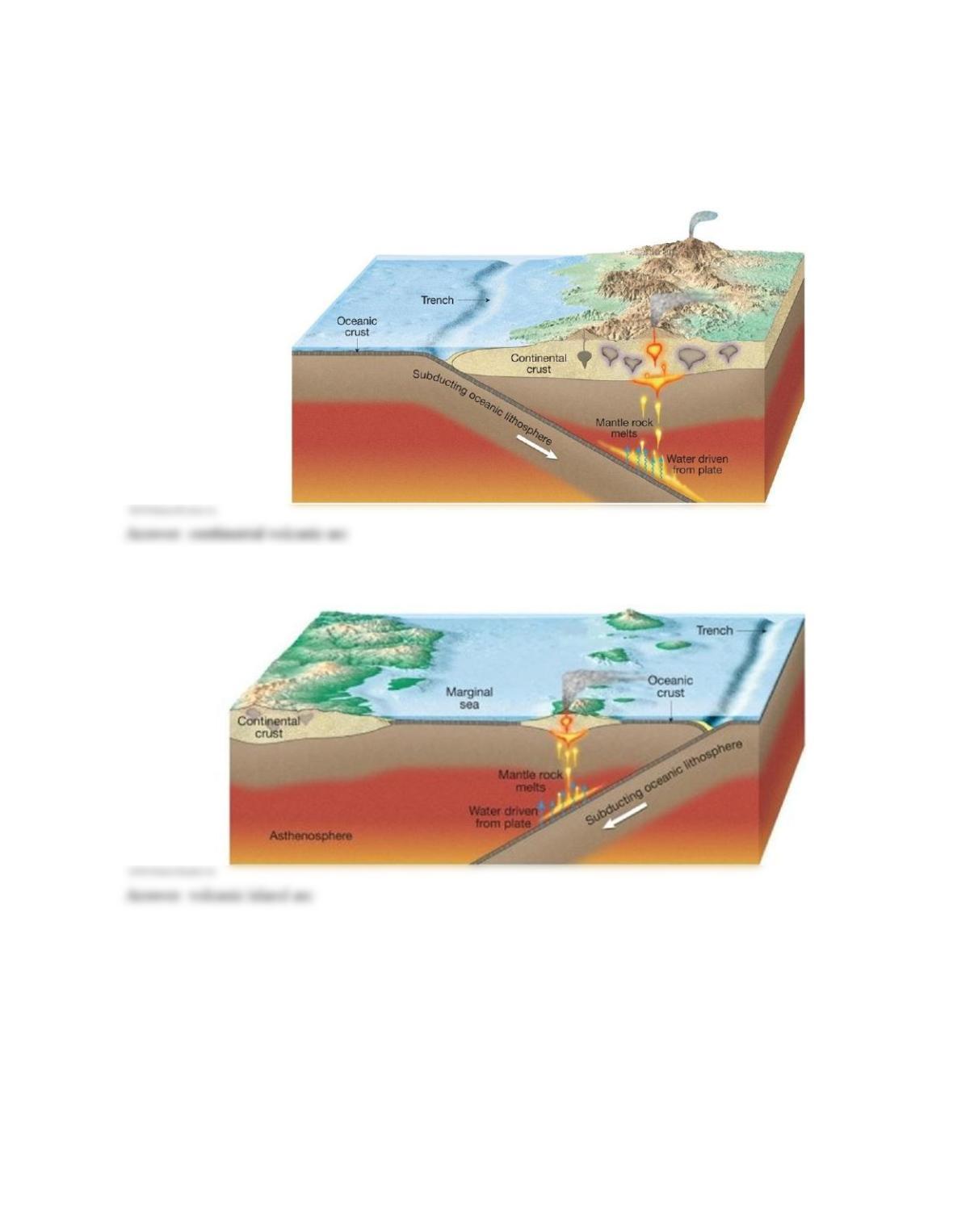
76)
What is the name of the chain of volcanoes below that forms at an oceanic to continental plate boundary?
77)
What is the name of the chain of volcanoes below that forms at an oceanic to oceanic plate boundary?
13
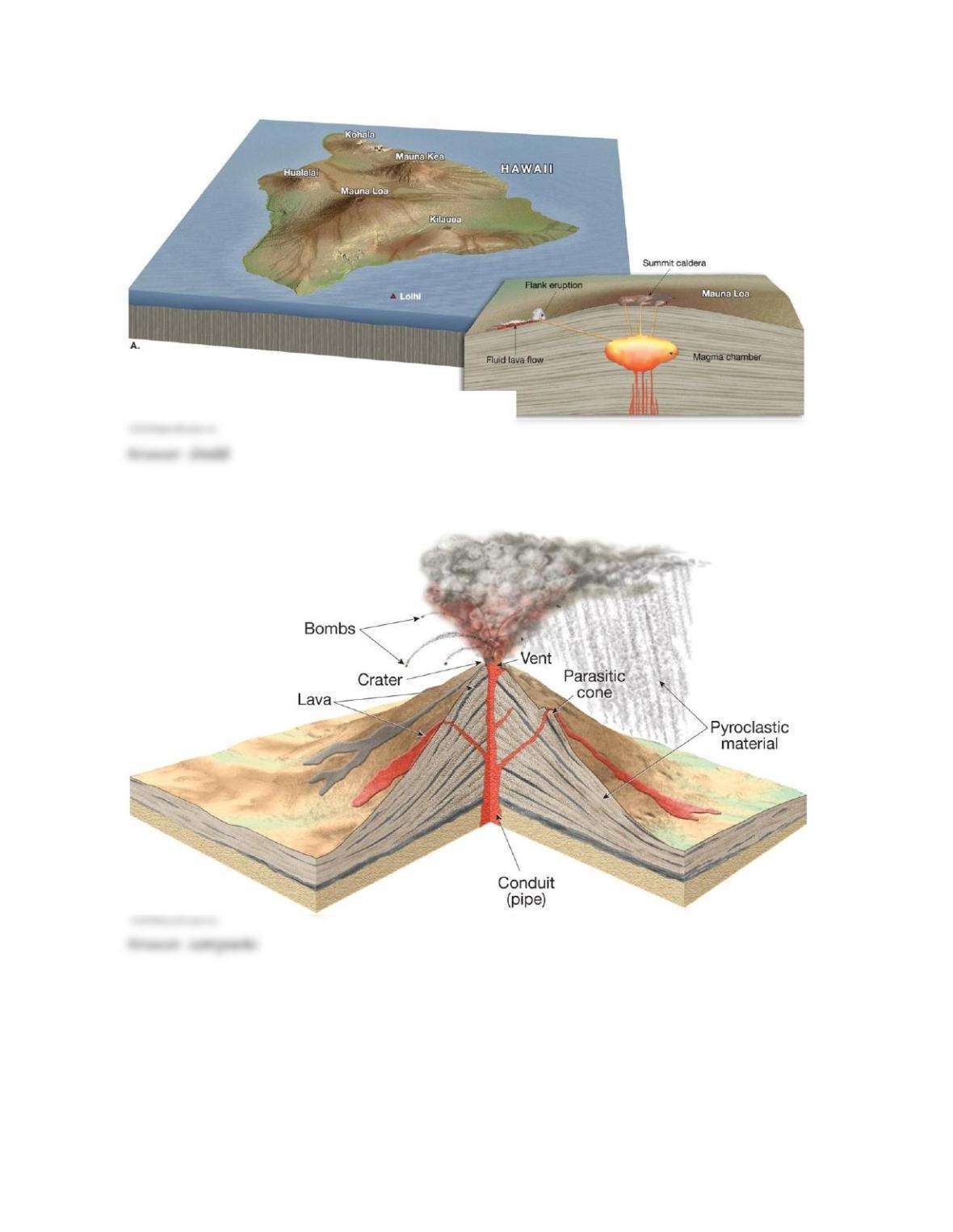
78)
What type of volcano is shown in the diagram below?
79)
What type of volcano is shown in the diagram below?
14
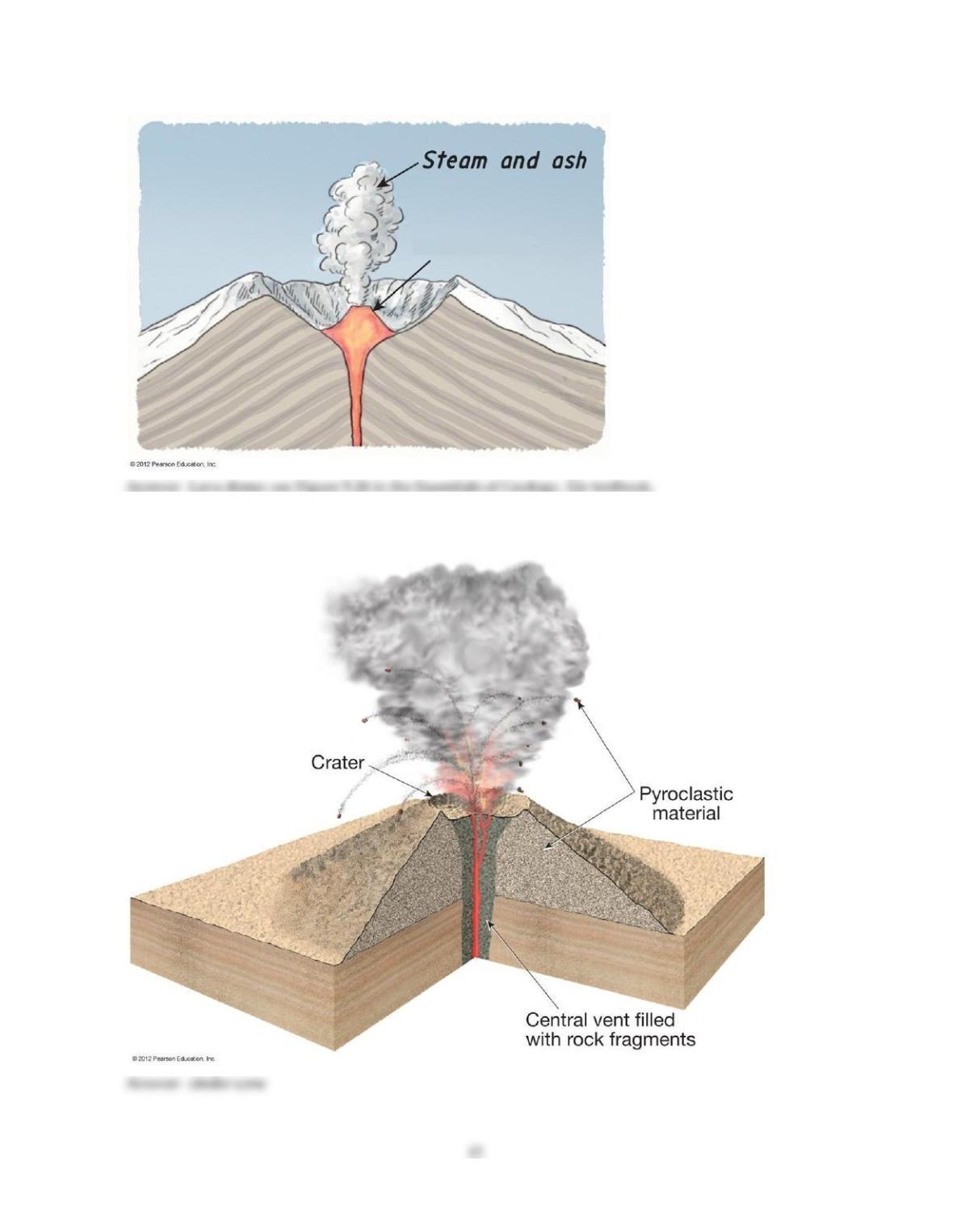
80)
What volcanic feature is shown in the diagram below?
81)
What type of volcano is shown in the diagram below?
Answer Key
Testname: C5
Answer Key
Testname: C5