
Chapter 5 — Intercompany Transactions: Bonds, Cash
Flow, EPS, and Unconsolidated Investments
MULTIPLE CHOICE
1. The usual impetus for transactions that create a long-term debtor–
creditor relationship between members of a consolidated group is due to
the:
a.
subsidiary’s ability to borrow larger amounts of capital at more
favorable terms than would be available to the parent.
b.
parent’s ability to borrow larger amounts of capital at more
favorable terms than would be available to the subsidiary.
c.
parent’s desire to decentralize asset management and credit
control.
d.
parent’s desire to eliminate long-term debt.
2. The motivation of a parent company to purchase the outstanding bonds of
a subsidiary could be to:
a.
replace the existing debt with new debt at a lower interest rate.
b.
reduce the parent company’s acquisition price for the subsidiary.
c.
increase the parent company’s ownership percentage in the
subsidiary.
d.
create interest revenue to offset interest expense in future
income statements.
3. Company S is a 100%-owned subsidiary of Company P. Company S has
outstanding 8%, 10-year bonds sold to yield 7%. On January 1 of the
current year, Company P purchased all of the Company S outstanding
bonds at a price that reflected the current 9% effective interest rate.
How should this event be reflected in the current year’s consolidated
statements?
a.
The bonds remain in the balance sheet and are accounted for at a
7% effective rate.
b.
The bonds remain in the balance sheet and are accounted for at a
9% effective rate.
c.
Retirement of the bonds at an extraordinary gain as of the
purchase date.
d.
Retirement of the bonds at an extraordinary loss as of the
purchase date.

Chapter 5
4. Company S is a 100%-owned subsidiary of Company P. Company S has
outstanding 6%, 10-year bonds sold to yield 7%. On January 1 of the
current year, Company P purchased all of the Company S outstanding
bonds at a price that reflected the current 9% effective interest rate.
How should this event be reflected in the current year’s consolidated
statements?
a.
The bonds remain in the balance sheet and are accounted for at a
7% effective rate.
b.
The bonds remain in the balance sheet and are accounted for at a
9% effective rate.
c.
Retirement of the bonds at an extraordinary gain as of the
purchase date.
d.
Retirement of the bonds at an extraordinary loss as of the
purchase date.
5. Company S is a 100%-owned subsidiary of Company P. Company S has
outstanding 6%, 10-year bonds sold to yield 7%. On January 1 of the
current year, Company P purchased all of the Company S outstanding
bonds at a price that reflected the current 6% effective interest rate.
How should this event be reflected in the current year’s consolidated
statements?
a.
The bonds remain in the balance sheet and are accounted for at a
7% effective rate.
b.
The bonds remain in the balance sheet and are accounted for at a
9% effective rate.
c.
Retirement of the bonds at an extraordinary gain as of the
purchase date.
d.
Retirement of the bonds at an extraordinary loss as of the
purchase date.
6. Intercompany debt which must be eliminated from consolidated financial
statements may results from:
a.
one member of a consolidated group selling its bonds directly to
another member of the group.
b.
one member of a consolidated group advancing funds to another
member of the group so that the member may retire bonds it had
issued to outside parties.
c.
one member of a consolidated group purchasing bonds from outside
parties as an investment that had been issued to outside parities
by another member of the group.
d.
all of the above.

Chapter 5
5-3
7. Elimination procedures for intercompany bonds purchased from outside
parties by another member of the consolidated group are:
a.
not needed except in the period of acquisition if purchased at
par.
b.
not needed except in the period of acquisition if purchased at a
premium or discount.
c.
not needed except in the period of acquisition if only a portion
of the outstanding bonds are purchased.
d.
needed each period as long as there are intercompany bonds.
8. Assuming the correct bond eliminations entry(s) are made for
intercompany bonds, intercompany bond interest expense will appear on:
a.
the consolidated income statement.
b.
the income statement of the bond issuer.
c.
the income statement of the bond purchaser.
d.
none of the above.
9. Assuming the correct bond eliminations entry(s) are made for
intercompany bonds, intercompany bond interest payable will appear on:
a.
the consolidated balance sheet.
b.
the balance sheet of the bond issuer.
c.
the balance sheets of the bond issuer and the bond purchaser.
d.
none of the above.
10. Company S is a 100%-owned subsidiary of Company P. On January 1, 20X9,
Company S has $200,000 of 8% face rate bonds outstanding, which were
issued at face value. The bonds had 5 years to maturity on January 1,
20X9. Premiums or discounts would be amortized on a straight–line
basis. On that date, Company P purchased the bonds for $198,000. The
amount on the consolidated balance sheet relative to the debt is:
a.
bonds payable $200,000.
b.
bonds payable $200,000, discount $2,000.
c.
bonds payable $200,000, discount $1,600.
d.
The bonds do not appear on the balance sheet.
11. Company S is a 100%-owned subsidiary of Company P. On January 1, 20X9,
Company S has $100,000 of 8% face rate bonds outstanding. The bonds had
5 years to maturity on January 1, 20X9, and had an amortized discount
of $5,000. On that date, Company P purchased the bonds for $99,000. The
net adjustment needed to consolidate retained earnings on December 31,
20X9 is __________.
a.
$(4,000)
b.
$(3,200)
c.
$(800)
d.
$0

Chapter 5
5-4
12. Sun Company is a 100%-owned subsidiary of Peter Company. On January 1,
20X1, Sun Company has $500,000 of 8% face rate bonds outstanding, with
an unamortized discount of $5,000 which is being amortized over a 5
year remaining life to maturity. On that date, Peter Company purchased
the bonds for $497,000. The adjustment to the consolidated income of
the two companies needed in the consolidation process for 20X2 (the
following year) is __________.
a.
$2,800
b.
$(400)
c.
$400
d.
$(2,800)
13. Company S is a 100%-owned subsidiary of Company P. Company P purchased,
at a premium, Company S bonds that are outstanding and have a remaining
discount. Consolidation theory takes the position that:
a.
interest expense should be adjusted to reflect the market value of
the bonds on the date of Company P’s purchase.
b.
the debt has been retired at an extraordinary loss.
c.
the debt is outstanding, but should be shown at face value.
d.
the gain or loss on retirement should be allocated over the
remaining life of the bonds.
14. Company S is a 100%-owned subsidiary of Company P. Company P purchased
all the outstanding bonds of Company S at a discount. The bonds had a
remaining issuance premium at the time of Company P’s purchase. The
bonds have 5 years to maturity. At the end of 5 years, retained
earnings:
a.
is greater as a result of the purchase.
b.
is less as a result of the purchase.
c.
is not affected by the purchase.
d.
cannot be determined from the information provided.
15. Company P owns 80% of Company S. On January 1, 20X9 Company S has
outstanding 6% bonds with a face value of $200,000 and an unamortized
discount of $3,000, which is being amortized on a straight-line basis
over a remaining term of 10 years. On January 1, 20X9, Company P
purchased all the bonds for $205,000. The premium also is amortized on
a straight-line basis. The net impact of the purchase on the
noncontrolling interest as of December 31, 20X9, is __________.
a.
$(8,000)
b.
$(1,600)
c.
$(1,440)
d.
$(1,200)

Chapter 5
5-5
16. The purchase of outstanding subsidiary bonds by the parent company has
the same impact on consolidated statements as:
a.
the subsidiary retiring its own debt with the proceeds of new debt
issued to outside parties.
b.
the subsidiary retiring the debt with the proceeds of a loan from
the parent.
c.
the subsidiary retiring the debt with the proceeds of a new stock
issue.
d.
allowing the bonds to continue to be held by outside interests.
17. A subsidiary has outstanding $100,000 of 8% bonds that were issued at
face value. The parent purchased all the bonds for $96,000 with 5 years
remaining to maturity. How will the parent’s use of the effective
interest amortization rather than straight-line amortization of the
discount affect the consolidated statements?
a.
No impact.
b.
Will result in a different gain on retirement
c.
Will result in more interest expense in the first year after the
intercompany purchase.
d.
Will result in less interest expense in the first year after the
intercompany purchase.
18. Powell Company owns an 80% interest in Sauter, Inc. On January 1, 20X1,
Sauter issued $400,000 of 10-year, 12% bonds at a premium of $25,000.
On December 31, 20X5, 5 years after original issuance, Powell purchased
all of the outstanding bonds for $390,000. Both firms use the straight–
line method of amortization.
What is the extraordinary gain on retirement on the 20X5 consolidated
income statement?
a.
$12,500
b.
$22,500
c.
$10,000
d.
$35,000
19. Powell Company owns an 80% interest in Sauter, Inc. On January 1, 20X1,
Sauter issued $400,000 of 10-year, 12% bonds at a premium of $25,000.
On December 31, 20X5, 5 years after original issuance, Powell purchased
all of the outstanding bonds for $390,000. Both firms use the straight–
line method of amortization.
Bond interest expense included in the 20X5 subsidiary income
distribution schedule is __________.
a.
$48,000
b.
$45,500

Chapter 5
5-6
c.
$47,500
d.
$0
20. Subsidiary Company issued $200,000 of 8%, 5-year bonds on January 1,
20X6. The discount on issuance was $12,000. Bond interest is paid
annually on December 31. On December 31, 20X8, Parent Company purchased
one-half of the outstanding bonds for $96,000. Both companies use the
straight-line method of amortization. How much interest expense will
appear on the December 31, 20X8, consolidated income statement?
a.
$18,400
b.
$16,000
c.
$9,200
d.
$8,000
21. Subsidiary Company issued $200,000 of 8%, 5-year bonds on January 1,
20X6. The discount on issuance was $12,000. Bond interest is paid
annually on December 31. On December 31, 20X8, Parent Company purchased
one-half of the outstanding bonds for $96,000. Both companies use the
straight-line method of amortization. How much interest expense will
appear on the December 31, 20X9, consolidated income statement?
a.
$18,400
b.
$16,000
c.
$9,200
d.
$8,000
22. The consolidated income statement in the year one member of a
consolidated group purchases bonds from outside parties includes:
a.
an extraordinary gain if purchased above book value.
b.
an extraordinary gain if purchased below book value.
c.
loss if purchased below book value.
d.
gain if purchased above book value.
23. The consolidated income statement in the year one member of a
consolidated group purchases bonds from outside parties includes a(n):
a.
extraordinary loss if purchased above book value.
b.
extraordinary loss if purchased below book value.
c.
loss if purchased above book value.
d.
loss if purchased above book value.
24. On an income distribution schedule, any gain or loss resulting from
intercompany bonds is absorbed by:
a.
the issuer of the bonds.

Chapter 5
b.
the purchaser of the bonds.
c.
allocation between the issuer and the purchaser.
d.
none of the above
25. In years subsequent to the year one member of a consolidated group
purchases bonds from outside parties, Consolidated Income Statements:
a.
recognize a prorated share of any gain or loss from intercompany
bonds.
b.
recognize a prorated share of any gain but would not show a share
of a loss from intercompany bonds.
c.
recognize a prorated share of any loss but would not show a share
of a gain from intercompany bonds.
d.
would not recognize any gain or loss from intercompany bonds.
26. When one member of a consolidated group purchases only part of the
outstanding bonds of another member of the group (for example, 80% of
the bonds),
a.
all bonds, and all the interest expense and interest revenue
applicable to the bonds should be eliminated.
b.
20% of the bonds, and 20% the interest expense and interest
revenue applicable to the bonds should be eliminated.
c.
80% of the bonds, and 80% the interest expense and interest
revenue applicable to the bonds should be eliminated.
d.
none of the bonds, and none of the interest expense and interest
revenue applicable to the bonds should be eliminated.
27. The cash purchase of a controlling interest in a firm on the statement
of cash flows is considered
a.
an operating activity.
b.
a financing activity.
c.
an investing activity.
d.
as all of the preceding.
28. The cash purchase of a controlling interest in a firm requires
disclosure on the statement of cash flows in the following as a(n)
a.
financing activity only.
b.
financing activity and in the schedule of noncash financing and
investing activity.
c.
investing activity only.
d.
investing activity and in the schedule of noncash financing and
investing activity.

Chapter 5
29. In a noncash purchase of a controlling interest in a firm, disclosure
is required on the statement of cash flows disclosure in the following
as a(n)
a.
financing activity only.
b.
financing activity and in the schedule of noncash financing and
investing activity.
c.
investing activity only.
d.
investing activity and in the schedule of noncash financing and
investing activity.
30. Amortization of excesses in periods subsequent to the purchase would
affect which sections of a cash flow statement?
a.
operating activity
b.
financing activity
c.
investing activity
d.
all of the above
31. The purchase of additional shares directly from a subsidiary by the
parent results in disclosure in which section of a cash flow statement?
a.
operating activities
b.
financing activities
c.
investing activities
d.
not reflected on the statement of cash flows
32. Dividends paid by a subsidiary have the following affect on the
consolidated cash flow
a.
all dividends to the parent and to noncontrolling stockholders
appear on the statement.
b.
only dividends to the parent appear on the statement.
c.
only dividends to NCI appear on the statement.
d.
neither dividends to the parent or to noncontrolling stockholders
appear on the statement

Chapter 5
5-9
33. Which of the following statements is true?
a.
The consolidated statement of cash flows treats the purchase of
intercompany bonds from parties outside the consolidated group as
a retirement of consolidated debt and includes the cash outflow
under cash flows from financing activities.
b.
The consolidated statement of cash flows treats the purchase of
intercompany bonds from parties outside the consolidated group as
a retirement of consolidated debt and includes the cash outflow
under cash flows from investing activities.
c.
The consolidated statement of cash flows treats the intercompany
interest payments and amortization of premiums and/or discounts on
intercompany bonds under operating activities.
d.
The consolidated statement of cash flows treats the intercompany
interest payments and amortization of premiums and/or discounts on
intercompany bonds under investing activities.
34. Assume investments in the stock of firms not included in the
consolidated group result in the nonconsolidated firm reporting income
of $200,000 and the firm paid dividends of $50,000. If the consolidated
firm paid $10,000 more than book value for its 40% interest and regards
the excess as attributable to goodwill, the operating activities,
prepared using the indirect method, would reflect a net increase as a
result of this investment of __________.
a.
$80,000
b.
$70,000
c.
$59,000
d.
$20,000
35..Ponti Company purchased the net assets of the Sorri Company for
$800,000. The net assets of Sorri Company were recorded as follows on
the acquisition date:
Cash……………………………………… $ 50,000
Inventory…………………………………. 150,000
Land……………………………………… 150,000
Building (net)…………………………….. 400,000
Liabilities……………………………….. (200,000)
Net assets………………………………. $ 550,000
=========
The market values were as follows: Inventory, $160,000; Land, $170,000;
Building, $450,000. The excess purchase price is allocated to goodwill.
What is the amount that will appear as cash applied to investing as a
result of this purchase?
a.
$800,000
b.
$720,000
c.
$750,000
d.
$670,000

Chapter 5
36. Company P acquired 80% of the outstanding common stock of the Company S
by issuing common stock with a market value of $550,000. The balance
sheet of Company S was as follows on the acquisition date:
Assets Liabilities and Equity
Cash ……….. $ 50,000 Liabilities………… $120,000
Inventory……. 120,000 Common stock, $10 par.. 100,000
Land………… 100,000 Other paid-in capital.. 150,000
Building (net).. 350,000 Retained earnings…… 250,000
Total……… $620,000 Total……………. $620,000
======== ========
The market values were as follows: Inventory, $130,000; Land, $120,000;
Building, $400,000. What is the amount that will appear as cash–
investing on the consolidated statement of cash flows, as a result of
this purchase?
a.
$600,000
b.
$500,000
c.
$(50,000)
d.
$0
37. Company P acquired 75% of the outstanding common stock of the Company S
by issuing common stock with a market value of $650,000 on January 1,
20X3. The balance sheet of Company S was as follows on the acquisition
date:
Assets Liabilities and Equity
Cash ……….. $100,000 Liabilities………… $100,000
Inventory……. 90,000 Common stock, $10 par.. 100,000
Land………… 150,000 Other paid-in capital.. 200,000
Building (net).. 500,000 Retained earnings…… 440,000
Total……… $840,000 Total……………. $840,000
======== ========
The market values were as follows: Inventory, $180,000; Land, $150,000;
Building, $600,000. What is the amount that will appear as cash–
financing as a result of this purchase?
a.
$560,000
b.
$100,000
c.
$75,000
d.
$0

Chapter 5
5-11
38. Company P acquired 60% of the outstanding common stock of Company S by
issuing common stock with a market value of $400,000 on January 1,
20X3. The balance sheet of Company S was as follows on the acquisition
date:
Assets Liabilities and Equity
Cash ……….. $ 50,000 Liabilities………… $ 80,000
Inventory……. 100,000 Common stock, $10 par.. 100,000
Land………… 100,000 Other paid-in capital.. 120,000
Building (net).. 250,000 Retained earnings…… 200,000
Total……… $500,000 Total……………. $500,000
======== ========
The market values were as follows: Inventory, $130,000; Land, $150,000;
Building, $400,000. The inventory was sold during 20X3, the building
has a 10-year life, and any excess purchase price is attributed to
goodwill. What adjustment is needed to consolidated net income to
arrive at cash flow-operations for 20X4, under the indirect method, as
a result of amortization of excesses from the purchase?
a.
$1,000
b.
$9,000
c.
$14,800
d.
$15,000
39. Company P purchased an 80% interest in Company S on January 1, 20X3, at
a price in excess of book value, such that a patent arises in the
consolidation process. As a result of amortizing the patent on the
consolidated income statement, where would an adjustment be required in
the following sections of the consolidated statement of cash flows?
Operating Investing Financing No Adjustment
a.
Yes No No No
b.
No Yes No No
c.
No No Yes No
d.
No No No Yes
40. A parent company purchased all the outstanding bonds of its subsidiary.
Will this cash transaction appear in the following sections of the
consolidated statement of cash flows?
Operating Investing Financing No Adjustment
a.
Yes No No No
b.
No Yes No No
c.
No No Yes No

Chapter 5
d.
No No No Yes
41. A parent company owns 80% of the common stock of its subsidiary. During
the current year, the parent purchases an additional 10% interest from
noncontrolling shareholders. On which line of the following sections of
the consolidated statement of cash flows would this cash transaction
appear?
Operating Investing Financing No Adjustment
a.
Yes No No No
b.
No Yes No No
c.
No No Yes No
d.
No No No Yes
42. Basic Earnings Per Share (BEPS) is calculated by dividing
a.
consolidated net income by parent company outstanding stock.
b.
consolidated net income by parent company outstanding stock and
subsidiary outstanding stock.
c.
consolidated net income by parent company outstanding stock and
subsidiary noncontrolling outstanding stock.
d.
the controlling interest in net income by parent company
outstanding stock.
43. When the acquisition of a subsidiary occurs during a reporting period
using the purchase method, the computation of both BEPS and DEPS
includes subsidiary income
a.
and subsidiary securities for the entire period.
b.
for the entire period and the number of subsidiary shares weighted
for the partial period.
c.
for the partial period and the number of subsidiary shares
weighted for the partial period
d.
for the partial period and the number of subsidiary shares entire
period

Chapter 5
44. Company P owns a 30% interest in Company S and accounts for the
investment under the sophisticated equity method. The investment was
purchased at underlying book value, and there is no excess of cost or
book value. Company S sells merchandise to Company P at cost plus 25%.
Intercompany sales during 20X1 were $100,000. There were $20,000 worth
of such goods in Company P’s beginning inventory and $30,000 worth of
such goods in Company P’s ending inventory. Company S’s reported income
for 20X1 is $40,000, and no dividends were paid. What amount will
Company P record as investment income in 20X1?
a.
$12,000
b.
$11,400
c.
$9,750
d.
$4,500
45. Company P Company uses the equity method to account for its January 1,
20X1, purchase of 30% of Company S’s common stock. On January 1, 20X1,
the market values of Company S’s FIFO inventory and land exceed their
book values. How do these excesses of market values over book values
affect Company P’s reported equity in Company S’s 20X1 earnings?
Inventory Excess Land Excess
a.
Decrease Decrease
b.
Decrease No effect
c.
Increase Increase
d.
Increase No effect
46. Company P purchased a 30% interest in Company S on January 1, 20X1, for
$100,000. The price was equal to the book value of the equity acquired.
The reported income (loss) and dividends paid by the Company S are as
follows:
Income Dividends
Year (loss) Paid
20X1……………………………. $ 5,000 $5,000
20X2……………………………. (270,000) 0
20X3……………………………. (100,000) 0
20X4……………………………. 50,000 5,000
Investment income reported in 20X4 under the sophisticated equity
method would be __________.
a.
$15,000
b.
$13,500
c.
$5,500
d.
$0
Chapter 5
PROBLEMS
1. The Planes Company owns 100% of the outstanding common stock of the
Sands Company. Sands issued $100,000 of face value, 9%, 10-year bonds
on January 1, 20X3, for $96,000. The discount is being amortized on a
straight-line basis. On January 1, 20X8, Planes purchased all the bonds
as an investment for $95,000.
Required:
Be specific in answering the following questions and include numerical
explanations.
a.
How will this bond issue be recorded and accounted for in 20X8
on the separate books of Planes and Sands?
b.
How will this bond issue be accounted for on the 20X8
consolidated statements?
c.
How will this bond issue be recorded and accounted for in 20X9
on the separate books of Planes and Sands?
d.
How will this bond issue be accounted for on the 20X9
consolidated statements?
as outstanding and will record interest expense of $9,400
($9,000 cash + $400 discount amortization).
price). No interest expense or revenue should appear in the
consolidated statements.
will continue to treat the bonds as outstanding and will
record $9,400 interest expense.
investment or as a liability. No interest expense or revenue
will be applicable to these bonds.
Chapter 5
2. On January 1, 20X8, Pope Company acquired 100% of the common stock of
Siegel Company for $300,000. On this date Siegel had total owners’
equity of $250,000.
Any excess of cost over book value is attributable to goodwill.
Also on July 1, 20X8, Siegel Company sold to outside investors $300,000
par value of 10-year, 10% bonds. The price received was equal to par.
The bonds pay interest semi-annually on July 1 and January 1.
During 20X8 and 20X9, Pope has appropriately accounted for its
investment in Siegel using the simple equity method.
During early 20X9, market interest rates on bonds similar to those
issued by Siegel decreased to 8%. As a result, the market value of the
bonds increased. On July 1, 20X9, Pope purchased $100,000 par value of
Siegel’s bonds, paying $163,000. Pope still holds the bonds on December
31, 20X9 and has amortized the premium, using the straight-line method.
Required:
Complete the Figure 5-2 worksheet for consolidated financial statements
for the year ended December 31, 20X9. Round all computations to the
nearest dollar.
Chapter 5
3. On January 1, 20X8, Pope Company acquired 100% of the common stock of
Siegel Company for $300,000. On this date Siegel had total owners’
equity of $250,000.
Any excess of cost over book value is attributable to goodwill.
Also on July 1, 20X8, Siegel Company sold to outside investors $200,000
par value of 10-year, 10% bonds. The price received was equal to par.
The bonds pay interest semi-annually on July 1 and January 1.
During 20X8 and 20X9, Pope has appropriately accounted for its
investment in Siegel using the simple equity method.
During early 20X9, market interest rates on bonds similar to those
issued by Siegel decreased to 8%. As a result, the market value of the
bonds increased. On July 1, 20X9, Pope purchased $100,000 par value of
Siegel’s bonds, paying $112,695. Pope still holds the bonds on December
31, 20X9 and has amortized the premium, using the effective-interest
method.
Required:
Complete the Figure 5-3 worksheet for consolidated financial statements
for the year ended December 31, 20X9. Round all computations to the
nearest dollar.
4. On January 1, 20X8, Pope Company acquired 100% of the common stock of
Siegel Company for $300,000. On this date Siegel had total owners’
equity of $250,000.
Any excess of cost over book value is attributable to goodwill.
Also on January 1, 20X8, Siegel Company sold to outside investors
$300,000 par value of 10-year, 10% bonds. The price received was equal
to par. The bonds pay interest semi-annually on July 1 and January 1.
During 20X8 and 20X9, Pope has appropriately accounted for its
Investment in Siegel using the simple equity method.
During 20X8, market interest rates on bonds similar to those issued by
Siegel decreased to 8%. As a result, the market value of the bonds
increased. On December 31, 20X8, Pope purchased $150,000 par value of
Siegel’s bonds, paying $163,000. Pope still holds the bonds on December
31, 20X9 and has amortized the premium, using the straight-line method.
Required:
Complete the Figure 5-4 worksheet for consolidated financial statements
for the year ended December 31, 20X9. Round all computations to the
nearest dollar.
Chapter 5
5. On January 1, 20X8, Parent Company purchased 90% of the common stock of
Subsidiary Company for $350,000. On this date, Subsidiary had common
stock, other paid in capital, and retained earnings of $20,000, $
130,000, and $200,000 respectively.
Any excess of cost over book value is due to goodwill.
In both 20X8 and 20X9, Parent has accounted for the Investment in
Subsidiary using the cost method.
On January 1, 20X8, Subsidiary sold $100,000 par value of 6%, ten-year
bonds for $97,000. The bonds pay interest semi-annually on January 1
and July 1 of each year.
On January 1, 20X9, Parent repurchased all of Subsidiary’s bonds for
$96,400. The bonds are still held on December 31, 20X9.
Both companies have correctly recorded all entries relative to bonds
and interest, using straight-line amortization for premium or discount.
Required:
Complete the Figure 5-5 worksheet for consolidated financial statements
for the year ended of December 31, 20X9. Round all computations to the
nearest dollar.
6. On January 1, 20X8, Parent Company purchased 90% of the common stock of
Subsidiary Company for $350,000. On this date, Subsidiary had common
stock, other paid in capital, and retained earnings of $20,000, $
130,000, and $200,000, respectively.
Any excess of cost over book value is due to goodwill.
In both 20X8 and 20X9, Parent has accounted for the Investment in
Subsidiary using the simple equity method.
On January 1, 20X8, Subsidiary sold $100,000 par value of 6%, ten-year
bonds for $97,000. The bonds pay interest semi-annually on January 1
and July 1 of each year.
On January 1, 20X9, Parent repurchased all of Subsidiary’s bonds for
$96,400. The bonds are still held on December 31, 20X9.
Both companies have correctly recorded all entries relative to bonds
and interest, using straight-line amortization for premium or discount.
Required:
Complete the Figure 5-6 worksheet for consolidated financial statements
for the year ended of December 31, 20X9. Round all computations to the
nearest dollar.
5-20
7. On January 1, 20X8, Parent Company purchased 90% of the common stock of
Subsidiary Company for $355,000. On this date, Subsidiary had common
stock, other paid in capital, and retained earnings of $20,000,
$130,000, and $200,000 respectively.
Any excess of cost over book value is due to goodwill.
In both 20X8 and 20X9, Parent has accounted for the Investment in
Subsidiary using the simple equity method.
On July 1, 20X8, Subsidiary sold $100,000 par value of 9%, ten-year
bonds for $106,755, which resulted in an effective interest rate of 8%.
The bonds pay interest semi-annually on January 1 and July 1 of each
year. Subsidiary uses the effective-interest method of amortizing the
premium.
An amortization table for 20X8 and 20X9 is presented below:
Carrying Carrying Effective Interest Nominal Premium
Value on Value Interest Expense Interest Write-off
7-1-X8 $106,755 4% $4,270 $4,500 – $230
– 230
1-1-X9 106,525 4% 4,261 4,500 – 239
– 239
7-1-X9 106,286 4% 4,251 4,500 – 249
– 249
12-31-X9 $106,037
========
On July 1, 20X9, Parent repurchased all of Par’s bonds for $94,153,
which resulted in an effective interest rate of 10%. The bonds are
still held at year end.
Both companies have correctly recorded all entries relative to bonds
and interest.
Chapter 5
Required:
Complete the Figure 5-7 worksheet for consolidated financial statements
for the year ended of December 31, 20X9. Round all computations to the
nearest dollar.
Chapter 5
8. On January 1, 20X7, Porter Company purchased 80% of the common stock of
Singer Company for $372,000. On this date Singer had total owners’
equity of $440,000.
Any excess of cost over book value is due to goodwill.
During 20X7 and 20X8, Porter has appropriately accounted for its
investment in Singer using the simple equity method.
On January 1, 20X8, Porter held merchandise acquired from Singer for
$30,000. During 20X8, Singer sold merchandise to Porter for $90,000, of
which $20,000 is held by Porter on December 31, 20X2. Singer’s usual
gross profit on affiliated sales is 40%.
On December 31, 20X8, Porter still owes Singer $10,000 for merchandise
acquired in December.
On December 31, 20X7, Porter sold $100,000 par value of 10%, 10-year
bonds for $102,000. Porter uses the straight-line method of
amortization for the premium. The bonds pay interest semiannually on
June 30 and December 31.
On December 31, 20X8, Singer repurchased $50,000 par value of the
bonds, paying $49,100. Straight-line amortization is used.
Required:
Complete the Figure 5-8 worksheet for consolidated financial statements
for the year ended December 31, 20X8. Round all computations to the
nearest dollar.
5-23
9. On January 1, 20X7, Porter Company purchased 80% of the common stock of
Singer Company for $372,000. On this date Singer had total owners’
equity of $440,000.
Any excess of cost over book value is due to goodwill.
During 20X7, 20X8, and 20X9, Porter has appropriately accounted for its
investment in Singer using the simple equity method.
On January 1, 20X9, Porter held merchandise acquired from Singer for
$40,000. During 20X9, Singer sold merchandise to Porter for $120,000,
of which $10,000 is held by Porter on December 31, 20X9. Singer’s usual
gross profit on affiliated sales is 40%.
On December 31, 20X9, Porter still owes Singer $5,000 for merchandise
acquired in December.
On December 31, 20X7, Porter sold $100,000 par value of 10%, 10-year
bonds for $102,000. Porter uses the straight-line method of
amortization for the premium. The bonds pay interest semi-annually on
June 30 and December 31.
On December 31, 20X8, Singer repurchased $50,000 par value of the
bonds, paying $49,100. Singer uses the straight-line method of
amortization for the discount. The bonds are still held on December 31,
20X9.
Required:
Complete the Figure 5-9 worksheet for consolidated financial statements
for the year ended December 31, 20X9. Round all computations to the
nearest dollar.
Chapter 5
Chapter 5
5-25
10. VERTICAL WORKSHEET PROBLEM
On January 1, 20X7, Porter Company purchased 80% of the common stock of
Singer Company for $372,000. On this date Singer had total owners’
equity of $440,000.
Any excess of cost over book value is due to goodwill.
During 20X7, 20X8, and 20X9, Porter has appropriately accounted for its
investment in Singer using the simple equity method.
On January 1, 20X9, Porter held merchandise acquired from Singer for
$40,000. During 20X9, Singer sold merchandise to Porter for $120,000,
of which $10,000 is held by Porter on December 31, 20X9. Singer’s usual
gross profit on affiliated sales is 40%
On December 31, 20X9, Porter still owes Singer $5,000 for merchandise
acquired in December
On December 31, 20X7, Porter sold $100,000 par value of 10%, 10-year
bonds for $102,000. Porter uses the straight-line method of
amortization for the premium. The bonds pay interest semi-annually on
June 30 and December 31.
On December 31, 20X8, Singer repurchased $50,000 par value of the
bonds, paying $49,100. Singer uses the straight-line method of
amortization for the discount. The bonds are still held on December 31,
20X9.
Required:
Complete the Figure 5-10 worksheet for consolidated financial
statements for the year ended December 31, 20X9. Round all computations
to the nearest dollar.
Chapter 5

Chapter 5
5-27
11. On January 1, 20X7, Parent Company purchased 80% of the common stock of
Subsidiary Company for $402,000. On this date Subsidiary had total
owners’ equity of $440,000.
Any excess of cost over book value is due to goodwill.
During 20X7 and 20X8, Parent has appropriately accounted for its
investment in Subsidiary using the simple equity method.
On January 1, 20X8, Parent held merchandise acquired from Subsidiary
for $30,000. During 20X8, Subsidiary sold merchandise to Parent for
$100,000, of which $50,000 is held by Parent on December 31, 20X8.
Subsidiary’s usual gross profit on affiliated sales is 40%.
On December 31, 20X8, Parent still owes Subsidiary $10,000 for
merchandise acquired in December.
On December 31, 20X7, Parent sold $100,000 par value of 11%, 10-year
bonds for $106,232, which resulted in an effective interest rate of
10%. The bonds pay interest semi-annually on June 30 and December 31.
Parent uses the effective interest method of amortization for the
premium.
An amortization table for 20X2 is presented below:
Carrying Carrying Effective Interest Nominal Premium
Value on Value Interest Expense Interest Write-off
12-31-X7 $106,232 5% $5,312 $5,500 – $188
– 188
6-30-X8 106,044 5% 5,302 5,500 – 198
– 198
12-31-X8 $105,846
========
On December 31, 20X8, Subsidiary repurchased $50,000 par value of the
bonds, paying a price equal to par.
Required:
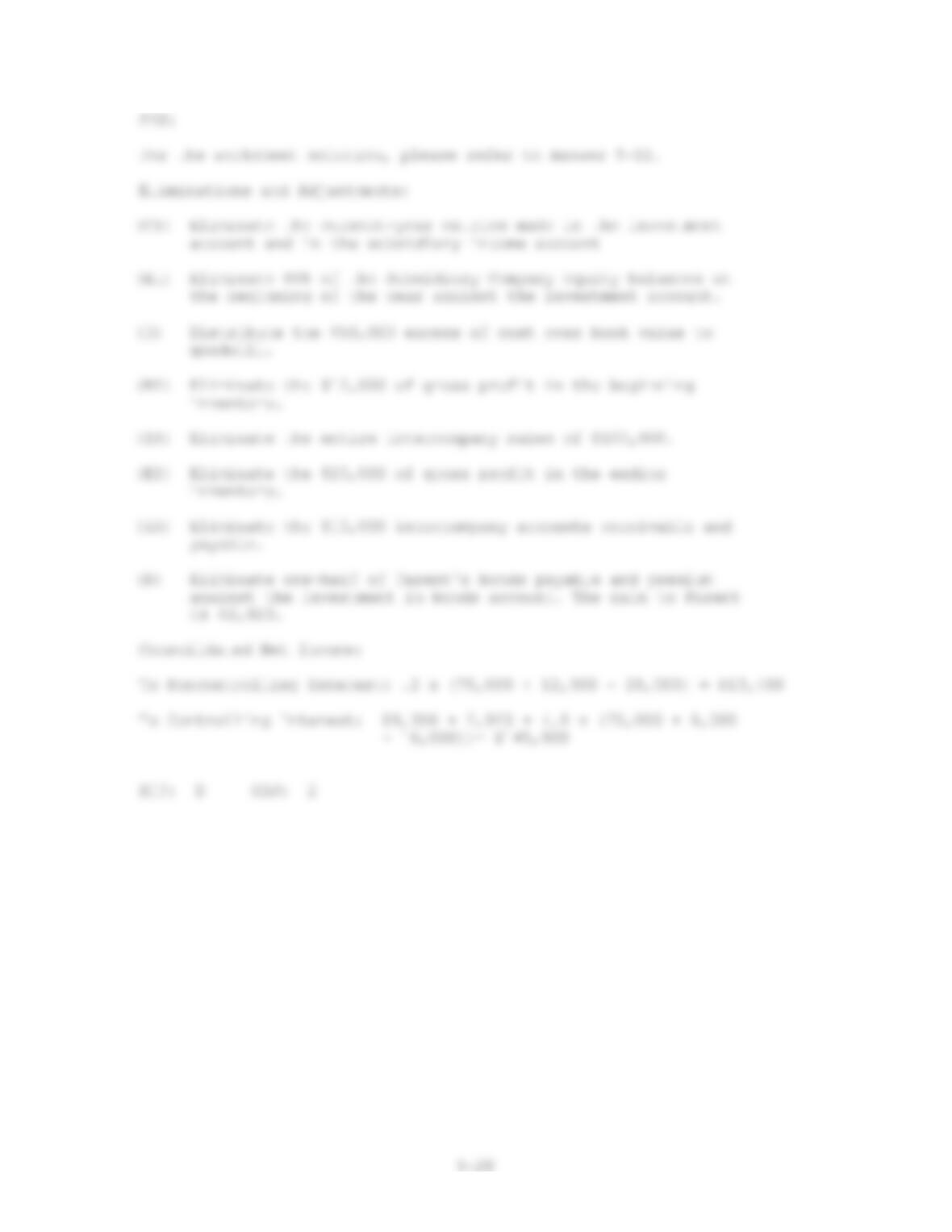
Complete the Figure 5-11 worksheet for consolidated financial
statements for the year ended December 31, 20X8. Round all computations
to the nearest dollar.
Chapter 5

Chapter 5
5-29
12. On January 1, 20X7, Parent Company purchased 80% of the common stock of
Subsidiary Company for $402,000. On this date Subsidiary had total
owners’ equity of $440,000. Any excess of cost over book value is due
to goodwill.
During 20X7, 20X8, and 20X9, Parent has appropriately accounted for its
investment in Subsidiary using the simple equity method.
On January 1, 20X9, Parent held merchandise acquired from Subsidiary
for $50,000. During 20X9, Subsidiary sold merchandise to Parent for
$120,000, of which Parent holds $30,000 on December 31, 20X9.
Subsidiary’s gross profit on sales is 40%. On December 31, 20X9, Parent
still owes Subsidiary $5,000 for merchandise.
On December 31, 20X9, Parent sold $100,000 par value of 11%, 10-year
bonds for $106,232, which resulted in an effective interest rate of
10%. The bonds pay interest semi-annually on June 30 and December 31.
Parent uses the effective-interest method of amortization for the
premium.
An amortization table for 20X2 and 20X3 is presented below:
Carrying Carrying Effective Interest Nominal Premium
Value on Value Interest Expense Interest Write-off
12-31-X7 $106,232 5% $5,312 $5,500 – $188
– 188
6-30-X8 106,044 5% 5,302 5,500 – 198
– 198
12-31-X8 105,846 5% 5,292 5,500 – 208
– 208
6-30-X9 105,638 5% 5,282 5,000 – 218
– 218
12-31-X9 $105,420
========
On December 31, 20X8, Subsidiary repurchased $50,000 par value of the
bonds, paying a price equal to par. The bonds are still held on
December 31, 20X9.
On December 31, 20X9, Parent sold equipment with a cost of $50,000 and
accumulated depreciation of $30,000 to Subsidiary for $40,000.
Subsidiary will use the equipment beginning in 20X0.
Required:
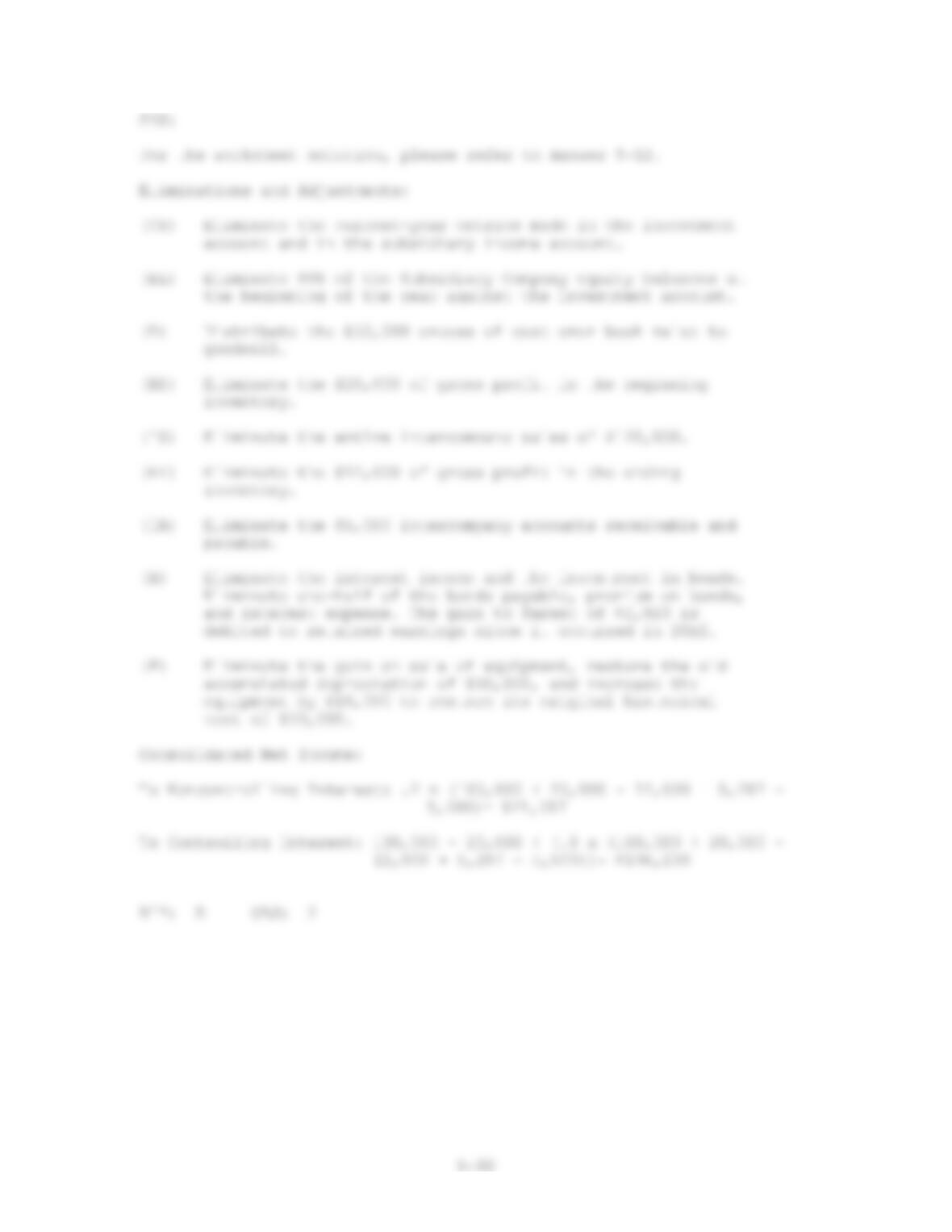
Complete the Figure 5-12 worksheet for consolidated financial
statements for the year ended December 31, 20X9. Round all computations
to the nearest dollar.
Chapter 5
Chapter 5
5-31
13. On January 1, 20X7, Parent Company purchased 80% of the common stock of
Subsidiary Company for $402,000. On this date Subsidiary had total
owners’ equity of $440,000 including retained earnings of $140,000.
Any excess of cost over book value is due to goodwill.
During 20X7, 20X8, and 20X9, Parent has appropriately accounted for its
investment in Subsidiary using the cost method.
On January 1, 20X9, Parent held merchandise acquired from Subsidiary
for $50,000. During 20X9, Subsidiary sold merchandise to Parent for
$120,000, of which $30,000 is held by Parent on December 31, 20X9.
Subsidiary’s usual gross profit on affiliated sales is 40%. On December
31, 20X9, Parent still owes Subsidiary $5,000 for merchandise acquired
in December.
On December 31, 20X7, Parent sold $100,000 par value of 10%, 10-year
bonds for $102,000. Parent uses the straight-line method of
amortization for the premium. The bonds pay interest semi-annually on
June 30 and December 31.
On December 31, 20X8, Subsidiary repurchased $50,000 par value of the
bonds, paying $49,100. Subsidiary uses the straight-line method of
amortization for the discount. The bonds are still held on December 31,
20X9.
Required:
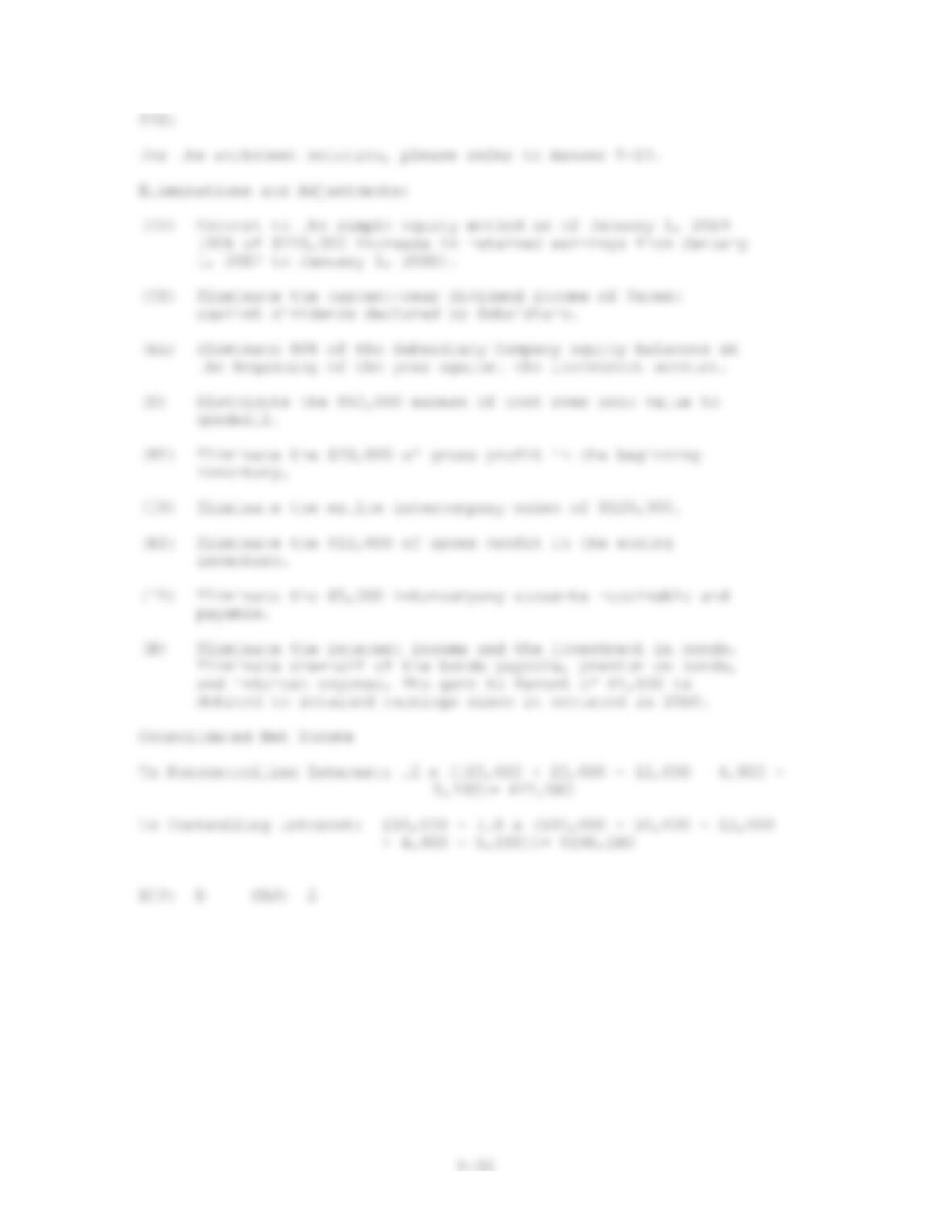
Complete the Figure 5-13 worksheet for consolidated financial
statements for the year ended December 31, 20X9. Round all computations
to the nearest dollar.
Chapter 5

Chapter 5
5-33
14. The separate condensed balance sheets and income statements of Par
Corp. and its wholly owned subsidiary, Sub Corp., are as follows:
Balance Sheets
December 31, 20X8
Assets Par Sub
Current
Cash………………………………. $ 149,000 $ 50,000
Accounts receivable ( net)…………… 190,000 60,000
Inventories………………………… 90,000 40,000
Total current assets………………. $ 429,000 $150,000
Property, plant, and equipment (net)……. $ 361,000 $200,000
Investment in Sub (equity method)………. 320,000 —
Total assets……………………… $1,110,000 $350,000
========== ========
Liabilities and Stockholders’ Equity
Current liabilities
Accounts payable……………………. $ 100,000 $ 70,000
Accrued liabilities…………………. 30,000 20,000
Total current liabilities………….. $ 130,000 $ 90,000
========== ========
Stockholders’ equity
Common stock ($10 par)………………. $ 220,000 $ 30,000
Additional paid–in capital…………… 140,000 100,000
Retained earnings…………………… 620,000 130,000
Total stockholders’ equity…………. $ 980,000 $260,000
Total liabilities and stockholders’
equity…………………………. $1,100,000 $350,000
========== ========
Income Statement
For the Year Ended December 31, 20X8
Par Sub
Sales……………………………….. $1,000,000 $300,000
Cost of goods sold……………………. 770,000 200,000
Gross margin…………………………. $ 230,000 $100,000
Other operating expenses………………. 130,000 50,000
Operating income……………………… $ 100,000 $ 50,000
Equity in earnings of Sub……………… 30,000 —
Income before taxes…………………… $ 130,000 $ 50,000
Provision for income taxes…………….. 40,000 20,000
Net income…………………………. $ 90,000 $ 30,000
========== ========
Chapter 5
5-34
On January 1, 20X8, Par purchased all of Sub $10 par, voting common
stock for $300,000. On January 1, 20X8, the fair value of Sub assets
and liabilities equaled the carrying amounts of $330,000 and $90,000,
respectively. The excess purchase price is attributable to goodwill.
There were no intercompany transactions other than Par’s receipt of
dividends from Sub and Par’s recording of its share of Sub’s earnings.
On June 30, 20X8, Par issued 2,000 shares of common stock for $17 per
share. There were no other changes in either Par’s or Sub’s common
stock during 19X8.
Required:
(1)
Par’s January 1, 20X8, inventory was $110,000. Par’s (parent
only) 20X6 inventory turnover ratio was:
a. 11.1 b. 10.0 c. 7.7 d. 7.0
(2)
The consolidated balance sheet of Par and its subsidiary
should report total consolidated assets of:
a. $1,110,000 b. $1,144,000 c. $1,200,000 d. $1,460,000
(3)
The consolidated balance sheet of Par and its subsidiary
should report total retained earnings of:
a. $620,000 b. $640,000 c. $650,000 d. $750,000
(4)
In the consolidated income statement of Par and its
subsidiary, how much expense should be reported for
amortization?
a. $0 b. $3,000 c. $4,000 d. $10,000
(5)
In computing the consolidated earnings per share for Par and
Sub, the number of shares used should be:
a. 25,000 b. 24,000 c. 22,000 d. 21,000
(6)
In the December 31, 20X8, consolidated balance sheet of Par
and its subsidiary, how much should be reported as total
current assets?
a. $150,000 b. $280,000 c. $429,000 d. $579,000

Chapter 5
5-35
15. Company S has been an 80%-owned subsidiary of Company P since January
1, 20X7. The determination and distribution of excess schedule prepared
at the time of purchase was as follows:
Price paid…………………………… $570,000
Less interest acquired:
Total stockholders’ equity…………… $600,000
Interest acquired…………………… 80% 480,000
Excess of cost over book value…………. $ 90,000
Undervaluation of equipment,
$62,500 x .8 x (10-year life)………… 50,000
Goodwill ……………………………. $ 40,000
========
On January 2, 20X9, Company P issued $120,000 of 8% bonds at face value
to help finance the purchase of 25% of the outstanding common stock of
Alpha Company for $200,000. No excess resulted from this transaction.
Alpha earned $100,000 net income during 20X7 and paid $20,000 in
dividends.
The only change in plant assets during 20X9 was that Company S sold a
machine for $10,000. The machine had a cost of $60,000 and accumulated
depreciation of $40,000. Depreciation expense recorded during 20X7 was
as follows:
Company P Company S Alpha Company
Buildings…………….. $15,000 $ 8,000 $12,000
Machinery…………….. 35,000 20,000 4,000
The 20X9 consolidated income was $180,000, of which the NCI was
$10,000. Company P paid dividends of $12,000, and Company S paid
dividends of $10,000.
Consolidated inventory was $287,000 in 20X8 and $223,000 in 20X9;
consolidated current liabilities were $246,000 in 20X8 and $216,700 in
20X9. Cash increased by $205,700.
Required:
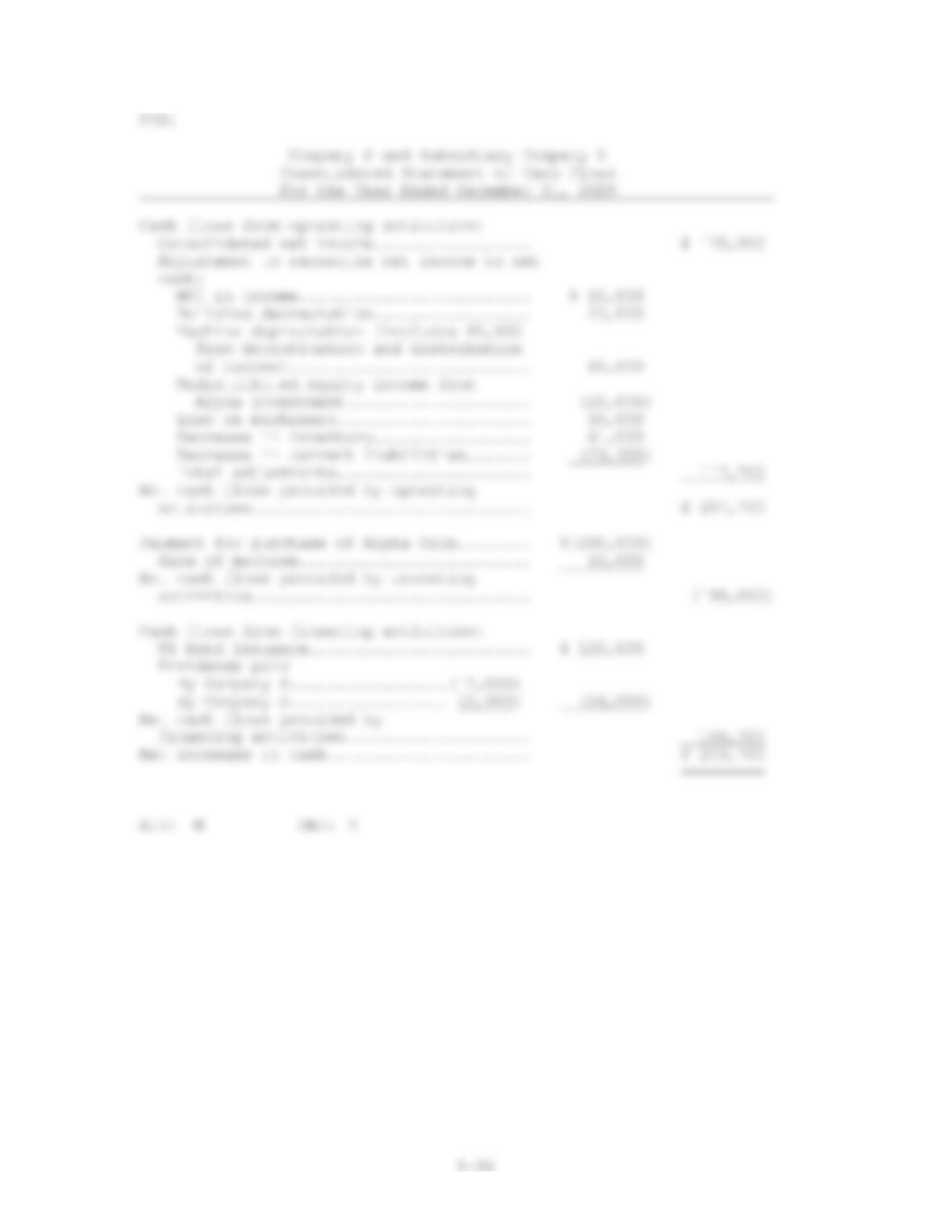
Prepare the 20X9 consolidated statement of cash flows for Company P and
its subsidiary, Company S.
Chapter 5

Chapter 5
5-37
16. Company P purchased an 80% interest in Company S on January 1, 20X3,
for $246,000 cash. The appraisal showed that some of Company S’s
equipment, with a 5-year estimated remaining life, was undervalued
$25,000. The excess purchase price is attributed to goodwill. The
following is the Company S balance sheet on December 31, 20X2:
Assets
Cash…………………………………………… $ 30,000
Inventory………………………………………. 30,000
Property, plant, and equipment……………………. 300,000
Accumulated depreciation…………………………. (90,000)
Total assets………………………………….. $270,000
========
Liabilities and Equity
Current liabilities……………………………… $ 30,000
Long-term liabilities……………………………. 40,000
Common stock ($10 par)…………………………… 150,000
Retained earnings……………………………….. 50,000
Total liabilities and equity……………………. $270,000
========
Comparative balance sheet data are as follows:
December 31, 20X2 December 31, 20X3
(Parent only) (Consolidated)
Cash…………………….. $ 100,000 $ 87,100
Inventory………………… 60,000 84,200
Property, plant, and equipment 950,000 1,346,000
Accumulated depreciation…… (360,000) (574,000)
Goodwill…………………. 0 66,000
Current liabilities……….. (80,000) (115,000)
Long-term liabilities……… (100,000) (130,000)
NCI……………………… 0 (43,000)
Controlling interest:
Common stock ($10 par)…… (350,000) (400,000)
Additional paid–in capital.. (50,000) (90,000)
Retained earnings……….. (170,000) (231,300)
$ 0 $ 0
========= =========
The following information relates to the activities of the two firms
for 20X3:
(1)
Company S issued 5,000 shares of common stock for $18 a
share.
(2)
Company S paid off $10,000 of its long-term debt.
(3)
Company P purchased production equipment for $76,000.
(4)
Consolidated net income was $103,900; the NCI’s share was
$6,000. Depreciation expense taken by Company P and Company S
on their separate books was $92,000 and $28,000,
respectively.
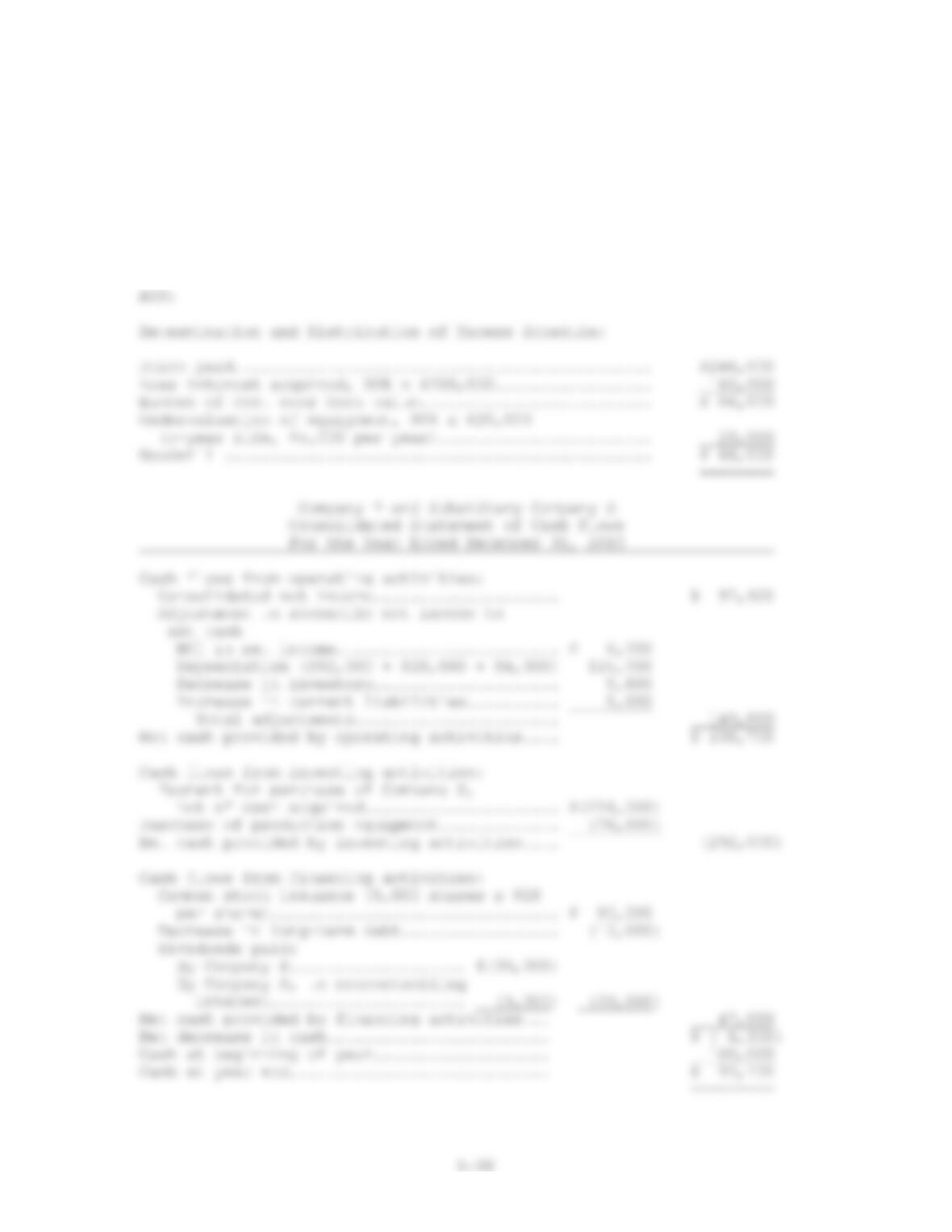
Chapter 5
(5)
Company P paid $30,000 in dividends; Company S paid $15,000.
Required:
Prepare the consolidated statement of cash flows for the year ended
December 31, 20X3, for Company P and its subsidiary, Company S.
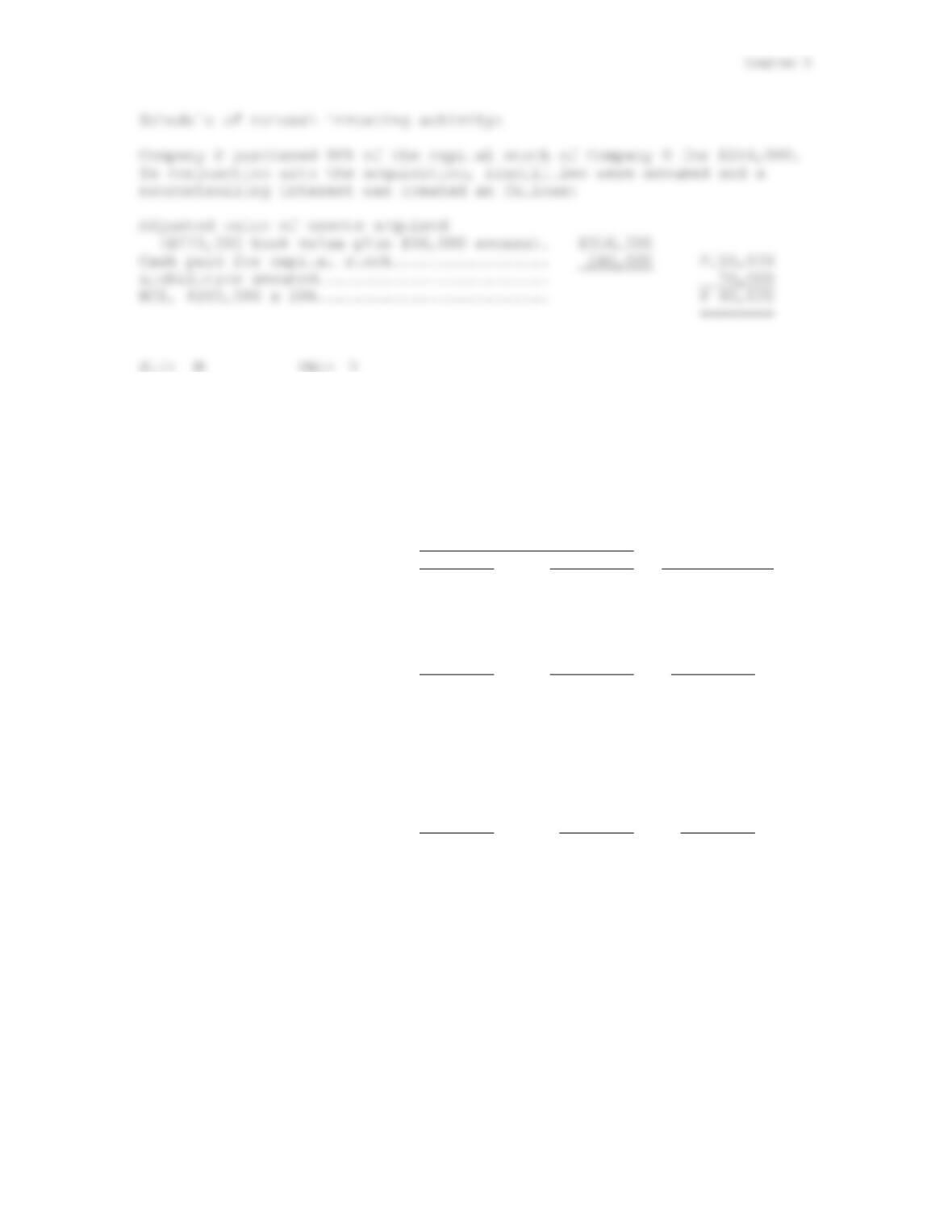
5-39
17. On January 1, 20X1, Price Company purchased 80% of the common stock of
Sidex Company for $228,000.
Presented below are columns for the January 1, 20X1 condensed balance
sheets of Sidex and Price, as well as the December 31, 20X1
consolidated balance sheet.
12-31-20X1
Balances, 1-1-20X1 Consolidated
Sidex Price Balances
Cash…………………. $ 20,000 $ 210,000 $ 90,000
Other Current Assets…… 80,000 100,000 250,000
Land…………………. 50,000 60,000 110,000
Building……………… 200,000 350,000 550,000
Accumulated Depreciation.. (40,000) (100,000) (159,200)
Patent……………….. 18,000
$310,000 $ 620,000 $ 858,800
======== ========= =========
Current Liabilities……. $ 25,000 $120,000 $185,000
Long-term Liabilities….. 50,000 100,000 150,000
Common Stock………….. 20,000 50,000 50,000
Other Paid-in Capital….. 80,000 150,000 150,000
Retained Earnings……… 135,000 200,000 270,800
NCI………………….. 53,000
$310,000 $620,000 $858,800
======== ======== ========
On January 1, 20X1, the only tangible net assets of Sidex which were
undervalued were inventory and building. Inventory, for which FIFO is
used, was undervalued $10,000. The building was worth $15,000 more than
book value. It had a remaining useful life of 10 years on January 1,
20X1 and straight–line depreciation was used. The excess purchase price
was attributed to a patent with a remaining life of 10 years. The Price
company concept (pro rata market value approach) was used in
revaluation of assets.
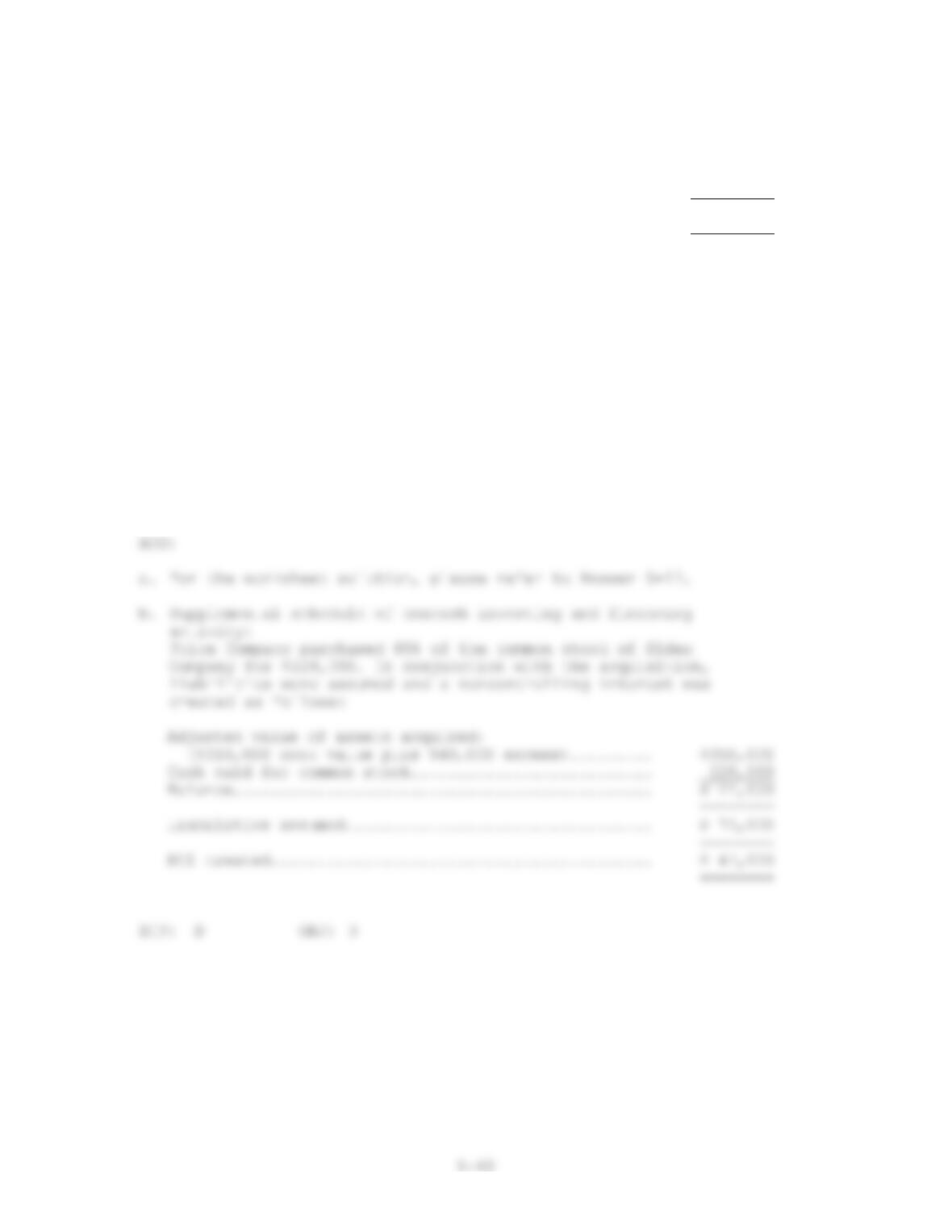
Chapter 5
The 20X1 Consolidated Income Statement showed:
Sales………………………………………….. $ 800,000
Cost of Goods Sold………………………………. (488,000)
Operating Expenses………………………………. (203,200)
Consolidated Net Income………………………….. $ 108,800
To NCI…………………………………………. 8,000
To Controlling Interest………………………….. $ 100,800
=========
Operating expenses include depreciation of $31,200 and patent
amortization of $2,000. In December 19X1, Price declared and paid
dividends of $30,000; Sidex declared and paid dividends of $10,000.
Required:
a.
Complete the Figure 5-17 worksheet for a consolidated
statement of cash flows for 20X1.
b.
Prepare the supplementary disclosure of noncash investing and
financing activities for the statement of cash flows for 20X1.
liabilities were assumed and a noncontrolling interest was

Chapter 5
5-41
18. On January 1, 20X1, Parent Company purchased 80% of the common stock of
Subsidiary Company at a cost of $252,000. Parent paid $152,000 in cash
and issued 1,000 shares of 8% preferred stock with par and market value
of $100,000 for 80% of Subsidiary’s common stock.
Presented below are columns for the January 1, 20X1 condensed balance
sheets of Subsidiary and Parent, as well as the December 31, 20X1
consolidated balance sheet.
12–31-20X1
Balances, 1-1-20X1 Consolidated
Subsidiary Parent Balances
Cash………………….. $ 25,000 $ 160,000 $ 177,000
Other Current Assets……. 90,000 100,000 266,000
Land………………….. 40,000 110,000 150,000
Building………………. 200,000 350,000 650,000
Accumulated Depreciation… (40,000) (100,000) (180,000)
Patent………………… 56,000
$315,000 $ 620,000 $1,119,000
======== ========= ==========
Current Liabilities…….. $ 25,000 $120,000 $ 185,000
Long-term Liabilities…… 50,000 100,000 300,000
Preferred Stock………… 100,000
Common Stock…………… 20,000 50,000 50,000
Other Paid-in Capital…… 80,000 150,000 150,000
Retained Earnings………. 140,000 200,000 280,000
NCI…………………… 54,000
$315,000 $620,000 $1,119,000
======== ======== ==========
On January 1, 20X1, all of the identifiable net assets of Subsidiary
had market values equal to book values, except for an internally–
developed patent. In the consolidated statements, the patent was
amortized over 15 years.
The 20X1 Consolidated Income Statement showed:
Sales………………………………………….. $ 800,000
Cost of Goods Sold………………………………. (480,000)
Operating Expenses………………………………. (204,000)
Consolidated Net Income………………………….. $ 116,000
To NCI…………………………………………. 8,000
To Controlling Interest………………………….. $ 108,000
=========
Operating expenses include depreciation of $40,000, as well as
amortization of the patent. In December 20X1, Parent declared and paid
dividends of $28,000; Subsidiary declared and paid dividends of
$10,000.
On July 1, 20X1, Parent sold land to Subsidiary for cash equal to the
cost of the land, $50,000. Subsidiary then paid cash of $100,000 to
have a building constructed by an independent contractor. To finance
the property acquisition, Subsidiary borrowed $150,000 from the bank on
a long-term note, guaranteed by Parent Company.
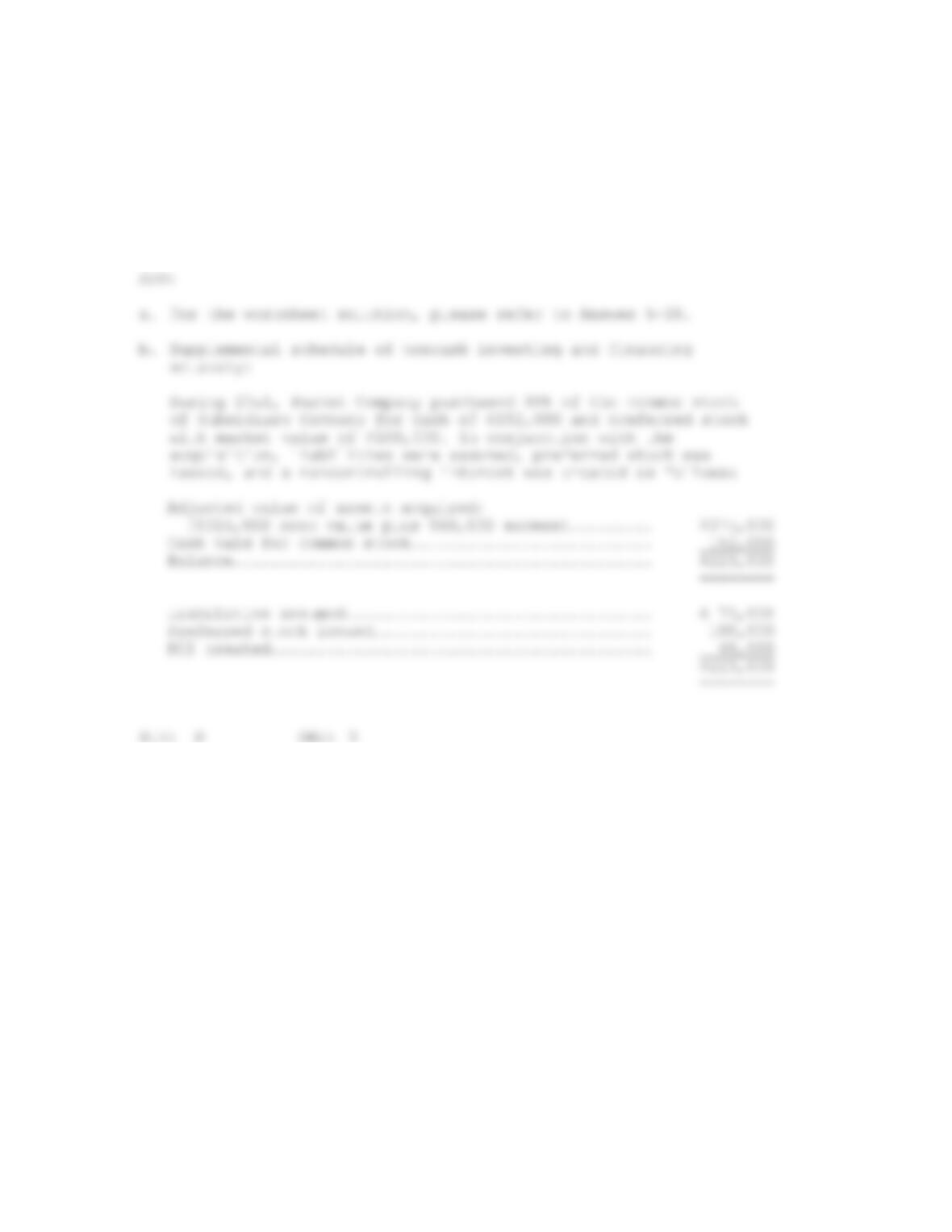
Chapter 5
5-42
Required:
a.
Complete the Figure 5-18 worksheet for a consolidated
statement of cash flows for 20X1.
b.
Prepare the supplementary disclosure of non-cash investing and
financing activities for the statement of cash flows for 20X1.
19. On January 1, 20X6, Company P purchased a 15% interest in Company S. On
July 1, 20X9, Company P purchased an additional 20% interest in Company
S. Both purchases were at a cost in excess of underlying book value.
Company S paid dividends each December from 20X6 to 20X9.
Required:
a.
How would Company P record its investment in Company S in its
financial statements originally issued for 20X6 to 20X8?
b.
Does a 35% ownership interest absolutely require the use of
the equity method?
c.
How will Company P account for its investment in Company S in
its 20X9 financial statements?
d.
How will Company P account for its investment in Company S in
the 20X6 to 20X9 comparative statements published in March
For the worksheet solution, please refer to Answer 5-18.
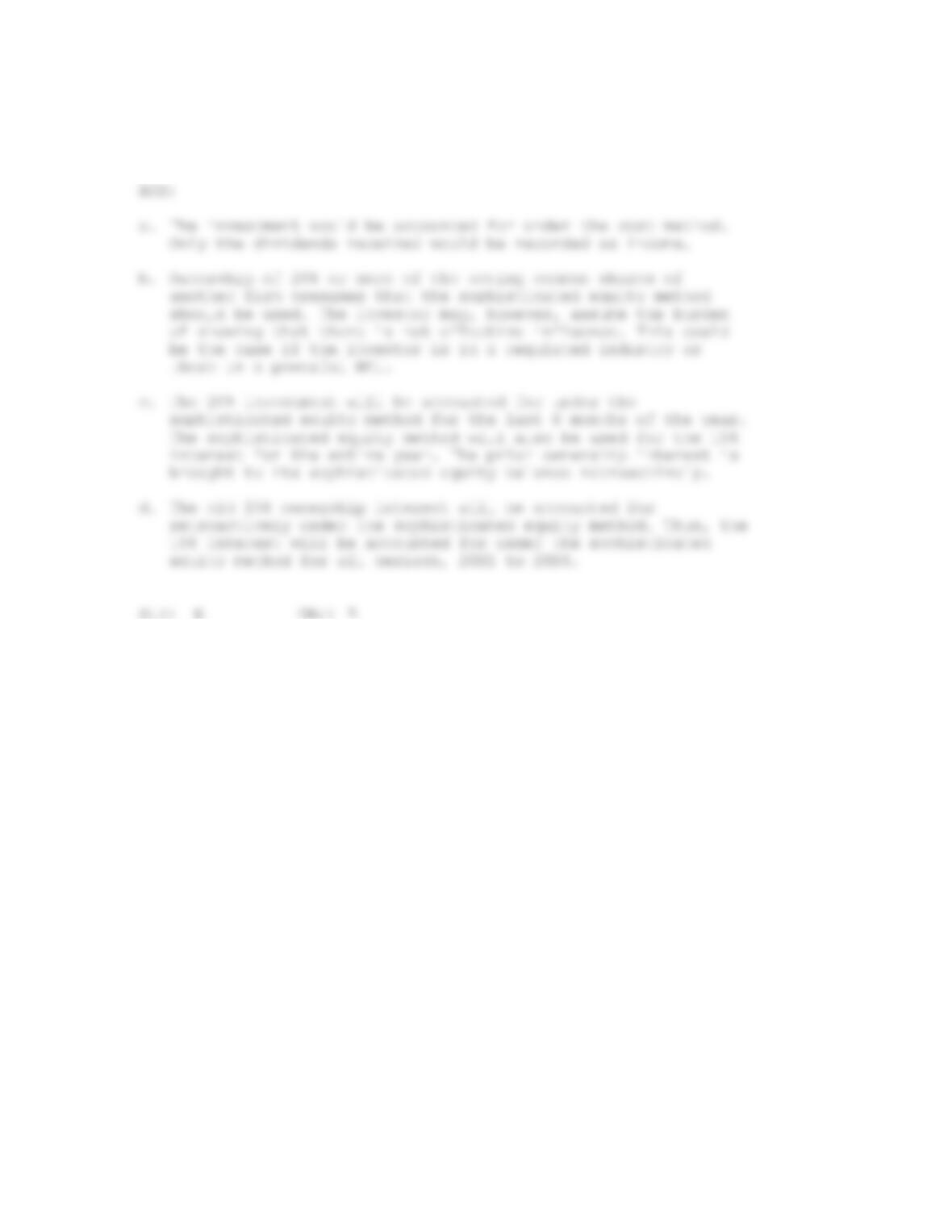
activity:
acquisition, liabilities were assumed, preferred stock was
issued, and a noncontrolling interest was created as follows:
Chapter 5
5-43
20X0?
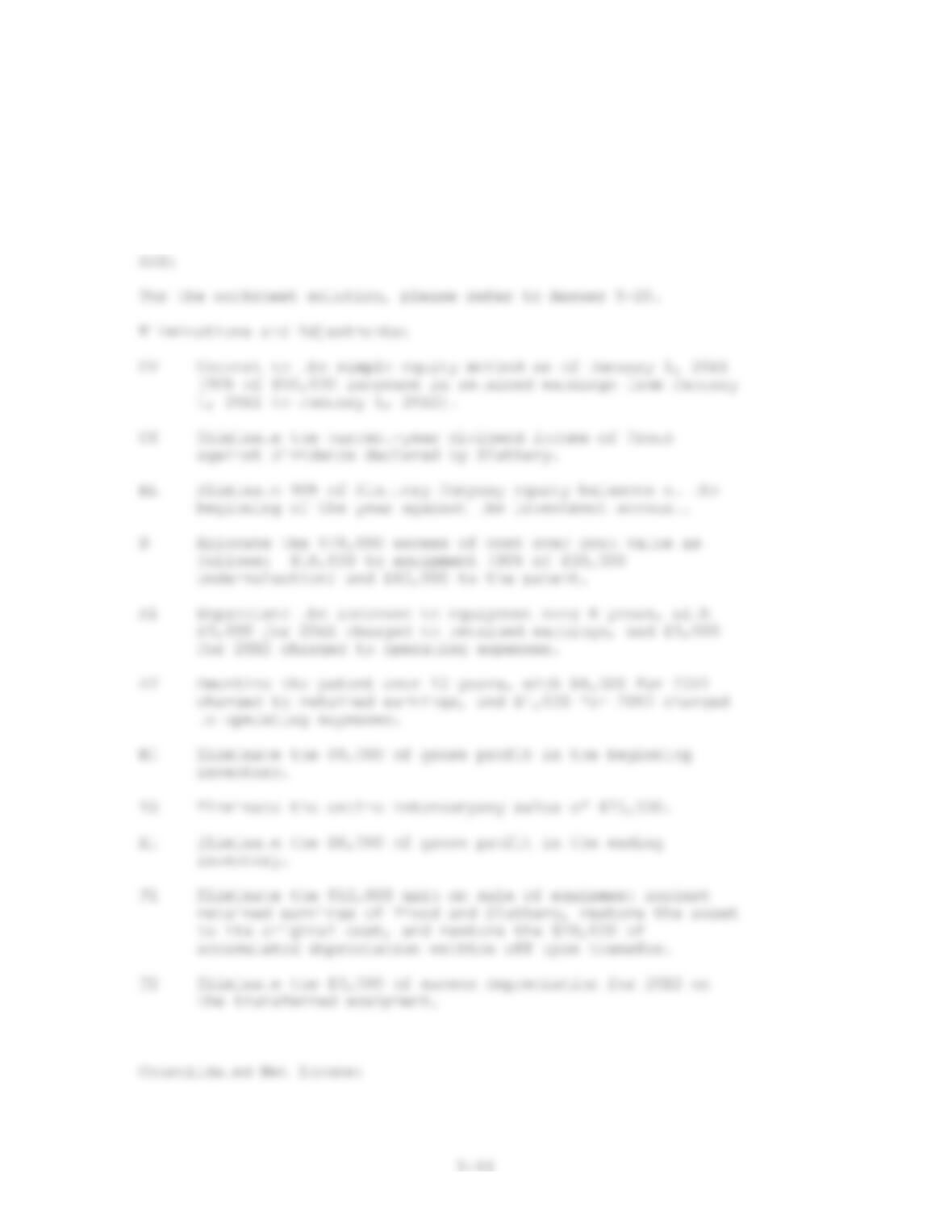
20. VERTICAL WORKSHEET PROBLEM: On January 1, 20X1, Proud Company
purchased 90% of the common stock of Slattery Company for $573,000, in
a taxable combination. On this date Slattery had total owners’ equity
of $550,000, including retained earnings of $300,000.
On January 1, 20X1, the only tangible asset of Slattery which was
undervalued was equipment, which was worth $20,000 more than book
value. The equipment has a remaining life of 6 years and is depreciated
using the straight-line method. The excess purchase price, if any, is
attributed to a patent to be amortized over 15 years.
During 20X1 and 20X2, Proud has appropriately accounted for its
investment in Slattery using the cost method.
On January 1, 20X2, Slattery held merchandise acquired from Proud for
$20,000. During 20X2, Proud sold merchandise to Slattery for $75,000,
of which $15,000 is held by Slattery on December 31, 20X2. Proud’s
usual gross profit on affiliated sales is 40%.
On December 31, 20X1, Slattery sold to Proud some equipment with a cost
of $40,000 and a book value of $20,000. The sales price was $32,000.
Proud is depreciating the equipment over a 4-year life, assuming no
salvage value and using the straight-line method.
Chapter 5
Required:
Complete the Figure 5-20 vertical worksheet for consolidated financial
statements for the year ended December 31, 20X2.
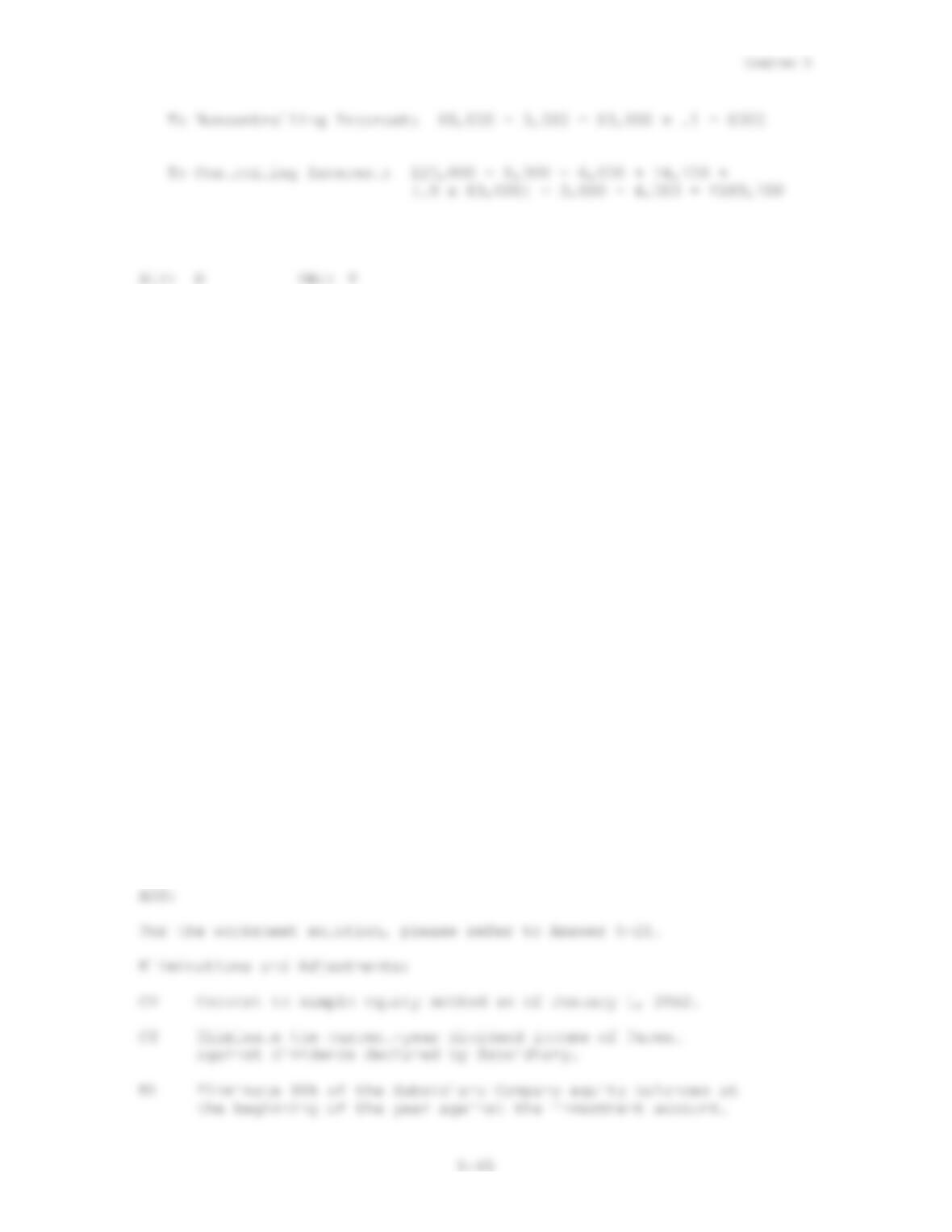
21. VERTICAL WORKSHEET PROBLEM: On January 1, 20X1, Parent Company
purchased 90% of the common stock of Subsidiary Company for $562,000.
On this date Subsidiary had total owner’s equity of $550,000, including
retained earning of $250,000.
On January 1, 20X1, the only tangible asset of Subsidiary that was
undervalued was building, which was worth $30,000 more than book value.
The building has a remaining life of 9 years and is depreciated using
the straight-line method. Any excess from the purchase is attributed to
goodwill.
During 20X1 and 20X2, Parent has appropriately accounted for its
investment in Subsidiary using the simple equity method.
On January 1, 20X2, Parent held merchandise acquired from Subsidiary
for $15,000. During 20X2, Subsidiary sold merchandise to Parent for
$80,000, of which $20,000 is held by Parent on December 31, 20X2.
Subsidiary’s usual gross profit on affiliated sales is 40%.
On December 31, 20X1, Parent sold some equipment to Subsidiary with a
cost of $50,000, and a book value of $25,000. The sales price was
$40,000. Subsidiary is depreciating the equipment over 3-year life,
assuming no salvage value and using the straight-line method.
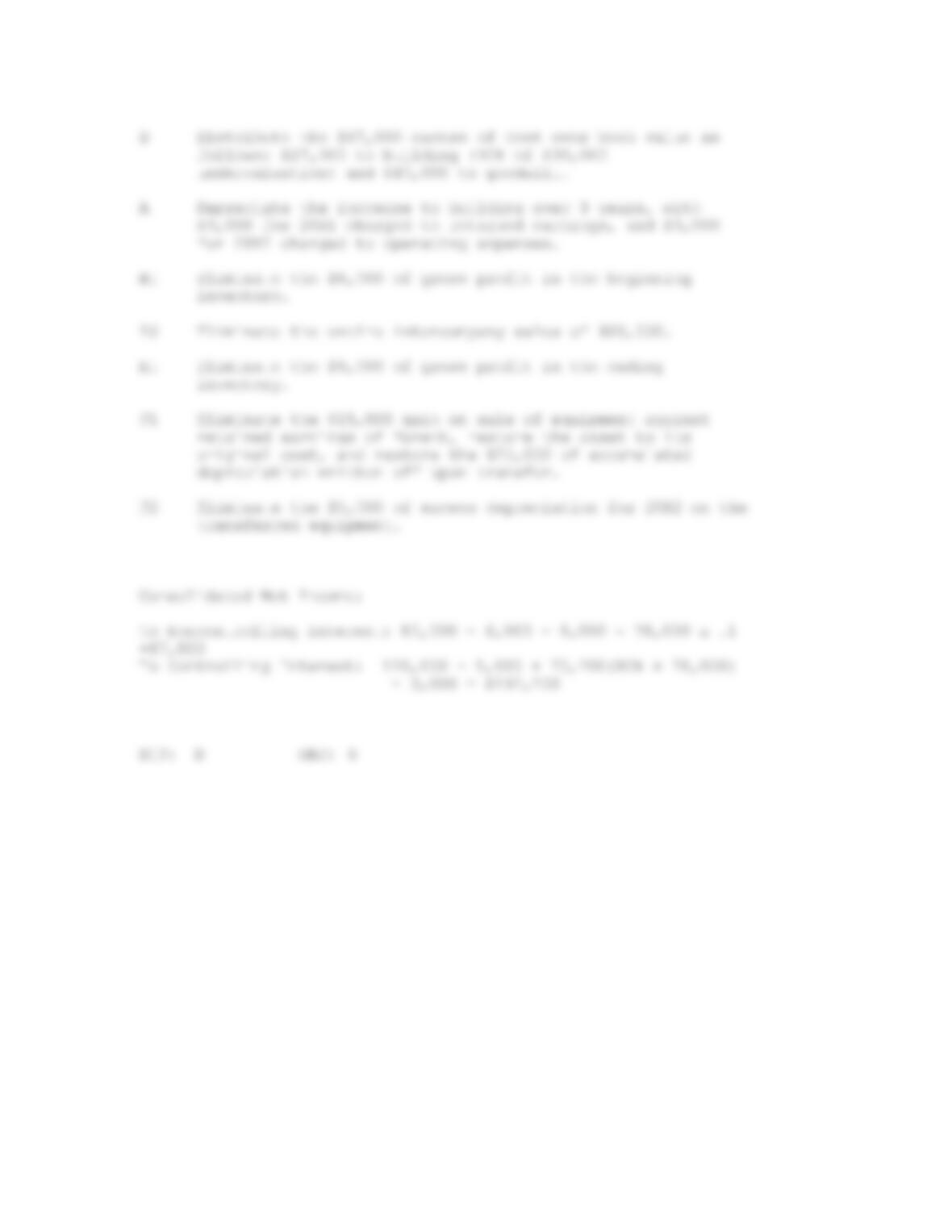
Required:
Complete the Figure 5-21 vertical worksheet for consolidated financial
statements for the year ended December 31, 20X2.
Chapter 5
5-46