Fundamentals of Corporate Finance 3e Test Bank
Chapter 5: The Time Value of Money
1.
The time value of money is based on the belief that people have a positive time preference for
consumption.
A)
True
B)
False
Ans:
A
2.
The value of a dollar invested at a positive interest rate grows over time.
A)
True
B)
False
Ans:
A
AICPA: Measurement
3.
The value of a dollar invested at a positive interest rate grows over time but at a slower rate
further into the future.
A)
True
B)
False
Ans:
B
Fundamentals of Corporate Finance 3e Test Bank
4.
The further in the future you receive a dollar, the more it is worth today.
A)
True
B)
False
Ans:
B
5.
The higher the rate of interest, the more likely you will elect to invest your funds and forgo
current consumption.
A)
True
B)
False
Ans:
A
6.
The future value technique uses discounting to find the future value of each cash flow at the
end of a project’s life.
A)
True
B)
False
Ans:
B
Fundamentals of Corporate Finance 3e Test Bank
7.
The process of converting the initial amount into future value is called discounting.
A)
True
B)
False
Ans:
B
8.
Compounding is the process by which interest earned on an investment is reinvested so that in
future periods, interest is earned on the interest previously earned as well as the original
principal.
A)
True
B)
False
Ans:
A
9.
Compound interest consists of both simple interest and interest on interest.
A)
True
B)
False
Ans:
A
Fundamentals of Corporate Finance 3e Test Bank
10.
Compound interest increases as the number of year decreases.
A)
True
B)
False
Ans:
B
11.
Compounding accelerates the growth of the total interest earned.
A)
True
B)
False
Ans:
A
12.
Due to compounding effects, the growth in the future value of an investment over time is linear.
A)
True
B)
False
Ans:
B
Fundamentals of Corporate Finance 3e Test Bank
13.
The growth in the future value of an investment over time is not linear, but exponential.
A)
True
B)
False
Ans:
A
14.
William invested $5,000 in an account earning 10 percent for one year. If he had left his
investment in that account for another two years, he would expect the total interest earned over
the three years to be higher by exactly $1,000.
A)
True
B)
False
Ans:
B
15.
The higher the interest rate on an investment, the more money that is accumulated for any time
period.
A)
True
B)
False
Ans:
A
Fundamentals of Corporate Finance 3e Test Bank
16.
The more frequently the interest payments are compounded, the larger the future value of $1 for
a given time period.
A)
True
B)
False
Ans:
A
17.
If Bank A pays interest on a monthly basis and Bank B pays the same interest on a quarterly
basis, then investing $1,000 in Bank B will lead to a higher future value than investing the same
amount in Bank A.
A)
True
B)
False
Ans:
B
18.
The future value of an investment of $5,000 earning an annual interest of 10 percent equals
$6,000 at the end of one year.
A)
True
B)
False
Ans:
B
Fundamentals of Corporate Finance 3e Test Bank
19.
The future value of an investment of $5,000 to be received in three years at a discount rate of
10 percent is $6,655.
A)
True
B)
False
Ans:
A
20.
The future value factor for 10 years at 15% is calculated as (1 + 0.15)10.
A)
True
B)
False
Ans:
A
AICPA: Measurement
21.
To calculate the present value of a future amount, we divide the future amount by the future
value factor.
A)
True
B)
False
Ans:
A
Fundamentals of Corporate Finance 3e Test Bank
22.
The present value is simply the current value of a future cash flow that has been discounted at
an appropriate discount rate.
A)
True
B)
False
Ans:
A
23.
The present value technique uses discounting to find the present value of each cash flow at the
beginning of a project.
A)
True
B)
False
Ans:
A
24.
The present value factor increases as the number of period decreases.
A)
True
B)
False
Ans:
A
Fundamentals of Corporate Finance 3e Test Bank
25.
The process of calculating the present value of a future cash flow is called compounding.
A)
True
B)
False
Ans:
B
26.
The present value of $3,000 to be received in two years at a discount rate of 10 percent is
$3,630.
A)
True
B)
False
Ans:
B
27.
The higher the discount rate, the lower the present value of a future cash flow.
A)
True
B)
False
Ans:
A
Fundamentals of Corporate Finance 3e Test Bank
28.
The farther in the future a dollar will be received, the less it is worth today.
A)
True
B)
False
Ans:
A
29.
If you had a choice of choosing a payment of $5,000 to be received in five years being
discounted at 8 percent or at 10 percent, you should always choose the higher rate because it
gives you the higher present value.
A)
True
B)
False
Ans:
B
30.
Future value focuses on the valuation of cash flows received over time, while present value
focuses only on the valuation of cash flows received at a point in time.
A)
True
B)
False
Ans:
B
Fundamentals of Corporate Finance 3e Test Bank
31.
The present value factor 1 / (1 + i)n is the reciprocal of the future value factor (1 + i)n.
A)
True
B)
False
Ans:
A
32.
The Rule of 72 allows one to calculate the return earned on an investment over six years.
A)
True
B)
False
Ans:
B
33.
The Rule of 72 allows one to calculate the approximate time needed to double an investment.
A)
True
B)
False
Ans:
A
Fundamentals of Corporate Finance 3e Test Bank
34.
Compound growth occurs when the initial value of a number increases or decreases each period
by the factor (1 + growth rate).
A)
True
B)
False
Ans:
A
35.
The compound annual growth rate (CAGR) is the average annual growth rate over a specified
period of time.
A)
True
B)
False
Ans:
A
36.
The time value of money refers to the issue of:
A)
what the value of the stream of future cash flows is today.
B)
why a dollar received tomorrow is worth more than a dollar received today.
C)
what the time required to double an amount of money.
D)
why people prefer to consume things at some time in the future rather than today.
Ans:
A
Fundamentals of Corporate Finance 3e Test Bank
37.
Which of the following statements is true of the time value of money?
A)
It means a dollar received today is worth less than a dollar received tomorrow.
B)
It assumes that inflation rate remains constant for the foreseeable future.
C)
It refers to the fact that higher cash flows in earlier years are less desirable.
D)
It is based on the assumption that people prefer to consume things at some time in the
future rather than today.
Ans:
A
38.
Which of the following statements is true?
A)
The value of a dollar invested at a positive interest rate decreases over time.
B)
The further in the future you receive a dollar, the less it is worth today.
C)
A dollar in hand today is worth less than a dollar to be received in the future.
D)
The higher the rate of interest, the more likely an investor will elect to consume at
present and forgo invest his funds.
Ans:
B
Fundamentals of Corporate Finance 3e Test Bank
39.
Which of the following statements is true of time value of money?
A)
A dollar received today is worth more than a dollar to be received in the future because
future dollars are not affected by inflation.
B)
A dollar received today is worth less than a dollar to be received in the future because
future dollars are not affected by inflation.
C)
A dollar received today is worth more than a dollar to be received in the future because
funds received today can be invested to earn a return.
D)
A dollar to be received in the future is worth more than a dollar received today because it
would have less risk associated with it.
Ans:
C
AICPA: Measurement
40.
Future value measures:
A)
what one or more cash flows are worth at the end of a specified period.
B)
what one or more cash flows that is to be received in the future will be worth today.
C)
the value of an investment after subtracting interest earned on it for one or more periods.
D)
the value of an investment’s worth today.
Ans:
A
Fundamentals of Corporate Finance 3e Test Bank
41.
Which of the following equations is used to compute the future value for continuous
compounding?
A)
FV∞ = PV × e i × n
B)
FV∞ = PV ÷ e i × n
C)
FV∞ = ei ÷ PV
D)
FV∞ = ei × PV
Ans:
A
AICPA: Measurement
42.
The process of converting an amount given at the present time into a future value is called:
A)
annualizing.
B)
discounting.
C)
compounding.
D)
capital budgeting.
Ans:
C
43.
Which of the following is true of the future value of an investment?
A)
The higher the interest rate, the higher the future value of an investment.
B)
The higher the inflation rate, the lower the future value of an investment.
C)
The lower the number of compounding periods, the higher the future value of an
investment.
D)
The lower the present value of an investment, the higher the future value of an
investment.
Ans:
A
Fundamentals of Corporate Finance 3e Test Bank
44.
Which of the following investments will have the highest future value?
A)
$1,300 invested at an annual interest rate of 10% for 5 years
B)
$1,000 invested at an quarterly interest rate of 2.25% for 10 years
C)
$1,300 invested at an quarterly interest rate of 2.25% for 5 years
D)
$1,000 invested at an annual interest rate of 10% for 10 years
Ans:
D
45.
Which of the following statements is true?
A)
The longer the time period that funds are invested, the greater the future value.
B)
The lower the discount rate that funds are invested at, the greater the future value.
C)
The shorter the time period that funds are invested, the greater the future value.
D)
The higher the interest rate, the slower the value of an investment will grow.
Ans:
A
Fundamentals of Corporate Finance 3e Test Bank
46.
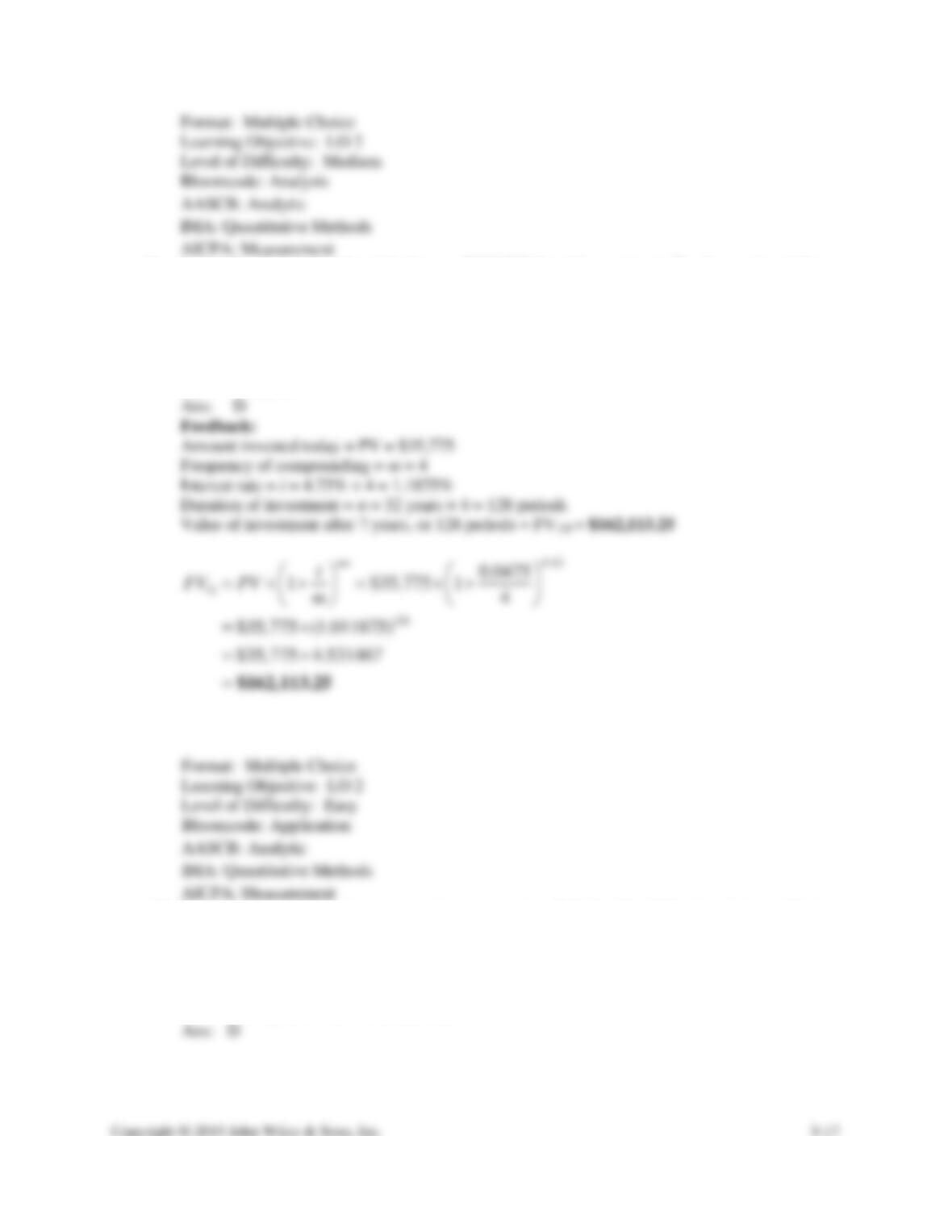
Joseph Ray just received an inheritance of $35,775 from his great aunt. He plans to invest the
funds for retirement. If Joseph can earn 4.75% per year with quarterly compounding for 32
years, how much will he have accumulated? (Round off to the nearest dollar.)
A)
$237,416
B)
$71,550
C)
$184,622
D)
$162,113
Ans:
D
47.
Your aunt is looking to invest a certain amount today. Which of the following choices will give
the maximum interest?
A)
Three-year CD at 6.5% annual rate
B)
Three-year CD at 6.75% annual rate
C)
Three-year CD at 6.25% annual rate
D)
Three-year CD at 7% annual rate
Ans:
D
Fundamentals of Corporate Finance 3e Test Bank
48.
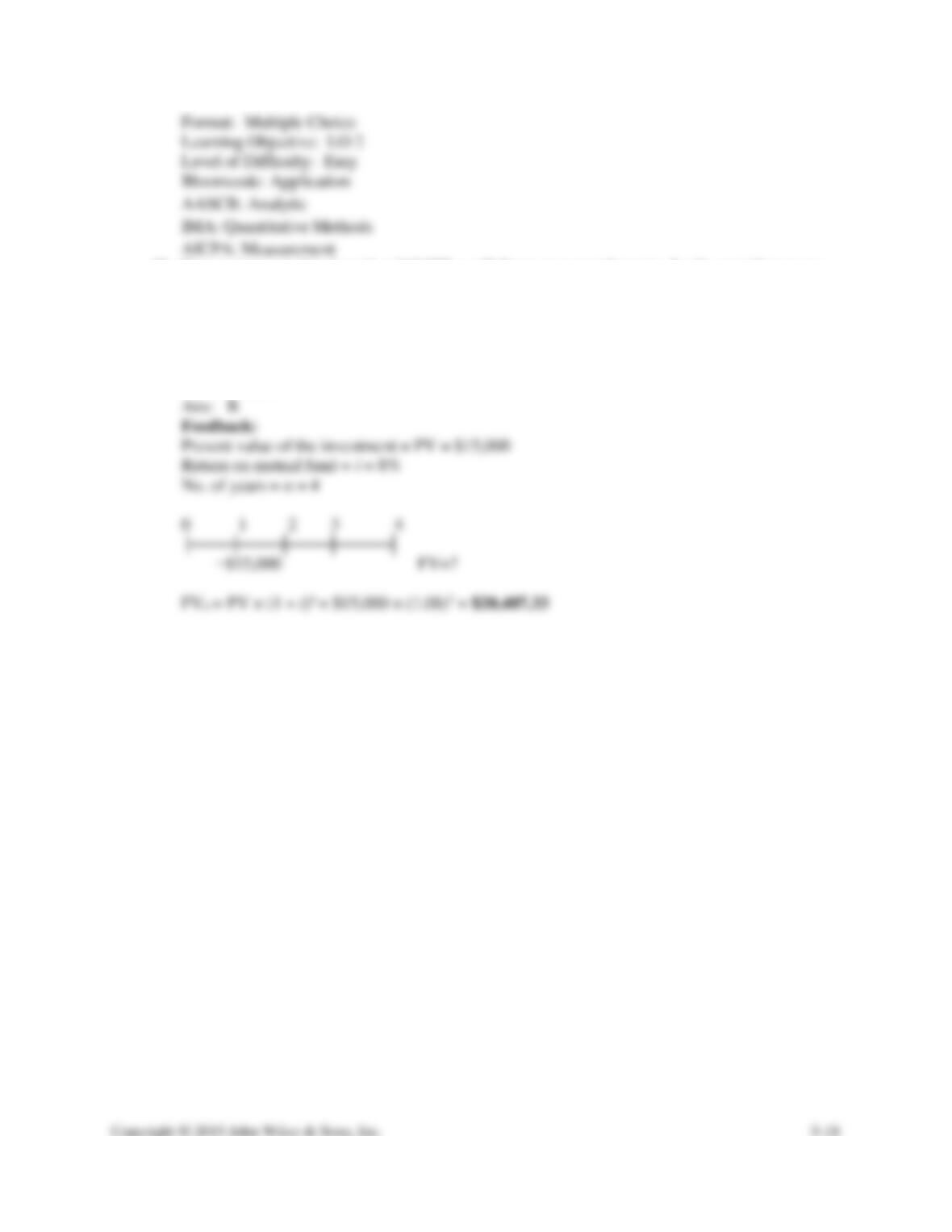
You are interested in investing $15,000, a gift from your grandparents, for the next four years
in a mutual fund that will earn an annual return of 8 percent. What will your investment be
worth at the end of four years? (Round to the nearest dollar.)
A)
$18,816
B)
$20,407
C)
$20,221
D)
$18,089
Ans:
B
Fundamentals of Corporate Finance 3e Test Bank
49.
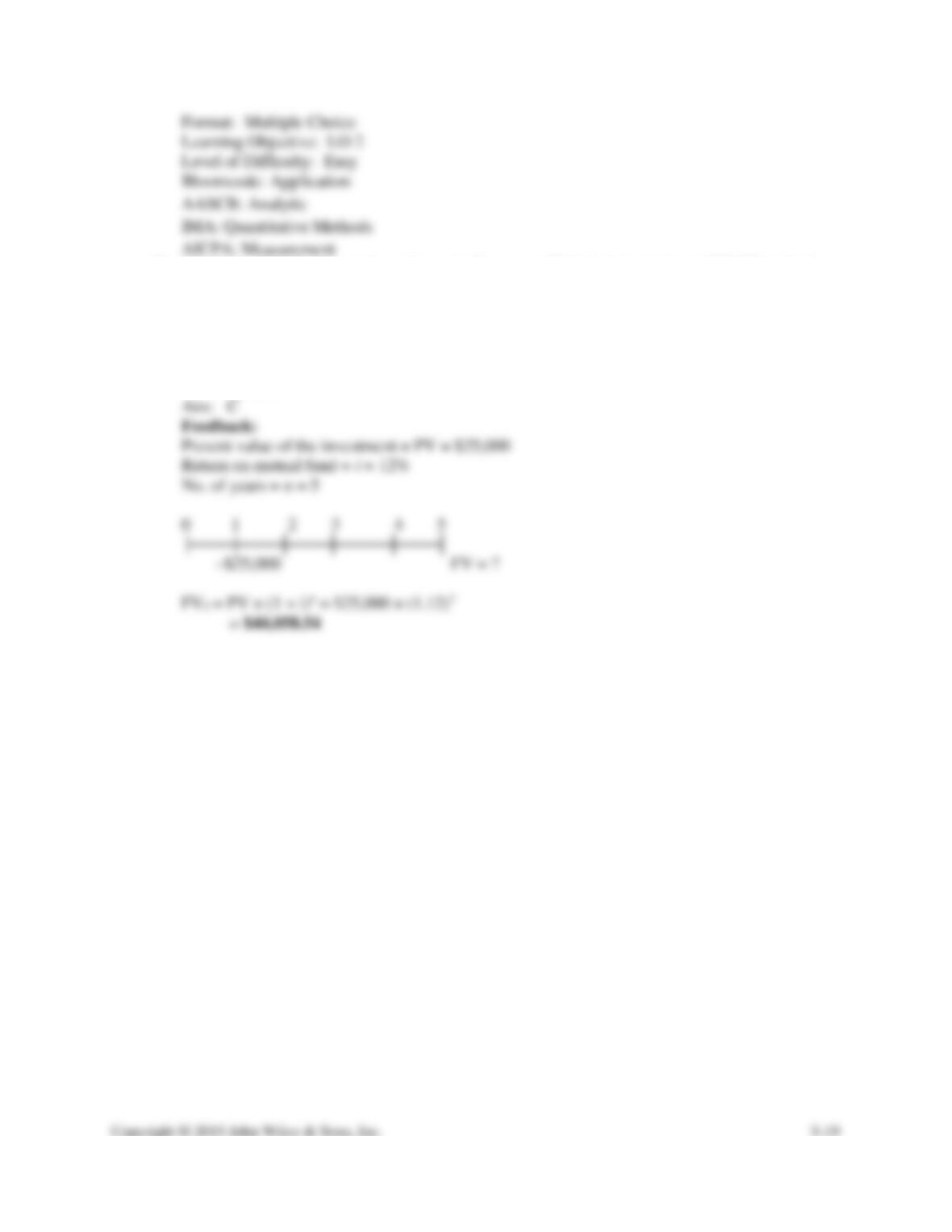
Juan Vinson is planning to buy a house in five years. He is looking to invest $25,000 today in
an index mutual fund that will provide him a return of 12 percent annually. How much will he
have at the end of five years? (Round to the nearest dollar.)
A)
$45,000
B)
$28,000
C)
$44,059
D)
$28,530
Ans:
C
Fundamentals of Corporate Finance 3e Test Bank
50.
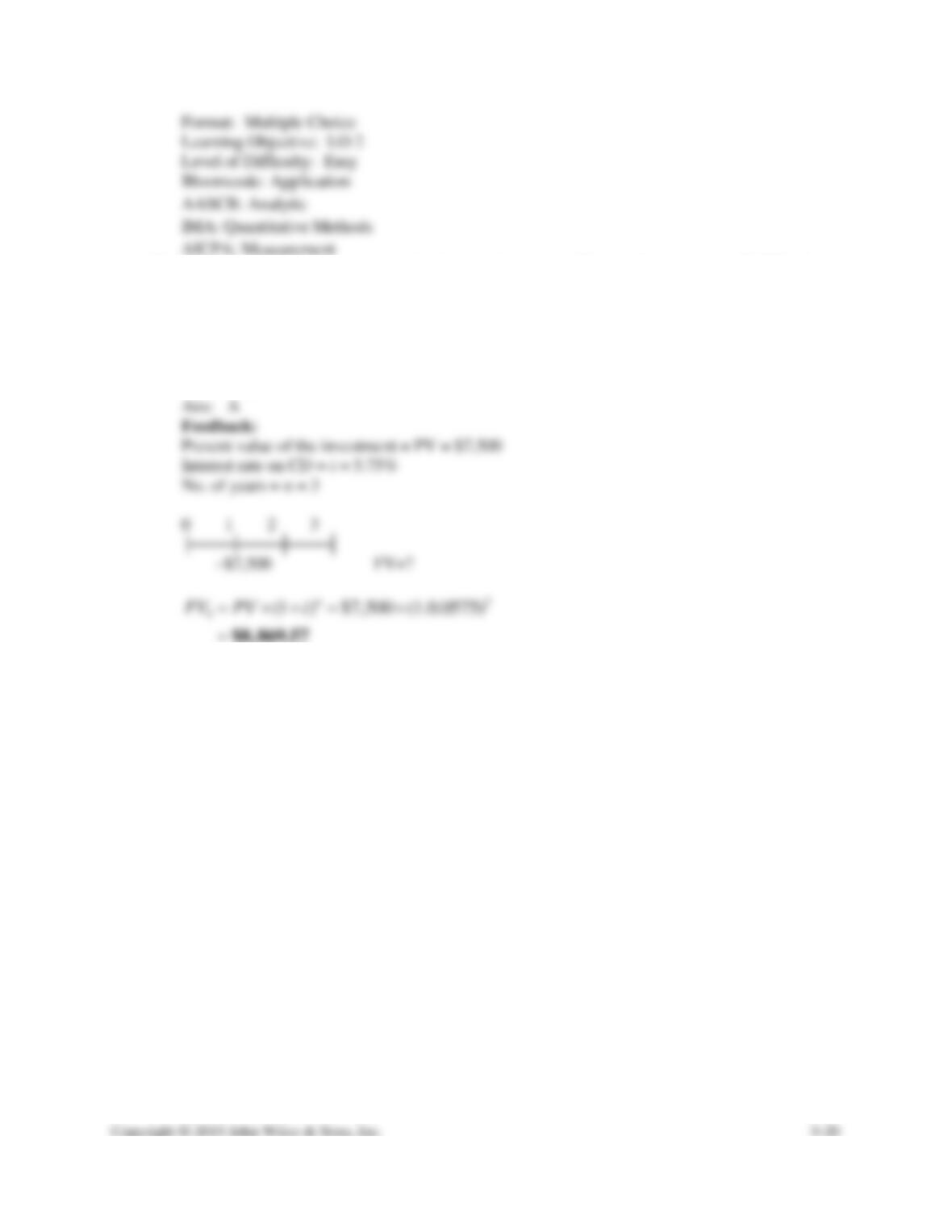
Carlos Lopes is looking to invest for the next three years. He is looking to invest $7,500 today
in a bank CD that will earn interest at 5.75 percent annually. How much will he have at the end
of three years? (Round to the nearest dollar.)
A)
$8,870
B)
$8,575
C)
$8,681
D)
$8,990
Ans:
A