5-1
Chapter 05 Test Bank KEY
1. The short run is defined as a period in which
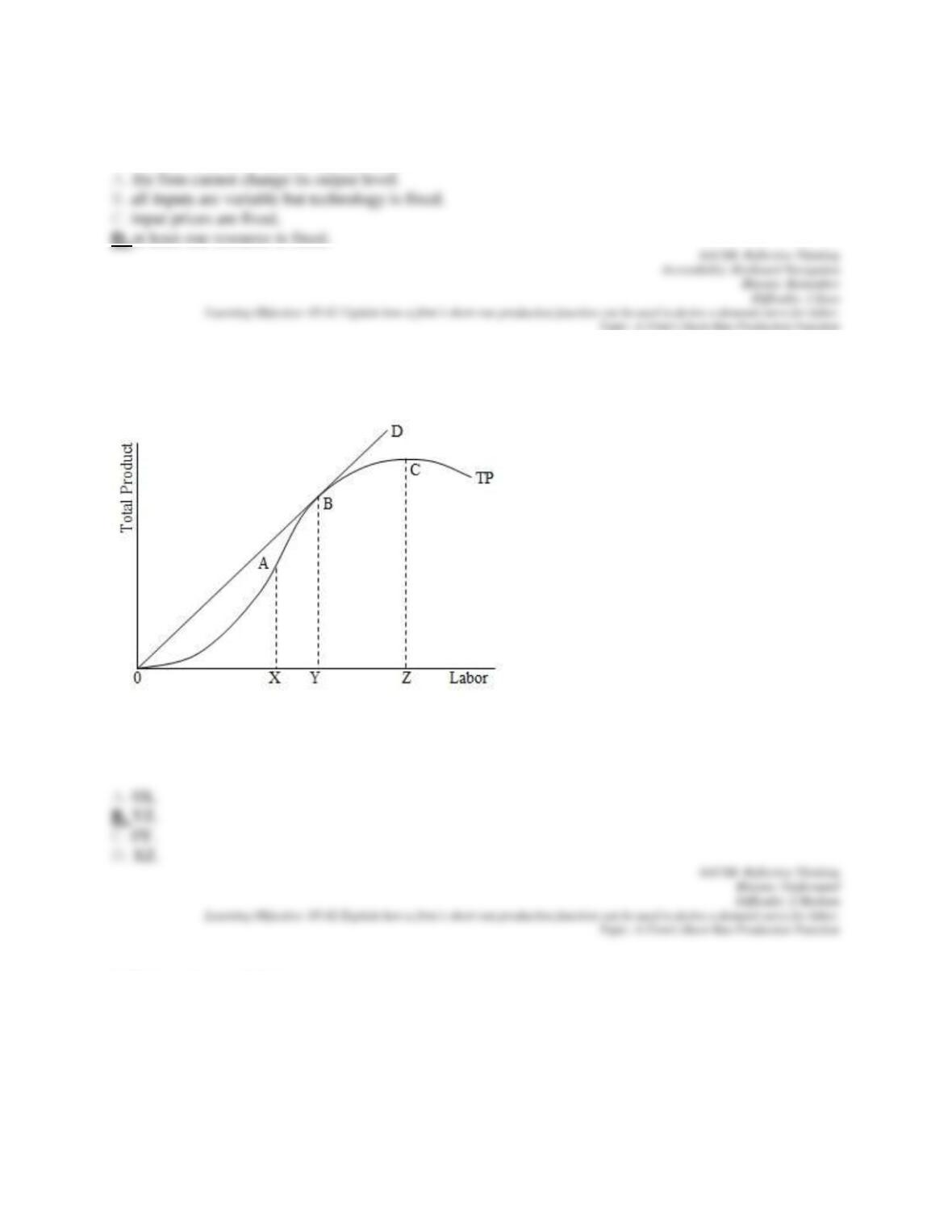
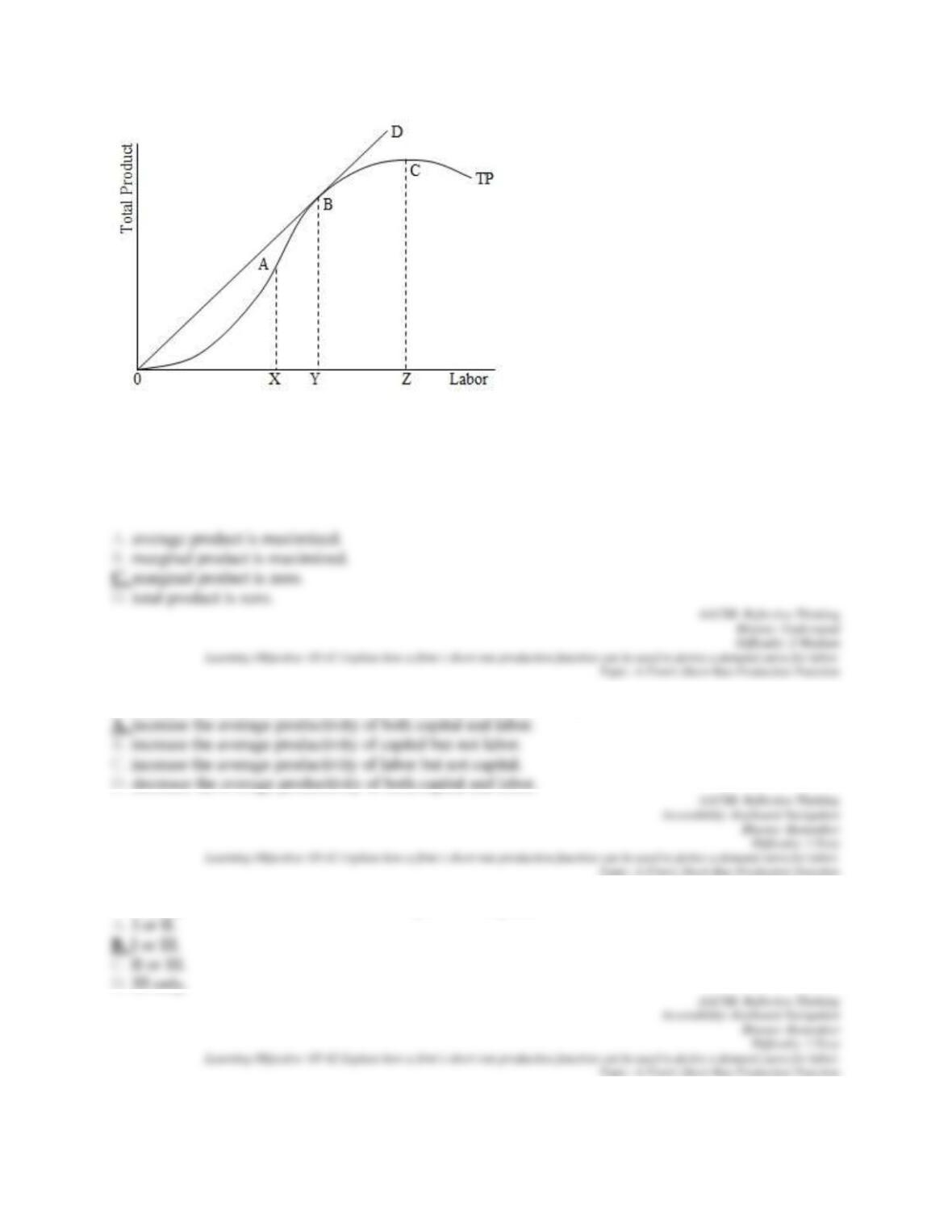
2. Refer to the graph below.
The “zone of production” consists of labor inputs over the range of
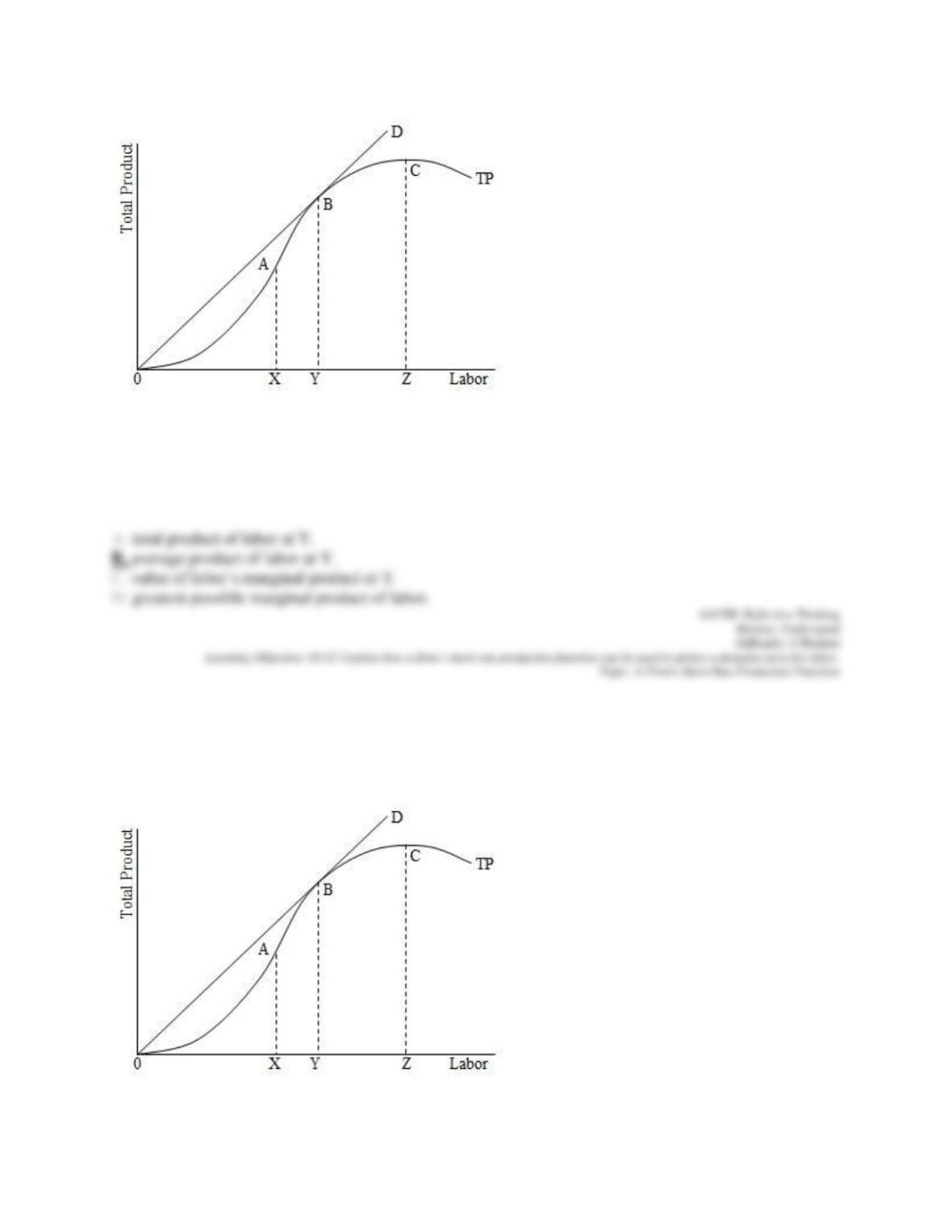
3. Refer to the graph below.
5-2
The slope of line segment 0D can be interpreted as the
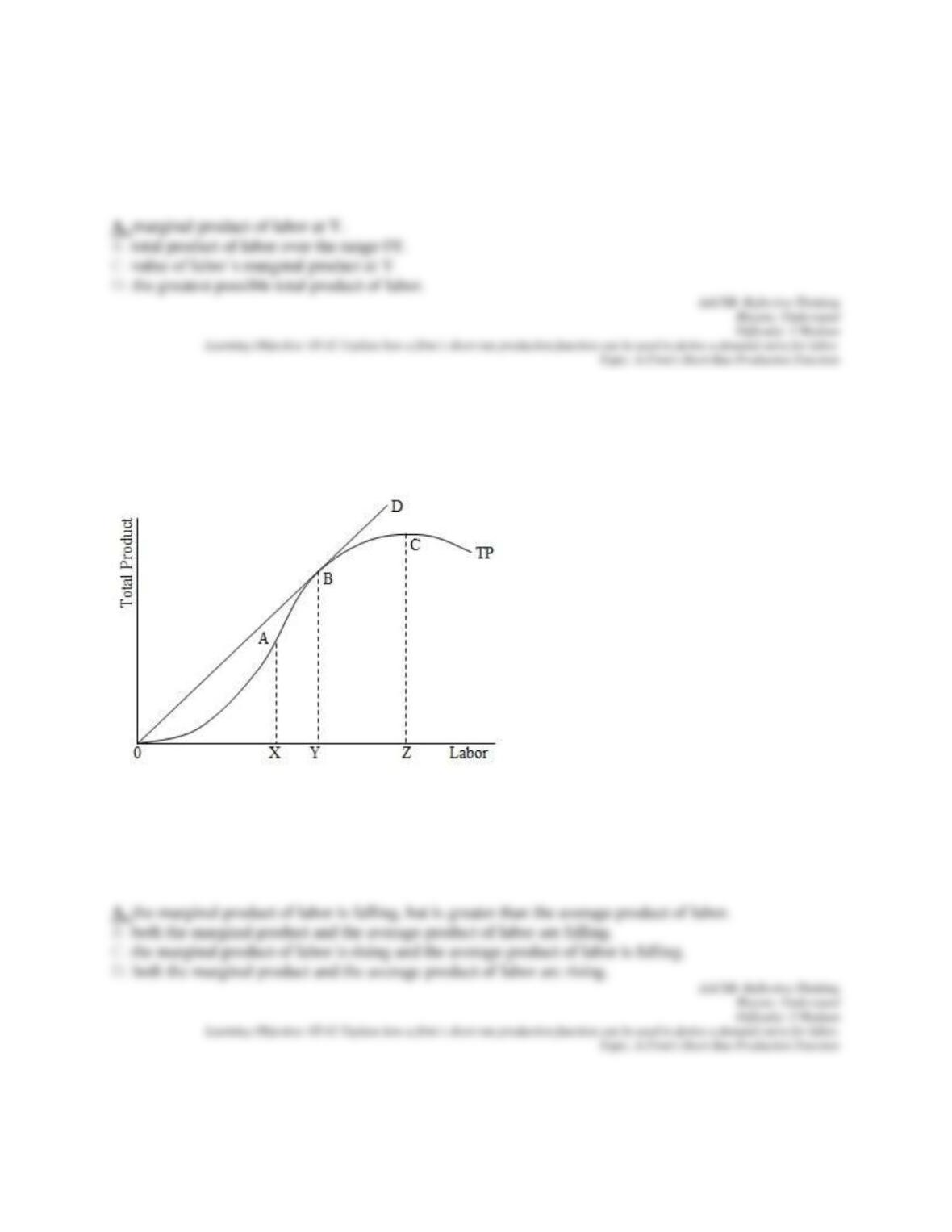
4. Refer to the graph below.
5-3
The slope of line segment 0D can be interpreted as the
5. Refer to the graph below.
For labor input levels between X and Y,
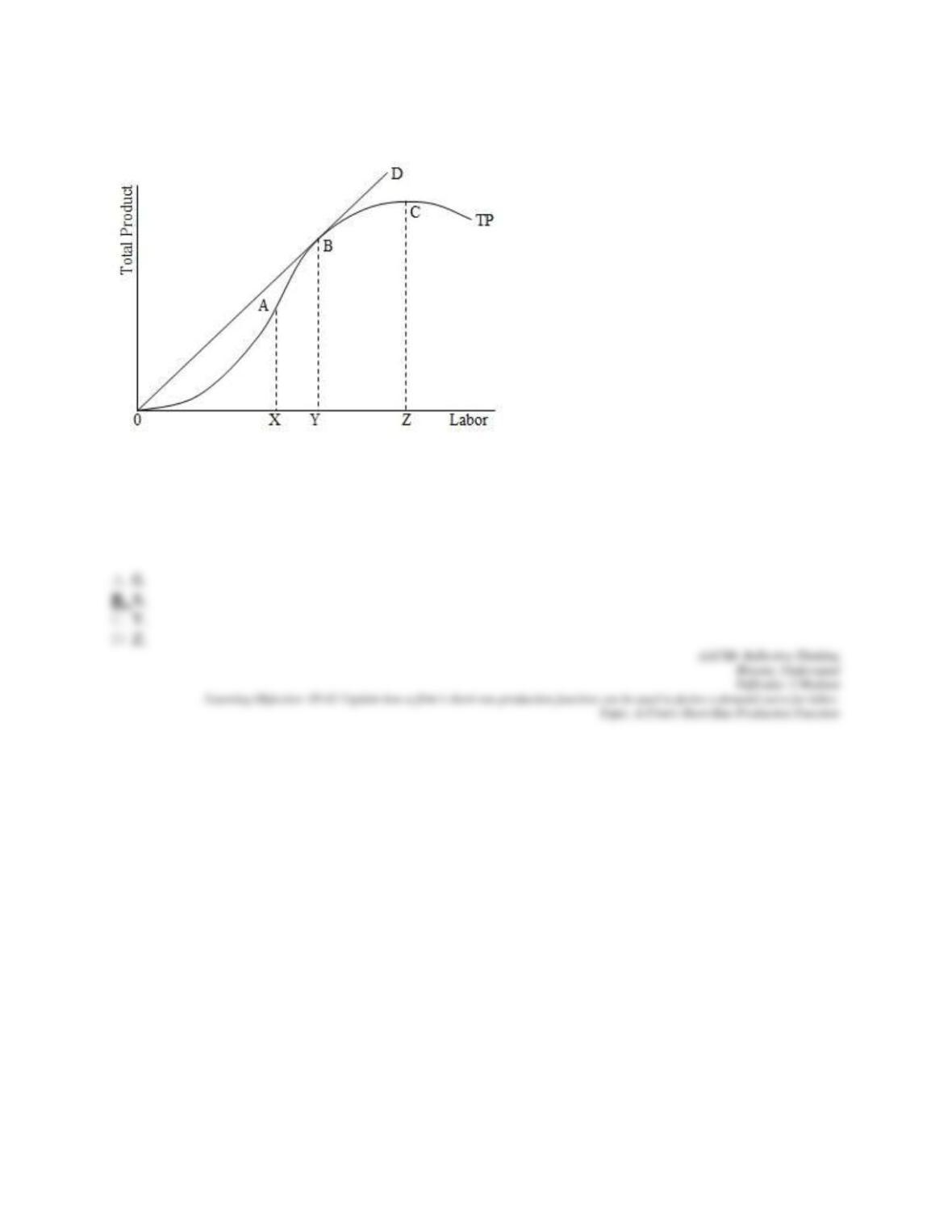
6. Refer to the graph below.
5-4
The “law of diminishing marginal returns” begins to take effect at labor input level
7. Refer to the graph below.
5-5
At labor input Z, labor’s
8. In stage I of the production function, increases in the amount of labor will
9. A competitive firm will never choose to operate in stage(s)
10. Which of the following best describes the “law of diminishing marginal returns“?
5-6
11. Which of the following equalities holds when the profit-maximizing quantity of labor is employed in
the short run?
12. The short-run labor demand curve of a competitive firm is
13. Value of marginal product (VMP) differs from marginal revenue product (MRP) in that
14. Refer to the following table.
5-7
Labor
Output
Price (D1)
Price (D2)
0
0
$10.00
$10.00
1
16
10.00
9.50
2
31
10.00
9.00
3
45
10.00
8.50
4
58
10.00
7.50
5
69
10.00
6.50
6
78
10.00
5.50
Assume that the labor market is perfectly competitive. Suppose the firm’s product demand is given by the
column labeled D1. If the wage rate is $100, the firm will achieve maximum profit by hiring _____
workers.
15. Refer to the following table.
Labor
Output
Price (D1)
Price (D2)
0
0
$10.00
$10.00
1
16
10.00
9.50
2
31
10.00
9.00
3
45
10.00
8.50
4
58
10.00
7.50
5
69
10.00
6.50
6
78
10.00
5.50
Assume that the labor market is perfectly competitive. Suppose the firm’s product demand is given by the
column labeled D1. If the wage rate rises from $100 to $135, the firm will reduce the quantity of labor
employed by _____ unit(s).
5-8
16. Refer to the following table.
Labor
Output
Price (D1)
Price (D2)
0
0
$10.00
$10.00
1
16
10.00
9.50
2
31
10.00
9.00
3
45
10.00
8.50
4
58
10.00
7.50
5
69
10.00
6.50
6
78
10.00
5.50
Assume that the labor market is perfectly competitive. Suppose the firm’s product demand is given by the
column labeled D1. If the wage rate is $125, the firm will achieve maximum profit by hiring _____
workers.
17. Refer to the following table.
Labor
Output
Price (D1)
Price (D2)
0
0
$10.00
$10.00
1
16
10.00
9.50
2
31
10.00
9.00
3
45
10.00
8.50
4
58
10.00
7.50
5
69
10.00
6.50
6
78
10.00
5.50
Assume that the labor market is perfectly competitive. Suppose the firm’s product demand is given by the
column labeled D1. The value of the marginal product of the fourth worker is
18. Refer to the following table.
or
Output
Price (D1)
Price (D2)
0
0
$10.00
$10.00
1
16
10.00
9.50
2
31
10.00
9.00
3
45
10.00
8.50
4
58
10.00
7.50
5
69
10.00
6.50
6
78
10.00
5.50
Assume that the labor market is perfectly competitive. Suppose the firm’s product demand is given by the
column labeled D2. If the wage rate is $100, the firm will achieve maximum profit by hiring _____
workers.
5-10
19. Refer to the following table.
Labor
Output
Price (D1)
Price (D2)
0
0
$10.00
$10.00
1
16
10.00
9.50
2
31
10.00
9.00
3
45
10.00
8.50
4
58
10.00
7.50
5
69
10.00
6.50
6
78
10.00
5.50
Assume that the labor market is perfectly competitive. Suppose the firm’s product demand is given by the
column labeled D2. The extra revenue generated by the second worker is
20. Refer to the following table.
Labor
Output
Price (D1)
Price (D2)
0
0
$10.00
$10.00
1
16
10.00
9.50
2
31
10.00
9.00
3
45
10.00
8.50
4
58
10.00
7.50
5
69
10.00
6.50
6
78
10.00
5.50
Assume that the labor market is perfectly competitive. Suppose the firm’s product demand is given by the
column labeled D2. If the wage rate rises from $100 to $130, the firm will reduce the quantity of labor
employed by _____ unit(s).
21. Refer to the following table.
Labor
Output
Price (D1)
Price (D2)
0
0
$10.00
$10.00
1
16
10.00
9.50
2
31
10.00
9.00
3
45
10.00
8.50
4
58
10.00
7.50
5
69
10.00
6.50
6
78
10.00
5.50
Assume that the labor market is perfectly competitive. Compared to a firm facing D1, a firm facing
demand schedule D2 but paying the same wage will hire
22. The marginal revenue product schedule
5-12
23. Refer to the following table.
Labor
Output
Price
0
0
$2.20
1
16
2.00
2
31
1.80
3
45
1.60
4
58
1.40
5
69
1.20
6
78
1.00
Assume that the labor market is perfectly competitive. If the wage is $18.00, how many workers will this
profit-maximizing firm choose to employ?
24. Refer to the following table.
Labor
Output
Price
0
0
$2.20
1
16
2.00
2
31
1.80
3
45
1.60
4
58
1.40
5
69
1.20
6
78
1.00
Assume that the labor market is perfectly competitive. What are the values of marginal product and the
marginal revenue product, respectively, for the third worker?
25. Refer to the following table.
Labor
Output
Price
0
0
$2.20
1
16
2.00
2
31
1.80
3
45
1.60
4
58
1.40
5
69
1.20
6
78
1.00
Assume that the labor market is perfectly competitive. If the wage is $11.00, how many workers will this
profit-maximizing firm choose to employ?
26. Refer to the following table.
Labor
Output
Price
0
0
$2.20
1
16
2.00
2
31
1.80
3
45
1.60
4
58
1.40
5
69
1.20
6
78
1.00