5.2 Application: Discount Rates and Loans
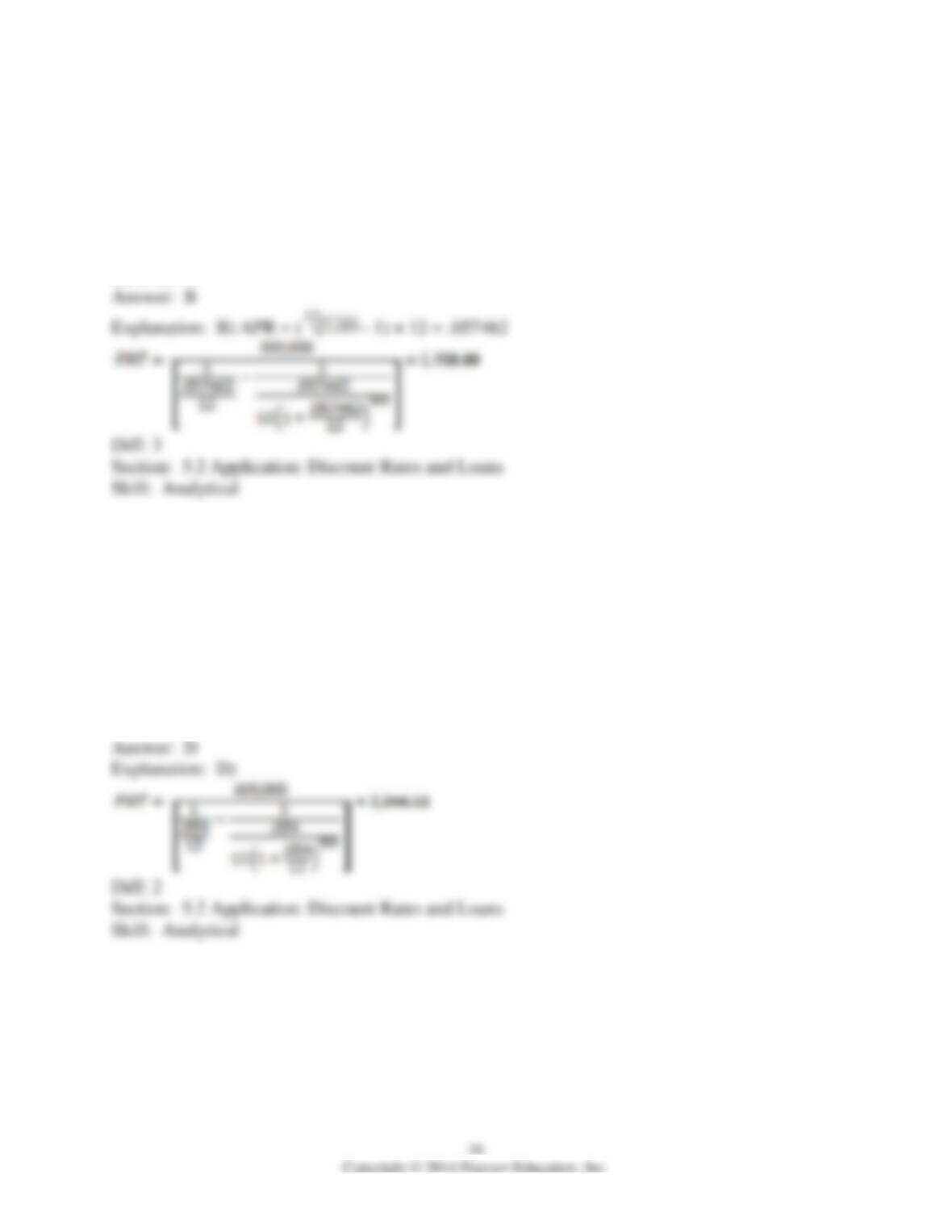
1) Hugh Akston took out a 30-year mortgage with an EAR of 5.9%. If Hugh borrowed $300,000
to buy his home, then his monthly payment will be closest to:
A) $835
B) $1,750
C) $1,780
D) $10,240
Use the following information to answer the question(s) below.
Dagny Taggart has just purchased a home and taken out a $400,000 mortgage. The mortgage has
a 30-year term with monthly payments and has an APR of 5.4%.
2) Dagny’s monthly payments are closest to:
A) $1,110
B) $1,800
C) $2,215
D) $2,245
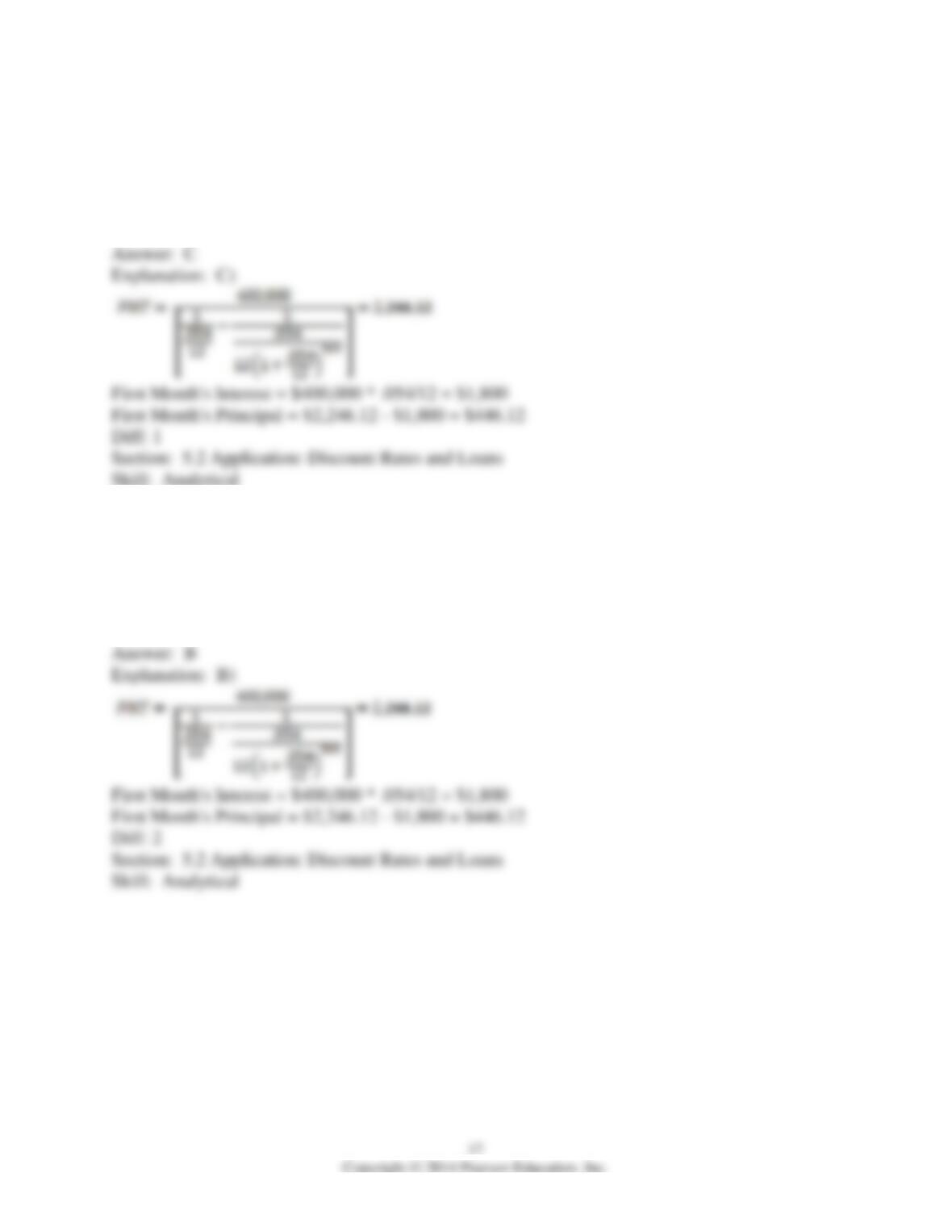
3) The total amount of interest that Dagny will pay during the first month of her mortgage is
closest to:
A) $1,110
B) $1,785
C) $1,800
D) $2,245
4) The total amount of principal that Dagny will pay during the first month of her mortgage is
closest to:
A) $246
B) $446
C) $1,800
D) $2,245
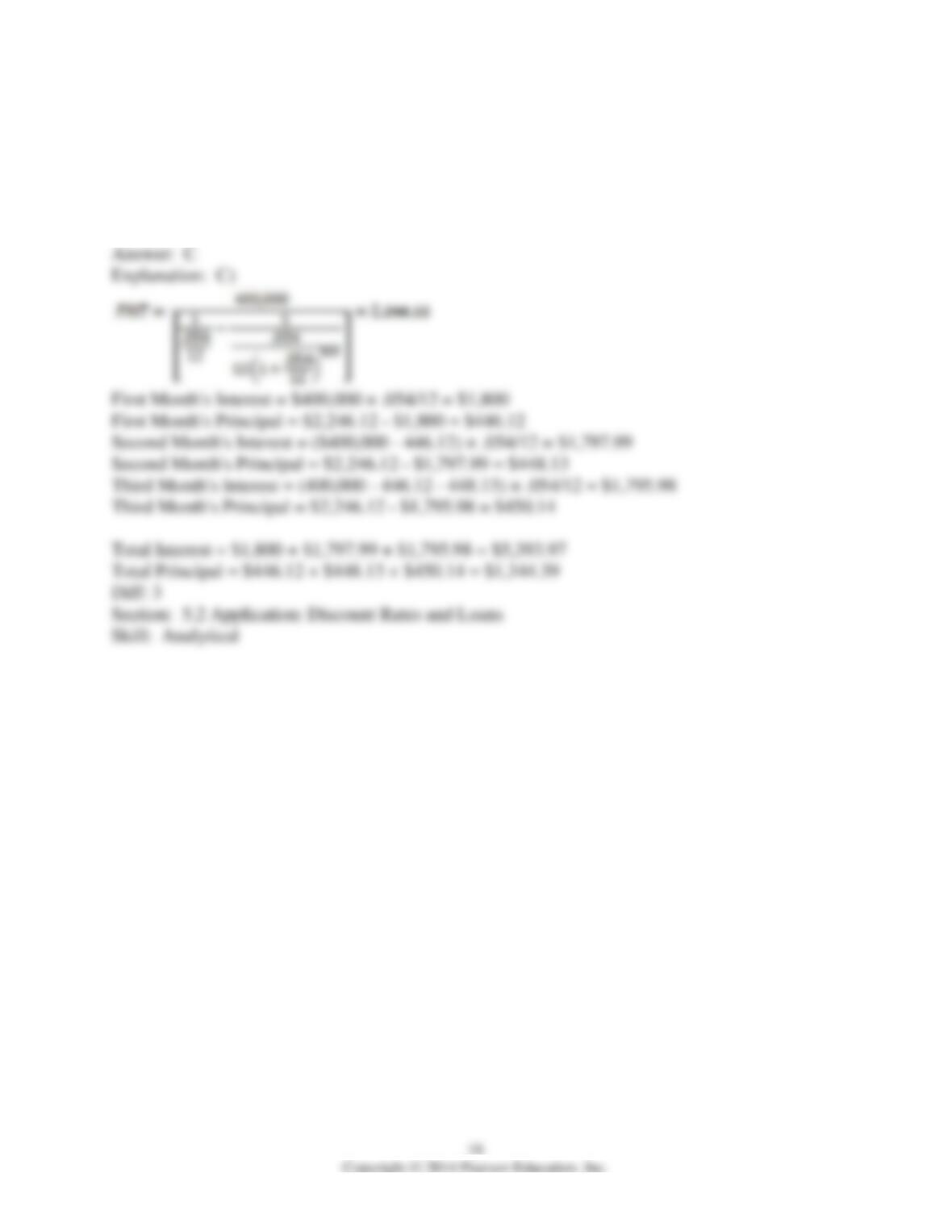
5) The total amount of interest that Dagny will pay during the first three months of her mortgage
is closest to:
A) $1,345
B) $5,380
C) $5,395
D) $6,740
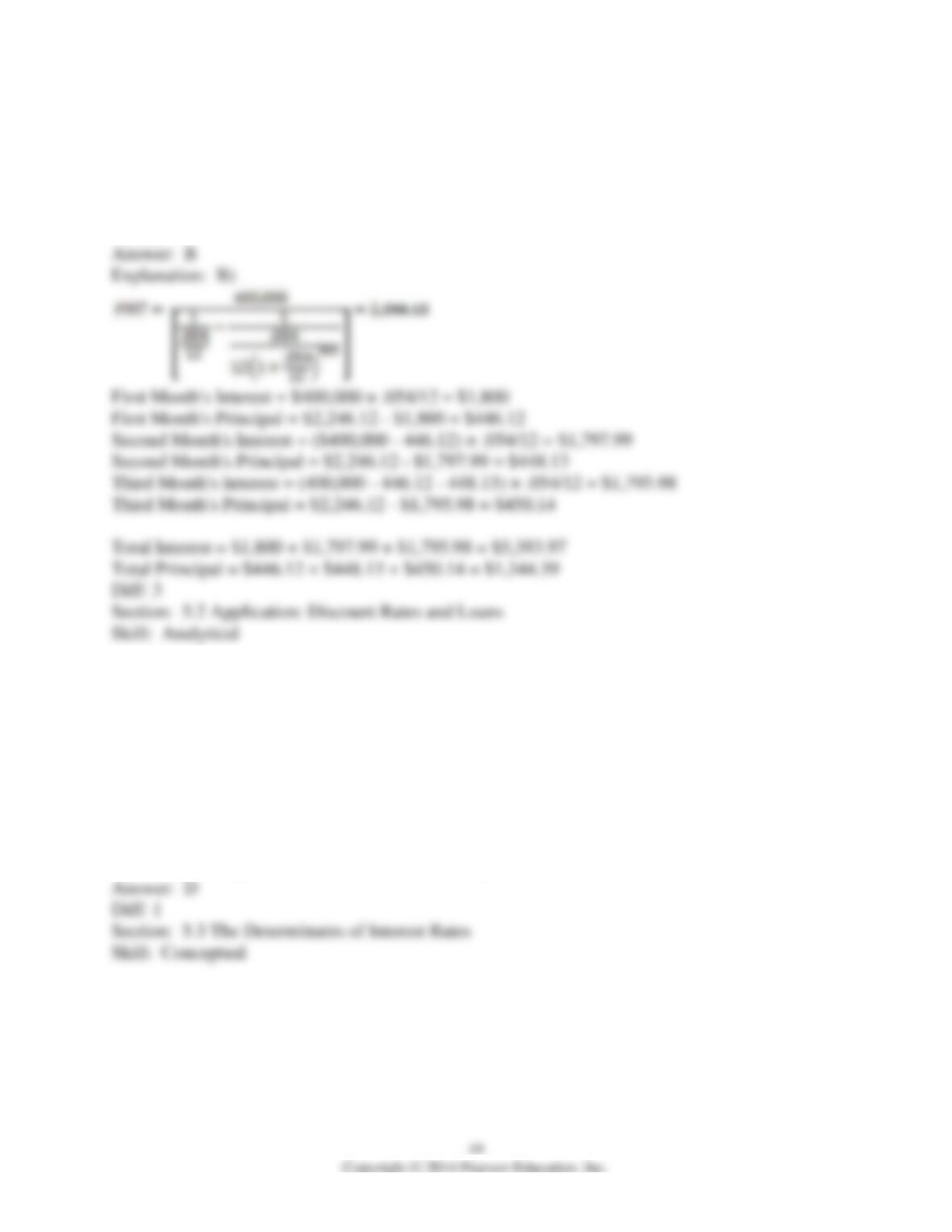
6) The total amount of principal that Dagny will pay during the first three months of her
mortgage is closest to:
A) $1,340
B) $1,345
C) $5,395
D) $6,740
5.3 The Determinants of Interest Rates
1) Which of the following statements is FALSE?
A) The interest rates that banks offer on investments or charge on loans depends on the horizon
of the investment or loan.
B) The Federal Reserve determines very short-term interest rates through its influence on the
federal funds rate.
C) The interest rates that are quoted by banks and other financial institutions are nominal interest
rates.
D) Fundamentally, interest rates are determined by the Federal Reserve.
2) Which of the following statements is FALSE?
A) The relationship between the investment term and the interest rate is called the term structure
of interest rates.
B) Real interest rates indicate the rate at which your money will grow if invested for a certain
period.
C) The yield curve is a potential leading indicator of future economic growth.
D) The shape of the yield curve will be strongly influenced by interest rate expectations.
3) Which of the following statements is FALSE?
A) The yield curve changes over time.
B) The formulas for computing present values of annuities and perpetuities cannot be used in
situations in which cash flows need to be discounted at different rates.
C) We can use the term structure to compute the present and future values of a risk-free cash
flow over different investment horizons.
D) The yield curve tends to be inverted as the economy comes out of a recession.
4) Which of the following statements is FALSE?
A) The plot of the relationship between the investment risk and the interest rate is call the yield
curve.
B) Each of the last six recessions in the United States was preceded by a period with an inverted
yield curve.
C) The nominal interest rate does not represent the increase in purchasing power that will result
from investing
D) A risk-free cash flow received in two years should be discounted at the two-year interest rate.
5) Which of the following statements is FALSE?
A) An inverted yield curve generally signals an expected decline in future interest rates.
B) An inverted yield curve is often interpreted as a positive forecast for economic growth.
C) All the formulas for computing present values of annuities and perpetuities are based upon
discounting all of the cash flows at the same rate.
D) The rate of growth of your purchasing power is determined by the real interest rate.
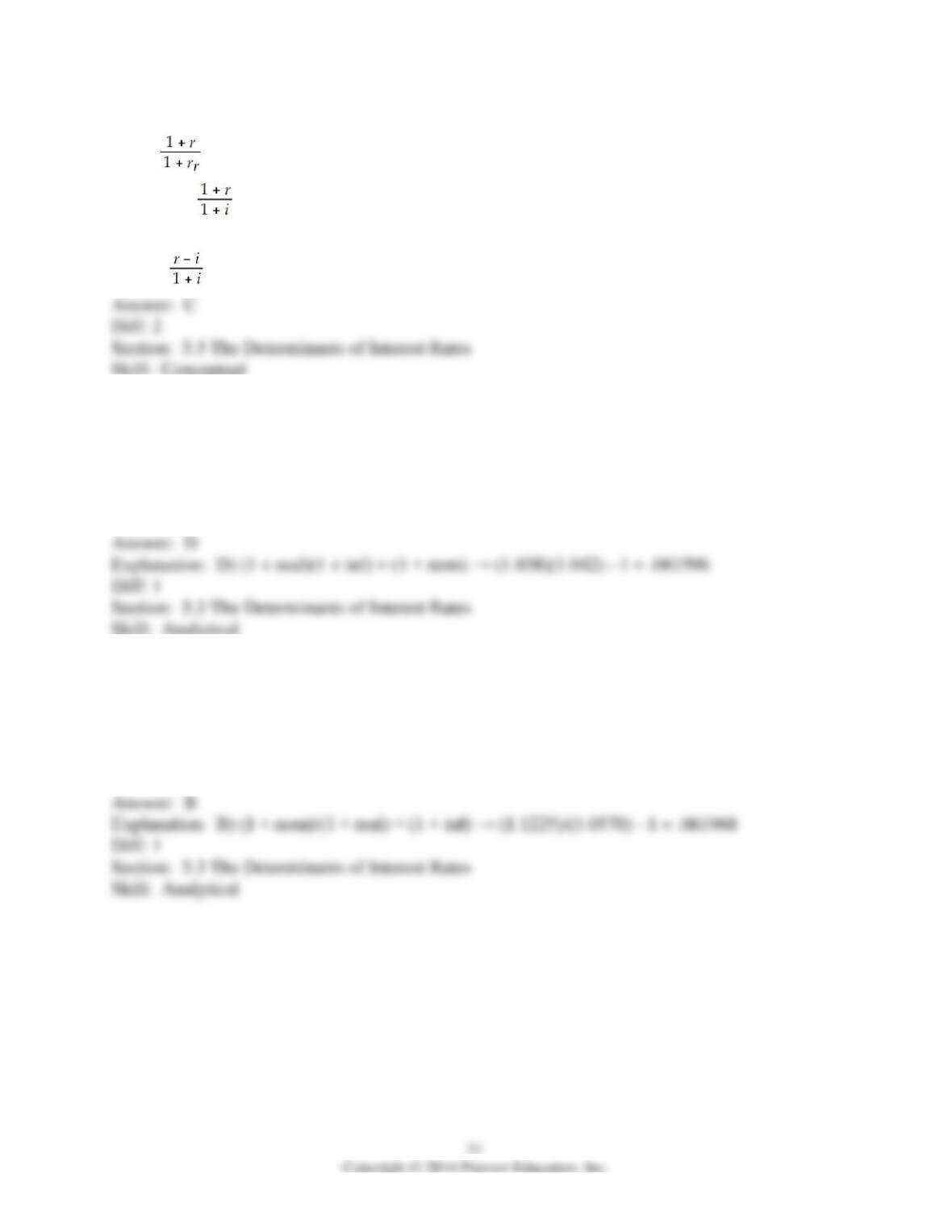
6) Which of the following formulas is INCORRECT?
A) i = – 1
B) 1 + rr =
C) rr ≈ i – r
D) rr =
7) If the current inflation rate is 4.2% and you are earning a real rate of return on an investment
of 3.8%, then the nominal rate on this investment is closest to:
A) 3.8%
B) 4.2%
C) 8.0%
D) 8.2%
8) If an investment providing a nominal return of 12.25% only offers a real rate of return of
5.70%, then the inflation rate is closest to:
A) 5.70%
B) 6.20%
C) 6.55%
D) 12.25%
9) If the current inflation rate is 5%, then the nominal rate necessary for you to earn an 8% real
interest rate on your investment is closest to:
A) 13.0%
B) 13.4%
C) 4.9%
D) 3.0%
10) If the current inflation rate is 4% and you have an investment opportunity that pays 10%,
then the real rate of interest on your investment is closest to:
A) 10.0%
B) 14.0%
C) 6.0%
D) 5.8%
Use the table for the question(s) below.
Suppose the term structure of interest rates is shown below:
Term
1 year
2 years
3 years
5 years
10 years
20 years
Rate
(EAR%)
5.00%
4.80%
4.60%
4.50%
4.25%
4.15%
11) What is the shape of the yield curve and what expectations are investors likely to have about
future interest rates?
A) Inverted; Higher
B) Normal; Higher
C) Inverted; Lower
D) Normal; Lower
12) The present value of receiving $1000 per year with certainty at the end of the next three
years is closest to:
A) $2,737
B) $2,723
C) $2,733
D) $2,744
13) Consider an investment that pays $1000 certain at the end of each of the next four years. If
the investment costs $3,500 and has an NPV of $74.26, then the four year risk-free interest rate is
closest to:
A) 4.50%
B) 4.58%
C) 4.55%
D) 4.53%
14) The NPV of an investment that costs $2700 and pays $1000 certain at the end of one, three,
and five years is closest to:
A) 21.47
B) $1665.62
C) -100.26
D) -71.38
15) Should the nominal interest rate ever be negative? Can the real interest rate ever be
negative? Explain.
Use the table for the question(s) below.
Suppose the term structure of interest rates is shown below:
Term
1 year
2 years
3 years
5 years
10 years
20 years
Rate
(EAR%)
5.00%
4.80%
4.60%
4.50%
4.25%
4.15%
16) What is the NPV of an investment that costs $2500 and pays $1000 certain at the end of one,
three, and five years?
5.4 Risk and Taxes
1) Which of the following statements is FALSE?
A) When we refer to the “risk-free interest rate,” we mean the rate on U.S. Treasuries.
B) Interest rates vary with the investment horizon.
C) All borrowers, besides the U.S. Treasury, have some risk of default.
D) When interest on a loan is tax deductible, the effective after-tax interest rate is τ × (1 – r).
2) Which of the following statements is FALSE?
A) The equivalent after-tax interest rate is r – (τ × r).
B) Interest rates vary based on the identity of the borrower.
C) The ability to deduct the interest expense increases the effective after-tax interest rate paid on
the loan.
D) For loans to borrowers other than the U.S. Treasury, the stated interest rate is the maximum
amount that investors will receive.

3) Which of the following statements is FALSE?
A) U.S. Treasury securities are widely regarded to be risk-free because there is virtually no
chance the government will default on these bonds.
B) In general, if the interest rate is r and the tax rate is τ, then for each $1 invested you will earn
interest equal to r and owe taxes of τ × r on the interest.
C) Investors may receive less than the stated interest rate if the borrowing company has financial
difficulties and is unable to fully repay the loan.
D) Taxes reduce the amount of interest the investor can keep, and we refer to this reduced
amount as the tax effective interest rate.
4) Which of the following statements is FALSE?
A) The actual cash flow that the investor will get to keep will be reduced by the amount of any
tax payments.
B) The equivalent after-tax interest rate is r(1 – τ).
C) The right discount rate for a cash flow is the rate of return available in the market on other
investments of comparable risk and term.
D) To compensate for the risk that they will receive less if the firm defaults, investors demand a
lower interest rate than the rate on U.S. Treasuries.
5) Assume that you presently have a monthly home mortgage with a stated interest rate of 7%
APR. If your income tax rate is 20%, then the after tax EAR for your home mortgage is closest
to:
A) 5.6%
B) 7.2%
C) 5.8%
D) 7.0%

Use the following information to answer the question(s) below:
Suppose the term structure of risk-free interest rates is given as:
Term 1 year 2 years 3 years 5 years 10 years
Rate 2.25% 2.80% 3.20% 4.10% 6.30%
6) The present value of an investment that pays $2,000 in one year and $3,000 in three years for
certain is closest to:
A) $4,707
B) $4,685
C) $4,729
D) $5,000
7) The present value of an investment that pays $1,000 in two years and $5,000 in ten years for
certain is closest to:
A) $3,660
B) $3,687
C) $3,707
D) $4,292
Use the table for the question(s) below.
Suppose you have the following Loans/Investments
Credit Card
14.90% APR (Monthly Compounding)
Automobile Loan
5.90% APR (Monthly Compounding)
Home Equity Loan
8.25% APR (Monthly Compounding)
Money Market Fund
5.10% EAR
8) If your income tax rate is 30%, then the after-tax EAR for your home equity loan is closest to:
A) 6.0%
B) 5.9%
C) 8.6%
D) 5.8%
9) If your income tax rate is 30%, then the after-tax return you receive on your money market
fund is closest to:
A) 3.7%
B) 5.1%
C) 3.6%
D) 4.2%
10) What is the effective after-tax rate of each instrument, expressed as an EAR?
5.5 The Opportunity Cost of Capital
1) Which of the following statements is FALSE?
A) The investor’s opportunity cost of capital is the best available expected return offered in the
market on an investment of comparable risk and term of the cash flows being discounted.
B) Interest rates we observe in the market will vary based on quoting conventions, the term of
investment, and risk.
C) The opportunity cost of capital is the return the investor forgoes when the investor takes on a
new investment.
D) For a risk-free project, the opportunity cost of capital will typically be greater than the interest
rate of U.S. Treasury securities with a similar term.
2) Which of the following statements is FALSE?
A) The actual return kept by an investor will depend on how the interest is taxed.
B) The equivalent after-tax interest rate is r(1 – τ).
C) The highest interest rate, for a given horizon, is the rate paid on U.S. Treasury securities.
D) It is important to use a discount rate that matches both the horizon and the risk of the cash
flows.
3) A tax free municipal bond pays an effective annual rate of 7.2%. If your tax rate is 30%, then
the effective annual rate that a comparable corporate bond would have to offer you an equivalent
after tax return would be closest to:
A) 5.0%
B) 7.2%
C) 9.4%
D) 10.3%
5.6 Appendix: Continuous Rates and Cash Flows
1) You are offered an investment that pays 8% APR compounded continuously. The effective
annual rate for this investment is closest to:
A) 7.70%
B) 8.00%
C) 8.33%
D) 8.50%

2) You are offered an investment that offers and effective annual rate of 8%. If this investment
offers continuous compounding, then the APR for this investment is closest to:
A) 7.70%
B) 8.00%
C) 8.25%
D) 8.33%
3) Wyatt oil is considering drilling a new oil well that is initially expected to produce oil at a rate
of 10 million barrels per year. Wyatt has a long-term contract that allows them to sell the oil at a
profit of $2.50 per barrel. The cost of drilling the rig is $175,000,000. If the rate of oil production
from the rig declines by 3% over the year and the discount rate is 9% per year (EAR), then using
continuous compounding, the NPV of this new oil well is closest to:
A) -$333,333,000
B) $28,128,000
C) $33,333,000
D) $39,340,000