Dugopolski’s 61College Algebra
Chapter 5 Test — Form A Name: _________________________
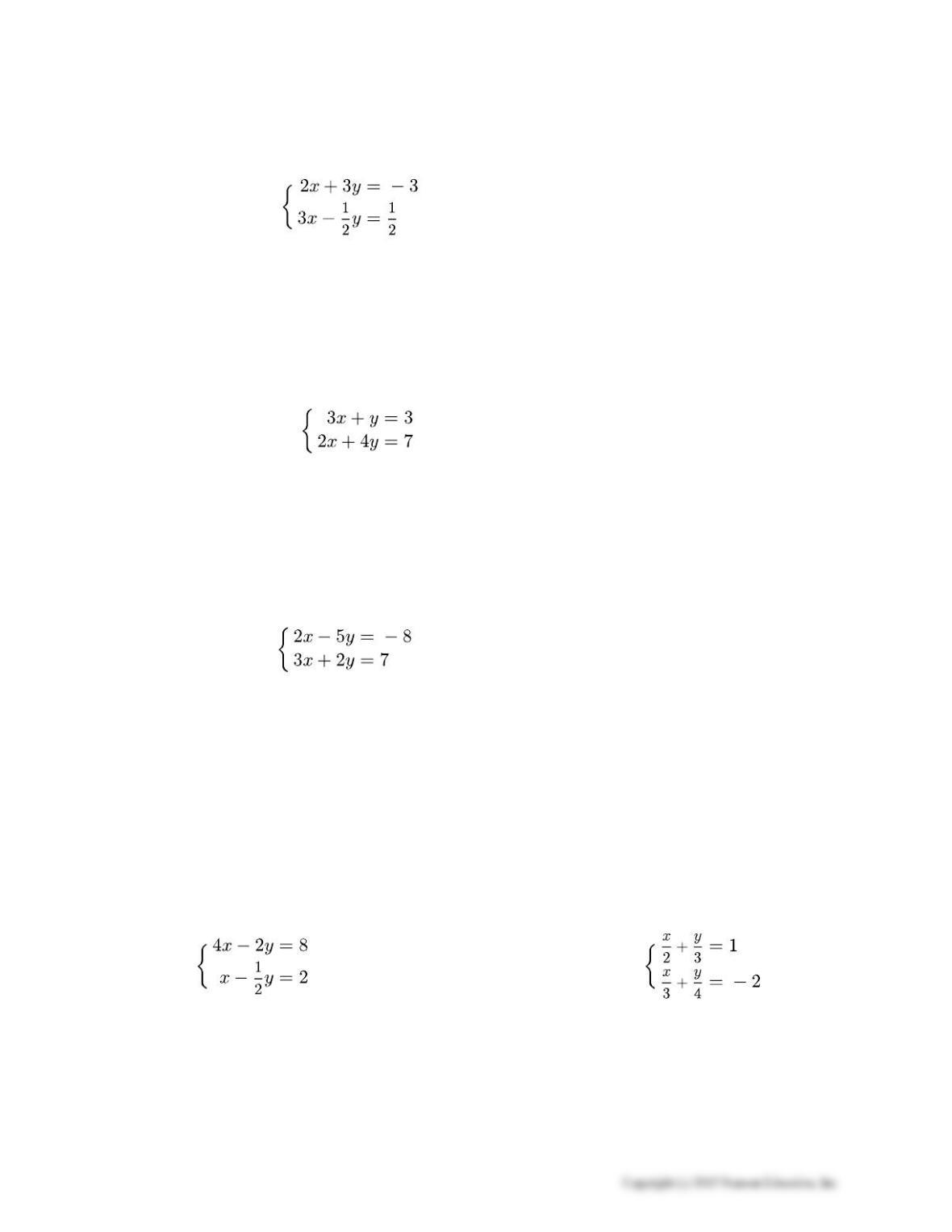
Solve each system by the indicated method.
1. Graphing:
1. _____________
2. Substitution:
2. _____________
3. Addition:
3. _____________
Determine whether each of the following systems is independent, inconsistent, or dependent.
4. 5.
4. ____________________ 5. ____________________
62 Form 5A
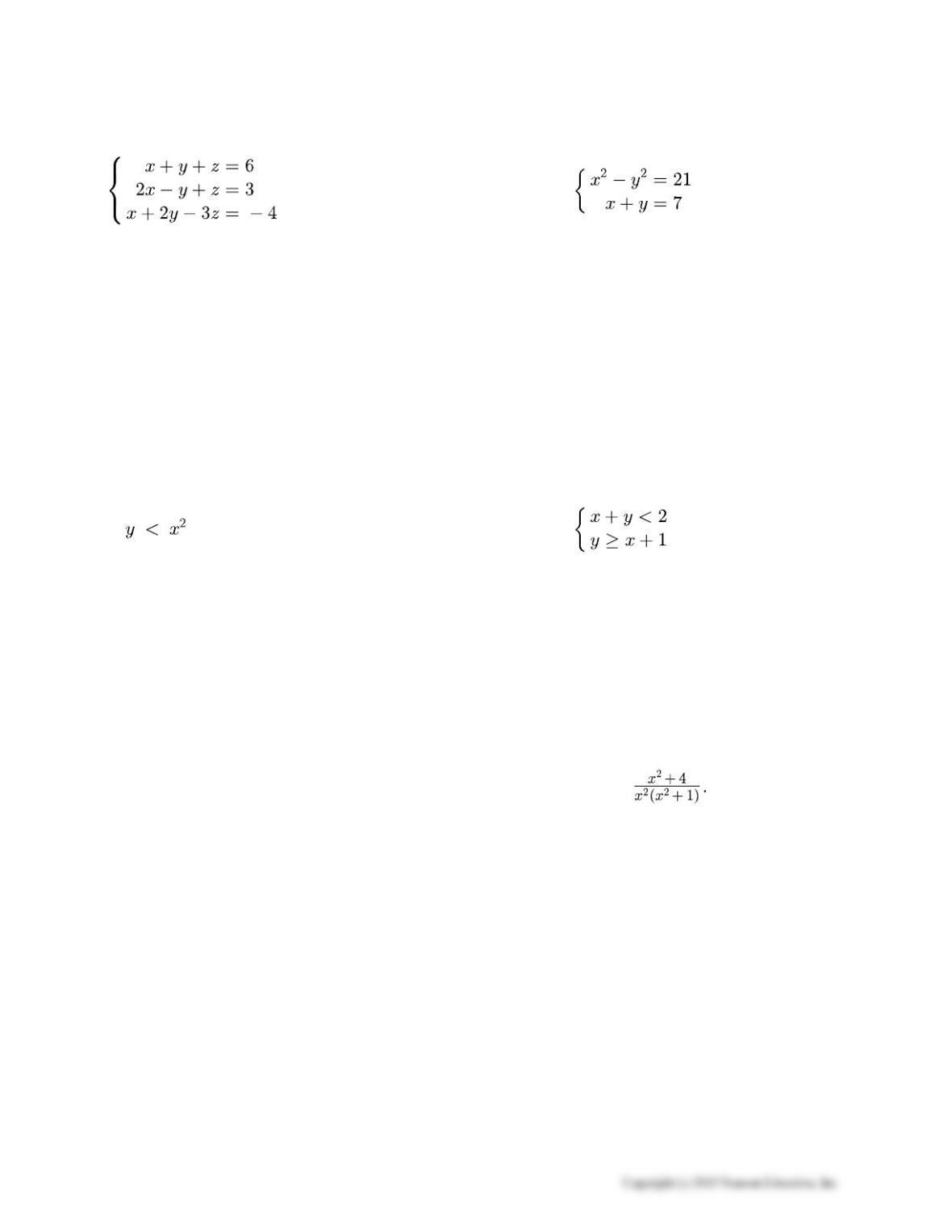
Find the solution set to each system of equations.
6. 7.
6. _________________ 7. _________________
Graph the solution set to each inequality or system of inequalities.
8. 9. + 1
Solve each problem.
10. Find the partial fraction decomposition for the rational expression:
10. ________________________________
11. The perimeter of a rectangle is 16 centimeters and its area is 15 square centimeters. What
are the rectangle‘s length and width?
11. ________________________________
Dugopolski’s 63College Algebra
Chapter 5 Test — Form B Name: _________________________
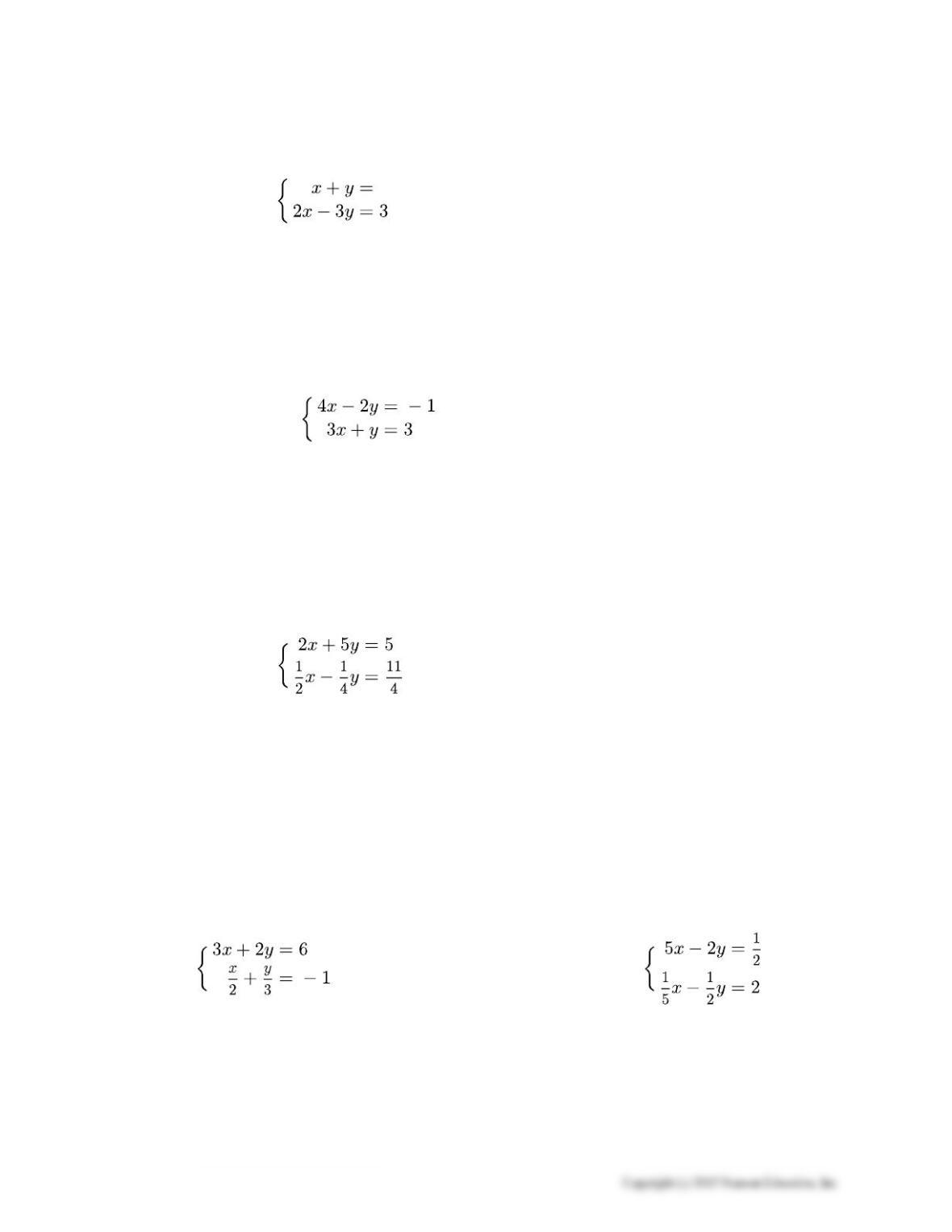
Solve each system by the indicated method.
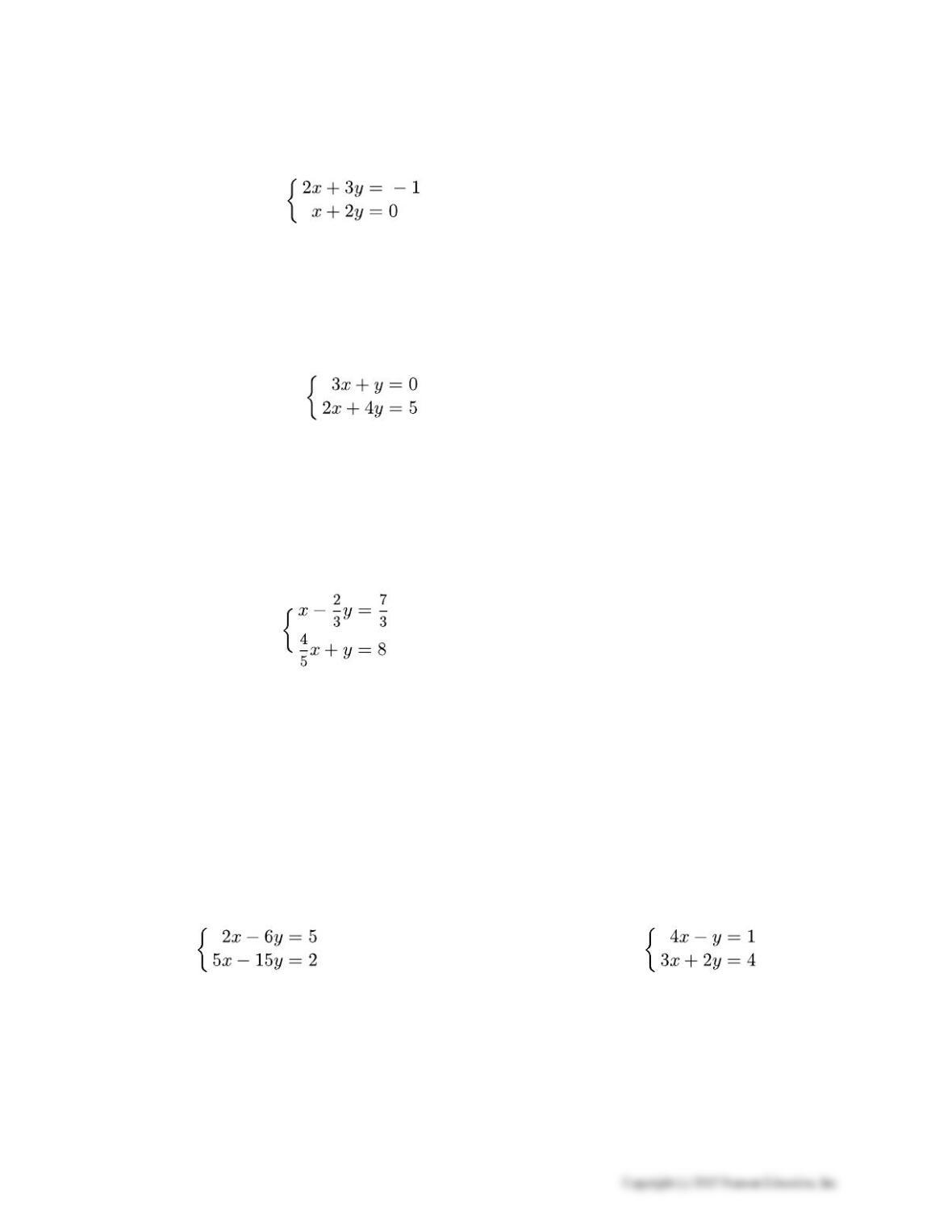
1. Graphing:
4
1. _____________
2. Substitution:
2. _____________
3. Addition:
3. _____________
Determine whether each of the following systems is independent, inconsistent, or dependent.
4. 5.
4. ____________________ 5. ____________________
64 Form 5B
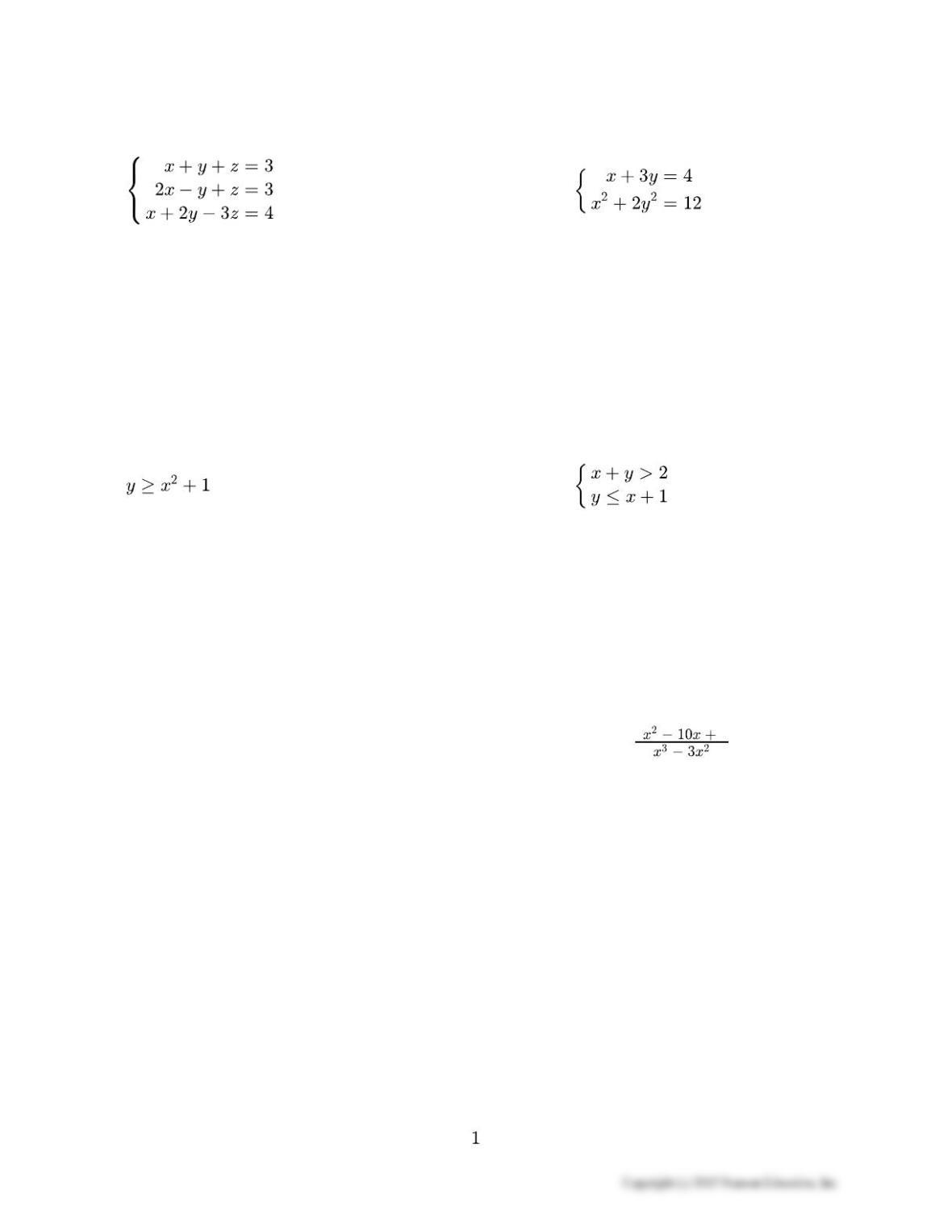
Find the solution set to each system of equations.
6. 7.
6. ____________________ 7. ____________________
Graph the solution set to each inequality or system of inequalities.
8. 9.
Solve each problem.
10. Find the partial fraction decomposition for the rational expression: 5 3
.
10. ________________________________
11. The perimeter of a rectangle is 13 centimeters and its area is 10 square centimeters. What
are the rectangle‘s length and width?
1 . ________________________________
Dugopolski’s 65College Algebra
Chapter 5 Test — Form C Name: _________________________
Solve each system by the indicated method.
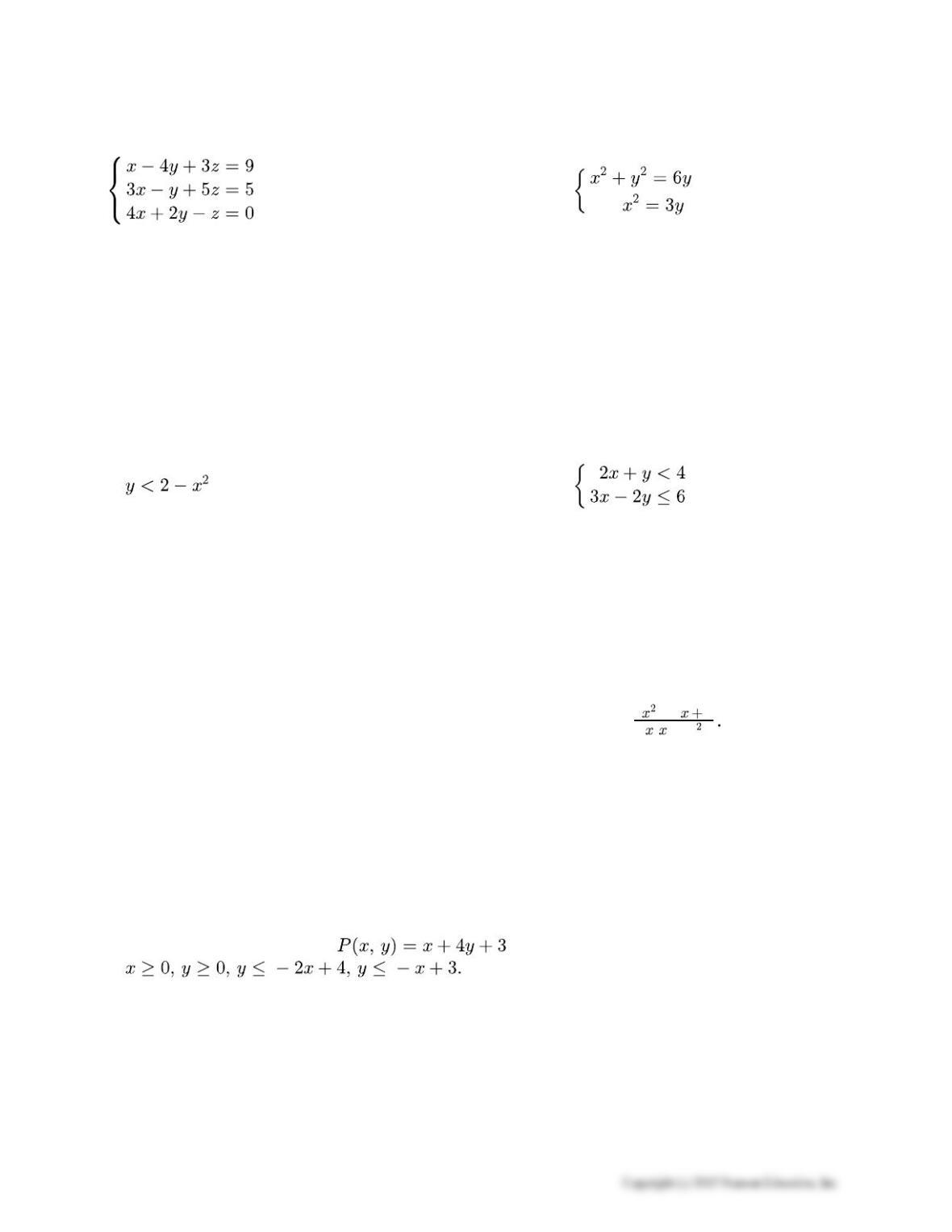
1. Graphing:
1. _____________
2. Substitution:
2. _____________
3. Addition:
3. _____________
Determine whether each of the following systems is independent, inconsistent, or dependent.
4. 5.
4. ____________________ 5. ____________________
66 Form 5C
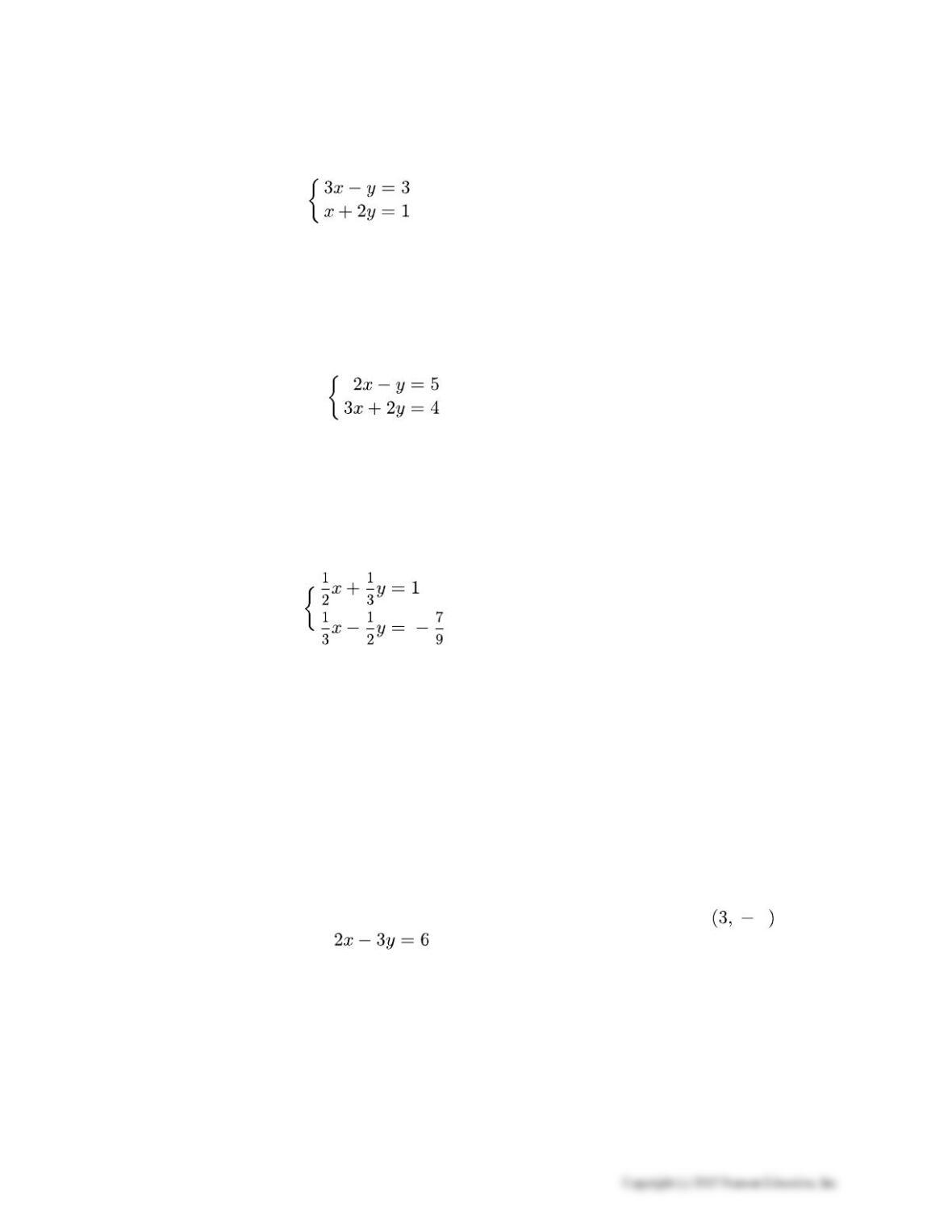
Find the solution set to each systems of equations.
6. 7.
6. _________________ 7. _________________
Graph the solution set to each inequality or system of inequalities.
8. 9.
Solve each problem.
10. Find the partial fraction decomposition for the rational expression: 2 + 7 3
( + 1)
10. ________________________________
11. Find the maximum value of subject to the constraints:
11. ________________________________
Dugopolski’s 67College Algebra
Chapter 5 Test — Form D Name: _________________________
Solve the systems by the indicated methods.
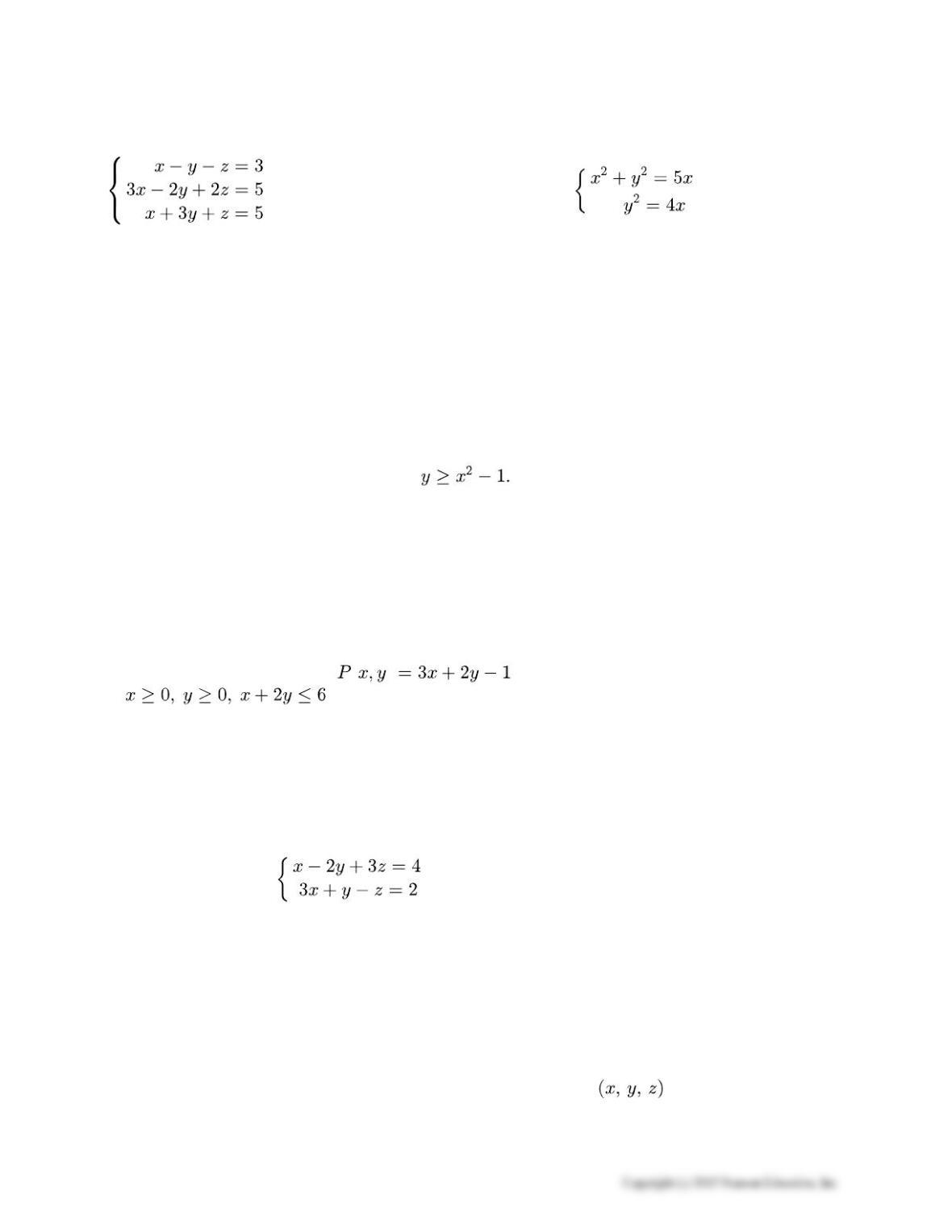
1. By Graphing:
1. _____________
2. By Substitution:
2. _____________
3. By Addition:
3. _____________
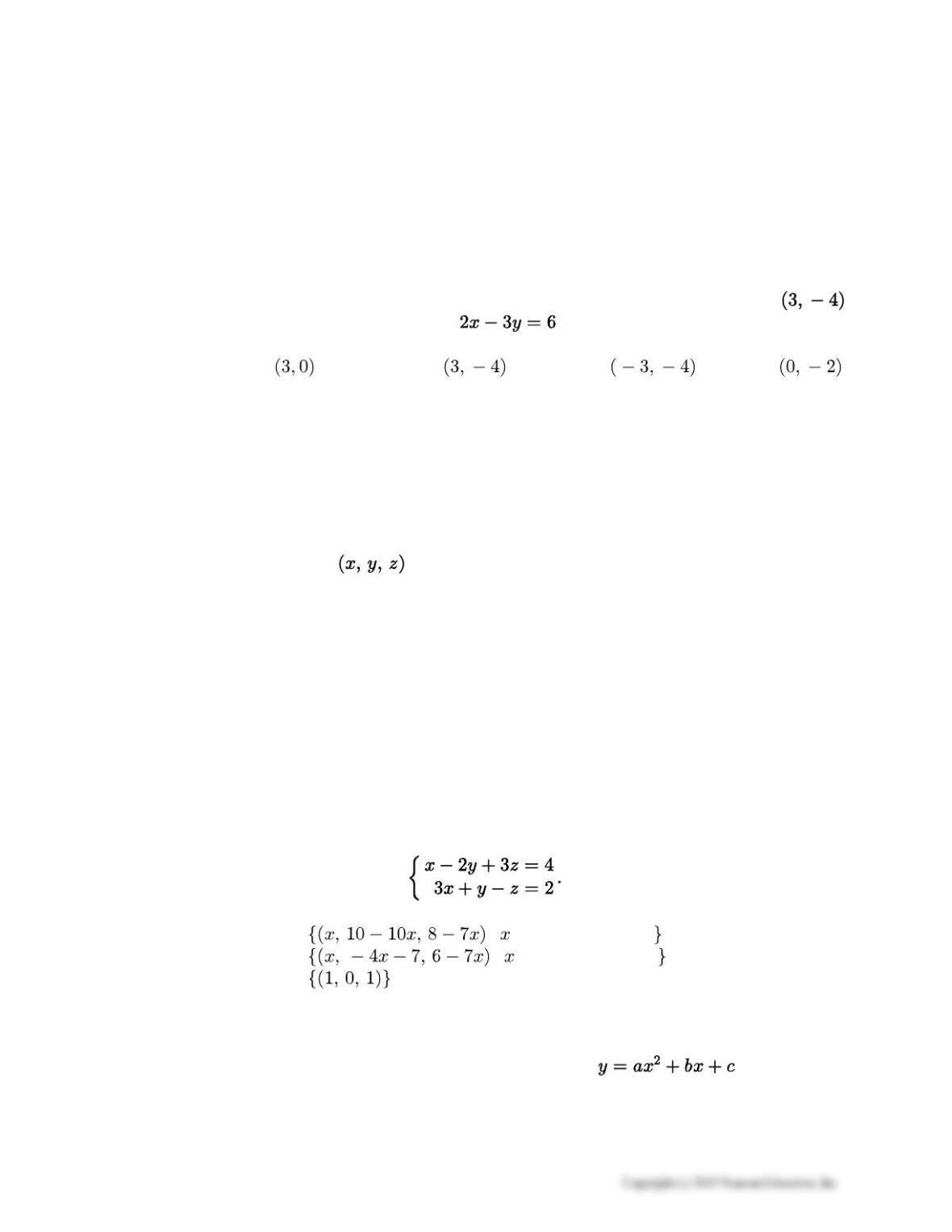
4. Find the point of intersection of the horizontal line through the point 5 and the line
whose equation is .
4. _____________
68 Form 5D
Find the solution set to each system of equations.
5. 6.
5. _________________ 6. _________________
Solve each problem.
7. Graph the solution set to the inequality
8. Find the maximum value of ( ) subject to the constraints:
.
8. ________________________________
9. Solve the system:
9. ________________________________
10. Given a linear system in three variables, what does its solution stand for
graphically?
Dugopolski’s 69College Algebra
Chapter 5 Test — Form E Name:_________________________
Multiple Choice: Choose the best answer for each problem.
_____ 1. If two lines intersect in a single point, a system consisting of these two
linear equations is:
a. dependent b. independent c. inconsistent d.systematic
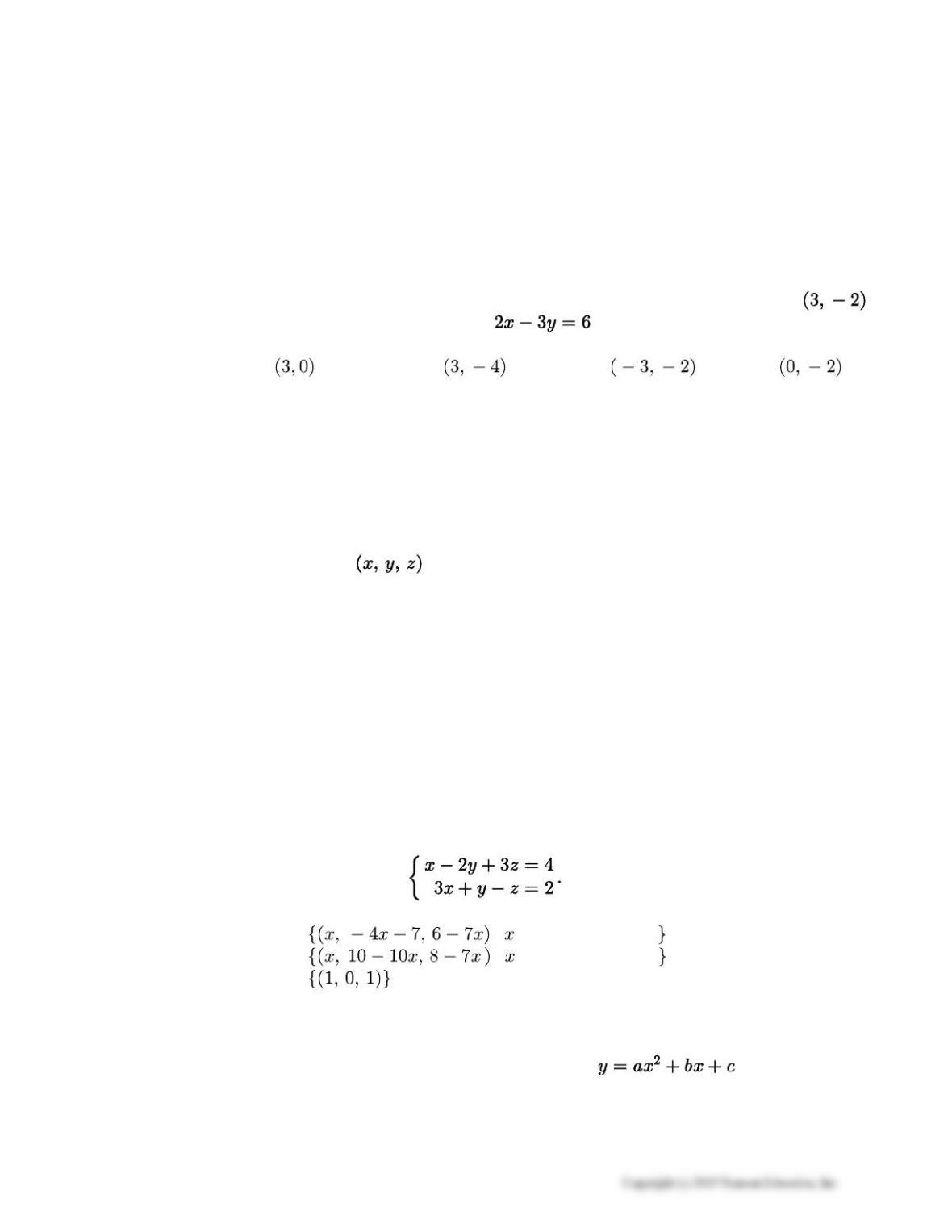
_____ 2. Find the point of intersection of the vertical line through the point and
the line whose equation is .
a. b. c. d.
_____ 3. Voodoo Fest tickets are sold in two levels: regular and VIP. Dan buys 2 VIP
tickets and 3 regular tickets for $797. Leah buys 6 VIP and 2 regular tickets
for $1698. Rebecca wants to buy a single regular ticket. What will she have to
pay for it?
a. $49 b. $79 c. $89 d. $99
_____ 4. A solution to a linear system in three variables stands for:
a. the intersection point of three lines c. the intersection point of three planes
b. three points in space d. a point where at two planes meet
_____ 5. Which of the following cannot occur if two planes appear in three-dimensional
space?
a. They can intersect in a single point.
b. They can intersect in a single line.
c. There can be infinitely many points which satisfy both equations
representing the planes.
d. There can be no points which satisfy both equations representing the planes.
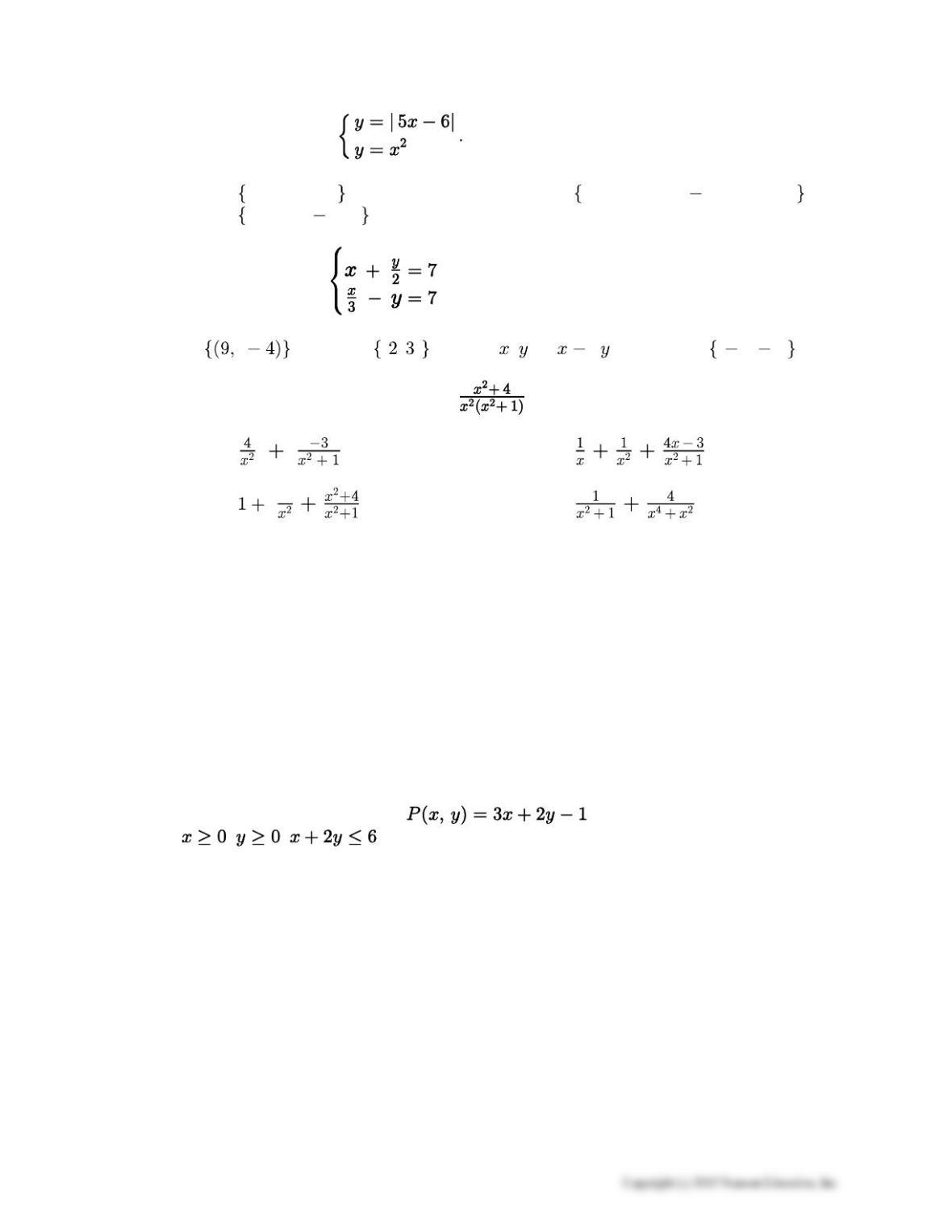
_____ 6. Solve the system:
a. | is any real number
b. | is any real number
c.
d. No solution
_____ 7. How many solutions can there be to a system that has one linear equation in
two variables and one equation of the form ?
a. 1 or 2 b. 2 c. 0 d. 0, 1 or 2
70 Form 5E
_____ 8. Solve the system:
a. (2, 4), (3, 9) c. (2, 4), (3, 9), ( 6, 36), (1, 1)
b. (6, 36), ( 1, 1) d. This is an inconsistent system.
_____ 9. Solve the system: .
a. b. ( , ) c. {( , ) | 3 2 = 0} d. ( 3, 2)
_____ 10. Decompose into partial fractions: .
a. c.
b. d.
4
_____ 11. The process of finding partial fractions is used to:
a. rewrite a fraction as its simpler factors.
b. take an irreducible quadratic in the denominator and decompose it.
c. reverse the process of addition of rational expressions.
d. give more practice using systems.
_____ 12. The main difference between the graph of a linear equation and the graph of a
linear inequality is whether:
a. we have many solutions or only one. c. we draw a solid or dashed line.
b. we shade a region or not. d. we have lines intersecting.
_____ 13. Find the maximum value of subject to the constraints:
, , .
a. 4 b. 5 c. 8 d. 17
_____ 14. Chairs for a dining table can be bought in two styles: side chairs or end chairs.
It takes 3 hours to construct the end chairs and 1.5 hours to finish the
upholstery. Side chairs can be constructed in 2.5 hours, with 0.75 hour needed
to finish the upholstery. The company allots 180 hours of construction time
and 72 hours of upholstery time per week. If the profit on end chairs is $750
and the profit on side chairs is $600, how many end chairs should be completed
per week to maximize profit?
a. 0 end chairs c. 36 end chairs
b. 30 end chairs d. 72 end chairs
Dugopolski’s 71College Algebra
Chapter 5 Test — Form F Name:_________________________
Multiple Choice: Choose the best answer for each problem.
_____ 1. If two lines intersect in a single point, a system consisting of these two
linear equations is:
a. dependent b. inconsistent c. independent d.systematic
_____ 2. Find the point of intersection of the horizontal line through the point
and the line whose equation is .
a. b. c. d.
_____ 3. The pre-tax price for 3 pens and 4 notepads is $7.37. The pre-tax price for 5
pens and 3 notepads is $7.70. What is the price for one notepad?
a. $0.79 b. $0.88 c. $1.25 d. $1.79
_____ 4. The solution to a linear system in three variables stands for:
a. a point where two planes meet c. the intersection point of three lines
b. three points in space d. the intersection point of three planes
_____ 5. Which of the following cannot occur if two planes appear in three-dimensional
space?
a. They can intersect in a single line.
b. They can intersect in a single point.
c. There can be infinitely many points which satisfy both equations
representing the planes.
d. There can be no points which satisfy both equations representing the planes.
_____ 6. Solve the system:
a. | is any real number
b. | is any real number
c.
d. No solution
_____ 7. How many solutions can there be to a system that has one linear equation in
two variables and one equation of the form ?
a. 0, 1 or 2 b. 2 c. 0 d. 1 or 2
72 Form 5F
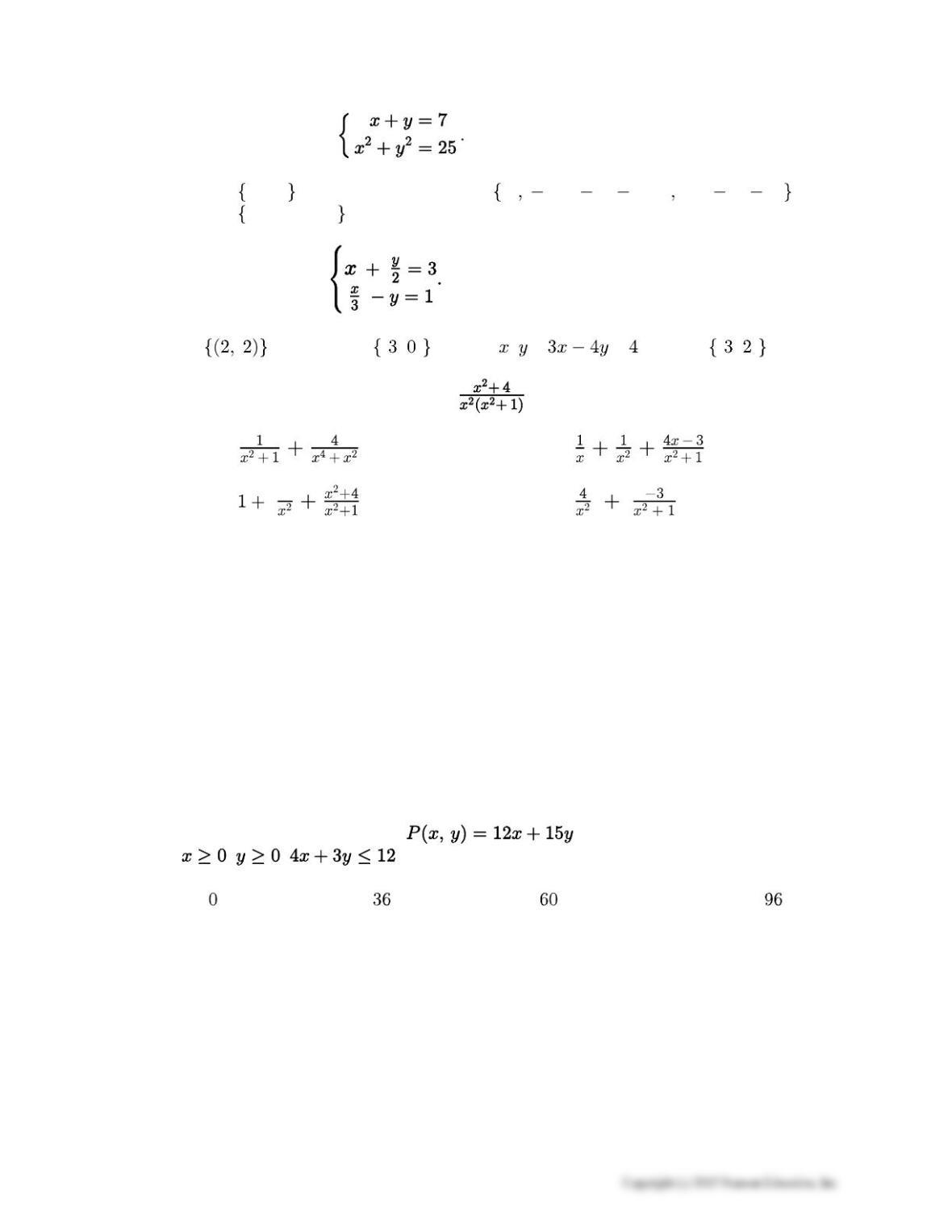
_____ 8. Solve the system:
a. (4, 3) c. (4 3),( 4, 3),(3 4),( 3, 4)
b. (3, 4), (4, 3) d. This is an inconsistent system.
_____ 9. Solve the system:
a. b. ( , ) c. {( , ) | = } d. ( , )
_____ 10. Decompose into partial fractions: .
a. c.
b. d.
4
_____ 11. The process of finding partial fractions is used to:
a. rewrite a fraction as its simpler factors.
b. reverse the process of addition of rational expressions.
c. take an irreducible quadratic in the denominator and decompose it.
d. give more practice using systems.
_____ 12. The main difference between the graph of a linear equation and the graph
of a linear inequality is whether:
a. we have many solutions or only one. c. we shade a region or not.
b. we draw a solid or dashed line. d. we have intersecting lines.
_____ 13. Find the maximum value of subject to the constraints:
, , .
a. b. c. d.
_____ 14. Chairs for a dining table can be bought in two styles: side chairs or end chairs.
It takes 3 hours to construct the end chairs and 1.5 hours to finish the
upholstery. Side chairs can be constructed in 2.5 hours, with 0.75 hour needed
to finish the upholstery. The company allots 180 hours of construction time
and 72 hours of upholstery time per week. If the profit on end chairs is $750
and the profit on side chairs is $600, how many side chairs should be
completed per week to maximize profit?
a. 0 side chairs c. 36 side chairs
b. 30 side chairs d. 48 side chairs
Dugopolski’s 121College Algebra
Chapter Test Keys
CHAPTER 5
122 Chapter 5 Test Key