82) The most widely spoken Indo-European language is
A) English.
B) Hindi.
C) Spanish.
D) Bengali.
E) Indo-European.
83) Australia and New Zealand’s language policies differ today in that Australia
A) emphasizes the English language while New Zealand gives a lot of support to linguistic
diversity.
B) was settled by English colonists but the original colonial language of New Zealand was
French.
C) recognizes Maori as an official Aboriginal language whereas New Zealand does not.
D) has virtually no indigenous language speakers remaining.
E) requires immigrants to take a dictation test whereas the New Zealand test is written.
84) Which statement best describes the use of English on the Internet?
A) English has become less dominant but is still the leading Internet language.
B) Different Internets exist for most other widely spoken languages, like Chinese, Japanese, and
Russian.
C) The number of English-speaking Internet users remains above 50 percent.
D) English has become more dominant as the most common language on the Internet.
E) No one seems to be able to spell English correctly anymore.
85) English has achieved unprecedented acceptance globally due to
A) the refusal to use English in colonial and imperial expansion.
B) the diffusion of command economies across much of the world.
C) its role as the common language of a global economy and culture.
D) the rise of folk culture and the decline of popular culture.
E) the diffusion of religion from LDCs to MDCs.
86) In the 1700s, 1800s, and afterward, English diffusion has been strongly related to
colonialism and imperialism in many parts of the world because
A) conquered populations refused to use English while colonial and imperial expansion was
underway.
B) as imperial Russia and China expanded they used English as a lingua franca in Asia.
C) conquered peoples wishing to participate in the new government and the increasingly global
economy felt pressured to learn English.
D) people in conquered countries knew that in the distant future, English would become the main
language associated with exports of popular culture, such as Disney cartoons and Hollywood
movies.
E) religious missionaries from every European country used English-language translations of the
Bible.
87) Language is a part of culture.
88) A language family is a collection of languages related through a common ancestral language
existing before recorded history.
89) Switzerland has four official languages.
90) Nearly half the people in the world speak an Indo-European language.
91) Germanic, Romance, and Latin are all branches of Indo-European.
92) One line of evidence suggests the first speakers of Indo-European were the Kurgans.
93) Indo-European divided into different branches because of the isolation of different cultural
groups.
94) The present distribution of languages around the world is due to technological advances and
the diffusion of popular culture.
95) The Angles, Jutes, and Saxons were Celtic tribes who invaded England 1500 years ago.
96) The most frequently spoken Afro-Asiatic language is Arabic.
97) American spellings were differentiated from British spellings primarily because of U.S.
desires for an independent identity.
98) New Englanders use a different dialect of English than other Americans primarily because
their ancestors came from different regions of England.
99) African American Vernacular English is often directly associated with ebonics.
100) All languages have a literary tradition.
101) All literary traditions are disappearing.
102) The most spoken language in China is Cantonese.
103) Icelandic has probably changed less over time than any other Germanic language.
104) Basque is the only non-Indo-European language currently spoken in Europe.
105) Hebrew is an example of an extinct language.
106) English was spread around the world through the establishment of British colonies.
107) Regional dialects in England can be traced back to the settlement patterns of the Angles,
Saxons, and Jutes.
108) Name the world’s second largest language family (used by nearly one-fourth of the world’s
population).
109) Name the world’s largest language family (used by nearly half of the world’s population).
110) What geographic factor accounts for the fact that both Americans and the British speak
English?
111) What geographic factor accounts for the fact that both Americans and the British use
different dialects of English?
112) In what three ways does the English used in the United States differ from the English used
in the United Kingdom?
113) How do we know that all Indo-European languages have a common ancestor?
114) Evaluate the main differences between the two leading hypotheses concerning the origins of
the Indo-European language family. Name each and discuss its main characteristics.
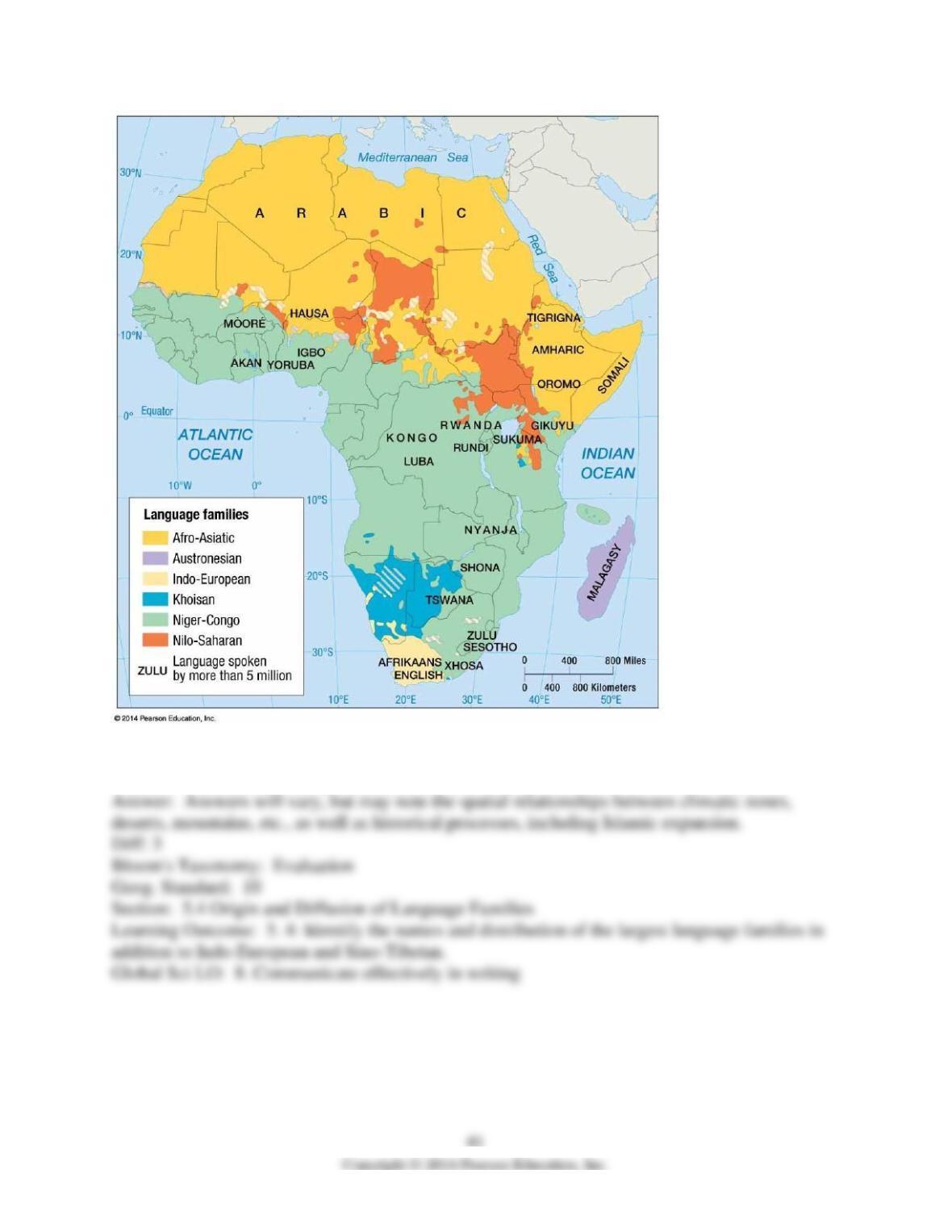
115) Evaluating the maps of the main languages of Africa, what physical and/or cultural factors
may have accounted for the patterns of diffusion indicated there?
116) In what ways does your dialect of American or British English differ from those of your
classmates? From other English speakers that you have encountered? Provide several specific
examples of vocabulary, accents, or other differences, and attempt to account for these
differences in spatial terms (naming regions of origin). What geographic factors explain the
similarities and differences in these dialects?
117) In what ways does your dialect of American or British English differ from television or
radio spokespeople that you typically hear? What geographic or cultural factors might you
consider to explain the similarities and differences in these dialects? Give specific examples.
118) In what country do the Flemings and Walloons live, and what languages do they speak?
Imagine that you live along the cultural border between these two groups. Note and discuss at
least four examples of problems or tensions that you can imagine existing in such a border
region.
119) What are the future prospects for two or three large populations of non-English speakers in
North America? In your opinion, will their languages begin to overshadow English, or will other
changes occur? Provide examples and evidence from this chapter to sustain your opinion.
120) Think of two or three examples of foreign language use or fictitious languages that you
have seen or heard in film or television programs. How convincing are the actors’ portrayals of
those languages? What clues indicate to you that the languages either seem authentic or fake?
Give specific names and examples to support your opinion.
121) Imagine that you were writing a science fiction book or a film script in which a fictitious
extraterrestrial language was to be created (at least in part). Assuming that you wish to create a
few phrases and terms of a fictitious language that does not resemble English and that sounds
unlike most other languages in common use today, how would you begin to create this “non-
Earth” language? Discuss some specific strategies or examples of terms or techniques that you
would employ.
122) Why do people in different regions of the United States speak English differently?
123) Discuss the implications of the role of English as the world’s lingua franca, at a time when
other languages are becoming more common on the Internet. Give evidence from this chapter to
support your opinion about the future role(s) of English in the world.