The Cultural Landscape, 11e (Rubenstein)
Chapter 5 Languages
1) A lingua franca is
A) an English word that has entered the French language.
B) a language understood by people who have different native languages.
C) an extinct language that has been revived.
D) an official language in a region of the world different from where the language originated.
E) a language used by French colonial administrations.
2) The main difference between languages in the same family, branch, or group is how
A) recently in time the languages were once the same.
B) closely the speakers of each language live to one other.
C) they correspond to the diffusion of free markets across much of the world.
D) similar the cultures of the speakers of each language are.
E) they all emerged at the same point in history, according to the Bible.
3) A group of languages that share a common origin but have since evolved into individual
languages is a
A) dialect.
B) language branch.
C) language family.
D) language group.
E) language root.
4) A group of languages that share a common ancestor before recorded history is a
A) dialect.
B) language branch.
C) language family.
D) language group.
E) language root.
5) Basque is a good example of a(n)
A) language family.
B) globalizing language.
C) language group.
D) lingua franca.
E) isolated language.
6) Franglais is
A) the lingua franca of France.
B) a dialect of French.
C) the standard language of French.
D) the use of English in the French language.
E) a language used by French colonial administrations.
7) The geographic study of the distribution of languages provides a good example of
A) the interplay between globalization and local diversity.
B) the diffusion of folk culture in different areas of the world.
C) the role and spread of religion across much of the world.
D) the diffusion of free markets across much of the world.
E) political conflicts that arise due to ethnic tensions.
8) The two largest language families in the world are
A) Indo-Iranian and Balto-Slavic.
B) Sino-Tibetan and Indo-European.
C) Afro-Asiatic and Sino-Tibetan.
D) Balto-Slavic and Sino-Tibetan.
E) Altaic and Nilo-Saharan.
9) When languages are depicted as leaves on trees, the trunks of the trees represent
A) dialects.
B) language groups.
C) language families.
D) possible prehistoric superfamilies.
E) language sects.
10) The language family encompassing the languages of the People’s Republic of China is
A) Indo-European.
B) Indo-Iranian.
C) Mandarin.
D) Sino-Tibetan.
E) Austro-Asiatic.
11) The charts or diagrams in this chapter indicate that the percentage of Altaic language
speakers in the world is greater than the percentage speaking ________ languages.
A) Sino-Tibetan
B) Austro-Asiatic
C) Indo-European
D) Niger Congo
E) Austronesian
12) The charts or diagrams in this chapter indicate that the percentage of Austronesian language
speakers in the world is greater than the percentage speaking ________ languages.
A) Sino-Tibetan
B) Dravidian
C) Indo-European
D) Niger-Congo
E) Afro-Asiatic
13) The diagrams in this chapter show that the percentage of Sino-Tibetan speakers in the world
is less than the percentage speaking ________ languages.
A) Austronesian
B) Indo-European
C) Dravidian
D) Altaic
E) Niger-Congo
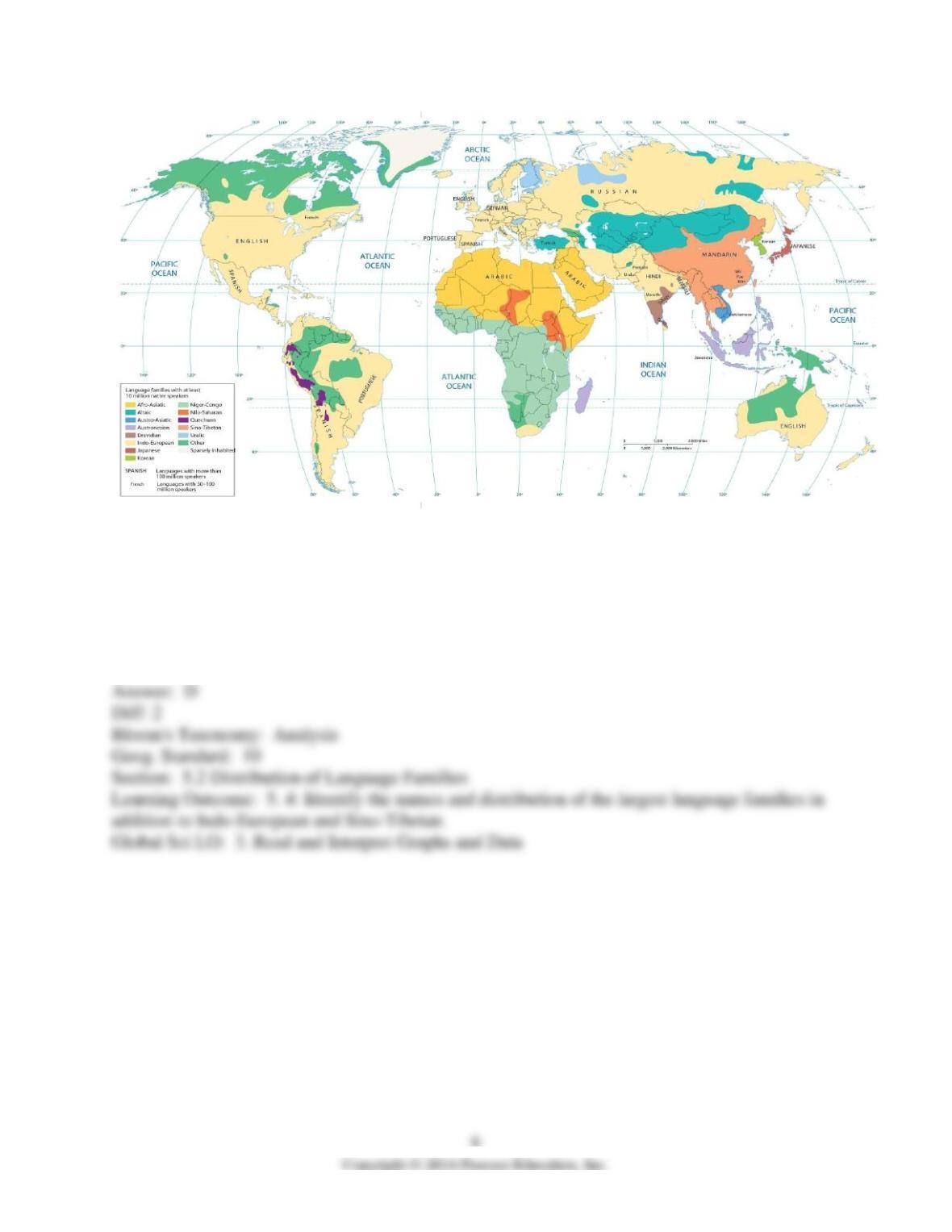
14) The maps in this chapter show that the second most widely spoken language family in
Europe is
A) Balto-Slavic.
B) Indo-European.
C) Romance.
D) Uralic.
E) Celtic.
15) Both the Angles and the Normans contributed to the development of the English language,
because they
A) spoke ancient English languages.
B) invaded England.
C) spoke languages derived from Latin.
D) diffused English around the world.
E) agreed to divide Ireland from England.
16) The first speakers of the language that evolved into English were tribes that lived in present-
day
A) France.
B) Denmark.
C) United States.
D) Italy.
E) Switzerland.
17) Dialects developed within England primarily because
A) different Germanic invaders settled in different regions.
B) the Normans invaded from the south.
C) the Viking invaders did not remain long in England.
D) British Received Pronunciation became the standard dialect.
E) commerce developed more slowly in England than on the European continent.
18) Which of the following is not a Romance language?
A) Bulgarian
B) Italian
C) Portuguese
D) Romanian
E) French
19) The language spoken by soldiers stationed throughout the Roman Empire was known as
A) Official Latin.
B) Romance language.
C) standard language.
D) Vulgar Latin.
E) Catalan Latin.
20) The most widely spoken language in Brazil is
A) Creole.
B) French.
C) Portuguese.
D) Spanish.
E) Catalan.
21) The most widely spoken language in Argentina is
A) Creole.
B) French.
C) Spanish.
D) Portuguese.
E) Catalan.
22) The four most frequently spoken branches of Indo-European include all but
A) Balto-Slavic.
B) Celtic.
C) Indo-Iranian.
D) Romance.
E) Germanic.
23) The two most important languages in South America are
A) Dutch and English.
B) English and Spanish.
C) French and Spanish.
D) Portuguese and Spanish.
E) Creole and Portuguese.
24) Russian is part of what language branch?
A) Balto-Slavic
B) Germanic
C) Indo-Iranian
D) Romance
E) Altaic
25) The Kurgans
A) conquered much of East Asia several thousand years ago.
B) were a Germanic tribe that invaded England.
C) were herders from the steppes of Central Asia.
D) preserved Basque in present-day Spain.
E) were the earliest speakers of Sino-Caucasian, which they diffused through conquest.
26) According to Colin Renfrew’s research, Indo-European languages diffused across Europe
A) entirely by sea.
B) by way of the Kurgan homeland.
C) with the conquests of warriors on horseback.
D) with the diffusion of agriculture.
E) following the traders on the silk road.
27) Colin Renfrew’s research constitutes much of the ________ Hypothesis.
A) Nomadic Herder
B) Kurgan Farmer
C) Nomadic Warrior
D) Sedentary Farmer
E) Silk Road Trader
28) English is part of which language branch?
A) Germanic
B) Northern
C) Western
D) Indo-European
E) Austronesian
29) English is part of which language family?
A) Germanic
B) North Germanic
C) West Germanic
D) Indo-European
E) Romance
30) Which group of the Germanic family is extinct?
A) West Germanic
B) North Germanic
C) East Germanic
D) South Germanic
E) Uber Germanic
31) According to the maps and diagrams in this chapter, the Germanic invaders of England
included which groups or tribes?
A) Germans, Normans, and Danes
B) Brittans, Normans, and Welsh
C) Irish, Welsh, and English
D) Scots, Irish, and Welsh
E) Angles, Jutes, and Saxons
32) According to the maps and diagrams in this chapter, England was invaded by tribes from
A) English-speaking areas
B) Uric-speaking areas
C) Native American-speaking areas
D) Italian-speaking areas
E) Germanic-speaking areas
33) Analyzing the maps and diagrams in this chapter, we can see that the branch of Indo-
European that includes Ukrainian is
A) European.
B) Balto-Slavic.
C) Indo-Iranian.
D) Romance.
E) Germanic.
34) According to the maps and diagrams in this chapter, the branch of Indo-European that
includes Slovak is
A) European.
B) Balto-Slavic.
C) Indo-Iranian.
D) Romance.
E) Germanic.
35) According to the maps and diagrams in this chapter, the branch of Indo-European that
includes Romanian is
A) European.
B) Romance.
C) Indo-Iranian.
D) Balto-Slavic.
E) Germanic.
36) According to the maps and diagrams in this chapter, the branch of Indo-European that
includes Haitian Creole is
A) European.
B) Romance.
C) Indo-Iranian.
D) Balto-Slavic.
E) Germanic.
37) According to the maps and diagrams in this chapter, the branch of Indo-European that
includes Rangpuri is
A) European.
B) Indo-Iranian.
C) Romance.
D) Balto-Slavic.
E) Germanic.
38) Analysis of the maps and diagrams in this chapter shows that the branch of Indo-European
that includes Kurdish is
A) European.
B) Indo-Iranian.
C) Romance.
D) Balto-Slavic.
E) Germanic.
39) Analysis of the maps and diagrams in this chapter shows that the Dutch language is from the
branch of Indo-European known as
A) European.
B) Germanic.
C) Romance.
D) Balto-Slavic.
E) Indo-Iranian.
40) According to the diagrams in this chapter, Turkmen is part of what language branch?
A) Altaic
B) Germanic
C) Indo-Iranian
D) Romance
E) Balto-Slavic
41) The maps and diagrams in this chapter show that an Indo-European language is chiefly
spoken in which of these countries?
A) Bulgaria
B) Finland
C) Hungary
D) Estonia
E) China
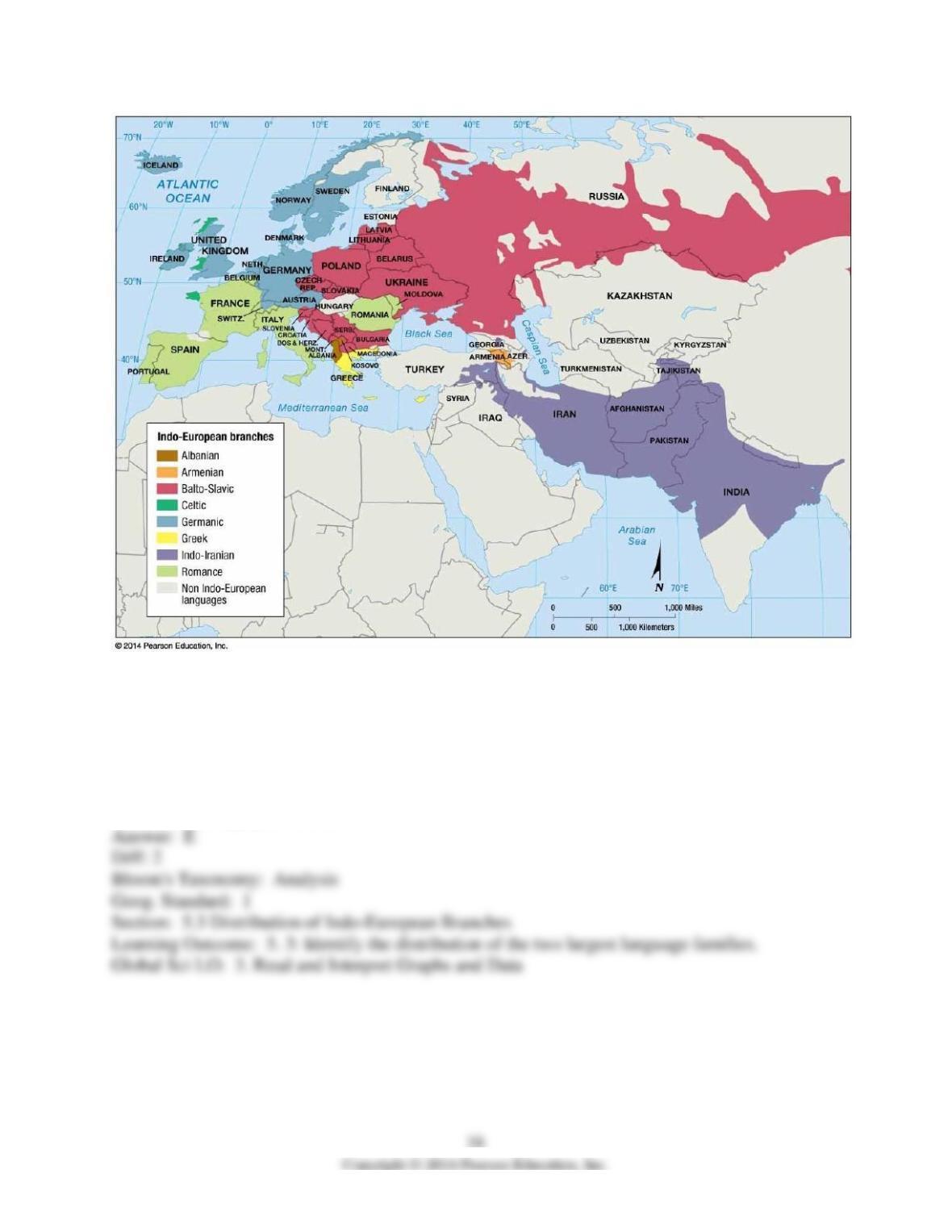
42) An analysis of the maps and diagrams in this chapter shows that every European country is
dominated by Indo-European speakers except
A) Spain, Italy, and Portugal.
B) Romania, Serbia, and Slovenia.
C) Germany, Austria, and Switzerland.
D) Denmark, Sweden, and Norway.
E) Finland, Hungary, and Estonia.
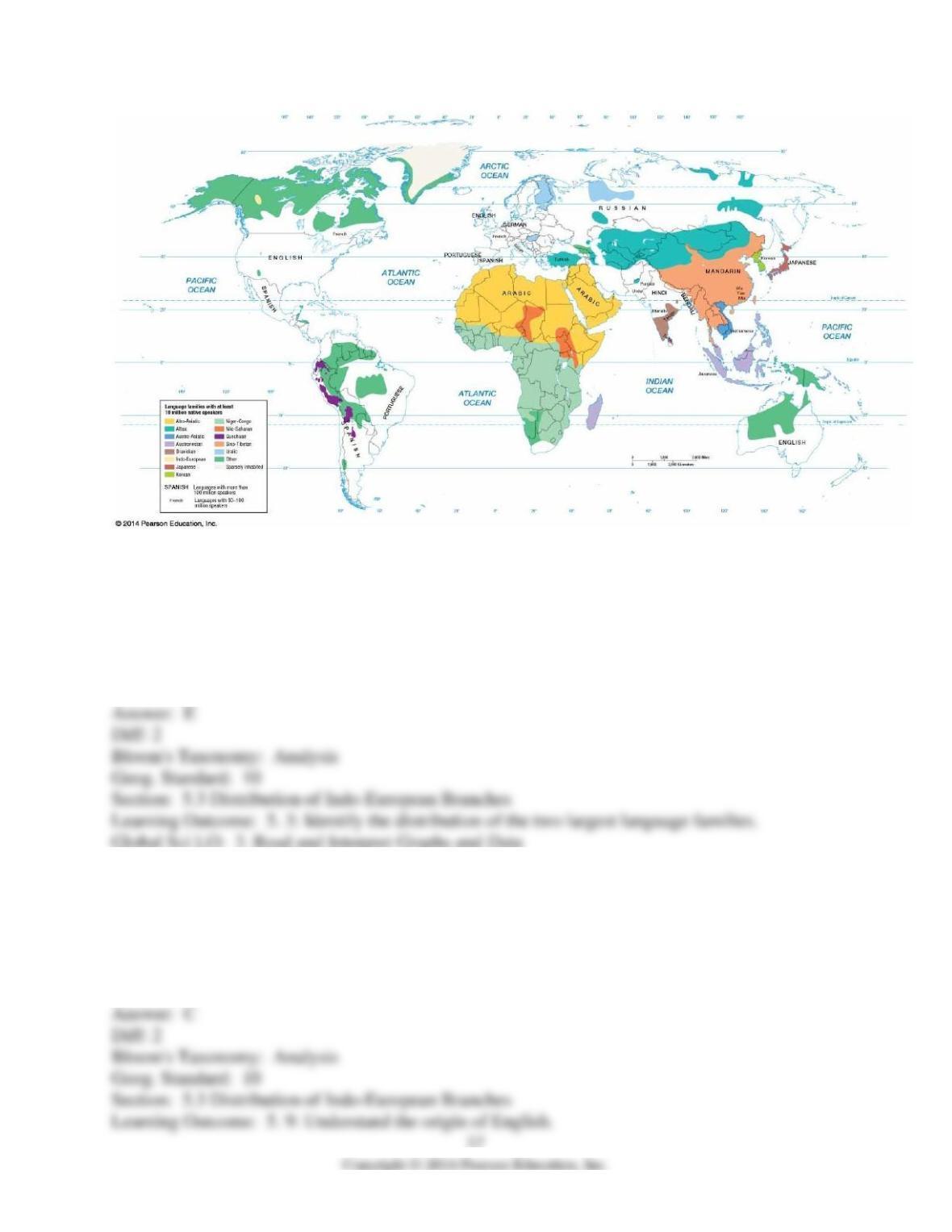
43) An analysis of the maps and diagrams in this chapter shows that Indo-European speakers
dominate
A) Estonia
B) Madagascar
C) Malaysia
D) Finland
E) Sweden
44) English is part of which language group?
A) East Germanic
B) North Germanic
C) West Germanic
D) Indo-European
E) Semitic
45) A literary tradition is
A) a form of a language intended to be printed in official government documents.
B) a language spoken in an area.
C) a collection of languages related to one other.
D) the written form of a language.
E) the variety of dialects in a language used in obscure examples of poetry.
46) An isogloss is
A) a form of a language spoken in a local area.
B) a collection of unique words.
C) a boundary between language regions.
D) a blending of two language families.
E) a line that separates literary traditions.
47) The second-largest language family is
A) Indo-European.
B) Sino-Tibetan.
C) Afro-Asiatic.
D) Austronesian.
E) Dravidian.
48) Marija Gimbutas’ theory points to the first speakers of the Indo-European language as the
ancient
A) Celts.
B) Germans.
C) Kurgans.
D) Russians.
E) Dravidians.
49) Marija Gimbutas has contributed to the ________ Hypothesis.
A) Sedentary Archer
B) Nomadic Fisher
C) Nomadic Warrior
D) Sedentary Farmer
E) Sedentary Farmer-Warrior
50) When languages are depicted as leaves on trees, the roots of the trees below the surface
represent
A) dialects.
B) language groups.
C) language sects.
D) language families.
E) possible prehistoric superfamilies.
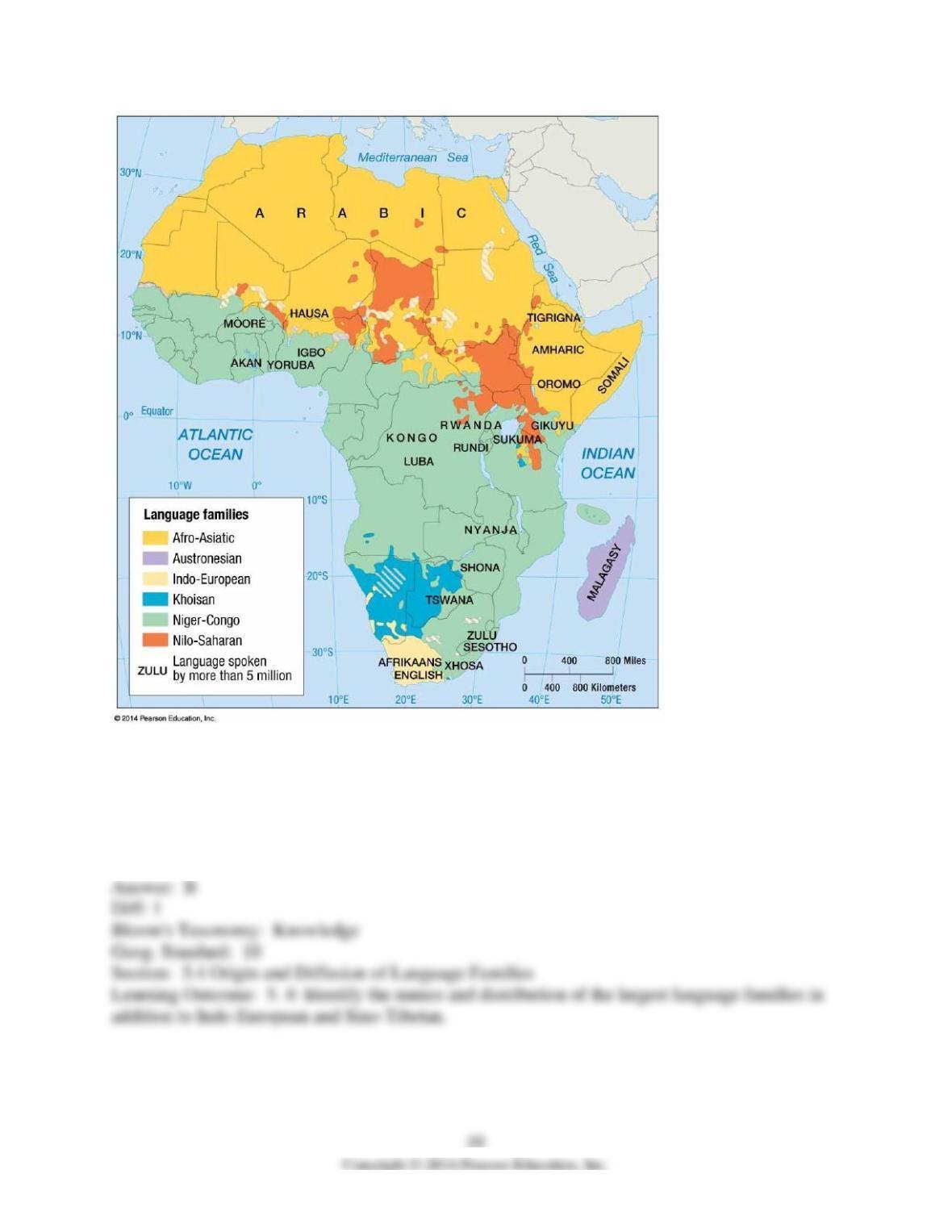
51) The most important language family in Sub-Saharan Africa is
A) Khoisan.
B) Niger-Congo.
C) Nilo-Saharan.
D) Afro-Asiatic.
E) Altaic.