73. Excessive earnings management typically begins as a result of
74. The GAAP Oval best represents
75. Which of the following groups on the earnings management continuum are always considered ethical?
76. The Sarbanes-Oxley Act establishes
77. The Public Company Accounting Oversight Board
78. The Public Company Accounting Oversight Board is NOT required to
79. According to Sarbanes-Oxley, which one of the following services is an accounting firm permitted to
provide to its audit client?
80. According to Sarbanes-Oxley, who are auditors required to report to and be retained by?
81. Which of the following does Sarbanes-Oxley NOT require management to do?
82. The internal audit manager reports directly to the
83. Which of the following activities would internal auditors NOT typically perform in a large company?
84. External audits are performed by
85. What is the most common professional designation for external auditors?
86. Which statement best describes the role of external auditors when auditing a large public company?
87. Which of the following requires CPAs to provide reasonable assurance that significant fraud or
misstatement is NOT present in financial statements?
88. Which of the following audit processes is used primarily by external auditors?
89. Which of the following audit processes attempts to identify areas that may deserve attention by using
techniques such as comparative ratio analysis?
90. Which of the following is an incentive that influences auditors to remain independent and to provide fair
and reliable financial information?
91. When does the Securities and Exchange Commission (SEC) typically require a company to submit a
registration statement to the SEC for approval?
92. What is the detailed report that companies file annually with the Securities and Exchange Commission?
93. Which form must be filed quarterly by all publicly held corporations?
94. Which of the following is NOT one of the effects that the Securities Exchange Act of 1934 had on
accountants?
95. Discuss the three types of problems that can occur in financial statements.
1.
Errors – occur when care is not taken in recording, posting, and summarizing accounting data. They are not intentional and are corrected
when discovered.
2.
Disagreements – occur when different people arrive at different conclusions based on the same set of facts. Disagreements usually occur
when judgment and estimates are required. The differences occur when those involved with producing the financial statements are
motivated by differing incentives.
3.
Frauds – occur when intentional errors are made by management to manipulate the financial statements for their own purposes.
96. During the end of year audit, the auditors found the following errors in Blossom Company’s financial
statements:
a.
No adjusting entry was made for salaries of $15,000 that were earned in December but will not be paid until January.
b.
On November 1, Blossom Company paid an insurance payment of $12,000 for a twelve month policy. On November 1, the full $12,000
was debited to insurance expense. No adjusting entries were made to insurance expense at year end.
c.
On December 15, Blossom Company received a $5,000 prepayment for services that will be performed in January. Cash was debited and
service revenue was credited when the cash was received.
d.
The recording of a payment for an accounts receivable of $15,000 was recorded twice.
e.
A note payable for $20,000 was inadvertently recorded as $200,000.
f.
Cash was credited when depreciation expense of $35,000 was recorded.
g.
Inventory of $40,000 was inadvertently recorded to the supplies account.
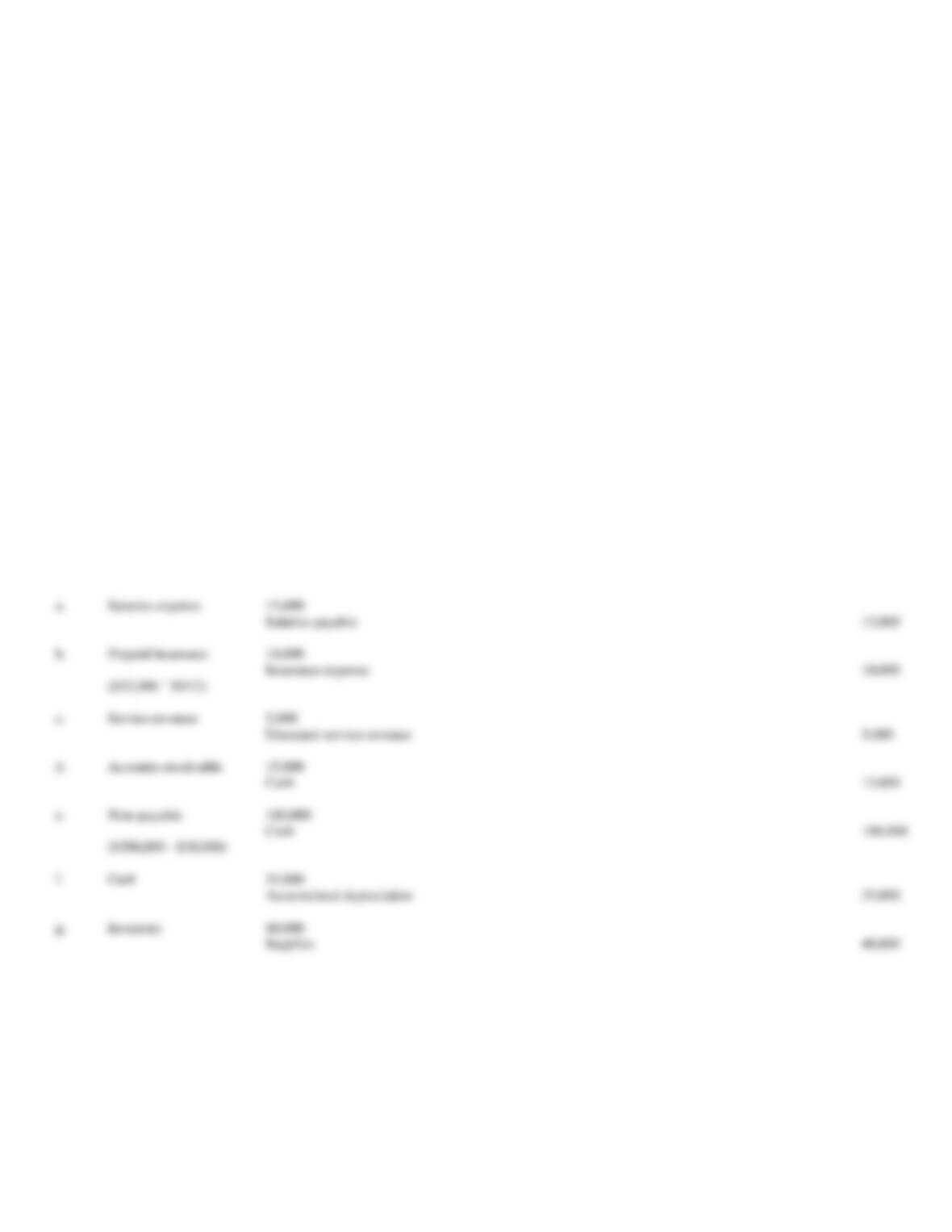
Prepare the necessary journal entries to correct each error (omit explanations).
a.
Salaries expense
15,000
Salaries payable
b.
Prepaid insurance
10,000
Insurance expense
($12,000 ´ 10/12)
c.
Service revenue
5,000
Unearned service revenue
d.
Accounts receivable
15,000
Cash
e.
Note payable
180,000
Cash
($200,000 – $20,000)
f.
Cash
35,000
Accumulated depreciation
g.
Inventory
40,000
Supplies
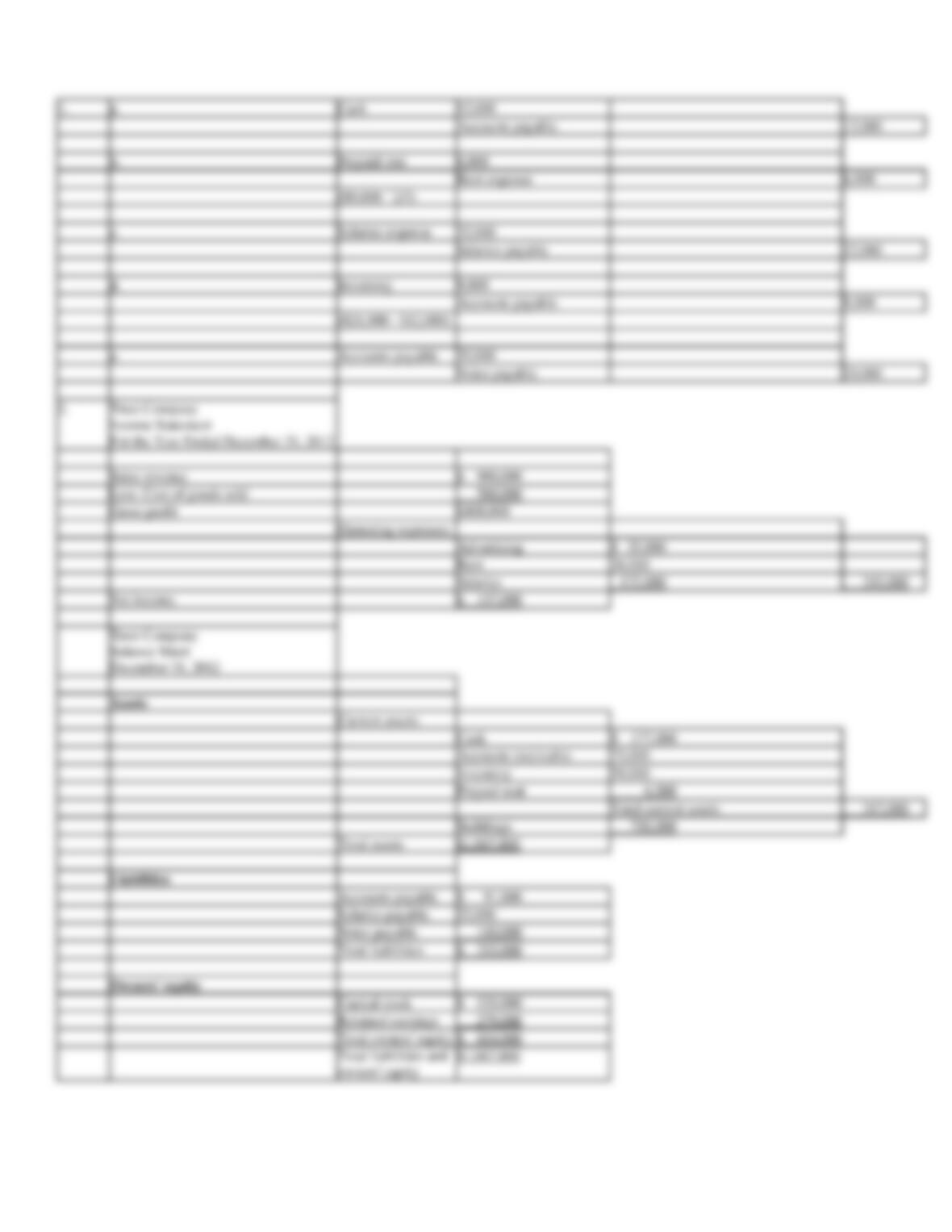
97. The income statement and the balance sheet for Trust Company for the year ended December 31, 2012 are
shown below:
Trust Company
Income Statement
For the Year Ended
December 31, 2012
Sales revenue
$900,000
Less: Cost of goods sold
500,000
Gross profit
$400,000
Operating expenses:
Advertising
$ 35,000
Rent
42,000
Salaries
150,000
227,000
Net income
$173,000
Trust Company
Balance Sheet
December 31, 2012
Assets
Current assets:
Cash
$ 165,000
Accounts receivable
75,000
Inventory
50,000
Total current assets
290,000
Buildings
750,000
Total assets
$1,040,000
Liabilities
Accounts payable
$ 90,000
Notes payable
120,000
Total liabilities
$ 210,000
Owners’ equity
Capital stock
$ 535,000
Retained earnings
295,000
Total owners’ equity
$ 830,000
Total liabilities and owners’
equity
$1,040,000
During the end of year audit, the auditors found the following errors:
a.
The payment of an account payable for $12,000 was recorded twice.
b.
On December 1, Trust Company paid a rent payment of $9,000 for three months rent. The full $9,000 was debited to rent expense on
December 1. No adjusting entries were made to rent expense at year end.
c.
No adjusting entry was made for salaries of $22,000 that were earned in December but will not be paid until January.
d.
Inventory that was paid for on account was recorded as $12,000 instead of $21,000.
e.
A note payable for $20,000 was inadvertently recorded as accounts payable.
1.
Prepare the necessary journal entries to correct each error (omit explanations).
2.
Prepare financial statements after the errors have been corrected.
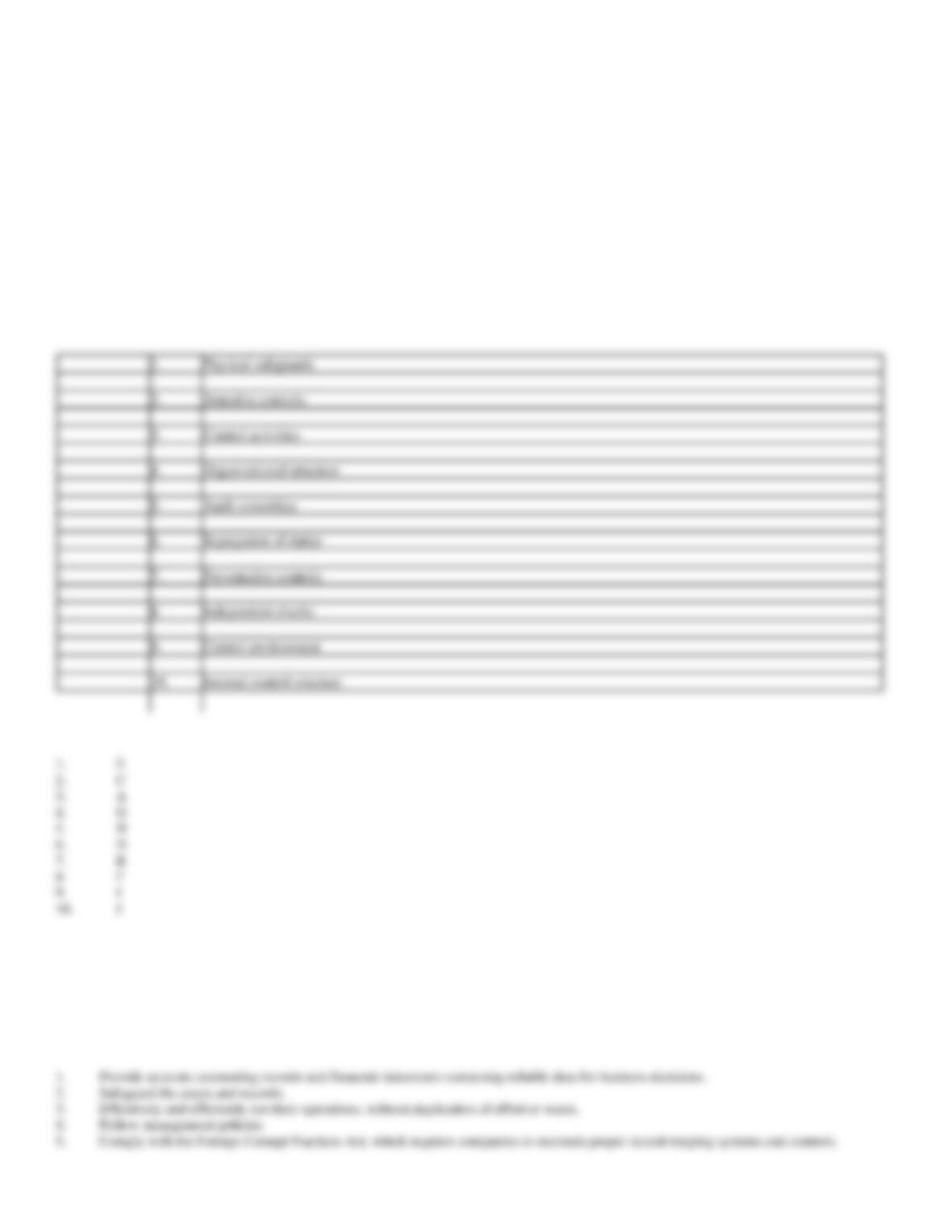
98. In the spaces provided, write the letter of the definition for each of the following terms.
A.
Policies and procedures used by management to meet their needs
B.
Internal control activities that are designed to prevent the occurrence of errors and fraud
C.
Internal control activities that are designed to detect the occurrence of error and fraud
D.
A strategy to provide an internal check on performance through separation of authorization of transactions, separation of operational
responsibilities, and separation of custody of assets
E.
Physical precautions used to protect assets and records
F.
Procedures for continual internal verification of other controls
G.
The lines of authority and responsibility within a company
H.
Members of a company’s board of directors who are responsible for dealing with the external and internal auditors
I.
The actions, policies, and procedures that reflect the overall attitudes of top management about control and its importance to the entity
J.
Safeguards in the form of policies and procedures established to provide management with reasonable assurance that the objectives of an
entity will be achieved
99. List the five major concerns that companies must keep in mind when designing their internal control
system.
Physical safeguards
Detective controls
Control activities
Organizational structure
Audit committee
Segregation of duties
Preventative controls
Independent checks
Internal control structure
E
C
A
G
H
D
B
F
I
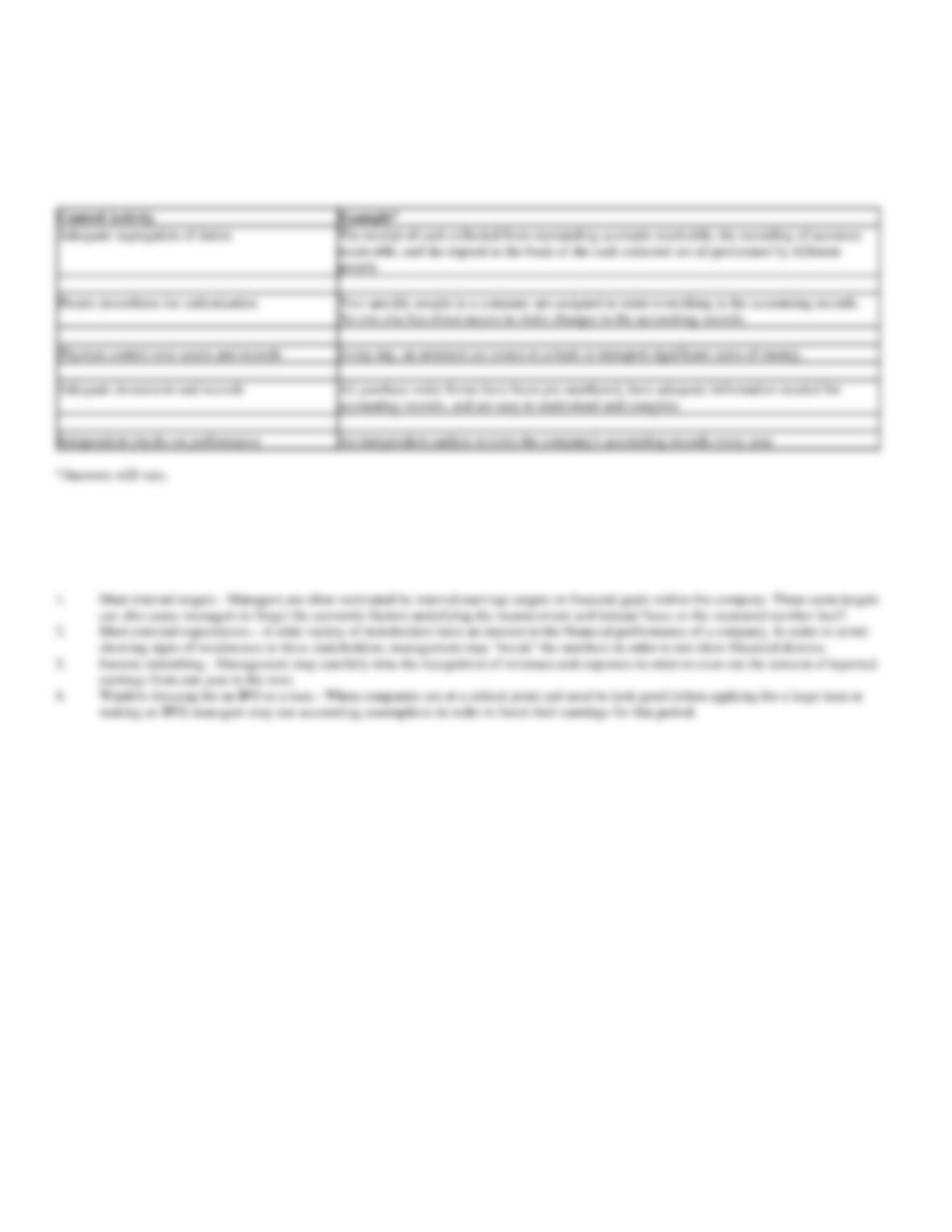
100. Control activities are the policies and procedures that management has adopted to provide reasonable
assurance that the financial reports are accurate and that the company’s objective are being met. List the five
categories of control activities and give a specific example of each.
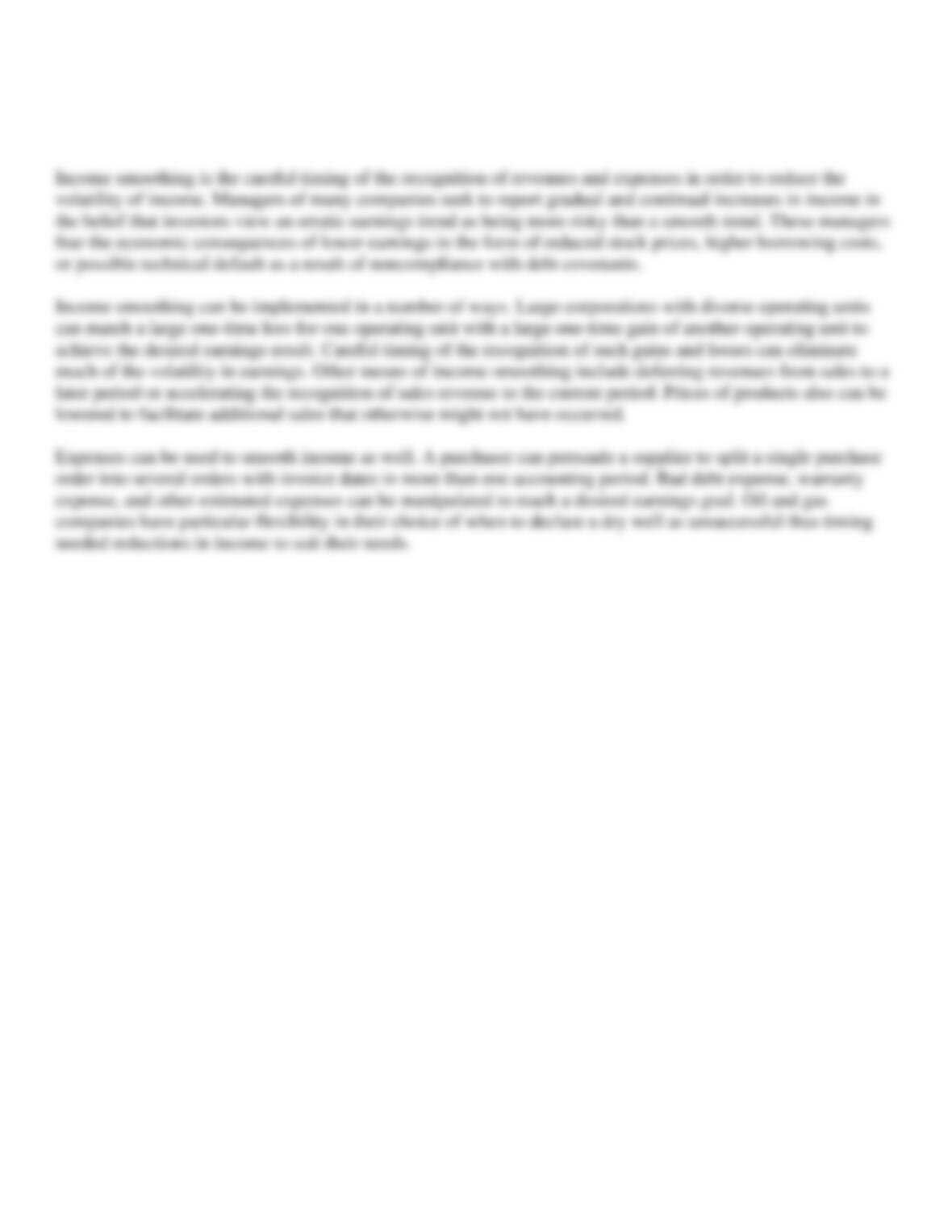
101. List and describe the four major reasons for managing reported earnings.
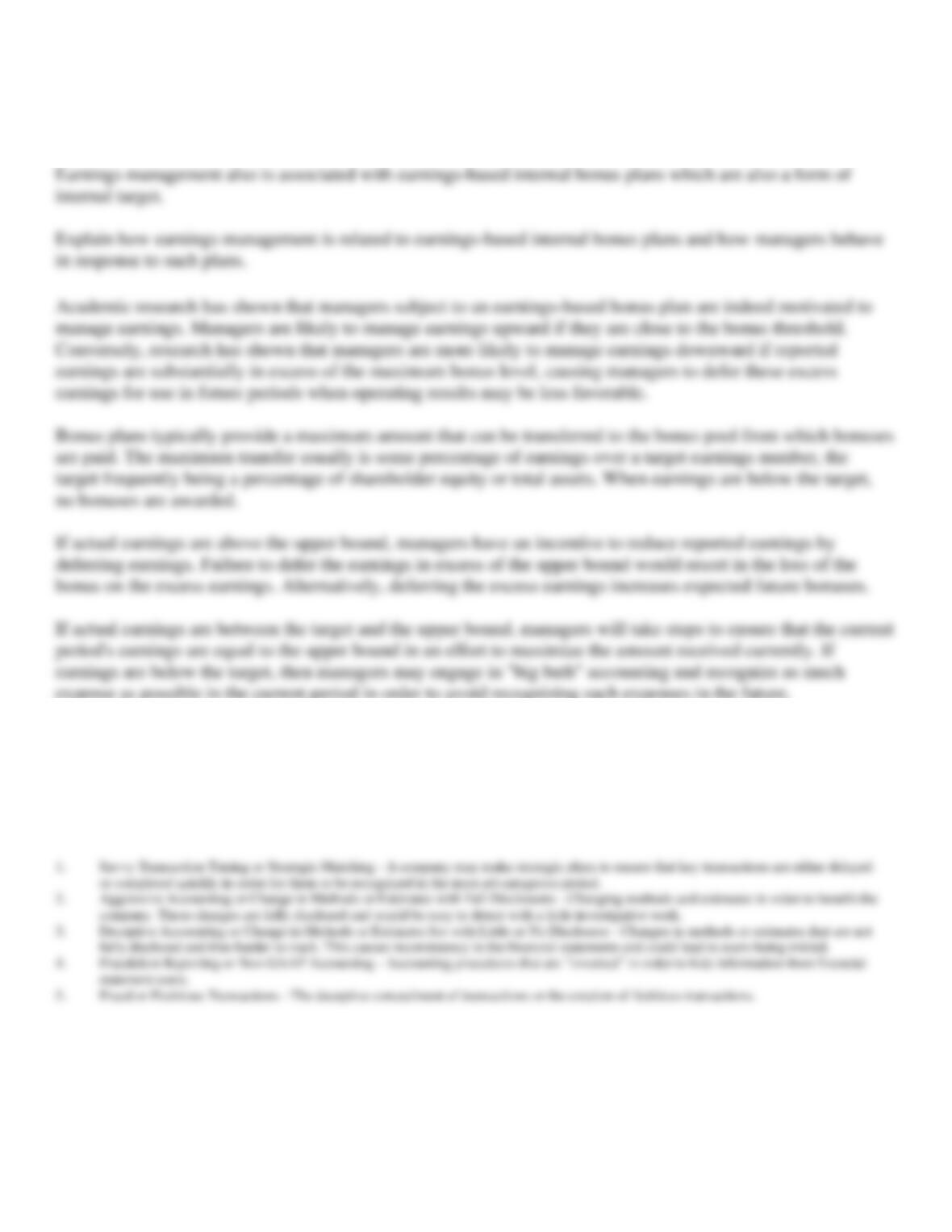
102. Research has shown that numerous companies manage their earnings. A variety of earnings management
techniques are available ranging from income smoothing to outright fraud.
Define income smoothing and explain how it is implemented.
103. Internal earnings targets represent an important tool in motivating managers to increase sales efforts,
control costs, and use resources more efficiently. Such internal targets also can cause managers to resort to
extreme measures in order to meet goals established by upper management. Earnings management often
appears in a variety of forms as a means of reaching these internal goals.
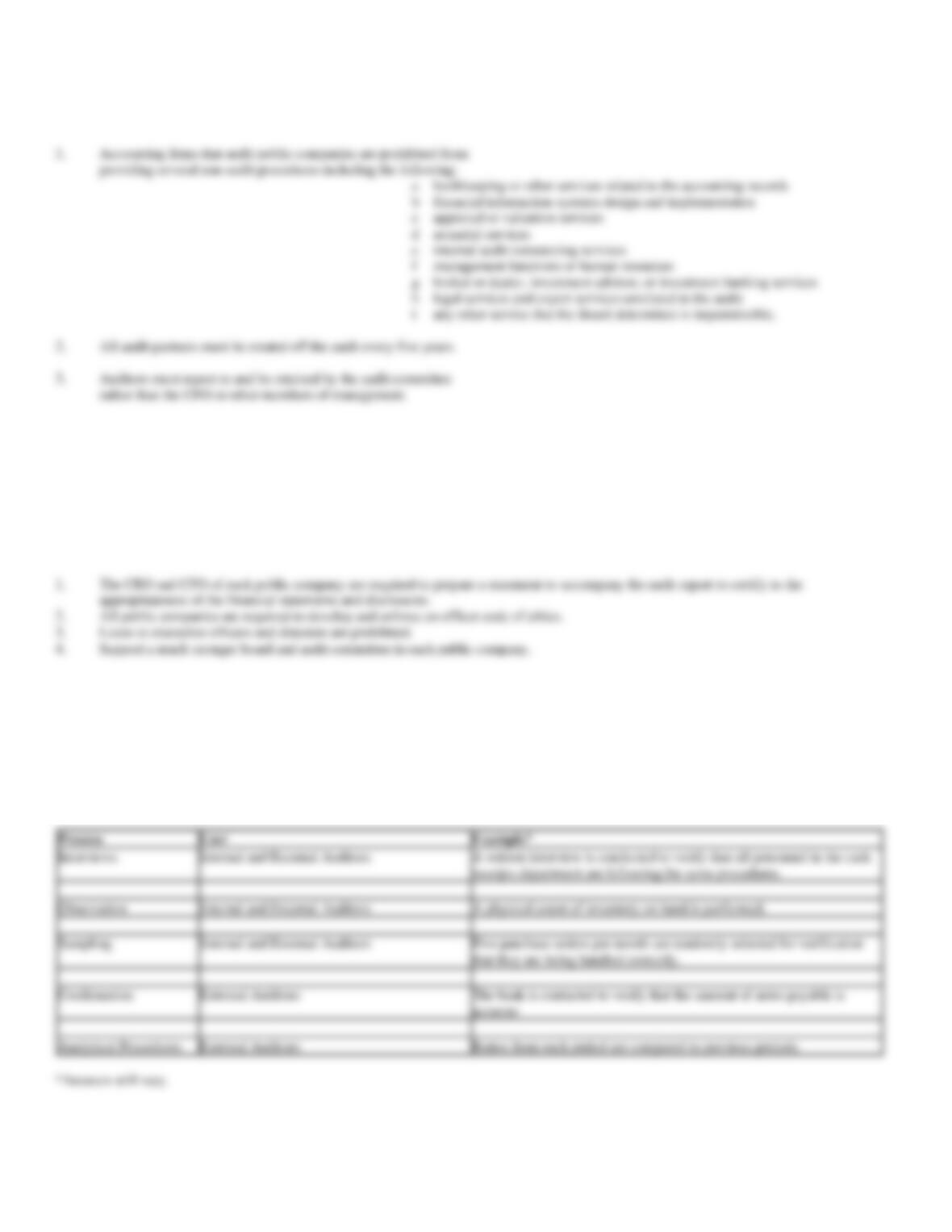
104. The Earnings Management Continuum has five levels. List, in order, the five levels of the Earnings
Management Continuum and give a description of each one.
105. Restoring public confidence in the financial reporting process requires that auditors remain independent.
How does the Sarbanes-Oxley Act constrain auditors to ensure independence?
106. Restoring public confidence in the financial reporting process requires that management ensure financial
statement users of the steps taken to provide quality financial information. How does the Sarbanes-Oxley Act
constrain management to achieve that public confidence?
107. List the five different processes used by auditors in order to gain confidence in the quality of the reporting
process. For each process, state who primarily uses this process (internal auditors, external auditors, or both)
and give a specific example of how this process would be used.
108. List and discuss three motivations for independent auditors to fairly represent the financial information of
the company.