Assume that the labor market is perfectly competitive. Rather than the product demand schedule shown in
the table, suppose this firm sold its output competitively for a price of $2.50. In this case, how many
workers will this profit-maximizing firm choose to employ at a wage of $25.00?
27. “The extra output, measured in dollars, that accrues to society when an additional unit of labor is
employed” best describes
28. For a firm selling output in an imperfectly competitive market, its labor demand curve will
29. All else equal, the imperfectly competitive seller’s labor demand curve is
30. Compared to an otherwise identical competitive firm, a firm with monopoly power will hire
31. Which of the following best describes the output effect of a wage increase?
32. Which of the following best describes the substitution effect of a wage increase?
33. Which of the following best describes the output effect of a wage decrease?
34. Which of the following best describes the substitution effect of a wage decrease?
35. Compared to the long-run labor demand curve, the firm’s short-run curve is typically
36. The long-run labor demand curve incorporates
37. In the long run, the substitution effect of a lower wage
38. The long-run response to a drop in the wage exceeds the short-run response for all of the following
reasons except

39. “To find the market demand curve for a particular type of labor, simply sum the labor demand curves
of all employers of that type of labor.” This statement is
40. When deriving the market demand curve for a particular type of labor, one must
41. The market wage increases from $9 to $11 and the firm responds by reducing its labor force by 16%.
The wage elasticity coefficient is
42. Suppose that, as a result of a decrease in the market supply of labor, the wage rate has risen 10%.
After adjusting its employment level, a firm finds its total wage bill has decreased. This occurrence
indicates that the firm’s labor demand
5-18
43. Suppose that, as a result of an increase in the market supply of labor, the wage rate has fallen 10%.
After adjusting its employment levels, a firm finds its total wage bill has decreased. This occurrence
indicates that the firm’s labor demand
44. A union leader told its membership that a wage increase, while resulting in some layoffs, would
nonetheless increase the total incomes of its membership. The firm replied that a wage increase would
reduce the total incomes of its membership. We can conclude that
45. In comparing two otherwise identical industries X and Y, an economist finds that labor demand is
more elastic in industry X. Which of the following would support this finding?
46. In comparing two otherwise identical industries X and Y, an economist finds that labor demand is less
elastic in industry X. Which of the following would support this finding?
47. In his comparison of over 100 studies of labor demand, Hamermesh concludes the overall long-run
elasticity of labor demand in the United States to be
48. Which of the following can be predicted to increase the demand for labor?
49. Which of the following can be predicted to increase the demand for labor?
50. Assume that skilled labor and energy are substitutes in production. An increase in energy prices is
then predicted to
51. If energy and unskilled labor are gross complements, an increase in the price of energy will
52. Skilled labor will benefit from an increase in the wage rate paid to unskilled labor if
53. In the textile industry, industrial robots and assembly line workers are gross substitutes. Accordingly,
the drop in the price of robots has
Topic: Real World Applications
54. Suppose that the decline in prices of personal computers has reduced the demand for labor at a
particular firm. We may conclude that at this firm
55. The contingent work force
56. Since 1980, the number of jobs in manufacturing has
57. International trade
58. In which occupations does the Bureau of Labor Statistics project the fastest employment growth over
the next ten years?
59. An isoquant shows all combinations of
60. At the least-cost combination of capital and labor,

5-22
61. The slope of an isoquant at any point reflects the
62. If the marginal rate of technical substitution of labor for capital is greater than the price of labor
relative to the price of capital, then the firm can produce the same level of output at lower total cost by
using
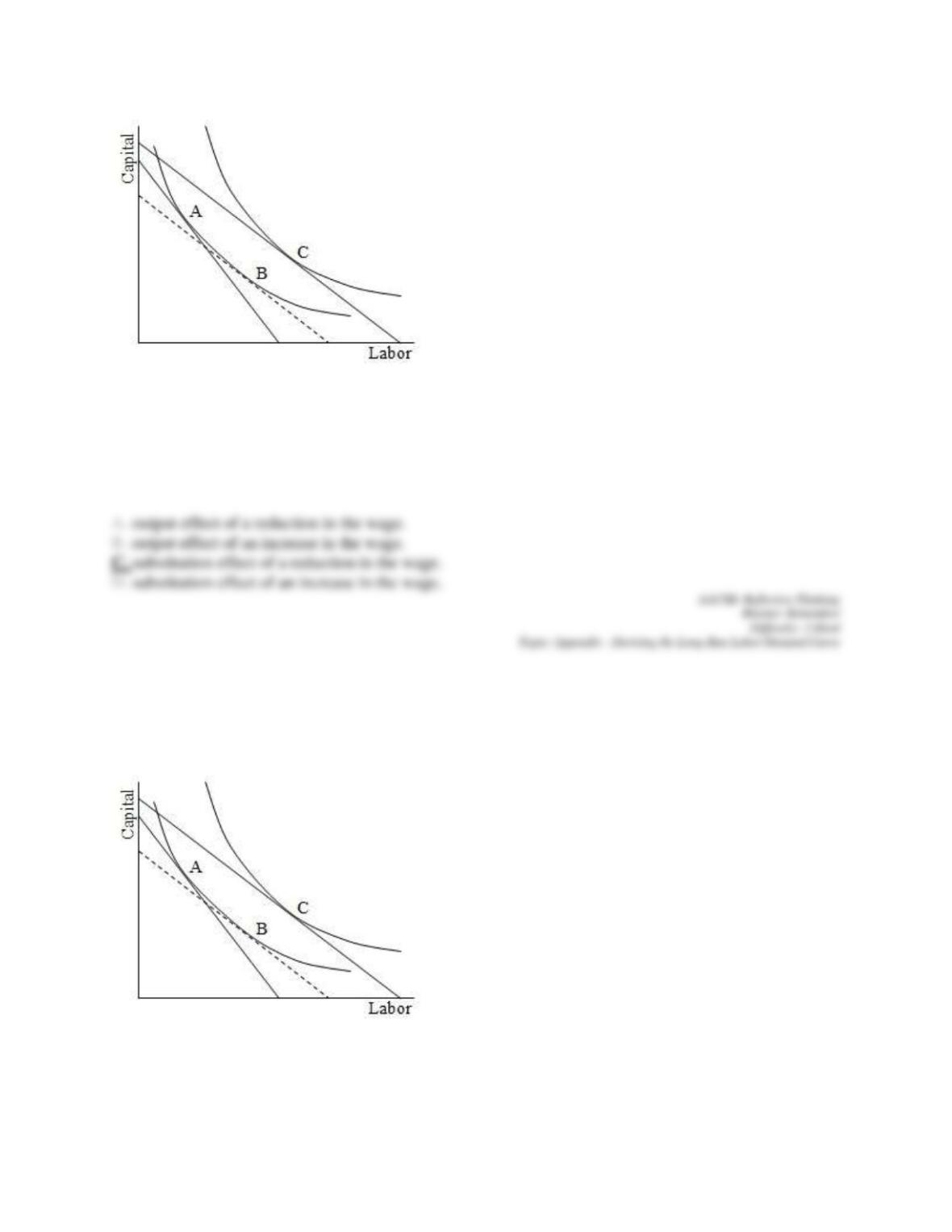
63. Refer to the following graph.
5-23
If the two isoquants represent profit maximizing levels of output for two different wage rates, the move
from point A to point B represents the
64. Refer to the following graph.

5-24
If the two isoquants represent profit maximizing levels of output for two different wage rates, the output
effect of a decrease in the wage rate is represented by the move from
Chapter 05 Test Bank Summary
Category
# of Q
uestio
ns
AACSB: Analytic
12
AACSB: Reflective Thinking
52
Accessibility: Keyboard Navigation
44
Blooms: Apply
12
Blooms: Remember
38
Blooms: Understand
14
Difficulty: 1 Easy
36
Difficulty: 2 Medium
14
Difficulty: 3 Hard
14
Learning Objective: 05-02 Explain how a firm’s short-
run production function can be used to derive a demand curve for labor.
17
Learning Objective: 05-
03 Contrast the labor demand curves of firms that operate in perfectly competitive versus i
mperfectly competitive output markets.
13
Learning Objective: 05-04 Discusses the differences between short-run and long–
run labor demand.
8
Learning Objective: 05-
05 Derive the market demand curve for labor from individual firm demands and explain w
hy it is more inelastic than the simple summation of the labor demand curves of all firms in
the market.
2
Learning Objective: 05-
06 Identify and discuss the determinants of the elasticity of labor demand.
7
Learning Objective: 05-07 Identify and explain the determinants of the demand for labor.
7
Learning Objective: 05-08 Relate the concepts of labor demand to real-world applications.
4
Topic: A Firm’s Short-Run Production Function
10
5-25
Topic: Appendix – Deriving the Long-Run Labor Demand Curve
2
Topic: Appendix – Isoquant Curves
2
Topic: Appendix – Least-Cost Combination of Capital and Labor
2
Topic: Determinants of Demand for Labor
8
Topic: Elasticity of Labor Demand
7
Topic: Real World Applications
3
Topic: Short-Run Demand for Labor: The Imperfectly Competitive Seller
3
Topic: Short-Run Demand for Labor: The Perfectly Competitive Seller
17
Topic: The Long-Run Demand for Labor
8
Topic: The Market Demand for Labor
2