Topic: Allowance Method
90.
The amount of cash that is actually expected to be collected on accounts receivable is
referred to as:
91.
The percentage-of-receivables method for estimating uncollectible accounts is sometimes
described as:
92.
The percentage-of-receivables method for accounting for uncollectible accounts focuses
on the:
93.
The first step in using a balance sheet approach to estimate bad debts is to calculate the
desired ending balance in which account?
94.
The purpose of recording an allowance for uncollectible accounts is to:
95.
A company’s adjustment for uncollectible accounts at year-end would include a:
96.
One advantage of the allowance method for accounting for uncollectible accounts is that
the company reports:
97.
The account “Allowance for Uncollectible Accounts” is classified as a(n):
98.
Allowance for Uncollectible Accounts is:
99.
The normal balance of the account “Allowance for Uncollectible Accounts” is a _______
because _______.
100.
Shupe Inc. estimates uncollectible accounts based on the percentage of accounts
receivable. What effect will recording the estimate of uncollectible accounts have on the
accounting equation?
101.
Under the allowance method, which of the following does
not
change the balance in the
Accounts Receivable account?
102.
At December 31, Gill Co. reported accounts receivable of $238,000 and an allowance for
uncollectible accounts of $600 (credit) before any adjustments. An analysis of accounts
receivable suggests that the allowance for uncollectible accounts should be 3% of
accounts receivable. The amount of the adjustment for uncollectible accounts would be:
103.
At December 31, Gill Co. reported accounts receivable of $238,000 and an allowance for
uncollectible accounts of $600 (debit) before any adjustments. An analysis of accounts
receivable suggests that the allowance for uncollectible accounts should be 3% of
accounts receivable. The amount of the adjustment for uncollectible accounts would be:
104.
At December 31, Amy Jo’s Appliances had account balances in Accounts Receivable of
$311,000 and in Allowance for Uncollectible Accounts of $970 (credit) before any
adjustments. An analysis of Amy Jo’s December 31 accounts receivable suggests that the
allowance for uncollectible accounts should be 2% of accounts receivable. Bad debt
expense for the year should be:
105.
At December 31, Amy Jo’s Appliances had account balances in Accounts Receivable of
$311,000 and in Allowance for Uncollectible Accounts of $970 (debit) before any
adjustments. An analysis of Amy Jo’s December 31 accounts receivable suggests that the
allowance for uncollectible accounts should be 2% of accounts receivable. Bad debt
expense for the year should be:
106.
At the end of 2018, Murray State Lenders had a balance in its Allowance for Uncollectible
Accounts of $4,500 (credit) before any adjustment. The company estimated its future
uncollectible accounts to be $12,000 using the percentage-of-receivables method. Murray
State’s adjustment on December 31, 2018, to record its estimated uncollectible accounts
included a:
107.
At the end of 2018, Murray State Lenders had a balance in its Allowance for Uncollectible
Accounts of $4,500 (debit) before any adjustment. The company estimated its future
uncollectible accounts to be $12,000 using the percentage-of-receivables method. Murray
State’s adjustment on December 31, 2018, to record its estimated uncollectible accounts
included a:
108.
At December 31, Tremble Music had account balances in Accounts Receivable of $300,000
and in Allowance for Uncollectible Accounts of $1,000 (debit) before any adjustments. An
analysis of Tremble’s December 31 accounts receivable suggests that 5% of the account
balances are not expected to be collected. The balance of Allowance for Uncollectible
Accounts after adjustment will be:
109.
At December 31, Tremble Music had account balances in Accounts Receivable of $300,000
and in Allowance for Uncollectible Accounts of $1,000 (credit) before any adjustments. An
analysis of Tremble’s December 31 accounts receivable suggests that 5% of the account
balances are not expected to be collected. The balance of Allowance for Uncollectible
Accounts after adjustment will be:
110.
At the end of the year, Mark Inc. estimates future bad debts to be $6,500. The Allowance
for Uncollectible Accounts has a credit balance of $2,500 before any year-end adjustment.
What adjustment should Mark Inc. record for the estimated bad debts at the end of the
year?
111.
Suppose that the balance of a company’s Allowance for Uncollectible Accounts was
$6,200 (credit) at the end of the year, prior to any adjustments. The company estimated
that the total of uncollectible accounts in its accounts receivable was $44,300 at the end
of the year. What amount of bad debt expense would appear in the company’s year-end
income statement?
112.
Prior to year-end adjusting entries, what would explain the Allowance for Uncollectible
Accounts having a
debit
balance?
113.
Suppose at the end of the year before any adjusting entries, a company has a balance in
Allowance for Uncollectible Accounts of $5,000 (debit). During the year, the company
reported the following amounts:
Credit sales to customers = $550,000
Cash collections from customers = $540,000
Actual bad debts = $20,000
What was the balance of Allowance for Uncollectible Accounts at the
beginning
of the
year?
114.
If the estimate of uncollectible accounts at the end of the current year is too high, which of
the following is true in the following year?
115.
On December 31, 2018, Coolwear Inc. had balances in Accounts Receivable and Allowance
for Uncollectible Accounts of $48,400 and $940, respectively. During 2019, Coolwear wrote
off $820 in accounts receivable and determined that there should be an allowance for
uncollectible accounts of $1,140 at December 31, 2019. Bad debt expense for 2019 would
be:
116.
On December 31, 2018, Larry’s Used Cars had balances in Accounts Receivable and
Allowance for Uncollectible Accounts of $53,600 and $1,325, respectively. During 2019,
Larry’s wrote off $1,465 in accounts receivable and determined that there should be an
allowance for uncollectible accounts of $1,280 at December 31, 2019. Bad debt expense
for 2019 would be:
117.
For accounts receivable, the longer an account is outstanding, the:
118.
The method of estimating uncollectible accounts based on the length of time the amount
is owed by the customer is referred to as the:
119.
When using an aging method for estimating uncollectible accounts:
120.
Compared to other methods of estimating uncollectible accounts, the aging of accounts
receivables method tends to:
121.
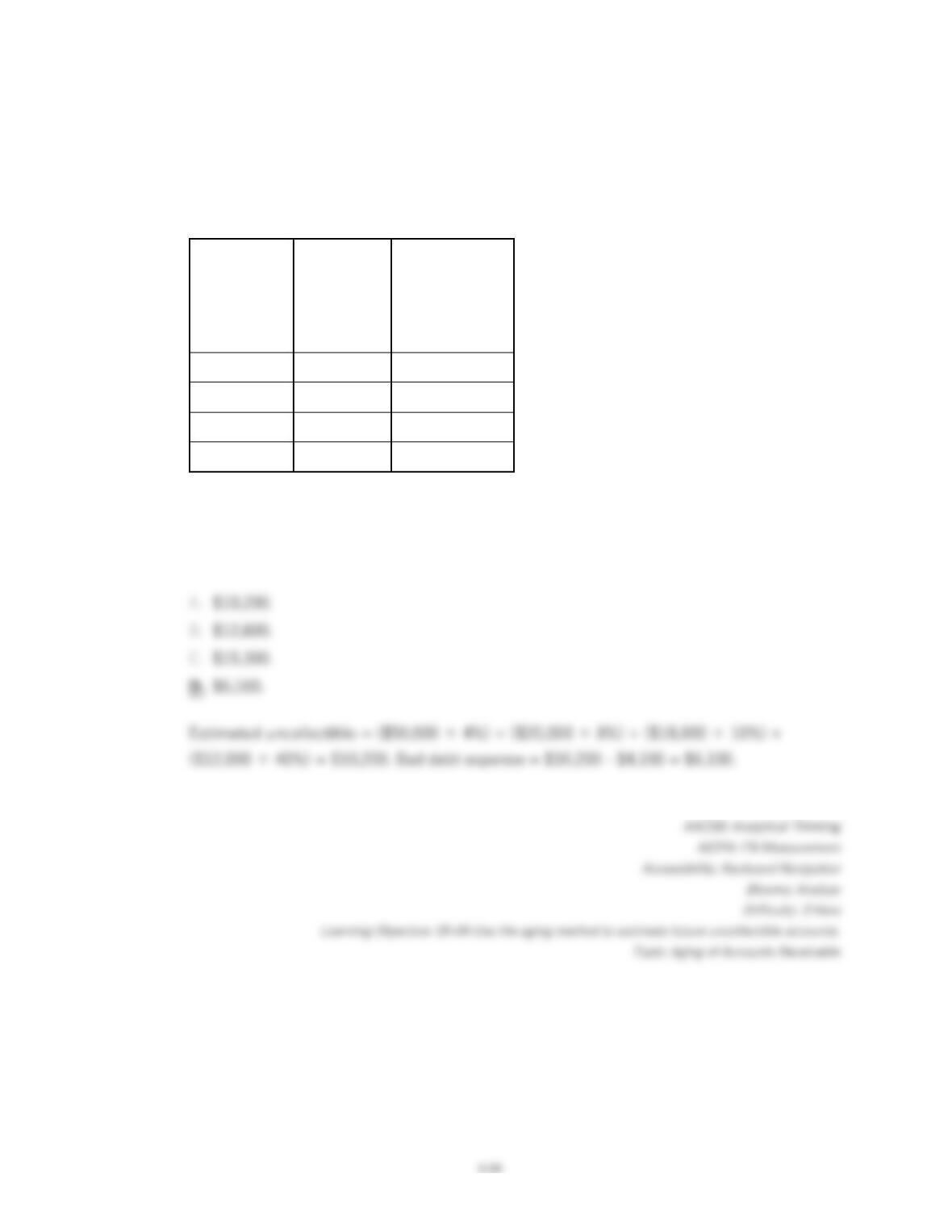
On December 31, 2018, Andy Inc. has a debit balance of $1,500 for the Allowance for
Uncollectible Accounts before any year-end adjustment. Andy Inc. also has the following
information for its accounts receivable and the estimated percentages of bad debts for
different past-due amounts:
Age Group
(days past
due)
Accounts
Receivable
Estimated Percent
Uncollectible
0-30
$50,000
5%
31–60
$20,000
10%
61–90
$10,000
20%
What is the amount of bad debt expense to be reported on Andy Inc.’s financial
statements for 2018 using the aging method?
122.
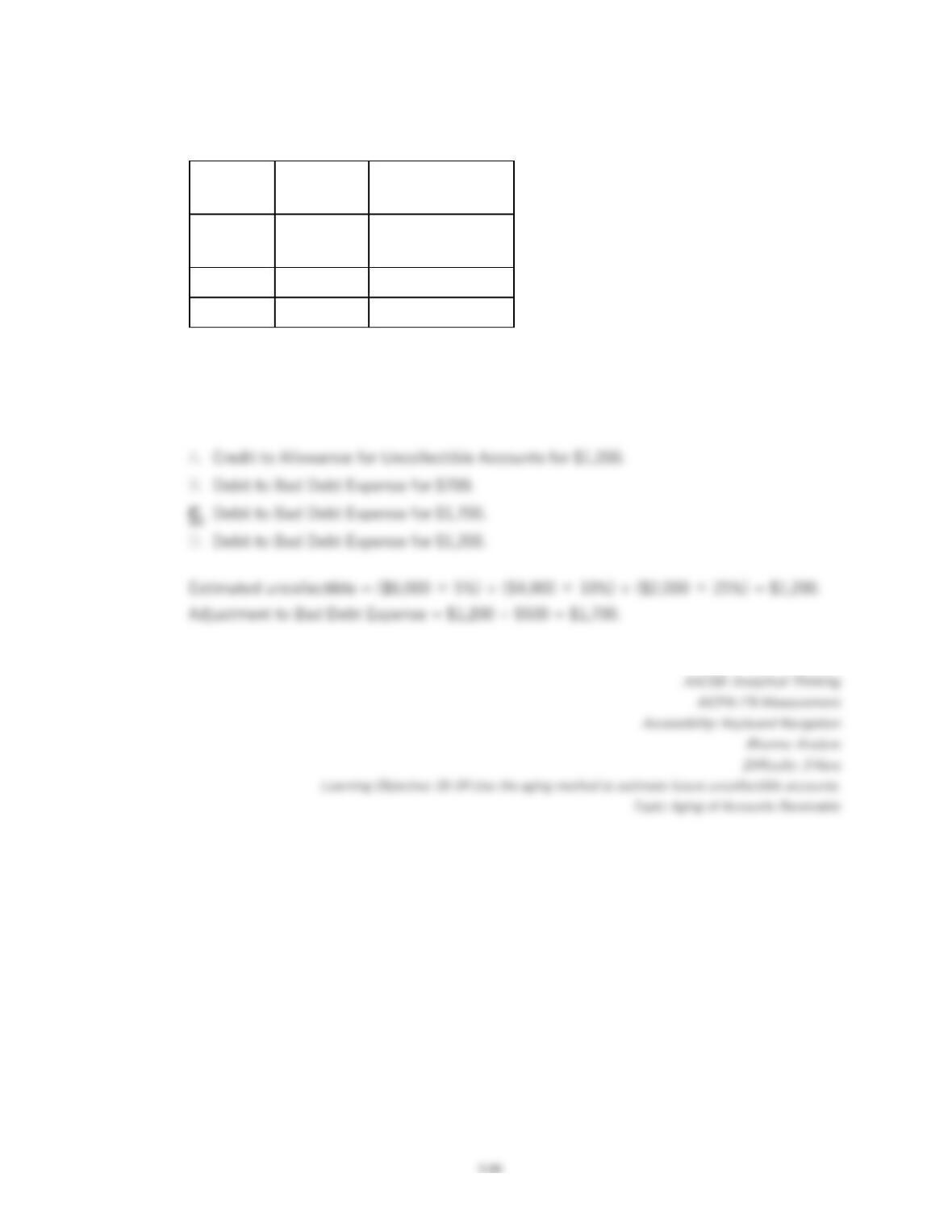
McConnell’s Bakeries had the following balances on December 31, 2018, before any
adjustment: Accounts Receivable = $100,000; Allowance for Uncollectible Accounts =
$4,100 (credit). McConnell’s estimates uncollectible accounts based on an aging of
accounts receivable as shown below:
Age
Group(days
past due)
Accounts
Receivable
Estimated
Percent
Uncollectible
Not yet due
$50,000
4%
0-30
$20,000
8%
31–60
$18,000
10%
More than 60
$12,000
40%
What amount of bad debt expense did McConnell’s record in its December 31, 2018,
adjustment to the allowance account?
123.
Timkin creates the following accounts receivable aging report at the end of the year:
Age
Amount
Estimated
uncollectible
Less than
30 days
$6,000
5%
31-60 days
$4,000
10%
61+ days
$2,000
25%
Prior to adjusting entries, the Allowance for Uncollectible Accounts has a debit balance of
$500. The year-end adjustment would include a: