52
CHAPTER 5
MULTIPLE CHOICE QUESTIONS
1. The manner in which “operational competitiveness” is embraced by
various service firms can be described by all the following stages except:
a. available for service
b. marketing and operations
c. journeyman
d. distinctive competencies achieved
e. world-class service delivery
2. Customers ultimately determine:
a. the type of demand
b. the levels of marketing effectiveness and operational efficiency
c. the cycle of demand
d. the length of the service experience
e. all of the above
3. The place within an organization where its primary operations are
conducted is called:
a. technical core
b. organizational point
c. factory
d. main system
e. none of the above
53
4. The strategy of breaking up large, unfocused plants into smaller units
buffered from one another so that each can be focused separately is
referred to as:
a. the perfect-world model
b. operations segmentation
c. the plant-within-a-plant concept
d. operations segregation
e. management by focus
5. The major goal of the plant-within-a-plant-concept is to:
a. produce a variety of services in one location
b. reduce operating costs
c. provider quicker response times to market demand
d. break up large, unfocused plants into smaller units buffered from
one another so that each can be focused separately.
e. none of the above
6. According to Thompson’s Perfect-world model, perfect efficiency occurs
when:
a. employees understand their jobs
b. role congruence occurs between customers and employees
c. inputs, outputs, and quality happen at a constant rate and remain known
and certain.
d. customer needs are being met
e. when the operation concentrates on performing one particular task in one
particular part of the plant.
54
7. Strategies to increase the efficiency of service operations include all of the
following except:
a. buffering
b. smoothing
c. anticipating
d. rationing
e. all the above
8. The strategy that resorts to triage when the demands placed on the
system by the environment exceed its ability to handle them is referred to
as:
a. buffering
b. smoothing
c. anticipating
d. rationing
e. allocating
9. The strategy that surrounds the technical core of the operation with input
and output components is called:
a. buffering
b. smoothing
c. anticipating
d. rationing
e. all the above
55
10. Which of the following strategy is not on the list regarding overcoming
some of the problems of service operations?
a. isolating the technical core
b. production-lining the whole system
c. creating flexible capacity
d. increasing customer participation
e. maximizing the servuction system
11. The objective of decoupling is:
a. separating consumption in time and space
b. unbundling services so that the may be purchased separately
c. separating the technical core of the operation from the high customer
contact areas of the firm so that efficiencies may be achieved
d. managing consumers so that they do negatively influence one anothers
service experience
e. separating co-workers who, due to their differences, decrease the
operational efficiency of the system.
12. Production-lining a service operation can be achieved through:
a. utilizing hard technologies
b. customizing services
c. utilizing soft technologies
d. meeting individual customer needs
e. a and c
13. With regards to the concept of “production-lining”, the rules, regulations,
and procedures that facilitate the production of a standardized product are called:
a. guidelines
b. specifications
c. soft technologies
d. organizational standards
e. codes of conduct
14. Soft technologies refer to:
a. the personal touches that ultimately lead to customer satisfaction
b. flexible rules that can be bent to meet customer needs
c. guidelines that permit employee empowerment
d. hardware that facilitates the production of a standardized product
e. rules, regulations, and procedures that facilitate the production of a
standardized product.
15. An Automatic Teller Machine (ATM) is an example of:
a. hard technology
b. soft technology
c. the perfect-world-model
d. complexity
e. divergence
16. One of the most common techniques used to analyze and manage
complex processes is:
a. CAD analysis
b. blueprinting
c. sequencing
d. process analysis
e. decoupling
57
17. Blueprints identify all of the following process steps except:
a. the direction in which processes flow,
b. the time it takes to move from one process to the next
c. the costs involved with each process site
d. the amount of inventory build-up at each step
e. all the above are identified in a flowchart
18. With regards to constructing a service blueprint, the time required to
perform one activity at one station is called:
a. process time
b. activity time
c. maximum output per hour
d. operation time
e. bottleneck time
The following questions (#19-26) are based on the below cafeteria flowchart and
the information provided in the table. Customers start at counter A and move to
Counter B. Customers then choose one of two counter Cs and then move on
toward Counter D. Customers then choose one of two counter Es and then
move on toward Counter E.
A————–>B————–>C\ /—————->E\
\ >————–>D< >——————>F
\————->C/ \—————->E/
INFORMATION TABLE
COUNTER(S) ACTIVITY TIME WAGE/PER PERSON
A 10 secs. $6
B 30 7
C 60 7
D 40 7
E 30 7
F 20 8
19. What is the activity time for Counter C?
a. 10 seconds
b. 20 seconds
c. 30 seconds
d. 45 seconds
e. 60 seconds
20. What is the process time for Counter E?
a. 10 seconds
b. 15 seconds
c. 20 seconds
d. 30 seconds
e. 60 seconds
21. Which of the following counters produces a maximum output per hour of
240 customers?
a. Counter A
b. Counter B
c. Counter C
d. Counter D
e. Counter E
22. How many customer can this cafeteria process in an hour?
a. 360
b. 120
c. 90
d. 240
e. 180
23. Based on its current configuration, the cafeteria’s service cost per meal is:
a. $42.00
b. $ .11
c. $ .46
d. $ 2.14
e. $ .62
24. Where is the bottleneck located in this example?
a. Counter A
b. Counter B
c. Counter C
d. Counter D
e. Counter E
25. If an extra counter is added at the bottleneck location, how many
customers can the cafeteria process in an hour?
a. 360
b. 120
c. 90
d. 240
e. 180
26. If an extra counter is located at the bottleneck location, what is the new
service cost per meal?
a. $49.00
b. $ .52
c. $ .46
d. $2.14
e. $1.90
60
27. A service operation consists of four stations. Station One can process
150 customers per hour. Station Two can process 300 customers per
hour. Stations Three can process 100 customers per hour, and Station
Four can process 150 customers per hour. What is the maximum number
of customers the entire operation can process in an hour?
a. 700
b. 300
c. 150
d. 100
e. none of the above
28. The __________ is calculated by dividing the activity time by the number
of locations at which the activity is performed.
a. service cost per meal
b. maximum output per hour
c. process time
d. activity time
e. bottleneck time
29. The most common mistake made when constructing a service blueprint is:
a. bottlenecks are not identified correctly
b. failure points are not identified correctly
c. the blueprint is one-sided—representing only the firm’s perception of the
process.
d. script norms are misunderstood
e. the time frame for service execution is miscalculated
30. Which of the following is not a step in the construction process of a service
blueprint?
a. obtaining scripts from both customers and employees
b. segmenting customers based on the content of the script
c. identify steps in the process where the system can go awry
d. calculating the time frame for service execution
e. analyzing the profitability of the system
31. A volume-oriented positioning strategy is achieved by:
a. increasing divergence
b. reducing divergence
c. increasing complexity
d. reducing complexity
e. unbundling the service
32. The positioning strategy that increases divergence so that the operation
can tailor the service experience to each customer is referred to as:
a. niche positioning strategy
b. volume-oriented positioning strategy
c. specialization positioning strategy
d. penetration strategy
e. market diversification strategy
33. A specialization positioning strategy is accomplished by:
a. increasing divergence
b. reducing divergence
c. increasing complexity
d. reducing complexity
e. unbundling the service

62
34. The positioning strategy that increases complexity by adding more
services and/or enhancing current services to capture more of the market
is referred to as:
a. niche positioning strategy
b. volume-oriented positioning strategy
c. specialization positioning strategy
d. penetration strategy
e. market diversification strategy
35. Divesting an operation of different services and concentrating on providing
only one or a few services in order to pursue a specialization position
strategy is called:
a. increasing divergence
b. reducing divergence
c. increasing complexity
d. unbundling the service
e. none of the above
SHORT-ANSWER ESSAYS
36.
A————–>B————–>C\ /—————->E\
\ >————–>D< >——————>F
\————->C/ \—————->E/
INFORMATION TABLE
COUNTER(S) ACTIVITY TIME WAGE/PER PERSON
A 10 secs. $6
B 30 7
C 60 7
D 40 7
E 30 7
F 20 8
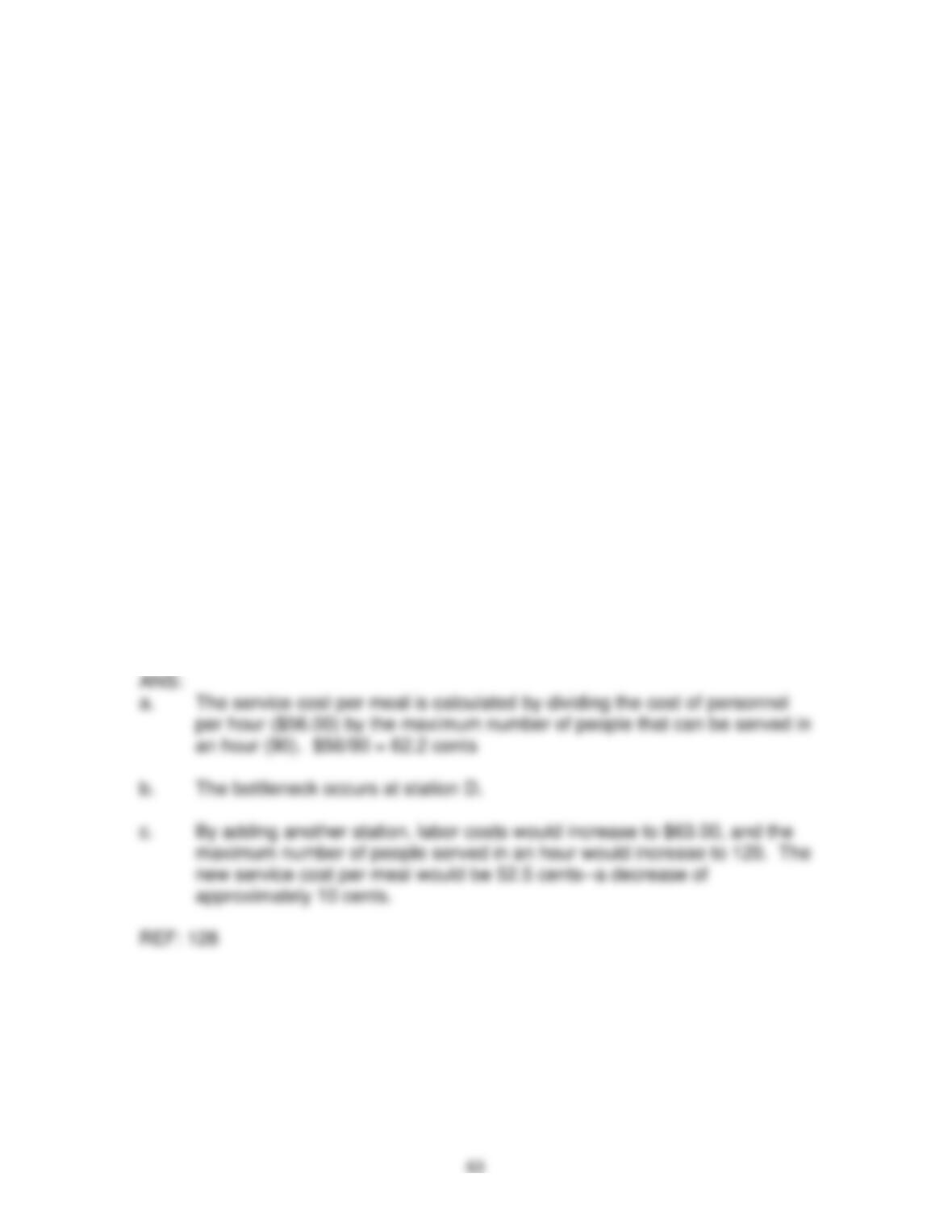
Based on the above cafeteria flowchart and the information provided in the
table: (a) What is the service cost per meal?; (b) If you were to add another
station to fix the current bottleneck, where would you add it?; and (c) How
does this affect the service cost per meal?
37. Discuss the relationship between operations and marketing as it
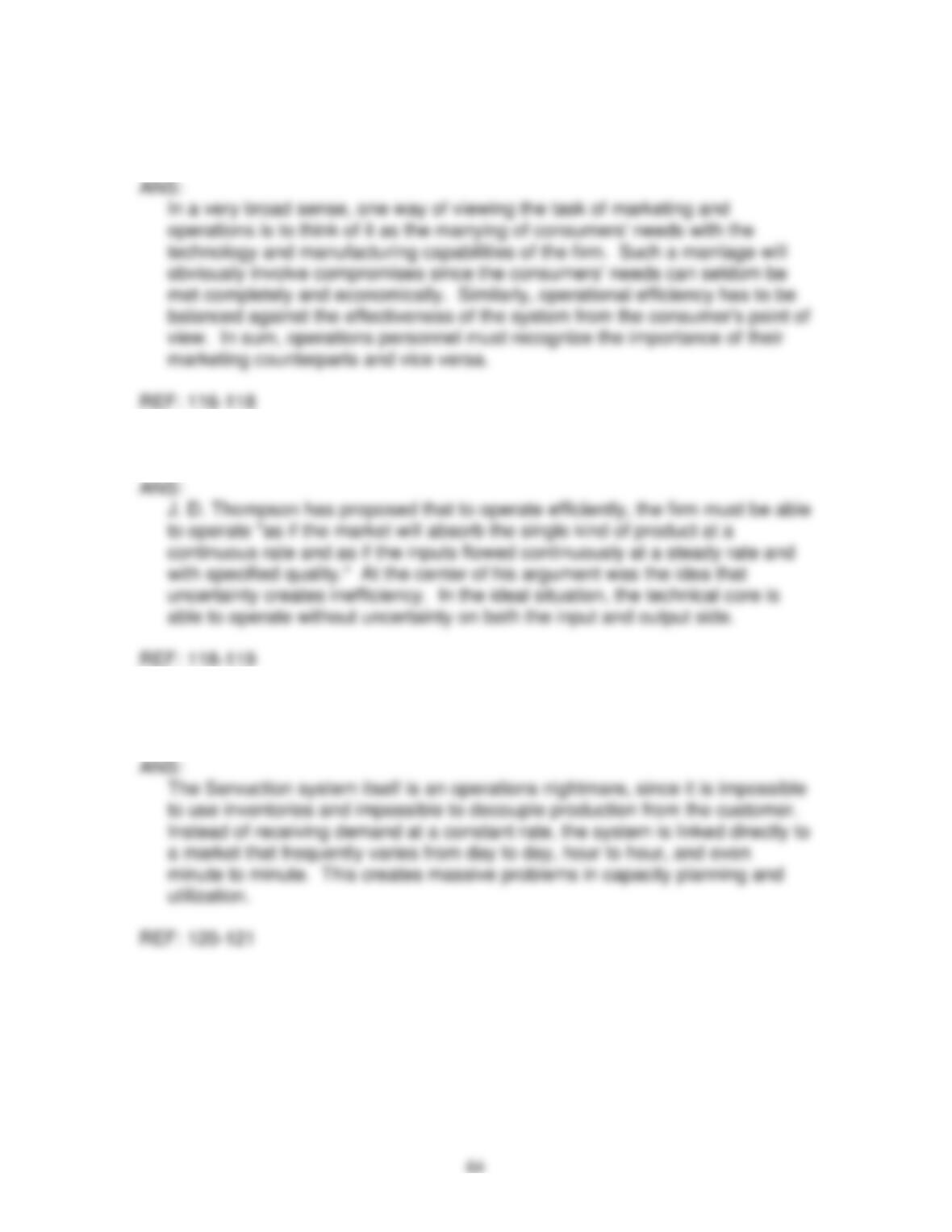
pertains to developing service delivery systems.
38. Discuss the type of operation that would typify peak efficiency.
39. Describe the difficulties associated with applying efficiency models
to service organizations.
40. Define the fundamental components of a service blueprint.
41. Discuss the strategies available for new service development.